The Youth’s Instructor, Vol. 54, No. 50.

A Word to the Young People

The Youth’s Instructor

Dec 11, 1906

Review and Herald Publishing Assn. · Takoma Park Station, Washington, D. C. · Dec 11, 1906

A Word to the Young People
THE Lord has wonderfully blessed us as a people; and in view of the fact that he has so greatly blessed us, I wish to ask our young people, What is our duty to him? Shall we, to whom has been revealed the glorious light, place ourselves as it were under a bushel? God forbid! We, to whom the light has been given, have power to shine, and this is our duty as well as our privilege.
Too often we feel that it is a burden to perform the duties that God in his infinite love has assigned us. God’s commandments are not grievous; and we are told “to make the work of God appear joyous, as it really is.”
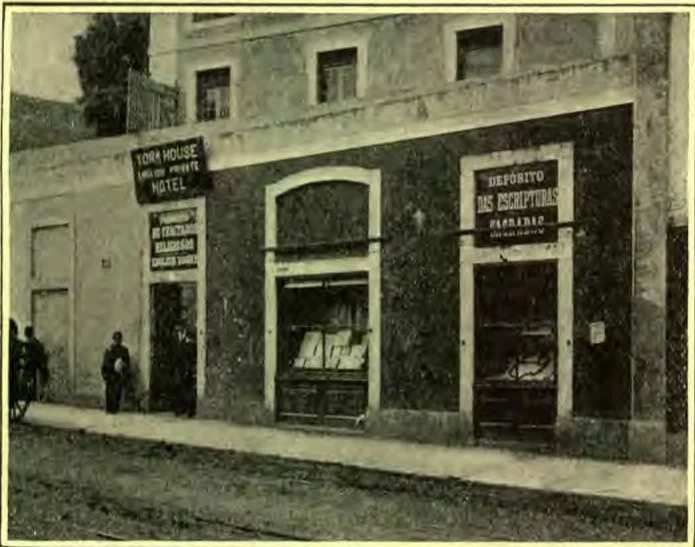
DEPOT OF THE BRITISH AND FOREIGN BIBLE SOCIETY OF LISBON
Never in the world’s history has there been a greater call for young men and women who are willing to lay all on the altar and take up the cross and do the bidding of the Master.
As I have gone from house to house during the summer vacation, trusting that by the aid of the Holy Spirit I might be able to unlock the door of some soul that the Spirit of God might enter and dwell there; as I have gone from town to town and have seen the great preparations being made for the pleasure of this life, I have not been able in it all to see a single expression of the hope of a soon-coming Saviour.
My brother, my sister, when we see these things all about us and know what they mean, let us ask ourselves the question, Are we ready? Is there time for more delay? Do we see in the world to-day a fulfilment of Luke 21:26? Have these awful calamities that have come upon the earth in the past few months aroused fear and unrest in the hearts of men? O brethren, the voice of God is speaking to us in every way possible. Shall we harken to his voice?
In view of the conditions that exist in our own country, where so many have a knowledge of God, what must be the condition in foreign lands where the glorious light of the gospel has never yet shone? To-day thousands of precious souls are going down to destruction, starving, as it were, for the Living Bread.
May God help us to arise and let our light shine forth that souls may be turned to the Lamb of God, and the words of Matt. 24:14 will be fulfilled. SILAS DAVIS.

Chats on Letter-Writing — No. 9

It may be thought that a special gift or talent is necessary in order for one to become an accomplished letter-writer. No doubt some are born with greater ability in this direction than others, but the fact remains that correspondence is a pleasure attainable by any one who will devote time and effort to acquire skill in it. Indeed, letter-writing might be called an art, a fine art; and perhaps but very few persons reach a high degree of attainment in it. No one will deny that the ability to write a really good letter is most desirable. To be able to write thus one must, of course, think accurately and be able to set thoughts in their proper and natural sequence, with clearness and precision. Unless the thoughts are thus marshaled, it is useless to attempt to present them in a straightforward manner on paper. There are many possibilities in training the mind to think clearly and accurately. The great benefits of such effort are well worthy of considerable attention.
The ability to compose a good letter implies skill in other directions; and equally so, inability to write a letter indicates a lack of capacity in other things.
THE BUILDING WITH SIX PILLARS WAS THE OLD INQUISITION BUILDING OF LISBON
To be able to write down thoughts, we must have words at our command. We get them by reading, by talking intelligently with educated persons. A mental habit of constant alertness will help wonderfully in acquiring ability in letter-writing. And the faculty of observation must be brought into daily, hourly use. The mind must be stored with material that will be serviceable when we wish to give out to others the thoughts that come to us. Facility in stating a thought so that all who hear it stated, or read it when written or printed, will know instantly what is meant, is far from being as common as it might and should be.
If properly approached, correspondence will prove a wide field for mental improvement. It will open endless channels of culture, afford unlimited opportunities of giving pleasure to others, and it will be a means of delight that will exert a beneficial influence on the mind of the one who strives after perfection in it.
The person who can write an entertaining, sensible letter usually has qualities of mind and heart which enable him to be a power for good; for the possession of the qualifications which make one capable of writing a creditable letter, argues, of itself, a degree of culture, ability, and skill in other ways, that may well be coveted, and earnestly striven for. Effort wisely directed and perseveringly made, is sure to produce a harvest of ample reward. HENRY W. ROSE.

Should the Practise Be Corrected?

It is said that in Quaker homes—the Quakers are habitually very polite and kind—a caller or visitor receives only one invitation to be seated, to lay aside wraps, or to partake of the meal, etc. If, as is the custom with many persons, he declines, expecting to be urged, he will be disappointed, and must make the best of the situation. We often hear young people decline to sing or otherwise assist in entertaining company, while it is quite evident they will feel flattered by a repetition of the request. Perhaps there would be less of such conduct were the Quaker act made a part of the entertainment.
MRS. D. A. FITCH.

Thy Pardon, Lord

DEAR LORD, forgive each unkind word And unkind deed that I have done,— For telling unkind things I’ve heard Worse than they were begun; Forgive the saddened, faltering hearts That I have sadder made to be,— For false conceit and false deceit I pray thou’lt pardon me.
And more than all, dear Lord, I pray Forgiveness for the heedless wrong That I have done to thee, each day,— For silencing the throng Of prayerful words I might have said To glorify and honor thee,— For selfishness and laziness I pray thou’lt pardon me.
BENJAMIN KEECH.

Poverty of a Millionaire

Most persons, in the opinion of the Rochester Post-Express, would be willing to chance unhappiness for an income of $2,284,000, but one man, we are told, finds it impossible to pay his bills on this amount. King Edward VII, who receives from the state this stipend, has trouble to “make both ends meet.” The Post-Express tells us of this sad case:—
“Out of this amount he has to maintain a number of castles and royal residences, support a small army of retainers and flunkies, and pension old and faithful servants. Consequently, when the year’s bills are paid, his majesty has no money to put in the bank against a rainy day. Recently the king petitioned to have his salary raised to $3,000,000 a year, but owing to the already heavy taxation the government refused the request. Compared with the other rulers, Edward VII is poorly paid. The czar of Russia has a total income of $20,000,000 a year. The sultan of Turkey manages to get along on $10,000,000. Emperor William supports the royal family on an income of about $4,000,000. The king of Italy exists comfortably on an income of $2,859,500, while the emperor of Austria-Hungary pegs along on $3,700,000. Other sums paid to European sovereigns are: Bavaria, $1,242,726; Belgium, $665,000; Denmark, $240,000, and $28,000 to the heir apparent; France, $288,000; Greece, $260,000; Netherlands, $246,000; Portugal, $567,000; Rumania, $201,482; Saxony, $628,460; Spain, $1,430,000; and Württemberg, $403,438. Compared with these sums, the yearly salary of the president of the United States is very modest indeed. Furthermore, the president earns his salary, which can not be said of many of the rulers mentioned in the list.”—Selected.

The Boy Who Is Faithful

It is all right to be smart, but it is all wrong to be smart in the wrong way. I have seen boys who think that they are smart in ordering others around and boasting of what they are to do. If I had any work to be done, I’d never hire a lad like that to do it.
It is true that some employers are in need of smart boys, and are ever on the outlook for them; but there are thousands of positions where boys of only ordinary ability are wanted. Boys that are too smart are often not desired, since they too often want to dictate and can not be dictated to; they try to run the business to suit, not their employers, but themselves.
There is a greater demand for faithful boys than for smart boys. There is nothing that one more appreciates in one under him than faithfulness. I once heard a gentleman say that he asked a friend why he paid his secretary such a very large salary when he could secure one for a much smaller sum. He replied that he could secure one for a less amount, but not one who would do the work as did this one. “When I am gone,” said the friend, “everything goes on just as if I were here.” Now if this secretary had been smart, rather than faithful, his employer might not have been able to say of him what he did. He might have been obliged to have said, “I can’t leave him, for when I’m gone, he tries to run matters to suit himself and to improve upon my methods, and it is not a partner that I want, but a secretary.”
Where one succeeds because of his smartness, ten succeed because of their faithfulness.
And not at the boy’s faithfulness alone does a would-be employer look; he desires a boy who is an all-round moral boy. He knows that it is of no use to hire one who smokes cigarettes, for these muddle the brain, cause heart trouble, and kill the smoker at so early an age that he will soon be obliged to secure another lad. Nor does he care for a boy who gambles, for his funds would be too handy for such, and the temptation to borrow them too great. Nor does the employer desire a boy who drinks intoxicants even in the slightest degree, for he thinks there will be possibility of his making a mistake.
It may be that the man who is thus critical himself indulges in all these vices, but he wants the boy he employs to be free from them. He knows more than any other to what they will lead, and it is probable that a boy who is inclined to them would obtain a position with a good man rather than from a man like this, for a good man would think that he might assist the lad to give up his evil ways.—Alice May Douglas, in American Boy.

Young Men, Tried and True, Wanted

In a conversation with a man who was rescued in boyhood from a slum life by a Sunday-school teacher, and who is now at the head of a large manufacturing establishment, the editor wished to know what chance there was in his line of business for an industrious, faithful young man. He promptly replied: “If you will find me a young man who has the patience to go through a short course of training, and who will treat my business as if it were his own, it will not be long before he will earn his two thousand five hundred dollars a year.” He then added that there was a great scarcity of just such men, because it had become the fashion to ask good wages at once, and to give as little service as possible.
I have since noticed how true this is in almost every vocation of life. The first thought when men and women hire out is, “How much do you pay?” Of course, that is not an unimportant question, and men in business expect to have it asked; but when it is followed up by other questions showing that the laborer is not anxious to do faithful, unselfish service, the case is different. Fidelity is the word. There is not a business firm that will refuse to recognize valuable service when an employee has proved that he is worthy of trust, that he labors for the interests of his employer as if they were his own. Let our young readers remember this.—Selected.

Kalamazoo Burglars

A CITIZEN of Kalamazoo, Michigan, has a valuable parrot. On three different occasions he has saved the house from being burglarized. The last time was on a recent night. The burglar got the door unfastened, but when he opened it, the parrot asked, in a stern voice: “Hello there! What’s the matter?” The burglar did not stop to answer.—Dumb Animals.

Which of These Two?

“How much will you take my goods to a safe place for?” asked a man during the San Francisco fire of another sitting idly in an automobile. “Twenty-five dollars,” was the reply. “But I haven’t twenty-five dollars.” “Well, then, your stuff can burn.” A little farther on was a colored man with a wheelbarrow, and he was asked, so the story goes, what he would take for the same service. “Bress yo’ heart, massa, nothin’. Dis yer ain’t no time for makin’ money.”
The man in the automobile was white, and the man with the wheelbarrow was black, but which showed himself the better neighbor and did the white deed?—The Wellspring.

When the Work “Didn’t Show”

I HAVE read of a prominent judge who, wishing to have a rough fence built, sent for a carpenter and said: “Mend this fence to keep out the cattle. As it is out of sight of the house, these unplaned boards will do, and I will pay you only a dollar and a half.” Coming to look at the work, the judge found the boards planed, and the work finished with excellent neatness. Thinking, of course, that greater pay would be demanded, he said: “I told you this fence was to be covered with vines, and I do not care how it looks.” “But I do,” said the carpenter. “How much do you charge?” asked the judge. “A dollar and a half,” said the man. “Why did you spend all that labor on the job if not for the money?” “For the job, sir.” “Nobody would have seen the poor work on it,” said the judge. “But I should have known it was there, sir,” and taking his one dollar and a half, he went away. Ten years afterward this carpenter obtained a large contract from the judge when a great crowd of competitors failed. “I knew,” said the judge, “we should have only good, genuine work from him. I gave him the contract, and it made him a rich man.” Soon or late, in things sacred and things secular, the one who is faithful over a few things is made ruler over many things.—Herbert E. Thomas.

What Some Great Men Say of the Bible

“God is light.” So is the religion of the Bible. It has no fellowship with darkness. Not one of its graces springs from stupidity or ignorance, but all of them from a knowledge of God. False religions are founded in darkness. The religion of the Bible, like its Author, dwells in light. God also is love, and so is the religion of the Bible.—Gardner Spring.
The Bible is the book of all others, to be read at all ages and in all conditions of human life; not to be read once, or twice, or thrice through, and then laid aside, but to be read in small portions of one or two chapters every day, and never to be omitted unless by some overruling necessity.—J. Quincy Adams.
We count the Scriptures of God to be the most sublime philosophy. I find more marks of authenticity in the Bible than in any profane history whatever.—Isaac Newton.
I have read the Bible through many times. It is the book of all others for lawyers, as well as divines, and I pity the man who can not find in it a rich supply of thought and rule for conduct.—Daniel Webster.
It is a belief in the Bible, the fruits of deep meditation, which has served me as a guide of my moral and literary life. I have found it a capital safely invested and richly productive of interest.—Goethe.
Within this ample volume lies The mystery of mysteries; Happiest they of human race To whom their God has given grace To read, to fear, to hope, to pray, To lift the latch, to force the way; And better had they ne’er been born, Than read to doubt, or read to scorn. —Walter Scott.
There are no songs comparable to the songs of Zion, no orations equal to those of the prophets, and no politics like those which the Scriptures teach.—Milton.
MAY S. COLE.

There Remaineth a Rest

Oft clouds with their gloom hover o'er us, And tired are journey-worn feet, But the promise of God is before us, Foretelling a rest long and sweet, For though earth is full of life's crosses, And hopings are often in vain, There is joy to reward all earth's losses, There's a recompense sweet for all pain.
The shining ones, high up in glory, Regard us with pitying eyes, And softly they tell the glad story Of a home in the radiant skies, Of the city of God with its splendor, Just over life's evergreen hills, Of a love that is holy and tender, A life that is free from all ills.
My loved, with their sweet, holy faces, I shall greet where the streets are of gold; With rapture and sweetest embraces Will the wonderful story be told “Of the Saviour,” so meek and so lowly, Of Jesus, the “Wonderful” One, Of sins that were dark and unholy, Washed away by the blood of the Son.
L. D. SANTEE.

Our Field — The World

Portugal

Program

OPENING EXERCISES;—
Song.
Scripture Reading.
Prayer.
LESSON STUDY: Portugal.
General Description.
Its Cities.
The Language.
Industries.
Beginning Work in Portugal.

General Description

PORTUGAL is one of the oldest countries and one of the newest mission fields for Protestant propaganda. It is a small country in the extreme southwest of Europe. It is about 362 miles in length by 140 in width, having about 34,420 square miles, and a coast line of nearly 500 miles, with excellent harbors. To this country belong two groups of islands, the Madeira and the Azores, situated a few days’ distance by steamer from the mainland. It also has large possessions in both east and west Africa, where, including natives and Portuguese, the population is about 14,000,000. Counting the population of Portugal on the continent, and the islands, and a small possession in India as 5,500,000, the 140,000 Portuguese in the United States, and 21,000 in Brazil, we have 40,000,000 to whom we must teach the third angel’s message in a language known by a very few workers.
The government is a monarchy; though a majority of the people desire a republic, the influence of the priests of the state religion, which is Catholicism, keep under subjection freedom of thought, speech, and action. In the last few months there has been brewing a wave of revolutionary ideas, but in a country where only twenty per cent of the people can read or write, it is difficult to start a republic.
The climate is quite good, and is recognized as being healthful. The center of the country is of the same latitude as that of New York, Philadelphia, Des Moines, Denver, and San Francisco. The climate is like that of California. Nearly all the fruit grown there is produced here, although not so plentifully, and of what there is, a lack is felt of ways to preserve it. For a person in poor health there can be no better place in the world to regain his health, or at least to hold his own against the inroads of disease. Though nature’s laws are little heeded, many persons live to a ripe age.
The diet of the people is quite varied, partly from the money standpoint; that is, those that have more money, have a greater variety. For the poorer classes, it is codfish, potatoes, and bread. The majority drink wine, and many eat fish, clams, and snails. But very few among those whom we have met have eaten stewed fruit.

Its Cities

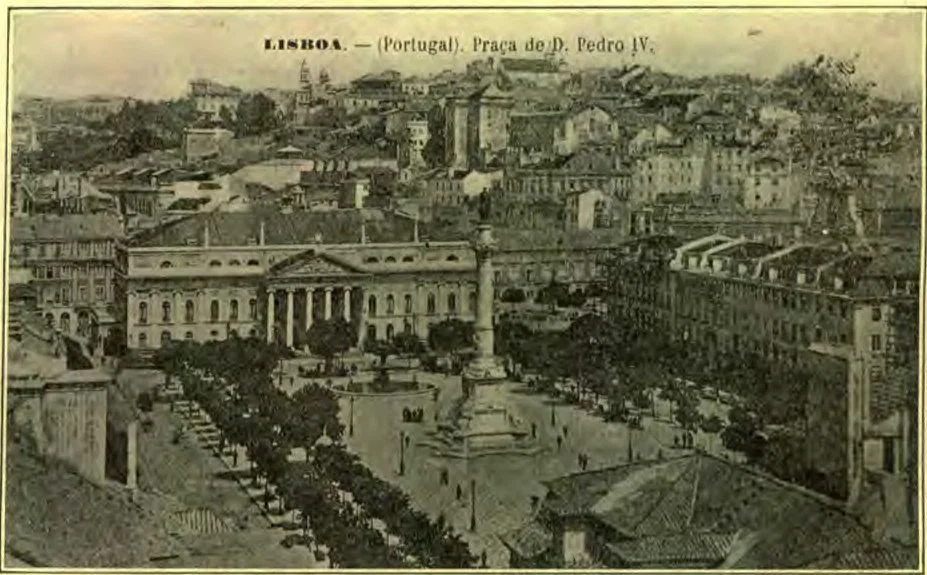
Lisbon is the capital and largest city, having a population of probably four hundred thousand. No city in Europe has a nobler position. It climbs steep hills on the north bank of the Tagus for fully five miles along the river, with a string of suburbs extending even farther. The houses, rising tier above tier, with roofs of snow-white tiles shining in the sunlight, are an imposing sight. Lisbon has an air of a modern city, but this is because of the rebuilding after the great earthquake of 1755. It was up the Tagus that the tidal wave ascended after the earthquake.
Sixteen miles northwest of Lisbon is the beautiful old town of Cintra, where wealthy families from the capital city have their summer villas. Huge oak trees, plane and cork trees, well-kept gardens and pleasure grounds, are on all sides. Mexican palms, Brazilian shrubs, groves of orange, lemon, and fig fill the air with perfume.
Oporto, situated at the mouth of a large river, is next in size, with about two hundred thousand inhabitants. Coimbra is another town, where is located a large university. Setubal, to the southern part, is situated among large groves of almond, walnut, orange, and lemon trees.
The capital city contains many edifices of a historic nature, such as convents and churches. On many churches are seen the marks of the great earthquake. After the expulsion of the Jesuits by the Marquez de Pombal in September, 1759, the religious orders were suppressed; that is, no more persons could become nuns or monks, but those already existing were allowed to remain until the last one died, when the property was to be turned over to the state. By such sales, old paintings were thus collected, and exposed to view in an art museum, with privilege given to certain ones to copy. Old books, manuscripts, and relics in general, in the same manner were collected and exhibited.
Lisbon was the seat of the Inquisition in Portugal. The building in which this terrible work was carried on is now a theater, and many of the convents are used as public buildings, such as libraries, government offices, schools, storage rooms, etc. In one convent is the British and Foreign Bible Society’s office and storage rooms. In the dark rooms of the monks, Bibles are piled to the ceiling. In another part is a hotel, in another is a Protestant chapel with a day-school near by. Thus God’s Word overthrows the machinations of evil hearts, bringing to light the hidden things, and knowledge to the ignorant.

The Language

The Portuguese language is a modification of the Latin. While it is known that formerly the language was a mixture of that used by the barbarian tribes, the Roman rule gave it its Latin construction. It seems to be more closely akin to the Spanish and Italian, although many grammatical constructions and nasal sounds are similar to the French. I would like to suggest to our young people who are planning for foreign missionary work, that in lieu of not having the Portuguese language in our schools the next best thing is the Spanish, and I hope some student will be impressed to prepare for the work among the forty million Portuguese. The construction of this language is very similar to the Spanish, and in many words there is only an extra letter or two. For an example, John 1:1, 2: “No principio era o Verbo, e o Verbo estava com Deus, e o Verbo era Deus. Este estava no principio com Deus.” Spanish, “En el principio ya era el Verbo; y el Verbo era con Dios, y Dios era el Verbo. Este era en el principio con Dios.”
The Portuguese pronounce the c as in English, a as in hat, e as in jet, i as in machine. The consonants are the same.

Industries

The farms are poorly tilled; large tracts of land are left as waste land; mines are not thoroughly worked; manufactories are few, and most of the industries which do flourish are conducted by Englishmen or Brazilians. Wine making is one of the principal industries. In and around the cities many have small gardens to raise vegetables for city consumption. These are taken to a large open market, whence they are bought by men and women hawkers, who carry large baskets full, either on the shoulders or on the head, about the street, supplying those who can not go to the market to buy.
Fishing occupies the attention of quite an army. A very pretty sight it is to see the fishing fleet of small sailboats standing out to sea, where they catch the finny tribe. These fish are unloaded at the fish market, to be in turn bought by retailers, who are men, women, and children. The retailer sells from house to house, or in small shops. Many in these parts are in the trades, or work as servants for the rich and the foreigners. Some of the rich are called “Fidalgos,” or “men of leisure.” These may or may not have a title; they perhaps own a small farm with an income sufficient to allow them plenty of leisure.
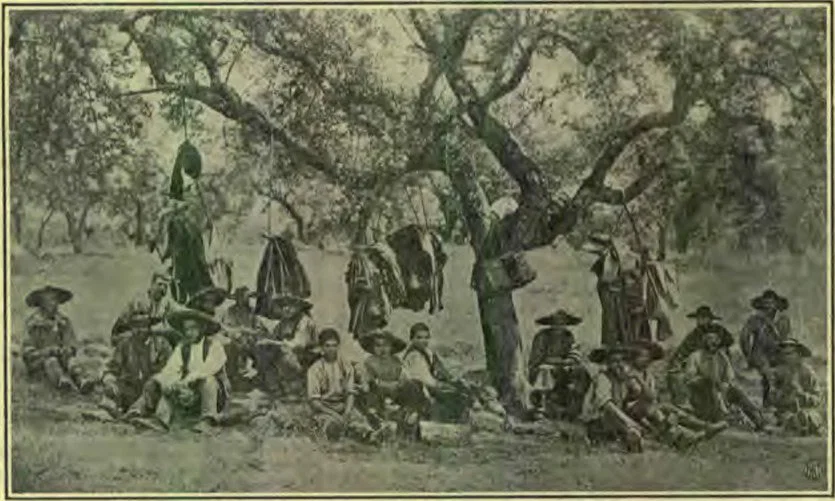
Another interesting thing is the cork industry. In the latter part of July and August this valuable product is gathered. When the bark is taken from the tree, no more can be gathered for seven years. It is piled and loaded on cars to be shipped to some place for cutting. From this bark comes our corks for bottles, cork limbs, insoles for shoes, life-preservers, and many other useful articles. The illustration of the cork workers shows them as they gathered at midday for lunch. Their traveling blankets, a necessary thing to the Portuguese, are hanging on poles strung to the limbs of a cork tree. Almost any time on the beach, one can see blocks of cork which have floated down the river Tagus, and finally landed on the shore. This reminds me of the stream of literature which is, and should be, flowing out to the great sea of humanity, where some here and there finds lodgment in a secure place,—an honest heart.
CORK WORKERS OF PORTUGAL

Beginning Work in Portugal

The twenty-sixth of September, 1904, we landed at Lisbon from the steamer “Magdalena” coming from Southampton, bound for Brazil. Our first work was to learn the language. Beginning with a teacher, we studied for five months. Not making the progress we desired, we changed location as well as teacher. The second knew how to adapt herself to our circumstances, and we made progress so that by November, 1905, we began to conduct Bible studies in homes of friends. By the beginning of 1906 I began to preach in our own house to an audience of from ten to twenty-five persons, besides having singing once a week for the purpose of attracting some to the gospel.
Having been able to translate some readings from The Family Bible Teacher, helped by kind friends and authorized by our Latin Union Committee, with funds supplied by friends of the cause living in California, I published two of three thousand copies each. Of these and some English tracts I distributed about seven thousand pages.
One day, while distributing in a neighboring village, I handed a copy to a gentleman, who directed me to some working men, saying to them, “Accept, accept, this is very good. It is from the Bible.” As I was about to depart, he called, saying, “Is this Catholic?” I replied, “No.” He then said, “If it had been Catholic, I would not have anything to do with it.” After a conversation, I learned that he had never talked with a Protestant, but for years he had known that the Catholic religion was false. He had practically left the church, and is desirous of something better. He bought a Bible and a copy of “Gospel Primer,” and has the Portuguese paper to read, also a number of tracts. We pray that this man may lose his fear of the Jesuits and walk in the light.
From Lisbon, a young man wrote me, asking for literature, saying that maybe the Lord would shed new light on his life. Another man bought copies of everything we have printed in the language, and is desirous of still more when ready. He is also selling “Gospel Primer” and “Steps to Christ” as he has opportunity. Because of seeming obstacles, I have not been able to hold continued Bible studies with either, partly owing to the work of one, and the illness of the other’s wife. These are hopeful cases.
About seven or eight months ago I began sending The Signs of the Times, a club of which was supplied by a dear old sister in Grinnell, Iowa, and a Portuguese brother in California, to an English lady in Lisbon. Once I sent a number of Present Truth, and finally a set of the Signs of the Times leaflets. One day while in the city I called at her place to see how she liked the papers. Of course, she liked them very much, and especially those on the Sabbath. After a short study and prayer, I left her, after asking her to study carefully and seriously the importance of keeping holy God’s day. During the week, I received a card in response to a letter I wrote, saying that we were welcome to spend Sabbath afternoon in study at her house. Then, during a study on “Who Changed the Sabbath?” she said, “Well, I shall try to keep the Sabbath.” How we did rejoice to hear this, the first fruit of the truth in Portugal! Will not those who furnished the papers receive their reward?
A usual thing seen in converts to this truth is a readiness to spread this message. This lady is a widow, and has one son of twenty-three years, who was reared a Catholic, while she was an Episcopalian. She has two nieces, young ladies, whom she says will keep the Sabbath, for she has told them of her change, and the reasons for it. They are Catholics, yet this truth about the Sabbath appeals to them strongly.
You would all have enjoyed a social service which we had last Sabbath. After a Bible study on confessing Christ before the world, in which a family of Portuguese engaged,—father, mother, two sons, one married son with his wife,—together with our English sister, opportunity was given to testify. The oldest and youngest sons spoke of their thankfulness to God for this blessed truth, and desired to spread a knowledge of it among their countrymen. The young woman who came out of Catholicism, said her husband had begged her to attend Protestant meetings, but she never desired to go. Now she thanked God for this truth that had attracted her.
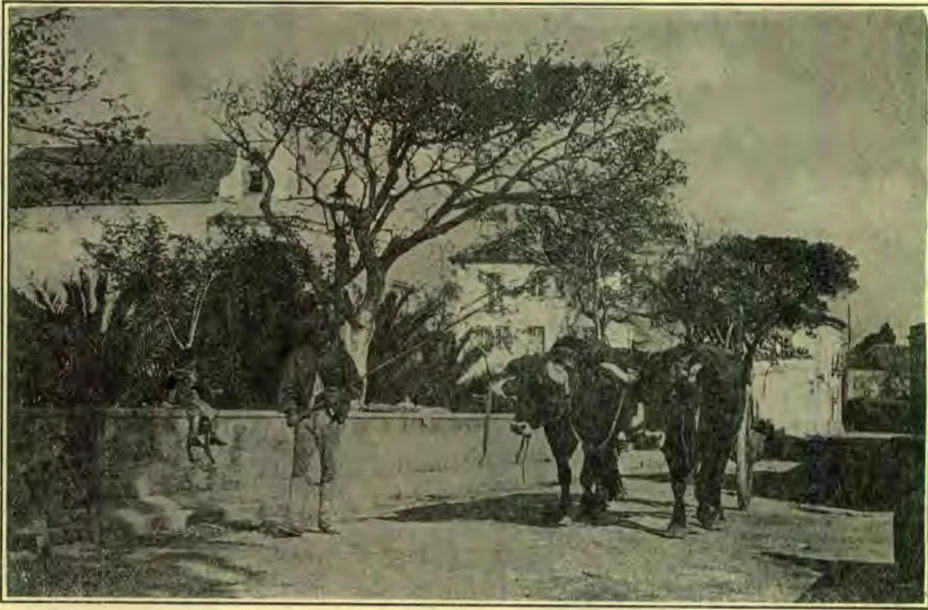
MAIN STREET IN CARCAVELLOS, PORTUGAL
The father, who just lately accepted the truth, told how he had been bowing down to images of wood, stone, gold, and silver, which have ears, but do not hear; eyes, but do not see; mouths, but do not speak; but now he was thankful he could worship the true God, and keep his law and the Sabbath. One son has said, “This Christian life is good, but in the work I have chosen, I can not keep the Sabbath.” His desire and ambition is to be a pilot. The father is a furniture maker, and his shop is closed on the Sabbath. The youngest son is working in the Department of Justice, but so far has the Sabbath free. We desire to educate this young man of eighteen years and his older brother to be workers. In this family, of which only one was a Protestant, we have seen the special working of God’s power. Some time ago the father did not care to know anything of Protestantism, but now he is all aglow with the truth.
Now, let me appeal to our young people, students, Young People’s Societies, Society leaders, and others young and old, to please remember the mother country of the Portuguese language and people. In remembering the fountainhead of the people, the branches will receive their share of attention. If there is a Society that wants to assist in educating Portuguese workers, please open correspondence with the Mission Board.
Our need here is literature published in the country. For this, money is required, of course. Who will take to heart the needs of the natives in Portugal, in East and West Africa, and in the isles that wait for his law? Forty million Portuguese cry aloud for freedom from Catholicism, darkness, and sin. Who will help? May God lay the burden on students to study the language, on some to supply funds, and others to pray. May he put his Spirit upon the people to bring them to him, and his power upon his representatives of present truth already here and in other places.
C. E. RENTFRO.

Household Hints

To remove the smell of onions or fish from the frying-pan, put a little vinegar in it immediately after using, and set it over the fire a few minutes. Then wash again in soapy water.
For washing bottles or vinegar cruets, save egg shells in a paper bag; crush them fine, put in the cruets with warm, soapy water, and shake well. This will clean and not scratch the finest glass.
In making iron-holders a sheet of asbestos should be spread between two pieces of denim to make an iron-holder that is light, easily held, and impervious to heat.
A very satisfactory way of washing flannels is by means of an ordinary scrubbing or vegetable brush. Take the article to be washed and place it upon the wash-board; rub over with soap, and brush it until clean. This will be found a much easier way than the old one, and the clothes will last longer. It is equally as good for fine laces and silk gloves.
To use gasoline without leaving a ring, fold a small Turkish wash-rag once, and make of it a tight roll, winding together with a stout twine. Use the folded end of this as a swab. Place a small quantity of gasoline in a saucer, dip the swab in lightly, avoiding too much fluid. Stroke the spot gently until it disappears. Never pour gasoline on a grease spot. The ring is caused by too free use of gasoline.
For mending hard substances like metal or glass there is nothing more satisfactory than melted alum. Simply melt the alum over an intense heat, and apply while hot. An ivory handle to a knife which was loosened was mended in this way forty years ago, and has been in use ever since without breaking or loosening.
Court-plaster pasted on the inside of the fingertips of silk gloves will make them last much longer.
The contents of the inner vessel of a double boiler will cook much more rapidly if the water in the outer compartment is salted in the proportion of half a cup of salt to two quarts of water.
To remove tea, coffee, or chocolate stains from table linen, sprinkle with borax and soak in cold water. Then stretch the stained part over a bowl and pour boiling water directly upon it. The stains will soon vanish.
Be sure to place a pad under the oilcloth cover of your kitchen table, as it lessens the noise, renders it easier to clean, and doubles its wearing qualities.
Very often death from lockjaw results from the wound of a rusty nail in some part of the body. There is a perfect and simple remedy for such wounds. As soon as possible, smoke the wound well with a woollen cloth. Twenty minutes in the smoke will take the pain out of the worst inflammation arising from such a wound. This has been frequently tested.—Selected.
Continue reading: Smile It Down