The Youth’s Instructor, Vol. 65, No. 41.

Self-Evident Truths and Facts Relating to the Bible

The Youth’s Instructor

Oct 9, 1917

Review and Herald Publishing Assn. · Takoma Park Station, Washington, D. C. · Oct 9, 1917

Self-Evident Truths and Facts Relating to the Bible

(A Compilation)
“The commandment is a lamp; and the law is light.” Prov. 6:23.
“Thy word is a lamp unto my feet, and a light unto my path.” Ps. 119:105.
“The whole Bible is a manifestation of Christ.”—White.
“The Scriptures being all written by one Spirit are one book.”—Jerome.
“The Scriptures not merely contain but is the word of God.”—Fausset.
“The whole Bible is a revelation of the glory of God in Christ.”—White.
“The Bible is a window in this prison-world, through which we may look into eternity.”—Timothy Dwight.”
“The Bible is the mine of the unsearchable riches of Christ.”—White.
“The Bible is a book of faith, and a book of doctrine, and a book of morals, and a book of religion, of especial revelation from God.”—Daniel Webster.
“The Holy Scriptures are the perfect standard of truth.”—White.

Character of the Bible

“Every word of God is pure.” Prov. 30:5; Ps. 12:6.
“All thy commandments are faithful.” Ps. 119:86.
“The law of the Lord is perfect, converting the soul.” Ps. 19:7. See also James 1:25.
“The law is holy, and the commandment holy, and just, and good.” Rom. 7:12.
“The law is spiritual.” Rom. 7:14.
“The Word of God is solid; it will stand a thousand readings; and the man who has gone over it the most frequently and the most carefully is the surest of finding new wonders there.”—James Hamilton.
“The Bible is good—it is very good—it is all good—it is good for all—it is good at all times.”—Binney.

What the Bible Contains

“In its wide range of style and subjects, the Bible has something to interest every mind and appeal to every heart.”—White.
“Well may it be styled the Book of books. No veneration of it can be too high, no attachment to it too deep, no attention to it too expensive.”—Pulpit Cyc.
“The Old and New Testaments contain but one scheme of religion. Neither part of this scheme can be understood without the other.”—Richard Cecil.
“The Bible contains all the principles that men need to understand in order to be fitted either for this life or the life to come.”—White.
“The Bible, or the Old and New Testaments, in Hebrew and Greek, contain a full and perfect revelation of God and his will, adapted to man as he now is.”—A. Campbell.
“The Bible contains an authentic and connected history of the divine dispensation with regard to mankind, as it was given by divine inspiration.”—Watson.
“Word of the everlasting God, Will of his glorious Son,— Without thee how could earth be trod, Or heaven itself be won? “Lord, grant us all aright to learn The wisdom it imparts, And to its heavenly teaching turn With simple, childlike hearts.”
ARTHUR L. MANOUS.

Miscellaneous News Items from Abroad and Home

“Tiffany finds customers for 100,000 necklaces: don't be afraid to show and talk the higher-priced goods.”
Hardly a foot of Cape Cod on the open ocean side, it is claimed, has escaped having been the scene of some wreck.
It is claimed that with coal now quoted in Paris, France, at $50 a ton,—but little for sale,—it will jump to $150 as zero weather approaches. Soap will cost $5 a cake, and water is now so scarce that the authorities there are expected soon to regulate bathing.
A hen shows by her cackle that she thinks she has done well when she has laid one egg a day; but in an egg-laying contest supervised by a farmer professor of the Kansas Agricultural College, Betty produced in one day six perfectly formed but miniature eggs.
Recently a number of restaurants in New York City were inspected, and the investigators found the glasses used at the drinking fountains of the average quick-lunch restaurant are not washed at all. After use, they are rinsed off and placed upside down to drain.
Nearly $3,000,000,000 worth of vessels can be saved annually if the United States and Great Britain will compel shipowners to adopt protective devices, guns and other methods of avoiding destruction. More than this money saving, is the fact that if the ships are saved the war will be of shorter duration.
The tightening of the embargo on neutral nations will have a far-reaching and disastrous effect. The European neutral countries just now need tea, coffee, cocoa, sugar, and other commodities of a like nature. Coffee frequently costs sixty cents a cup in American currency at a restaurant, and to get a satisfying meal one has often to pay not less than $2.50.”
The famous painting of “Judith with the Head of Holofernes,” by Andrea Mantegna, and known popularly as the Pembroke Mantegna, has arrived in America. The painting, which measures only seven inches by twelve inches, is valued at $200,000. Three other Mantegnas are in America besides the one which has just arrived. They are “The Adoration of the Magi,” in the Johnson collection at Philadelphia; “Madonna and Child,” in the Altman collection; and also a “Madonna and Child,” in the Gardner collection in Boston.

The Greatest of Campaigns

“Won by One”
ERNEST LLOYD
PERSONAL work, briefly, is delivering God’s love message to the individual next to me. This personal evangelistic method is, simply, forming the habit of conversation about Jesus and his coming, and of praying for such opportunities. The great need is that the rank and file of the church seek to habituate themselves to a campaign of personal testimony. “God’s pathway to one heart is through another heart.” “Ye are my witnesses.” No other method could have the advantages of this one, both in its effect upon the witnesses and upon those receiving the message. Do not go out after everybody. Go out after somebody.
We have all heard of Kitto. He was perhaps “the most prolific of all Bible illustrators. He died a young man, only forty-nine, with his name as the author of almost as many books. And he was a layman. In the whole range of religious biography there is hardly a parallel. His life reads like a romance—he was born in a drunkard’s home, in poverty and hunger; through an accident in early youth he became entirely deaf and almost a mute. How many of us have heard of Richard Baxter? Who was he? Why, a simple lover of the Lord, who found this deaf youth, Kitto, and led him into the light.” When Joel Stratton laid his hand on the shoulder of John B. Gough, a drunkard in the gutter, and said to him, “Man, there is a better life for you than this,” he did not know what he was doing. There are not many of us who remember anything about Joel Stratton, but we will not forget John B. Gough. When Robert Eaglon enabled young Spurgeon to see the Lamb of God, he did a greater work than if he had fed five thousand people.
No Christian will become effective in seeking to attract others into fellowship with Christ until he has formed the habit of conversation about the Saviour, as opportunity is offered, and of seeking to find such opportunities.
It can be done at any time or place: At night, John 3:1; by the wayside, Luke 24:32; place of business, Mark 2:14; when traveling, Acts 8:29; close of public meeting, Acts 18:26; house to house, Acts 20:20; 5:42; market place, Acts 17:17.
This work is perennial. “Instant in season, out of season,” are the times when we should be working for the salvation of the perishing.
“Come ye after me, and I will make you to become fishers of men” (Mark 1:17), is Christ’s first recorded command. Our equipment for this service is conditioned on following Christ. The Master loved men. Paul expressed the intensity of his “passion for souls” in the words, “I made myself servant unto all, that I might gain the more. . . . I am made all things to all men, that I might by all means save some.” Is it any wonder that he was such a successful soul-winner? It is love that wins.
Alexander Marshall reminds us that “there are more people concerned about their soul’s welfare than we imagine.” The customs of society too often hinder us from speaking to the unsaved about the Lord Jesus. Satan persuades us to hesitate and keep quiet when the Spirit impresses us to go and speak.
Some time ago one of our brethren while riding on a train got into conversation with an intelligent woman sitting by him. When writing of this experience, he said: “When she learned I was an Adventist, she remarked, ‘Oh, I know all about your people. For years I lived by one of your members, an old gentleman, who was one of the most earnest Christian men I ever knew. He always kept me supplied with your books and papers, and I read a great deal.’ I had a long talk with this woman. While she had not accepted the message, the life of this isolated brother made her favorable to it, and had made a deep impression upon her. He passed away a few months ago. In referring to the future, the lady said: ‘I know he will be saved; he was a saint if there ever was one.’ Think what it means to live such a life, and carry this kind of influence.”
Successful personal work for others must be planned for. How many of us are spending ten minutes a day thinking seriously, and planning to the end of actually doing something in this line? Make a list of calls you might make, and set aside a little time for it. You will not always find time, but you must take time for it. Think over the class of families you plan to visit, and remember the children with Our Little Friend, and include a Signs or a “World War” for the parents.
I recently heard of a home worker who so plans her work that a few hours are given each week to making calls with our literature. She is situated just as hundreds of others are, but makes it her regular business to get in touch with all the families in her vicinity and others as she can extend her territory. She makes acquaintances first, and then as the way opens gets them to reading. She has seen several families come into the truth during the past two years.
It is safe to say that the printed page is the greatest helper we have with which to reach the majority of the people with the message. One of our Western brethren while recently in the North, wrote his wife the following encouraging item: “Over in that Russian settlement they now have between twenty and thirty Sabbath keepers. The thing that broke the ice and let in the rays of light was the tracts we sent there in the Russian language and which were so freely scattered.”
Every one of us should pledge ourselves anew to this personal service, and should get others to enter it. If all were engaged, as all should be, in daily witnessing for the Master, in conversation or with the printed page, the spiritual life of our people would be so stimulated and deepened that the entire church would quickly feel the throb of new spiritual energy. The work requires tact; but good sense, guided by enthusiastic love for Christ and for those whom he came to save, would make this united and earnest campaign of daily witnessing, wondrously effective in forwarding the message.

A Peep into Brazil

“If one wishes to grow strong, and perfect his Christian experience quickly, then let him go as a missionary to a foreign field and dedicate his life to the uplifting of his fellow men,” writes one of our missionaries from her field of operations—Brazil, South America. “I can see a marvelous spiritual growth in all the members of our company of workers in three short years. We seem to be more as one individual. The result is that the work is progressing, not ‘by leaps and bounds’ as we used to express it, but in a steady, rapid current, its influence deepening and widening as time goes on.”
Miss Wurts left America in 1913, being one of a company of seventeen who sailed from New York to connect with the work in the Brazilian Union Conference. A brief personal sketch may be of interest, as it shows how Providence directs a consecrated life:
“I was born in Philadelphia, and educated in private schools until the year 1898, when I entered the Children’s Hospital there, to begin medical training to fit me for missionary work in India, under the auspices of the Presbyterian Mission Board. After graduating from the course in the Children’s Hospital, I nursed in a number of Philadelphia hospitals, and did private work in a number of Eastern States, until my health broke down and I went to California to rest. While there, and constantly praying that God would prepare me for the one great desire of my life, i. e., to go to India as a missionary, I came in touch with an osteopathic physician, and feeling that osteopathy was a more rational system of treatment than medication, I decided to study this method, even if it might interfere with my dreams of going to a foreign field under the protection of a mission board. I felt that God was leading me, and would continue to guide me. Through the kindness of relatives, and by practicing most rigid economy, I was able to finish the course, after which I went to Loma Linda, California, to learn something of hydrotherapy. The wonderful truth of the soon-coming Saviour, and the preparation needed to fit us for our heavenly home, came to me in my senior year in college, and changed all my views of life, leading me to prepare for the work I am now doing in Brazil. The medical college at Loma Linda came just a little too late for me, much to my constant regret.”
“After spending a year and a half at the Washington Foreign Mission Seminary, I was called home to care for my father in his last illness. My father had never been willing that I should leave America, so after his death, I felt that the last hindrance to my going to a foreign field was removed.”
“Shortly after the General Conference in 1913, Elder Spies asked me if I had ever thought of going to Brazil. ‘No,’ I replied, almost with indignation at the thought, ‘India is my field.’ ‘But,’ said Elder Spies, ‘everybody wants to go to India and nobody wants to go to Brazil.’ I calmed down and grew thoughtful. To go to Brazil would certainly be a heavy cross to bear, I reasoned; and then there came the conviction of duty, and I said to myself, ‘If the Lord will accept me, I will go.’ I replied to Elder Spies that I would pray about the matter. There never was the least doubt in my mind from that time that God wanted me to go to Brazil, although he had hidden that fact from me until then.”
After reaching Brazil and devoting three months to constant study of the Portuguese language, the company of workers from the States was located in a village named Santo Amaro, where a tent, with seating capacity for one hundred persons, was pitched, and for the first time in the history of Brazil a series of tent meetings was held. In further reference to the experiences and development of the work, Sister Wurts writes:
“This tent effort was a new and thrilling experience. Of course we had with us some of our ministers who could preach in the Portuguese language, but our limited knowledge of the language was tested to the utmost, and we learned a great deal in a practical way. As a result of this effort, twenty persons were rescued from darkness and superstition. The greater part of these have remained faithful. Three of the young people are today doing colporteur work and giving Bible readings. Five of them will be in attendance at the school this coming winter.”
“The work has grown in three years beyond our fondest hopes. We certainly have the evidence of the guiding hand of the Lord, and know that the work is his, for, with the limited men and means we have had, the same results could not have obtained without him. For years the brethren have been praying that the Lord would give them a school for the training of native workers. This prayer has now been answered, and if you could go with me, you would be surprised to see the large and substantial brick building which is erected for this purpose on the summit of a hill. There is nothing like it in the neighborhood, and most of the natives in that part of the country have never seen its equal. There is a stream at the foot of the hill, across which a dam has been placed and a hydraulic pump installed. This enables us to have water piped into the building and barns. As the water came flowing from the faucets, the natives exclaimed, ‘Well, these Americans are great folks! They know how to make water run uphill.’ We have accommodations at this school for seventy students, and are happy in anticipation of being able to do much better work in the training of young people than ever before.”
“The students are spending their vacation this summer carrying our truth-filled books to the inhabitants of the states of Sao Paulo and Minas Geraes. We have excellent reports from them. Quite a number have already completed their sales for securing scholarships. Of these, a number are girls, and they have done as well as the boys. We are very proud of them, and rejoice in the privilege of having a part in their training.”
“The providence of God was evident in sending us help in the garden work at the school. Just at the time we were needing help in this line, an experienced gardener was having great difficulty in securing a position. Hearing of us, he applied for the position. He was told that if we employed him, he would have to stop his bad habits, as smoking and drinking would not be allowed on the place. He wanted the position very much, but was not at all sure he could get along without his pipe. He decided he would try it, but he brought with him several pounds of tobacco and his pipe, for indulgence at such times as he might have opportunity to walk out away from the grounds. He soon came to admire our men, who were free from the dreadful habit, and resolved he would never again use the harmful weed, and shortly turned over to one of our workers his pipe and all he had left of the tobacco. He was given some of our literature. He became so interested that he would sit up nights to read, and through this means and attending the meetings held, he has been led to accept the truth for this time. He is one of the happiest members of our school family. The Lord has blessed his efforts also, for the garden has supplied the table at the school, and there have been some vegetables to sell. The garden is the prettiest spot on the school lands. There is a summerhouse, and roses and many other kinds of flowers—a veritable paradise in the midst of the barren waste.”
“Since coming to this country I have never once been homesick, and I am sure not one of our workers would ever want to return for a permanent stay in the States. The people are lovable, and when converted are as earnest Christians as are to be found anywhere. Our constant prayer is that God will richly bless his great army of young men and women in the States, to whom we are looking for recruits.” M. V. D.
(To be concluded)

An Island Visit

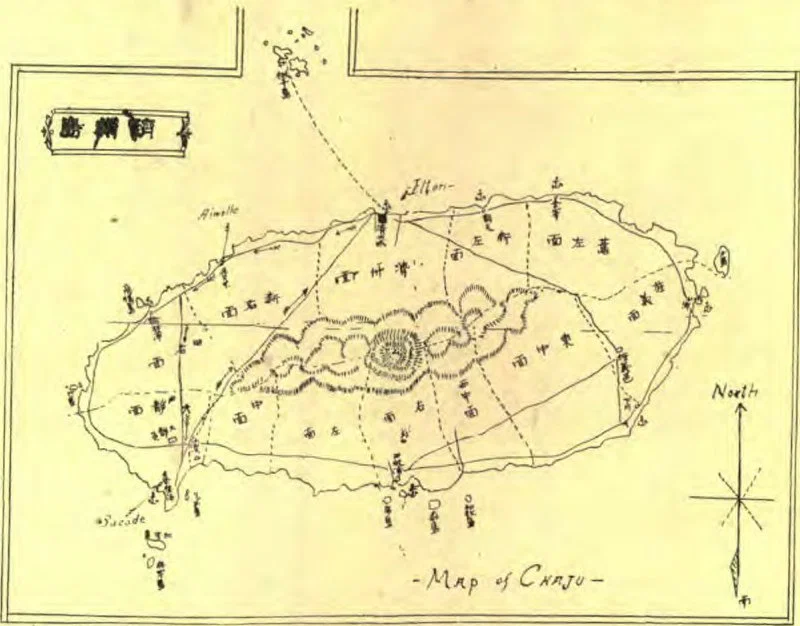
MORE than one hundred miles to the south of the mainland of Korea, in the Yellow Sea, lies Chaju (Quelpart on American charts), the mysterious; an island of volcanic origin about twenty-five miles wide by fifty-five miles long, with a regular unbroken coast line. The central figure of the island is the great extinct volcano rising several thousand feet above the level of the sea. Its top is usually lost in the clouds and its crater is filled with water.
The great stone slabs set up along the highways and bypaths in memory of the illustrious dead, with evidences of great highways that have fallen into disuse and the great walls around the cities, proclaim an ancient civilization much superior to that of today, a civilization which no doubt was at its height when Rome was but an infant.
The reclamation of the island from its original waste was an undertaking so gigantic as to make it one of the wonders of a wonderful East. It is evident that when the first settlers arrived here the ground was completely covered with bowlders of lava formation weighing from pounds to tons, because today every lot, the majority of them no larger than one fourth of a city block, is surrounded with a cobblestone wall. Some of these walls are six feet thick and eight feet high, so constructed as to make use of the rocks from the ground. Aside from the walls great monuments of stones are thrown up over the lots. One may walk from one end of the island to the other, and be between stone walls all the way. However, the island possesses some redeeming features. Among these are its many springs of water rivaling the ice-cold ones of the Rocky Mountains. We saw several of these pouring a volume of water the size of a man's body out of the solid rock. Aside from frequent high winds the island also has a desirable climate, the north side receiving an abundance of sunshine and the south side much rain. The mountains furnish an endless supply of wood and lumber, the waters of the sea supply fish, while the long summers insure two crops of cereals annually.
The ancient capital, Iltori, was at one time a walled city, and part of the wall even today is in a comparatively good state of preservation. The two arches where this wall spanned the little creek that flows through the city are still there, one of them being used as a bridge. The old south gate is also preserved. We passed out through it over a street paved with lava rock. As we passed through the gate we came upon groups of images by the street side, sitting as solemnly on their pedestals as when they were placed there in the dark ages of the past, as the gods of the island. When almost a mile from the city, we came to a circular stone wall inclosing perhaps five acres of ground. Within this outer inclosure was a smaller square one. Both of these are too sacred for the plow, the inner one bearing only grass, while the outer one is almost filled with large pine trees, making a splendid park. In the center of the inner inclosure is a hole in the ground about ten feet deep by twenty in diameter, with three smaller holes in the bottom of it. In front of this hole is a square platform of cut rock with a huge rock slab resting upon it, declaring in Chinese characters that from these three holes issued the first parents of the human race who went forth from here and peopled the world. This tradition is credited by most of the people today, they believing that their little island is the first of nations and the mother of the world.
In walking from Sacade on the southern coast of Chaju to Iltori on the north, one must cross the lower levels of the mountains. After journeying for several miles in a six-foot lane with a stone wall on either side, one comes to an old highway with a twelve-foot bed and a twenty-foot lane. In past ages much effort and work were spent upon this road in the way of cuts and fills to make it suitable for carts or wagons. Doubtless this road was once used extensively by the populace, the resources and the products of the island being distributed over it. But today I hardly think there is a wheeled vehicle on the island. As one mounts higher and higher up the side of the mountain, one comes to a place beyond the bounds of reclamation. For a time the rock wall is on only one side, while the upper side is a wilderness, and finally the wall disappears altogether. These higher levels are almost free from the bowlders that characterize the lowlands. There are thousands of acres of natural meadow but waiting as it would seem, for the farmer's plow. We asked the natives why this land lay thus unused, and they replied: “Snow falls up there, and the wind blows too hard.” However, we believe that it is simply a case of following the paths of the fathers. The lanes in the higher districts are the most beautiful, being slightly traveled. The grass grows within them and the walls are so covered with shrubbery that they look like hedges of living green spread with beautiful wild flowers.
This little island for ages maintained an independent kingdom, but was annexed by conquest to Korea about eight hundred years ago. During the years of Korean ownership it has been used extensively as a place of banishment for offenders of the state.
We found the customs of the people much different from those of the mainland, while the people themselves are a larger and stronger race. There are about three women on the island to every man, and as it is unlawful for a woman to go through life unmarried, it means that almost every man has from two to five wives. Very few of the men work, as the women are the burden bearers. Many of them gain a livelihood by diving into the ocean for shellfish and seaweed. On good days they go out by hundreds from the shore, taking with them meshed bags made of twine, with the open end secured to a stick bent in a circle, in which to carry their catch. These are tied to large gourds which keep them floating. The gourds also serve as supports to the divers when resting on the surface of the water. The women frequently remain in the water for half a day at a time, being as fearless and as much at home in the sea as the fabled mermaids.
We have found Chaju one of the hardest places in the Korean field for our work; yet a slight foothold has been gained. We have two native workers, with a baptized membership aside from them of eleven: also several others are keeping the Sabbath, and a score of interested ones are studying the truth. Brother Smith and I spent five days on the island, visiting and baptizing believers. While the gods of stone by the roadside were responsible for the decay in the civilization of the island, we are confident that the Lord has a people on Chaju who will welcome him with rejoicing at his appearing.
E. J. URQUHART.

Uruguay, South America

URUGUAY is about equal in size to all the New England States. This republic is also known as the Banda Oriental (which means east side), so called in early days to distinguish it from Argentina, since this small country lay on the east side of the Uruguay River. Its flourishing capital, the fair city of Montevideo, is known as the Queen of the Plata, since on its southern side the Rio de la Plata pours its flood of waters into the South Atlantic in a river mouth one hundred and fifty miles in width. This city of the Uruguayans, with its 400,000 progressive people of Spanish stock, is said to have been named from the exclamation of an early missionary who, while far away at sea, on observing the hat-shaped mountain lying in the foreground, cried, “Montem video!” (I see a mountain!) Through this fine ocean port there are exported, year by year, all the products of the cattle industry, as well as cereals, to the amount of $75,000,000, while there enter imports, chiefly of manufactured articles from Europe and the United States, amounting to considerably more than $50,000,000.
Uruguay is also the land of flowers. Mr. W. H. Hudson in his fascinating book has called it “the purple land,” because of the predominating flor morada, which covers the country with a carpet of rich purple. Here is a coming country, with temperate climate, a vast grazing land with upward of 45,000,000 acres, of which only about five per cent is devoted to agriculture, because of the lack of population, there being only one and a half millions of inhabitants in a wonderful region of rivers and smiling lands capable of supporting fifty times the number. For grazing purposes, Uruguay is the most favored land in all South America. Although the cultivation of wheat and maize especially is now advancing, the grass lands are unsurpassed, and these now support for the world’s food supply more than 9,000,000 head of cattle, 30,000,000 sheep, 800,000 hogs, 600,000 goats, and 500,000 horses.—Christian Herald.

A Glimpse of Life in the Bay Islands

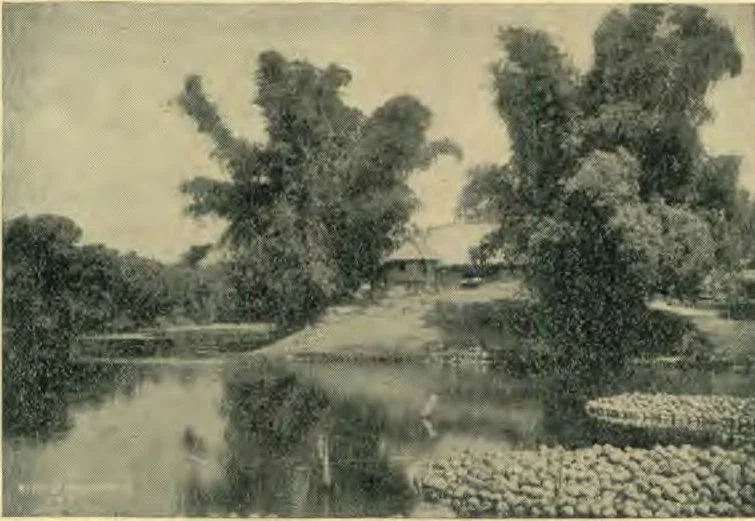
FLOATING COCONUTS TO MARKET
I HAVE spent two years in the Bay Islands. Conditions are not ideal here; but the responsibility for this state rests upon the government, rather than upon the people. It seems that nearly everything that would be helpful to progress is withheld by the government. The inhabitants are largely English-speaking people and want to be taught in the English language, while the government, being Spanish, requires the schools to give the preference to Spanish. Nearly all of the people can read and write.
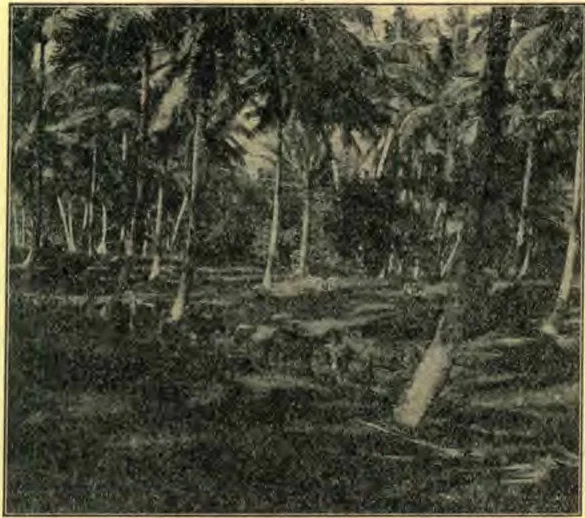
Strange to say, the people like to use the name that others have given their country, “the lazy man’s paradise.” They truly have a right to that name; for if a man has a coconut garden, he need do nothing else for his living but pick and husk the coconuts and take them to market. Many products can be grown here, but most of the people do not care to spend their strength in that way. There are so many pests to eat what they plant that it is discouraging. Even the coconut trees have their enemies.
'Guavas, cashews (kā-shoos’), hog plums, craboos, coco plums, alligator pears, cherry berries, and mangoes are among the fruits of the islands. The cashew is the strangest looking of all, as it has but one seed, which is a large nut hanging on the blossom end of the fruit. The nut is shaped like a mitten, and is delicious when roasted, better than peanuts. I was surprised to find that the breadfruit could not be pulled from the tree and eaten as fruit. It is more of a vegetable, although it grows on a tree. It must be boiled, baked, or cooked in some way, to be edible.
Among the pests of the country are the wee-wees, large dark-red ants which eat many kinds of plants and roots; the marching armies, large black ants which also feed on plant life; and large black bugs, which bore into the coconut trees. There are also troublers for the housewife,—four or five kinds of small ants, and roaches.
The mode of living in this country is not very different from that in the Southern States. The houses are not built very substantially because the wood lice eat up the timbers and a new house must soon replace the old one. All that is needed in this climate is shelter from sun and storm. Many of the houses are built over the water, as such a site is more healthful. One settlement near the island of Bonacca is built almost entirely over the sea, just a few houses being built on two small quays that are a few rods apart.
A COCONUT GROVE
A COCONUT GROVE
The people are good-natured and kind-hearted, and are anxious to learn better ways. They put great confidence in their leaders, if they are people worthy of such trust. They soon learn to read with or without help. I believe their politeness, especially that of the children, would surpass many who have had better advantages. Most of the people are regular attendants upon church services, and they have looked up to their old leaders so long that it is not easy to convince them that it is unsafe to follow them. The need here is for workers, who with strong love and perseverance, will open their eyes to the greater light for these last days. May the Lord send forth more laborers into this part of his vineyard that many sheaves may be gathered into his garner.
JOSEPHINE PADEN.

What the Trees Are Called Upon to Do

THE secretary of the National Lumber Manufacturers’ Association estimates that the government will need this year about two billion feet of lumber, hard measure, for the army and navy.
“This big lumber order would be sufficient to build homes for a city of a million inhabitants. It would house more people than there are in any city of the United States, excepting New York, Chicago, and Philadelphia. If the lumber were loaded on cars, it would fill a solid train from New Orleans to New York, and half way on from New York to Boston.”
Mr. Frank G. Carpenter, in the Christian Herald, cites some of the uses to be made of this lumber. He says:
“More than one fourth of it will be required for the mobilization camps of our new army of 1,000,000 men. It will be put into long one- and two-story buildings, forming the best arranged and most up-to-date barracks that have ever been known. The officers’ training camp at Fort Sheridan required almost a million and a half feet of lumber, or enough to make a board walk a foot wide, reaching from New York to Boston. . . .
“The same kind of work is going on in the building of the great barracks for the army of a million men. These are being erected at the mobilization sites throughout the country. The estimates, based upon the plans of the War Department, are that 13,500,000 feet of lumber will be needed for each infantry division of 35,000 men, or in all about 600,000,000 feet for barracks alone. A million feet of lumber would just about floor twenty acres, so that the barracks for each division will need enough to cover 270 acres, and those for the army would make a floor an inch thick over the whole 12,000 acres with some over.
“Among the other buildings required by the government are some for the Y. M. C. A. These have been planned by the War Work Council, and will be situated at the various army and navy training camps. They will number two hundred and will be clubhouses or amusement places for the men in the camps. Each building will take about thirty-seven thousand feet of lumber.
“It has not yet been decided just how many ships will be built, but it is pretty certain that two hundred and fifty vessels of standard type will be constructed of wood. Each of these will need one and a half million feet of lumber, enough to floor thirty acres, and the total will be something like four hundred million feet. At five thousand feet to the mile, for easy figuring, the ship lumber would more than plank an automobile highway sixteen feet wide, reaching from Boston to San Francisco, and from St. Paul to New Orleans.
“More than 30,000 vehicles have already been ordered for the army. These orders will require at least 25,000,000 feet of high-grade yellow pine and oak.”
“Among the machines which require fine lumber are the airplanes. It is said that the Allies have 20,000 flying machines on the western front, and that Uncle Sam will probably ship thousands to France. Ash is used for the bent woods, and a variety of different woods are employed for the propellers. Spruce is used for airplane wings. To build 10,000 airplanes we shall need something like 20,000,000 feet of rough lumber, or enough to floor 400 acres.
“I might mention a score of other demands, such as artillery trucks, automobiles, new docks and piers, tools and railroad construction, as well as the lumber for timbering mines, and the new factories now building to make army and naval supplies. All of these will require more or less wood, and the total estimate of two billion feet is probably under what will be required.”

Obstacles Surmounted Give a Broader Outlook

“OBSTACLES surmounted give a broader outlook.”

Mission Notes

In 1905 the publication of the first Seventh-day Adventist paper in China was begun by Dr. H. W. Miller. It had a circulation of 500 copies, and the sales of the colporteurs averaged fifty cents a month. This work has grown until today it has a monthly circulation of 60,000 copies, and a subscription list of 7,000.
The young people of Australia have raised $10,000 for a boat for Elder G. F. Jones. This he will use in his work among the Pacific Islands.
There are 60,000,000 people in Malaysia who must have the light of truth before Christ’s second advent.
The American Bible Society sent out from Calcutta 23,600 copies of the Scriptures in 1816, and 1,000,000 in 1916.
Judson published his first Burmese tract in 1916.
“The World War” has had a larger sale in four months than “The World’s Crisis” had in two and one-half years. At the Maine camp meeting this year 22,000 copies of “The World War” were sold.
Continue reading: Whale Fishing