THE whale fishing of today is far different from that of the past. The boats used a century ago were little sailing ships of three hundred or four hundred tons, which carried a number of dories, or small boats. When a whale was sighted, the men went out in their whaleboats and threw the harpoons by hand. Each harpoon had a long line attached to it, and at the end of this was a float. After the whale died, it was dragged to the vessel, where the oil and bone were saved, the carcass being thrown away.
Today the whaling vessels are small steamers, and the harpooning is now done from the steamer, and that by means of a gun invented by a Norwegian sailor named Svend Foyn. He used his gun first about the year 1866, and fifteen years later he is said to have made as much as $2,000,000 out of his invention.
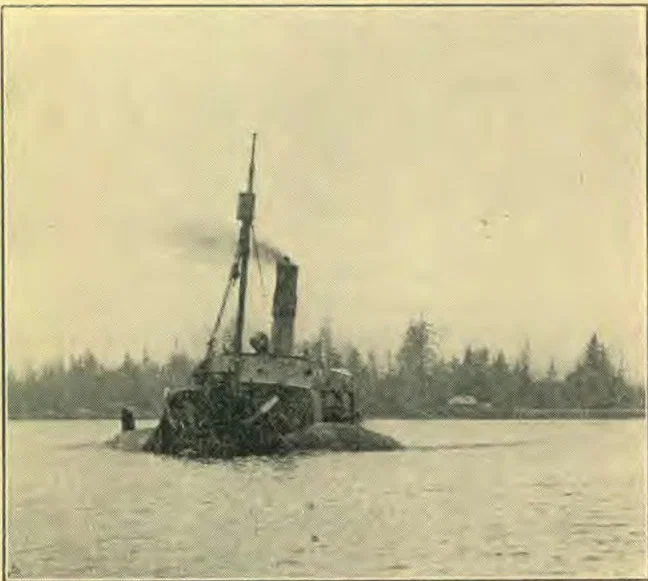
A WHALER BRINGING IN THREE SPERM WHALES
The gun is a short tube cannon on swivel bearings, with a muzzle as big around as the largest teacup. It is discharged with a Krupp firing screw. The explosive used is black gunpowder with a bunch of waste as a wad. On the top of this is the harpoon, which is attached to a long line connected with a steam winch on the deck. The harpoon ends in a sharp point, which consists of a hollow iron cap filled with blasting powder. To this cap a time fuse is attached, and the bomb explodes inside the whale. The harpoon has expanding arms which spring out after it enters the whale and holds it while it is fighting for its life. The cable consists of about two thousand feet of Manila rope as thick as a man's arm.
When the animal is dead, this rope is reeled up by the steam engine on board, thus dragging the whale to the ship. The great mammal is now filled with air from the air compressor on board. This makes the carcass so light that it will float. It can then be towed to the nearest harbor and anchored, or it may be towed direct to the station. Some of the whales weigh as much as ninety tons, but they are easily carried along through the water in this way.
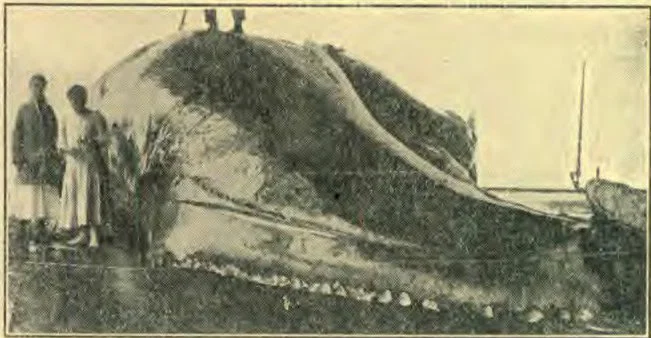
VIEW OF THE HUMPBACK WHALE
After the whale arrives at the plant, it is hauled up an inclined plane onto the wharf by means of a donkey engine. The men then get on the whale, and cut the fat into long strips. They use axes and knives. A hook is attached to the end of one of these strips, and the engine pulls it off the body by means of a wire cable. At the same time two men walk along and chop the blubber loose with heavy ax blades. The blubber is cut up by revolving knives and put into steam cookers to get out the oil. It is cooked again and again in order that none may be lost. The next process is cutting up the carcass. In this the workmen use long knives and chop the meat into thirty- or forty-pound chunks. They then throw it into boilers where it is cooked eight or ten hours. The oil rises to the top and is drawn off, while the meat left goes into the drying tanks for conversion into fertilizer.
The bones also are cooked. They are rich in oil and valuable as a fertilizer. They are crushed, and then dried and sacked for the market. There are different varieties of whales—sperm, sulphur-bottom, finbacks, and humpbacks. These varieties are among the most common to the whale fisheries of today.
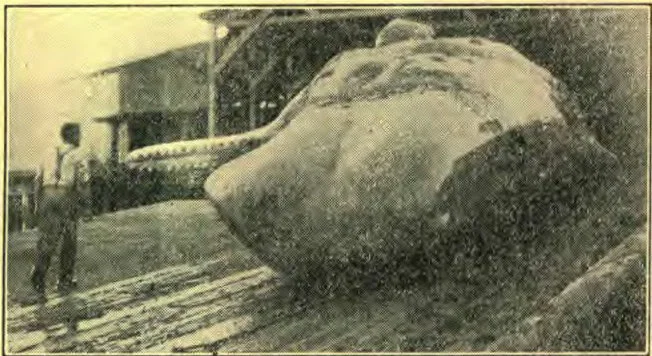
The right whale is the most valuable. A single one may yield bone to the value of $10,000, and at the same time produce fifteen or more tons of excellent oil. The right whale is one of the greatest giants of the seas. It is from forty to fifty feet long, and sometimes weighs ninety tons. It is not the largest of the whales. The sperm whale often reaches sixty feet, while the rorqual sometimes runs up to eighty feet. The blue rorqual is the largest of known animals. A single sperm whale will produce from fifty to sixty barrels of oil, most of which comes from a hole in the head. The first step in butchering sperm whales is to sever the head and take out the oil.
It is from the sperm whale that ambergris comes. The word means gray amber, and the substance is a gray, waxlike, solid mass, that is found in the abdomen of the sperm whale, in lumps weighing from a half ounce to one hundred pounds. It is sometimes found floating on the sea, or lying on the sand near the sea-coast. Ambergris is very valuable. It is worth in the neighborhood of $300 a pound, and two pieces recently taken from a sperm whale sold for $10,500. They weighed about thirty-eight pounds. The stuff9is used largely in perfumery and also in medicines. It is formed by the bile of the sperm whale, and when first taken out it has a disgusting smell.
J. W. BOYNTON.
HEAD OF A SPERM WHALE. PROJECTION AT LEFT IS LOWER JAW
Riding Through Space
By Elmina Hicks-Hartwick
ABOUT fifteen miles west of our home is the spot where gold was discovered in 1848 by a Mr. Marshall. This discovery was the cause of the rush to California in the “days of ’49.” Even yet, following some distance by the Lincoln Highway on the way to our nearest city, Placerville, may be seen the remains of the old immigrant trail.
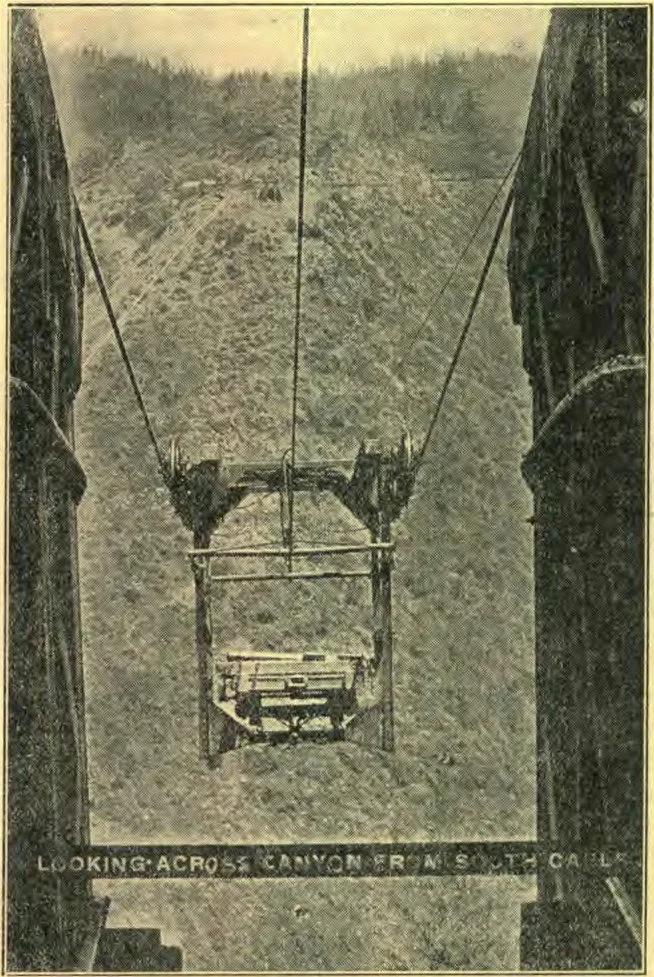
Fifty miles to the northeast is the beautiful Lake Tahoe, on the main line of the Highway. Thousands of tourists pass over this trail every summer on their way to this resort. About five miles north is the cable stretched across the American River Cañon at such appalling length and height as to be compared with the new aerial line at Niagara Falls. The cable is operated by a large lumber company and is principally used for carrying lumber across the cañon. When a train of lumber arrives from the lumber camp at Pino Grande, a car is unhooked, run into the cage, fastened securely, and carried across, and then the cage returns and another car is fastened in and transported.
When a passenger ventures, he is not fastened in, but hangs on to a thin iron rail on the side of the cage, and standing up he can look over the side and out at the ends, and through the bottom if he is brave enough, for there is a great open space in the center of the cage floor. When everything is in readiness the signal is given to the engineer. The passenger’s heart almost makes its way to his mouth, as the great timbers creak and groan, and he begins to move out of the little building that houses that great cage. Then down he goes at a terrific pace, but still he is not very far down, for he is hanging by three large twisted iron cables between eleven and twelve hundred feet above the river. That river surely looks beautiful tumbling along its turbulent and treacherous course and round the bends as if it were longing to be free, but finding no way out.
If the passenger has thought to wrap a large rock in white paper, he may drop it now, but it will very seldom reach the water. Now, brace yourself and “pull for the shore,” for the cable seems to be pulling you up so steep a grade that it is like standing on the steep roof of a house, and then, crack, groan, a good bump, and he is safely landed, to find his heart still beating, although he may have thought ten minutes ago that it never would beat again.
CABLE CAR ACROSS THE AMERICAN RIVER CANON
The light streak to the left is the chute through which the timber was shot into the river before the cable was built.
After he has taken a few snapshots, and a good look at the home side of the cañon, with perhaps a short walk and examination of the old chutes, he may go through his former experience, if he did not get used to it the first time. When he comes to his starting place, the lumber train is ready to leave for home, so he may clamber up the cars and sit on the lumber and have a jolting ride home. He can enjoy a hearty meal of mountain strawberries and mountain potatoes with a dessert of some of the finest pears ever grown. if he has enough vigor left to walk to the opposite hillside and pick them.
ELMINA HICKS-HARTWICK.
Craved Sugar
SUGAR is so much a necessity of life that men in the trenches who have been without it for weeks demand it instead of tobacco.
One night, after a sugarless week in Przemyśl during the Russian attack on the forts, I said to an Austrian officer, expressing a very deep craving:
“I’d give a week of my life for some candy.”
“So?” he said simply.
An hour later, in the officers’ crowded casino, he took me gently by the arm and said:
“Come with me.”
We went into the pitch-dark streets, and, at the risk of our necks, made our way over the slippery, mud-covered sidewalks. We turned into a side street; then into an alley; then into a back yard, and he led me to a door in the rear of a little shop. He knocked gently three times. The door opened, and a timid little woman thrust forth her gray head.
“It’s only I, with a friend,” said the officer.
“Ah! Come in,” said the woman.
It was the kitchen of a little home bakery. One oil lamp stood on the big brick stove. A dozen officers sat about, chatting.
(Concluded on page eleven)10
(Concluded from page nine)
“Have you bonbons tonight?” asked the officer.
“You see what I have,” said the old woman, turning and pointing to a shelf that bore an array of chocolate drops neatly set out in rows on strips of oiled paper.
“Behold!” said the officer to me triumphantly.
All the yearning of a drug fiend for his cocaine was in my soul for sugar.
“You may have only four tonight,” said the old woman. “They didn’t bring me much sugar today.”
The officer and I paid thirty cents for four little chocolate drops, and we sat down at the kitchen table with the other officers, to eat them slowly, and to talk as we ate.—Every Week.
A Hard-Earned Dollar
By Annie H. Donnell
I WISH I could earn some money, too,” Roly Poly said, with a wistful little sigh. It was hard to be only five years old “come June,” and not have a single penny to put in the Famine Bank.
“I wish I could, mamma.”
They were all in the nursery together, having their “go-to-bed sociable,” as Eunice called it. Eunice had names for everything. She was on one arm of mamma’s chair and Roly Poly was on the other. The boys were lying upside down on the rug, leaning on their elbows, and Queen Mab was in her own rocking-chair, as usual. It was she who spoke next.
“O, you’re too little, Roly Poly—you can’t earn money hemming towels and piling wood and raking the lawn,” she said. “You’ll have to wait till there’s another famine in India. Will there be another one ever, mamma?”
“I’m afraid so, dear,” mamma answered, her sweet face grave with pity. “India is so full of people, and there are so likely to be drouths, when the wheat won’t grow, or the other crops they depend on for food. If there was only better irrigation there—”
“Ir-ri-what, mamma?”
“Irrigation, Eunice. That means a way to water the land artificially with pipes or open trenches. But India has to depend altogether on the rain, and so when there isn’t rain, the people starve.”
“And the little babies,” murmured Queen Mab softly. It was the thought of the little babies starving that seemed most dreadful. The little baby in the cradle across the room was so round and fat and dimpled! Instinctively they all looked across the room.
“I’ll hem a dozen towels,” Queen Mab resolved valiantly.
“I’ll rake Mr. Leadbetter’s lawn, too,” thought Dick.
“I’ll pile up grandpa’s woodpile,” Robert vowed.
And poor little Roly Poly’s sweet round face lengthened again.
“I wish I could earn some money, too,” she sighed.
“I’ll pay you a dollar if you’ll go to bed without any kiss from mamma,” laughed Aunt Gwen, mischievously leaning over to twitch a little pink ear. Everybody laughed, as if Aunt Gwen had made a joke. The idea of Roly Poly going without her good-night kiss!
The Famine Bank was really a little brown jug that had to be broken to get out the pennies. It stood on the nursery table in plain sight, and mamma had used it as the text for her little go-to-bed sermon tonight. She had talked about the hundreds and hundreds and hundreds of hungry people in poor, far-away India—the mothers who watched their little brown babies starve in their arms, the little gaunt brown girls and boys, and the grandmothers. That was almost as bad as the little babies starving—the grandmothers! Roly Poly remembered how plump and comfortable looking her grandmother was, and how soft she was to cuddle up to. Those other grandmas in India were terribly thin and weak.
So it was that when the little sermon ended, they all began at once to plan ways to earn money to put in the Famine Bank. They decided to begin the very next day, because there was so much need to hurry. Somewhere in India, perhaps, there was a little brown baby that their pennies would save. But they must hurry—hurry.
“A whole dollar, Puss in Boots!” whispered Aunt Gwen temptingly. “Think of putting a hundred pennies into the Famine Bank! And just as easy to earn—fie, just to go without a kiss!”
“’Tisn’t a kiss, it’s mamma’s kiss,” Roly Poly murmured, snuggling against mamma. She and mamma were very “int’mate.”
In slow strokes the nursery clock began to strike, “Bed-time—bed-time—bed-time;” and the children got up obediently. They were accustomed to obey the nursery clock.
“I’m going to get up at five o’clock to begin raking,” announced Dick.
“So’m I, to pile wood,” Robert echoed.
But Queen Mab shook her yellow head. “I’m not,” she said. “I shall need all my sleep to prepare me for hemming towels.”
Upstairs in the girls’ room mamma unbuttoned Roly Poly’s “behind-buttons,” and rolled up her soft hair into a row of little white “popcorns.” Then she tucked her into bed.
“Good-night, little one,” mamma said, after the little prayer was whispered in God’s ear. “Pleasant dreams—why, where’s your mouth disappeared? I can’t find it to kiss.”
Roly Poly mumbled something into her pillow, but the little red lips stayed hidden. And slowly—very slowly, indeed—and gently, Roly Poly’s two moist, warm hands pushed mamma away.
“Don’t kiss me, mamma,” the little girl said tremulously; “I’ve ’cided I’d go ’thout. Please go away just as fast as you can. I’m ’fraid I’ll change my mind.”
“Why, Roly Poly! Why, little one!”
Mamma looked down at the back of Roly Poly’s head, with its fringe of little white “popcorns,” and felt an almost irresistible impulse to stoop over and kiss the little warm neck under the fringe. But she waited.
“Do you really mean it, dear?” she said gravely.
“Yes’m, oh, yes’m, if you’ll only please to go away, out o’ my reach! I’ve ’cided to earn that dollar for the Famine Bank, an’ the little hungry babies, mamma. I’ve ’cided to. Good-night.”
“Good-night,” mamma said, squeezing a little hand lovingly. Then she stole away, out into the hall. She sat down on the upper stair, to be within hearing if Roly Poly called her back. She hardly believed the child’s courage would hold out.
Five, ten minutes went by, then another ten. Then mamma heard Roly Poly singing, in a soft, broken voice:11“Oh, do not be discullidged,
For Jesus is your F’end;
He’ll give you g’ace to conquer,
An’ keep you to the end!”
She sang it over and over to herself, and mamma knew it was to keep from calling her back. She knew that in there in the dark Roly Poly was earning her dollar by the sweat of her brow.
“Dear little heart!” murmured the mother brokenly; “it’s harder than hemming towels and piling wood.”
When the singing dropped into silence, word by word, mamma crept back and stooped over little Roly Poly’s tear-wet face. But Roly Poly never knew that she got her kiss, after all.—Annie H. Donnell, in the Congregationalist.
A Dream
By Laura Bell Scott
From childhood I have been very fond of reading, and at one time read nearly everything that fell into my hands.
After my conversion, however, I was led to see that a certain class of books was not good for me, and I read no more of them; but I still read the better books. As God led me into more light, I was impressed with the thought that even this class of literature, clean, moral stories though they were, was not the best for those who are seeking to be ready for our Lord’s coming; but the habits of a lifetime are not easily broken up, and I clung to this pleasant pastime, hoping that I might be mistaken in thinking it was the Holy Spirit bidding me give it up.
I prayed for more light, whereupon the following dream came to me: I seemed to be wandering in a great forest, lost and alone. So many were the trees and so dense their foliage I could not see the sky; not a ray of sunlight shone through, but a deep gloom filled the place. I noticed that each tree trunk bore the name of a book or of an author, some of them good, many of them of the cheaper class.
Thinking I might see my way out of the woods, I tried climbing some of the trees bearing the names of this last kind, but to my disappointment, I only became entangled among the branches and was scarcely able to extricate myself from them.
Next I climbed some of those bearing the names of the best books of fiction, those commonly recorded as quite harmless. In these I reached a point higher than the tops of the first, and could see the sunlight upon the tops of the trees as they stretched out like a great sea of green, but still I could not determine the way out of the forest. I found my way down, and then as I walked along I came to a tall, straight tree with the word Bible printed upon it in large letters.
At first I had difficulty in ascending this, as the branches were far apart; but as I went higher it became easy, and I finally found myself far above all the other trees. The branches of this tree grew so strong and straight that I walked out upon one until I came into a beautiful land, filled with flowing streams, bright flowers, and singing birds. I was delighted. Just then I awoke; and it came to me that my dream was the answer to my prayer.
Is there not a suggestion in it for all who spend their time in idle reading? Can any book, however good in the sight of men, lead one into the rich pasture provided by God for those who read his Word? Let us then climb high above the dark forest of low ideals into the bright sunlight of the beautiful land of pure delight.
LAURA BELL SCOTT.
Questions for the Finding-Out Club
TELL what you know of the author of the book of Mark.
2. Who was the first child to have a feast made in his honor?
3. Who is in command of the American forces across the Atlantic?
4. Who discovered Salt Lake? The Yellowstone Park?
5. Who took Prof. Henry van Dyke’s place as ambassador to Holland?
6. Which is nearer to Rio de Janeiro, Brazil, Galveston or Boston?
7. Give the pronunciation and meaning of Sinn Fein.
The Best Thing in Our Home
By Dena McCune
SOUTHEY calls the fireside “the cat’s Eden;” but pussy has no monopoly of the domestic grate. Our open fireplace with its cheery flame is our Eden. Around it we gather after the evening meal, while our daughter at the piano beguiles away our weariness and perplexity.
After this quiet relaxation, the lights are flashed on, and our unfinished book or new magazine plays the rôle of entertainer and instructor. We read aloud; for the fireplace commands the community spirit.
When too much reading becomes a weariness, we eat popcorn and apples, while talking over the day’s news and interesting incidents.
Here in days gone by wonder stories galore were told while my husband’s arms enfolded our child,—the hour that drew father and daughter wonderfully near to each other. Here my husband and I discuss our business problems and rehearse our domestic joys.
All too soon the clock strikes its admonition to us who must never forget that tomorrow brings its toil. So we read the Book, and before the glowing coals we pray that the fire of God’s love may ever burn in our hearts, consuming all dross and brightening all life.
Thus has our fireside become our Eden.
DENA MCCUNE.
Adventist Mission Work in India
INDIA is the Gibraltar of the Far East, and probably the hardest mission field in which to labor. We have there a membership of about six hundred. In the last two years, 210 persons have been baptized. We publish literature in India in ten different languages and dialects. Extensive work is also being done among the English people in cities like Calcutta and Bombay.
Missionary Volunteer Work Summary, North American Division, Quarter Ending March
By M. E. Kern
Summary of Missionary Volunteer Work in the North American Division Conference for Quarter Ending March 31, 1917
Number of Societies
Present Membership
No. Members Reporting
Missionary Letters Written
Missionary Letters Received
Missionary Visits
Bible Readings
Cottage Meetings
Subscriptions Taken
Papers Sold
Papers Lent and Given
Books Sold
Books Lent and Given
Tracts Sold
Tracts Lent and Given
Hours of Chr. Help Work
Articles of Clothing Given
Value of Food Given
Treatments Given
Signers to Temperance Pledge
Bouquets Given
Scripture Cards Given
Offerings for Foreign Miss.
Offerings for Home Miss.
Conversions
ATLANTIC UNION
E. New York
8
121
44
37
34
115
---
1
97
1289
14
40
78
44
157
18
$ .60
30
1
10
25
$ 81.52
$ 32.20
---
Gr. New York
12
392
---
536
260
1376
264
48
2438
8892
447
263
223
4097
927
277
---
---
---
---
---
172.65
117.45
8
Maine
9
173
106
110
52
229
107
4
1394
1141
204
88
---
797
235
27
1.84
5
42
4
3
62.74
15.04
11
Massachusetts
18
379
340
521
119
6048
295
4
1035
3727
135
154
115
1300
549
124
8.50
6
---
6
9
160.58
148.71
17
N. New Eng.
6
40
40
39
6
81
24
---
1000
617
144
22
---
79
108
41
---
5
2
2
2
26.80
11.57
---
S. New Eng.
9
78
---
82
24
144
49
2
1406
---
122
70
80
646
40
51
.50
2
---
12
59
25.76
13.10
---
W. New York
15
148
---
146
78
648
64
50
1155
4672
55
82
221
6739
690
97
32.80
45
---
27
114
199.58
177.66
5
Bermuda Mis.
1
26
---
1
1
---
---
---
9
14
36
1
---
20
---
1
---
---
---
3
100
---
---
---
CENTRAL UNION
Colorado
30
725
448
671
343
1219
300
61
1498
6259
201
300
90
1458
2172
278
52.40
201
1
50
929
213.06
247.34
31
Kansas
41
713
275
447
206
724
189
53
581
3548
45
226
17
1398
1068
251
26.85
132
30
48
179
115.15
122.26
10
Missouri
15
293
170
241
78
495
97
31
893
3318
113
226
22
3241
762
139
11.25
4
1
32
194
375.84
91.86
23
Nebraska
20
520
147
621
210
660
295
82
1809
7213
404
171
6
1513
1047
76
61.00
77
9
57
5
93.13
13.60
5
Wyoming
6
105
---
61
27
87
36
5
136
515
30
53
100
145
81
23
8.00
---
---
---
---
33.09
4.68
---
COLUMBIA UNION
Chesapeake
13
109
76
32
2
214
51
6
13
1208
2
30
2
151
142
57
16.00
6
---
1
28
12.69
146.64
---
Dist. of Col.
6
337
---
1356
112
353
52
13
5972
10635
57
77
57
770
289
112
3.90
23
1
16
115
43.14
40.26
---
E. Penn.
20
255
---
120
61
298
88
15
399
1895
40
127
93
603
1007
97
33.08
23
3
8
209
45.11
161.22
---
New Jersey
25
334
256
446
256
1067
392
9
1664
2579
318
211
571
6688
1000
277
15.29
57
2
22
56
79.75
61.10
2
Ohio
25
500
418
373
315
803
338
122
488
5031
41
30
35
11015
1073
182
23.10
96
---
31
361
132.40
5.54
---
Virginia
10
203
---
80
26
221
61
---
484
569
32
35
6
2944
315
101
4.50
3
18
---
42
26.65
1.23
6
W. Penn.
3
153
78
632
284
931
390
19
2402
8886
242
82
52
1386
533
169
45.00
187
---
4
3
185.96
212.93
---
W. Virginia
2
24
---
74
12
145
26
21
198
1477
215
122
---
307
84
31
5.00
126
---
---
---
21.01
.70
---
LAKE UNION
E. Michigan
35
677
---
354
207
507
66
5
734
2876
79
147
146
1860
1497
475
53.20
25
42
56
108
30.23
49.04
4
Indiana
34
474
252
414
185
607
133
13
691
5529
116
326
238
1644
758
213
22.15
126
79
37
138
138.27
48.98
1
N. Illinois
39
782
510
966
431
2669
623
62
3286
4803
207
306
462
7661
4331
875
23.21
309
19
62
711
190.83
263.99
47
N. Michigan
26
179
---
80
51
450
67
40
36
5908
9
45
115
840
1450
30
.69
20
33
---
49
17.70
10.00
---
N. Wisconsin
11
114
42
20
---
40
12
1
---
299
61
9
---
23
89
25
---
2
---
2
24
6.15
6.94
1
S. Illinois
15
183
193
72
39
205
81
34
263
2577
36
394
81
366
590
72
.45
7
---
12
---
127.00
---
---
S. Wisconsin
29
375
204
355
122
376
127
43
161
2612
128
150
17
766
1006
216
.58
78
14
11
84
60.07
14.50
---
W. Michigan
40
979
395
2489
210
1067
160
46
188
7771
1015
108
39
3491
1837
821
1.79
27
110
85
---
171.05
126.42
25
NORTHERN UNION
Iowa
22
475
160
454
227
534
138
42
1568
4818
185
189
222
2768
1023
403
31.00
75
19
57
1097
160.00
87.79
5
Minnesota
36
640
318
375
164
719
205
83
367
5614
247
212
57
2830
701
162
37.50
52
26
28
371
168.51
55.06
6
North Dakota
15
---
---
427
130
219
21
25
600
1843
---
19
---
933
313
41
.25
20
10
---
19
140.78
54.75
---
South Dakota
---
311
153
577
174
298
108
82
522
3387
57
108
90
937
470
215
10.00
73
2
4
148
520.48
94.03
---
NORTH PACIFIC UNION
Montana
5
---
21
20
12
31
16
---
5
700
2
4
2
74
9
8
.25
---
---
---
---
---
---
---
S. Idaho
14
257
---
137
60
160
14
10
248
1119
29
50
73
930
111
18
.50
10
---
174
---
55.24
4.70
3
S. Oregon
9
146
90
180
77
212
65
59
47
1812
6
67
12
783
194
37
10.30
28
---
4
14
12.14
25.66
2
Upper Col.
25
604
258
188
58
380
75
95
140
3292
145
221
44
775
438
237
8.40
39
13
28
230
145.29
34.25
10
W. Oregon
20
339
173
168
49
205
49
26
16
3946
5
132
33
353
555
249
14.90
14
3
19
392
213.48
48.51
---
W. Wash.
18
253
---
33
18
146
8
2
35
893
17
24
5
158
43
25
.50
---
---
---
---
19.36
10.03
---
PACIFIC UNION
Arizona
3
65
---
130
49
153
47
14
73
618
19
48
1
260
404
90
8.70
27
---
8
---
67.42
25.55
---
California
18
490
240
454
159
859
210
70
799
4362
243
235
19
2162
1032
205
22.80
88
10
198
388
175.47
47.35
20
Cen. Cal.
31
622
---
227
99
622
139
85
34
3842
22
182
20
874
650
371
19.65
18
40
129
88
228.74
68.84
3
Inter-Mountain
10
113
---
368
167
381
155
82
80
2277
24
108
7
384
77
16
2.40
---
2
---
---
8.23
25.50
---
Nevada Miss.
1
---
7
3
1
19
---
---
---
334
---
25
---
80
42
11
.30
3
---
1
10
---
---
---
N. Cal.
15
443
160
253
83
353
82
47
1398
4498
110
237
74
904
675
386
15.00
33
9
108
198
163.27
80.01
13
N. W. Cal.
22
531
213
449
109
541
59
178
301
3829
32
140
30
1114
624
350
30.45
33
---
339
297
250.61
72.46
---
S. Cal.
24
574
302
193
68
376
210
5
40
3944
47
133
22
1968
322
332
13.65
41
8
60
43
71.31
35.51
5
S. E. Cal.
24
700
346
302
69
520
80
54
77
2661
1019
94
12
765
642
151
21.30
53
---
73
19
53.19
33.11
---
SOUTHEASTERN UNION
Cumberland
---
102
---
55
25
213
37
5
864
464
3
19
102
730
137
28
3.00
25
---
4
---
23.00
103.00
---
Florida
17
230
160
241
118
432
84
40
2145
5796
393
67
14
907
435
99
19.35
22
19
99
93
56.30
33.24
34
Georgia
---
91
66
157
97
659
144
11
557
1194
37
61
181
583
325
77
32.00
18
16
9
19
59.49
38.84
---
N. Carolina
---
251
162
132
66
217
15
25
750
294
39
22
165
1229
199
83
10.25
5
4
2
100
29.01
4.15
---
S. Carolina
---
16
12
1
---
8
---
---
3
23
---
---
---
---
9
3
---
---
---
4
1
4.40
---
---
SOUTHERN UNION
Alabama
6
108
53
195
101
426
17
6
520
486
43
69
41
120
709
97
33.75
53
9
112
216
41.90
10.94
2
Kentucky
5
105
52
71
39
135
25
6
216
923
1
44
---
402
196
57
6.75
30
1
6
2
6.44
4.46
2
Louisiana
3
61
45
47
25
275
70
9
171
475
8
26
3
115
156
9
2.70
10
---
14
4
35.30
.79
2
Mississippi
6
45
5
42
39
86
71
1
---
65
---
6
---
43
---
22
.60
13
---
---
---
.57
---
2
Tenn. River
12
233
163
160
93
408
57
6
497
1532
138
109
4
533
746
173
15.25
62
1
34
460
185.73
48.11
2
SOUTHWESTERN UNION
Arkansas
9
119
41
81
41
33
11
12
62
1371
36
33
11
116
140
11
1.25
9
17
3
11
10.01
1.75
2
N. Texas
10
249
144
137
60
245
17
10
93
965
31
40
3
226
1224
51
5.00
116
---
18
109
105.15
2.85
1
Oklahoma
20
216
101
107
61
236
28
19
223
3656
111
152
44
1301
476
142
.60
38
5
1
101
45.99
22.82
18
S. Texas
5
65
54
98
27
313
185
---
290
264
141
22
---
1198
105
1
---
17
1
6
---
23.31
---
---
Texico
8
---
33
7
8
9
9
---
13
1356
14
24
2
34
116
5
2.25
---
---
---
1
28.82
2.10
---
EASTERN CANADIAN UNION
Maritime
2
63
15
35
7
39
24
---
679
305
262
22
---
59
26
32
3.30
28
---
---
---
40.81
5.02
---
Ontario
10
185
150
196
68
146
5
5
1085
1394
133
55
13
1125
159
42
1.00
---
---
4
33
55.66
---
32
Quebec
3
50
14
116
75
389
73
1
113
209
24
46
---
35
700
17
.75
2
---
---
3
139.25
14.45
---
Newfoundland
3
---
---
3
4
26
3
---
---
597
---
10
---
864
25
27
---
---
---
---
36
7.75
---
---
WESTERN CANADIAN UNION
Alberta
10
173
99
322
58
103
7
3
229
1493
9
48
93
301
15
51
.30
87
13
---
16
101.15
79.85
---
British Col.
6
89
39
19
6
100
24
4
296
762
2
30
3
289
262
20
---
---
---
---
---
21.35
10.51
---
Manitoba
5
57
9
28
9
16
3
17
163
253
---
22
---
166
2
4
13.50
---
5
---
---
46.38
28.66
---
Saskatchewan
6
102
51
142
44
30
35
17
50
409
16
50
---
356
42
39
2.70
15
---
1
47
8.75
11.50
---
Totals
981
18564
7903
18681
6595
83037
7007
1917
45749
183935
8418
7099
4268
91726
38366
9053
$853.83
2779
640
2145
8013
$6527.95
$3371.11
382
Totals for quarter ending March 31, 1916
762
13883
---
13920
6117
26122
7029
3601
89989
134326
5366
6733
11851
90616
26713
14434
2368
1553
2414
5439
$708.68
1903.55
265
M. E. Kern, M. V. Secretary for the N. Am. Div. Conference.
Missionary Volunteer Society Programs for Week Ending October 20
THE programs for this date, with notes, illustrations, and other helpful material, will be found in the Church Officers' Gazette for October.