Is the name under which the young people of South Lancaster have conducted the work of their missionary society for the last year and a half. The membership includes young people of the sanitarium, the academy, and the church, and numbers about sixty. There has been a steady growth of activity in the work of our society ever since its beginning.
One of its aims is the mutual work of developing Christian character. This aim is continually exercised, and has already borne fruit in a company of active Christian workers, as their name implies. A society or individual who works within, soon works without. The outside missionary effort has therefore been constantly on the increase, till now it has become the larger phase of our work. We act on the idea that to become workers for Christ in any field, we must work where we are now; for it is only now and where we are that we can work, be it in any part of God's vineyard.
We are taking one hundred and thirty-five copies of the Signs and fifteen copies of the Sentinel. One hundred of the Signs are sent direct from the office of publication to persons whose names we furnish, and the remainder are distributed by the members to people in Clinton and vicinity, together with many other papers which are handed to us. We find the people more than willing to receive our papers.
A number of young men go out with papers Sabbath morning before the service; they visit the farmhouses, the stations, the mills, the factories in Clinton, and the jail. They have been allowed to distribute literature on the trains also. In about twenty minutes, the silent messengers are sent speeding along north, south, east, and west. At the jail they were glad to receive our literature; they said they preferred it to any other, and promised to send it to the county jail at Worcester when it had been read in Clinton. The literature has consisted chiefly of the Signs, the Sentinel, and the Life Boat, collected by the young people and others in South Lancaster. We have been greatly encouraged by our success in this work.
As there is no school Friday, we devote the time chiefly to Christian Help work. The people are almost always glad to have us call, even if we can not help them. The children are generally our friends after the first shyness wears off. They are bright and interesting, loving and lovable. An incident will illustrate. We had been visiting a widow with two little girls, aged four and six. They are alone, or running wild from six in the morning until six at night, except for a few minutes when the mother runs down from the mill at noon. We had been helping her sew one afternoon, and half a dozen little ones had gathered round the basement window to watch the “ladies from Lancaster.” If we looked at them, they disappeared like a flock of birds. When we were preparing to go, four-year-old Lora began to cry silently. She wanted to go home with us. We told her that we would come again, and suggested that she should go to the corner with us.
At one place we found a little boy who had run a stick into his face near his eye. The wound had not been properly cared for, and was in a very bad condition. Several of the young ladies gave it treatment, and it is now completely healed. This was something new. The people had heard of clothing being given away, but this idea of caring for their bodies and cleaning their houses was something new. One day I accompanied one of the young ladies who was giving treatment, and I can still hear the old sick grandmother's, “God bless ye, and speed ye!” as we left. It meant more to us than she thought.
Besides this, several of the students who have musical talent visit the poor farm and hospital. They are cordially welcomed by those in charge, and the inmates are delighted. Several of the singers possess portable instruments, and that adds to the enjoyment.
The people here have generously aided us by donations and sewing. Some of this has been solicited, while others brought their contributions to us. A sewing society at Lancaster has given its work, and a number of older people in our own church are ready to assist us in any way they can. Merchants of whom we purchase articles give us a large reduction when we tell them what they are for, and say that they want a part in the work too. In this way, its influence is made more and more far-reaching.
Our society holds its regular weekly meeting at the church on Sabbath afternoon. These meetings are bright occasions, in which we receive new inspiration for service. Any display of talent for talent's sake, or for the entertainment socially of those present, is discouraged. The praise of God, and the inspiration of Christian activity, are the chief features of the hour. Thoughts upon some Christian virtue or practice, or a description of some missionary field and its work, are presented, and the experiences of the week are told in the social part of the service. Prayer and song have their proper place, and we feel that these occasions are, what they should be, recruiting seasons for the great work we have to do.
We all enjoy the work, with its mingling of the sad and the pleasant. We are glad that we have the privilege of working in Christ's vineyard now, and our experiences are growing brighter and deeper because of it. Pray that we may help these souls, not only physically and mentally, but spiritually. Wm. B. Watson.
Look Up
By Elizabeth Rosser
Are there thorns upon thy road?
Such a way thy Saviour trod
Long ago.
Are there trials thou must bear?
All thy sorrows and thy care
He doth know.
Pressing on toward the mark,
Leave behind the shadows dark,
Look ahead.
Past the shadows on the way
Gleams the dawning of the day,
Golden red.
Past the clouds, so dark and dun,
Shines undimmed for aye the sun,
Warm and kind.
Keep thy face toward the light,
Let the shadow and the blight
Fall behind.
ELIZABETH ROSSER.
Sister Langdon Praises the Weekly Instructor
Sister Carrie Langdon, of St. John, New Brunswick, writes as follows concerning the INSTRUCTOR: “We greatly appreciate the weekly visits of the INSTRUCTOR. It should be a welcome visitor to the home of every Seventh-day Adventist, and to many other homes throughout the world where it would enter as a messenger of hope and cheer. I shall certainly do what I can to help in increasing its circulation.”
Studies in the Message
(April 20 - 26)
HOW TO STUDY THESE LESSONS.—(1) Read the lesson story; (2) try to recall or find scriptures in proof of each statement; (3) study the questions and texts; (4) see how many missing links you can supply; (5) give the lesson to some one else. You will keep only what you give away.
God is love. No one can be truly acquainted with him, and not love him; for he is lovable. Because he is love, therefore his law can be only the law of love. It is the only road to true happiness. God’s greatest desire is that every person should be happy. As happiness can come only through obedience to God’s perfect law, he earnestly pleads with all to obey. Satan is the enemy of God and man. He desires to grieve God and bring misery to man. So he constantly plans how to lead men to disobey God. In order to succeed, he must lead men to doubt God’s love and wisdom. Satan desires that men shall believe the lies that he tells about God, instead of the truth that God tells about himself.
2. His law is love. All the law is fulfilled in the one word, “Thou shalt love.” Gal. 5:14. “He that loveth another [one other] hath fulfilled the law.” Rom. 13:8. “Love is the fulfilling of the law.” (Love fills the law full.) V. 10.
6. Whosoever breaks God’s law (sins), does not know him. 1 John 3:6.
Long-Ears, A Prairie Rabbit
By Edison J. Driver
In the lives of all the little wild creatures some chapters speak of God, and I have often wondered why those who write so many nature stories for us, do not speak more of the God they see in nature. So in this story, made up of things I have seen and heard in the lives of rabbits, I have tried to tell a very few of the strange incidents that again and again have led me to exclaim, “This is the hand of God.”
To begin with, Long-Ears, a baby jack-rabbit, was dreadfully hungry. If he had been a little boy, he would have been crying, “Mama! mama!” and wondering and fretting because she did not come home. You can imagine how cold and lonesome, and hungry he must have been, when I tell you that his mother had been away two whole nights—cold nights, too,—and one long day. Somewhere away off on the wide prairie she lay dead, filled with shot from some cruel hunter’s gun. Of course Long-Ears knew nothing about hunters or guns, so he sat patient and still, with bright-brown eyes looking pitifully toward the opening of the nest, waiting, waiting, waiting—and starving.
Soon the sun rose bright and clear, warming the hillside where he lived, and awakening the hill-folk, one and all, with his golden touch. Among them was a long, ugly creature, which uncurled lazily, and glided down the hillside through the weeds and grass, and, as it happened, right into Long-Ears’ nest. O, what an awful visitor! On it came. Its quivering tongue touched his fur. Horror and fear shot through the little rabbit. He dashed over the snake; struck it with his feet as he passed. Then he stopped to listen, and a queer buzzing “whirr” came to his ears. What could it be?
Long-Ears sat still, trembling. He didn’t know what to do; and if it had not been for the dreadful noise there, he would soon have gone back into the nest and starved. But just at that moment a meadow-lark lighted not far away, and sent forth his morning carol, while a squirrel on the hill-top expressed his thankfulness for the bright day in noisy chirrups. All these things interested Long-Ears; and for the first time in his life he looked about him on the big, wide world, till the whirr ceased, the lark turned his thoughts toward breakfast, and he himself forgot his fear and remembered his hunger.
IN TROUBLE
As it happened, the hillside was covered with tender blades of wild oats. They were all around Long-Ears, and now he could eat, surely—if. And such a big if! He had never learned how to eat grass. He had never seen anything else eat grass. How was this poor little fellow to know that grass was fit to eat? How, indeed! First a blade brushed his nose. He sniffed at it; and as he did so, something like a memory awakened in him. It was the voice of God, that had said, when the first rabbits were created, “To every beast of the earth . . . I have given every green herb for meat.” Now this Voice said to Long-Ears, “The grass is good to eat,” and Long-Ears ate his breakfast, as his ancestors had eaten six thousand years before.
As the days lengthened, and summer came on, Long-Ears began to explore the country about the little hill that thus far had been his home. In the early mornings he would set off through the wheat-field around the hill, go for many miles during the day, and come back to his nest at nightfall. How did he find it? you ask. I can only answer that God made him so. If you want to try how this wonderful power works, some dark night put your pet cat in a bag, go a long way from home, and leave the animal to find its way back. No wisdom of man can tell how it is done, but in the morning you will find the cat curled up on the mat at the door. Long-Ears seemed to have a compass in his brain, and it always led him safely home.
Each day he went a little farther away; and one morning before the sun had fairly risen, he came to an alfalfa field, where a horse and a cow were breakfasting. Long-Ears sat up on his haunches, and watched them. Instinct told him they were harmless. Still he hesitated, but still the Voice repeated, “No danger there.” It was the same Voice that had told him to fear the snake, to eat the grass, and to find his way home again. It is present with animals as conscience is present with us. It teaches them the right way in their simple lives, and survives as a fragment of the wisdom that was theirs when God created them.
Long-Ears ate his breakfast in company with the cow and the horse, till a boy and a dog came down the road. He sat up to look. He had never seen a human being before, except a great way off, and yet a thrill of terror shot through him now. What could it have been that frightened him so? As they approached, he ran,—O how he did run! The dog saw him, and the boy cried out, “Sick ’em, Shep!” The little rabbit seemed to know that in an open race the dog would catch him; so, seeing a brush heap, he ran under it, and was safe.
By and by he crept out, and hopped off down the road, but only to meet another horrid man—this time without a dog. What should Long-Ears do? Run?—No; not this time. He merely crouched beside the road, behind a dead weed, till the man had passed. Who told him to hide, instead of running?
In this section of the country Long-Ears lived till one day he was chased by hounds,—slow runners it is true, but he was miles and miles away before he could shake them off his trail, and in a new and more desolate section of the country, away up toward the foothills of the great Sierra Mountains. But the wheat-fields were green, and wild grass was tender, so Long-Ears lived there, and became a big, strong rabbit.
One day a mountain eagle saw him, and decided to have rabbit meat for her dinner. Long-Ears did not notice her till she was close upon him. Then he merely squatted down on the plain, folded his ears back straight, and waited. The eagle shot downward. Would Long-Ears tamely wait to be killed and eaten? I must say I had lost patience with him when I saw him act that way; for there was a little grove of cottonwoods a hundred yards or so off on the plain, and I thought he ought at least to try to reach it. The eagle had almost touched him, and her great claws were open to clutch his tender flesh, when Long-Ears bounded high in air, leaving the astonished bird to clutch the ground while he scurried away toward the trees. The eagle was soon after him again, and again he waited for her. This time she was prepared to catch him in the air as he jumped, but he knew better than to jump. He flattened himself out on the ground,126allowing the eagle to spend her force in the air, and then darted toward the trees again. The next time a sidewise leap discomfited the bird, and again she clutched the sand. So time after time, just at the right moment, the rabbit varied his tactics, and at last gained the shelter of the trees, while the eagle circled grandly out over the prairie.
But, alas! “the deaths of all the wild creatures are tragedies.” Sooner or later there comes a time in their lives when the wisdom that God gave them for peaceful Eden is not sufficient for this cruel world. We see them to-day, fleet, strong, intelligent, and happy; and perhaps tomorrow they lie by the roadside torn, and crushed, and mangled. But while he does live, the life of Long-Ears sounds ceaseless praise to his Maker. EDISON J. DRIVER.
The Old-Fashioned “S”
“THIS book is very odd indeed,” said Little Tom to me;
“I think the man who wrote it must have lisped a lot,” said he.
(It was a leather-covered book of Seventeen-Naught-Three.)
“Wherever he should put an s, he puts an f instead;
Just listen to this nonsense;” and the learned Thomas read:
“‘He fauntered off in queft of fport.’ It’s all like that,” he said.
“‘The fquire and parfon fat at eafe, and feafted undifmayed;’
‘The fage, though ufually fhrewd, a lack of fenfe difplayed;’
‘And eaft and weft they failed to find the ftatefman who had ftrayed.’”
I took that leather-covered book of Seventeen-Naught-Three,
And said: “Those are long s’s, not the f’s they seem to be.”
“We print books better nowadays,” said Little Tom to me.
— St. Nicholas.
Teddie and Roderick Dhu
Teddie Blair’s Shetland pony, Roderick Dhu, had a stall in the basement of the stable that was at the back of the garden behind Mr. Blair’s house, and had to go up four broad stone steps to reach the garden. He did not mind going up the steps; perhaps he thought them some queer kind of rocks, unlike any he had been used to scramble over in his native island; but when it came to going down the steps, he did not like that in the least, at first, but went very timidly, and often stopped and shook his shaggy little head, as if he doubted whether that was at all a safe thing for a pony to do.
But he soon became accustomed to the steps, and did not mind going down any more than going up, and Teddie often led him up into the garden, and rode him around, and played with him there for hours.
One day, Teddie and Roderick Dhu were playing in the garden, and Teddie led the pony by the bridle, running up and down the paths, and around and around the grass-plat until he was tired of running, and got up on his back to ride. There was no saddle on the pony’s back, but that made no difference to Teddie; for he had learned to sit firmly, and he kept his place well while Roderick Dhu trotted around the garden. Mrs. Blair sat in the library window that overlooked the garden, watching her little boy, much pleased to see him having such a happy time. Teddie was enjoying his ride, and had not even begun to tire of it, when Roderick Dhu made up his mind that there had been quite enough of this play; he was tired, and wanted his dinner, and was going down into his stall to look for it.
When Mrs. Blair looked up from her work to take another glance at her little son, she was horrified to see the pony starting to go down the steps to the stable basement. As he took the first step down, his front feet were so much lower than his hind feet that Teddie, having no saddle nor stirrups to hold him on, slid off his smooth back, right over his head, and down on the stones of the lower steps.
Mrs. Blair flung down her sewing, and rushed into the garden and across to the stable, expecting to find Teddie terribly injured by his fall on the stones, and still more by the pony trampling him under his feet in getting down to the stable door. When she came near the place, she could hardly bear to look, so frightened was she at what she might see. But when she looked, there was nothing dreadful to be seen. There stood the pony, just as she had seen him from the window, his hind feet on the upper step, one of his front feet on the second step, and the other held above the breast of his little master, who lay on his back on the lowest step, too frightened to move until some one should come to help him.
There was no way for the pony to get into the stable but by stepping on the boy, and that he would not do. So he had waited patiently there until some one should take the boy away.
Mrs. Blair could not reach Teddie herself, so she called Philip, the coachman, who came running to see what the trouble was; and all the while Roderick Dhu stood as still as a statue of a pony, with his foot held up over Teddie’s breast.
Philip came out at the basement door, close to where Teddie lay, and lifted him up. The minute the way was clear, the pony set down the little foot that had been held up so long, followed it with the other three, and trotted into the stable to look for his oats. Philip carried Teddie into the house, and laid him on a sofa, and his mother bent his knees and his elbows, and worked his shoulders, and felt his back all over, and could not find a spot that hurt, except a small bruise on one shoulder.
Teddie recovered from his fright even more easily than from his bruise, and felt no more fear of Roderick Dhu than before the accident. Indeed, he became such a fearless rider that, when the family went to the country the next summer, Mr. Chalmers, the farmer, who saw Teddie ride past his house almost every day, said to Teddie’s father:— “Well, Mr. Blair, I guess that boy of yours could a’most ride that pony of his along the top of a picket fence.”—S. S. Times.
THE INTERMEDIATE LESSON
IV—The Firmament
(April 26)
“And God said, Let there be a firmament in the midst of the waters, and let it divide the waters from the waters. And God made the firmament, and divided the waters which were under the firmament from the waters which were above the firmament: and it was so. And God called the firmament Heaven. And the evening and the morning were the second day.” Gen. 1:6–8.
“He stretcheth out the heavens as a curtain, and spreadeth them out as a tent to dwell in.” Isa. 40:22.
“Dost thou know the balancings of the clouds, the wondrous works of him which is perfect in knowledge?” Job 37:16.
He maketh “the weight for the winds; and weigheth the waters by measure.” Job 28:25.
“Who maketh the clouds his chariot: who walketh upon the wings of the wind.” Ps. 104:3.
“Thou visitest the earth, and waterest it: Thou greatly enrichest it with the river of God, which is full of water.” Ps. 65:9.
(The Scripture texts are the lesson to be studied. Go over these carefully every day, until you know just what each one teaches. The following notes will help to a fuller understanding of the lesson. Read them carefully several times. Lastly go over all the questions, and be sure you can answer each one in the words of Scripture.)
The word “firmament” means an expanse, or space. God said, Let there be a space between the waters. The waters above the firmament we call the clouds, and that which comes between, and divides the waters above from those below, is the air. When you look into the blue sky where there are no clouds, you are only looking into the depths of the air.
There can be nothing that does not come from God himself. The light which he made to shine over the world on the first day, was a gleam from the shining of his glory. And the air—the firmament which he made on the second day—is his own life-giving breath, which he breathed between the waters to divide them, and to make a place for us to live in.
Without the air we could not live a moment. So God has with his own breath spread out the firmament as a tent for us to dwell in. Truly “in him we live, and move, and have our being.”
Away up in the air, far above our heads, are hanging and floating the waters that are above the firmament. Oceans of water held up in the air! What keeps it there?—It is the word of his power who said, Let there be a firmament, and let it divide the waters.
We can not tell how it is done; for no man knows the “balancings of the clouds.” It is “the wondrous works of him which is perfect in knowledge.” When he by wisdom made the heavens, he weighed the air, and measured the waters. And he made the water to ascend in vapor that is lighter than air, so it would rise and float in the sky, as a cork floats in the water because it is lighter than the water.
God said of the firmament that he made, “Let it divide the waters.” It is by means of the air itself that the waters are separated, and some are carried up into the heavens.
You have sometimes seen the pavement very wet after a heavy shower, but in a little while it has become quite dry. And you have seen a wet garment hung out in the air, quickly become dry. Where did the water go? We say it “evaporated,” which means that it was carried off by the air in the form of vapor. When there is a strong wind; that is, when the air is moving quickly, things become dry very soon. This is because there is more air passing over the wet objects, and all the air carries off some of the moisture.127
Now you see what takes place when the air passes over the face of the waters—the rivers, lakes, seas, and oceans. Some of the water is constantly rising into the air, and being carried up into the clouds. So to-day you can see with your own eyes the working of God’s word; for by that living word the waters are still being divided and held up in the sky.
The clouds are God’s water-carriers, by which the water is carried on “the wings of the wind,” to just the places where God wants it to be poured out again upon the earth. The water, like the light and the air, comes from God himself; for he is “the fountain of living waters.” He says that the clouds that carry the rain are his “chariots;” so you see that his own Spirit comes in the rain, to make the earth beautiful and fruitful.
God also “walketh upon the wings of the wind,” or the air; for the wind is the air moving. So the air also is full of his life-giving Spirit, which comes into us with every breath.
All through the Bible, God’s wondrous work of making and sending the rain is spoken of as proof that he is the only true God, with all power in heaven and earth. So wonderful and important is the work of the second day. The Holy Spirit of God, which “breathes in the air,” and is poured out in the rain to make the earth blossom and bud and bring forth fruit, will, if you will open your heart to his sweet influence, make the flowers of grace and the fruits of righteousness grow in your heart and be seen in your life.
Questions
What did God say was to be in the midst of the waters?
What is the firmament for?
Of what is it made?
What took place as soon as God spoke?
On what day was this done?
What two things made the second day?
How are the clouds held up in the sky?
What are the clouds?
How does the water get up in the sky to form the clouds?
What comes from the clouds to the earth?
Who is it that waters the earth?
Where does God ride?
Since the clouds are God’s chariots, what comes to us in the rain?
Where does all the water that enriches the earth come from?
Tell how we can still see the working of the word that God spoke on the second day.
Giant and Dwarf
By Ethel Hatton
You open the door of your heart, my friend,
To a very small vice or sin,
And see! as the dwarf comes softly through,
His shadow enters in;
For who can forbid a shadow friend,
Or shut it out with a prayer?
Unheeded it grows, as shadows will,
And lo! a giant is there.
— Ethel Hatton.
Alfred's Prayer
“MAMA,” said Alfred one night as he was going to bed, “I prayed that God would keep us children from quarreling; but he has not answered that yet, for Sister Daisy and I quarreled dreadfully to-day.”
“Ah, dear boy, you will have to help the Lord answer your prayer.”
“Help him, mama! Can’t he do everything?”
“He won’t make you good against your will. If you choose to be a naughty boy, God will be sorry for you; and when Satan tempts you to quarrel, if you turn right to God for strength to resist him, and fight like a good little soldier to keep down the naughty temper, then God will give you the victory. But he won’t do the work for you.”
“O, I didn’t understand,” said the little boy.
“Yes, dear,” continued mama; “you have something to do yourself, when you pray such a prayer, to help God to answer it. You must watch as well as pray, and fight against temptation; and if you do this, you will be able, by and by, to tell me that God has answered all your prayers.”—Kind Words.
“Not All ‘There’”
By Edison Driver
“I shall certainly have to let that boy go,” said a business man; “he’s bright and strong, and I’d like to keep him; but somehow he doesn’t half do his work. He’s not all there, that’s why. When I set him weighing out sugar, he’s thinking about baseball; I can’t depend on him.”
“Not all there,” has lost more positions than anything else in the world. It is a regular botch, and a failure from start to finish.
On the other hand, successful people are all there. They throw their whole mind into whatever they do, though it be only to talk with a friend. If they are doing carpenter work, hoeing corn, making a speech, or writing a book, they center the strength of their brain upon that. Their concentration conquers; and what many people say is their great genius is often nothing more than a habit of being all there.
EDISON DRIVER.
THE INSTRUCTOR PREMIUM BIBLE.
By Editor
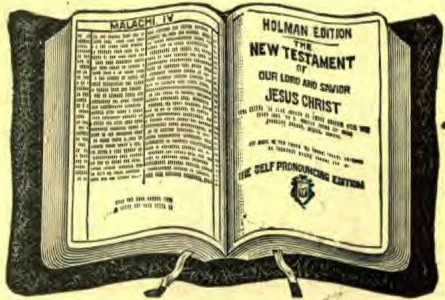
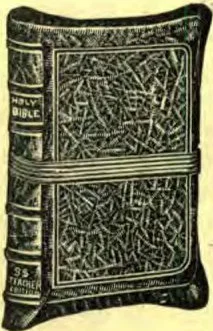
A Self-Pronouncing Teachers' Reference Bible, containing the celebrated Teachers' Helps, and comprising nearly 400 pages. Also a complete series of 15 new maps.
This beautiful book is bound in Imperial Seal Binding, Tuck Edges, known as
“Divinity Circuit,” Rounded Corners, Full Red under Gilt Edges.
We offer this Bible, postpaid, for only six new yearly subscriptions at 75 cents; or twelve new six-months' subscriptions at 40 cents.
We will also send it, postpaid, with the INSTRUCTOR one year for $2.25. For 20 cents extra we will stamp your name in gold upon the cover. Address—
THE YOUTH’S INSTRUCTOR,
BATTLE CREEK, — — — MICHIGAN.
IV—The Two Mysteries—Godliness and Wickedness
(April 26)*
MEMORY VERSE: “And to make all men see what is the fellowship of the mystery, which from the beginning of the world hath been hid in God, who created all things by Jesus Christ.” Eph. 3:9.
To Adam was the first gospel message given. Gen. 3:15. This was repeated to Abraham (Gen. 12:1–3, 7), and Christ was the promised seed. Gal. 3:16. All through the ages the hope was cherished that the Father would reveal himself to the world.
Christ’s name Emmanuel (Matt. 1:23) means “God with us,”—el, God, and emmanu, with us. When Joseph was about to die, he said, “God will surely visit you.” Gen. 50:25. This promise was kept in mind until Christ did come, and then it was said, “God hath visited his people.” Luke 1:68; 7:16. This wonderful visit by the Father to a lost world in the person of his Son is a great mystery,—the mystery of godliness it is called. 1 Tim. 3:16. It is also the secret of the ages (Rom. 16:25),—the Father manifest in our own flesh.
Every time God does any work, Satan tries to make a counterfeit of it; and so, when One was found in whom God might put his goodness,—the Son of man,—Satan found one in whom he might put his wickedness,—the man of sin. In the second chapter of 2 Thessalonians this man of sin is described. He might well be called Satan in the flesh,—he “who so exalts himself above them [gods] that he seats himself in the temple of God, and displays himself as actually being God.” 2 Thess. 2:4, a translation. We are God’s temple (2 Cor. 6:16), and here the man of sin has taken his seat as God.
The prophet Daniel also saw this man of sin, only under another name,—the little horn. Dan. 7:8. He had a man’s eyes, and a mouth speaking great things,—even “great words against the Most High.” Verse 25. But the judgment shall sit, and his dominion shall be destroyed, and the greatness of his kingdom under the whole heaven shall be given to the saints of the Most High. Verses 26 and 27.
In the time of the judgment, then, we find a controversy between the beast and his image, and the Creator, and one between the little horn, or man of sin, and the Most High. These must be one and the same controversy, for they take place at the same time, between the same parties,—God and Satan,—and the point of controversy is the same,—the dominion and law of the most high God.
It thus appears that the controversy now is over the same question as at the beginning,—who is supreme, Christ or Satan. Then, “there was war in heaven;” now, the war is on earth. Christ, in man’s flesh, has already met Satan and conquered him, and he is still to meet him and conquer him in ours. This is the mystery of godliness at war against the mystery of wickedness, and must be the principal theme of the message in Revelation 14.
Questions
To whom was the first gospel message given?
In what promise was it repeated to Abraham?
Who is this promised seed?
What does his name Emmanuel signify?
Of what promise did Joseph remind the people when he was about to die?
Who recognized the fulfillment of this when he came?
What is this revelation of God through his Son called?
What counterfeit of this revelation has Satan made?
Where is this described?
What is the one called in whom Satan has put his wickedness?
Where has he taken his seat as God?
Under what name has Daniel described this same representative of Satan?
Whose eyes had the “little horn”? Against whom did he speak?
What did he think to do concerning time and laws?
What finally becomes of his dominion and power?
At what time does this occur?
How, then, is the controversy between the “little horn” and the Most High identified with the one in Revelation 14?
What is the main point of this controversy?
With what did it begin?
Where is its warfare now taking place?
Who are engaged in this warfare?
What victory has already been gained?
What one is still before us?
What, then, is the theme of the message against the beast and his image?
Shorthand by Mail
YOUR spare time can be well improved by studying shorthand, and this can be done at small expense to you by taking a mail course at your home. We are using “The Rogers Compendium of the Graham System of Shorthand,” a method arranged especially for home study, and giving an epitome of a system of shorthand acknowledged to be the best, the briefest, and the most complete. The only presentation of Standard Phonography in which all shorthand outlines are written as first learned, thus greatly abbreviating the work on the part of the student. A complete course in thirty lessons, illustrated by facsimile notes, with key. The correction of all students’ papers given special attention by experts. Reasonable tuition rates. If interested, write for full particulars. Practicing stenographers wishing to prepare for rapid reporting work should secure the last twenty lessons.
FIRESIDE CORRESPONDENCE SCHOOL,
Battle Creek, Mich.