The Youth’s Instructor, Vol. 50, No. 16.

The Flycatchers

The Youth’s Instructor

Apr 17, 1902

Review and Herald Publishing Company · Battle Creek, Mich. · Apr 17, 1902

The Flycatchers
THE family of Flycatchers numbers among its members some very interesting birds. None of them are songsters, but they may be known by their calls. They have large heads and shoulders, and broad, flat, bristly bills. From high places on the tips of dead branches or tree-top perches, they watch for insects. As soon as they see their prey, they shoot out upon it, catch it with a snap of their hooked beaks, and instantly return to their perch to watch for still other unfortunate flies. Swallows, swifts, and nighthawks also feed upon insects, but in a different way; when feeding, they fly through the air, snapping up insects as they go. In the North, as you know, the insects disappear in the fall, and then the Flycatchers have to migrate farther South to get food. They leave the North early in the fall, and return late in the spring.
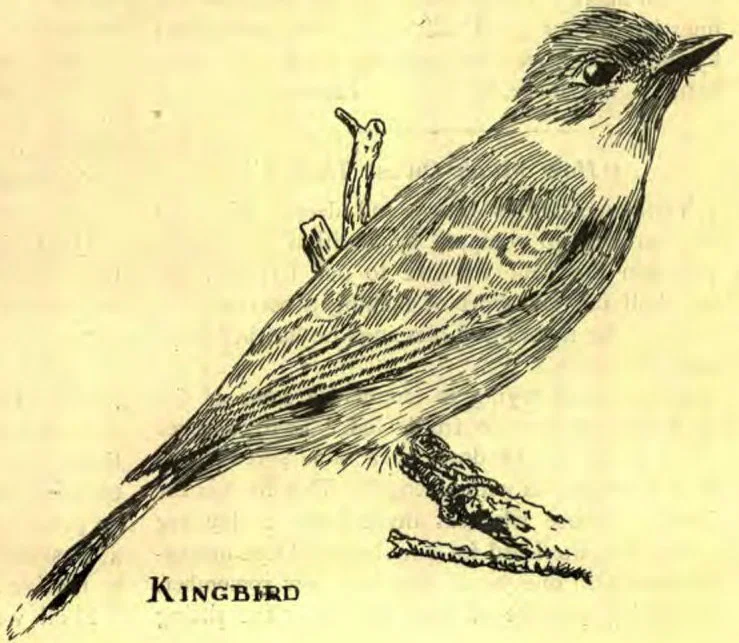
One of the best known of the Flycatchers is the Kingbird. I think most boys are acquainted with this interesting bird. He is not quite so large as the robin, brownish-black, with white breast, and white tips to his tail. If you watch him very closely, you may possibly see a small spot of orange color hidden among the dark feathers of his crest.
The Kingbird is also called the Bee-Martin because it eats some kinds of bees. Some bird students have written in quite a mournful strain regarding this seemingly bad trait, but it seems that their conclusions were somewhat mistaken. For instance, it is said that a certain bee-keeper in California saw a great many Kingbirds among his bees. Thinking the birds were eating his bees, he killed one hundred of the birds. After all this damage to the birds, he went a little further, and examined their stomachs to see if they had eaten honey-bees, when he made the astounding discovery that they had eaten only drones! The birds had been working for him all the time by killing off the drones, and now he had killed them in return for their good service. The labor of these birds had not been appreciated.
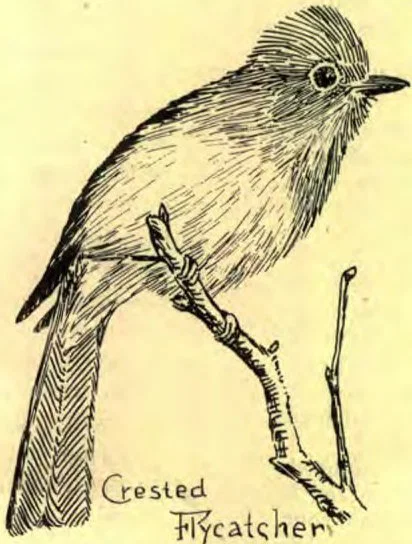
Crested Flycatcher
Crested Flycatcher
For that matter, very few appreciate the work that any of the birds do for us. But when we come to the matter of appreciation, where shall we stop? The birds are doing but a small part of the work of their Creator. Through every avenue possible, God is working for the good of his creatures; and who appreciates it? Christ Jesus came to the world on a special mission of mercy and love, and how was he received? We need not multiply instances. The sun rises on the evil and the good, and the rain is sent on the just and the unjust alike. And who is thankful?
But to return to the Kingbird. An examination made by Professor Beal of two hundred and eighteen Kingbirds' stomachs is a further demonstration of the fact that the Kingbird is not given to the eating of honey-bees. Out of this number only fourteen contained remains of bees, nearly all of which were drones, while sixty per cent of the Kingbirds' food was found to consist of injurious insects.
The Kingbird is not such a tyrant, either, as some have made him out to be. He is a good fighter in a good cause, but he is not a rowdy. Some birds are afraid of him, that is true. I remember watching some birds that were feeding on the fruit of the mulberry one day in the latter part of June. Among them were a number of our familiar small birds. Suddenly, as if by a given signal, they flew swiftly away; and as I stood wondering at their sudden flight, a Kingbird appeared, and alighted in the top of the mulberry. He made no show of fight, he did not chase any of the birds, but they always left when he came. This happened a number of times. The rose-breasted grosbeak, however, and the robin held him in no fear whatever. In fact, the robin seemed always to take pleasure in driving the Kingbird as far away as he could; the Kingbird is certainly not king of the robin.
The Kingbird is usually peaceable, and does not molest other birds unless they come about his nest; but he is very faithful to his young, and for their sakes will fight gallantly. But always and ever the Kingbird is death on the crow. During the nesting season, no crow can venture near the home of the Kingbird without paying the penalty for his lack of discretion. From his high lookout, the Kingbird darts forth at his enemy, charging at him with a fervor and fearlessness impossible for the crow or any other bird to withstand. Though the crow is much the larger, the Kingbird is fighting for home and family, and as if he realized that right is on his side, and that right through might must win. The crow soon learns that it will not do to stay,—nor even to attempt defense against the bill and wings of the Kingbird; and so, squawking, he flies away faster than he came. But the Kingbird cares nothing for his squawks; he is deaf to his cries for mercy; he has had experience with crows, and knows their treachery. On and on, without mercy, he pursues and punishes the foolish crow until the creature has learned a lesson he will not soon forget. Then back to his post comes the triumphant Kingbird, and with crest erect, and wings quivering, sounds forth his notes of victory.
The Crested Flycatcher is generally not so common as the Kingbird, and therefore not so well known. You will find him in the woods, high up in the trees, and also in old orchards. The nest is usually built in a hollow limb, and almost always among the materials of which it is made may be found a bit of cast snake-skin.
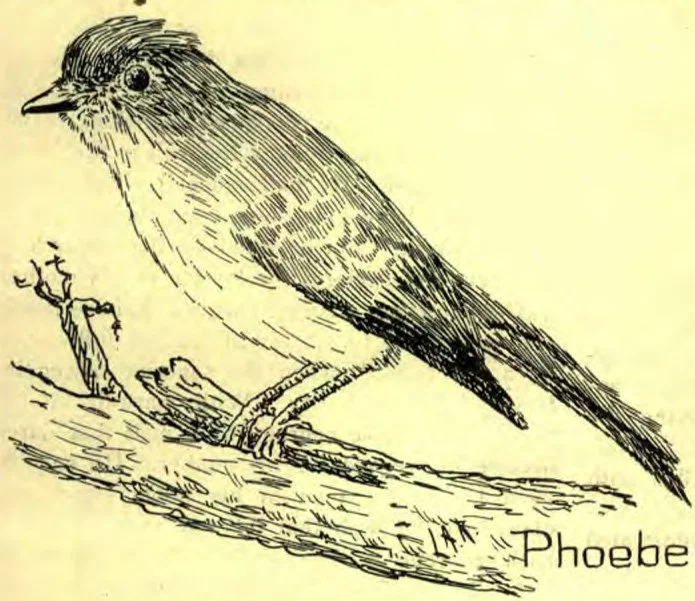
The Phoebe places its somewhat large nest, made of moss and mud, on a beam in the barn, the shed, or the piazza.
The Least Flycatcher usually builds its nest in the crotch of a fruit-tree. It is made of plant-down, fibers, and rootlets.
KINGBIRD
KINGBIRD
But these birds look somewhat alike, and how shall we know them apart? Well, first of all, you probably already know the Kingbird; anyway, he may be easily recognized by the white band on the end of his tail. The Wood Pewee is strongly marked on the wings with bands of white. Its call is somewhat longer than the Phoebe's, as, Pee-ah-we! while the Phoebe calls more shortly, Phoe-be! The Least Flycatcher calls, Che-beck! che-beck! till you tire of hearing him; and the Crested Flycatcher whistles from the treetop in the woods, Whair, whahee, whit-whit! L. A. REED.

“How Much Owest Thou?”

THIS question is broad and deep. We may try our best to compute by addition and multiplication the debt we owe to our Creator, but we shall fall far short of making a correct estimate of the favors and blessings he has bestowed upon us.
I have been trying to enumerate some of the blessings we receive from God. Two or three times a day we sit down to a table spread with food to supply us with strength. This food is the Lord’s. Those who eat three times a day are indebted to the Lord for one thousand and ninety-five meals in one year. But how few remember, when they partake of food, that they are sitting at the Lord’s table! How few bring the poor to their homes to share their blessings! Many are afraid to share with the poor that which the Lord has given them. They think that thus they would be made poor, forgetting the words, “There is that scattereth, and yet increaseth; and there is that withholdeth more than is meet, but it tendeth to poverty.”
Many who profess to be waiting for the coming of the Lord are absorbed in the things of this life. Many who are already wealthy think only of how they can obtain more wealth. They take little or no interest in the advancement of Christ’s kingdom. Dollars and cents are more to them than the souls of men. These may have earthly treasure, but in the sight of God they are poorer than the poorest. They may have houses and land and money at their disposal, but every year their soul-poverty increases. The record in the courts above shows them to be bankrupt. They may be adding to their earthly gain, but each day they are adding to their eternal loss.
A professed Christian once said, “I have been a Christian for many years, and it has cost me only twenty-five cents.” Think you that this man could expect to be a partaker in the glory of Him who gave his life for sinners? Could he look for a seat beside the One who counted not his life dear unto himself, that he might rescue the perishing? This professed Christian has been “rich in good works” to the value of twenty-five cents! Such was his estimate of the worth of redemption.
His testimony called forth from the minister the well-deserved reproof, “The Lord have mercy on you, poor, stingy soul!” And to this we say, Amen.
God tests all men. To some he intrusts riches. This he does to see if they will use earthly riches in such a way that he can bestow on them the heavenly riches. To others he sends poverty and affliction, to lead them to turn to him in trusting confidence.
Many who endure the test of poverty and sickness fail when prosperity comes to them. While they feel that they are dependent on their Heavenly Father for all they have, they preserve their purity and simplicity. But when prosperity comes to them, and they accumulate riches, they forget the Giver. They lose their trust in God. Self-confident and self-sufficient, they look upon their prosperity as the result of their own wisdom and perseverance. They forget that as their money increases, God desires them to use it in doing good.
The world says, It is of more consequence to be rich than good. And many in the church have adopted this standard, and are acting accordingly. Men who can make money are applauded. The love of money is lowering the standard of Christianity.
God’s Son was sold for money. Filled with covetousness, Judas betrayed him to the priests for thirty pieces of silver. Thus is illustrated the power of covetousness over the human heart. To-day men sell truth and righteousness for worldly gain. Covetousness has taken its abode in the hearts of professing Christians. Those who have all for which heart can wish, live for self-gratification, while the poor lie at their gates, unnoticed and unhelped.
Money is a curse unless it is used in the Master’s service. With our means and our influence we are to work for him. God forbid that we should live for self, devoting time and means to selfish interests. When Jesus comes in the clouds of heaven, he will then have no use for the money he has intrusted to us. It is now that we are to give it to him. He calls upon us to bring him our tithes and offerings now, and he promises, if we do this, to pour upon us such a blessing that there will not be room enough to receive it.
Shall we take him at his word? His claims upon us transcend every other claim. The first and best of all that we have belongs to him.
MRS. E. G. WHITE.

What Good?

How often we feel sorry for things we have said! How often we exclaim, “I'd just give anything, if I could unsay that!” There are little thoughtless, barbed arrows sticking all around in people's hearts, and in our own, too. Sometimes they work deeper and deeper, till even friendship is killed, or some one has suffered severely. And we who shoot them often spend hours lamenting over our untimely speech.
And this when just a little timely thought would have saved all the trouble. There was no real need of our saying what we did. Most of us are too much like the Irishman who thoughtlessly shot a hole through his hand with a revolver, and then thoughtfully exclaimed that he wouldn't do that if he had it to do again. Would it not be better for us to consider what kind of impression our words will make before we utter them? If we will make it a rule always to ask ourselves the question, What good will it do? and be guided by the answer, we shall save ourselves and others many a heartache. EDISON DRIVER.

A Test of Courage

In the “back blocks” of Australia, as the interior country is commonly called, lives a large family of grown-up sons with their parents. The parents became interested in the present truth, and began to observe the true Sabbath. They were able to carry most of their children with them. One young man of about twenty years still lived at home. He belonged to a company of military volunteers in the town twelve miles distant, and it was his custom to go each Sabbath to drill with his company, where he was held in high esteem. His mother said to him, “Now, my son, you understand that to-day is the Sabbath. How, then, can you go to your drill on the day God has sanctified? It is my wish and counsel that you withdraw from the company if you will be allowed to do so.”
This was a hard proposition for the young man. He had only recently joined the militia; his uniform and gun were bright and new; his associates were agreeable; the music and show were attractive,—every earthly consideration urged him not to abandon his comrades. Besides, he was sure to be laughed at for taking a position that to others would seem utterly foolish. But his resolution was quickly formed. He could not ignore the wish of his mother, nor disregard her counsel. He appeared before the captain and lieutenant, and stated his request that he might be released from his connection with the company. The lieutenant questioned him. “What is your reason for taking such a step?” he asked. Then came the test of courage. “My reason is, sir, that my mother has begun to observe the seventh day, or Saturday, as the Sabbath; and it is her desire that I should not attend drill upon that day.”
If one were to search the annals of the past, I doubt if he would find a more courageous and noble response to a question. The youth was no coward nor baby. He was a stalwart woodman, tall and manly. He had recently on two occasions plunged into deep water at the risk of his life, and saved others from drowning. He had faced hardship and danger in many ways. He was a true man. He was at an age when natural affection is frequently at a low ebb in the hearts of young men. He had reached a time when most youth have long since “cut their mother’s apron-strings.” But he stands in the presence of the men, and declares his loyalty to his mother.
The lieutenant answered with a derisive laugh, and was about to set his outlandish folly aside by a flat refusal, when the superior officer intervened his authority. With warmth he applauded the noble courage of a man that dared declare his regard for his mother. He encouraged the young man in his noble stand, and expressed the wish that there were far more of such courage in the world. With regret he ordered his release from the company.
G. C. TENNEY.

They Shall Be Filled

God’s truth is as beautiful as the flowers, and even hardened hearts will be touched by it. In every new truth that comes to us, we are only securing one more glimpse of God; and let us not forget that there are oceans of truth yet to open to us, in both physical and spiritual things. Every humble seeker for truth will be rewarded. God has no spiritual favorites; wherever, the world over, a face is turned toward heaven, God is looking into that face. For has he not declared, “Blessed are they which do hunger and thirst after righteousness: for they shall be filled”? If we are in this attitude, God would send angels to teach us, if he could find no one else. DAVID PAULSON, M. D.

The Bible

. . . HAST thou ever heard Of such a book? the author, God himself; The subject, God and man, salvation, life And death—eternal life, eternal death— Dread words, whose meaning has no end, no bounds! Most wondrous Book! bright candle of the Lord! Star of eternity! the only star By which the bark of man could navigate The sea of life, and gain the coast of bliss Securely; only star which rose on Time, And, on its dark and troubled billows, still, As generation, drifting swiftly by, Succeeded generation, threw a ray Of heaven’s own light, and to the hills of God, The eternal hills, pointed the sinner’s eye.
This Book, this holy Book, on every line Marked with the seal of high divinity; On every leaf bedewed with drops of love Divine, and with eternal heraldry And signature of God Almighty stamped From first to last,—this ray of sacred light, This lamp from off the everlasting throne, Mercy took down, and in the night of Time Stood, casting on the dark her gracious bow; And evermore beseeching men, with tears And earnest sighs, to read, believe, and live. —Robert Pollock.

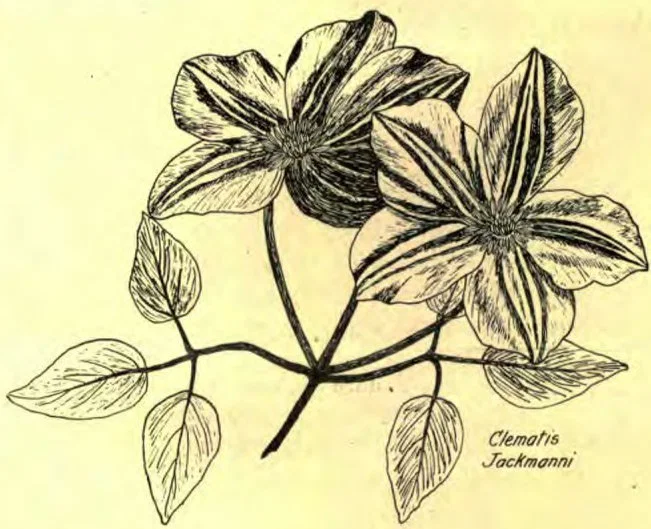
Clematis Jackmanni

THIS is perhaps the best known of the cultivated clematis, and is regarded by many as the most beautiful hardy climbing plant in cultivation. The blossoms are from four to six inches in diameter, of an intense violet-purple color, and remarkable for their rich, velvety appearance. They are produced in great profusion until the arrival of cold weather.
It is a hybrid between a cultivated species from China, which bears lavender-colored flowers from six to ten inches across, and the Vine Bower Clematis from Europe, with flowers from two to three inches across.
There are several different varieties of large-flowering clematis, the flowers being of various colors,—pure-white, creamy-white, sky-blue, purple, crimson, and red.
These vines are excellent for trellises and piazza pillars, and for covering rocks, mounds, stumps, stone walls, etc. They may be cultivated as low trailers, when this is desired, by fastening the branches to the ground.
The large, showy blossoms are often produced so abundantly that they almost completely hide the foliage during the blooming season.
A little time spent in planting some of these vines about the home premises will be well repaid by their beautiful flowers, neat foliage, and graceful habits.

Clematis Paniculata

This vine was brought from Japan, and is now becoming popular in this country. The plant derives its specific name from its mode of inflorescence; that is, the arrangement of its flowers, which are borne in large, compound clusters, something like those of oats and many of the grasses.
Flowers of Clematis paniculata
Compound flower clusters of this kind, in which the branching is apparently irregular, are known as “panicles.” As this mode of inflorescence is one of the most striking characteristics of the plant, it has been given the name “paniculata.”
The flowers bear both stamens and pistils, and for this reason are said to be perfect, these two organs being always essential to form a perfect flower. This would perhaps be as good a place as any to state the difference between a complete flower and a perfect one. When we speak of a complete flower, we mean one that has all the parts present,—calyx, corolla, stamens, and pistils. But a flower is perfect if it has stamens and pistils, even though both calyx and corolla are lacking.
Flowers of Clematis paniculata
The foliage is attractive and glossy. In August and September the vine is covered with a sheet of snow-white bloom, which gives off a delicious fragrance. The plant grows rapidly, and can be easily raised from the seed.
This vine, like the large-flowering varieties, is well worth planting about the home.
B. E. CRAWFORD.

Our National Flower

A WRITER in the March number of Our Times says that “the United States can not boast of a national flower.” Many others have said the same thing, and have advocated, in turn, the hardy goldenrod, the graceful corn, or the delicate columbine.
They forget that we already “bear the olive-branch heraldically and by law.” It was heraldry that selected the fleur-de-lis of France, the rose of England, the shamrock of Ireland, and the thistle of Scotland; and heraldry has done the same thing for us. The olive-branch is our national flower, because it has been impressed upon our coat of arms. In this matter the voice of heraldry is final. So says a man who is perhaps more deeply skilled in this subject than any other person in the United States.
Clematis Jackmanni
Clematis Jackmanni
And is not the olive a fit symbol of our country? It is one of our native trees. The ash and the lilac, belonging to the same genus, grow everywhere; so we have the olive in some form, from the Atlantic to the Pacific, and from the Lakes to the Gulf. Through the olive, men of old honored God, its oil being used in consecrating the priest and in worship. The olive-leaf is the symbol of peace, and having this meaning, and connected as it has been with the people of God from the flood to the present time, could we have any more glorious national flower?
We are one of the great peoples to whom it has been given to carry the oracles of God to far-away lands. It is fitting that the flower of peace should go with the gospel of peace as a harbinger of the coming reign of the Man of peace. Let us choose the olive in preference to all other flowers. S. ROSANA WINCE.

A Garden Study

A Suggestion from a Barren Slope

WE have a terraced garden at our home, and have been anxious to have the sloping banks covered with verdure. Upon one bank we have planted English ivy, and upon another ivy geraniums. These have done well, and have almost covered the slopes with their foliage.
Upon another bank, however, we have not done so well. A large olive-tree grows so near the slope that it draws nearly all the moisture from it, and the vines do not grow well there. Finally we thought of a vine that appears to live partly upon air,—a sort of so-called dew-, or ice-, plant. It has beautiful little radiate pink blossoms, and blooms nearly the whole year through. So we obtained some cuttings, and put them in along the top of the bank as the most likely place for them to grow. Most of the cuttings thrived well, and soon the larger part of the slope was covered with the pretty pink flowers—for the bloom is so thick that they lie almost on top of one another.
But directly opposite the large olive-tree the vines have not grown well. We think of offering a prize to one of the boys if he will get the ground well covered with vines before summer; for we feel sure that if they get a good start, they will grow, and soon cover the slope.
God has also a barren slope that he is anxious to have covered with vines. It is, however, in a fruitful hill, and is “barren” only because no one has planted it with vines. In this hill God has planted a choice vine. He says to us: I have put you into my vineyard, to dress it and to keep it. Gather out the stones. Take of the cuttings of the vine, and plant them in every unoccupied space. Plant them carefully. Care tenderly for the young shoots. Water abundantly. Prune judiciously. Keep the branches clean, that they bear much fruit. When you have planted and covered the hill with vines, and the fruit is ripe, I will come again to receive the fruit. My reward is with me, which I will give to the faithful worker.
If I said to my boy, “I will give you two dollars if you will get the ground of that slope covered with vines before the close of summer,” how faithfully he would work! How anxiously he would watch for every place where he could put in a cutting; how regularly he would water, how carefully protect from heat, and cover from frost, and fence from heedless foot or hoof, until he rejoiced in his completed work, and the reception of the promised reward!
Why, then, do we not go about God’s work with the same earnestness and fidelity? The work is definite,—“This gospel of the kingdom shall be preached in all the world, for a witness unto all nations; then shall the end come.” The reward is abundant and sure. Let us all take hold with earnestness to cover God’s waste places with the goodly vine speedily. E. L. PAULDING.

Giving of Thanks

WITHIN a mighty fane, where music rose In pealing praise from grateful lips and heart To bless the Giver at the harvest-close, One knelt beside a carven shaft, apart.
“Dear Lord,” he said, “they come to worship thee For gifts of garnered corn and coffered gold. Another praise hast thou appointed me. To bless thee for the good thy hands withhold.
“They praise thee that their ships have sailed the seas, And come again with wealth for house and mart; I thank thee, O my Father!—not as these,— For loss and wreck that swept me to thy heart.
“They praise thee for their ease by night and day, The goodly heritage their eyes may see; I for the idols crushed and torn away, The death of hopes that held my heart from thee.
“Well may they praise thy name for peace and pelf, Thy plenteous answer given when they cried. But, thou whose hand has saved me from myself, I bless thee for the prayers thy love denied!”
—Mabel Earle.

“By Their Fruits Ye Shall Know Them”

We may keep our plants in full control Throughout the summer of our soul; But how will it be when the fierce blasts blow? Will the winds of winter lay them low? Contentment, patience, long-suffering; Wisdom and knowledge that no doubt bring; Temperance, steadfastness, hope,—these three; Mercy, justice, and purity; Honor, which is but truth’s own breath; Faith that is stronger than life or death; Meekness, gentleness, charity, The love that is to all joy the key; Godliness, reverence, trust, and peace, And the grace whose beauty never shall cease;— All these plants in our garden of life We must nurture through storm and strife, Nurture and watch with tenderest care, That heavenly fruit each one shall bear. —Selected.

A Letter from India

THE following interesting letter has been received from one of the schools in India to which a small club of INSTRUCTORS is sent from week to week. We are sure our readers will be glad to learn how much the papers are appreciated:—
“ZENANA TRAINING HOME,
“2 PHAYSE ROAD,
“POONA, Feb. 14, 1902.
“To the Editor of the Youth’s Instructor:
“DEAR FRIEND: I do not know you, but I make bold myself to write to you a few lines. I thank you for the YOUTH’S INSTRUCTOR you so kindly send for my school. It is very interesting and instructive. The girls who know English read the papers. They like them very much.
“I have a home to train girls for Christian work. Most of them are famine girls. Praise the Lord, they are getting on nicely with their studies, and growing in grace. Except a few, all the girls are converted. They all take great interest in the Bible. Now I have about sixty girls, and the Lord supplies all our needs. I shall send the report of this home. From that you will learn about this work, and something about the women of India, and what they suffer.
“This is a new work, and very few people know anything about it. Please remember me and my work when you kneel before the throne of grace. The Lord is with me. Glory be to his name.
“Yours in Jesus,
“SOONDERBAI H. POWAR.”
The little pamphlet mentioned sets forth the condition of the poor girls of India in a way to touch every heart. Much that they suffer can not be told; and when we think of them as a whole, it would seem almost an impossibility to bring happiness and sunshine and hope into their lives; but there are many earnest-hearted men and women working faithfully in that land to bring about these very results. And something is being accomplished. Much remains to be done; and those who can not go themselves into this great harvest-field, may yet have a part in the work by helping with their money, with their influence, and with their prayers.
Continue reading: Young People's Society of Christian Workers