I. WHAT was man's condition when created? Eccl. 7:29.
2. When man sinned, what did he lose?—The power of self-control, the fear and love of God, and love toward his neighbor; in other words, he became selfish. (See note .)
3. What striking illustration of this lack of self-control do we have soon after the fall?—The murder of Abel. Gen. 4:1–8.
4. Since man refused to obey God, and therefore to respect the rights of his neighbor, what became necessary?—Civil government. (See note .)
5. What is the character of the work which the rulers of civil governments are to perform? Rom. 13:3, first clause; verse 4, last clause; 1 Peter 2:13, 14.
8. Even though it be used against God's people, is it still from him? John 19:10, 11.
9. May such power be resisted with impunity? Rom. 13:2.
10. For whom were earthly governments ordained?—For those who have not the principle in them to govern themselves,—the principle of love. Rom. 13:3, 4.
It is divine, eternal, and absolutely true. Ps. 119:142.
As one has said, “Let us own its supremacy, bow to its authority, confess its sufficiency, cling to its integrity, walk in its light, expect every prophecy, obey every precept, cherish every promise, heed every warning, believe every fact, and be what it demands.”
MARY KEELE.
TOO LITTLE AND TOO BIG.
To-day I asked my mama if I could whittle:
Yes, I did.
"Oh no, my girlie," said she; "you're too little;"
So she did.
But Tom stepped so hard right on my toe,
I cried, I did.
She said, "Oh, you're too big a girl to cry out
so!"
That's what she did.
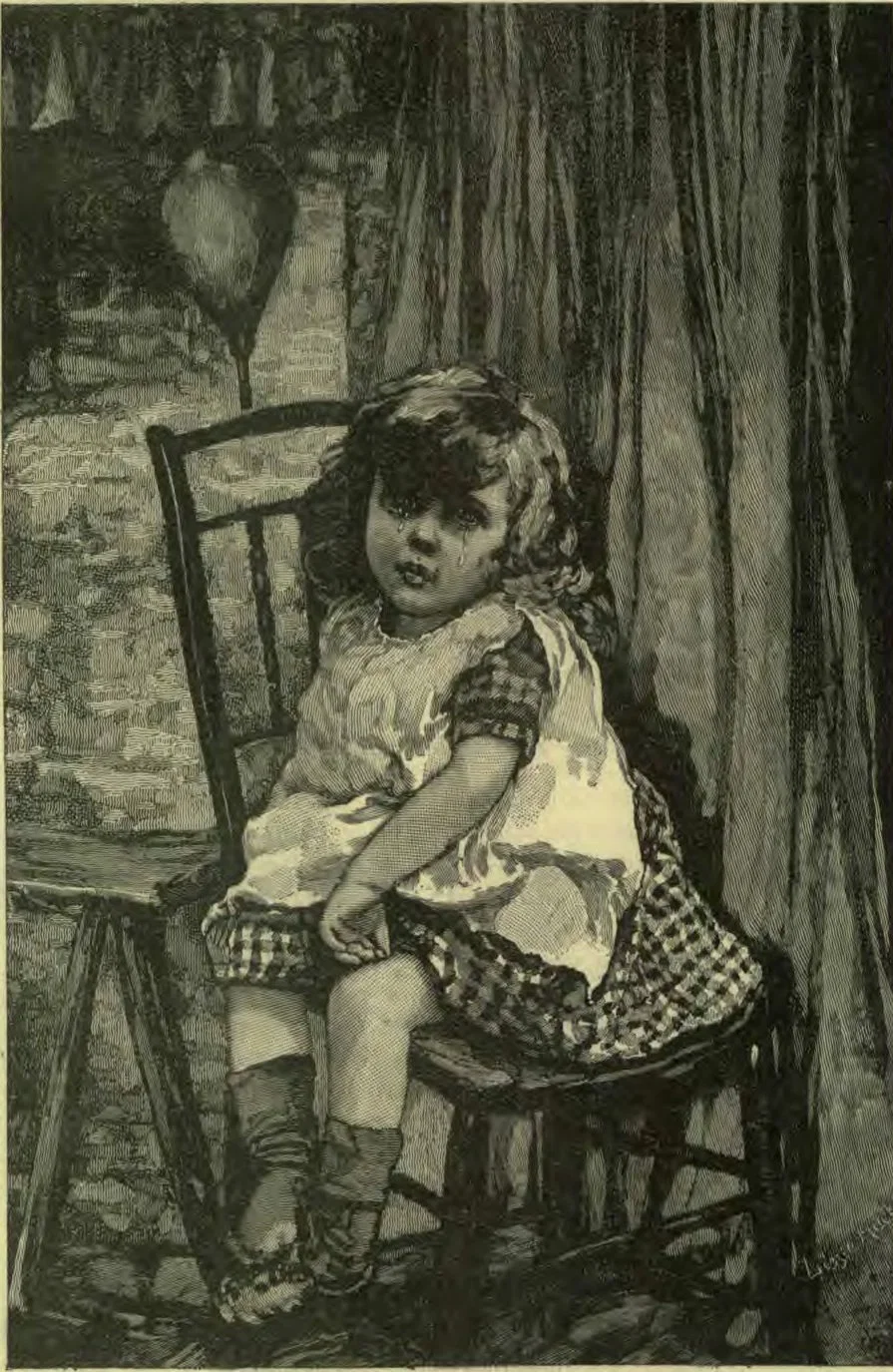
“WHY CAN'T I CRY, IF I AM LITTLE?”
Why can't I cry, if I am little?
Or, if I'm big, why can't I whittle?
—Selected.
WORKING FOR LOVE.
“Fred! I say, Fred, where are you? Why, here you are!” exclaimed Jack Tower to his cousin Fred Waters, as he put his head through the half-opened door of the dining-room. “Taking tacks out of that matting! Well, I never! I thought you were to be ready to start at nine prompt. It’s a glorious morning; thermometer only ten above; the ice hasn’t a flaw, and the skating’s superb.”
“I don’t believe I can go, Jack. Pipes froze up last night, and the plumbers are to be here at eleven.”
“I don’t see what they have to do with you. Why doesn’t your mother get old Pete to do that kind of work? He’s always wanting a job.”
“Pete’s laid up with the rheumatism this week.”
“Let one of the servants do it, then.”
“This is their busy day, mother says, and they’ve got too much to do.”
“Well, if I were you, I’d just skip. Somebody would find time to do it.”
“Yes,” answered Fred; “somebody would, I suppose; but if I don’t take this matting up, mother will. It’s got to be done, and it’s too hard for her hands. These tacks were put in for keeps. My hands are stronger than hers.”
“Well, I can’t waste time talking,” said Jack. “If you like skinning your fingers better than skating, all right for you; but you’re a goose, all the same.”
Fred hesitated. Should he go with Jack? Could any boy honestly say that he liked to dig rusty double-pointed nails out of half-worn matting? and the floor was cold, too, and his fingers were not only getting rough and scratched, but were stiff in the bargain. It was only for a moment. If it was hard work for him, what would it be for his mother?
“No, Jack; I can’t go. Perhaps I’ll get to the pond before lunch-time. Don’t wait.”
“All right. Good-by,” and Jack slammed the street door as he ran off.
Fred took up the tack-lifter slowly, and went down on his knees again; and as he worked with his fingers, his mind worked busily, too.
Yes, it was a shame to ask him to do that work. If he could just lift the tacks around the door where the water-pipes were, it wouldn’t be so much; that wouldn’t take so long. But to go over the entire floor, so the matting could be changed around, that was unreasonable. No! it wasn’t unreasonable; for if the matting was changed around, it would last six months longer; and instead of buying a new one in a little while, mother could get the muff she had been wanting so long. That’s what she had said at the breakfast table. And, besides, he had offered to do the work himself; he hadn’t been asked. Wasn’t his birthday last week, and wasn’t he thirteen years old,—just as old as his father had been when he began to work in a store to earn his own living? That would be tough, to have to get out of bed mornings at half-past five, and go off down town to sweep offices and make fires. No; lifting tacks wasn’t so bad, and the floor wasn’t so cold; and did any one ever have a better mother than his mother was?
By the time the plumbers appeared with their bag of tools, the matting was rolled up into five compact rolls, and the floor was ready to be swept.
“Now then, mother, I’m off skating, if you don’t mind. My work’s done,” called Fred upstairs to his mother. “I’ll help put that matting down after lunch, if you want me to.”
“You’re a darling, Fred. I don’t know what I’d do without my helper. It was too bad to take so much of your morning.”
“Never mind that, mother. What’s the use of having a boy if he can’t help a little now and then?”
When Fred reached the pond, Jack was about starting for home.
“So you’re here at last, are you? I don’t know but you’re soon enough, too. The wind’s been blowing a perfect gale. I’ve got to go home to thaw out; and you’ve got a nice little sum in your pocket, too, I suppose.”
“What do you mean?” asked Fred.
“Why, of course aunt paid you for your morning’s work, didn’t she?”
“Jack Tower,” said Fred, his face reddening even under his rosy cheeks and ears, “I wasn’t working for money. I did it for”—
Just then a gust of wind nearly swept the two boys off their feet, and the last word of Fred’s sentence flew so far away no one could catch it. What was it?—“pleasure,” “duty,” or “love”?—Sunday-School Times.
THREE LITTLE-GIRL LETTERS—2.
By Ella White
My first letter closed just as our party were gathered on deck taking a last look at land.
Before leaving the wharf we took a walk through the boat. It had three decks and four masts; one on either end deck, and two on the middle deck. It was very seldom that the sails were up, but when they were, we went much faster. Between the two center masts were two large red smokestacks. The first-class cabins were very nice; but we did not see much of these, as our abode was toward the back part of the boat, among the second-class cabins. Mabel and I did not enjoy our stay there; so we spent most of the daytime on deck.
When we started, we were quite determined not to be seasick; but before we had lost sight of land, most of our party began to lean over the side of the ship in a very suspicious way. We made an early retreat to our cabins; but the next morning found us again on deck.
Promptly at seven o'clock the rising-bell rang, and at eight we had breakfast.
The dining-saloon contained four long tables. Only two of these were used, at which from thirty-eight to forty-five passengers were usually seated. As for the food, those who provide a supply before starting will find themselves the best provided for. Fruit is not furnished to second-class passengers, and on the ship it cannot be bought at any price. Dinner was served at one o'clock, tea at five, and supper, consisting of bread and cheese, at nine. Of the latter meal, however, we had no need.
I don't like traveling by sea as well as by land. We longed to set our feet on something that would stand still. We tramped about the deck for exercise, sometimes clutching at whatever was nearest to hold ourselves as the ship rolled. For a few days our minds were taken up by seeing the many new and strange335things about the ship; but soon the novelty wore off. Then, day after day, how tiresome it did seem out there in the ocean, with little to look upon outside of the ship but a vast expanse of blue sea! Yet it was pleasant to see the water sometimes almost as smooth as glass, rising and falling in gentle swells, and again covered with whitecaps as the wind swept over it. Then there were the sunrise and sunset, and at evening the changing stars, and the beautiful phosphorescent light, which made a shining track in the wake of our ship, far across the water to the horizon. A day or two before reaching Honolulu we caught sight of a few flying fish. They are beautiful little creatures. As they rise out of the water, their little wings glisten in the sunshine as if covered with silver.
Then one morning we awoke in sight of land, and oh, what a glad sight that was! As we drew near, we could see the palm-trees, with little cottages among them. After a while we saw the city of Honolulu, surrounded with green trees, and with a background of hills. It was a lovely scene, and was something as I had always pictured Palestine to be.
As we neared the shore, many native boys swam around the boat, calling for nickels and dimes. The passengers would throw them a small coin, and all would dive for it; and the one who caught it, would hold it up in triumph, and then put it in his mouth and call for more. It was laughable to see them. When a piece of money was thrown, there was a great splash, and half a dozen black feet were the only things visible on the top of the water; then these disappeared, and just as we began to fear that the owners were drowned, we would see their heads pop up, and they would call for more money.
The boat stayed here only about three hours. We went on shore, and rode a little way out of the city to visit a lady who was acquainted with our grandma. Her home was a large one-story cottage, with broad veranda, surrounded by a wide, grassy lawn shaded with palm-trees. We were most hospitably entertained, and greatly enjoyed our visit and a breakfast on land. Some of the passengers who went on shore saw the ex-queen sitting in the window of her vine-covered house. She seems comfortably situated, although deprived of the throne.
The journey between Honolulu and Samoa occupied seven days. During this week we crossed the equator, passing from the northern to the southern hemisphere. We watched the great dipper sink lower and lower, until it was just visible above the horizon. The only companions of the ship were sea-gulls and flying fish, the latter sometimes seen in schools of forty or fifty. We watched quite closely for whales, but saw none.
At Samoa we had our first sight of a coral island. We stopped off the town of Apia, but our boat could not touch at the land, because the island is surrounded by a coral reef. From the strip of low land along the shore, covered with palms, the island rises until it is quite mountainous in the center, all covered with trees, which were beautifully green. As soon as the steamer was near land, we saw the little native canoes coming toward us from all parts of the shore. These canoes are made of the trunks of trees split lengthwise and hollowed out. Most of them were paddled by the natives, but a few had sails. To the back end of each canoe was attached a wide piece of board, from four to six feet long. This was the outrigger. It lay flat on the top of the water, and served to keep the canoe from upsetting. The canoes were loaded with fruit—oranges , bananas, pineapples, cocoanuts, lemons, and limes—together with coral and shells. These were drawn up in baskets on to the deck, and the sellers climbed up on a rope. Then business began. A basket of oranges—five or six dozen—sold for twenty-four cents; bananas, at about two cents a dozen.
The natives wear very little clothing, and in their warm climate they need but little. The men wear a garment something like a short skirt or wide sash, reaching almost to the knees. The women were nearly all arrayed in “Mother Hubbard” gowns. Many men, women, and children had their hair plastered over with lime, and at a distance they looked as if they had white caps on. They use the lime to bleach their hair, turning it from black or brown to an ugly red.
Our boat stayed three hours at Samoa, as at Honolulu, but we did not go ashore. Then the whistle sounded as a signal for departure, and the natives scrambled down into the canoes, and paddled off for the shore.
All the way from San Francisco we had a smooth passage, and our steamer made from one hundred and fourteen to one hundred and forty miles a day. On the Monday after leaving Samoa we crossed the day line, and had both Monday and Tuesday in twenty-four hours.
Five days from Samoa brought us into the beautiful harbor of Auckland. As we looked on the shores of New Zealand, we missed the rich luxuriance of the tropics, but the landscape seemed more like home. Now we have parted with our good old friend, the north star, and in its stead welcomed the southern cross. A few more days will bring us to our southern home.
ELLA WHITE.
Family Pride.
The following story is told of the visit of Albert Edward, Prince of Wales, to the West when he was a lad: The royal party of tourists were entertained by Mr. Blank on his ranch. He was naturally anxious that they should fully enjoy the sport of the neighborhood. A fishing excursion was arranged for one day, and a gruff old farmer promised that his nephew would provide bait for “the Englishman,” of whose rank he was ignorant.
Mr. Blank, it is said, sent for him the previous evening, and anxiously inquired:—
“Has your nephew brought the bait?”
“No.”
“We want it by daylight.”
“You’ll hev it,” calmly replied the old man.
“This is a matter of great importance. Are you sure that we shall have it?”
“Did n’t Jabez give you his word?”
“But how do I know he’ll keep it?” said the uneasy host.
“How do ye know?” said the farmer, sternly. “Because he’s a Pratt. None of the Pratts ever was known to tell a lie, an’ I reckon Jabez is n’t a-goin’ to break the record,” and he tramped off.
“You must pardon the old man, your Grace,” Mr. Blank said, turning to the Duke of Newcastle, who was standing near by. “He does not know who you are.”
“Pardon him? I call that very fine! Why should not the Pratts be proud of their honest blood, as well as the Pelham-Clintons?”—his own family.
The daylight brought Jabez and the bait.
In one of the noble houses of England a delicate glass vase, call the “Luck of Edenhall,” has been preserved with scrupulous care for centuries in consequence of a legend that when it is broken, the family to which it belongs will perish also from among men.
If every American family cherished, like the Pratts, a faith in the truth, or honesty, or piety of their ancestors, with a resolve, like Jabez, “never to break the record,” what a lightening and uplifting of our social life would follow! No useful or really sensible purpose is served by burrowing into family history to find chain-clocks or bits of ancient plate. It is far better to search for some virtue of our forefathers,—stern or gracious,—and then to strive to make it our “Luck of Edenhall,” and to hand it down unbroken to the generation which will come after us.
That is the true family pride, which the day-laborer may share with the duke.—Youth’s Companion.
BILLY’S “TATERS.”
“BILLY,” said Mr. Holt one day when I was at the farm, “why don’t you go to work on that little patch of potatoes?”
“Oh,” whined Billy, “there’s so many of them ’taters, I’ll never get them hoed.”
“You won’t if you don’t begin soon.”
“I hate to begin.”
“How are you ever going to do the work, if you don’t begin?”
“Well, I’ll begin pretty soon.”
His father walked away, and I heard Billy exclaim in a tone indicating great mental distress: “Plague on them old ’taters! It makes me sick to think about them!”
“Why do you think about them, then?” I said, laughingly.
“I’ve got to,” he replied, dolefully, with a sorrowful shake of the head. “I’ve been thinking about them ever since I got up this morning.”
“How long, now, Billy, will it really take you to hoe them?”
“Well, at least an hour.”
“And you’ve been distressed about it ever since you got up?”
“Well, I hate to hoe ’taters.”
“And you’ve been up a little more than five hours?”
“Well, I—I”— Billy began to grin, took up his hoe, and said: “I never thought of that!”
And the potatoes were hoed in just forty minutes.—Exchange.
“HOME, SWEET HOME.”
A GREAT singer had just finished singing “Home, Sweet Home,” and many of the audience were in tears.
“It is a beautiful song,” said a girl to an older woman, who sat next to her.
“Yes,” was the reply, “and the sentiment to which it moves all these people is beautiful. How much happier the world would be if every one had as much principle as sentiment on the subject, and followed out a plain, every-day rule of making home sweet!”
The girl turned thoughtfully away. She hardly heard the next song. She was acknowledging to herself that, in spite of her love for her home, she made it unhappy every day of her life by her wilfulness and quick temper. How many of us really do our best to make home happy?—Selected.
Counting Our Mercies Amid Trials
“TRY to count your mercies, and many of your troubles will be rubbed out.”
A Lie Trembles When Truth Draws Near
“A LIE trembles all over whenever it discovers that truth is on its track.”
The First Artesian Wells.
The first of these is at Grenelle, near Paris. This well was commenced in 1834, to supply the French capital with water. When a depth of twelve hundred and fifty-four feet had been reached, a length of two hundred and seventy feet of the boring rods broke off, and fell to the bottom of the hole. Nowadays, the laborious rod process is quite obsolete. Fifteen months were taken up in fishing up the broken rods, and then work was resumed. When the boring was carried down to fifteen hundred feet, the French government wished to stop the work, on the ground that further expense was simply throwing good money after bad.
The savant Arago, however, urged them to exercise a little more faith and patience. His advice was followed, with the result that, at a further depth of three hundred feet, water was encountered, and those who had labored at the enterprise from 1834 to 1841 were rewarded by seeing a stream of six hundred gallons a minute escape from the orifice of the well.
In 1855 another well was commenced in the Paris basin. Water was tapped at a depth of nineteen hundred and twenty feet, and this enormous boring, which is six feet four inches in diameter at the bottom, ejected a stream of water to a height of fifty feet at the enormous rate of five million five hundred thousand gallons a day.—Chambers's Journal.
THE TEST.
By Fannie Bolton
He that is faithful in the least
Is faithful in the much.
I'll know thee servant, king, or priest
By look, or word, or touch.
One line, O poet, tells thy verse;
Thou need'st not read the lay.
Let chord be struck, if string be terse
The music lasts alway.
Judgment is not so intricate;
The skilled hand knows the grain,
And just one touch will intimate
What is for loss or gain.
One test will try the heart, and then
Destiny's known above.
If warm your heart is toward all men,
You're like to God in love.
If in the heap one crystal shine,
One gem from midst the dross,
Title it is to crown divine;
For Christ is in thy cross.
The pearl in oyster's shell is proof
That life is not in vain;
Some gracious essence comes to smooth
The keenest edge of pain.
Only be faithful in the least,
And when the test shall touch,
Thou shalt be crowned as king and priest,
And faithful found in much.
FANNIE BOLTON.
TWO PAIRS OF FETTERS.
More than eighty years ago a fierce war raged in India between the English and Tippoo Sahib. On one occasion several English officers were taken prisoners; among them was one man named Baird. One day a native officer brought in fetters to be put on each one of the prisoners, the wounded not excepted. Baird had been severely wounded, and was suffering from pain and weakness.
One of the prisoners, a gray-haired officer, said to the native official, “You surely do not think of putting chains upon that wounded man?”
“There are just as many pairs of fetters as there are captives,” was the answer, “and every pair must be used. Those are my orders.”
“Then,” said the noble officer, “put two pairs upon me. I will wear his as well as my own.”
The native looked surprised at such an exhibition of generous self-sacrifice, but it was done. Strange to say, Baird lived to regain this freedom, and lead in the capture of that very city; but his noble friend died in prison.
Up to his death he wore two pairs of fetters. Having taken upon himself the double punishment, he endured it till death.
Is not this a beautiful illustration of our golden text? Our Saviour, Jesus Christ, took upon himself the punishment for the sins of the whole world. Through him we are freed from the thraldom and consequences of our transgressions.—Exchange.
IRON IN FOOD.
PROFESSOR BUNGE, in the course of a paper on iron as a medicine, read before the German Congress of Internal Medicine, has been ventilating some ideas which are as much matter of general science (and therefore extremely important) as they are details connected with the physician’s domain. He is strong on the point that iron should reach our blood through the medium of our food, rather than through the druggist’s specialties. Iron, as everybody knows, is a food element absolutely essential for the proper constitution of the body. It is as rigidly demanded by the plant as by the animal; and it is from plants that Professor Bunge shows we should chiefly receive our iron supply. Spinach, he tells us, is richer in iron than is the yolk of eggs, while the yolk contains more iron than does beef. Then succeed apples, lentils, strawberries, white beans, peas, potatoes, and wheat, these substances being given in the order in which they stand as regards the plentifulness of their iron constituents. Cow’s milk is poor in iron; but, as balancing this deficiency in the food of the young mammal, it is found that the blood of the youthful quadruped contains much more iron than the adult. Thus, in a young rabbit or guinea-pig one hour old, four times as much iron was found as occurs in these animals two and a half months old. These are interesting facts, showing that nature probably draws on the original store of iron in the young animal for its nutrition during its milk-fed period.—Scientific American.
THE BEST HE COULD DO.
The Telegraph Age tells how a telegraph editor in a Boston newspaper office wrote a note of remonstrance to the telegraph operator, because the latter in his copy had entirely omitted the letters “f” and “k” where they should have appeared. The operator replied to this note as follows:—
“MR. EDITOR: Mistaques are liable to happen in the best ov regulated phamilies, and to typewriters as well. It is, indeed, a very unphortunate aphair, but the ‘eph’ and ‘cay’ phell out, and are lost. This morning I called at the ophice ov the gentleman phrom whom I rent this outphit, but phailed to phind him in; in phact, the ‘ophice cid’ says he will not return phor phour or phive days. I do not lique the loox ov this variety ov spelling my-selph, but will get the specials aphter a phashion. I, myself, consider this no joque, but a serious aphair. Phaithphully yours.”