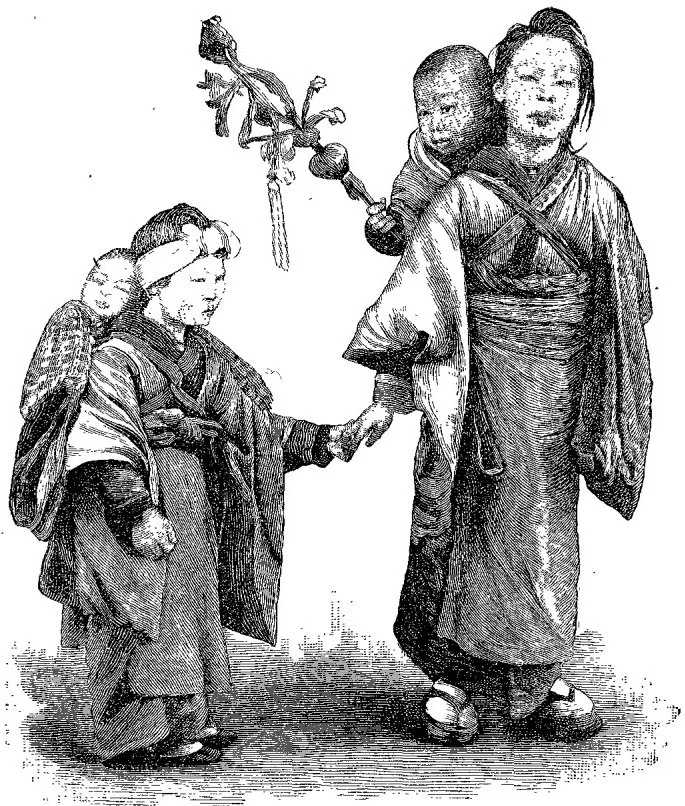
The Sabbath-school contributions for this quarter are to go to spread the gospel in Japan, where Brother Grainger has already been sent to begin the work. Now the more we know of a people, the more interest we take in them; and our willingness to help them is directly commensurate with our knowledge of, and interest in, them. I believe that the boys and girls who read the REVIEW will be willing to make sacrifices in order to give their pennies and dimes to help send the gospel to Japan, when I tell them how much the people there need it. I will first tell something about the little girls in Japan, and at some future time I may write something about the boys.
When girl babies come into the homes in Japan, they are far more welcome than they are in China, where they are sometimes killed because they are not wanted. As soon as the friends of the family learn that a baby has arrived, they all pay it a visit. Each one carries a present, such as toys, cotton or silk to make it dresses, and many other things that the little one cannot appreciate or understand. When the child is seven days old, she receives her name, and the family eat rice cooked with red beans to bring her good luck. Children are not given the names of living members of the family in Japan; but the little girls are named from beautiful objects in nature, such as snow, sunshine, flowers, etc.
When the infant is a month old, she is taken to the temple to be dedicated to a god. Great preparations are made for this visit. She is dressed in the finest silk, with a pattern of gaily colored flowers all over it. The god to whom she is consecrated is chosen from a long list of gods that are worshiped in Japan. It is supposed that after she is placed under his protection, he will take special care of her; but her subsequent history often proves how mistaken this idea is. In order to induce the god to do his duty well, and to obtain the blessing of the officiating priest, the parents make offerings to both.
THE “LITTLE MOTHERS” OF JAPAN.
At an early age the baby is strapped upon the back of a nurse or an older member of the family. It is not uncommon to see a little girl, seemingly but a little larger than the one upon her back, hopping about in a lively fashion, with the head of the baby bobbing up and down with every movement, till one almost expects that it will be shaken quite off. But no such accident ever happens, and the babies seem to flourish and grow hardy. They live much in the open air, bareheaded in sunshine and rain alike, going wherever the older children choose to play.
Many of the little ones in Japan suffer from lack of suitable food; for their mothers do not understand feeding them properly. I visited a woman one day whose little three-year-old girl was sick, and found her coaxing the child to eat hard rice cakes and raw fish. On one occasion our own little daughter's Japanese nurse told me that the Japanese mothers had been asking her what we fed our baby. They thought that it must be very fine food for children, as she was unusually large and strong; and they wanted to get some like it for their own little ones. She told them that we fed her condensed milk. Not long after that, one of the women came to her and said that her baby seemed to have some difficulty in swallowing the food that she told her about. The nurse questioned her, and found that she did not understand diluting the milk, and had been trying to feed the milk, just as it came from the can, to an infant only a few days old! You can see the need of instructing these mothers even in the bodily care of their little ones.
The natives of Japan have no chairs or furniture in their homes, and when the baby is taught to sit alone, she is placed on the floor, but not with her limbs straight in front of her, as is the custom with us. Her limbs are bent under her, and she sits upon them. The floor is covered with a soft matting, which is kept clean and neat, for shoes are never worn in the house, but are always left at the door. It is not so much trouble to remove one's shoes in Japan as it is in this country; for those worn there are quite different from ours. They consist of oblong blocks of wood, hollowed out beneath, and held on the foot by a thong that passes between the toes. These shoes look quite awkward, and produce a very ungainly carriage, but they possess the advantage of never cramping the feet. When the children outgrow their clogs, their heels stick out over the back, and the feet do not suffer. Their toes become quite prehensile as a result of grasping the thongs, and one often sees workmen in Japan using their toes to help them with their work, where the assistance of another man would be required in this country.
After the little girl has emerged from babyhood, she finds that there are many things for her to learn, some of which are by no means pleasant. She discovers, among other things, that, being a girl, she can have but little independence. If she is possessed of a strong will, she must surrender the exercise of it, and always obey the older members of her family, especially the male portion of it, even in matters pertaining to things of very little consequence. She must learn, above all things else, to be obedient and polite,—two very excellent qualities if not carried too far in the wrong direction, as is often the case with her. She must always seem cheerful, and be pleasant to others, no matter how much her own heart may ache. This idea is carried so far that a Japanese will sometimes tell you that his mother has just died, and break into a merry laugh, not because he doesn't grieve at the death of his mother, but it would not be polite to make you feel bad by seeing him display sorrow. Self-control is the great lesson that is inculcated from earliest years. The little girl must learn to suppress all emotions except such as will be pleasing to others. The result of this training is seen in the gentle, dignified, attractive women of Japan. Members of a Japanese household are extremely polite to one another. One never sees such demonstrations of affection as kissing or embracing between members of families. Even after a prolonged absence, they greet one another with the most formal bows, accompanied by courteous speeches in regard to their mutual welfare.
The little girls are taught to sew, cook, and serve food. They do not use sewing-machines in making their garments, but simply baste them together. When they are washed, they are ripped apart, and spread upon boards to dry. They need no further ironing. Besides these necessary accomplishments, the girls are now often sent to school, and become quite well versed in literature.
When the child becomes a woman, she finds that instead of being allowed more freedom, the restraints become much stricter, and that she is little more than a puppet in the hands of others. When she reaches the age of sixteen, her parents expect her to marry some young man of their selection. One who is a friend of the family is consulted in reference to the matter, and she immediately begins to canvass among her acquaintances for a suitable young man who wishes a wife. When she finds one that she thinks will do, she reports to the maiden's parents. Should the parents be pleased with her selection, the young lady is informed of it, and arrangements are made for a meeting at the home of the go-between. If the young man likes the girl, he signifies it to the go-between; and if no objections are raised, they are married, and go to housekeeping at the home of the groom's parents.
Fitting Exercise to the Individual Case
“EXERCISE should be fitted to the individual case. One whose employment includes a certain amount of manual labor should supplement this by special attention to the muscles neglected in his daily duties. A farmer, much of whose work requires stooping and bending, might gain restful recreation in a light exercise which would develop the muscles of the chest and expand the lungs. A scientific authority on physical development has recently given his ideal of a theory for perfect physical condition as follows: ‘Exercise moderately and temperately for a short time at the same relative hour every day of your life.’”
WHAT IS MISSIONARY WORK?
By G. C. T.
Missionary work consists of doing something for humanity, either individually or collectively, in the name of, and for the sake of, Jesus. The true missionary is the messenger of Christ, sent to minister to his fellow beings. Every Christian is, therefore, a missionary. Missionary work is as varied as are the wants of our suffering race. Wherever sin has left its foul taint, wherever suffering, or weakness, or distress has followed as the result of sin, there the Christian is to go with the gospel of salvation and help.
It is emphatically true of us as a people that we are called to be missionaries, or ministers of the grace of Christ, because a great crisis is approaching, and a special work of preparation must be made to meet it. We feel it to be incumbent upon us to make known to all men the duties and dangers that pertain to this hour. For this purpose we have established extensive publishing institutions, we have organized and equipped our various societies, and have sent forth trained workers who are doing what they can for the propagation of our faith in the commandments of God and the faith of Jesus. We rejoice in the success of this work, and scan the reports of the laborers with interest. We cherish the statistics of our growth and development, only wishing that they were much larger, and to this end urge on our energies.
Under certain conditions this is a very laudable work, and the ambition which inspires it is commendable. Under other conditions, it may become altogether unprofitable and unchristian. Making proselytes to our peculiar doctrines with the sole or principal aim of swelling the ranks of nominal Seventh-day Adventists, is not the work to which Christ has sent his servants. People may nominally and even intelligently receive theoretical truth or adopt outward practices, without receiving the work of divine grace that is necessary to make them true disciples of Jesus. And when people thus embrace the truth, they are liable to be self-deceived as to their real standing before God. But sinners in a Seventh-day Adventist church are not intrinsically different from other sinners, nor are they one whit better, nor do they stand any more secure than as though they were under the banner of the enemy.
The liability of many to accept the doctrines we teach simply through the persuasion or conviction of the mind, under the force of Scriptural teaching and logical reasoning, is something of which the godly worker should always beware. Nor should these children of faith be forbidden to come. But how many, many sad experiences have testified to the folly of bringing together a company of people who have accepted present truth through polemic discussion, by the force of argument and evidence, forming them into a church, and then leaving them to carry forward the work in the same spirit in which they have received it! Argumentation, discussion, strife, and desolation are the various steps that have marked the brief histories of such churches. Perhaps after a few years a few souls who had previously been converted to Jesus Christ were all who remained.
Every unsaved sinner needs most of all to know Jesus as a personal Saviour. For this knowledge there is no effectual substitute on earth or in heaven. No individual is fit for the Master's work until he has learned and experienced this truth. If he has accepted the other doctrines we teach before learning this, he must be taught it; and the faithful minister of Christ will not be satisfied to leave a company or church until each individual gives evidence that he has obtained for himself this precious assurance.
But this truth is primary, and not collateral; it should be taught first. The need of a Saviour's love and compassion is the greatest want of our race. Therefore every worker for humanity should, first of all, present Christ as the Saviour of the world. This may best be done by presenting him as he presented himself, a ready and present helper in every form of need or distress. When people thus learn Jesus through us, they learn of us that we have been with Jesus. They learn, through our feeble efforts to represent him, of that higher, that infinite love that gives its life for sinners. In the persons of Jesus' messengers, they see a manifestation of a love that is divine in its origin, and gladly accept that love for themselves. Then, having felt and experienced it, they gladly follow on to know the truth and to accept the same. It is a very easy matter to lead people to accept the truth of God, unpopular and inconvenient though it be, when their hearts are won and subdued by the wonderful love of God. It is then they are prepared to appreciate the truth, and to love it, and to live it out, which they never can do until their hearts are in Jesus' keeping.
Missionary work, then, primarily consists in presenting Jesus to sinners. This can always be best done in the way that Jesus presented himself—not so much in theory as in practice. Every deed or word of love or sympathy should come to suffering humanity as a token of heavenly love for Jesus' sake and in his name. Love wins the heart, forgives sin, cleanses the soul, and leads into truth.
It is not claimed here that missionary work cannot be done on any other line than the above; but it must eventually include the Saviour's love as its essential element, and it is undoubtedly better to begin with the essential thing itself. This may not be as satisfactory to the worker in its apparent results as more aggressive work on purely denominational lines, or in the advocacy of specific doctrines. But it is vain to overlook the sowing time in our anxiety to reach the harvest. Three and a half years of patient seed-sowing by the Master was followed by a quick and bountiful harvest under the ministry of the first apostles. Thousands eagerly sought the way of truth, because they had learned of the dying Saviour's undying love. Our time to work is brief, to be sure; but the Lord will take time enough to do his work well.
Our Saviour, in his work, had to meet prejudice and determined opposition. Rulers and dignitaries opposed and persecuted him and wished to destroy him. But the common people had learned of his love and goodness, and this was his protection. Apparently, no other thing stood between him and a violent death on many occasions. Nothing will so effectually allay prejudice and quell opposition to-day as the manifestation of the same spirit of disinterested love. All kinds of work prompted by this spirit is missionary work, and nothing that is devoid of it can be such.
G. C. T.
ZECHARIAH, CHAPTER 14.
By Uriah Smith
Third, and Last, Paper.
IN the two preceding articles on this chapter, we have found the way all clear down to verse 12. Three great epochs are brought to view; namely, (1) the day of the Lord, with its attendant scenes, which closes the present dispensation (verses 1–3); (2) the scenes that take place at the end of the thousand years, when the wicked are raised, the city, New Jerusalem, comes down from heaven, and the earth is prepared for the everlasting inheritance of the saints (verses 4–7); (3) the glorious condition of things when the kingdom is established, when the Lord shall be ruler over all the earth, and the New Jerusalem, as its metropolis, shall be safely inhabited by the redeemed forever. Verses 8–11.
Now, in verse 12 we come to a transition, and the prophet goes back to describe more particularly the fate of the enemies of Zion. Why this is brought in in this way, Henry Cowles, D. D., in his commentary on this chapter tells us in the following words: “The prophet left the enemies of Zion at the third verse to follow the fortunes of Zion herself, and to show us, through verses 4–11, how signally the Lord appeared for her help, and how gloriously he turned her darkness into day. . . . Now he returns to inform us of the doom of those old enemies who marshaled their hosts against Zion, as appears in verses 1–3.”
Thus we are here taken back to the great battle of the day of the Lord in the opening of the chapter. This is the time when the seven last plagues (Rev. 16: 1–17) are at their height, and will produce the results of verse 12. This is also the time when the “great whirlwind” of Jer. 25: 30–33 will be raised up, and the slain of the Lord shall be from one end of the earth even to the other end of the earth.
Verse 14 says, “And Judah also shall fight at Jerusalem.” Dr. Cowles says, “In Jerusalem, not against her,” as the margin reads. Judah here would, then, stand for the powers of righteousness enlisted in this conflict, as symbolized in Revelation 19 by Him that sat upon the horse, and his armies. Mention is then made of the heathen, which harmonizes with Joel, who says that the heathen are to be summoned to the great battle in the day of the Lord. Joel 3: 12–14. The same plagues that fall upon the men destroy their animals, according to Zech. 14: 15.
We now come to verse 16, which is often considered a difficult passage; but we think it will appear that there is only one place to which it can apply. It reads: “And it shall come to pass that every one that is left of all the nations which came against Jerusalem shall even go up from year to year to worship the King, the Lord of Hosts, and to keep the feast of tabernacles.” We have seen the fate of those who make war upon the King of kings (Rev. 17: 14; 19: 19–21),—they are all destroyed. We have also seen that the judgments and convulsions of that fearful time extend to all the earth, and destroy all the wicked, from one end of the earth to the other. Then who are those that are “left”?—It is those who escape these scenes (Luke 21:10536), and are saved in the day of the Lord. Dan. 12: 1. They cannot possibly be any others. And this is why the text is so positive: “Every one that is left.”
And when, then, do they go up to keep the feast of tabernacles? The typical feast of tabernacles is nevermore to be kept; but the glorious antitype is to be kept in the kingdom of God. Isaiah describes it in these words: “For as the new heavens and the new earth, which I will make, shall remain before me, saith the Lord, so shall your seed and your name remain. And it shall come to pass, that from one new moon to another [or from month to month. Rev. 21: 2], and from one Sabbath to another, shall all flesh come to worship before me, saith the Lord.” Here, then, we have another detached glimpse of the blessed state of the redeemed thrown in as a ray of light upon the dark picture, just as the prophet Daniel, in the midst of a description of the wicked governments of the earth, represented by ravenous beasts, all at once throws a flash-light on the fact that the saints are at last to take the kingdom and possess it forever and ever. Dan. 7: 18.
Then the prophet passes back to the time when the requisite preparation could be made to attain to the condition of verse 16, and when men had the power to refuse to accept the conditions; for it is evident that verse 17, referring to a time when some would refuse to worship the King, the Lord of Hosts, cannot apply at the same time with verse 16, which declares that at that time every one will go up to worship the Lord of Hosts. It therefore goes back to the time of probation, and brings to view those who, under the figure of refusing to keep the feast of tabernacles, reject the overtures of the gospel. Thus Barrows, in Butler’s “Bible Work,” under this text, says: “In these words the future reception of the true religion by all nations is foretold under the symbols of the Mosaic economy with its ritual, its yearly feasts, and its central place of worship. For this principle of interpretation we have the authority of the New Testament. Rom. 12: 1; 1 Peter 2: 5.”
Upon these there was to be no rain. That is, those who refuse the gospel now, in the day of probation, shall be destitute of all spiritual blessings, fitly symbolized by having no rain, rain being the source in those Eastern countries of all vegetation and fruitfulness. Their hearts will be destitute and barren of all good, and the time will come when, all opportunities of mercy being past, no showers of grace can ever reach them more. Egypt was especially dependent upon the rainfall on the Upper Nile, and would most severely feel its loss. So Egypt is taken especially to represent the threatened judgment. In verse 19, the mention of Egypt and all nations shows that this is a universal principle in the economy of God’s grace.
Verses 20 and 21 show the state of things in the future kingdom of God. “Holiness unto the Lord” shall characterize everything. Every vessel and utensil used in the ordinary routine of life, as well as in the service of the Lord, shall be holiness to the Lord. And “there shall be no more the Canaanite in the house of the Lord of Hosts.” John, speaking of the holy city in Rev. 21: 27, gives a parallel expression in these words: “And there shall in no wise enter into it anything that defileth, neither whatsoever worketh abomination, or maketh a lie: but they which are written in the Lamb’s book of life.”
Thus broad and wonderful is the scope of that far-away prophecy of Zechariah, made clear and harmonious in the later revelations of New-Testament times. U. S.
In the Question Chair.
[Designed for the consideration of such questions as will be of interest and profit to the general reader. All correspondents should give their names and correct post-office address, that queries not replied to here may be answered by mail.]
733.— FOLD VS. FLOCK.
How many folds are there, as spoken of in John 10? Please explain John 10:16. C. H. B.
Ans.—The word “fold” is used twice in this verse, with nothing to show that the words do not come from the same original. But they are not from the same word. In the first instance, “Other sheep I have, which are not of this fold,” the word “fold” means an “enclosure, a place where sheep are kept,” and would well apply to the Jewish organization. But in the last clause of the verse, “There shall be one fold, and one shepherd,” the word “fold” is from an entirely different word, and means “flock,”—there shall be one flock. The sheep to make this flock are gathered from all over the world. The mark is not now on the fold, but on the sheep. Whoever belongs to Christ belongs to the one “flock,” whatever may be the fold, or enclosure, he is in.
734.— MILLER AND MORMONISM.
By whom did Wm. Miller first hear the Advent doctrine preached? Was it by a Latter-day Saint, as is sometimes claimed? Where are the copper plates which Joseph Smith claimed to find?
Ans.—William Miller did not learn the doctrine of the soon coming of Christ from any one. He drew his conclusions from the study of the prophecies for himself. See the work, “Life of William Miller.” The Latter-day Saints had nothing to do with it. The plates which Joseph Smith pretended to have found were a hoax.
Ans.—Yes. See his whole treatment of Saul and his family. His putting his captives under saws, harrows, and axes, as stated in the first text, does not signify that he tortured or killed them with these instruments, but only that he exacted from them the tribute of labor with these implements, and made them work in the brick-kilns. This he had a right to do, and it was much more merciful than putting captives to death, as was often the custom in those days. The second text only refers to the race of giants who were the defiant enemies of Israel, and who were treated as any other enemies would be who were warring on the kingdom.
736.— LAZARUS AND THE ADAMIC PENALTY.
Did not Lazarus pay the penalty of the Adamic transgression when he died? Then when he was raised from the dead, could he die again, or was he translated? L. D. W.
Ans.—So far as the Adamic penalty is concerned, the case of Lazarus was no different from that of the many others who were raised from the dead at different times (see 1 Kings 17:22; 2 Kings 4:35; 13:21; Luke 7:14; 8:40, 45; Acts 9:40); and if, for that reason, Lazarus could not have died again, neither could any of these others. But the Bible gives no intimation that they did not die again. Disease and suffering are a portion of the Adamic penalty, only in a lesser degree than death; but people often are raised up from a deadly malady, but fall under disease again. To raise one from the dead is only a further manifestation of restorative power; and one restored only to the mortal plane of existence, would naturally die again. When raised to immortality, as the saints will be in the last day, of course they die no more.
737.— SECRET SOCIETIES.
Is it right for Christians to belong to lodges, such as the Maccabees, Foresters, Granges, Odd-Fellows, Templars, Masons, etc.? W. C.
Ans.—Doubtless some secret societies are more objectionable than others; but the principle underlying the whole of them cannot commend itself to a follower of Christ, who declared emphatically that he did nothing in secret. The one grand, supreme organization which should enlist the sympathy and devotion of the Christian, and command whatever time, talent, and means he has to spare after caring in a Scriptural manner for his own (1 Tim. 5:8), is the church and its immediate auxiliaries. But the principles upon which this institution is founded, and the motives by which it is quickened, are so different from those of the secular lodges and societies referred to that one who is a consistent member of the former cannot well fraternize with the latter. We would commend to our correspondent, and all others interested in the subject, a little tract on Secret Societies, by Mrs. E. G. White, to be had of the Pacific Press, Oakland, Cal. Price, three cents.
TO THE GENERAL CONFERENCE.
By G. C. T.
FEBRUARY 9 was our first day at the place appointed for the convening of our General Conference. We reached College View late on the previous evening, coming over the Burlington from Kansas City, after a week of pleasant visiting and resting with relatives and friends in the two cities which bear that name. The cause is being built up in each. The Missouri church has purchased a lot and begun a creditable building, having finished and dedicated the basement, which forms a very comfortable place for meetings. They pay as they build. But from the congregation we had on a dark and muddy Sunday evening, we judge their house will be too small when they get it built. The Sabbath-school now numbers over one hundred and fifty, and additions are being continually made. In Kansas City, Kan., and adjacent suburbs, quite a large company is being brought out, and a lot has been purchased with the purpose of building next season.
The situation of Kansas City is such as to give it great commercial importance. It has been injured in its growth by a violent “boom” bubble, which, in its explosion, has shattered many hopes and flimsy prospects. But in the ordinary course of events, the city would be destined to become great. As a railway center and stock market, it is now second in the West only to Chicago. At the time of our visit, it was not even second for mud and general discomfort. Leaving at Battle Creek good sleighing, we found no snow at Kansas City. But quite a large quantity fell during our visit, most of which melted as it fell. Coming two hundred miles north to College View, we were not disagreeably surprised to find no trace of snow; but dry, hard roads and good walking. The air is clear and cool, and as usual in brisk motion.
College View is a little village of five or six hundred, surrounding Union College, five miles southeast of Lincoln, the State capital. It is connected with the city by an electric-car line, which, however, barely runs with sufficient frequency to prevent active people from walking. The inconvenience of holding our General Conference away from Battle Creek is such as to make the expediency of doing so a serious question—one which is not clear to all. But the claims of other sections on the advantages of these important meetings should be recognized, even at the cost of considerable inconvenience.
The meetings were formally opened on the 9th of February at 10:30, though for more than a week previous to this, the members of the General Conference Committee and others were engaged in meetings, holding two each day, besides public meetings which were held in the evening. At these meetings the Bible and Testimonies were studied, and time was taken for special seeking of God. Those who were present report these meetings to have been very profitable; and of this we who came later can form some judgment from the earnestness and depth of spirit which pervades the place and characterizes our first meetings.
At the opening meeting on Tuesday morning, Elder Olsen referred in brief remarks to the preceding exercises, and stated that the Auditing Committee had been able to dispose of much of its work. Thus, much of the time of the Conference will be saved. He stated that services of the Biblical Institute, which is to occupy the principal part of the time until the Conference is called on the 19th instant, would be held on the following plan: At 10:30 A. M. the writings of Sister White will be studied, especially from the standpoint of recent communications. At 3:30 a Bible study will be held in the meeting-house, conducted by Elder E. J. Waggoner. The first meeting is to be especially for the benefit of members of the Conference. The second is to be general. At five o’clock daily there will be a meeting for the consideration of educational matters, to be led by the educational secretary, Prof. W. W. Prescott. The evenings will be occupied by preaching services in the meeting-house.
It is upon this schedule that the exercises are now going forward. But no mere mention of the program will give any idea of the real character of these most important meetings. We often wish for the power to communicate with ink and paper the real spirit that pervades our solemn assemblies. The assurances that the Spirit is there in power will encourage and incite those who read; but only those who feel and experience the actual presence of the Spirit of searching and refining can realize what it is to be there. This can only be communicated by our preserving its presence and spreading it to others.
The attendance at this stage of the meeting is very encouraging, and fresh arrivals are constantly swelling the numbers. The Nebraska Conference and the local churches of Lincoln and College View show an undoubted appreciation of the presence of this meeting in their midst, and have exerted themselves to provide a pleasant and comfortable reception. They have succeeded well. The ample buildings of Union College furnish convenient quarters for the entertainment of delegates, for committee rooms, and for reading- and writing-rooms. The meeting-house will seat one thousand five hundred people, which will probably be ample for all requirements.
Next week we shall have more to say of the meetings, and so through the session. Though the Bulletin will contain the most thorough reports, we shall endeavor to give our readers the main features of the occasion. G. C. T.
HE KNOWS.
O wounded heart, thy pain is known
To him who leaves no soul alone;
His tender love round thee is thrown —
O doubting heart, he knows!
O burdened life, thou canst not share
With human friend thy load of care;
Thy Father heeds thy broken prayer;
Trust thou in him — he knows.
O struggling soul, in darkest hours,
When, crushed with grief, thy spirit cowers,
And o’er thy way temptation lowers,
Be this thy strength — he knows.
God is so near! Thy heart forgets,
And seeks him far when sin besets,
And feels alone when sorrow frets;
Yet he is here — he knows.