One of the saddest and most discouraging elements in ordinary life to-day is not the striking evidences that are brought out now and then of deplorable corruption in a certain city, of a malefactor among congressmen, of roguery in high places; it is that society itself, the whole social life of the republic, is becoming honeycombed with essential dishonesty. We are sure that our older readers can remember the day when the horse-jockey was about the most disreputable character of any in a community, that a man who dealt in trading horses would cheat if he could, but when pinned down and his opinion really demanded, very few questioned his word,—there were few that were wholly unscrupulous,—but that is not the case in trade circles to-day. Society lies, of course everybody knows; there are enough of them, and always in evidence. But trade lies were a minus quantity in the olden days. If a dealer told you eggs were fresh you believed him; but it is common to see items in the paper of people who buy eggs and are assured by the grocer of whom they purchased them that they are absolutely fresh, and yet find dates on them running from three months to two years back.
We have a striking illustration of this in the March number of the “Ladies’ Home Journal,” entitled “The Dishonest Paris Label; How American Women Are Being Fooled by a Country-Wide Swindle.” The article is written by Samuel Hopkins Adams, who made a special investigation of the matter; and he questioned seriously whether such labels as he knew were forged labels could be purchased. He thought it would be with difficulty that these labels could be obtained; but he found that they were for sale by the thousand by the wholesalers, and he could go to retailers and secure them in smaller lots. He declares that a “conservative estimate would indicate that not fewer than two million and a half hats, gowns, and cloaks, are on sale under fraudulent labels to the American public.” He says, “The American woman’s slavish and insistent demand for things Parisian has brought about a SWINDLE THAT TO-DAY PERMEATES ALMOST THE ENTIRE DRESSMAKING AND MILLINERY BUSINESS IN THE UNITED STATES.” He continues: “If, for example, a woman has a so-called imported gown with a ‘Worth’ label sewed in it, the odds are overwhelming that it is fraudulent; or a Paquin or a Drecoll or a Doucet label, or any other French label. If she has in her hat a Georgette, a Talbot, a Reboux, a Marie Louise, or any other Paris label, it’s a hundred chances to one that the hat was made in America and the label is a forgery.”
When asking regarding these trademarks which he could buy by the thousand, he inquired: “How do I know that these are correct?” The reply was, “They are made from photographs. They are accurate, and the colors we guarantee.” And they were for sale, as before remarked, by the thousand.
Profits of Forgery
He tells the story of an acquaintance of his who was buying a number of hats for a charity bazaar, and went into a wholesale house. A number of these hats she tried on. Later, missing a valuable hatpin, she recalled that she had used it in trying on one of the rejected hats, and so returned to the wholesaler’s in quest of it; but they informed her that they had sold it to a store not far away and her pin probably went with it, hidden under one of the bows. She inquired of the manager if he thought she could get it if she went to the store. He said she could, but not to say anything to them about the pin. “Just describe the kind of hat you want to see,” and then she would probably find her pin in it, intimating that if she told them that she had left a pin in one of the hats she would never see it. The pin would be taken and then the declaration made that there was no such pin there. She found her hat, however, and found her pin. She was told that the hat was one of their recent importations, that their buyer had just brought it from Paris, and it bore the trademark of a world-famous milliner. She inquired the price. “Forty-five dollars, and a real bargain;” and yet at the wholesaler’s, five blocks away, the lady had rejected that hat for a price under five dollars. A good retail price for the hat would have been $10.00; the extra $35.00 “represented the profits of forgery.”
$10,000 a Yard
Another friend of Mr. Adams bought a new imported cloak which she proudly brought out for inspection. She thought it was a wonderful bargain — $175.00. “It cost more than that in Paris.” A gentleman to whom it was shown said, “It might have, if it had ever been in Paris.” The hostess held the label up under his nose. “That is very well done,” he said, “and it is a very good name, but a highly expensive bit of cloth,”—that is, the label. He figured for a moment. “It comes to about ten thousand dollars a square yard,” he concluded. “What does?” the lady demanded. He replied, “That forgery which you suppose to be a Paris label. Your cloak was made in America; the finish shows that. Without the label it would have cost perhaps one hundred dollars. Therefore you really paid seventy-five dollars for that little bit of cloth, about three by three inches. Next time, why not buy the whole garment on an American-price basis?”
“Genuine” French Goods
Again. A woman partner in a wholesale dress-making establishment, wishing to get one of the new French gowns last autumn, went to a certain New York department store, “one of those that insistently vaunts the genuineness of its goods.” The second dress shown her attracted her attention. “Is this an importation?” she asked. “Yes; it is from Paris,” replied the saleswoman, indicating the label to that effect. The prospective customer turned up the bottom of the garment to examine the hem. “O,” said the saleswoman hastily, “you can’t tell anything by that. The Paris modistes are finishing their models for exportation in the American fashion.” The lady responded, “Indeed! I would like to speak to the buyer.” He was called. He assured her that it was a Paris label, that it came from Paris; but she replied, “That doesn’t look like Paris finishing. It’s too good and solid.” But the buyer said, “To show you how far wrong you are, I bought that gown myself when I was in Paris three months ago.” The lady responded, “That’s very curious,” and left with a broad smile. The reason of the smile was that the misbranded dress had been turned out at her own establishment not three months previously.
$20.00 for a Label
Another instance. A woman went into a New York hat shop and tried on a hat not having in the lining a Paris label. She asked the salesgirl, “Don’t you think it is a little—well, ordinary? Rather American?” The salesgirl replied, “I can get you from the workroom the Paris model from which this is taken, and then you can compare the two.” There were other hats, of course, exactly like it in the workroom, and into one of those the11girl quickly sewed a Paris label. The hat was precisely like the one she tried on. “This is the Paris hat,” unblushingly announced the salesgirl. “Of course it is better made and all that, and has that chic that our American hats lack; but that is what makes this Paris hat cost twenty dollars more than the American copy.” And the woman took it and paid $20.00 for a Paris label, and still had an American hat.
And thus instance after instance, instance after instance, is given of the dishonesty that there is in this branch of the work. And Mr. Adams tells us, “SO MUCH HAS IT BECOME A RECOGNIZED HABIT OF TRADE THAT MANY DEFEND IT, or at least resent with a lively show of wrath any criticism of it.” And the editors of the “Ladies’ Home Journal” declare, “The list of firms and stores where dishonesty in labels was practised is too large to give space to.” The shops in New York City, for instance, both large and small, where the labels could be accepted as absolutely honest, were almost negligible, so wide-spread has become the dishonest use of labels. Eleven large firms are given who can be depended upon, three of these under one company.
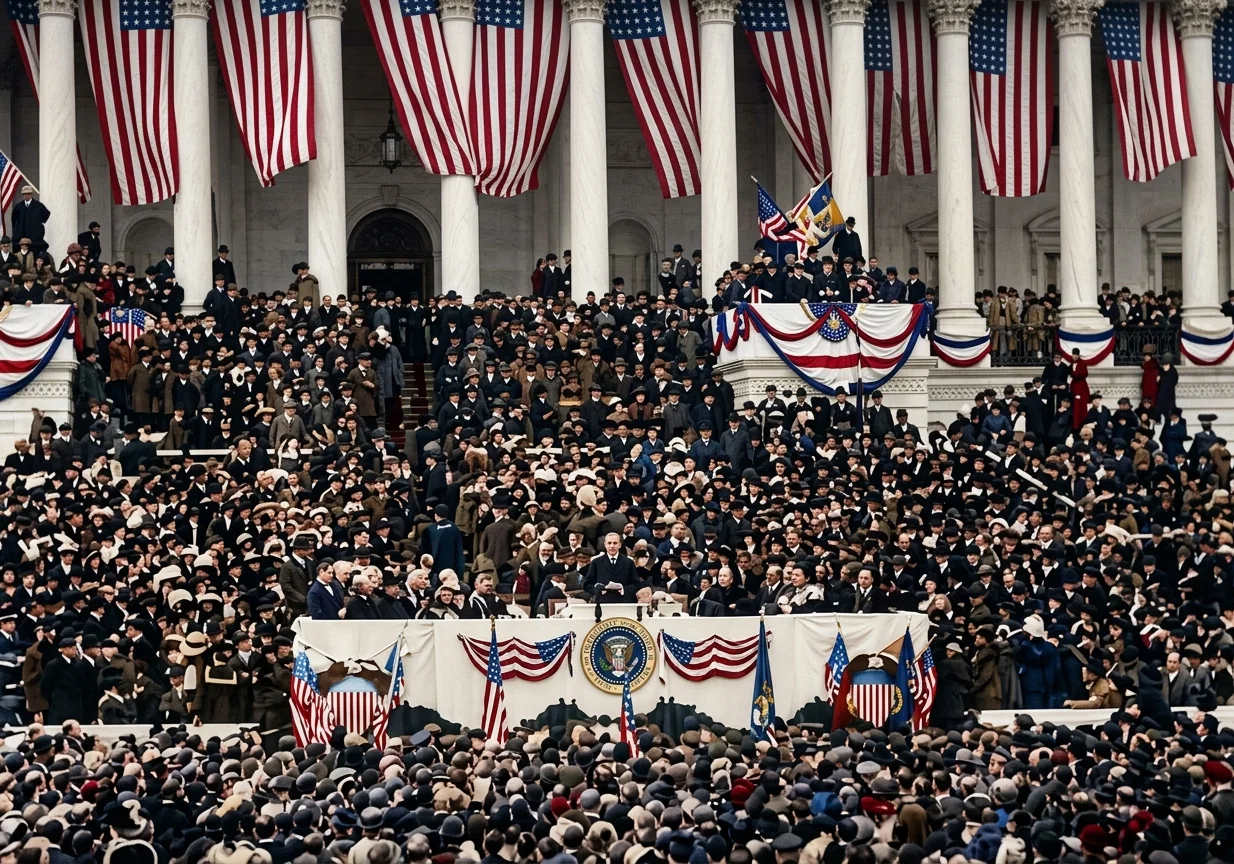
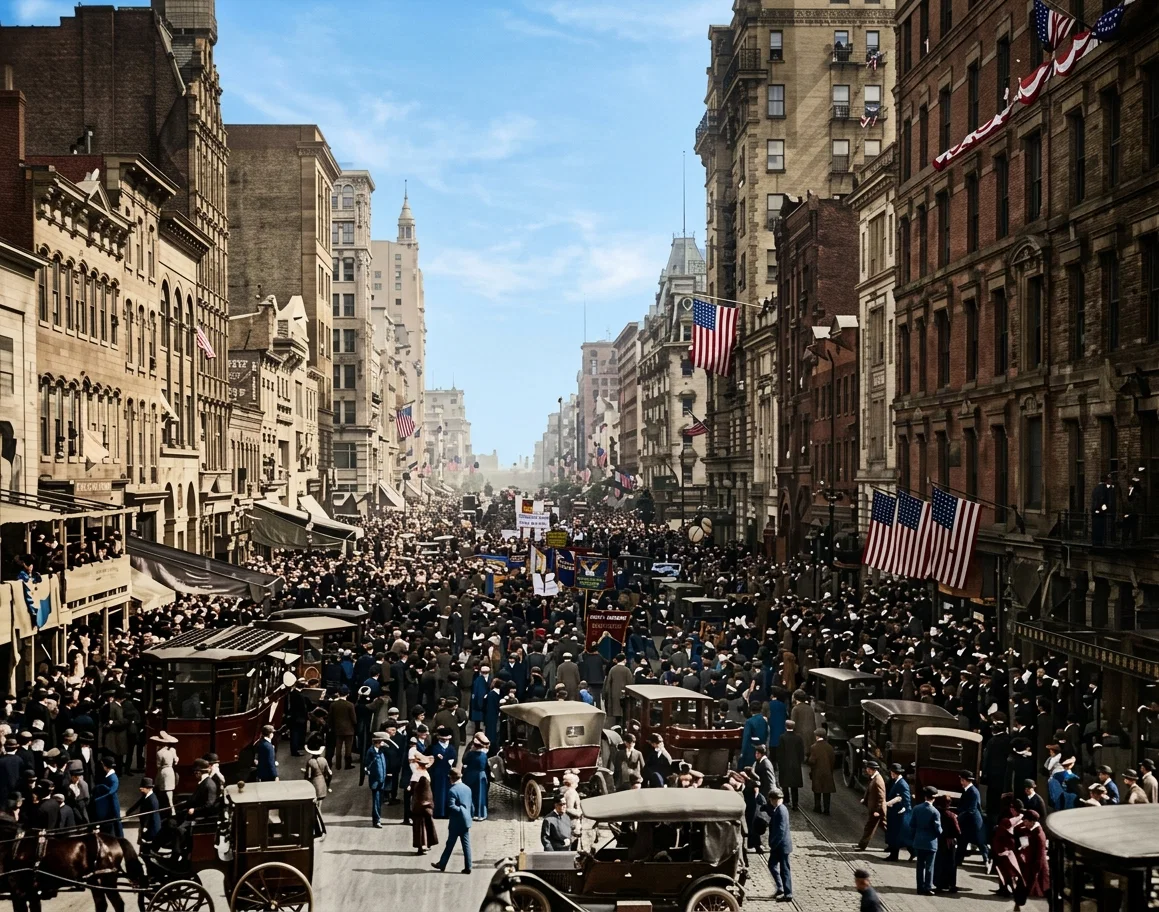
Among the noted events in Washington was the great Suffragette Procession, witnessed at times, we are told, by more than 500,000 people. It is said that sometimes the conduct of the beholders was disgraceful. In other places they were received with cheering and respect. After all, it is a real question whether they gained anything by such demonstrations. There is a strong organization of the antisuffrage association who have been, and are opposing the movement. Altho the latter were not so much in evidence in Washington at this time, evidently their influence was more or less felt.
True to Profession
Marshall Field’s house is named as among those that can be depended upon, and an instance is given of what occurred in the store of that company. A lady came in and asked for a genuine importation, and she was shown a hat the price of which was $65.00. The customer felt that she could not pay that price, and asked if it could be copied for her. “Certainly,” was the reply. “Could anybody tell the difference?” “Nobody but an expert. Our workmanship would be a little better finished.” “How much would the copy be?” “Eighteen dollars.” “And it would have the name of the French firm in it?” “No, madam.” “No? what label would it have?” “Marshall Field & Company.” “If I paid a little more?” “No, madam. Every hat made by us carries our label. Every hat imported by us carries its own label. That is the rule of the house.”
A few men in leading position may become dishonest and the country may not suffer. Men trusted in office may fail; but if the strong moral sense of the people in general stands, there is hope. But when the people themselves become honeycombed with essential dishonesty, what hope is there of the nation and the world? It is such things as these, foretold by Inspiration, that should be a warning to the people that the old earth is nearing its end. There is no hope of reform in a people who do not know essential integrity. There is no basis for reform. That perhaps is a little too broad: there is ONE basis of reform, and only one; but the world is turning from that,—that lies in the regenerating power of the Lord Jesus Christ. Through the creative power of God the dishonest heart may be made honest, and the dishonorable character may be made honorable; there is no other way.
Swindlers by the Wholesale
THE so-called Kansas Blue Sky Law has been not only a benefit to that state, but it ought to prove beneficial to the people of the United States. The provisions of that law, according to Governor Stubbs, demand that every corporation must secure the approval of the state before it can sell its stocks or bonds. The penalty for its violation is imprisonment in the state penitentiary. But that law has developed this, that OF MORE THAN 1,000 CORPORATIONS which have applied for the right to sell their stocks and bonds, Governor Stubbs says that “after a most thoro investigation made through our banking department, LESS THAN ONE HUNDRED CORPORATIONS have been granted the right to sell their stocks.” That is, it was not deemed safe for the people of the state to allow more than one in ten of those corporations that applied to exploit the people. The rest were considered utterly unsafe, or so exceedingly suspicious that they could not be licensed. Governor Stubbs says that
“one of the corporations thrown out of Kansas had already sold more than $3,000,000 of stock that I would not buy at any price. Most of this stock was sold to farmers or widows who had received money on insurance policies, and people who were not good judges of the value of stocks and bonds. After a most thoro investigation of the subject, I am convinced that the people of Kansas were being robbed of anywhere from five to ten million dollars annually, by an army of promoters and agents who were selling stocks and bonds that practically represented no value.
“It can be definitely proved that the Kansas Blue Sky Law has saved the people of this state more money since it has been enacted than the entire cost of the state government during that time, including our educational, charitable, and penal institutions, and every item of expense necessary to pay for the executive, judicial, and legislative branch of the government.”
It is a sad, sad fact that conditions in Kansas represent conditions throughout the United States. It is no wonder that finances are in as bad shape as they are; the wonder is that they are not worse. Surely Kansas ought to be congratulated on endeavoring to prevent these commercial harpies from preying upon the people. The various promotion schemers tell wonderfully smooth stories. These stories are so strong that to the uninitiated they seem as true as Scripture. Many wish to improve their financial condition, and so invest their little all, that they may do it. The result is that they lose everything.
But all this, in connection with many other things, shows the growing trend toward dishonesty, instability, and lack of integrity in the commercial world. Read what God's prophet said in Isaiah 59; Micah 7:2-4, A.R.V. The Blue Sky Law is important legislation. Dr. Stubbs, in this letter to Mr. E. H. Harriman, of Los Angeles, from which we have quoted, says that it can be improved. It would be a splendid thing for the people of the United States if every state would enact such a law as this.
In the Balkans
A DISPATCH from Athens, March 6, states that the great Western Turkish fortress, Janina, surrendered to the Greeks that day, with 32,000 prisoners. The constant stoppage of supplies had greatly weakened the Turks, and the fall of the garrison became inevitable. For four hundred years Janina has been a bulwark in the Western Turkish Empire in Europe, and many of the conflicts of the Middle Ages raged around it. Its defenses were exceptionally strong, but its fall now, with the dispersal of the Turkish forces at Monastir, is expected to take away nearly all resistance of the Turkish armies in that part of the country. Scutari, however, holds out still against the Montenegrins and Servians. In the East, as has been before reported, the Bulgarians have driven the Turks to Tehatalja, about twenty-six miles from Constantinople. Servians fought their way to the Adriatic, cleared Macedonia, and considerable of Albania. The Greeks have now added the victory of Janina to that of Saloniki. Adrianople, Scutari, and Constantinople are still left, and the Turk is pleading with the powers to arrange the best peace they can for the Sublime Porte.
For some time there has been little fighting on account of the severe winter through which the armies have passed, but as soon as the rigors of the winter are over, unless peace is arranged before that time, the war will be renewed. Adrianople will doubtless fall, notwithstanding its brave defenders, and all that will be left to the Turk will be Constantinople and a little strip of land along the Sea of Marmora.
Will the powers of Europe permit the Turk to keep Constantinople? Perhaps so for the present, and yet even that is questionable. The jealousies of the powers may not permit it. That will be the only thing that will stand in the way. Turkey may be driven to Asia Minor, and for a while, under certain conditions, allowed to remain there. She has no stable government anywhere, never has had, never has shown a genius for government. If not at war with her neighbors, she has been constantly at war among her own people and states and provinces. Her government has been so corrupt that it has12been impossible for her to gather for the general government the tribute that is collected. Her near future depends upon the agreement of the great powers of Europe.
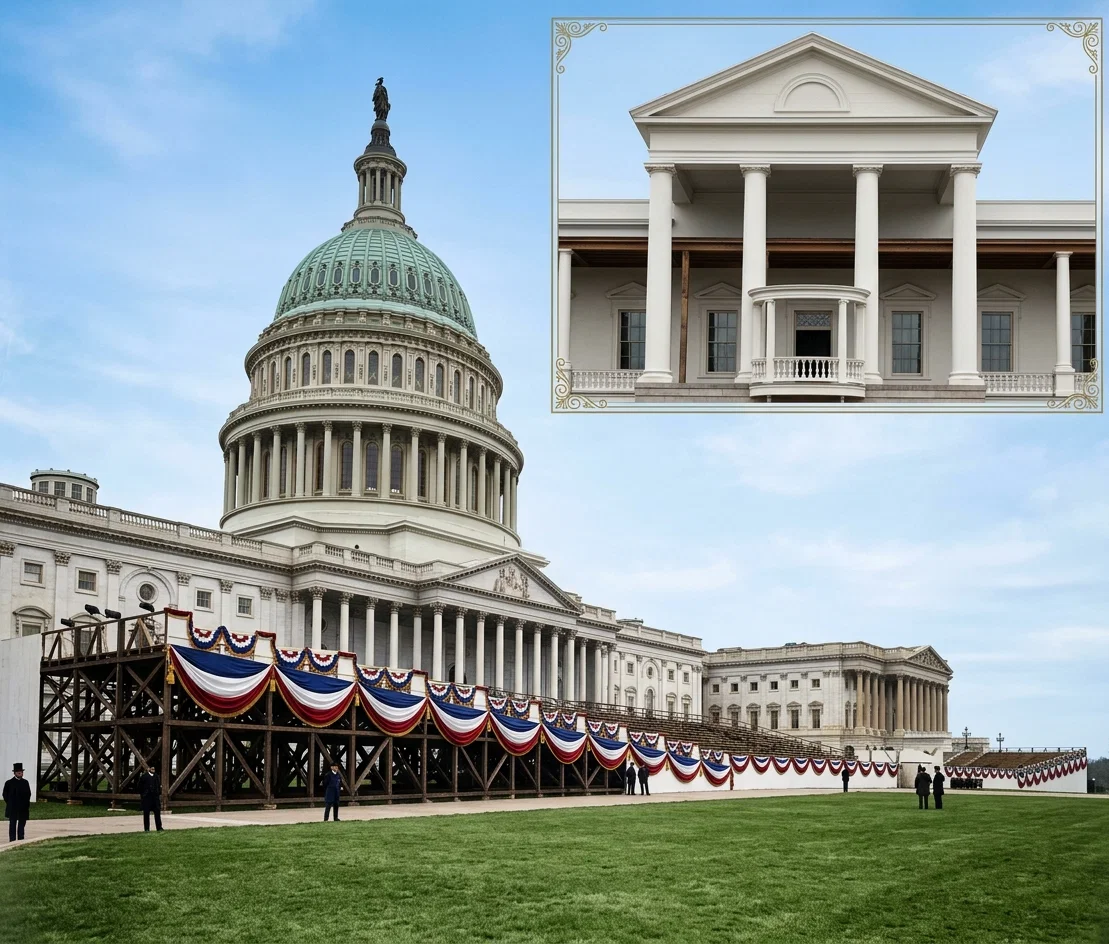
THE CAPITAL AT WASHINGTON, with the stand prepared for the inauguration services. In the upper part of the picture is the reviewing stand of the president, made after the pattern of Jefferson's house at Monticello.
Chaos in Mexico
THE El Paso Herald, published right on the very border of Mexico, has very little hope in present conditions in Mexico. In a recent issue, under an editorial entitled, “Lo, Chaos Is Restored,” it says that “an angel of good cheer, indeed, is the man who can see any light ahead in the Mexican situation. It was never darker, never more confused than now.” The editor declares that no man should gloat over Madero’s fall, but he thinks that Mexico has little to hope for from the men who have succeeded Madero. He says:
“A military dictatorship, if it be strong enough, can hold things level. This is the only hope for peace in Mexico. There is a scant hope of settlement by surrender or by compromise, and any settlement by purchase would be only a temporary arrangement, with no secure foundation.”
“There is one argument to sustain the position of those who look for prolonged peace. Under the military dictatorship of Porfirio Diaz the nation enjoyed much progress, considerable stability, and substantial peace for a third of a century. Under Madero’s ‘representative democracy’ it did not know progress, stability, or peace for one single day.”
And then we are told to watch for factions to split further, watch the leaders forsake the masses, watch the malcontents, the new revolutions, etc., etc., etc. “Primeval chaos has been restored in Mexico. That MAN that the prophet Ezekiel was looking for in 620 B.C. has not shown up.”
And this is the fruit of Roman Catholicism in a country where it was the teaching force for hundreds of years.
“A Vicious Measure.”
One of the bills before the California Legislature has been rightly called “a vicious measure.” It is Assembly Bill 1620, introduced by request. The penal code now fixes a dry zone around the grounds of the University of California, at Berkeley, with a radius of one mile. The Claremont Hotel proprietors built, as they thought, just outside of the mile limit. Unfortunately, however, they failed to measure accurately, and the building is in the dry zone. In order to get within the wet zone, a bill has been introduced to extend the dry zone from one mile to one and a quarter miles in the city of Berkeley, and right in that last adjunct lies the joker of the bill. As amended, the section would mean that within the city of Berkeley liquor can not be sold within one and a quarter miles of the University grounds, but within the city of Oakland it can be sold within less than a mile of these grounds. It is urged by some that the limit shall be made a mile and a half, regardless of city lines. And so it ought to be. It is to be hoped, for the sake of the students of the university, that the bill will be dealt with as it deserves.
War Scare in Europe
ACCORDING to a report from Paris, the purpose of Kaiser William to increase the strength of the German army has added fuel to the fire of patriotism in France. Even the most radical Socialists are eager to checkmate Germany. The whole nation, it is said, is now clamoring for a restoration of the length of the French military service from two to three years, as formerly. The general opinion is, We do not want war, but nothing is more likely than that war will soon be brought about by a force of circumstances over which we have no control, and if this be the case, we are determined to make every sacrifice to be found ready to fight and win.
If the kaiser's plans are carried out, the German army will surpass the French army by about 35 per cent. But if this is done, it is argued that Germany will be unable to spend any money on modernizing her material, especially her field artillery, which is now admitted to be inferior to that of France, while France has plenty of money to take advantage of every new military invention made.
In the meantime, Germany's pacific tone toward England, of a few days ago, is distrusted by noted Englishmen. Germany spoke of limiting war preparations respecting her navy, but the kaiser's suggestion to increase the German army has made England discount that concerning the limitation of the navy. Lord Roberts has seized upon Germany's plan to increase her army, to push forward with renewed energy his agitation for general conscription in England; that is, instead of a volunteer army, to have the army modeled after the continental plan.
All this is in fulfilment of the prediction of the old prophet eight hundred years before Christ, “Prepare war; wake up the mighty men.” These are preparations for the great last war of Armageddon, and yet we are sure that God will hold the winds of strife till His work is done in the earth.
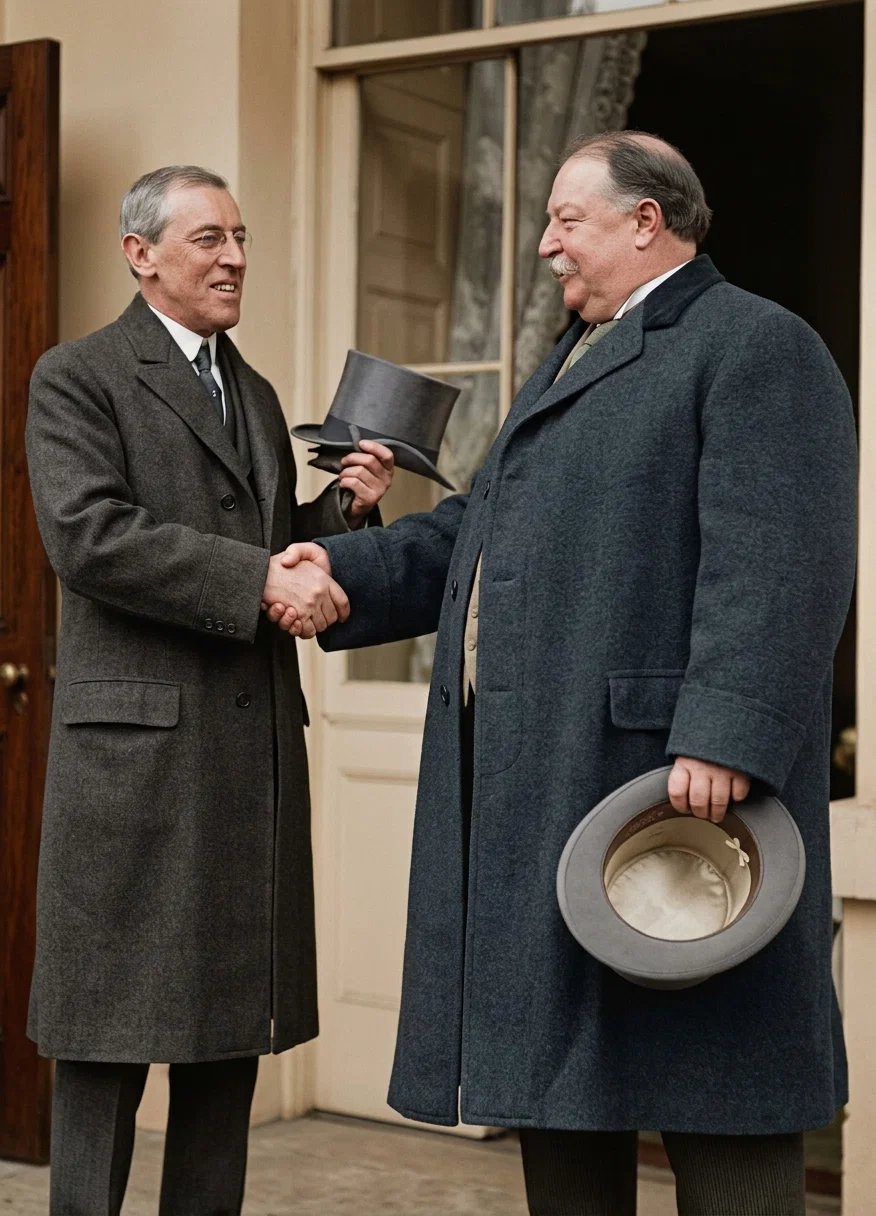
THE OUTGOING AND INCOMING PRESIDENTS
Liquor and Snakes
Postmaster-General Hitchcock has classed intoxicating liquor among the articles prohibited from transmission through the mails, thus shutting out liquor from participating in the parcel-post privileges. The classification of liquor with diseases, germs, explosives, poisons, and snakes, by the official head of the national government department, is not only in accord with public opinion, but it indicates the judgment of an important branch of our government with reference to the business of distributing and handling intoxicating liquor.—Michigan Christian Advocate.
Prehistoric Skeletons Unearthed
Prof. Harold Heath, of the Geology Department at Stanford University, has unearthed, about two miles south of Palo Alto, the skeletons of men all more than six feet in length. They are excavated from what is supposed to be a prehistoric village covering nearly two acres. With the skeletons were found stone hammers, bone awls, and ornaments.
California’s Petroleum Production
It is of interest to our readers, we are sure, to know that California produced one fourth of all the petroleum of the world last year. The world's production for 1912 was 350,000,000 barrels, an increase of 12,500,000 barrels over the previous year. Of this the United States produced 60 per cent. The production in the state of California was about 90,000,000 barrels.
Darrow Jury Unable to Agree
Mr. Clarence Darrow, tried for bribery in connection with the dynamiting case of the McNamaras, is yet unconvicted. The jury standing eight to four for conviction, unable to agree, is dismissed by the court after forty hours' deliberation. It probably may result in another trial.
A Wonderful Deliverance
By L. D. Avery-Stuttle
(Concluded)
By Mrs. L. D. Avery-Stuttle
HEATHEN tho these mariners are, they shrink from the awful deed. But the sense of self-preservation is strong in every breast. They hesitate no longer, and with a cry of mortal terror, the outcast drops from the vessel’s rail into the boiling sea.
But before this, in answer to the hurried and anxious questions of the seamen, the recreant son of Amittai had spoken to them about the true God who made heaven and earth, the sea and all that is therein, and had borne a ringing testimony to the truth; so that, before this last awful step is taken, these heathens bow themselves and ask forgiveness of the God of heaven, whose divine law they fear to break.
Instantly there is a hush. The boiling sea becomes calm. The fierce winds die away. The tempest ceases. But hardly has the body of the prophet touched the sea, when the awe-struck mariners notice a mighty leviathan of the deep, headed directly toward them. The horrified face of the prophet is seen for a moment above the wave, and in the next, the terrified watchers behold him disappear within the horrid maw of the monster!
The vessel keeps on her course, the seamen believing that the wretched man has received the punishment of death for his wickedness.
Not so; there is no height too sublime, no depth too awful to be pierced by the humble cry of faith, or the earnest prayer for mercy and deliverance. From the belly of the monster, the penitent voice of the prophet is heard by a loving and long-suffering God, tho, as it seemed to the despairing man, “the bars of the pit were around about” him forever. Three days of horror, of prayers, of searching of heart, and of deep contrition pass away.
It is enough. “And the Lord spake to the fish.”
Away toward the East, in the heathen city of Nineveh, there is great alarm and consternation.
A man in the simple garb of a prophet of the one true God, has entered her gates, and is delivering his thrilling and awful message: “Yet forty days, and Nineveh shall be overthrown!”
Up and down the crowded streets of the great city he passes, his mournful cry echoing through her palaces and temples. Before him, every face reflects the shadow of a terrible fear, and every heart beats with alarm. At once the news reaches the palace of the king.
“Hear, O king!” cries a messenger, hurrying into the royal presence. “The herald of the God of Israel, the mighty One, has this day entered the gates of our city, and the doom thereof is sure.”
“What is his message?” demands the startled king.
“Ah, his message is as brief as it is terrible ,” responds the courier: “Yet forty days, and Nineveh shall be overthrown!”
The king turns an ashen face toward his courtiers. He had heard the fame of Israel’s God, and a deadly fear overtakes him. Even while with trembling voice he questions the first messenger, another stands before him, spent with running and eager with haste:
“Hear, O king! many days ago I had a call to journey westward, even to the great sea. The last morning of my tarry, I walked on the shore, conversing with the fishermen who were spreading their nets. Suddenly, as we looked afar to the westward, where the blue waves of the Mediterranean were dancing in the morning sun, we saw a mighty monster of the deep, hurrying toward the shore. Nearer and nearer he came, his tremendous body dashing the white spray in feathery flakes about him. We watched him with fascinated eyes. As he drew nearer and nearer, the fishermen turned to flee. But tho I was struck with an awful fear, my trembling limbs refused to bear me from the spot. At last, borne on the crest of a mighty wave which seemed to rise before him, the monster gained the shore, his great, gaping jaws wide stretched. Then, O king, my eyes saw a vision which almost stopped the wild beating of my heart. Out from the open jaws of the monster, leaped a man,—a man seeming to be clothed in mortal flesh like unto us. I marked well his features, tho he paid no heed to me. Meanwhile the leviathan headed for the deep once more, on the receding wave. Then, O king, a faintness came over my flesh, and I fell with my face to the ground. When I awoke, the man was gone, and I thought never to behold him again, for I said, Surely it is one of the gods, whose dwelling is not with man. But hear me, O king. This day mine eyes have again seen him,—the mysterious man of the sea,—and it is none other than he, O king, who crieth against this city; which, as soon as I had heard and seen, I hasted to tell thee.”
The face of the king is livid with fear, and a trembling seizes him. Turning to one of his chief officers, he cries hoarsely:
“It is the God of Israel, fighting against the Assyrian. Up, every man of you! proclaim a fast. Let not man or beast eat or drink, and let every man’s flesh be clothed with sackcloth, and let him make his bed in ashes. It may be God will turn from His fierce anger, that we perish not; for mine ears have heard before, of the fame of this so great a God.”
Forty days thereafter, during which time the cry of the prophet had ceased not, some who were passing in and out of the Eastern gate of the city, noticed a small booth, covered with boughs, in the shade of which sat a lonely man with eyes fixed intently upon the city.
As day after day passed, and the sun still rose and shone with friendly beams over the great city, the face of the strange man grew dark with anger. Had he not for many days foretold the utter destruction of Nineveh? Had not her wickedness been great, until her sins reached unto heaven?
The pride of the son of Amittai is touched. Why should he, a prophet of the Most High, be thus humiliated before the idolatrous enemies of his people?
Fiercely the East wind blew great gusts of heated air as from an oven, upon the head of the disconsolate man. Already the gourd which had promised him some comfort and protection by its cooling shade, was withered and dead at his feet,—fit emblem of a ruined and blasted life, as his had been. It was as he had feared while yet in his own country. He must bear the dreaded stigma and reproach of the false prophet as long as he lived. Already he imagines that the eyes of the people who pass in and out of the city gate are turned askance at him, and that he hears the mocking laugh and the bitter sneer.
In his self-love, he ponders and grieves over his humiliation, until it has led him to prefer the total destruction of the repentant city rather than that his own good name should suffer, or his foolish pride become humbled. Finally, in an outburst of reckless anger, the rebellious man even dares to lift up his eyes to heaven and reproach the Almighty.
“Doest thou well to be angry?” mildly inquires the voice from heaven.
“I do well to be angry even unto death!”
We wonder at the daring and reckless reply of the unreasonable and cruel prophet; but most we wonder at the infinite loving-kindness of the Lord, and the vast mercy which made possible such a reply as this,—a reply which must forever stop the mouths of those who would defame the Almighty by representing Him as a God who could take pleasure in condemning to eternal torture and endless suffering a portion of the creatures of His hand. Listen:
“And should not I spare Nineveh, that great city, wherein are more than sixscore thousand persons that can not discern between their right hand and their left hand; and also much cattle?”
Words of Help
By F. B. Meyer
DRESS perplexes some and takes up much time and thought. It is a difficult subject, and yet there are several clear rules to guide a Christian girl. Do not dress showily, or extravagantly, or beyond your means. Do not dress in such a way as to call attention to any part of your figure, or to distort or alter it. Do not dress so that people will notice your dress more than yourself. Whatever makes others think of us, or us think of ourselves, turns our thoughts away from Jesus, and from better things. I think that there is no higher art for a Christian girl than to dress simply, quietly, and tastefully, as one who is careful of the body which Christ has given, but who is mindful also of the apostle’s words: “That women adorn themselves in modest apparel, with shamefacedness and sobriety.”14
The use of ornaments is also a matter of great heart-questioning. Where there are doubts, the little trinkets should be laid aside, till the great Owner tells His servants what He would like them to do. It does seem strange that so much money should be locked up in articles of personal adornment, when the Lord’s cause is suffering for want of help! A Chinese Christian lady brought her jewels one morning to her husband, to build an opium-refuge; and when he expressed surprise, she said, “I have taken Christ for my adornment, and surely that is enough for any Christian woman.” Put on the Lord Jesus, dear sisters, and you will lose your taste for many things you now hold dear, as most girls would put away glass jewelry, if offered real gems. “Whose adorning let it not be that outward adorning of plaiting the hair, and of wearing of gold, or of putting on of apparel; but let it be . . . the ornament of a meek and quiet spirit, which is in the sight of God of great price.” The woman who loads herself with jewels, confesses herself wanting in the jewels of the heart; but she who has these, troubles little about the diamonds or pearls of earthly mines.—Rev. F. B. Meyer, in Words of Help for Christian Girls.