VERILY My Sabbaths ye shall keep: . . . that ye may know that I am the Lord that doth sanctify you. Wherefore the children of Israel shall keep the Sabbath, to observe the Sabbath throughout their generations, for a perpetual covenant.” Ex. 31:13, 16. That divinely appointed institution, ordained of the Lord to be the evidence of sanctification to Israel, lost none of its significance or power in the life and teaching of Christ. He, who through the sacrifice of Himself has become the sanctifier of sinners, appointed the Sabbath as a part of the law, and gave it to His people to be the means of retaining their justification. Heb. 2:11; Rom. 3:21.
At the close of the six days of creation, when the hours of the first seventh day began, it was Christ who rested upon that day, and sanctified it, and made it a Sabbath. John 1:1-3; Col. 1:16. When Israel stood afar off and trembled at the awful spectacle of flaming Sinai, it was Jesus who made the covenant with His people, and uttered the sacred words of the Decalogue. 1 Cor. 10:1-4; 1 Peter 1:10, 11. Thus by creation and command, the Sabbath emanated from, and received the sanction of Christ. It would scarcely be supposed then, when He took upon Himself human form (John 1:14), that He would deny the eternal claims of the Sabbath as given in the fourth commandment. It will be noticed that Christ made the Sabbath before sin entered the world, and the sacrifice of His life had become necessary.
The Sabbath was the bulwark of Israel’s religion, because it occupied that peculiar and important position in the Decalogue of designating the Giver of the law, and pointing out His work. When Israel forgot God, and trampled the Sabbath under foot, they soon turned to the worship of Baal. Elijah charged Ahab and his people with having forsaken the commandments of God and followed Baal. The result was, that nearly all Israel had lost sight of God as the creator; and it was necessary for Him to perform a mighty miracle by the hand of Elijah to convince them of the true God. 1 Kings 18:18.
There can be no question about the important place the Sabbath occupied in the old covenant, or the dispensation of law. The question we wish to answer now is, Was the Sabbath institution, including the definite day that it stood for when it was made, transferred to the new covenant, or the dispensation of grace? Let us consider first the relation of Israel to the new covenant, and secondly the relation of Christ to the law and the Sabbath.
For Israel
Israel, that remarkable word which stands for God’s people in all ages, expresses the idea of the divine and human united, the last two letters of the word denoting the divine. God gave the name to Jacob when he had wrestled all night with the Lord. He said, “Thy name shall be called no more Jacob, but Israel: for as a prince hast thou power with God and with men, and hast prevailed.” Gen. 32:28. The new covenant was made with the house of Israel (Heb. 8:6), and its promises were for Israel only. Eph. 2:12, 13. When Christ is accepted in the heart, the “stranger” and “Gentile” becomes an Israelite indeed, and an heir to the covenant of promise. Gal. 3:29; Rom. 2:28, 29.
How completely the atonement of Christ and the privileges of the gospel accomplish that work for man whereby he can be called “Israel”—the divine and human united. With this thought in mind, Paul said, “And so all Israel shall be saved.” Rom. 11:26. Sinful man could never have been called “Israel” had not God in mercy made possible the promises of the new covenant that was ratified by the blood of Jesus. Heb. 9:12-15. Israel, under the old covenant, was vitally related to the new, for they were saved by virtue of its promises and conditions; while their observance of the laws of the sanctuary as given to them, became the thermometer of their faith in the coming Saviour, who was to make the new covenant with the house of Israel. The Sabbath, however, was to remain a test of loyalty to both houses of Israel. “Wherefore the children of Israel shall keep the Sabbath, to observe the Sabbath throughout their generations, for a perpetual covenant.” Ex. 31:16. Webster, in defining the word “perpetual,” says it means “never-ceasing,” “unfailing.” The seventh-day Sabbath occupies this “never-ceasing, unfailing” position in the new covenant. As it was the covenant of “knowledge” to ancient Israel (Eze. 20:20), so it remains for Israel under the blessings of the gospel. Its claims are even greater under the new, than under the old covenant, for under the new the law of God, the Ten Commandments, are inscribed upon the fleshy tablets of the heart. Heb. 8:10. We conclude, then, in harmony with Inspiration, that the seventh-day Sabbath which occupied such a large place in the worship of Israel under the old covenant, should occupy the same position under the new.
Christ’s Relation to the Law and the Sabbath
Jesus’ mission on earth was not to disregard constituted authority, or make of none effect the law. He charged the scribes and Pharisees with having done this by heaping traditions upon the commandments of God. Matt. 15:3, 9. At the beginning of His earthly ministry He clearly defined His position relative to the moral law, in the following words:
“Think not that I am come to destroy the law, or the prophets: I am not come to destroy, but to fulfil. For verily I say unto you, Till heaven and earth pass, one jot or one tittle shall in no wise pass from the law, till all be fulfilled.” Matt. 5:17, 18.
We may readily infer from this, that He regarded with equal importance each of the Ten Commandments. Not only this, but He regarded the very letters as important, for not one “jot” (yod, the smallest letter in the Hebrew alphabet) or “tittle” (meaning the “horn,” a short projection in certain Hebrew letters extending the base line beyond the upright one which rests upon it) of the law could perish. In His own life, He practised to the very letter this teaching regarding the law of God. Who could convict Him of sin? He kept the commandments perfectly. John 15:10; Heb. 4:15.
His mission on the earth in the flesh was to keep the law that man had failed to keep, and so perfectly did He succeed, that no voice could be raised, or finger point out one place wherein He had transgressed God’s precepts. He did not exalt the fourth commandment above the other nine, neither did He give it a secondary place. From His childhood, until the close of His earthly ministry, both by observance and instruction, Jesus showed His regard for the seventh-day Sabbath. In early life, it was His custom to attend the synagogue for worship on that day. Luke 4:16. At the beginning of His ministry, He exalted that day by declaring that He was Lord of it. Mark 2:28.
Again, just before He finished His earthly mission, He commanded the disciples to pray that they might be kept from transgressing the Sabbath when Jerusalem would be destroyed. Matt. 24:20. This command called for Sabbath observance at least forty years after the death of Christ, for Jerusalem was not destroyed until A.D. 70. No act, or teaching in the Saviour’s life, relative to any institution, could be more significant than thus asking the church to remember the Sabbath in prayer.
Finally, in the completion of the divine plan for man’s redemption, or re-creation, the seventh day was again the day of rest from a completed work. Jesus was crucified on the sixth day, or Friday. Just before the close of the day the Father hid His face from His Son. In that awful hour of darkness, Jesus cried, “It is finished,” and gave up the ghost and died. John 19:30. On that Friday afternoon, when He yielded up His life, the plan of salvation was forever sealed, and the new covenant ratified. His body was taken down and laid away. The Sabbath drew on, and the Son of God rested in the tomb on that day from His work of redemption. He who rested on the first seventh day of earth’s time, “from all His work which God created and made,” also rested on the same seventh day in the sepulcher from His great work of recreation.
Many years after, in writing of this particular Sabbath day, and the events that are connected with it, Luke tells us that the women also returned, “and prepared spices and ointments; and rested the Sabbath day according to the commandment.” When Luke wrote his Gospel, he still remembered the Sabbath of the fourth commandment. After Jesus ascended to His Father, He sent back this word to us through His servant:6
“He that saith he abideth in Him ought himself also so to walk, even as He walked.” 1 John 2:6.
The lives of the apostles, and all their writings are in accord with this teaching. They kept the Sabbath. It was Paul’s manner so to do. Acts 17:2. He kept the day among the Gentile nations. Acts 16:13; 13:14, 42, 44; 18:4. All the New Testament writers are in harmony with the Saviour’s statement, that He “came not to destroy the law” of God. Paul says, “Circumcision is nothing, and uncircumcision is nothing, but the keeping of the commandments of God.” 1 Cor. 7:19. James’s admonition is, “So speak ye, and so do, as they that shall be judged by the law of liberty.” James 2:12. And the Holy Spirit in speaking through John the revelator says, “Blessed are they that do His commandments, that they may have right to the Tree of Life, and may enter in through the gates into the city.” Sabbath observance is essential to-day for the one that would have his life perfected in Christ according to the commandments, for the Sabbath command is a part of the Ten Commandments, and “whosoever shall keep the whole law, and yet offend in one point, he is guilty of all.” James 2:10.
Islam’s Message to Christianity as Voiced by One of Her Sons
By Hajim, Son of Ibrahim
Pertinent Questions to Christians
By “Hajim, Son of Ibrahim”
I AM Hajim, the son of Ibrahim. The moon hath waned ten thousand times and grown again in glory since the days when my fathers first trod the fair land whose coast is laved by the Great Inland Sea. The sun hath risen to paint with its magic tints the Eastern skies, to grow in refulgent splendor, to call forth the harvests, to gild the grain and paint the ripened hues on fruit and flower, only to sink each evening into the setting glows and glories of the West, for O, who shall say for how many days since the voices of my fathers first waked the echoes in the hills and dales of the land which to this day cradles the glories, the hopes, the aspirations, the ideals of my people! How long is it that Islam hath called or answered Muezzin—answer Broussa, El Khods, Hebron el Khalil!
For many a year the laughter of our brooks has been echoed by the laughter of our children in careless play. For many a year our placid pools, lovely in their peacefulness, did but reflect the peacefulness of our land. But time and again storms burst and wild winds rushed across our land. Then, laughter was turned into moaning, and peace gave place to the horror and curse of passion-storm or war.
Now, hear, O Christian world! thus saith Islam!
I was born. Who called me into life? Who blessed my growth? Who was it who caused my Crescent to stretch with its Eastern horn touching Crimea and its Western horn resting on the glades and glens of Andalusia? Look upon it as thou wilt, O Christian world, thou shalt confess that it was the power, the will, the purpose of Him who rules the world, who governs all nations and who guides all destinies, that I, Islam, should be born, should grow, and should conquer for over a thousand years!
If there is a miracle in the growth of Christianity, and miracle there is, surely there is miracle in the growth of Islam. If to-day it is Kismet that the Crescent of Islam shall fade and disappear, every son of Islam shall say “Amen” as he bares his heart to receive the stab of Time. If Potemkin drove in our Crescent’s right horn; if Martel at Tours drove in our left; if Boabdil yielded yet more of our Crescent’s glory to Ferdinand and Isabel of Arragon and Navarre; if defeat frowned upon us when Vienna escaped our power, or Belgrade hurled us back, or Plevna’s trench was drenched with blood from hearts of sons of czar and sultan—we, the sons of Islam, cry “Kismet,” and are ready to cry again “Kismet” when the last remnant of our Crescent shall sink forever in the tides of Time, in the sea of Eternity, in the ocean of Oblivion.
O Christian world! thou hast conquered me, but art thou Christian? Was it Christian to change my culture in Grenada, to close my universities, to show hate to those whom I befriended and protected, even tho they were not sons of Islam? Was it Christian to turn fair Spain into a state of decrepitude, from which she hath hardly yet emerged? Was it Christian to seize one province after another and tear it from my grasp, asserting that my grasp meant misrule, oppression, and intolerance? Was it Christian for you, Christian nations, not one of whom is guiltless of misrule, of oppression, and of intolerance, to quote my sins when yours are just as glaring? Was it Christian for thee, O fair Italia, to wrench from me the land of Tripoli, with but twenty-four hours’ notice, and for what reason or reasons? Proclaim the reasons! Were thy sons who settled on Tripoli’s coast so saintly that they sinned never—never took advantage, ever sought the adjustment of dispute by appeal to higher court in Yildis, or, higher court still, the court at Hague, in the far-off land? And is thine own conduct in Erythee so stainless? Not so long ago the defiles of Abyssinia were stained with the blood of thy sons, and their bones lie to this day in those valleys! Was thy invasion Christian? Was it Christian to cause the death of thy brave sons?
I have spoken of the court at Hague. O the mockery of it! O the shame it is to Christendom! The word came forth to me, “O Islam, we Christian nations will meet at Hague to pledge ourselves to arbitrate where arbitration there can be. Wilt thou, O Islam, join the pledge?” Then answered I: “With all my heart, with every fiber of my being, yea, with my very soul!”
But when Italia declared her war against me, why, if she had grievances, did she not call me before the court at Hague? Why did not the other so-called Christian nations—nations that call themselves Christians after their Teacher who proclaimed “peace on earth and good will to men”—why, I say, did not those Christian nations insist that both Italia and Islam should be summoned before that court of Hague and bow to Justice as there pronounced? Did Italia fear that the court would say, “Thou hast no right to rob Turkey, thy wrongs must be adjusted under the shield of Law and Order”?
Why create the court at Hague for “peace on earth and good will to men” if its existence is to be flouted, its usefulness mocked, its power derided? Is that Christian? Why invite me and others to pledge ourselves to support that court and then say to us: “It is but an idea, a mockery, a wisp of straw for idiots to twist and wear and cry, ‘O see my crown!’” Crown! Yes, that Hague court should be the crown of Christianity’s glory! Instead, it is its mockery.
And now that I, Islam, am near my death-throe, when Bulgar, Serb, Greek, and Montenegrin band against me, what shall I say? If they had grievances, why not have cited me before that Court of Hague? If the great powers are really powers, and Christian powers, why did they allow the present war even to begin?
O Time, what will thy revelations bring when thy Scroll shall be unrolled for all men to read the story of the true reasons that impelled the cursed war? Was Agadir a cause? Did Italia, tho the ally of Allemaine, fear to have Allemaine seize my land of Tripoli and thus get on the shores of the Great Inland Sea the foothold she was denied at Agadir? Or, does the land of the White Czar use the Balkan States as pawns for her winning on the chessboard of history? Is this her way because the rattling of the German arms, the shining armor of great Teutonia, held her off when Bosnia and Sisterland were grasped by Teuton’s ally?
What is Christianity? Is it the rule of force? Is “Might Makes Right” its creed? Doth Treason unthrone Reason? I say, again, the greatest and most precious gem in the coronet of Christianity’s glory is its creation of the court at Hague. Why is its luster dimmed? Why was not its light permitted to prevent these wars that have meant sorrow, ruin, death—wars the glory of which is the glory of having turned wives into widows, the honor of which is the honor of turning happy children into saddened orphans? O, the glory! O, the honor! And the mocking echoes of the eternities answer: “O, the glory, O, the honor, of Christianity!”
(Concluded next week)
Questions for Scoffers
I CAN not forget the confusion into which I saw a conceited young fellow thrown once, when he turned to an aged minister, and as if challenging discussion said, “I am told you believe in the inspiration of the whole Bible.” The good man answered quietly, “O, yes, my friend; what do you believe in?” A little laugh covered the defeat, but he continued, “But you certainly know what the great scholars say about it?” when again the calm answer met him, “Somewhat, but what did they say to you about your soul?” Now the inquirer grew restive. “They say you are leading men along with a farthing taper in your lantern.” To this the aged preacher only said, “Do they say men would see any better if we would let them put the taper out?”—The Christian Age.
Sweetness, Sunshine, and Patience
“SWEETNESS of spirit and sunshine is famous for dispelling fears and difficulties; patience is a mighty help to the burden bearer.”
Disappointment
By Frances Ridley Havergal
Our yet unfinished story
Is tending all to this:
To God the greatest glory,
To us the greatest bliss.
Our plans may be disjointed,
But we may calmly rest;
What God has once appointed
Is better than our best.
And when amid our blindness
His disappointments fall,
We trust His loving-kindness
Whose wisdom sends them all.
They are the purple fringes
That hide His glorious feet;
They are the fire-wrought hinges
Where truth and mercy meet.
No shattered box of ointment
We ever need regret,
For out of disappointment
Flow sweetest odors yet.
The discord that involveth
Some startling change of key,
The Master's hand resolveth
In richest harmony.
—Frances Ridley Havergal.
The Sabbath in the Old Testament
[NOTE.— Very much could be said regarding the Sabbath in the Old Testament, so as to fill a whole page, but a few of the most striking scriptures will be sufficient.]
1. The Sabbath was instituted at the close of the first week of time by three distinct acts,—God rested upon the day, and God blessed and sanctified it.
“And on the seventh day God ended His work which He had made; and He rested on the seventh day from all His work which He had made. And God blessed the seventh day, and sanctified it: because that in it He had rested from all His work which God created and made.” Gen. 2: 2, 3.
2. At the close of the patriarchal dispensation, and in the beginning of the Levitical dispensation, the Sabbath was strongly affirmed in the Decalogue.
“Remember the Sabbath day, to keep it holy. Six days shalt thou labor, and do all thy work: but the seventh day is the Sabbath of the Lord thy God: in it thou shalt not do any work, thou, nor thy son, nor thy daughter, thy man servant, nor thy maid servant, nor thy cattle, nor thy stranger that is within thy gates: for in six days the Lord made heaven and earth, the sea, and all that in them is, and rested the seventh day; wherefore the Lord blessed the Sabbath day, and hallowed it.” Ex. 20: 8-11.
3. In a prophecy of the last days, we are told that the Sabbath would be restored, and that those from among the Gentiles would be blessed in its observance.
“Thus saith the Lord, Keep ye judgment, and do justice: for My salvation is near to come, and My righteousness to be revealed. Blessed is the man that doeth this, and the son of man that layeth hold on it; that keepeth the Sabbath from polluting it, and keepeth his hand from doing any evil.” Isa. 56: 1, 2.
“And they that shall be of thee shall build the old waste places: thou shalt raise up the foundations of many generations; and thou shalt be called, The repairer of the breach, The restorer of paths to dwell in. If thou turn away thy foot from the Sabbath, from doing thy pleasure on My holy day; and call the Sabbath a delight, the holy of the Lord, honorable; and shalt honor Him, not doing thine own ways, nor finding thine own pleasure, nor speaking thine own words.” Isa. 58: 12, 13.
4. The same gospel prophet predicts that in that new heavens and new earth the same Sabbath of the Lord will be observed.
“For as the new heavens and the new earth, which I will make, shall remain before Me, saith the Lord, so shall your seed and your name remain. And it shall come to pass, that from one new moon to another, and from one Sabbath to another, shall all flesh come to worship before Me, saith the Lord.” Isa. 66: 22, 23.
The Bible
By N. D. Anderson
By N. D. Anderson
The grand old Book of many tongues
That speaks to man with one;
The sweet old scroll, the sacred roll,
God guardeth with His Son.
The sunlight, garnered in a sheaf,
Shines ever from each page,
While soaring from each hallowed leaf
Rise songs Time can not age.
Within its bounds the universe
Is chained for us a span;
God speaks His will, and does not kill,
Here face to face with man.
Who held its guiding arms aloft
Through all the battling years,
While fought its fearful foemen oft
To pierce its side with spears!
Exalted Tome! Astounded stand
The heights, the depths, and all,
And feel invisible thy hand
About them as a wall.
When empires halt, when nations die,
When all perplexed, religions fall,
Thou art man's guiding star on high,
His haven sure, his all in all!
Thou grand old Book of many tongues
That speaks to all with one;
O sacred roll, O sweet old scroll,
God guardeth with His Son!
Advent Song
By Frances Ridley Havergal
Thou art coming, O my Saviour!
Thou art coming, O my King!
In Thy beauty all resplendent,
In Thy glory all transcendent;
Well may we rejoice and sing!
Coming! In the opening East
Herald brightness slowly swells;
Coming! O my glorious Priest,
Hear we not Thy golden bells?
Thou art coming, Thou art coming!
We shall meet Thee on Thy way,
We shall see Thee, we shall know Thee,
We shall bless Thee, we shall show Thee
All our hearts could never say!
What an anthem that will be,
Ringing out our love to Thee,
Pouring out our rapture sweet
At Thine own all-glorious feet!
Thou art coming! Rays of glory
Through the veil Thy death has rent,
Touch the mountain and the river
With a golden glowing quiver,
Thrill of light and music blent.
Earth is brightened when this gleam
Falls on flower and rock and stream;
Life is brightened when this ray
Falls upon its darkest day.
Not a cloud and not a shadow,
Not a mist and not a tear,
Not a sin and not a sorrow,
Not a dim and veiled to-morrow,
For that sunrise grand and clear!
Jesus, Saviour, once with Thee,
Nothing else seems worth a thought!
O how marvelous will be
All the bliss Thy pain hath bought!
Thou art coming! At Thy table
We are witnesses for this,
While remembering hearts Thou meetest,
In communion clearest, sweetest,
Earnest of our coming bliss.
Showing not Thy death alone,
And Thy love exceeding great,
But Thy coming and Thy throne,
All for which we long and wait.
Thou art coming! We are waiting
With a hope that can not fail;
Asking not the day or hour,
Resting on Thy word of power,
Anchored safe within the veil.
Time appointed may be long,
But the vision must be sure.
Certainty shall make us strong,
Joyful patience can endure.
O the joy to see Thee reigning,
Thee, my own beloved Lord!
Every tongue Thy name confessing,
Worship, honor, glory, blessing,
Brought to Thee with glad accord!
Thee, my Master and my Friend,
Vindicated and enthroned!
Unto earth's remotest end
Glorified, adored, and owned!
— Frances Ridley Havergal.
Hero-Harpers
By Delwin Rae Buchner
By Delwin Rae Buchner
All stand triumphant on the glassy sea,
Earth heroes they, twelve dozen thousand strong,
From whose lips swells a glad thanksgiving song
Which none can learn except that company—
A paean, which pulsates with victory
O'er that cruel, antichristian beast which long
Afflicted them, tho they had done no wrong
That they should be deprived of liberty.
In caves they suffered, back of prison bars,
From hunger, thirst, and men, insane with hate,
But harvested at last a rich reward,—
Harps, carved from gold, and crowns, aglow with stars;
A key to heaven's massive, all-pearl gate;
The right to be forever with their Lord.
Look High
By Chas. D. Bulla
Look high, O soul! for what is wealth but dust,
And the fleeting shadow of the better things?
The heavens are thine if thou wilt use thy wings,
And sighs are songs if thou wilt only trust.
Aim high, O soul! for on the higher forms
Is always room; the lower ranks are filled.
Who climbs the heights will find earth’s noises stilled,
And a sweet calm and peace above the storms.
Be high, O soul! scorn what is low and base,
Child of a king they call thee; be a king,
And troops of vassals shall their tribute bring
To crown thee heir of glory, child of grace.
—Chas. D. Bulla.
My Creed
By Howard Arnold Walter
I would be true, for there are those who trust me;
I would be pure, for there are those who care;
I would be strong, for there is much to suffer;
I would be brave, for there is much to dare.
I would be friend of all — the foe — the friendless;
I would be giving, and forget the gift;
I would be humble, for I know my weakness;
I would look up — and laugh — and love —
and lift.
—Howard Arnold Walter in "Harper's Bazaar."
Selfishness
By Scott
Despite those titles, power, and pelf,
The wretch, concentrated all in self,
Living, shall forfeit fair renown,
And, doubly dying, shall go down
To the vile dust from whence he sprung,
Unwept, unhonored, and unsung.
— Scott.
Aim High
“Aim high, my friend, thy shaft may fall beneath thy feet,
Thy bow break in thy hands, it matters not;
Aim higher still, no broken bow canst break thy will,
No missent shaft thy purpose kill,
So upward let thine arrows fly, aim high.”
Dare to Be True
By Herbert
DARE to be true; nothing can need a lie.
A fault which needs it most, grows two thereby.
— Herbert.
A Sure Support
By Julia H. Duffie
By Julia H. Duffie
An aged pilgrim was entering the dark valley from which no traveler returns except by the voice of the Lifegiver. The worn muscles refuse to longer obey the dictates of the will, the weary brain restfully lapses into peaceful unconsciousness, then partially recovering itself, again takes note of surroundings.
An attendant seeing that the journey’s end was near, remarked,—“The Lord has promised to be a sure support to us even unto death.” Instantly the fading face brightens with a smile as the mind grasps the sentiment, the voice exclaiming, “Praise the Lord! A sure support!” Again the thoughts peacefully rest, soon to revive again with the response, “A sure support! Praise the Lord!” And thus leaning upon the sure support of God’s promise, the weary one passes beyond human recall. What a beautiful illustration of the psalmist’s words: “Tho I walk through the valley of the shadow of death, I will fear no evil; for Thou art with me; Thy rod and Thy staff they comfort me.”
Possibly the attendant did not realize how especially appropriate the words quoted were in this particular case. From boyhood the busy hands had been occupied in forming sure material supports; buildings framed by these hands more than half a century ago still bear their silent testimony to the maker’s love of having everything secure, firm. The coverings might warp and decay, but their support, the framework, remains good for another century’s wear, no swaying ridge-poles, no parting joints, everything solid and durable.
Nothing so displeasing to this lover of stability as a flimsy structure—something not strong enough for the purpose intended. And when he sought the protection for his home which man offers against accident, one can think with what satisfaction he saw the plate which the company supplied, bearing the word “Security,” fastened above his doorway. Truly this was a man who could grasp and appreciate the surety of God’s promises in this hour of need.
And is it only when passing out of this life that we need this sure support? Ah, no! we need it, and can have it every step of the way. The young need it when entering upon the uncertain pathway of life; the middle-aged need its certain help when bearing the heat and burden of the day; and when could its aid be more needed than in the declining years when earthly supports may fail? When the faltering steps and feeble eyes may not discern the way, then the sure support of God’s promises will carry the worn traveler safely through the gloom to the desired haven beyond. And is it only in the hereafter that we may feel the security of the Father’s house? No, indeed; here and now we may realize that “the eternal God is thy refuge, and underneath are the everlasting arms.”
Reader, have you found this support? You can not afford to try to do without it. Possibly man has misrepresented this support to you; perhaps some of those professing to lean upon this staff have not appeared to be very well upheld. Perchance some do not realize how well they are supported. But oh, there is a “multitude which no man can number” who can and will testify to God’s sustaining power and might in every nation, clime, and age.
David, it is said, was led through every experience possible to man, that from the emotions of his own heart, he might put into forceful and beautiful language just the assurance and consolation which would be needed by those who should after pass through these various paths. And from the penitent sinner to the triumphant victor, from the disloyalty of friends, from the jealousy, conniving, and sneers of inferiors, the misjudging of the well-meaning, the false witness of strong enemies, from every possible condition, we hear him rising with songs of praise and rejoicing for God’s final help and deliverance. What wonder that he should exclaim, “Tho an host should encamp against me, my heart shall not fear.”
God is not a respecter of persons. The “least of these” may claim the sure support of His promises with as much confidence as did King David upon his throne. Truly with what assurance we may sing—
“How firm a foundation, ye saints of the Lord,
Is laid for your faith in His excellent Word!”
“Thou Shalt Call His Name Jesus”
By George W. Bethune
Jesus! How does the very word overflow with sweetness, and light, and love, and life, filling the air with odors like precious ointment poured forth, irradiating the mind with a glory of truths on which no fear can live, soothing the wounds of the heart with a balm that turns the sharpest anguish into delicious peace, shedding through the soul a cordial of immortal strength! Jesus, the answer to all our doubts, the spring of all our courage, the earnest of all our hopes, the charm omnipotent against all our foes, the remedy for all weakness, the supply of all our wants, the fulness of all our desires! Jesus, at the very mention of whose name every knee shall bow and every tongue confess! Jesus, our power! Jesus, our righteousness, our sanctification, our redemption! Jesus, our elder Brother, our blessed Lord and Redeemer! Thy name is the most transporting theme of the church, as they sing going up from the valley of tears, to their home on the mount of God. Thy name shall ever be the richest chord in the harmony of heaven, while the angels and the redeemed unite their exulting, adoring songs around the throne of God.—George W. Bethune.
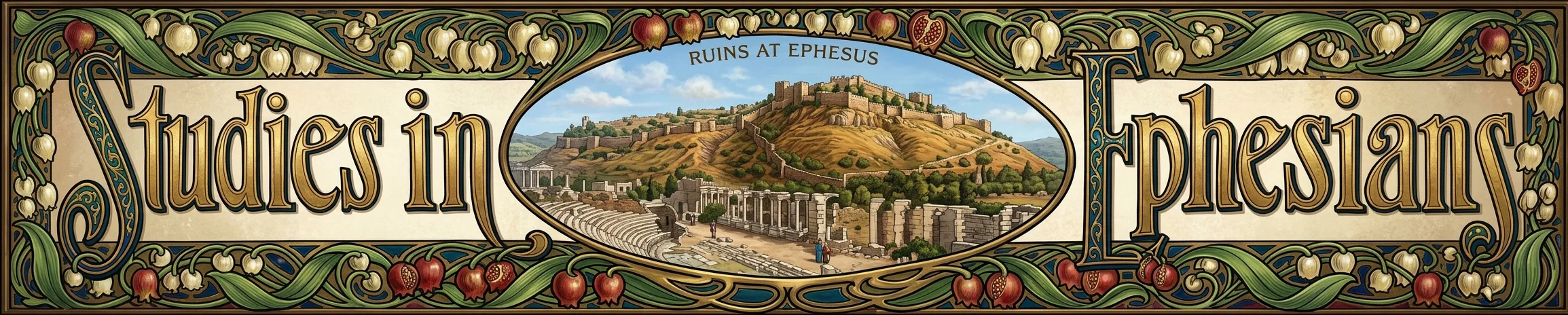
Studies in Ephesians
From Gentile to Israel
Chapter 2, Verses 11-22
Questioning the Text
1. What does the apostle call upon the Christians whom he addresses to remember?
“Wherefore remember, that once ye, the Gentiles in the flesh.” Verse 11, first part.
2. What were these Gentiles called by the Jews?
**“Who are called Uncircumcision by that which is called Circumcision, in the flesh, made by hands.” Verse 11, last part. Note .**
3. What was their relationship to Christ at the time that they were Gentiles?
“That ye were at that time separate from Christ.” Verse 12, first clause.
4. What was their relationship to Israel?
“Alienated from the commonwealth of Israel.” Verse 12, second clause.
5. How were they related to the covenants?
“And strangers from the covenants of the promise.” Verse 12, third clause.
6. How is their condition summed up?
**“Having no hope and without God in the world.” Verse 12, last clause. Note .**
7. What change was wrought by their conversion?
**“But now in Christ Jesus ye that once were far off are made nigh in the blood of Christ.” Verse 13. Note .**
8. What is Christ to us, and what has He wrought for us?
**“For He is our peace, who made both one, and brake down the middle wall of partition.” Verse 14. Note .**
9. What has He abolished, and where?
**“Having abolished in His flesh the enmity, even the law of commandments contained in ordinances.” Verse 15, first part. Note .**
10. What did He accomplish by this abolition?
**“That He might create in Himself of the two one new man, so making peace; and might reconcile them both in one body unto God through the cross, having slain the enmity thereby.” Verse 15, last part, and 16. Note .**9
11. What therefore did He preach?
**“And He came and preached peace to you that were far off, and peace to them that were nigh.” Verse 17. Note .**
12. How therefore do both Jew and Gentile stand on the same basis?
**“For through Him we both have our access in one Spirit unto the Father.” Verse 18. Note .**
13. How does the apostle sum up the change which has been wrought by conversion?
**“So then ye are no more strangers and sojourners, but ye are fellow-citizens with the saints, and of the household of God.” Verse 19. Note .**
14. Upon what are they builded?
**“Being built upon the foundation of the apostles and prophets, Christ Jesus Himself being the chief Corner-stone.” Verse 20. Note .**
15. To what does the apostle liken the believers?
**“In whom each several building, fitly framed together, groweth into a holy temple in the Lord.” Verse 21. Note .**
16. Of whom is this spiritual temple the habitation?
**“In whom ye also are builded together for a habitation of God in the Spirit.” Verse 22. Note .**
Notes
Some Truisms
FAITH will end in sight. Hope will end in the presence of the glorified Christ. Charity will never end.
Faith gets the most. Humility keeps the most. Hope endures the most. Love works the most.
Faith looks forward to. Hope looks upward into. Love looks inward for.
Faith writes about redemption. Goodness provides redemption. Hope sees redemption. Love enjoys redemption,
Faith must be worked with works. James 2:22. Hope maketh us not ashamed. Love worketh no ill.
Let Us Give More Gratitude
By Stopford A. Brooke
We give much blame, and it may be well. Let us give more gratitude, and it will be better for the world. It is very sore with many sorrows, many blows; and we know not how much good a tender voice and a soft hand may do. We have so short a time to live, let us feel and give all the gratitude we can. We shall never regret that in the world beyond, where God is grateful for all who have been kind to His children here.