As in other localities, here the Lord can take uneducated men and make them a power for good. One of our church elders could not read when he accepted the truth. Now he not only reads much, but preaches excellent sermons. The points he makes are really pointed, and the originality of framing which he sets about the thoughts expressed, impresses his hearers as coming from one who is acquainted with the Master. His love for this message, which he has known only a few years, leads him to devote his evenings to the holding of cottage meetings.
Sometimes the best of schools fail of making their instruction practical to all pupils. A boy from the seventh grade, now under private instruction, was having a lesson in liquid measure. His teacher, having a doubt as to his understanding of the terms used, went with him to the kitchen, where some measuring could be done. Her fears were not groundless. After several measurements of water the boy said, “You do8teach me well. For a long time I have been able to repeat the table, but had no idea how much a pint or a quart is.”
In all the Sabbath schools I have attended in more than the forty years past, I have seldom heard more interesting reports than we do in the Santurce school. Our secretary is a boy of fourteen who gives thought to writing his report, and is able to give the story in a variety of ways. No longer are we given just the dry statistics read in a still drier manner.
One of the boys I am teaching had a habit of listlessly dreaming away his time when not being directed in his work by others. Thus many precious moments were lost which he sadly needed for improvement. One day his reading lesson was an article on “The Value of Minutes,” written by Prof. Frederick Griggs. An effort was made to impress the lesson upon him personally, and a radical change has taken place.
One of my pupils had difficulty in pronouncing and learning the significance of the word “tranquillity,” as used in the account of Nebuchadnezzar’s dream. When asked for a practical application of its meaning and reminded that Christians should always be tranquil, he said, “But when the troubles come we forget the word.” Can we who are older remember having forgotten the word?
A colored pupil in defining the word “race” gave several correct definitions, and as a final one, “a class of beings.” He was asked the following question: “Were you to be placed back to the time of your birth and were given the privilege of choosing to which race you would belong, which would it be?” The significant and characteristic answer was, “Just the one to which I do belong.” MRS. D. A. FITCH.
Holding the Attention
By Frank F. Mills
A MOTHER with her three children was hurriedly crossing the campus of one of our Western institutions on her way to the grocery store. As she was passing by a large wire cage which contained a parrot, her attention was suddenly attracted by hearing the word “mamma” called out in a most distressing way. Thinking that something had happened to one of her little ones, she quickly turned around to see what the trouble might be; but when she learned that they were all right and that it was only a parrot calling her, she hastened on.
It is one thing to call attention, and it is quite another thing to hold the attention after we have called it. This parrot succeeded well in calling the mother’s attention, but there its influence ceased. Its vocabulary consisted chiefly of the one word “mamma,” which some one had taught it to say years before, and it was incapable of going farther.
There are thousands of persons in this world who are hungering and thirsting for the bread and water of life, but who are too busy to stop very long to listen to a parrot. Intelligent workers are needed everywhere. The Saviour of the world is earnestly calling for young men and young women who are willing to enlist their all, to go out into the dark places of the earth and help to prepare a people for his coming; but only those who are constrained by the love of Christ, and are capable of speaking forth words that come from a sincere heart overflowing with the Holy Spirit, will have a commendable measure of success. God desires that his people shall be the most refined, the most intelligent, and the best-educated people in the world, not only because they are his children, but because they are engaged in the greatest work ever given to man.
“We are not here to play, to dream, to drift;
We have hard work to do, and loads to lift;
Shun not the struggle; face it; ’tis God’s gift.”
For this very reason Seventh-day Adventist young people should improve every opportunity for developing into strong Christian workers who have not only a theory of the truth, but an experimental knowledge of it as well. Then as we go out into a scoffing world to do our Master’s bidding, we will be classed among that corps of workers who rightly divide the word of truth, and we will not be put to shame.
FRANK F. MILLS.
Authoritative Ignorance
By J. O. CORLISS
It has been suggested that the most densely ignorant people are especially haughty in conduct toward those who differ from them in theory. An apt illustration of this is found in Saint Simon’s Memoirs of the Courts of Europe. In these he tells of one Breteuil who, in the reign of Louis XIV, though not without considerable natural intellect, was very free when in company, to advance in a strong, knowing way, some of the most absurd ideas, which caused his friends sorely to ridicule him.
Having obtained the post of “Introducer of Ambassadors” at the king’s court, he was one day dining at the house of Madame Pontchartrain, and began discoursing quite authoritatively on some subject, when his hostess ventured to dispute his statements. As the contest of words waxed warm, the madame, in order to test his knowledge, offered to lay a wager that he did not know who wrote the Lord’s Prayer. He defended himself the best he could, until able to leave the table, before being called upon to decide the point.
Caumartin, another courtier, seeing his embarrassment, ran to him and whispered in his ear that Moses was the author of the Lord’s Prayer. Thus encouraged, Breteuil returned to the encounter, and while sipping coffee managed to bring the conversation round again to the point of the wager. He then reproached the madame for supposing him to be ignorant about so simple a question, and added most emphatically that Moses wrote the Lord’s Prayer. The burst of laughter which followed was overwhelming, even to the confusion of the poor ignoramus. He is said never to have fully recovered from the experience, because of the persistency of those learning of it to make it a standing reproach to him.
Another similar case of ignorance is related by the same author. A certain marquis of Gesvres was one day talking in the king’s cabinet about some fine paintings of the crucifixion hanging on the walls, and remarked that they were all made by the same artist. His statement was challenged by some one present who recognized the different styles of the artists, and named the authors of the various productions. “Not at all,” said the marquis, “the painter of them is called INRI; do you not see his name on each of the pictures?”
When one considers that these letters, “INRI,” which were over the cross in all the pictures under consideration, were but the Latin inscription which is made to stand for “Jesus of Nazareth, King of the Jews,” he may well imagine what followed such gross stupidity and ignorance as was displayed by the haughty marquis.
But the dense darkness illustrated by the cases cited9is in no wise confined to seventeenth-century annals. There are present generation records of those supposed to be fair Bible teachers—preachers at least—who have supposed the ten commandments to be found, as first given, in the New Testament. Such have been known to search for a long time to find the noted document, and then have acknowledged their inability to locate it.
It is well for the youth to know fully, each for himself, on whom he believes, and so be persuaded that God is able to keep that which has been committed to him. It is not enough to take for granted what some human being has said about the Word of God. Instead, he should hold the opinion expressed by the Irish boy when told by the priest who found him reading the Bible, that it was the “milk of the Word,” and he being only a babe, should take the milk as it is given by the church. “So,” said he, “give me the Book, and come to me for guidance.” “But, sir,” said the boy, “I would rather keep the cow, and draw the milk for meself.”
May each and every one decide now that the milk of the Word shall become his daily nourishment for his individual self, so that he may indeed become wise unto salvation. J. O. CORLISS.
As It Was in the Days of Lot
By Gladys Rosser
It was a bright, clear day when Abraham and his nephew climbed to the top of a hill overlooking the beautiful valley of the Jordan, to the south and west of which was the hill land of Canaan.
“Let there be no strife, I pray thee, between me and thee. . . . If thou wilt take the left hand, then I will go to the right; or if thou depart to the right hand, then I will go to the left.” This generous offer was made by the older man; but Lot had already made up his mind that, being a younger man, and standing a better chance of becoming a great man in the world, it was his right to have the best part of the country; so he quickly availed himself of first choice, and pitched his tent toward Sodom.
Finally Moved into the City
That the girls might enjoy the city’s social advantages, Lot finally moved into Sodom. Here they continued their education in music and art. Very soon they came to think that their simple manner of dress stood in the way of the popularity they desired, though their father insisted on their maintaining the simple style of dress they had worn in the mountains, while living with their Uncle Abraham. But the girls were not satisfied to do this. They held a conference with their mother. “You see,” they told her, “we do not like to be a gazingstock. More than that, the young people will not associate with us so long as we dress so oddly, and we have no opportunity to tell them of the true God. Now if we dressed differently, then we could associate with them, and have a much better chance to do missionary work.”
Mrs. Lot was unable to withstand their arguments, though Lot was still reluctant to give his consent for them to forego the simple mode of life, and the modest costume that he knew was becoming a child of God. The mother quietly said: “I admire the missionary spirit in our girls, and I’d be afraid to place anything in the way of it. The people of this town certainly do need the gospel, and who knows but that we may be able to reach them through our girls. More than that,” she added, “I cannot bear to see my children made a gazingstock.” Lot was silenced, but not satisfied.
The more fashionable gowns were obtained, and in due time there followed the purchase of bracelets and earrings, and a necklace of pearls they had always coveted. It was a costly and very beautiful article, left with the principal jeweler of the town by some merchantman from the East. The girls of Sodom envied Lot’s eldest daughter when she first wore the treasure. These compromises brought the coveted popularity. As the girls were accomplished musicians and versatile entertainers, the dark-skinned young men of Sodom soon began to show them pronounced attentions.
Mrs. Lot Shocked at the Announcement
One day the girls announced that there was to be an instructive play of an innocent kind in the Central Theater that night, and that the young men had promised to take them to see it.
Mrs. Lot was shocked. “No, girls, never!”
“But, mother,” they insisted, “the boys say that if we will go with them tonight, they will go with us to Uncle Abraham’s next Sabbath; and we’re anxious for them to hear Uncle Abraham, he is such a good speaker; and we want the boys to hear of the true God.”
Mrs. Lot said no more, and the girls went.
Now Abraham held a meeting with his three hundred servants every Sabbath; and Lot and his family usually joined them in the worship. Here they could rest and enjoy the day together with those who served the same God. Indeed, had it not been for these meetings, no doubt Lot and his family would have been quite overcome by the strength of idolatry with which they were in daily contact.
Lot usually took part in the meetings, but the wife and daughters, though maintaining a quiet and respectful attitude, never took part. Lot excused them to his uncle, saying the girls were naturally reserved.
It had grieved Abraham to notice that his nieces had adopted the style of dress of the Sodomites, and that their language seemed to be of the world more than of Canaan.
One Sabbath day, though the usual preparations for the visit out to the hills with the patriarch Abraham, had been made, the girls said to their parents, “You may go on. The boys are to call for us. We’ll be out in time for meeting.”
It was a lovely ride across the plain, up to the vine-clad hills and through the olive groves, and the young people greatly enjoyed it. The young men were attentive and seemed deeply moved by the sermon. On the way home they told the girls of a feast to be held in one of their largest temples in honor of the sun god, and invited them to attend. “You see,” they said, “we have been out to learn about your God, now we want you to learn of ours.” The girls were curious, so accepted the invitation.
A year passed in this sort of interchange, the girls going to feasts and to other questionable places of amusement, and the young men scarcely missing a Sabbath out in the hills, until they had a fairly good technical knowledge of the true God.
Then, as such associations usually end, Lot’s two eldest daughters decided to link themselves up for life with the young men who had been so attentive to them; and of course to please them the ceremony was performed in the temple of Ashtaroth.
For some time Abraham missed Lot’s regular visits, so he and Sarah decided to visit their nephew. They were surprised to find the girls married, and inquired if the young men they had chosen kept the Sabbath.10
“Well, no;” Lot was reluctant to answer so pointed a question, but added reassuringly, “They believe it just as much as you and I do. You ought to have heard them arguing in the market place; you could not have preached a better sermon on the subject yourself.”
Abraham tried to say something about faith without works being dead, but Lot interrupted him to say, “They told me that as soon as they had enough laid up to supply them with comforts the rest of their lives, and their affairs all settled, they would keep the Sabbath; but just now it would interfere with their business, and they could not afford it.”
Sodom grew richer and more prosperous. Crowds of idlers thronged the streets; sight-seers were continually coming and going. Not a day passed without a feast, a dance, or some new entertainment, and Lot’s daughters were in a round of excitement.
The Fateful Day
But a last day came, as it must come to all. It seemed to be like all other days. “Evening fell on the scene of loveliness and security. A landscape of unrivaled beauty was bathed in the rays of the declining sun. The coolness of the eventide had called forth the inhabitants of the city, and the pleasure-loving throngs were passing to and fro, intent upon the enjoyment of the hour.”
It is late evening when Lot is seen making his way through the streets to the homes of his daughters. Strange is the message which he bears! What is it that has made him speak it so earnestly? What has impressed so vividly upon his mind the thought that the city is to be destroyed?
Lot’s daughters are at first alarmed; but not so with his sons-in-law. They look out over the great city and question, “Where is the promise of this destruction?” then add reassuringly, “‘All things continue as they were from the beginning of creation.’ Leave the city? — No, we cannot leave our beautiful homes, even if we must be destroyed with them.” So they turn a deaf ear to his entreaties, laugh at his tears, and in a fit of provocation drive him from the house.
Grieved, Lot was compelled to leave them to the coming destruction, for already the clouds of divine vengeance were gathering over the doomed city.
When the sun next rose on the proud city of the plain, it was a smoking ruin of those treasures, homes, and pleasures that had bound the hearts of the once devout girls to them.
Dear young people, what associations are you forming? What friendships are you making? Are they such that the message, “Come out from among them, and be ye separate,” will not be able to break off your associations? Are you binding yourselves with strong cords to this world, to its pleasures and its riches? Are you walking hand in hand with the world? Remember, a last day is coming. Where will that day find you?
GLADYS ROSSER.
Marion’s New Year’s Resolution
By Elizabeth J. Roberts
MARION WILCOX had made just one New Year’s resolution this time, and had written it in very large letters on the first page of her new diary for 1918. It read,
“I AM RESOLVED THAT I WILL NOT ALLOW MY TEMPER TO GET THE BEST OF ME ONCE THIS YEAR. MARION WILCOX.”
On previous New Year’s Days she had usually written down at least a dozen resolutions, and when there were so many it was easy to excuse oneself for forgetting; but there would be no excuse for forgetting when there was only one, she decided. She felt so sure of herself that she even held her diary open before the eyes of her roommate, Beth Agnew, that she too might read and admire.
“What made you write it in those big capital letters?” inquired Beth.
“Why,” explained Marion, “they look so much more important than little letters. I just felt it would make more of an impression on me, somehow.”
Several times during the day Marion opened the little diary to glance at the bold lettering of her resolution, and each time she felt more sure that there would be no excuse for breaking it.
Two days later found her lying face down on her bed, crying as if her heart would break, while Beth sat beside her, gently stroking her friend’s clenched little fist. After a time the sobbing grew less, then a muffled voice wailed:
“O Beth, whatever am I going to do? Here I have broken my resolution already, and let my horrid temper get me into trouble again. Miss Perry has been so dear and good to me in a thousand ways, and I was simply impudent to her because she spoke to me about my poor recitations. She will never respect or love me again, and I might as well be dead.” Whereupon the sobs began again with renewed vigor.
“Oh, I think Miss Perry will overlook it, Marion,” said Beth in a comforting tone. “She knows you can’t help being quick tempered, and will make allowances.”
“But I ought to help it,” wailed the muffled voice. “I call myself a Christian, and every night when I say my prayers I pray for God to help me to overcome my temper, but it doesn’t seem to do one bit of good.”
“Well,” argued easy-going Beth, bent on consolation, “your temper was born with you, so you are not to blame. Once I heard my uncle say of a man, ‘That fellow can’t be a Christian, he is too wide between the eyes.’ I couldn’t understand what his eyes had to do with his not being a Christian, but anyway he was born with them that way, so he couldn’t help it.”
“Why, Beth Agnew!” exclaimed Marion, sitting up with sudden vigor and turning red and reproachful eyes on her friend. “You talk like a heathen, and so did your uncle. If the gospel isn’t able to save the very worst sinner on this earth, it isn’t any good at all. I know God can help me overcome my temper, but I just don’t yet understand the way well enough. Come on, let’s go and see the preceptress.”
In a few minutes the two girls were in Mrs. Smith’s quiet room, and Marion, seated on a footstool close beside her teacher, was pouring forth the tale of her woes. At the end, with a pathetic little catch in her voice, she said:
“I’ve prayed, and I’ve cried, and I’ve tried as hard as I know how, yet my temper just goes on getting the best of me nearly every day of my life, and I’m perfectly discouraged.”
During this recital Mrs. Smith had placed her hand lovingly over the tense little hand resting on her knee, but her eyes still sought the pages of the Bible she had been reading when the girls entered. Now she looked at Marion with a smile and asked, “Have you studied your Sabbath school lesson for this week?”
The question was such a complete surprise that for an instant Marion hesitated, then answered:
“No, Mrs. Smith, I have not—yet.” And both girls blushed uncomfortably, for the students of Holden Academy had been urged many times to avail themselves11of the help and strength to be derived from the daily lesson study.
“I believe this lesson would be a great help to you in understanding just how that troublesome temper may be overcome,” continued the preceptress, quietly.
“What is it about?” asked the girl eagerly, then added apologetically, “of course we have our new quarterlies, but with New Year’s and all, we haven’t looked at them yet.”
“The subject is, ‘The One Mediator,’ meaning, of course, Jesus Christ. It speaks first of how every created thing was made through and by him. Then in Hebrews 1:3, we learn that he upholds all things by the word of his power.”
“Turning to Genesis 1:27, we find that man was created in the image of God; but after Adam sinned the curse of death entered his body, and Genesis 5:3 says he begat a son in his own image and likeness. Ever since that time, man has been born with the sinful, or carnal, nature that came to Adam when he disobeyed, and ‘all have sinned, and come short of the glory of God’ as a result.”
“Your temper is a part of this carnal nature; all selfishness, laziness, or inclination to indulge in anything sinful, is a part of it. We are all born with this carnal nature.”
Beth now leaned forward with sudden interest—she had always felt very sorry for that man who had been born with his eyes too wide apart.
“Could every one on earth be saved if he wanted to be?” she asked.
Mrs. Smith held out her Bible with the words, “Read Romans 1:16, Beth.”
Finding the place, the girl read, “For I am not ashamed of the gospel of Christ: for it is the power of God unto salvation to every one that believeth; to the Jew first, and also to the Greek.”
“You see it says ‘every one that believeth,’ dear. It is harder for some to have faith than it is for others; but every one who earnestly and honestly wants to believe will be enabled to do so.”
“Now,” she continued, “if we are all born with this carnal nature that makes it natural and easy for us to do wrong, there would have to be some great change in us, would there not, before God would dare trust us with eternal life?”
“Yes, there would,” exclaimed Marion earnestly. “And Jesus tells us about it in the third chapter of John. He said if we want to have eternal life we must be born again; but that is the part I don’t quite understand—how can I be born again?”
“I am glad you girls see the need of a change in our natures; I am glad you understand how impossible it would be for God to take any one to heaven who enjoyed doing wrong, for then heaven would be no better than this earth. Now we will try to find out how we can have this carnal nature that loves to do wrong changed to a spiritual nature that loves to do right. Jesus never told us to do anything that it is impossible to do; just remember that whenever you are tempted to feel discouraged.”
“In 2 Corinthians 5:17 we read, ‘Therefore if any man be in Christ, he is a new creature: old things are passed away; behold, all things are become new.’”
“But how is it done?” asked both girls together.
“God gives the new nature, the new birth,” said Mrs. Smith, reverently. “But there is something for us to do before he can give it. Jeremiah 29:13 says we shall find Jesus when we search with ‘all our heart,’ so a very earnest desire is one of the first things necessary. If you want a thing with all your heart, you will be willing to work hard to obtain it. How were the heavens and the earth made in the beginning?”
“God spoke, and they were,” answered Marion.
“Yes, it was by the word of God that this earth and all it contains came into existence. Now read 1 Peter 1:23.”
Beth turned and read, “Being born again, not of corruptible seed, but of incorruptible, by the word of God, that liveth and abideth forever.”
“You see,” said their teacher, “that the same word that created this world is used to create us new creatures in Christ Jesus. What is the ‘word of God’ to us?”
“Why, it is the Bible, isn’t it?” questioned Beth.
“Yes, the Bible is the word of God, sent to us through the holy prophets. And if we really want to get rid of our sinful, carnal natures, and be born again new creatures in Christ Jesus, what will we be willing to do?”
“Read a great deal of God’s Word and think about it and believe it,” answered Marion.
“That is right, dear. If we read and think and believe God’s words there is a living power in them that changes us. As we think much on the perfect life of Christ, our own life will become perfect like his, and we will begin to hate sin. It is very wonderful, and we cannot explain just how this change comes about, but it is true, and any one who is willing to try it honestly, may prove its truth.”
“I’m beginning to see why I cannot control my temper,” announced Marion, looking bravely into her teacher’s eyes. “I’ve been so busy with my own work and pleasure that I have spent very little time studying and thinking on the words of God; no wonder I am not like Christ.”
“I think Marion and I understand why we need the daily lesson study now, and will be more faithful,” remarked Beth.
Mrs. Smith picked up her Morning Watch Calendar lying near.
“Have you girls read the Morning Watch text for today?” she asked.
“No; we have neglected that too,” said Marion contritely.
“It is Psalm 86:5. Will you please read it, Beth?”
Finding the text, Beth read, “For thou, Lord, art good, and ready to forgive; and plenteous in mercy unto all them that call upon thee.”
“Why, that sounds as if you yourself had picked it out for us; isn’t it queer that it happened to be the text for this particular day?” exclaimed Marion, leaning over to look at the calendar.
“You see it is really the text for Jan. 3, 1918,” said Mrs. Smith, smiling. “I think that if you are faithful in studying your Morning Watch texts, you will find that they very often just exactly fit your need.”
“I will be faithful in studying them,” said Marion, with decision.
“The Lord helping,” supplemented Mrs. Smith softly. “Prayer and the Morning Watch in the morning, prayer and the daily lesson study at night, will work a transformation in any life. “Remember, dear girls, there is still creative power in the words of God, and if we will use them as he has directed, we shall become ‘new creatures in Christ Jesus,’ according to the promise.”
Good nights were now said, and the girls started down the hall. The preceptress stood watching them12until they reached the foot of the stairs, then she heard Marion say:
“Go on up, Beth; I want to see Miss Perry a minute, then I shall come.”
“God bless the child,” whispered the watching teacher, softly. “She is beginning with confession and she will end with victory, please God.”
ELIZABETH J. ROBERTS.
Intensive Training of Aviators
SOON after our entry into the war, aviation ground schools were established at the Massachusetts Institute of Technology, at Cornell, Princeton, the Ohio State University, the University of Texas, the University of Illinois, Georgia School of Technology, and the University of California. These institutions soon put a thousand choice young men through the preliminary courses and are graduating others every week into the government flying schools.
These schools, each costing about a million dollars, were built at great speed as soon as the enormousness of the American training program was evident. During this early time of preparation, however, the government was extremely glad to accept the offers of its Allies, for training American aviators in schools in Canada, England, France, Italy, and Egypt, where finished airmen are now being turned out each week. At the same time the United States accepted the proffer of trained and experienced instructors for the fields in this country, and many such men are now here.
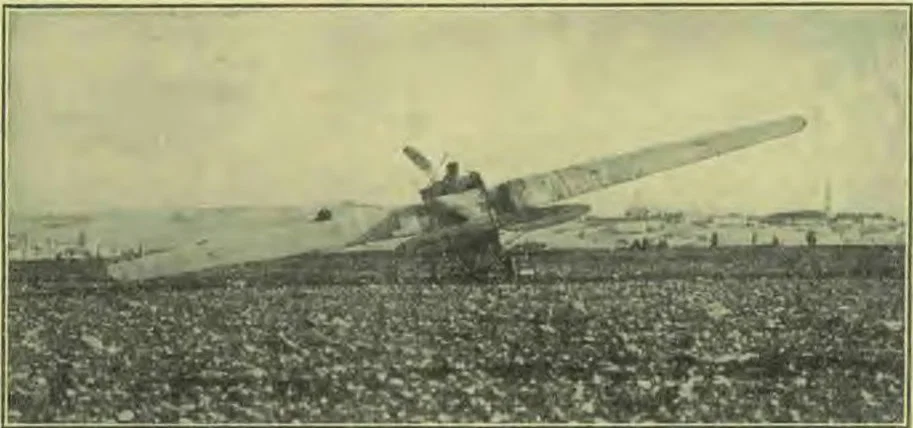
FIRST AEROPLANE TO VISIT JERUSALEM, PALESTINE
The man who would fly has a difficult training before him. His course at the ground school is eight weeks, and that in actual flying four months in length before he is ready to go abroad. He begins in the ground school with gaining an understanding of engines. Then comes the theory of flight, including the planes themselves and the principles of different types, the mysteries of the rigging that holds the wings in place and how to repair it. The student must learn enough of astronomy to steer his course at night by the stars. Then he must know how to operate a camera under unusual conditions and how to read the meaning of a mile-high photograph. The classes study typographical maps from the tops of sixteen-foot ladders in lieu of looking down on the earth from two miles up. Upon these maps the instructors locate batteries and give problems in spotting. The student from his perch gives corrections for the operation of hypothetical big guns. These corrections are given with a wireless key, the use of which is a part in the thorough mastery of the Morse code. Finally the student takes his buddy, the machine gun, unto himself and comes to know its every impulse.
The second stage in the cadet’s training is at the big new flying fields, where he first goes into the air and applies the theoretical knowledge gained at the ground schools and continued in advanced instruction here. The cadet’s first joy ride and his earlier trips generally are taken in company with the instructor, who has full control and responsibility for the machine, and whose main purposes are, first, to estimate the cadet’s coolness, and, second, to accustom him to the feel of the air. As soon as his skill warrants it the cadet is allowed to direct the controls himself, always subject to the check of the instructor, in order that he may learn with safety just how to manage the wings, rudder, and engine. This early practice consists largely of short flights with many starts and landings, the most difficult phase of flying.
Then when the cadet has shown himself a master of these principles, he goes up alone into the air for the first time. He is watched with the most infinite care by the instructors below, surrounded with the most rigid instructions to prevent accidents, and fully coached upon landing as to any errors he may have made. By the end of this instruction he is doing the more simple evolutions at a height of ten thousand feet or soaring off on thirty-mile cross-country flights. By this time he will have completed his tests as a Reserve Military Aviator, will receive his commission as an officer of the American Air Service, and will be ready to go abroad to the fields on the other side for his final training in the more complex evolutions and in squadron formation.—Saturday Evening Post.
Adams's Trained Bears
By W. S. Chapman
BARNUM'S museum, the first, or “old,” one, was a marvel, not only for the quantity and quality of its exhibits, but for the ingenuity displayed in its construction. Yet it was a veritable fire trap, one that would not be tolerated in any city today. Had the fire which finally destroyed it occurred during exhibition hours, when the building was usually crowded, there would certainly have been a loss of life comparable to the awful Chicago theater fire.
In the cellar of the building, Barnum constructed a large tank in which he had on exhibition a baby white whale, about sixteen feet long. Some said that it was not a whale but a sport blackfish. Around the cellar walls were arranged a series of iron cages, each containing a bear, and in the center, in front of the whale tank, and facing the entrance hall, was a giraffe yard. The floor of the second story was cut away, leaving an opening about six feet square fenced about with an iron railing. On this rail were hung baskets containing hay and other feed for the animal, as the head and neck of the giraffe reached fully to the top of the railing. The giraffe soon became very tame and would feed from the hands of the visitors. All the portion of the animal below the floor was visible from the street. At all hours there were crowds of people gazing at the show. It proved a great advertisement, as was anticipated. The yard was just at the rear of the ticket office, so the people would become anxious to see the rest of the animal and would buy tickets in order to reach the second floor to look at his head.13
There was an old hunter and trapper named Adams who had spent a lifetime in California and the Far West. For years he had been catching young bears and training them as they grew, looking forward to a time when he would be able to exhibit them in the cities of the East. That had been his life dream, but he had no money to finance such an undertaking. When the time came that the bears were properly trained and fit to exhibit, Adams wrote to Mr. Barnum, offering him a half interest in the profits if he would furnish the necessary funds. Barnum agreed to do so, and Adams bought cages and other exhibition paraphernalia and shipped his show to New York. Here a small vacant theater was engaged, the stage was altered into a circus ring, and the animals were chained at regular intervals by chains around their necks, the cages being grouped around them. As Adams performed with them he would unchain such as he needed, and the animals would act their parts with no disposition, apparently, to roam outside the ring. To the audience it looked scary, but this was part of the show.
In the center of the ring was a pole about twenty feet long, with a platform from the top. Here rested a small brown cinnamon bear, unchained, that was the clown of the show, and he certainly maintained his reputation, to the delight of the small boys in the front seats, who, if they came a second time, were careful to get on the next back row of seats, outside of his reach.
In the circle of bears, and well to the front, was chained an immense female grizzly bear, crosser “than all get out,” as Adams put it, no doubt having been trained to act in that way in public; a terror even to look at, that snarled and spit and struck at her owner each time he came near her. Adams made things worse by striking back at her each time he passed, and then jumping back out of her reach. At such times creeping chills would go up the backs of the small boys in the front seats, and a general scramble for the rear would take place, which of course was a part, also, of the performance, as Adams remarked, to “make it interesting.”
Well, the show opened and ran for two nights with crowded house. The third night it closed abruptly and for good. It had progressed nicely for a half hour, and the audience had become worked up to a highly appreciative mood over the wonderful training shown by the ungainly brutes, when Mr. Adams, growing overbold, in hurriedly passing the old bear, and striking at her as usual, slipped slightly, so that his spring did not carry him beyond her reach. One claw caught in his coat, and the bear drew him towards her, crushing him in an embrace which no mortal can go through and live. When she opened her arms the man dropped in a limp mass before her. He was quickly rescued and carried off the stage, while the thoroughly frightened people struggled in a desperate attempt to reach the doors, many women shrieking and others fainting, forming a wild and terrifying scene.
Order was finally somewhat restored when Mr. Adams walked into the ring and announced, in a weak voice, that he was not much hurt and would appear the next afternoon; but he died that night. The animals were taken by Mr. Barnum and placed in the cellar of his museum, where they perished, miserably, in the great fire that shortly afterward destroyed the building and all its contents. In that fire Barnum lost the collection that had occupied the greater part of his life to bring together. Adams lost his life just as his dream of success was apparently coming true. No more fitting illustration of the vanity of all human plans and aims could be presented—the vanity and unreliability of human inventions.
The fearful cries of the poor imprisoned animals, for whom it was impossible to do anything, and the shrieks of terror from the poor little creatures on the top floor in the happy-family cage, were pitiful and horrible to hear. The scores of windows in each hall made it possible to watch the progress of the fire as it crept from floor to floor, licking up the cases of curios, and finally reaching the cages. It was possible that the dense smoke suffocated the creatures before the flames touched them. The monkeys were the last to succumb, their pitiful calls continuing long after all others had ceased. W. S. CHAPMAN.