The Youth’s Instructor, Vol. 66, No. 7.

Criminals to Be Tested by Alienists in New York

The Youth’s Instructor

Feb 12, 1918

Review and Herald Publishing Assn. · Takoma Park Station, Washington, D. C. · Feb 12, 1918

Criminals to Be Tested by Alienists in New York

Criminals condemned to death in New York hereafter, are to be tested by alienists as to their mentality.
Mississippi, Virginia, and Kentucky have already ratified the amendment for national Constitutional prohibition.
At the Council of the Allies held at Paris a few weeks ago, a permanent war council was appointed to sit at Versailles. By this means the effort of the Allies will be directed and co-ordinated rather than each working singly.
A “quicker than walking” form of exercise has been discovered. Chas. H. Clark, of New York City, has invented a ball-bearing, pneumatic-tired skate which will run easier on a level road or street than an ice skate will slide on ice.
A cord of wood has as much heating value as a ton of coal. Hard wood is equal to hard coal, and soft wood to soft coal. It may become a patriotic service to burn wood, wherever possible, in order to relieve the shortage for war industries, and for the people who are entirely dependent on coal for fuel.
According to Mr. Sunday, the well-known evangelist, gossipers or scandalmongers, are victims of the “hoof-and-mouth disease.” There's but one cure for this disease when it manifests itself in the human being, namely, the answer to David’s prayer, “Create in me a clean heart, O God; and renew a right spirit within me.”
In Bohemia and Bavaria there were no muskrats until 1894. As an illustration of how rapidly muskrats increase in some districts, the Bavarian Commission which reports on the matter says that in Schlüsselburg in 1911 there were ten muskrats, while in 1913 the number had increased to three hundred, and in 1916 to more than one thousand.
Japanese mosquitoes’ and ants’ eggs are the principal ingredients of a food which has been found especially valuable to bird feeders. The nationality of the mosquitoes is not supposed to make a difference in the style or digestibility of the food. The reason the insects are imported from Japan is that the Japanese have a method of catching them in large quantities which as yet Americans have not discovered.
The Boy Scouts of Washington, D. C., have the honor of having had the most famous corn field in the country. This was the one they cultivated last year in Potomac Park. The boys harvested nearly 8,500 bushels of cob corn, and sold it to a Washington miller for more than a dollar a bushel. The large sum of money realized from the sale is being devoted to patriotic purposes.
The European trenches are not the only places where gas masks are used. They have been used for years in American industries. Men who handle barrels of chloride of lime use them, for the chloride of lime gives off irritating dust powder and chlorine gas, the destructive gas used in trench warfare. Foreign cotton has to be disinfected to kill the boll weevil. It is treated sometimes with hydrocyanic gas pumped at a pressure of one thousand pounds to the square inch. A whiff is fatal. Chemists use masks when experimenting with dangerous combinations of chemicals. Motion picture photographers are obliged to use them in getting some kinds of pictures.
Junior Red Cross units are to be schools. As soon as an amount equal to twenty-five cents for each pupil has been placed in the local school fund, the school becomes an auxiliary of the Red Cross, and is entitled to display a Red Cross banner.
The people of Littau, Saxony, were urged by the city council to go shoeless during the mild weather, as, owing to the scarcity of leather, they might otherwise be compelled to go shoeless during the winter.

For the Finding-Out Club

Answers to Questions in “Instructor” of Nov. 6, 1917

1. Isaac Watts. English. Noted writer of sacred poems.
2. John Gay. English poet and dramatist. Best remembered by song, “Black-Eyed Susan.”
3. William Wordsworth. English poet and nature lover.
4. William Hazlitt (1778-1830). English critic and essayist.
5. John Lothrop Motley. American historian and diplomatist.
6. Jonathan Swift. Born in Dublin of English parents. Celebrated satirist and man of letters. Wrote “Gulliver’s Travels.”
7. Robert Charles Sands. American poet and author.
8. Phillips Brooks. Noted American clergyman.
9. Bill Nye, or Edgar Wilson. American humorist.
10. Julia Ward Howe. Born in New York. Wrote “The Battle Hymn of the Republic.”
11. Eugene Field. Native of St. Louis. American journalist and poet. His love of children inspired much of his best work, such as, “Little Boy Blue.”
12. Charles Brockden Brown. Eminent American novelist, born in Philadelphia.
13. Thomas Gray. English poet. Wrote “Elegy Written in a Country Churchyard.”
14. John Bunyan. English. The author of “Pilgrim’s Progress.”
15. Thomas Paine. Anglo-American political writer and freethinker. Published the periodical Crisis.
16. Mark Twain, or Samuel Langhorne Clemens. Noted American humorist.
17. Charles Reade. English novelist and dramatist, born in 1814.
18. Paul E. More. American editor, essayist, and critic. Born in St. Louis.
19. Thomas Hughes. English author, social economist, and barrister. Author of “Tom Brown’s School Days at Rugby.”
20. Bede (673-735). English monk and ecclesiastical writer.
21. Alice and Phoebe Cary. American writers of poems, stories, and sketches.
22. Thomas Knox. Popular American writer. Author of “The Boy Travelers.”
23. Washington Irving. American writer, often called the father of American letters. Author of “Rip Van Winkle.”
24. Rev. J. A. Wylie. Wrote extensively on religious history. Author of “History of Protestantism” and “The Papacy.”
25. John Foxe. English. Wrote “Book of Martyrs.”
26. David Ross Locke. American humorous writer. Wrote much political satire, under the name of Petroleum V. Nasby.
27. Francis Scott Key. American. Author of “The Star-Spangled Banner.”
28. Joseph Addison. English writer of the seventeenth century.
29. George Crabbe. English poet.
30. Geoffrey Chaucer. The father of English poetry. His principal work was “Canterbury Tales.”
31. William Dean Howells. Distinguished American author. Editor-in-chief of the Atlantic Monthly from 1871 to 1881.
32. Laurence Sterne. Celebrated English novelist and humorist.
MRS. GRACE HOOVER.
(Concluded next week)

Castles by the Sea

S. J. TOWNSEND
I stood at sunset on Daytona beach, Its lonely stretch with eager vision scanned, When I espied, beyond the breakers’ reach, Two lads at gleeful play upon the strand. Swiftly they reared from out the plastic sand A mimic castle with its moat and tower; Deftly they fashioned it, with careful hand, Till, loath to leave their pleasures of an hour, They slowly took their way to home’s inviting bower.
Perchance they slept and dreamed, and then returned To view their handiwork, at morning sun; And with dismay and childish sorrow, learned Nor place nor trace of what they had begun. So builds mankind today,—the dream is one. Men still uprear their castles, close beside Time’s surging sea; to dream, then find undone That which they builded, but did not abide. Woe, woe to him who builds, yet recks not of the tide!
Let us our castles rear beyond the tide,— Beyond the raging storm, and breakers’ roar; Aye, let us build safe and secure, beside That crystal sea which laves the golden shore. Our Master Builder has gone on before, Preparing castles there for you, for me. The key of faith will ope to us the door; And love shall give us entrance full and free To mansions that shall stand through all eternity!

Our Missionary Volunteer Pledge

Our Aim and Motto

MATILDA ERICKSON
Since our Missionary Volunteer pledge is the embodiment or outgrowth of our aim and motto, it seems best to consider the aim and motto briefly before studying the pledge in detail.
Under the beautiful, inspiring motto, “The Love of Christ Constraineth Us,” our Missionary Volunteers everywhere are pressing on in conquest of their one great aim. That love in the heart is the secret of the Missionary Volunteer movement. Without it there can be only formal marching and certain defeat; but with it success becomes inevitable, for this is the love that “never faileth”—this is the love that always succeeds. It presses on through obstacles of every kind until the conflict is over, the work is done, and the final victory won.
And the aim before the army of young people advancing under this stimulating motto is, “The Advent Message to All the World in This Generation.” How general, and yet how very definite, it is!
The advent message, that is what they are to take.
To all the world, that is where they are to take it.
In this generation, that is when it must be given.
The aim presupposes a knowledge of the advent message; for one cannot give to others what he has not himself received. It calls for more than an intelligent conception of it. The heart must know it as well as the head, for it takes both to carry this message to the world. Missionary Volunteers must not only know the advent message,—know that Jesus will soon return,—but their lives must prove that they really believe it. The advent message is of infinite value to the world, and those who carry it should obtain the best possible preparation of heart, mind, and life, that in their work they may show themselves “approved unto God.”
To carry this message to the world—to “every nation, and kindred, and tongue, and people” is no small task. The problems with which we are struggling in our local churches almost stagger us; but when we think of China, of India, of the Dark Continent, and of other great mission fields, and recall the insurmountable obstacles (humanly speaking) with which the small band of missionaries in those fields are wrestling, our hearts grow faint till we remember that this great work is to be done, “Not by might, nor by power,” but by God’s Spirit working through his consecrated messengers.
We, as Missionary Volunteers, must realize that our aim is not a mere phrase to roll over our tongues; it is a stupendous fact, a stern reality, a solemn obligation. It comes to us purchased by the blood of our Saviour, and consecrated by the lives of his followers. Our Saviour’s command and example, and the lives of the faithful workers before us call us to “forsake all” else and follow in their train. Bishop Hannington said: “I have purchased the road to Uganda with my life;” and that was a call for others to follow. Ludwig Krapf, in the hour of bitter bereavement, when he buried his young wife and little babe, wrote: “Tell our friends at home that there is now on the east African coast a lonely missionary grave. This is a sign that you have commenced the struggle with this part of the world; and as the victories of the church are gained by stepping over the graves of its members, you may be more convinced that the hour is at hand when you are summoned to the conversion of Africa.” And just so the lives and deaths of missionaries at home and abroad in all the world are summoning us to loyalty to our great aim.
The fact that the message is to be given in this generation helps to drive home to the heart its immediate urgency; the greatness of the task looms up before us and calls for immediate and complete surrender to this work. Only when fully co-operating with our great Commander, who has all power in heaven and upon earth, can this be accomplished. And only as we are individually yoked up with him in service can we share in the final consummation of the most glorious work on earth,—the giving of “The Advent Message to All the World in This Generation.”

What the Pledge Means to Our World-Wide Movement

Well may we say “blest be the” pledge “that binds” our young people all around the world into one great Missionary Volunteer movement. It binds them to one another, and it binds them one and all to heaven for the accomplishment of God’s work on earth.
In speaking of the Christian Endeavor pledge, or covenant, as he prefers to call it, Dr. Francis E. Clark says: “The idea of the covenant has entered into the very fabric of the society and has largely made it what it is today. It is its strength and sinew. It has supplied iron for its blood, tonic for its nerves; yet it is the feature of the society that has been the most criticized and most misunderstood.” At another time he spoke of the pledge as “the citadel of the Christian Endeavor movement.”
This is a forceful explanation of what a good pledge is to a great movement. It is only another way of saying that every movement is carried forward on the wheels of pledges. Coming to the Missionary Volunteer pledge wheel, we realize that it has three important parts: The sentiment of the motto forms the hub; the “I promise” supplies the spokes; and the thought included in the aim becomes the rim.
We cannot get along without the pledge. Without it we cannot have a Missionary Volunteer movement, for a movement must have loyal supporters. And to be loyal to the movement means to live in the spirit of the pledge.

What the Pledge Means to the Individual

The societies that have been true to the pledge have flourished and have been a great blessing to the members, to the church, and to the community; and the members who have endeavored faithfully to live in the spirit of the pledge have grown to be pillars of strength in the Missionary Volunteer organization.
Of the value of the Christian Endeavor covenant to the individual, Dr. Francis E. Clark says: “The covenant was first adopted . . . because of the necessity of the case. The very object of the society was to bring back the young people from frivolity and carelessness to the earnest service of Christ, and the covenant was adopted as a most effective way to secure these results because it put a personal obligation, voluntarily assumed, upon every willing young soul to confess the Master’s name and to do the Master’s business. No more effective way of securing these results has been found from that day to this.”
As we look into our own movement of organized youth, we realize that our pledge sustains the same important relation to our young people. And it is the young people who keep it who are going out from the societies to fill important places in the organized work, and wielding a wider influence for good.

Our Pledge Is Reasonable

Our pledge binds young people everywhere together.
Urges each to press forward in loving service.
Reminds us of our duty to our fellow men.
Promotes faithfulness in personal devotion.
Leads us to God for power and to others in service.
Each demand of the pledge calls for consecration.
Draws one away from the world and its allurements.
Growth of the Missionary Volunteer is promoted by faithfulness to the pledge.
Every Missionary Volunteer may receive power from God to keep the pledge.

Our Pledge Analyzed

1. “Loving the Lord Jesus.” This introductory phrase of our pledge includes the motto. It is the heartbeat of the Missionary Volunteer pledge,—of the Missionary Volunteer movement. Every Missionary Volunteer who desires to become more efficient in service should first of all endeavor to deepen his love for the Saviour; for the value of service is measured by the love that flows through it.
To know the Saviour is to love him; and the better you know him, the more you will love him. He will meet you in the chamber of secret prayer; he will go with you as you do your miscellaneous duties through the day; and he will teach your tongue to speak his words, and your hand to give his soothing touch. All this and more he will do for those who love him enough to meet him regularly in prayer and Bible study, and who often commune with him through the day. And let us add, those who meet him regularly will learn to love him.
Occasionally test your love for Christ. Is it driving sin out of your life? Is it keeping you from doing things that you fear might grieve him? Does it keep you from going to places, from reading books, from saying things, that cannot have his approval? Does your love for him lead you to trust him implicitly? to obey him in every detail? If not, linger in his presence until you understand the cause of your failure. Take courage, for you may learn to know and to love him so fully that you, too, can say:
“He leadeth me! O blessed thought! O words with heavenly comfort fraught! Whate’er I do, where’er I be, Still ’tis God’s hand that leadeth me!”
2. “I promise.” Dan B. Brummit, author of the book “The Efficient Epworthian,” says, “The world is moved by the two words, ‘I promise.’” One who attended the World’s Fair in Chicago says that almost everywhere visitors saw the image of a vigorous young woman upon which were inscribed the words, “I will.” The image typified Chicago; the inscription, the spirit, the determination, so largely responsible for making Chicago the flourishing city it was, even in 1893.
The words “I promise” (which in this case at least are synonymous with “I will”) can revolutionize a life; and when they bind a young life to a noble purpose, their value is beyond computation. As Paul, who literally promised to forget the things behind and press forward to the goal of perfection, became an ideal Christian, just so every young person who strives for the highest goal will find that his striving ennobles life.
“I promise” is not a resignation of one’s liberty; but it is harnessing this liberty for effectual service. It is making the most of life. It is choosing what one counts the best, and mapping out the chosen course. It is laying a plan and promising to work it. It is expressing determination to conserve one’s energies for the accomplishment of life’s chosen work. Scattering of effort leads to failure; but “I promise” fixes the eye on the goal, concentrates one’s efforts on its attainment, and makes success almost inevitable. The “I promise” of our pledge looks forward to life’s greatest work and consecrates life’s energies to its accomplishment.
3. “To take an active part in the work of the Young People’s Missionary Volunteer Society, doing what I can to help others and to finish the work of the gospel in all the world.” “When a hand gathers food, it does so for the whole body, itself included, and apart from the general nutrition of the body there could be no nutriment for the hand.” Just so when a young person becomes a member of the Missionary Volunteer Society, he pledges “to take an active part” in its work, and in this way he obtains the greatest benefit for himself, and does the most good for others.
“An active part in the work of the Young People’s Missionary Volunteer Society” includes the meetings as well as the band work, for it is part of the work of the society to conduct meetings that will inspire every member to deeper consecration, and help build up all the lines of missionary work conducted by the society. This part of the pledge calls upon the member to work diligently in the band where he holds his membership; to be faithful in taking an “active part” in the prayer and social meeting of the society; and to “ask not to be excused” from taking part on the program.
These requirements may be considered the A B C of the Missionary Volunteer vow; but since the society is a part of the church, no Missionary Volunteer has learned the full alphabet until he is doing what he can to help build up the church, and doing what he can “to help others” in every walk of life. For the Missionary Volunteers who work diligently for their society, but refuse to help in the Sabbath school and regular church service, there is an appropriate Bible message: “These things ought ye to have done, and not to leave the other undone.”
4. “Doing what I can to help others.” How that phrase spreads itself over the entire life as we look at it! It calls for a life whose unconscious influence will draw others Christward. It calls for one’s very best efforts on the society program, in the society meetings, and in the society work; for all these are avenues for helping others. It calls for alertness at all times for opportunities “to help others.”
It calls for study of the community and of the worldwide field. It calls for such study as the Bible Year, the Morning Watch, the Reading Courses, and the Standard of Attainment plan provide. It calls for much study and much prayer; for there is a close relation between knowing and doing, or trying to do. If a man knew there was an immense quantity of gold ore hidden in the extreme northwest corner of his land, would he not bend his energies toward getting it? So the true Missionary Volunteer who knows the special needs of his own community, and in a general way the needs of the world, has his sympathy aroused, and endeavors to the best of his ability to alleviate them.
Each day this phrase of our pledge demands of us deeper consecration and better service, for the Christian must grow, and never let dead yesterday “unborn tomorrow shame.” From a study of the Review and Herald and other missionary literature, the circle of vision widens, and one sees more clearly the needs of the world; from an earnest study of the Bible and other good books and papers comes equipment for better service; and in unconditional surrender, unceasing prayer, and untiring service lies the secret of ever “abounding in the work of the Lord.”
5. “And to finish the work of the gospel in all the world.” This part of the pledge begins with a local interpretation. It calls upon the Missionary Volunteer to do all that he can to “finish the work of the gospel” in his community; for “the light that shines the farthest, shines the brightest nearest home.” A former part of the pledge calls for faithfulness to the society; this calls for faithfulness to that portion of the world the Missionary Volunteer touches,—first his friends and neighbors who know not God, and then the regions beyond his community, even unto the uttermost parts of the earth.
The Missionary Volunteer can help in four ways to finish the work: By living a life that calls others to consecration; by rendering such service as his opportunities allow; by praying for the work and workers at home and abroad; and by giving of his means for the promulgation of God’s work. And the really ambitious Missionary Volunteer will study the worldwide field, and endeavor to keep pace with our missionary operations, that he may know how the work to which he has consecrated his life is prospering; and this enlarged vision will widen his sympathies, deepen his interests, increase his liberality, intensify his intercessions, multiply his ability for service, and help him in every way, directly or indirectly, to do efficiently his share in finishing the work of the gospel in all the world.

Signing the Pledge

Signing the pledge is enlisting in the great army of Missionary Volunteers; it is promising to submit to the training that this army gives, to participate in all drilling, and to endeavor to become a good soldier of the cross.

Living the Pledge

But enlisting does not make good soldiers; neither does signing the pledge make good Missionary Volunteers. Signing the pledge is an important step; it is the doorway to a noble career; but it is only a step, only a doorway, and calls for advance. Drilling follows enlistment; and so faithful service always should follow the signing of the pledge, for it is living the pledge that counts.
Use the pledge frequently as a measuring rod of your faithfulness to it. Look at the pledge. Think just what it means. Does it mean more to you than when you signed it? Do you see your own neighborhood in it? Do you see in it a call to more earnest prayer? to deeper consecration? to more active service? For all that you fail to do that it demands of you, can you give an excuse that would not cause you to blush were your Saviour to call for it in person? If not, are you living your pledge? Are you ever absent from service unnecessarily? Do you occasionally fail to speak in social service? Do you let slip opportunities for doing missionary work? Do you habitually neglect Bible study and prayer and other known essentials to Christian growth? If so, are you really living your pledge?
Some soldiers enlist for a given time, but some for “as long as the war lasts.” To the latter class all Missionary Volunteers should belong; they should enlist in Prince Immanuel’s army till the close of the great conflict between good and evil. In fact, that is what they pledge themselves to do when they promise to do what they can “to finish the work of the gospel in all the world.” And it is worth while. Missionary Volunteers should not let the world deceive them. To enlist in the army of soul-winners is the best investment of life, for in this army they learn to be true to God and true to their fellow men. They press forward in the conflict from victory to victory, for their “labor is not in vain in the Lord.” And when the conflict is over, they will receive their eternal reward,—a greater reward than the world can even dream of. Inspiration tells us that “eye hath not seen, nor ear heard, neither have entered into the heart of man, the things which God hath prepared for them that love him.”

Wishes for a Path of Sunshine

I WOULD not have a cloud arise, I would not have a shadow stray upon the brightness of thy skies, across the sunshine on thy way. May God thy every effort bless, and each returning season be a stepping-stone to happiness.—The Calendar of Sunshine.

Loyal in the Face of Persecution

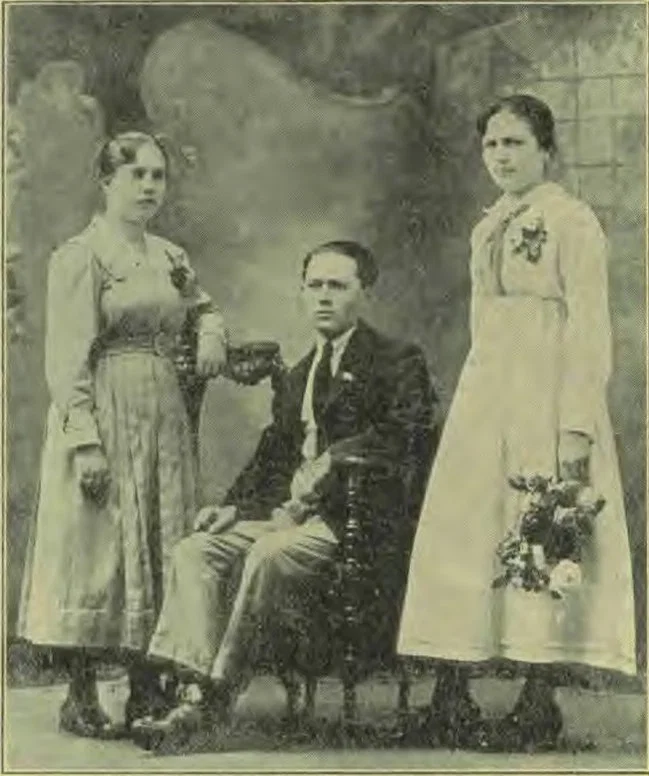
A SHORT time ago, while attending the annual meeting of the Alto Parana Mission in Posadas, in the province of Misiones, it was my privilege to meet a young man about twenty-two years of age, named Atilio Paoloni, and his two sisters of sixteen and eighteen years.
These young people were all rejoicing in the third angel's message, and feasting on the spiritual blessings of the meeting. In talking with him I learned something of his experience in accepting the gospel, and I asked him if he would not write for me a brief story of his experience.
The following is a translation from the Spanish of his story. I am passing it on to our young people in the homeland with the hope of enlisting a deeper interest in the work in this neglected continent which, as this letter demonstrates, is the land of opportunity for those loving the third angel's message. This is not an isolated case, for we have many loyal Seventh-day Adventists who, like this young man and his sisters, are living this truth in the face of persecution, and with us rejoicing in the blessed hope.

A Trying Experience

ATILIO PAOLONI AND HIS SISTERS
“A little more than two years ago I first became acquainted with the gospel and the message which is being proclaimed to all the world, both of which were taught me by a canvasser whom I happened to meet.
“From the very first moment that he spoke to me about the gospel, I was intensely interested and pleased, and resolved that thenceforth I would follow the teachings of the Saviour. A little later I learned of the Sabbath truth, and the very next day being the Sabbath, I resolved to keep it. This greatly angered my family, especially my father, who is a man opposed to all kinds of religious belief. As he threatened to kill me, I fled from the house. I hardly think he would have dared to carry out his threat, nevertheless I thought it safer to leave.
“After this my father tried to persuade me by argument to his way of thinking, and would perhaps have convinced me if it had not been for the constant pleadings of the one who first taught me the truth. A little later father had to go a long way from home to work, and then I was anxious to find out everything I needed to know in order to be saved and do the will of God. I also taught my sisters and stepmother the little which I knew, and they too began to keep the Sabbath.
“A little later the person who gave me the knowledge of the truth left the city, we ourselves being then the only ones in that place who kept the Sabbath.
“For four months we all continued to keep the Sabbath. Then my father came back to visit us. He was exceedingly angry when he learned that I had not obeyed him. For several days he refused to speak to me and, due to his threatenings, my stepmother gave up obeying the law of God.
“When my father returned to his work, my stepmother began to illtreat my sisters and myself. It finally became impossible for me to live in the same house with her, so I decided to send a letter to my father complaining of her treatment of us. She also wrote letters to him influencing him against us, and as a climax to all, a neighbor suggested that the police be told, and that I should be kept in prison until my father should return. My stepmother sought an opportune moment by rousing me to anger by punishing my sisters. I tried to defend them, whereupon she called in the neighbor who had suggested the plan of calling in the police. The neighbor called the police, telling them that I was illtreating my stepmother. Under such circumstances, and having little knowledge so far of the help that the Lord could give me, and lacking also in experience, I found myself in serious difficulty; but the Lord did not abandon me.
“At this time I received a letter from my father, informing me that I could leave my stepmother and take my two sisters along with me. I did as my father had said I could do, and since the chief of police as well as the judge to whom my stepmother had gone, were not opposed to this, my stepmother was obliged to leave us alone.
“Thanks be to God, we were not molested any more until we could be baptized. Then my father returned and wanted to take away my sisters, and forbade their keeping the Sabbath. This time he was the one who punished them for keeping the day the Lord commands. He wanted to take them with him, but they refused to go. He then went to the police, and afterward to the judge of the juvenile court, and finally to an attorney, thinking that through the judge he would be able to get my sisters away from me.
“I found myself in an extremely difficult situation, and not yet knowing fully the power of the Lord, was very much troubled, for I feared that my father would finally turn my sisters away from the truth; but once more the protecting hand of God was manifested in our behalf, for when we thought that at any moment the judge might summon us to appear before him, we learned that father had decided to leave us completely alone.
“Now we are entirely free, and I am working to get enough money to send my sisters to our school the coming year, since they are anxious to obtain an education in order to have an active part in the Lord's work.
“In all these experiences we have seen the protecting hand of God, and with the help of his Holy Spirit we mean to be faithful to him until the end.”
C. P. CRAGER.

Missionary Volunteers in China

SOME persons say they do not believe in foreign missions. Others express doubt as to the real sincerity of the converted heathen, giving them the name of “rice Christians.” I am sure such have lacked opportunities of observing the results of Christian influence and teaching upon the heathen mind and manners that have come to some of the rest of us.
Very few in the homeland have a correct idea of these foreign countries and much less of the people. When we try to picture China and her populace, some of the crudest pictures of wild, native life are taken as representative of the people at large. The people are thought of as naked or half dressed, uncivilized, and uncultured. Such is not the case. True, we do find many people, especially in the tropical parts, who cover themselves with little—and this only by accident. However, this class is small in numbers, while the majority are clad simply, yet comfortably.
The better class appear in their grass cloth and silks, and show more culture and etiquette than many of our own countrymen. The respect shown to superiors and elders both in language and manner in some instances, is almost enviable. The gospel, however, works just such changes in character for the Chinese as it does for the people of the New World.

A Chinese Dialogue

The degree of intelligence to which our young people attain on points of doctrine held by us is clearly shown in the following dialogue arranged and presented by two of our girls in the young people’s meeting in the Swatow mission in China. The translation causes much of the force of argument to be lost; but as it appears one cannot mistake the knowledge of the subject as displayed by these young people.
Ruth was sitting in her room reading the Bible very diligently, when her friend Lydia came to the door. As soon as she saw Ruth, she remarked,
“So you are reading the Bible. That is good, and I am sure God will bless you.”
“Yes, I went to the Seventh-day Adventist mission and the preacher gave me some Bible readings.”
“How dare you go and listen to the Adventist minister. If the other missions knew that, they would be angry with you.”
Ruth hesitated a minute, “What is wrong about that? What harm comes from studying the Bible?”
“Because our minister told us that the Seventh-day people talk only about the Old Testament, the coming of Christ, the keeping of the Sabbath; but you know we are in the New Testament times and need not believe any of these things. We just keep Sunday the same, because Christ said that he is Lord also of the Sabbath.”
Ruth replied: “The Sabbath is the seal of God. The Old Testament is a part of the Bible and is still as binding as ever. This means we must keep the commandments.”
“No one can keep all the commandments. Perhaps you Adventists can, but you never tell us about the grace of Christ. You must confess that it is very hard to obey all the commandments.”
“If we love God, he will help us keep his precepts. 1 John 5: 2, 3.”
Lydia then backed down a little, but insisted that “God wants our hearts, not our time or money. The day does not matter. If I worship him on Sunday with all my heart, surely he will accept, because he says, If two or three meet in my name, I will be in their midst. On Sunday many more than three all over the world worship God. We sing on Sunday, read the Bible, and pray—is that sin?”
“You pray, sing, and read the Bible, that is not sin; but you do these only to ease your conscience. If you pray so that you need not keep the fourth commandment, then let us pray now and go and break the second or sixth commandment. Perhaps we should read Proverbs 28: 9.”
Lydia turned to the Bible and said, “Please see what Christ himself says in John 3: 16. If we believe, we shall have eternal life. It does not say keep the Sabbath; it is faith we need.”
“Yes, Paul knew of such people when he said, If you have faith and keep not the commandments, then your faith is vain. We cannot abolish the law by faith. We only establish it. Rom. 3:31.”
Then Lydia asked the plain question, “If I believe in Christ and do not keep the Sabbath, can I be saved?”
“I am not God, the judge of the world,” replied Ruth. “If you know what is right and do not do it, do you think you can be saved? Read Romans 2: 12-15. When Martin Luther saw his mistakes in following the Catholic Church, did he come out? He surely did.”
“But Luther kept Sunday. Why are you not a Lutheran?”
“That is easy. Just as Luther saw mistakes in his church and came out, so I see mistakes in mine and am going to go out.”
“Well, you know our minister said, ‘Beware of Advents, because they are only “sheep stealers” from other churches.’ So I must go, and I shall not come back again.”
Ruth simply answered, “If the grass is good, the farmer need have no fear that his sheep will run away. Home is good enough.”
The young people’s societies in America have close rivals in their Chinese friends when it comes to giving interesting programs and doing real work. But why should it be otherwise? These Volunteers have enlisted for service. It may not be possible for them to go to another far-distant field as some of the Volunteers from America have done, but their service is seen in their native village or for the neighbor who lives in the next room of the same house.
D. E. Rebok.
Continue reading: Incidents in Porto Rico