The Youth’s Instructor, Vol. 66, No. 2.

Miscellaneous Facts and Current News Items

The Youth’s Instructor

Jan 8, 1918

Review and Herald Publishing Assn. · Takoma Park Station, Washington, D. C. · Jan 8, 1918

Miscellaneous Facts and Current News Items

The standard proportion of the United States flag is: Length, 1.9 times the width.
The tallest chimney in the world is at Great Falls, Montana. It was built in 1909, cost $50,000, and is 506 feet high.
The new revenue bill which became a law on Oct. 3, 1917, provides for the raising of $2,534,870,000 for the current year.
The history of postage stamps begins with the issue made by Great Britain in 1840, under the administration of Sir Rowland Hill.
One-quarter million dollars of the tithe funds of the Mormon Church was used to purchase Liberty Bonds of the second Liberty Loan.
The gullets of seals, a product heretofore thought to be of little use, has been found to make a good quality of gloves, as fine as good kid.
Trading-with-the-enemy Act is a regulation recently passed by Congress, which imposes on the offender a fine of $10,000 or ten years in prison.
The Rockefeller Foundation has given China a $2,000,000 hospital and medical college. The Chinese minister of education recently laid the cornerstone.
The Japanese mission visited the grave of Commodore Perry, at Newport, Rhode Island, for it was he who, in 1850, opened the Kingdom of the Rising Sun to the rest of the world.
An electric machine has been invented which is designed to make people smile. It affects certain nerves of the face which control the muscles, causing a smile. Its aim is salutary.
If one were on a certain star at twelve o’clock noon on the first day of January, 1918, and had a large enough telescope, he could see the Battle of Gettysburg as it was being fought fifty-four years ago.
Mr. Charles Crawford Gorset, an authority on birds, states that fifty carloads of insects are consumed by the birds of Michigan every day. In one summer this would make a trainload 425 miles long.
Frederick Mac Monnies has been engaged to make a statue in honor of the heroes of the Marne. It is to be named “The Soul of France.” The figure of a winged woman will be used to represent the idea.
Mr. Frank Vanderlip, eminent banker of New York City, has accepted the chairmanship of the committee in charge of floating the $2,000,000,000-war-certificate loan. Mr. Vanderlip’s salary is fixed at $1 a year.
Much of the best chewing gum is said to be made from the gum of the chicle zapote tree found in Mexico. It was first introduced into the United States in 1870, and soon largely replaced other gum materials then in use.
A new army truck, called Type B, designed by the leading motor experts of the country under the direction of the Society of Automotive Engineers, has recently been completed for the United States Army. This truck is said to be in advance of anything yet produced, and after January 1, no other trucks will be supplied our army.
In a recent spelling test of one hundred forty freshmen of Northwestern University only fifty-six passed.
Crop returns show the pea crop of the United States to be fifty per cent larger than that of 1916.

Nikalgin, Conqueror of Pain

A MIRACLE of medical science and a messenger of mercy is nikalgin, the conqueror of pain. It was discovered by Gordon Edwards, a native of Milwaukee, a college graduate, an electrical engineer, a bond broker. Hearing that dentists had no anesthetic that was satisfactory, he went into his laboratory, and after extensive experimentation, found a solution which, sprayed on the surface, completely killed the pain. He realized that it would be of immense service in other forms of surgery, and went to the medical profession with it, but the doctors would not pay any attention to it. At last he got them to try it at the Vanderbilt clinic in New York, where it was pronounced a success. Edwards made as much of it as he could carry, and took it to England in 1914 to apply to the wounded. The doctors brushed him and his discovery away, counting it almost an impertinence. He went to France, and after importunate pleading, he got them to try it with the wounded in the Verdun hospital. They gave him for trial their worst cases, men burned almost to death with liquid fire, who suffered such pain when the wounds were dressed that they often died of the agony. His remedy gave instant relief to the insufferable pain during the dressing of the wounds, and gave complete insensibility to pain in all operations performed. He was too poor to make large quantities of his remedy for donation to the public, but Miss Anne Morgan, who had gone to Paris to aid the French, provided him with the means, and he is now making his nikalgin for two armies, and pain will be eased, and hundreds of lives will be saved by it.—Christian Herald.

We Give Thee Thanks

For all true words that have been spoken, For all brave deeds that have been done, For every loaf in kindness broken, For every race in valor run, For martyr lips that have not failed To give God praise and smile to rest, For knightly souls that have not quailed At stubborn strife or lonesome quest; Lord, unto whom we stand in thrall, We give thee thanks for all, for all.
— Margaret E. Sangster.

Reading Vastly Outpaces a Single Lifetime

“If a man were to read industriously from dawn to dark for sixty years, he would die in the first alcove of the 850,000 volumes in the Imperial Library at Paris,” said Emerson.

A Deed and a Word

A LITTLE stream had lost its way Amid the grass and fern; A passing stranger scooped a well, Where weary men might turn; He walled it in, and hung with care A ladle at the brink; He thought not of the deed he did, But judged that all might drink, He passed again, and lo! the well, By summer never dried, Had cooled ten thousand parching tongues, And saved a life beside.
A nameless man, amid a crowd That thronged the daily mart, Let fall a word of hope and love, Unstudied, from the heart; A whisper on the tumult thrown, A transitory breath— It raised a brother from the dust, It saved a soul from death. O germ! O fount! O word of love! O thought at random cast! Ye were but little at the first, But mighty at the last.
—Charles Mackay.

Blessed Are They That Do

MRS. M. A. LOPER
THERE is enough latent force pent up in our Missionary Volunteers to stir the world. It is possible for them to accomplish a great work in a short time. Yoked up with Christ, for them “all things are possible,” and before them there is no such thing as failure. They are committed to the greatest work that was ever given to mortals, in which each has a definite part to do, and of which it is his to make a grand success.
And yet it is difficult to convince young people of their possibilities, or to persuade them how much the world needs just the help which it is theirs to render. One must climb high enough to catch the broader vision of life, in order to appreciate rightly the needs of the world and his own obligations to minister thereunto.
Every Missionary Volunteer should count one as a recruit in God’s army, and should now be receiving a fitting up for the special work he is called to do in the mighty struggle against sin. Every Missionary Volunteer Society should be a training camp for just this purpose. Success later on depends largely upon the thoroughness of present training. But thoroughness is largely an individual matter, even though the leader may be very capable of filling his position.
The boy or girl who cheerfully says to the leader, “You can count on me to attempt to do anything I may be asked to do,” thereby takes a decidedly advanced step on the highway to success. And any one who is old enough to be a Missionary Volunteer is capable of making this decision and of living up to it.
The banner of success is inscribed, “I can.” The banner of failure is inscribed, “I can’t.” Under which one are you enlisted?
Every member of the Missionary Volunteer Society should consider himself under discipline—under strict orders to do whatever task falls to his lot. He should be loyal in the matter of self-improvement, and learn to conquer every obstacle in the way to higher and more noble achievements in the work of God for this time—the giving of the gospel to all the world in this generation.
The one who tries is the one who succeeds.
Success does not depend upon natural capabilities. Some of the worst life failures have come to persons who depended upon their natural smartness to carry them to success. Indomitable perseverance in doing right in spite of all obstacles or discouragements, brings true success even to the weakest and most unpromising soul.
I once knew a boy who was possessed of the courage to show to the public his inefficiency. He certainly was unpromising as a speaker in those days, if one had judged merely from the viewpoint of fluency and eloquence. He could scarcely give a connected topical talk of three minutes’ duration. But, Demosthenes-like, he stuck to his task, and did not become wholly discouraged because of what his audience may have classed as failures. When he was requested to repeat his efforts, he repeated. In due course of time signs of improvement began to appear. He learned how to study so as to become familiar with a subject, and how to tell what he knew. Today that young man bids fair to fill an important place in giving the last warning message to the world.
Young people, it is possible for you to blossom into usefulness just as the plant blossoms into beauty. It is possible for you to bear the fruits of the Spirit just as the plant bears the natural fruit. But it requires decision on your part. It requires a cheerful willingness to do; in spite of all obstacles, a willingness to try.
In helping with a society program, what if John does at first become so confused as to forget whether Asia is in the Eastern or the Western Hemisphere? What if William does look in the New Testament for the Book of Ezra, and Sarah cannot think of the name of a single foreign missionary? Let them keep on trying until they gain the mastery of themselves—until they can stand before an audience and present their thoughts clearly and concisely.
“Go ye . . . and teach all nations” cannot be our experience until we learn to tell to others what we know, in a way that they may be able to understand.
I recently sat with other friends near a pearl-white casket within which reposed one whose earthly career had compassed the brief space of twenty-six years, a young man before whom life had presented many possibilities and cherished hopes, but to all of which death had brought the end. He had known something of the keen disappointments of life as well as its hopes, but he had “chosen that good part,” and so his life closed in blissful triumph. I remember him as one who believed in doing things, and who was always willing to try.
Although battling for some time against a fatal malady, he did not sit down discouraged, and cease his efforts to assist others. On Tuesday, one week before the end came, he was busy with the Harvest Ingathering work. On Sabbath he gave his public testimony for Christ. On Sunday he was suddenly taken more seriously ill, and on Tuesday night he fell asleep, resting under the benign benediction, “Blessed are they that do.”
Reader, are you a doer or a shirker? Are you a soldier or a slacker in God’s army? Have you enlisted under the banner “I’ll try,” or “I can’t”?
“I can do all things through Christ which strengtheneth me.”
“Blessed are they that do.”

The Relief of Leyden

Holland is such a tiny country, tucked away in the corner of northwestern Europe, that it does not seem very important. No one would ever guess what thrilling chapters of history have been written in this little triangle of delta land bounded by Germany, Belgium, and the sea. But time was when the eyes of all Europe were turned to the Netherlands; when the sturdy, thrifty, resolute Dutch proved the despair of queens and kings and emperors.
Holland is a land reclaimed from the sea. Dikes hold back the tides from the lowlands and keep the fertile fields, as well as farm homes, villages, and cities, in comparative security. For centuries these people have waged a constant war against their one relentless enemy—the ocean.
In time our story goes back about three hundred years. The Netherlands were under the rule of Catholic Spain, and the Inquisition was in power. Persecution and broken promises of political as well as religious freedom, finally aroused the Hollanders, who were stanch Protestants, to action, and the Dutch Republic was born, Prince William of Orange, sometimes called William the Silent, being chosen as leader. The struggle with Spain which followed centers about the siege of Leyden.
This was perhaps the most beautiful city in Holland. “On every side were broad green fields, reclaimed by tireless industry from the very sea itself, smiling villages, gay gardens, and fruitful orchards. The city was interlaced with many small streams, and these watery streets were shaded by lime trees, poplars, and willows, and crossed by one hundred forty-five bridges of hammered stone.” There were comfortable homes and substantial public buildings, and in the center of the city rose the Tower of Hengist, an ancient ruin which afforded an excellent view of the surrounding country.
The besieging army, under the Spanish commander Valdez, and numbering about eight thousand men, closed Leyden on May 26, 1574. Inside there was no defending army—only a small corps of “freebooters” and five companies of burgher guard. The main reliance of the city for its defense “was the stout hearts of the inhabitants within the walls, and the sleepless energy of William the Silent without.” The prince encouraged them to remember that not only their own fate, but the future of their country, depended upon their bravery, and the people vowed, “As long as there is a living man left we will contend for our liberty and our religion.”
Early in the siege an account was taken of all foodstuffs, and every one in the city placed on a strict allowance. Half a pound of meat and half a pound of bread were allotted to a full-grown man, and the rest a due proportion. The only communication they had with their friends outside was by the use of carrier pigeons.
The Prince of Orange, in spite of the efforts of the Spaniards, held the important cities of Delft and Rotterdam, and the keys to the relief of the suffering city, for while Leyden was not on the sea, he could send the sea to Leyden by breaking the dikes along the Meuse and Yssel and opening the great sluices at Rotterdam, Schiedam, and Delfshaven. This he determined to do. He realized that “the damage to the fields, villages, and growing crops would be great, but he felt that no other course could rescue Leyden, and with it the whole of Holland, from destruction” at the hand of covetous Spain. His loyal people rallied to his aid with the cry, “Better a drowned land than a lost land,” and on the third of August, 1574, the dikes were broken and the sluice gates opened.
Meanwhile the people inside the city had become very much discouraged, for their bread was gone and other provisions were low indeed. When word came from the prince that the water was rising upon the “Landscheiding,” the great outer barrier which separated the city from the sea, the burgomaster ordered the bands to play, and the starving city celebrated a holiday, much to the astonishment of the Spaniards outside.
Soon the besieging army found itself in turn besieged, and by a power stronger than man’s. It was no trifling danger which threatened them—“to be attacked by the waves of the ocean which seemed about to obey with docility the command of William the Silent.”
The incoming waters spread slowly over the wide fields, and the Spanish forces were obliged to retreat inward, but day after day the starving people of Leyden climbed to the Tower of Hengist, “with heavy heart, and anxious eye, watching, hoping, praying, fearing, and at last almost despairing of relief by God or man.” It is hard to trust when one is hungry. Just at this time came assurance from their brethren outside: “Rather will we see our whole land and all our possessions perish in the waves than forsake thee, Leyden.”
The prince was ill in Rotterdam, but from his sick bed he directed the assembling of a relief fleet under Admiral Boisot, and by the first of September, three months after the siege began, more than two hundred ships were slowly advancing over the broken dikes. These were manned by twenty-five hundred veteran soldiers and sailors, experienced on land as well as water. The distance from Leyden to the outer dike was fifteen miles, and the relief vessels made their way easily enough to a strong dike within five miles of the city. The approach was surrounded by sixty-two strong forts, one within the other, and it was necessary to break through this series of defenses, held by Valdez, with a force four times as strong as that coming to the rescue.
The prince gave orders that the large dike, still one and one-half feet above water, should be taken at any cost. By mere chance it was left weakly guarded, and on the night of September 10, the patriots fortified themselves there without the loss of a man. When morning came, the astonished Spaniards rushed out to recover what they had lost, but were completely defeated, and the work of breaking the dike was done under their very eyes.
Another long dike three fourths of a mile nearer Leyden next stopped the rescue fleet. General Boisot seized it before the enemy realized its importance, leveled it in many places, and brought his ships in triumph over the ruins. Now he found that entrance to a large mere, called Freshwater Lake, into which he expected immediately to have floated, could be had only by passage through one deep canal. “The sea which had thus far borne him on, now diffusing itself over a wide surface, and under contrary winds, had become too shallow for his ships. The canal alone was deep enough to afford passage, but it led directly to a bridge strongly occupied by the Spaniards.” With a few of his strongest ships and bravest soldiers, Admiral Boisot attempted to open the way, but met with defeat.
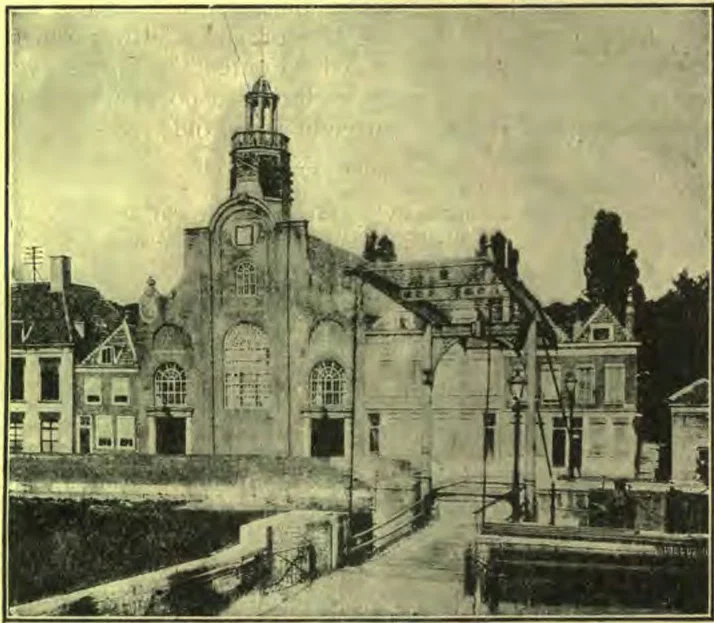
CHURCH AT DELFSHAVEN, HOLLAND
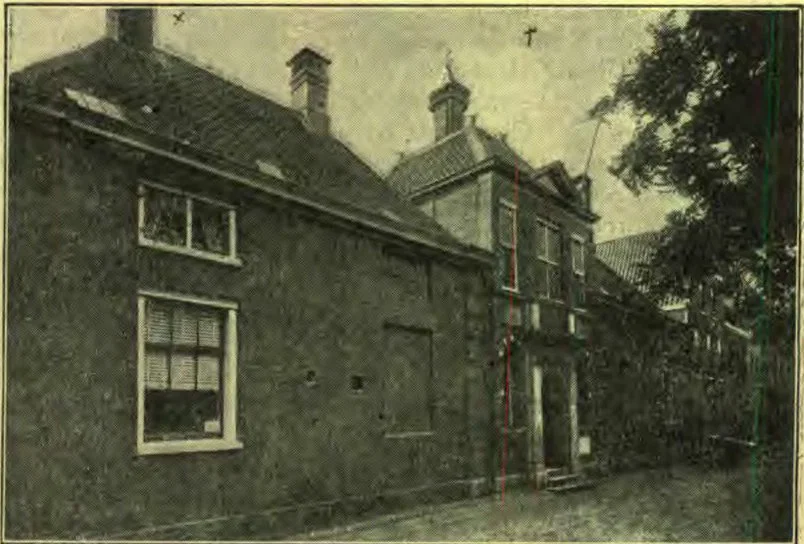
THE JOHN ROBINSON HOME AT LEYDEN
A week passed, and still the relief ships lay motionless in the shallow water. But on September 18 the wind shifted, and the following day the vessels were again afloat. A fugitive from one of the villages guided the ships over a low dike, and the terrified Spaniards fled toward Leyden. Brave as they were on land, they lost their courage in the presence of the sea. Reaching Zottermeer, the rescuers, after a short delay to allow the escape of the villagers, set this fortress as well as Benthuyzen, on fire and abandoned it. The blaze, seen from Leyden, was hailed as a beacon of hope.
But the relief ships were now delayed at north Aa by another barrier called the “Kirk-way,” and again contrary winds left them stranded in shallow water. The Prince of Orange arose from a sick bed and came to look over the situation. He at once gave orders for the destruction of the “Kirk-way,” the last important barrier between the fleet and Leyden. Meanwhile the besieged city was almost at its last gasp. “Bread, malt cake, and horseflesh had entirely disappeared; dogs, cats, rats and other vermin, were regarded as luxuries. A few cows remained, kept as long as possible for their milk, but a few were killed each day and distributed in small portions, hardly enough to keep the famishing people alive. Green leaves were stripped from the trees and eaten, and still many died. Mothers dropped dead in the streets, with their dead children in their arms, and in many a house the watchmen in their rounds found a whole family of corpses, for pestilence stalked at noonday in the streets.
Some, faint-hearted at delayed relief, favored surrender, but the heroic burgomaster, surrounded by a clamoring crowd, waved his hat for silence and cried: “Here is my sword. Plunge it into my breast, and divide my flesh among you. Take my body to appease your hunger, but expect no surrender as long as I remain alive.” Thus heartened by their magistrate, they renewed their vows of fidelity. “Ye are rat eaters and dog eaters,” shouted the Spaniards. “It is true,” replied the heroic citizens, “but so long as ye hear a dog bark or a cat mew within the walls ye may know that the city holds out.” “As well,” derided the Spaniards, “can the Prince of Orange pluck the stars from the sky as bring the ocean to the walls of Leyden for your relief.” But boasting is vain.
On the twenty-eighth of September the equinoctial winds came on, and in twenty-four hours the waves were breaking with unrestrained power over the ruined land. At midnight the fleet sailed across the “Kirk-way” in the storm and darkness. A fierce naval battle followed, resulting in victory for Admiral Boisot.
Two strong forts still stood, but hardly was the fleet in sight of the first when the panic-stricken Spaniards fled along the narrow path that was rapidly vanishing in the waves, toward their last refuge, Lammen, about two hundred fifty yards from Leyden.
“This obstacle rose formidable and frowning, directly across the path of the rescuers. Swarming as it was with soldiers, and bristling with artillery, it seemed to defy the armada either to carry it by storm or to pass under its guns into the city.” Admiral Boisot was discouraged, for it appeared to him that the relief plan must after all fail in sight of success. He “anchored his fleet within a respectful distance,” and spent what remained of the day in carefully laying his plans. At last he announced his intention of carrying the fort, if possible, on the following morning, but if obliged to retreat, he observed with something like despair, that there would be nothing for it but to wait for another gale of wind.”
Meanwhile Leyden was wild with expectation. A dove had brought a message informing them of the exact location of the fleet. “Yonder,” cried the burgomaster, “yonder behind that fort are bread and meat, and brethren in thousands. Shall all this be destroyed by the Spanish guns, or shall we rush to the rescue of our friends?” They resolved to attack their enemies in conjunction with the fleet at daybreak.
“Night descended upon the scene, a pitch-dark night, full of anxiety to the Spaniards, to the relief fleet, to Leyden. Strange sights and sounds occurred at different moments to bewilder the anxious sentinels. A long procession of lights issuing from the fort was seen to flit across the black face of the waters, in the dead of night, and the whole of the city wall, between the Cow-gate and the Tower of Bergundy, fell with a loud crash. The horror-stricken citizens thought that the Spaniards were upon them at last; the Spaniards imagined the noise to indicate a desperate attack.”
“Day dawned at length, ending a feverish night, and the admiral prepared for the attack. Within the fortress reigned a deathlike stillness. . . . Suddenly a man was seen wading breast-high through the water from Lammen toward the fleet, while at the same time one solitary boy was seen to wave his cap from the summit of the fort. After a moment of doubt the happy mystery was solved. The Spaniards had fled panic-stricken during the darkness. Their position would still have enabled them to frustrate the enterprise of the patriots, but the hand of God, which had sent the ocean and the tempest to the deliverance of Leyden, had struck her enemies with terror likewise. The lights which had been seen moving during the night were the lanterns of the retreating Spaniards, and the boy who was now waving his triumphant signal from the battlements had alone witnessed the spectacle. So confident was he in the conclusion to which it had led him that he had volunteered at daybreak to go thither all alone. . . . All obstacles being now removed, the fleet of Boisot swept by Lammen and entered the city on the morning of the third of October. Leyden was relieved.”
“The starving and heroic city, which had been so firm in its resistance to an earthly king, now bent itself in humble gratitude before the King of kings. After prayers the whole vast congregation joined in the thanksgiving hymn. Thousands of voices raised the song, but few were able to carry it to its conclusion. The hymn was abruptly suspended, while the multitude wept like children.” Lora Clement.

Fanny Crosby’s Story of Ninety-Four Years

“Singing for Jesus, telling his love All the way to the home above, Where the severing sea with its restless tide Never shall hinder, and never divide.”
HERE we see the true cause of Fanny Crosby’s success. Her long life of ninety-four years was spent for the most part in voicing in poem and song the love of Christ for a dying world. Although she was blind from infancy, she gave the world thousands of hymns which will never die, but will continue inspiring sinners to live the Christian life as long as sin exists.
Fanny Crosby was born in a little one-story cottage in New York State in the year 1820. Her parents were of fine New England stock, and were noted for their longevity of life. It was Aunt Fanny’s desire to exceed the age of her great-grandmother, who reached the age of one hundred and three.
Her sight was destroyed by poulticing her eyes when she was six weeks old. Never afterward was she able to see the faces of her friends, the blue of the skies, or the flowers of the fields. But this did not cause her to become discouraged and pine her life away. On the contrary, she decided to store up a little jewel in her heart, which she called “Content.” This served as a comfort all her life. Here is a poem which she wrote when she was but eight years old:
“O what a happy soul am I! Although I cannot see, I am resolved that in this world Contented I will be.
“How many blessings I enjoy That other people don’t. To weep and sigh because I’m blind, I cannot and I won’t.”
What a sensible and optimistic way of looking at such an affliction!
Her grandmother took it upon herself to teach the poor sightless child until she should be old enough to enter an institute. She would tell her stories of birds and flowers, take her out of doors, explain the beauties of nature, and describe them in such a way that they lingered in the child’s memory all her life. Thus was developed in her a love of the beautiful and also of the Creator of the universe. She was taught the stories of the Bible and its many precious promises, and she would often sit, in the evening shadows, on her grandmother’s lap and listen as she told of a kind heavenly Father who sent his only Son Jesus Christ down into this world to be a Saviour and a Friend to all mankind. The following expresses in her own words her great love for the Bible:
“O Book, that with rev’rence I honor, What joy in thy pages I see! O Book of my childhood devotion, More precious than rubies to me.”
At the age of fifteen, Aunt Fanny entered the Institution for the Blind in New York City, where she remained for nine years, improving her opportunities and stocking her mind with useful knowledge. While here she became acquainted with the poetry of many great writers, and really did her first work in writing poems. Whenever possible she met with noted statesmen, masterful musicians, literary readers and artists. This gave her much joy, for she always said that a great life was a wonderful inspiration to her. She prided herself on having lived during the lifetime of all of the Presidents of the United States, Washington excepted, and on having met several of them.
After she had been at the institute about five years, a gifted young man by the name of Alexander Van Alstyne came there. He, too, was blind, and was making a specialty of the study of music. The two became greatly interested in each other through their work, and were married on March 5, 1858, after a courtship of eight years. Mr. Van Alstyne died in 1902.
Even from earliest childhood Miss Crosby had a love for poetry, and always sought to express her thoughts in poetic language. Her teachers in the institute did not encourage her writing until one day Dr. Combe, of Boston, visited the school and examined the heads of the pupils. As he touched the head of Fanny he remarked, “And here is a poetess; give her every possible encouragement. Read the best books to her, and teach her to appreciate the finest there is in poetry. You will hear from this young lady some day.” This gave her real joy, and she continued writing poems and songs.
  • (Continued on page twelve)*
(Continued from page six)
On leaving the institute her real work of Christian hymn writing began, and she was thrown into association with many famous men and women in the religious world. Among these were Bradbury, Doane, Sankey, Moody, and Stebbins. Perhaps it would be of interest to tell the story of a few of Miss Crosby’s best known hymns. Their popularity has been unbounded both in this country and in lands beyond the seas. They carry a message of faith, of hope, and of love which appeals to the human heart everywhere.
One of the most popular of her hymns is “Rescue the Perishing.” It was written after an experience in New York mission work. She was addressing a large company of working men one hot summer evening, when the thought kept forcing itself on her mind that some mother’s boy must be rescued that night or not at all. So she made a pressing plea that if there was a boy present who had wandered from his mother’s home and teaching, he would come to her at the close of the service. A young man of eighteen came forward and said, “Did you mean me? I promised my mother to meet her in heaven, but living as I am now that will be impossible.” They prayed for him, and he finally arose with a new light in his eyes and exclaimed, “Now I can meet my mother in heaven, for I have found God.”
Some of Fanny Crosby’s other well-known hymns are “Safe in the Arms of Jesus,” “Blessed Assurance,” “Pass Me Not, O Gentle Saviour,” and “Every Day and Hour.” We see by the following little verse that she believed song writing to be as practical as preaching, or more so:
“I think that life is not too long, And therefore I determine That many people read a song Who will not read a sermon.”
Miss Crosby did not consider that her blindness was a curse, but rather a blessing. She put her entire trust in God, and she had faith to believe that he would supply her with all temporal needs. Her prayer was, “Give me neither poverty nor riches.” Although she had many a hard struggle, she never gave up to grief or complaining, but was always cheerful and pleasant, and was ever seeking to brighten some one’s life. All through her long life she lived the sentiment of this song:
“Never be sad or desponding, Only have faith to believe; Grace, for the duties before thee, Ask of thy God and receive.
“Never be sad or desponding, There is a morrow for thee, Soon thou shalt dwell in the brightness, There with the Lord thou shalt be.”
She had an unusual love for children, and delighted in gathering them about her and telling them stories and reciting verses composed for them.
At the age of ninety-two, Miss Crosby visited Cambridge, and conversed with and learned at the feet of the great professors there. This gave her great joy, and upon returning she exclaimed, “I feel like a girl again! Truly I have drunk from the crystal streams of thought and knowledge.”
Perhaps the greatest cause of the long life of this noble woman was that she lived simply and formed the habit of being cheerful. She said that from girlhood days she had had three little angel-guards: the first to guard her taste and cause her to be careful about her eating, the second to control her temper, and the third to control her tongue. She spent much time in the open air studying nature, retired early, and observed simple habits of life in general.
Fanny Crosby quietly passed away on the night of the eleventh of February, 1915, and the news of her death was quickly flashed around the globe. Her funeral was attended by a large number of noted men and women, especially hymn writers and poets with whom she had formed close friendships. It was said to be the largest funeral service ever conducted in Bridgeport.
In the sermon the feelings of the whole nation were expressed that by her faith, her hope, and her love she more nearly exemplified the Christian graces than any other person of her time. In the thousands of hymns she has given the world, not a false note has been sounded. Her great desire was to help the sinful to a better life, believing as she always did that—
“Down in the human heart, crushed by the tempter, Feelings lie buried that grace can restore; Touched by a loving hand, wakened by kindness, Chords that were broken will vibrate once more.”
DOROTHY L. PEARCE.
Continue reading: W. S. CHAPMAN