These articles are written especially for the boys who are constantly “tinkering,” that is, trying to make things or to study out things already made. It is not designed to give them simply working models or many specific drawings from which they can construct articles. The idea is to so familiarize them with the use of tools as to make them competent to construct properly whatever their brains may brood over.
So, then, the effort will be to start the reader to doing some practical thinking, to help him to learn how to properly handle tools and to understand how to work, so that when he undertakes a task he may know beforehand how to accomplish it. In short, to have him develop into a handy boy to have around the house, competent to handle almost anything in the way of repair, or to originate almost any household article needed. This is the aim and hope in presenting these simple elementary principles in carpentry.
If you can make the acquaintance of some good-natured dealer in hardware, or of a clerk, and tell him of your desire to become handy in handling tools, and that, as your means will allow, you propose to collect a practical set of carpenter’s tools, one or two at a time, maybe, then ask him if he will allow you to call occasionally and look at tools and ask questions. Make the acquaintance also of one or more carpenters whom you can question. This will be of the greatest assistance to you, and the practical instruction these men can give will aid your advancement in carpentry as nothing else could do. Be careful not to annoy them. Especially keep away when they are busy. Show them that you appreciate their kindness, and they will take pleasure in instructing you. Talk with old wood choppers and men who, as boys, learned to split kindlings. You will be surprised at the amount of useful information you can obtain, all interesting and valuable, coming in very handy sometimes when the knowledge of how to do is wanted.
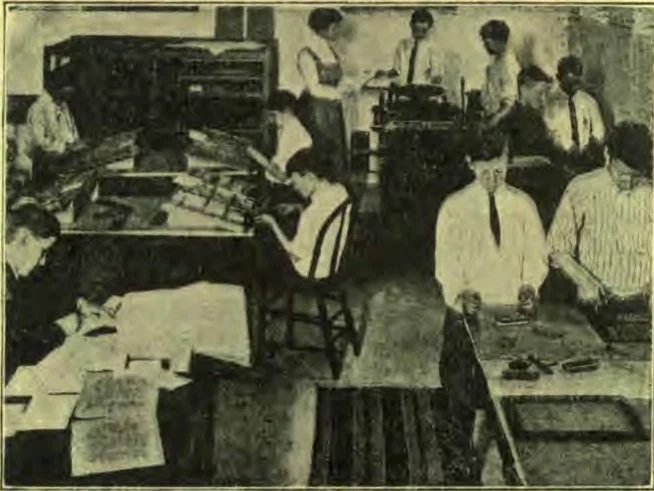
BOYS LIKE THE WORKBENCH, AND ALL IT STANDS FOR
Hammers
Do you know how to pick up a hammer? “That is simple enough,” you say. Is it? Ask a blacksmith if he can tell a good workman by the way he picks up his hammer. Remember his answer.
Does a carpenter handle his hammer differently in driving a twentypenny spike and in sending “home” a fourpenny nail?
Why does a carpenter spit into the palm of his hand when he has a hard blow to strike, while a blacksmith uses a dry palm no matter how hard the blow?
Do not wait for me to answer these queries, but ask questions of carpenters, as you have opportunity, and then practice at home what you learn from their answers. Examine hammer handles. Note the difference between the hammer of the carpenter and that of the blacksmith; the hammer of the ten-cent store and the finished article sold by the hardware dealer. Note also the difference between the turned, the sawed, and the shaved handles, and ask the dealer for an explanation. Examine critically machine-made handles for axes. Note the different shapes and sizes and the “set” of the handle in the head of the ax. Ask for reasons, and when you at last come to the conclusion that you are competent to select the hammer that suits you, buy it and a medium-sized “nail set” with it, and you will be ready for your first lesson. The hammer is the most important tool in the carpenter’s chest, and a poor one is dear at any price, being always a source of trouble and vexation. Do not be too economical in the selection of tools. Wait until you have money enough to buy first-class ones. It will pay to be patient.
Nails
It will pay any boy to learn to drive nails properly. Some may reply, “Why, any one can drive a nail!” Perhaps these will be surprised when told that there are lifelong carpenters who never learned to drive a nail correctly. It was so simple a thing that they never thought it worth while to study over it, yet that spirit of carelessness crept through all their work and made them unreliable, and so retarded their advancement. They remain simply carpenters all their lives.
Watch your sister hammer a tack into the carpet. Notice that she slips the index finger over the handle of the hammer. “Why, what difference does it make where the fingers go?” Try it, first with the index finger on the top of the hammer handle and then with the whole hand gripping the handle. Which gives the more effective stroke? Talk to a carpenter about it. If you ever get into a tight corner where you will be called upon to handle your hammer in some odd positions, this knowledge will come in handy as a guide to what to do.
Kinds and Use of Nails
There are very many sorts of nails, but the principal one is the common or wire nail. Another is the flat-sided iron nail with a small head. This is called the “finishing” nail, because it is intended for use where it is to be driven wholly into the wood, head and all out of sight. These are made of the same sizes as the common or round nail, and there are still smaller ones called “brads,” used in thin woods. All finishing nails have two flat sides. They must be driven with the flat side parallel with the grain of the wood. Do you know what the “grain of the wood” means? Ask your father.
A finishing nail should be driven into the wood up to the head. Then, with a “nail set” placed upon the top of the head, with two or three quick, sharp blows, drive the nail “home” so that the head sinks below the surface. The trick is to do this without allowing the “nail set” to slip off the nail, or the wood will be smashed where the set strikes the wood, as finishing8nails are used in particular work where such a blemish is to be regretted. To guard against this accident, when the set is placed upon the top of the nail, lay it against the four fingers and hold it there with the thumb, resting the little finger on the wood.
Nails are sold by the pound, and this must be borne in mind in purchasing, as there will be more small nails to the pound than of the larger sizes. The manufacturers regulate the thickness of the nails according to their length, so that a carpenter has to attend only to the length of nails, all else being arranged by the factories. The length of nails is denoted by the word “penny”—twopenny, threepenny, fourpenny. These numbers run up to tenpenny in regular order consecutively, the smallest being one inch long and the others increasing by quarter inches up to tenpenny, which is three inches in length. Next is the twelvepenny, three and a quarter inches long, and the sixteenpenny, three and a half inches long. The next size is twentypenny, and from this on the numbers jump ten at a time—20d, 30d, 40d, 50d, and 60d, increasing one-half inch at a time. These are called “spikes,” the sixtypenny being six inches long, and large, of course, in proportion.
So far this is presenting to you simply the theory of carpentry, that is, the how to do, but it cannot be a reality to you until you put into practice what is suggested. Suppose therefore you now arrange to take your first lesson, provided you have the hammer and the nail set. Now purchase a small quantity of nails, both common and finishing—three or four of each kind of 2d, 4d, 6d, 8d, 10d nails.
Procure a dressed board, that is, one that has been planed smooth, and rest it upon something solid into which the nail can penetrate without doing damage. Dirt is a good foundation, as the point of the nails will not be injured, and they can be used again. Begin at the upper left-hand corner and a quarter of an inch from the top of the board, drive in carefully a twopenny finishing nail a half inch or more, using steady blows of such force as you think is right. An inch below this nail drive in a twopenny common nail. Note the difference in the stroke made and the force required as to whether there was any difference. Continue down with the other sizes, driving first a finishing nail and following it with the same size common nail, noting any difference in the power and the position of the hand and the grip on the hammer handle. In all this exercise let the arm be held as nearly at right angles to the nail as is possible, driving the nails farther into the board as they increase in length.
Pulling Out Nails
It pays to be careful. The spirit of carefulness exercised in details rewards you with nice-looking, finished work. A nail pulled carelessly will leave a mark of the hammer on the wood, and will be useless for further work. Nails are what costs a boy his pocket money. A nail saved is a nail earned.
In pulling out nails few carpenters try to save them—time is worth more than the nail, they will tell you. But a boy has no such excuse, and some day he may be where this spirit of carefulness will be an absolute necessity. If a nail has been properly driven and proper care is exercised in withdrawing it, there is seldom any injury done to the nail, and it comes out of the wood “good as new.” So, then, it is wise to become proficient in the drawing of nails.
Have by you some small pieces of wood, say about six inches in length and three inches broad, of which one is an inch thick and two others a half and a quarter inch. With one or more of these build up a platform beside the nail so that just room will be left for the insertion of the hammer head. Stand the hammer on its head upon this platform and slip the claw under the head of the nail, then pull the hammer handle toward you. Some nails can be drawn easily; others require a smart blow or two on the handle to start the nail upward. Try to administer just the proper force without bending the nail. Draw the nails out and straighten them.
This first lesson may not seem of great importance to you now, but time and again, as you are working on some undertaking, a hint of how to do and what to do will flash through your mind, which you can easily trace to the practice had with your collection of nails, and this spirit of carefulness will color all your work and help to make you successful in what you try to accomplish. It is therefore urged upon you to follow patiently and carefully the instructions, so you can feel capable of saving a nail under almost any circumstances, if it ever becomes necessary. What if, as a missionary, you were to be cast upon a desert island with a stove-in boat and just so many old rusty nails to repair it with? How carefully you would use them, and how thankful you would be that you had learned to drive them to the best advantage!
Earth's Soliloquy
By E. F. Collier
E. F. COLLIER
MINE is a strange and awful vision: Only the God who made me knows All the fearful bloody specters, All the brood and bane of woes, All the heights and depths of passion, All the bounds and breadths of wrong, All the tumult, all the sighing, All the dearths and deaths that throng Through my senseful soul of knowledge, Born of spirit sound and sight,— Ways of God and men and demons, Highest dawn and darkest night.
I have seen creation’s morning Light with beauty Eden’s bowers, Watched two million golden daytides Swing the pendulum of hours. I have bathed in star-touched twilight, Rode in darkness, storm, and fire, Sent my note of music ringing With the planetary choir; Down the heaven-spangled vistas I have traveled in my sphere, Seeking to fulfil my mission Till the grand Sabbatical year.
I have felt the throb of nations Like the rolling of a sea. Gave my breast a willing nurture From the motherhood of me; Felt the pang of constant travail, Gave my offering drenched with tears, Suffered, sorrowed, hoped, and gloried— For my destined pawn of years Was to bring from out the chaos Of a sin-cursed, lost domain A redeemed and blood-bought treasure That should live and reign again.
I have seen the strength of nations Melt to weakness in a day, And the glory of the honored In succession pass away. I have seen disease and famine, Like twin vultures, cross my bound, And ten thousand hideous thunders Join in war’s tumultuous sound. I have seen the people scattered, Seen them lying torn and scarred; Seen the face of all creation Prostrate, bleeding, woeful, marred.
Once the waters of my storehouse Swept the dross of men away; Then the generation following Built a tower of brick and clay.9But my thunderbolts destroyed it, Sent its Babel far and wide, And a broken base of ruin Marks its folly and its pride. Then men reared their seats of empire, Crowned their work with self-esteem, But I saw their strength and greatness Vanish like a passing dream.
Babylonia, golden empire!— Cup of beauty, best of all!— “Mene, tekel”—fade and vanish Like the writing on the wall. Media vast, and Grecia splendid, Rome with iron strength to stand,— All are fallen, all are broken, Scattered far in every land. Kingdoms vast are, O, so fragile ’Neath the hammer strokes of time! Learn the lesson: not a building Stands but that which is divine.
Thus I’ve watched the course of empire, North and east and south and west; E’en the greatest, e’en the mightiest, Wane and perish like the rest. Thralled in vision I beheld then, From the lofty mountain side, Rock of power, vast, dismaying, Hurled against that restless tide, Till the force of human striving Broke in shattered, drifting spray, And the winds of heaven blowing Swept their remnant mist away.
Then I saw the Rock take being, Stood revealed the Man of love, Nail-pierced hands, outstretched, inviting To the restful realms above. What a sea of love was mirrored In the lowly Naz’rene’s face! How the hearts of millions kindled In the sunlight of his grace! And his words—what wondrous power!— Brought men weeping to his side, And the gates of glory opened, For the world had found a Guide.
I have seen his gospel carried To the islands and the mains, I have heard his proclamations In the mountains and the plains; I have seen his people gath’ring Like the doves at close of day, Waiting for the glad home-coming In God’s city far away. In my bosom myriads slumber, Dead in Christ, but one and all Waiting for the resurrection, Answering creation’s call.
Yes, I’ve seen full many a conquest, But their weight and worth are dim To the glad regeneration And redemptive work of Him. I have giv’n my all to aid him, I am waiting now his voice; Heaven and hell shall see my travail, And my sister worlds rejoice When I’m mother to a nation That is born within a day: God of wonders, I acclaim thee, Maker, Master, King for aye!
Five-Hundred-Thousand-Dollar Fire
By D. D. Fitch
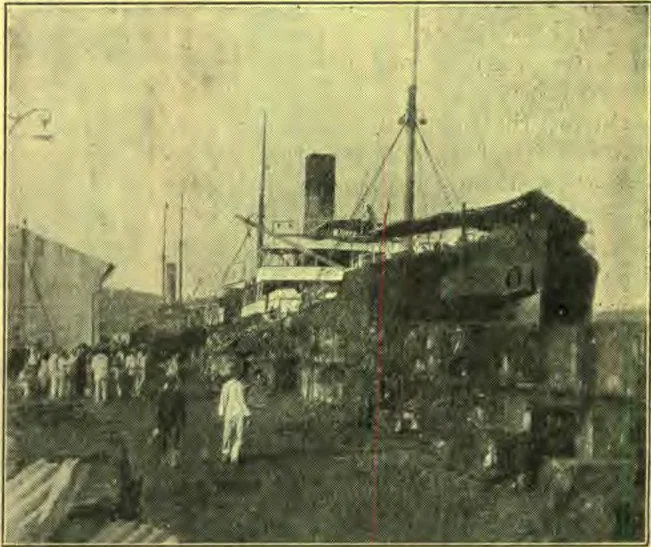
What a great matter a little fire kindleth! Our steamer had been tied up to the wharf at St. Thomas in the Virgin Islands overnight, and as I had time to spare before we sailed I took a stroll to make some observations of the vessel just ahead of us. The “Virginia,” a Danish boat, had sailed from New York for Rio de Janeiro, with a cargo valued at about a million and a quarter dollars, and when four days out fire was discovered in one of her holds. Steam was turned into the part of the vessel on fire, but proved to be futile, so it became necessary to fill this part with water before the fire could be quenched. The vessel had come into St. Thomas in order to make such adjustments in her cargo as were necessary before continuing her voyage. At the time of my visit that part of the hold where the fire had wrought its destructive work had been nearly emptied, and the wharf and the freight shed were strewn with the débris.
The accompanying picture shows a row of fifty-one10automobiles that had passed through fire, steam, and water. Naturally it will be easy to see that their value had been considerably depreciated. Besides these there was a medley of materials such as barrels of paraffin, cement, rolls of paper, string, bolts of cloth, electric-light globes and fixtures, sacks of salt, and furs.
(Concluded on page thirteen) *
(Concluded from page nine) *
After having seen the extent of the destruction of the fire as pertained to the cargo I was interested to visit the ship, and in a talk with the supercargo, or the one in charge of the cargo, I was informed that the damage sustained amounted to about $500,000, and he intimated that the fire was the result of a cigarette thrown down by one of the men while loading the vessel.
D. D. FITCH.
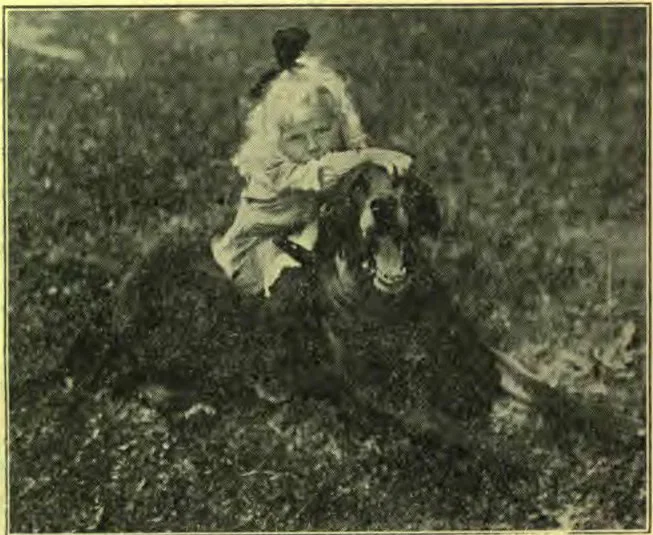
DOROTHY AND HER GUARDIAN, A BIG DANE
The Bible in a Persian Hospital
A MISSIONARY in Persia, L. F. Esselstyn, writes: “A Gregorian Armenian in the Meshed Hospital, El Persia, had been there for some weeks seriously ill with heart disease. One morning, when his condition was very bad, his wife asked that he be given the sacrament. The service was held in the surgery, and was attended by the sick man, his wife, all the missionaries, and an Armenian friend of the patient. The medical treatment used was blessed, and the man got better. A few days later the wife said: ‘Yes, of course he is better. You read the prayers, and I told you he would get well.’
“Several men came into the waiting-room at a moment when I did not happen to be reading, and one of them said, ‘Please read to us.’ They often ask that the Bible be read. One morning a young sayid said, ‘In the book I bought the other day is a section called John. Won’t you read to us this morning from that book?’ Another young sayid came in, and his first words were, ‘I want to buy a book.’ I replied, ‘Which book do you want?’ He said, ‘I want the book containing the story of the shepherd and the sheep.’ A man who had bought a Testament came in and said, ‘You cannot understand how much we are enjoying the Testament in our house. We read it every night. It is very sweet!’
“A Guklon Turkoman picked up a Bible from the table and read to a group of men, while another Moslem read to another group in another corner of the room. Such incidents have occurred scores of times. A man came in and said, ‘Some people who have bought your books have talked about them a great deal at my shop, and I want to buy one.’ I sold him a Persian Testament. A merchant said, ‘A year ago I bought a Testament from you, and now I want a Bible.’
“It has become popular for all classes of people to buy the Scriptures, and even the illiterate buy them, saying they will get some one to read to them. We have been told repeatedly that the Persian Gospels are being used as textbooks in the native schools of Kuchan and Meshed.”—Christian Herald.
’Dustrious Bill
By Robert Yocum
A penny for a spool of thread,
A penny for a needle.
BUT that was not the price of needles and thread at Dawson City and the Klondike gold camps in 1897—according to the account I got from a visitor in Washington.
This man had made a fairly large sum of money in Alaska, and had wisely put it into sound investments. But he had paid a great price: although he was not more than thirty-eight years old, his face was lined and drawn; and he had lost his right foot and the thumb and forefinger of his left hand. He now spent most of his time in traveling; in the course of his journeys he came to Washington for a month, and hired me as his guide. We got pretty well acquainted, and toward the last of his stay he told me how he had been so cruelly crippled, and how he had made his money.
In the spring of 1897, when the “Klondike fever” swept over the country, he had left his home in Missouri and joined a party of adventurers traveling overland to Alaska, through Alberta and the Rocky Mountain passes.
Hardships indescribable beset the party. Numbers of them turned back, several died, all were near starving. This boy—William Doolthy—was one of the fifteen of the company of seventy-one who finally reached Dawson City. He arrived in a snowstorm, with no outfit except a little bundle on a stick over his shoulder. After a week of semistarvation at Dawson, a miner offered three of the party food and shelter for the winter in return for their labor.
That man was one of the first to practice winter mining by “burning,” that is, burrowing under the hard-frozen ground and melting the “pay dirt” on the bed rock beneath.
During the summer he had excavated a tunnel a hundred feet long that led from the creek bank back beneath a stratum of frozen earth forty or fifty feet thick. There he had struck a thin layer of black dirt rich in gold, but he had to thaw it before he could get it out. To accomplish that he had sunk a shaft, which tapped the lateral tunnel; and his first plan was to throw firewood down the shaft and burn it at the bottom, with the tunnel furnishing an indraft of air for combustion.
The scheme worked after a fashion; but the miner found presently that a better way was to heat round bowlders, and roll them along the tunnel to the place where the thawing was to be done. As fast as the “pay dirt” thawed, the miner scraped it up in buckets and carried it to his cradle outside the mine.
So rich in gold was this substratum of earth that he cleaned up from four to five hundred dollars a day. The three lately arrived wanderers, however, did not share in the profits; they were working for their board—working hard, too. Twice daily young Doolthy and one of his two companions had to go to a growth of spruce on the snowy hillside above the creek, prepare loads of it with axes, and draw them down to the shaft on a kind of large sled. With the fuel that they brought, the third man kept up the fire and heated the stones.
The cold had become intense, and they were poorly clad. Then one day a blizzard of fine, icy snow swept down upon them as they plied their axes. The temperature probably fell to fifty degrees below zero. Instead of fleeing instantly to camp, they delayed a little, to draw down a load; and in consequence both were frostbitten. When they reached shelter young Doolthy’s fingers, toes, and one entire foot were frozen white.
From lack of proper care, his foot and his fingers fell into a bad condition. For weeks he lay well-nigh helpless. Finally as a last resort a Norwegian, who had some little knowledge of surgery, operated on him; but it was not until the following May that Doolthy, still painfully weak, was able to hobble about.
As he was quite without means of getting home, and as he was incapacitated for mining work, his situation in that region, where life depends on strength and vigor, was indeed pitiable. His clothes were in rags, and as he sat one day in his hut, brooding over his misfortune, he decided to try to mend his garments.
When he left home his mother, thinking that his clothes would erelong need mending, had put a paper of needles and a spool of coarse linen thread into the little packet of his personal belongings. It happened, too, that a schoolmate—a girl of whom he was fond—had been equally thoughtful, and at parting had slipped a little package into his hand, in which there were a paper of needles, several darning needles, and a spool of linen thread. The weight of those useful little articles was so trifling that he had never thrown them away, even during the extreme hardships of the journey overland.
Threading a needle, young Doolthy now began awkwardly to mend his tattered clothes. While he was at work a miner looked in.
“Say, young pard,” he cried, “I’ll weigh ye a dollar in ‘dust’ for that needle of your’n and a bit of that thread!”
The munificent customer had not been gone an hour when two other men whom he had told of his purchase appeared at Doolthy’s shack. Soon others came. One brought his trousers and his drilling jacket to be patched, and offered the boy a dollar a patch; he produced a canvas sack for the patches.
By evening the young cripple had not only sold all except six of his needles, but found himself launched in a new industry—patching the miners’ clothes. Prices had established themselves according to the laws of supply and demand. It was a dollar for a needle and two yards of thread, and a dollar for sewing on a patch! Those prices were no greater in proportion than the prices of other things in the Klondike during the first year or two. Bacon was a dollar a pound,11flour fifty dollars a sack, quinine pills a dollar apiece, and hens’ eggs a dollar apiece, and hard to get even at that price.
“The thumb and forefinger of my right hand were as good as ever, and when I saw what I could do, setting on patches, I took heart a little and got busy,” Doolthy told me. “I began to hobble round from one camp to another, patching the miners’ clothes for them. Some days I cleared twenty dollars. In the course of a week I got so I could patch pretty well and do a good, strong job. But my thread gave out, and I had to lay off two months, till I could send down the Yukon to St. Michael for more. I wasn’t able to get to work again till September. But I had gained my hint as to what was wanted and what I could do. I said nothing to any one about my plans, but as steamers were now running on the river both ways, I kept sending out to Juneau and to St. Michael for more needles and thread.”
“If you had seen me at any time during the next two years you would have seen a pretty homely specimen of a youngster, with a crutch under one armpit, a cane in the other hand, and a pack on his back, hobbling over the rough trails from one mining camp to another on Klondike Creek, Forty-Mile Creek, and Sixty-Mile Creek.
“‘Here comes Crutchy Bill,’ the miners used to say, or ‘Limpy Bill, the patcher.’”
“Those Klondikers of 1897 were a pretty rough lot, but they always treated me first-rate. I was doing something they needed done.
“‘You didn’t get here a minute too soon!’ one miner shouted to me one day. ‘I’d been right out to the weather in another day!’”
“Then I would sit down anywhere, open up my pack, and go at it, patching their clothes with canvas patches, gummy-sack patches, or anything that could be sewed on to cover holes. I made it a point to do my work pretty well, and to sew the patches on strong. While I was patching their garments, those miners would stand around barelegged, and dance and sing songs! They even made up songs about me. I kept busy cutting out patches on a board and sewing them on. For a while they nicknamed me Dr. Breeches, but finally settled down to calling me ’Dustrious Bill.”
“Of all the jolly crowds, those fellows beat everything! I have known half a dozen of them to come, running races with one another, to meet me, with their clothes in their hands. Once while I was at the Jim Holmes Camp, the miners from another camp just round a bend in the creek made a rush and kidnapped me, and carried me off on their backs to their camp. Then they formed a ring round me, to keep the Jim Holmes fellows from getting me away. There was a great deal of fun up there in those days in spite of all the hardships and hard work.
“The miners were very square, decent fellows, too; none of them ever tried to cheat me, and more than twenty times I have known a miner to weigh me out two dollars for a patch instead of one; and when I said, ‘Hold on! that’s too much!’ he would say, ‘Oh, put it away! That’s for your old missin’ foot!’”
“In the course of three years I had saved enough to open a shop in Dawson City. My experiences in going from camp to camp had shown me what the miners needed. I laid in a stock of wool socks, with yarn and darning needles for mending them; patches of all sizes, with needles and thread for repairing their clothes; also salves, arnicated oil, and quite a stock of medicines. I put up small portable outfits of all those things for prospectors and others who were setting off on long trips. No one at Dawson, thus far, had thought of doing that. I soon had a brisk trade, which paid me large profits. When I quit two years ago, I was a hundred and fifty thousand to the good; and it all started with those two papers of needles and those two spools of thread that my mother and little Cherry Ainsworth put into my pack when I left home.”
“Well, I suppose you did not forget them when you came back,” I hazarded.
’Dustrious Bill did not reply; and I saw that I had made an unfortunate remark.
“My mother died while I was at Dawson,” he said at last. “And when I finally went back home to Missouri, I found that Cherry Ainsworth had been married eight years.”—Robert Yocum, in Youth’s Companion.
Tit for Tat
By Max Hill
O SISTER, will you mend my coat?” The torn garment was thrust unceremoniously into Mabel’s lap. It was promptly returned with, “Who was your servant last year?”
“But mother’s busy, and it looks shabby this way,” persisted the boy.
“I can’t help that. I’ll not mend it. Take it to the tailor.” And Mabel proceeded with another row of circles and scallops of tatting.
“If this were Ralph’s coat, it would be mended in a hurry,” was George’s next line of argument. “It makes a great difference whether a fellow is just your brother or—”
“Now, George Brown, that will do—I don’t run a tailor shop, that’s all!” And Mabel considered the conversation at an end.
Later in the day, when tired fingers had taken time to mend the unfortunate coat, another favor was desired. Mabel wanted something from the store. George was driving to town, but not very near the store.
“Could you take me along, George?” she asked.
“No, indeed; I’m going to see the game,” was George’s reply.
“But, George, it will be so little out of your way.”
“Makes no difference—I don’t run a jitney!” And off he went alone, Mabel thinking indignantly, “That is the way with brothers!”
An hour later Sarah Hoyt came in radiant from riding, exclaiming, “Do you know what a jewel of a brother you have, Mabel Brown? I wanted some things from the store in a hurry, and just as I ran out to catch a car, along came George and took me in. He declared it was no trouble, and yet I knew he was going to the game. And he brought me to your lane. I positively refused to ride farther, and walked in. What fine times you must have!”
“Fine times indeed!” in scorn. “It makes a great difference—” and then she stopped as she recognized the trend of her sentence.
“What do you mean?” asked Sarah.
“You’d understand if you had a selfish brother.”
“A selfish brother? O, I have wished a thousand times I had a brother like yours! George is grand!”
“Yes, a grand sham! He refused to take me to that same store just one hour ago!”
“Refused? Your brother refused to take you when he was going out with the car?”
“Just that—he refused to take me; said he did not run a jitney.”12
A light came into Sarah’s eyes, and with a sudden resolution she asked, “And what did you refuse to do for him?”
“I refused to mend his old coat,” Mabel blurted out before she realized what she was saying.
“Loving brother and sister, aren’t you?” And then before there was time for an answer, she caught her friend into her arms and begged her forgiveness. “I had no right to say such a horrid thing, Mabel. Please forgive me. But really, Mabel, is it right? Here I have always wished for a brother, one like George. He is always so polite and obliging. I have always thought of you two as I think of Miriam and her brother Howard.”
“O, but there is no similarity at all, Sarah! Howard is as attentive to Miriam as a lover.”
“Forgive me again, Mabel, if I tell you that it always seemed the other way to me, if there is a difference. Miriam is so thoughtful of Howard.”
“Implying, I suppose, that I am not thoughtful of George,” broke in Mabel.
“You refused to mend his coat, and you know how helpless boys are,” was the answer.
“Let’s look for a pitcher of ice water,” was Mabel’s irrelevant reply.
However, she could not put the matter from her mind. After Sarah had gone, she found her tatting tiresome, and laying it aside started down the lane. There George met her as he turned the car from the road.
“Who’s for a ride?” he exclaimed, slowing down and opening the door. Mabel stepped into the car without a word.
“Where, madam?” he asked archly, but holding the car toward home.
“Great game we had,” and thus informally started, he launched into an animated recital of its course. His passenger said never a word, though she loved the game and was interested. But she was taking a fair look at this “grand” brother of hers. He was good-looking; and he was a bright fellow—everybody said that.
Arriving at the gate, he stopped to let her out. “Splendid conversationist, Mabel! Come again!” And on he sped to the garage.
“The big mischief!” she said to herself, but to him she made no answer, though she could not resist waving her handkerchief at him as he rounded the corner; and the answering salute settled a great matter in her heart.
“I’ll do it,” she said, half aloud.
“What is it, dear?” asked her mother, whom she met at the door. “What will you do?”
“I’ll give you a kiss!” she exclaimed evasively, suiting the action to her words, “and some other things besides. I’ve a grand brother; do you know it?”
“Who said so?” was the knowing query.
“Sarah Hoyt said so, and so do I, and I am ashamed to confess I never really knew it till some one else told me so—I’m going to tell him, this very minute!”
Out to the garage she ran, into the wide door by the car. There sat her brother looking straight through the wind shield, at the wall, the engine still running.
“George Brown, what are you doing?”
“Wasting my valuable time,” he ejaculated. “I’m thinking.”
Up into the seat she slipped.
“George, I’ll mend your coat for you.”
“Mend my coat?” Then seeing her serious face, and suddenly remembering the particular unpleasantness of the day, he asked, “Still need that spool of pink thread?”
And before she could answer, the car shot out of the garage, turned around with a whir, and fairly leaped down the lane.
“What are you doing? Where are you going?” she exclaimed, when she could catch her breath.
“Going for that same spool of pink thread!” shouted the happy big boy at her side. MAX HILL.