Your ShelfYour Projects

Review and Herald, Vol. 85, No. 36.

TO-DAY
Earlier text: Provision for Our Schools

The Work in Hunan, China

P. J. LAIRD
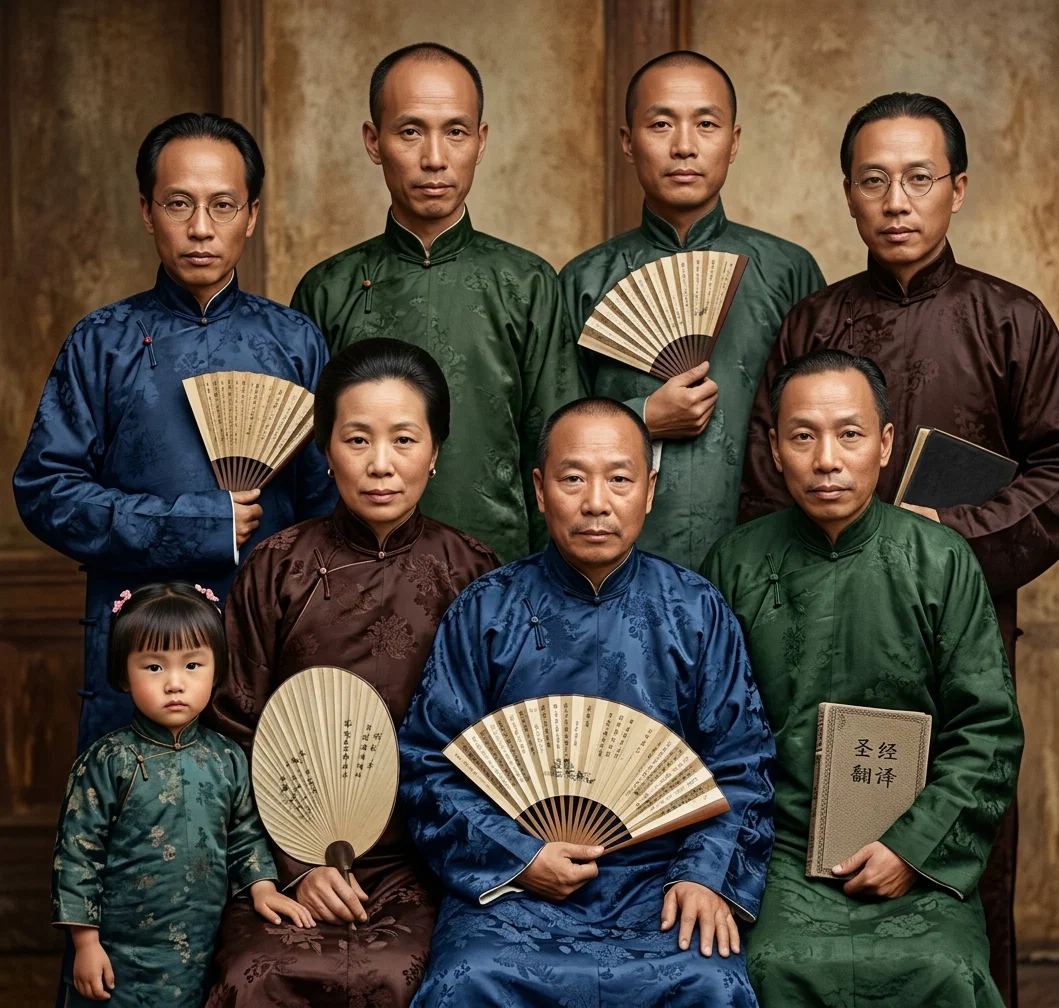
Yesterday I took a picture of a group of those assisting us, which I am glad to send. Our evangelist, Brother Chang Kangheo and wife of Honan province, sit in front, with her daughter between.
NATIVE HELPERS AT THE CHANG-SHA MISSION
God has certainly blessed this brother since he came to us, soon after our arrival at Chang-sha. Whatever measure of success God has vouchsafed to the mission here is in no small measure owing to this man's faithfulness. Soon after coming to us, he was excommunicated from his former mission, and later the Chinese Christian Union took a like action. Personally, we feel that this was beneficial rather than detrimental to his faith, helping him to develop character.
The first on the right, Mr. Shih Tingchen, is our translator and teacher. After we came into this house, he would come every now and again after meeting was over to chat with Brother Chang or me, but did not seem to be much impressed with the gospel. In fact, on one occasion, he told Brother Chang he could not expect to bind him with the beliefs that had bound himself. But while we were away at Shanghai this spring, his heart was softened toward the message considerably. He is exceedingly bright, and very critical, but not overbearing. He is well connected at Chang-sha. His home is in the Anhui province. Since coming into our home, he has had to suffer some persecution at the hands of these friends and relatives. We long and pray that the message may get complete control of him. Last week he drew up a tract, in classical Chinese, confuting the argument that man has an immortal soul.
Second from the right is Brother Lü Chuanleo, of Kiangsi province. He tendered his resignation to the Methodist mission there last year. One regrets the cause which has delayed even an answer to his registered letter; for these seemingly trifling incidents can be taken to mean so much. Brethren, pray for us, that we may have the meekness, gentleness, and above all, the courtesy of Jesus in dealing with these Chinese friends. These will probably speak plainer than our language, be it ever so perfect to their ears. The breach between Chinese and Westerners is not decreasing very rapidly just now. Brother Lü was in their school for eight years, and felt this slight very keenly. He has been employed as our probationary canvasser, and has done faithful work, although his sales have not run high for a few weeks past. We have given him instruction in the message, and trust he will yet see his way clear to unite fully with us.
Third from the right in the picture is Huang Hanyong, of Hunan. He acts as writer and teacher. He has been attending our meetings regularly for many months past.
The man on the extreme left, Ho Chintsin, of South Hunan, is a teacher of English in his own district school at Chang-sha. He attended our classes last year to become more conversant with the English language. As he is also a good Chinese scholar, we felt it would be a splendid thing for our translation work to obtain his services, but it was a trifle difficult to know just how to approach him. However, we feel that the Lord opened the way for us. He came into our home, and takes lessons from me five mornings each week from seven to eight and with my wife from nine to ten, while I take the service in Chinese. In return he gives us the afternoons for translation work with Mr. Sz and myself. His text-books in English have been “Christ’s Object Lessons;” “Patriarchs and Prophets;” “Christ our Saviour,” and a book of readings in the words of Scripture .
In addition he attends our family worship in English morning and evening. It is with very deep regret that we find he has to seek other quarters because of the heat and noise in his room, which is just over the street; but if he goes, he is desirous of returning in the fall. He has become interested in the message, and refused to teach on the Sabbath. Incidentally we discovered that he gave a splendid testimony as to the world's being created by Jehovah, before a gathering of teachers last week. In effect he said, If God was not the Creator, who was? They answered that they did not know. Should he become a real Christian, he would be a great help to the work in Hunan. This is our earnest desire.
Last month the missions in Hunan held a sort of Bible institute for four days for their Chinese workers. We were not invited. At its close a party of Chinese made an appointment to come and study the Sabbath with us. After waiting long beyond the time, my wife and I went for our usual stroll on the city wall. Returning we found Brother Chang had been taking them through the Scriptures, and they told me they were convinced that the seventh day is the Sabbath. Moreover, they invited us to visit with them in their homes. So, the dragon-boat festival being over, and as they thought it better for me to stay at Chang-sha, Brethren Chang and Lü left yesterday with a good supply of the gospel in Chinese. Pinchiang is about three days’ journey direct, but they may take a circuitous course to visit the tea markets with their books. May God bless them abundantly!
You will be interested to know these Pinchiang men were originally strict vegetarians, and experience proves that they make the most earnest Christians. There appears to be quite an interest springing up among them.
Chang-sha.

Rays of Light and Liberty From Austria

JOHN WOLFGARTEN
Religious liberty has recently been proclaimed in Russia, and Bavaria and Austria quickly followed. Though to us as a denomination, liberty of propagation has not been granted officially by the government, yet under a certain organization we are allowed to hold public meetings, and to give lectures throughout the country, and thus we can now proclaim the precious truths of the third angel’s message in this stronghold of Catholicism.
In the fall of 1906 we were sent to Austria to take up the work; but not much time elapsed before we experienced what it meant to be in prison for the truth’s sake. According to the laws of this country, members of one creed may assemble in their homes for family worship; but it is unlawful for their friends and acquaintances to attend such gatherings. The possibility of spreading the message in such meetings is therefore entirely cut off. On the other hand, religious liberty is fully granted to every individual on the statute-books; every one may worship his God according to the dictates of his conscience, without being allowed to proclaim his religion in public.
Here is another act of Roman toleration: children under six years of age may attend meetings of those of another faith. This is a great privilege for the mother who visits our lectures, as she may bring with her the baby or the other small children. From the age of six to fourteen the children are under the school laws, and in this period only the “mother church” has the “right” to educate the youth.
The first of January, 1907, after we had labored for three months under the blessed hand of God, I prayed that the Lord might give us more freedom the coming year. I expressed this thought and our great need at different times, and had the conviction that this year must establish a waymark in the history of our work here. In April of the same year Bavaria received liberty, and this encouraged us to pray without ceasing that God would also answer our petitions in regard to Austria. I consulted different members of the Parliament for advice, and also obtained an audience with the minister of public worship and education; at last one of the representatives said to me, “Why don’t you organize a society?”
This occurred between the council of the General Conference at Gland and the camp-meeting in Friedensau. At the latter meeting it was planned that I should change my field of labor, and go to Hungary. I asked the brethren to let me stay in Austria as I had laid some plans, the result of which I expected would bring the long-desired liberty. My request was granted. In the fall of that year, Brother Gruber, one of our workers and a native of Austria, in whose name everything had to be undertaken, my wife, and I worked out the constitution and by-laws of the society which was to be organized. We had carefully examined the constitution of a similar organization, but had to adapt them to suit our needs.
We presented this document to the administration of the state, and, with some alteration, it was approved by it about the last of November. The name of the organization is a “Society of Christian Men and Women.”
The object is the fostering and promotion of humanity, of Christian life, and education in general; the promulgation and advocacy of the knowledge of acquiring and preserving physical strength and spiritual life, thus leading humanity upon a way that is in harmony with God and beneficial to mankind.
The method of accomplishment is by lectures and instruction on scientific and profitable subjects, according to the needs and desires of the members, and by public meetings, lecture tours, etc., with practise in singing and music. One paragraph about the practise of prayer was crossed out by the administration.
Thus our prayers were answered, and our faith strengthened. In December we made all necessary arrangements and preparations, and on Jan. 3, 1908, we began public lectures. Since then fourteen dear souls have accepted the precious truth, and followed their Lord in baptism. Six others are deeply interested, several of whom keep the Sabbath, and have expressed their desire to be among the next company for this ordinance.
“The Lord has done great things for us; whereof we are glad.”
*Vienna.

Evangelistic Work in Italy

HORACE GIRALDI
SEVERAL weeks ago I was invited to go to Gravina, a town of twenty thousand inhabitants, situated south of Naples, and on the eastern side of the Apennine Mountains. Here Brother Creanza lives, with his family. They were converted in New York, at our Italian mission at One Hundred and Eleventh Street, and now they are back in their home country.
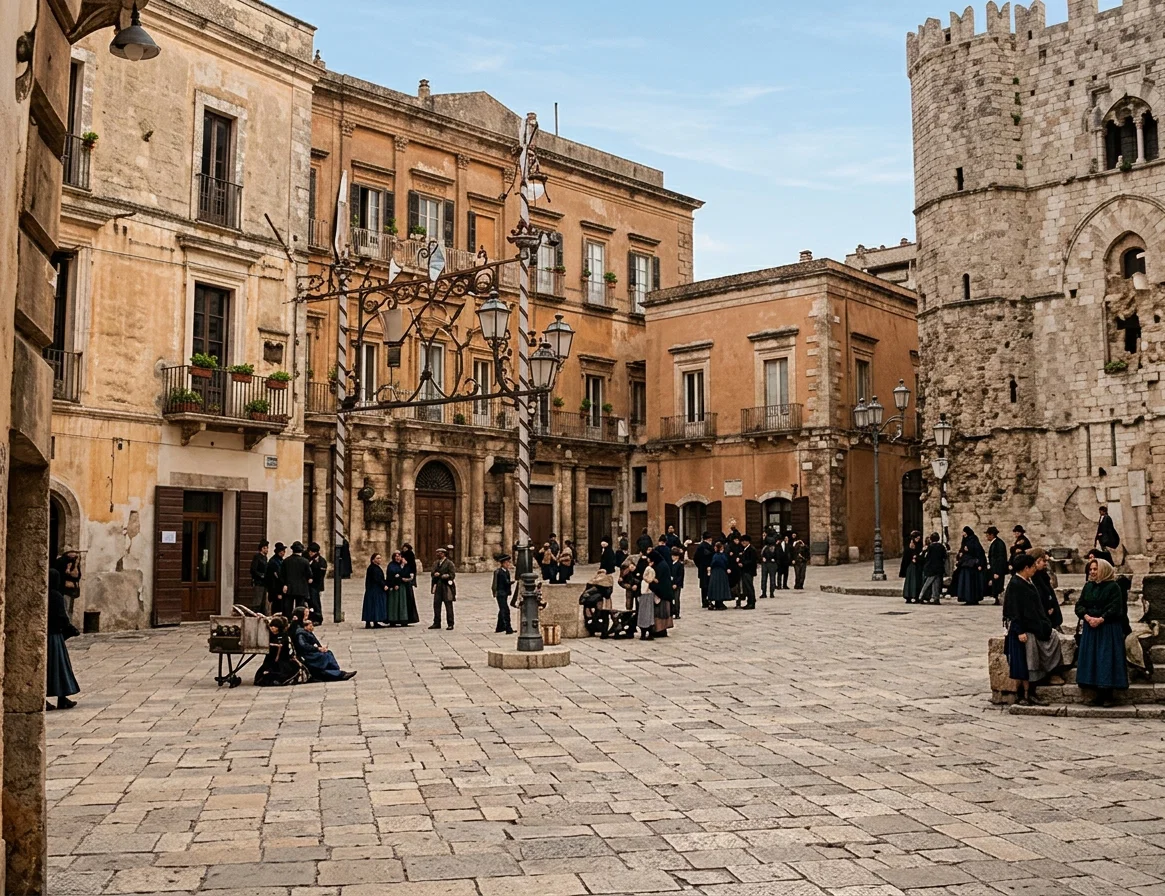
A SQUARE IN ALTAMURA, ITALY
I was very glad to receive this invitation; for it afforded me an opportunity to preach the message in a new field, and to see our brother, whom I had known in New York. So, as soon as possible, I started for Gravina.
The trip, although rather a long one, is delightful, because the train winds through a beautiful country, gradually ascending from the sea-level up to the Apennines, to descend again to the sea-level at Bari, on the other side of Italy. Several hours before reaching Gravina, the train passes through a magnificent plain, bounded on each side, in the far distance by a range of blue mountains. It looks like the immense plains of the West, in the United States, only here one can not find an acre of deserted land; all is cultivated.
At 7 P. M., after a fourteen-hours’ journey, I arrived at my destination, and had the pleasure of meeting Brother Creanza. We went to his house, and were greeted by his wife and children.
As soon as the children saw me, they recognized their old Sabbath-school teacher; they have not forgotten their lessons, nor the hymns that they used to sing so nicely.
That evening we went to visit some families. We did the same next day, speaking to them about the message, and extending an invitation to a meeting to be held in the evening. At the appointed hour, about fifteen persons gathered at the home of Brother Creanza, where we preached to them the third angel’s message. At the close we announced another meeting the following Monday night.
In this town the only Protestant church is the Baptist. We called on the minister, and had a long talk with him. At the end of it he asked us to go away from Gravina, and not to trouble the peace of his people. Of course we could not grant such a request as this.
As soon as we began our work, the power of Satan was aroused against us. The Second meeting was not nearly so well attended as the first. When I again visited the families I had visited before, they began to talk about charity as the most necessary virtue of Christians, especially to Italian Protestants. A little incident was typical. In one family I asked several questions about the Sabbath and the third angel’s message, but could not get a word from them; they would not talk on these subjects, but presently began to talk about charity. We could easily recognize that they were repeating a lesson learned from some one.
Nevertheless one family accepted the truth, and began to keep the Lord’s Sabbath. Another has promised to join at least the Sabbath prayer-meeting that Brother Creanza will hold in his home, and two other families are disposed to study the message.
In order to hold public meetings in Gravina a hall would be necessary.
Naples.

Trial by Conjurer

D. C. BABCOCK
A MENDI court was in session, just in front of our house. Instead of our boys being at work, as I expected, I found them and all the Mendi boys and women in the neighborhood at court, to be tried for stealing a glass tumbler. I tried to get my boys to go to work, but it was of no use. They had their conjurer seated on a stone, his medium completely under his control, with a whip, consisting of a handle about ten inches long, and three strands of rope, with knots tied in them, plying the whip over each one, until the guilty one was found.
Each one had to sit down before the judge, and then the whip was tried on him. If not guilty, he was released. One after another was tried, but no one seemed to be the right one. Then they remembered that one of the suspected ones had gone to town, so they chose one to be tried in his place, as his representative. The very fellow who had stolen some of our lumber the day before was selected, and took his seat.
Although the fellow had taken our lumber, I must confess that my sympathy was deeply aroused for him. I can not understand how he ever stood the flogging he got. He bore it as long as he could, and then ran for life. All the Mendies started a shout, “Tief! Tief! Tief!” and ran the poor fellow almost to death. When they brought him back, he was almost exhausted.
But the matter did not end there. In the afternoon the really guilty man returned, and again the court was called. I had begun work for the afternoon (I had some boys building a better roadway up to the house), and soon all were gone to see the final trial. I went to see what they could possibly do with that fellow, as they had given the other boy such a whipping in his place that I could not think they would whip him. He was soon found guilty, and took his treatment like a man. At first he denied; but when they whipped him, he confessed his crime. It is useless for one to say he is not the guilty person; for if he is tried, and their god says he is the one, that is the end of all controversy.
The man who is under the spiritual influence of their god is in a desperate condition. They always choose a strong young man to be used as the medium. He very soon becomes wild, running about the room, out into the yard, and down the road, frothing at the mouth. When his work is over, five or six young men pounce on him, to take the whip from him. This is a desperate struggle. It took four to hold him, and another held the hand that the whip was in, and the sixth man had all he could do to get the whip from him with both hands. As soon as they got the whip from him, and the conjurer put a little water in his hands, he was as helpless as a babe. He dropped exhausted on the ground. This is spiritism in its darkest form. Their worship is real devil-worship—sometimes in a snake, sometimes in an alligator, or in anything that suits them. The son of one of our sisters killed a snake in this city which a young woman was worshiping, and she actually went insane over the matter.
We need men and women who are not tainted in the least with spiritism—those who know from personal experience that there is a personal God. To tell these people that God is in the trees and in the creatures which he has created, would only encourage them in their present form of worship.
Freetown, Sierra Leone, West Africa.

Western New York

As the result of the tent effort held in Medina, N. Y., where Elder J. W. Raymond and wife, and Brother Theodore B. Westbrook and wife, have been laboring, fourteen persons are made to rejoice and praise our Heavenly Father for this last message which he has impressed upon their hearts. Some of these are heads of families. Some come from churches where they have been active members.
We have organized a Sabbath-school here. Many are interested, and we feel sure that more will soon step out on the promises of God.
The work is onward. Let us work as never before, for the night will soon come, when no man can work.
LIDA MAY WESTBROOK.

Asia Minor

KOZOLOUK.— This is a village near Tarsus, on a high mountain, composed of about one hundred houses. The people are Armenians. We have had a Sabbath-keeping family there for several years. Lately Brother A. Buzugherian made a visit to this village. He writes the following:—
“Several weeks ago I had written you that a sister from Aintab, named Victoria, had accepted the truth, and that her husband, a Kurd, was persecuting her. This sister at last was obliged to quit the truth, not being able to endure. But when the people relate the persecutions she has borne, heart can not bear it. Her husband has beaten her many times with a half-burned stick, and with heavy stones. One day, while his Kurd companions were drinking liquor, and had become drunk, they counseled to go and kill her and Brother Kasbar; but her husband did not consent, but said, ‘Wait a moment; let me go first, and if I can’t convince her back, then you may go and kill.’ He came home and gave much trouble, and she was obliged to run away to Brother Kasbar, who, seeing that something terrible would happen, advised her to go home, and obey her husband. Sister Naomi says that they did not encourage her, else she was willing to die. Though she is away from us now, her heart is with us. She would have us pray for her. Her husband has strictly forbidden her calling on us, but she called twice. Her whole desire is to obey. I spoke many encouraging words to her. Would God that she might rise once more.
“Here there is a Bible woman. She called many times to study the Bible. Others also came, but very few. This case of Victoria and the case of the priest’s wife have frightened the people. The priest’s wife would call on me every time I visited this village, but this time she feared to call. That priest has spoken many hard words to the Armenian priest, whose wife has advised Sister Victoria to keep the Sabbath. He caught a stone weighing about ten pounds, and cast it at the priest. Good that it has not touched him. The priest also has cast a stone at him to oppose him, while the priest at that time was coming to give advice to Victoria that she obey her husband.
“Brother Charles Simmons was also with me here. He, too, advised Sister Victoria to obey the truth. Sister Victoria dared come to our meeting, and we prayed for her.”
If a Kurd can dare to do such evils when the protection of the government is upon us, what evils can he not do when we are excommunicated. Indeed, we shall more and more understand that it will mean death to be a Christian. Brother Alexan writes again from Adana, June 26:—
“To-day Brother G. Keshishian came here from Tarsus to be baptized. Last Sabbath day Elder H. Kupelian baptized Brother Stepan, and the church celebrated the Lord’s Supper. Brother Keshishian also was baptized.”
Brother Keshishian was in the truth once, but last year went back to the world. Thank God that he did not long serve the world, but soon returned to the Lord.
Z. G. BAHARIAN.

The British Union Conference

AFTER attending three of our good camp-meetings in the Columbia Union Conference, which have already been reported through the REVIEW, I left New York, August 9, on the steamship “Baltic” of the White Star Line for England. July 17 we landed in Liverpool, and at once proceeded to Watford, the headquarters of our work in this field. From this time to the beginning of the union conference, which convened in Watford, Friday, July 31, I spent visiting through the field, and generally assisting in the work, also making preparation for permanently leaving England. was adopted by the Watford church and the publishing house.
Sabbath, July 25, in company with Elder W. H. Meredith, the president of the South England Conference, was spent at Bristol, where we organized a church of twenty-one members. This church consists very largely of new members, who have embraced the truth through the labors of Elder G. A. Nickels, Brother and Sister Brooks, and Sister Brewer during the last year. Others are awaiting baptism, and following this ordinance will unite with the church.
The camp-meeting was held on a beautiful field in the suburbs of Watford, on the opposite side of the town from the Stanborough Park estate, where our institutions are located.
The attendance of our own people was somewhat larger than at any previous meeting, there being about five hundred present. These were comfortably lodged among the people of the town, while meals were provided on the grounds in a large dining-tent.
The interest from the outside was quite good from the first. A somewhat novel feature in the way of advertising was adopted by the Watford church and the publishing house. Three editions of nine thousand each of a sixteen-page paper, called The Gospel Tent, were printed and circulated, one of each number being placed in each house in the town. The first number contained an announcement of the meetings, especially dwelling upon its novel features. The two following numbers were devoted to the reporting of sermons and various other meetings. This appeared to be a real success. The expense of printing the paper, I understand, was met by the advertising matter it contained. The first Sabbath was a most blessed occasion.
At the close of the morning discourse, based on Rev. 7:13-17, fully one hundred persons responded to the invitation to those who were conscious of unpreparedness for the end, and would now seek forgiveness and cleansing in the precious blood of the Lamb. The Spirit of God brooded over the congregation, and all hearts were melted to tenderness. Victory came to many hearts in the inquiry meeting which followed. The results of this meeting were due in part to the splendid meeting on Friday evening, conducted by Elder W. J. Fitzgerald. He first spoke of this great movement as a fulfilment of prophecy, then of the need of the Holy Spirit in order to finish the work. In the afternoon Elder W. D. MacLay led out in a service where the sweet strains of praise from all hearts blended harmoniously. Thus the meeting was started in such a way as to place all the business of the conference under the direction of the Holy Spirit. This same attitude was maintained as long as I remained. Monday Elder L. R. Conradi and Brother Guy Dail arrived from Holland, and remained to the close of the meeting.
Elder Fitzgerald was unanimously elected president of the Union Conference, and Elder S. G. Haughey vice-president. On account of the precarious condition of Sister MacLay’s health, making it necessary that they should seek a drier climate, Elder MacLay presented his resignation of the presidency of the North England Conference, where he has successfully served two and one-half years, to the delegates present, which was regretfully accepted. On the recommendation of the British Union Conference, Elder S. G. Haughey of Scotland was elected president of the North England Conference, and Elder M. A. Altman, of Ireland, was invited to take the place in Scotland made vacant by Elder Haughey’s removal. Elder J. J. Gillatt, of North England, was invited to take the superintendency of the Irish mission, made vacant by Elder Altman’s removal.
It was voted to divide the Scotland mission field along the line of the Grampian Mountains, following the southern boundary of Inverness, Aberdeen, and Kincardine, and to place the northern division immediately under the direction of the union conference; also to organize the southern division, consisting of all of Scotland south of the above-mentioned line, into a conference to be known as the Scottish Conference, these changes to take place Jan. 1, 1909.
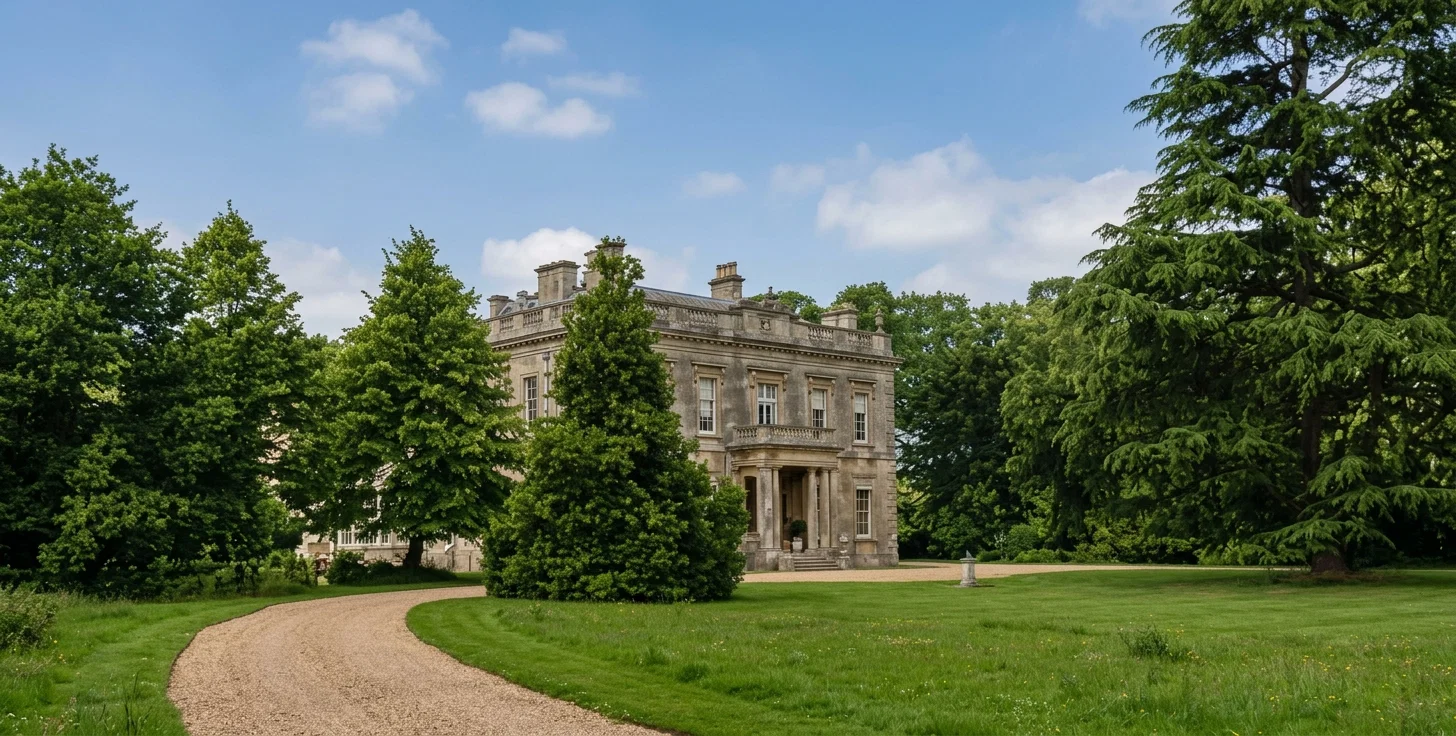
A VIEW ON THE ESTATE AT WATFORD, ENGLAND
It was also voted to organize the Welsh mission field into a conference, this to take effect at the date given above. The organization of these fields is to take place within a few weeks, at meetings of their constituency, to be held in their territory. I regard this as a great step in advance. We have long looked forward to this move, and though I am deprived of the privilege of continuing my labors in that field, it was a source of great pleasure to me that I could assist in making these plans, and see them so heartily adopted by the union conference.
Friday afternoon the writer had the privilege of baptizing nine candidates in a temporary baptistery erected on our estate. Following the evening discourse, an ordination service was conducted. Brother W. A. Shafer, who came over from America some six years ago with a company of canvassers, and Brother Chas. E. Penrose, formerly a Baptist minister in Wales, but who about two years ago embraced the truth, and brought with him a number of his congregation, and has since been laboring successfully in this cause, were set apart by prayer and the laying on of hands to the sacred work of the ministry.
A very pleasing feature of these meetings, which I feel deserves mention, was the service of song very successfully conducted by Brother Glen Wakeham. He and those assisting him had put forth much effort previous to the meeting in training for the occasion, and the music produced greatly added to the effectiveness of the services. I am convinced that vocal music, and especially choir and congregational singing, should be given a much larger place in our colleges than they have ordinarily received.
The work in this union conference never appeared to be so prosperous throughout the field as now. The Lord has greatly blessed in the efforts which have been put forth to build up our institutional work. Plans were laid at this meeting for the erection of a college building and dormitories to accommodate about one hundred fifty students, at a cost not to exceed six thousand pounds. Over five hundred pounds was raised in cash and pledges on the grounds.
After Elder MacLay had become so well acquainted with the field, it seemed sad that it should be necessary for him to leave; but this had been anticipated for more than a year. Long before I had any thought of having to leave so soon, plans were laid for their departure; but they continued to labor on as long as it seemed at all wise. They will be greatly missed in that field.
Before the meeting closed, August 8, my son Celian and I had to leave for Liverpool. From there we sailed on the R. M. S. “Lucania,” of the Cunard Line, for New York.
During a little more than nine years of labor in Great Britain we had all become greatly attached to the people and the work; but however much we have enjoyed our labors there, and regret the necessity of a change, we are content to labor on where God directs, awaiting the glad morning of our reunion, which we are more than ever persuaded is very near at hand.
E. E. ANDROSS.

Cuba

AFTER several months of waiting in suspense we left Walla Walla, Wash., May 19, and an unexpectedly prolonged stay in the East gave us a longer visit than we anticipated with friends, and an opportunity to attend the good camp-meeting at Wilmington, Del.
Owing to some developments in eastern Cuba, it was thought best for us to ship to Havana. Hence, after two days’ most cordial entertainment in New York, by Elder Knott and wife, German laborers there, we sailed on July 9, and arrived in Havana four days later.
The island has a territory about the same as that of Pennsylvania, and a climate that permits of growing crops the year round. The agricultural and horticultural resources are great; and with the methods and thrift of the United States, rich returns can be reaped.
The Cubans are far from being up with the spirit of the New World, and are even behind the Orientals in learning and advancement.
The excellent pasture lands here, where both cattle and goats do well, afford good opportunity for those of our brethren who have means to come and engage in the stock business, and at the same time be representatives of the truth, and help form bases for our churches and schools.
The Roman Catholic religion became the established religion of Cuba under Spanish rule, and public services of any other denomination were prohibited. The churches and religious orders were very rich, possessing great estates and plantations, and here in pomp and solemnity the functions of the church were unrivaled by any in Europe. In a circular issued by a Spanish governor to induce immigration, it was provided that none "but Roman Catholics can be inhabitants of the island." The Protestant Bible was interdicted in the custom house, and the British government made repeated but futile efforts to secure for its subjects living in Havana permission to build a chapel for Protestant worship. So late as 1898, the bishop of Havana refused to comply with the request of Captain Sigsbee that the Protestant burial service might be read over the Protestant dead.
The Spanish-American war changed all this, and there are now in Havana representatives of various Protestant denominations. As we sat in a home in the suburbs of Havana some evenings ago, and beheld how interestedly two or three families drank in present truth as it was presented by Elder E. W. Snyder, and as we see some of the native brethren engaging in colporteur work, selling our papers and tracts, we can but know that surely God is gathering from this generation a people to his honor from every nation, kindred, tongue, and people.
We are now located here near San Cristobal, and, so far as we know, the only representatives of the third angel’s message on the south side of the mountains in this western province (Pinar Del Rio) of Cuba. San Cristobal is the town of records for this division or part of the province, and is a place of perhaps a thousand or more population.
S. H. CARNAHAN.

The Missouri Camp-Meeting

The annual conference and camp-meeting for Missouri was held at Sedalia, August 6-16. The camp was well located in Liberty Park, at the edge of the city, with good street-car service. The attendance of our own people was fair, and an excellent spirit was manifested throughout. Quite a good work was accomplished along spiritual lines, and a number gave their hearts to God. Elder Meade MacGuire, Sister Merrell, and others did a good work among the young people. Forty-two were baptized.
One of the principal things accomplished was the dividing of the State into two conferences. The Missouri River is the dividing line, with the exception of the counties of Jackson, Saline, and LaFayette, which lie south of the river and include Kansas City. These go to the north. This gives a population to the northern conference of 1,250,000, with seven hundred twenty Sabbath-keepers, and a tithe last year of $5,949. The southern conference has a population of 1,750,000; Sabbath-keepers, 930; tithe last year, $8,916.
Both conferences were able to fill the various offices with capable laborers.
Elder D. U. Hale, the former president of the State conference, was elected president of the Southern Missouri Conference, and Elder A. R. Ogden, of Kansas, president of the Northern Missouri Conference. The headquarters of the Northern Missouri Conference will probably be at Chillicothe; that of the Southern Missouri Conference at Springfield. We are fully convinced that this division is a wise one, and will work a new era of progress in the great State of Missouri. The utmost unity was manifested in the division, hardly a discordant note being heard throughout the meeting.
A liberal spirit was manifested toward the work. Almost six hundred dollars was raised for the Oakwood Industrial School, and $4,360 in cash and pledges was given for foreign missions. The Sabbath-school donations were greatly increased over those of last year.
Elders G. A. Irwin, E. T. Russell, G. F. Haffner, Meade MacGuire, and J. S. Wightman, Profs. C. C. Lewis and B. E. Huffman, and the writer attended the meeting, and shared its burdens with the conference laborers.
Our prayer and desire for these two conferences is that the unity and power of the Holy Spirit may characterize their work, and that progress proportionate to the greatness of the work and the shortness of time, may be seen during the coming year.
G. B. Thompson.
Continue reading: A Canvassing Institute in Mexico City