[As announced last month, a series of articles on manual training is to be presented in these columns during the coming school year by Mrs. E. M. Long. We plan to have one of these articles appear each month. They will afford sufficient suggestions and help, we believe, to enable our primary teachers to give a thorough course of instruction in manual training continuing throughout the school year. The paper needed for the work may be obtained from the Review and Herald Office. For twenty cents they will send twenty sheets of manila paper, eight inches by eight inches, and the same number of sheets of colored assorted “cover” sheets.—P. G.]
The courses of work which will be outlined in the following articles may be used with equal success in either graded or ungraded schools. The first course, which is paper work, is designed for children from seven to nine years of age. Younger children have done the work, but for them it is better to omit the more difficult models. More harm than good results from giving work too difficult to be successfully completed by the child’s unaided efforts. Unaided effort is not undirected effort. It is the teacher’s business to direct, but more than that should not be necessary.
If inaccurate work is accepted, the child’s standard is lowered, and thus, in a great measure, the object of the work is defeated. If the teacher does the difficult parts, the finished model is not a true expression of the child’s ability, and his own sense of honor recognizes that fact, and thus he is robbed of the pleasure and honest pride which he would feel if the work were all his own.
The object of the work is to teach neatness, carefulness, accuracy, attention, and some degree of skill. In short, it is to educate the eye to observe and the hand to perform. It aims to do this through the medium of attractive forms and colors, which appeal to the interest of the child.
The tools needed for each child are a foot rule, a pencil, scissors, compasses, and a coarse darning-needle. The ruler should not be marked finer than one eighth of an inch. The pencil should be sharpened to a fine point. Scissors with long blades are preferable. Do not use poor compasses; that is, compasses that can not be locked, or that “wabble.” A good pair can be procured for twenty-five cents at retail, or for about fifteen cents by the dozen. If you can not obtain good ones, use a home-made substitute, directions for making which will be given later.
The materials needed for this work are two eight-inch squares of paper for each model. One square of plain paper for the drawing, and one of colored for the model. Also have some yarn or ribbon for tying. The best paper for the purpose is what is known as “cover” paper. It can be procured in assorted colors, and be cut to the required size, at almost any job printing-office.
Everything should be in readiness, and an eight-inch square for the teacher’s use drawn on the board before the class is called. The teacher should also have a finished model to place before the class. Let no teacher attempt to give instruction in manual training who has not herself done the work, and recently enough so that every point is fresh in mind.
Show the children the model, explain its use, and call attention to its good points of workmanship. Give them a high ideal to work to, and inspire them with an ambition to reach it.
The child, of course, sees only the model, but the teacher should see the deeper and more lasting results which may be gained through his efforts to reproduce the model, and should spare no pains to secure excellence of workmanship. Let no negligence or short-sightedness on the part of the teacher defraud the child of the benefits which he should receive. Teach him that carelessness in only one point will result in an imperfect model. Let perfection be the standard, and remember that it is made up of trifles.
One model, with the drawing, is all that should be given for one lesson, and as the more difficult models are reached, it is sometimes well to let the drawing constitute one lesson, and the making of the model another.
Give each child a square of the drawing-paper, and carefully explain how, by placing the fingers of the left hand on the ruler near its center, and letting either the wrist or the thumb and little finger rest on the paper, lines may be drawn across without either ruler or paper slipping out of place. This exercise27should be practised until thoroughly mastered.
Then you are ready to take up the work of the first model. In every case the drawing on plain paper should precede the actual work of the model. The drawings should be preserved, and may be placed in the envelope which is the last model of the course, and each child’s complete set be given to him at the close of the term.
Model No. 1
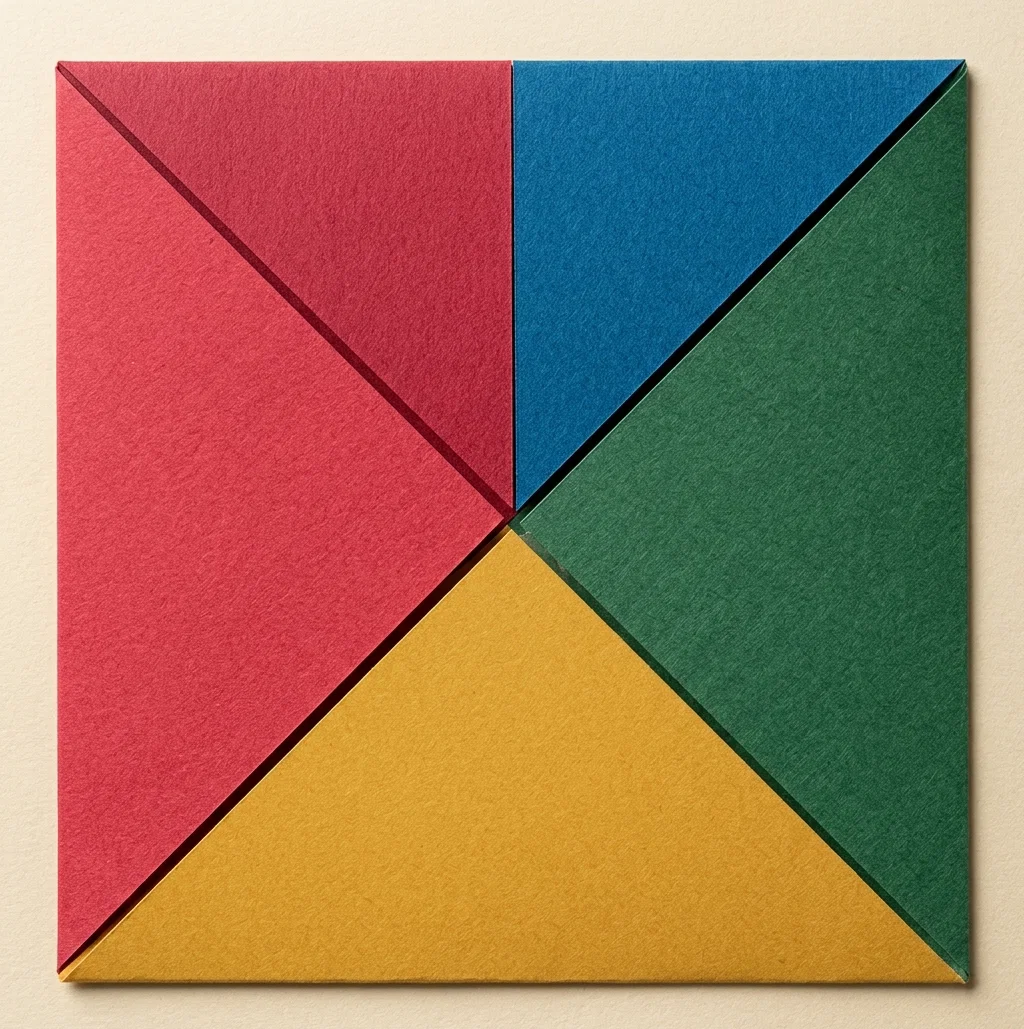
The first model is a very simply made envelope. For the drawing (Fig. 1), place the ruler across the square diagonally, and draw a line entirely across. Call attention to the fact that the line runs exactly into each corner. Emphasize the importance of this, and ask the children to draw similar lines on their paper. Pass around, and see how successfully they have done this. Make any needed suggestions.
THE ENVELOPE
Then return to the board, and with the same care as before, place the ruler across the square in the opposite direction, and draw a line from one corner to the point where it meets the first line. Stop exactly at the point of meeting. Make a special point of having each line of every drawing begin and end just where it should. Examine each child’s work. If well done, let each write his name on his own, and give him a sheet of colored paper. If not well done, he may turn the paper over, and try on the other side.
In every case as soon as the colored paper is received, let each child repeat the drawing on that, without any suggestions from the teacher. Teach the children to work independently, and not to expect help, after the first drawing is completed.
To form the envelope, fold the corners which have lines through them over to the center. Place them, just one at a time, so that the very tip of the corner is exactly at the point where the short line meets the long one. Hold with the left hand in such a way that it can not slip out of place while the fold is being made with the right hand. If correctly done, the edges will just meet, and the corners made by the folding will be true and square.
Provide each child with yarn of suitable color, and a darning-needle. Teach them how to thread the needles properly, and see that each child threads his own. Show them how to roll the needle between the thumb and forefinger, as it draws the yarn through the paper. This will prevent the paper from being torn.
FIGURE 1
FIGURE 2
THE WINDMILL
Then show them how to push the needle in through the right-hand flap, out through the lower one, and out through the left-hand one. Carefully draw the corners together. Slip the needle under the stitch formed by passing from the lower flap to the left one, bring together at the center, and tie.
When finished, the envelope may be hung on the wall to receive unanswered letters, or letters ready to be posted.
Model No. 2
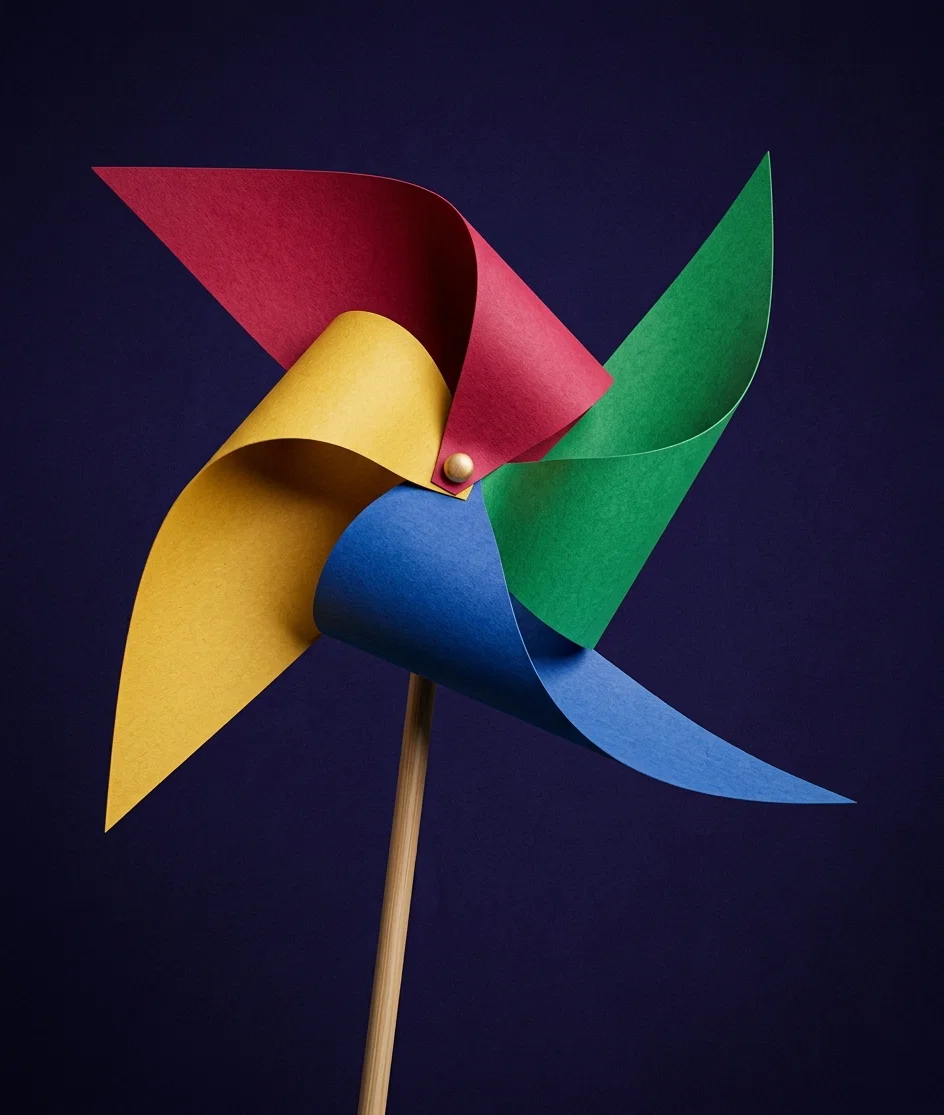
This is a windmill. To make it, the teacher will need for each child, in addition to the paper, a good-sized common pin, two quarter-inch squares of cardboard, or heavy paper, and something for a handle. Willow or alder shoots may be used, or a smoothly whittled pine stick, as large around as a lead-pencil. If none of these can be readily obtained, half-inch strips cut from a heavy pastboard box may be used.
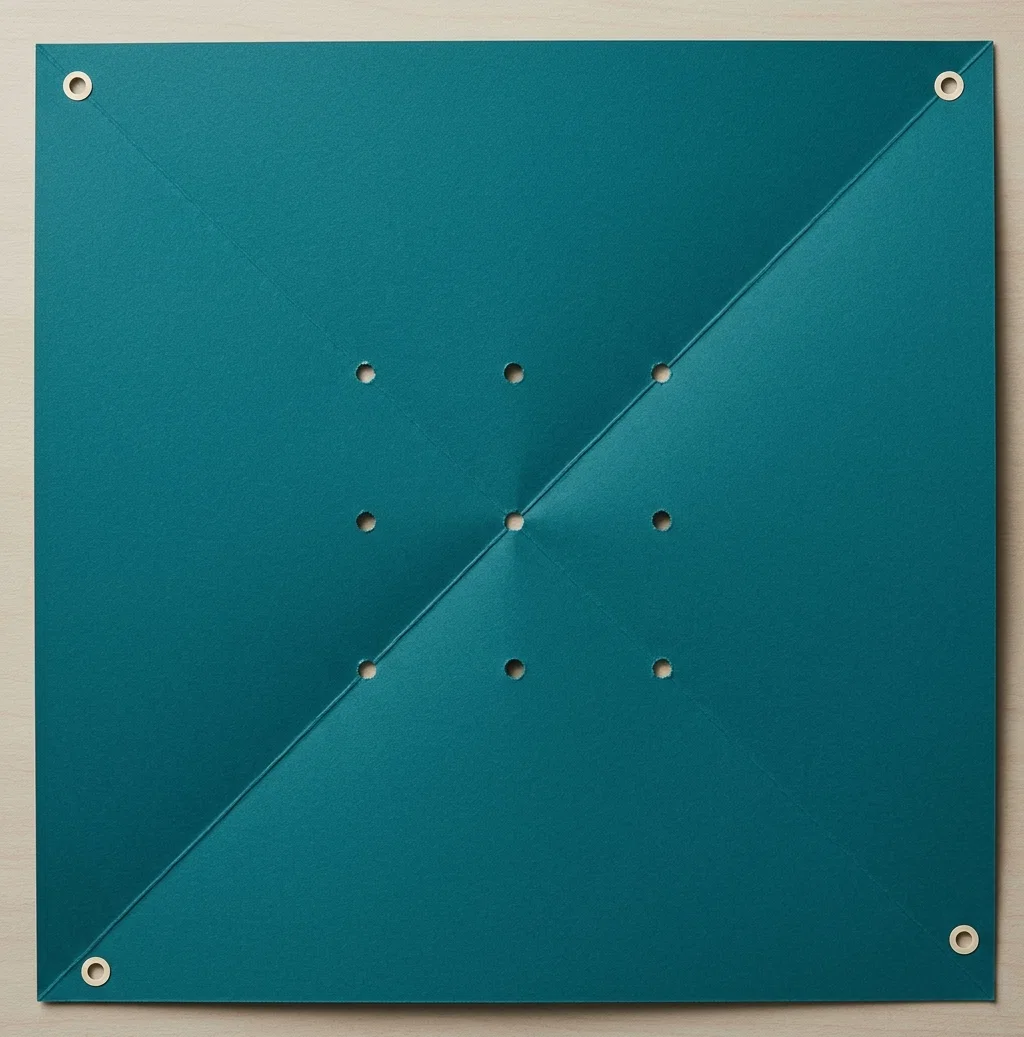
The drawing is the same as for the envelope, except that both lines are drawn entirely across.
With each drawing let the children follow, step by step, your work on the board. Pass around often enough to assure yourself that they are following correctly. Notice the points on each line not far from the intersection of the lines. These are located by measuring four inches from each corner of the paper. If the children do not know how to measure, they must be taught now. Teach them also the correct way of making a “point;” that is, to place the point of the pencil exactly where the “point” is needed. With the pencil upright, press lightly, and roll between the thumb and forefinger without moving it along on the paper. This makes a small, round dot. Accept nothing else.
Notice the very small circles near each corner of the drawing in Figure 2, and be sure that similar ones are placed on the board, and correctly copied by the children. On the colored paper these should be perforated with a pin; also perforate the center, where the lines cross. Cut each line from the corner of the paper to the four-inch point near the center. The cuts should be straight and smooth, and right in the center of the line. This can be done easily by opening the scissors wide, and closing them steadily on the line. A long, steady cut gives better results than short, clipping ones.
Now show the children how to put their models together, but let each child have the pleasure of doing his own.
First push the pin, clear to its head, through one of the small squares of cardboard. With the windmill lying before you, pick up one of the perforated corners, bring it over so that the pin can enter the perforation from the under side of the drawing, and slip the pin through. Also through each of the other perforated corners in the same way; then through the perforation in the center, through the second small square of cardboard, and well into the end of the handle. The squares of cardboard serve as washers.
MRS. E. M. LONG.
Growth and Temptation
THE stronger we grow to be, the stronger will be our temptations. The nearer we grow into the likeness of Christ, the fiercer will be the onslaughts of the enemy. We can not escape life's battles by moving into a different or higher sphere. Each stage, or sphere, has its own temptations. As Jesus was tempted, so will his disciples be tempted. But, as he was made perfect through sufferings, so our trials, which are but for the moment, will work for us a far more exceeding and eternal weight of glory. —Selected.
True Education
By L. B. Ragsdale
“TRUE education means more than the perusal of a certain course of study. It means more than a preparation for the life that now is. It has to do with the whole being, and with the whole period of existence possible to man. It is the harmonious development of the physical, the mental, and the spiritual powers.” If the student develops one of these powers to the neglect of the others, he is not living up to his privilege, nor will he grow up into the perfect man.
From the following statement we can see the importance of forming a good character while we are gaining our education. “True education does not ignore the value of scientific knowledge or literary acquirements; but above information it values power, above power goodness, above intellectual acquirements, character.”
We have many examples of noble characters who have surmounted the difficulties of to-day, and have reached their aim in life. There is encouragement for those who are self-distrustful, and whose lack of self-reliance leads them to shrink from care and responsibility. Let these rely fully upon God. Thus many a one who would otherwise be but a helpless burden will be able to say with the apostle Paul, “I can do all things through Christ which strengtheneth me.”
Success in any line demands a definite aim. He who would achieve true success in life must keep steadily in view an aim worthy of his endeavor. The heaven-appointed purpose of giving the gospel to the world in this generation is the noblest that can appeal to any human being. We need to follow more closely the example of our Saviour. When he worked in the carpenter shop with his father, he developed his physical powers; as he sat by his mother’s knee and learned the sacred truths of the Scriptures, his mental powers were developed; and his spiritual powers were developed by those seasons when he spent all night in prayer to his Heavenly Father.
L. B. RAGSDALE.
Methods
By Ruth Watson
Consecrated Music
“THE melody of praise is the atmosphere of heaven; and when heaven comes in touch with the earth, there is music and song.” It is said that when the earth was first created, “the morning stars sang together, and all the sons of God shouted for joy.”
Music is one of the best means of impressing hearts with spiritual truths. Cheerful, happy songs drive away the gloom and despondency that come so often to each one. The adversary is well aware of this fact, and in order to make the broad way attractive, has caused to be written a class of music which is bright, but which has no depth of feeling, and whose influence is not uplifting.
The way of the children of Israel was cheered by the sacred songs of their deliverance; so are the children of God to-day bidden to lighten their pilgrim life by song. Such songs have power to transform lives. How important, then, that we study the principles of music, in order that these songs may be sung with the harmony that will approach that of the heavenly choirs.
“As an act of divine service, singing is as much an act of worship as is prayer.” Indeed, many of the songs we sing are prayers, and if sung with the spirit and the understanding, have a power that can not be realized. “If the child is taught this, he will think more of the meaning of the words he sings, and will be more susceptible to their power.” “As the echo of the angels’ song is awakened in our earthly homes, hearts will be drawn closer to the heavenly singers. Heaven’s communion begins on earth. We learn here the keynote of its praise.” RUTH WATSON.
Correlation in History
THIS is only one of the fields where correlation suggests rich improvement in our methods. A young friend wrote me not long since, concerning the study of history: “A boy learns from his study of Persian history that Darius fell at Arbela, and the Persian power was crushed. He may also remember from his study of Greece that Alexander won a victory at Arbela in 331 B. C., but it never occurs to him that Darius and Alexander were in one and the same battle.”
How can a proper understanding of our own early history be obtained without a study of the history of Spain, Holland, England, and France? The different motives of settlement and colonization can be appreciated only by a study of the conditions that existed in Europe; and why France was our friend in the Revolution will be found to have been not from purely humanitarian impulses, but because it furnished a means of harassing her “ancient enemy.”
Another personal experience may assist28in making my meaning clear. I learned in geography that “a hill is a small elevation of land,” and “a mountain is a vast elevation of land.” And yet the “hill” that I had to climb twice a day in taking the cows to pasture and bringing them home was to my mind a “vast elevation.” It was not shown to me that such terms are relative, and that what we called a “hill” might sometimes well be called a mountain. I learned, too, that “a river is a stream of water flowing through the land.” Now, I had to cross two miniature rivers every time I went to school. There was not the slightest effort on the part of my teachers to correlate these facts, which lay at the very door of the schoolhouse, with the definitions and theories of the books. And yet what an opportunity for practical correlation!
Does not correlation in this sense offer material that is quite within the reach of every teacher? If the young teacher finds something in this discussion that sets him thoughtfully to find a more complete unification of his school work, so that each subject shall sustain, ally, and strengthen every other subject in the school course, he will have reached the best correlation possible.—Selected.
Politeness
THE teacher will find frequent opportunity to give instruction on the duty of being polite to strangers, to teachers, and to companions. Schoolchildren frequently insult, or in various ways act impudently toward, strangers who may happen to pass the schoolhouse during play-hours. The teacher should try to check any such conduct at once, and take the opportunity to give a lecture on politeness. Pupils fail sometimes to speak in a respectful manner to the teacher or to each other. The teacher should call attention to these points, and remind the pupil of his want of politeness. The teacher should always speak and act politely toward pupils wherever he may meet them, thus teaching by example.—Selected.
Morning Exercises in Our Church-Schools
By C. H. Countryman
The purpose of this article is to suggest how the morning exercises in our church-schools may be made interesting and profitable to the youth who are seeking a Christian education.
In order to maintain the interest of the school in this part of the daily exercise, we must make changes—not every day or every two days, but at least once a week. Our children, as it was said of Timothy, should know the Scriptures from their youth; but how may the morning exercises be made a factor in obtaining this desired end?
In the first place the children of Seventh-day Adventist parents should know in their simplest form the truths which we hold dear. Suppose we devote one week of each month to the consideration of some Bible topic, making an outline, or short reading. Our first would be on the “Word of God.” This exercise, if rightly conducted, may be made very interesting. The children will enjoy looking up the texts at home; and after the weekly study is properly arranged in logical form, they should be requested to copy them in a note-book, for future reference and review. Written tests add greatly to the interest of the exercise, and should be given once a month. So we pass on, devoting the first week of every month to a short reading, which should be so impressed upon the average child’s mind that he can, when out selling papers, talk to the people if they ask questions concerning the truth, giving reasonable answers. At the end of a year we have completed the subjects of Christ’s Second Coming; the New Earth, the Sabbath, the Resurrection, the Destruction of the Wicked, and Justification by Faith, all of these having been presented simply.
Another very important exercise which can be employed with much benefit to those instructed, is the learning of chapters in the Bible, such as Psalms 1, 13, 19, 23, and 91; also Isaiah 55. These are all excellent chapters for this purpose, and will prove a great blessing to the school.
The third week of each month can be very profitably employed in looking up, for instance, scriptures concerning the hand, ear, tongue, eye, different animals, birds, hail and frost, rivers, and many other things in nature, besides having readings from the book, “Ministry of Healing.”
Some profitable study should be assigned to the fourth week of the month. The miracles of the Old and New Testaments may be dwelt upon, such as Elijah’s and Elisha’s deeds, the miracles of Christ, noticing the prophecies which relate to his work here on earth, his deeds of kindness, his healing, and illustrations from nature. The books, “Early Writings,” and “The Great Second Advent Movement,” are especially useful in this part of our school work.
C. H. COUNTRYMAN.
With the Children in the School-Room
By BERTHA LOFTSTAD
THE responsibility of the teacher in training the young is a great and sacred one; for much depends on habits formed in early years. Harsh, unkind words may leave upon the mind an impression never to be forgotten, while lack of discipline will result in an equal evil.
A difficult task is assigned the class. To one child it seems almost too difficult to accomplish, but she tries, and, as she thinks, fails. The class is called. One after another recites the lesson until her turn comes. No word is uttered, the little form trembles, the large eyes droop lower and lower, and, bursting into tears, she exclaims, “Mine wasn’t any good.” But a loving arm is thrown around her, and words of encouragement bring hope to the fainting heart, and finally the lesson is recited. Not for this lesson only was the hope instilled, but for lessons, even life’s lessons, to come.
“I can not study; I do not feel like it.” Shall we say, “All right,” and permit the habit of idleness to be formed? Of course, should there be a real cause, the lesson might be omitted; but when this is repeated as an excuse for not studying, the lesson must be exacted with a kind but firm command. The child bursts into tears, but duty must rise above pity, until, seeing he can not conquer, he goes to his lessons; and another lesson is learned.
There is trouble,—not a great trouble, for children’s troubles are not great, though to their little minds they seem so. Happy is the teacher who so wins the confidence of the children that these troubles will be brought to her. Calling them together in Bible class, the sweet lessons of forgiveness and of loving one another that our Saviour taught are told them, the little wrongs are forgotten, and they are happy again.
And so as the days pass, and the little minds are developed, we learn how to guide each child, and each one grows nearer and dearer to the teacher’s heart.
BERTHA LOFTSTAD.
Don’t Be a Mummy
By CLAUDE E. HOLMES.
Moses was once on the way to the royal cemetery of Theban-hill mummies. But he changed his path toward the wilderness, that he might live with the wandering children of God. Had he not made that decision, and cast off the purple vestments of Egyptian glory, we might to-day look upon his mummy in some museum. This change was caused by a knowledge of the true education. There were two paths which appeared before Moses. The distance between them may not have seemed far apart as he viewed them. But as time went by, Moses found that they were as far apart as heaven and earth; for he is now in heaven, and his royal successor a mummy on earth!
You are making decisions to-day which will be as far-reaching in their results as those of Moses. Look for the teacher that will guide you the way Moses was led by his mother.
When you start in your school work, do not “keep back part of the price,” but make all your efforts tell. Throw all your strength into getting something definite and eternal.
A little of the right kind of training will do wonders. Do you know that mosquitoes stopped the French nation from digging the Panama Canal? The mosquitoes did not succeed in doing that with the United States. Why?—Because an energetic man ferreted out the cause of the difficulty. Maybe it is some little thing that is keeping you from having success in clearing up the King’s highway. Investigate. Talk with some of our faithful teachers; possibly they can discover your difficulty. Have you ever consulted them about it?
One place in the city of Washington which few tourists fail to visit is the Navy Yards. Here are made the monster29guns for the war-ships. Not far from this interesting spot is another important place much less assuming than the navy yards both in size and sound. It is called the “Barracks.” Here the government makes its soldiers. In the business of war such institutions are necessary. Cannon must be made; and men must be trained in order to act understandingly and successfully against the foe.
Seventh-day Adventist training-schools, whether they be church-schools, academies, or colleges, bear the same relation to our work as the navy yards, barracks, and forts do to the national government. One discouraging feature of modern warfare, however, is the rapidity with which a weapon becomes obsolete. This is not true with the weapon of the Christian. He has only one,—the sword (the Word of God),—and it never becomes antiquated. Nothing has ever been invented, or ever will be invented, that it can not pierce. The work of our schools should be converged upon one thing,—training volunteers in the use of that sword. To teach them the philosophy and so-called truths of worldly science is like building cannon to-day that will be worthless to-morrow.
While the sword is our only weapon, Paul informs us that we need an armor. Did you ever think that the enemy might get the advantage of you if you have only the sword? The armor is necessary to protect you from the fiery darts of Satan. You know that a sword is useful only in a hand-to-hand conflict. Darts can be thrown from a distance. You need the armor—the helmet of salvation, the breastplate of righteousness, the shield of faith.
As soon as possible, you want to go to one of our schools, and join the classes which teach the art of making such shields, helmets, breastplates, and sandals. Take lessons in using that sword. Goliath made a fatal mistake when he trusted his shield to the hand of another man. What person on his death-bed ever regretted that he spent more time studying the Bible than any other book? How many, if they could have lived a few more years would have searched it more faithfully? Why should we not learn a lesson, and begin where they left off?
Factories take pig-iron and turn out finished cannon. That is their business. Scores of theological seminaries are supposed to be in the business of making well-rounded Christian ministers. Where does the fault lie when students enrol as Christians, and are graduated unbelievers, or perhaps they are infidels when they matriculate and are the same when they step out into the world to wield their influence? To send a product out in no better state than when received would not be tolerated in a worldly institution making material things. Thus while many universities are failing in their purpose, I am glad that our schools are taking decided steps in fulfilling their sacred duty. At the end of the school year we have read of many baptisms. The students are going out into the field to engage in actual work. When such a spirit is implanted in their minds, the schools are doing their proper tasks.
There is one degree that all should endeavor to secure, and that is the degree of B. A. You no doubt think that the degree of Bachelor of Arts is worth having. It looks good after one’s name. But that is not the B. A. that you want. It goes after your character — Born Again. Do not rest satisfied until you possess it.
Our schools are numerous, and do excellent work; and we have scores of young men and women with rare talents. The problem to solve is: How can we get the two together? It won’t do to corral and drive them there. I am convinced that the problem has already been partially, if not entirely, solved. The scholarship plan is practical, and will fill our schools with ambitious youth.
Before one will care to attend a school, he must have a desire to learn. The experiences gained by canvassing will place this longing in his heart. As he talks with persons about the truth, he quickly discovers his lack of knowledge and his need of ability to present what he knows. Then he will go to school. Man can not stop him, and God will not.
Do not think that even getting an intellectual training in one of our schools is the end of your efforts. When you are called up before the Judge, you will not be asked to repeat the multiplication table or give selections from some Shakespearean play, but, How have you served your fellow men?
It takes a good heart training to be graceful and skilful in giving cups of cold water to thirsty travelers along life’s dusty pathway. Maybe along the way you will find some in prison. Sing a stanza of the song of praise composed by Paul and Silas, and possibly you may free them. Learn how to apply bandages of love to broken hearts, and to give sight to the blind. God will then give you a post-graduate course in the heavenly school. He has one hundred forty-four thousand scholarships ready and waiting for those who will pass the examinations.
CLAUDE E. HOLMES.
The School
What Good Order Is
Good order in the schoolroom is attained when every pupil attends to his own work at the proper time without unnecessary noise, promptly and cheerfully obeys the teacher, and, above all, exercises perfect self-control.
The pupil should never be idle. Idleness in itself is disorder, and the teacher should be disturbed by it. Then the work engaged in must belong to that particular time. A time for everything, and everything in its own time, is an aphorism in school government, which, if observed, will go a great way toward securing good order. It also establishes a habit that is vitally essential to success in after-life. Every child should understand not only that he must be busy, but that he must be busy with the task that belongs to each particular period. Methodical habits will thus be formed, and these, too, are a part of education as well as of good order. Of course this necessitates a statement in the daily program of seat-work to be done, as truly as the work of the recitations; and the teacher should hold the pupils to the one as strictly as to the other. This will save a great deal of confusion, and do much to secure a proper preparation of the lessons. It will also prevent the unnecessary noise which distracts attention, and destroys the respectability of the school. Then it will be easier for the teacher to distinguish between “the noise of busy industry,” and the noise which is disorder.—Selected.
The Rome Mission School
By C. T. EVERSON
We have recently moved our school from Via Cavour to Piazza Venezia, the very heart of Rome. This is on the square where all the car-lines meet. We have a flat on the first floor, extending the length of the building, so that we have been enabled to put up a large sign, fifty or sixty feet long, that can be seen across the square. That is what we would call a sign of the down-town district.
It was no small risk to rent such a place, especially as we had a lease on the old flat that entailed an expense of nearly two hundred dollars if we should fail to rent it; but as this was such a magnificent situation for a school, we took it, trusting the Lord to help us. And the Lord did help us to rent the old place so we did not lose a day of school; for we so arranged the moving that the school went on uninterruptedly.
We have an enrolment close to the one hundred mark all the year, and have even passed that number. We have brought our tuition up so that we take in about one hundred dollars tuition a month from the students, which represents a good sum from a poor country like Italy. In fact, if we go ahead next year with the same increase that we have been blessed with this year, we shall be more than self-supporting. However, we are endeavoring to build solidly; for we want this school to prove a power for good in Rome.
We have a faculty of about ten teachers in the school, and come in contact with a very good class of persons. We have students of the university, high school, and other institutions, as well as employees of the government, doctors, lawyers, and other professional men. Our students respect us, and we believe that this same respect they show for us as teachers can, by wise planning and prayer, become an influence to lead them to respect our religion.”
C. T. EVERSON.
Educational Notes
PROF. C. SORENSON, principal of Keene Academy, writes: “The school, including the different industries, has made a gain of over four thousand seven hundred dollars this past year. While, of course, we do not have all that money in the bank, yet the board feels encouraged to make some improvements in the equipment of the school for the coming year.”
On account of the resignation of Prof. A. W. Spaulding as principal of Bethel Academy, at Bethel, Wis., Prof. Paul Scheppler has been chosen to act in that capacity. Professor Scheppler has been connected for years with the work of the Bethel Academy, and is well qualified to carry out its purposes. Professor Spaulding is leaving to engage in educational work in the South.
Reference was made some time ago to the call for teachers for the Spanish field. Sister Ellen B. Fattebert, 2a de Maltos, No. 3, San Luis Potosi, Mexico, is desirous of corresponding with persons who are willing to go to Mexico to connect with the teaching work there. This is a needy field, and there is an excellent opportunity for an important work to be done in teaching.
Profound learning can never take the place of familiar and every-day contact with men and women. To move the world we must know the world. To influence men and women we must appreciate their condition and be in some sense familiar with the things in which they are interested. It is only in this way that learning can have its rightful influence over the lay mind.—United Presbyterian.
We wish to call the attention of our people, particularly our teachers, to the Church-School Manual, which has recently been issued by the Pacific Press. This book contains outlines of courses, suggestions with reference to text-books, methods of teaching, the principles underlying our school work, etc., and is very comprehensive in the study of the whole general subject of Christian education. It should be in every Seventh-day Adventist home.
In response to the invitation of the Department of Education at a meeting held at Cleveland, Ohio, Brother Gerard Gerritsen is making arrangements with the Walla Walla College Press to publish a musical journal. This musical journal will be published monthly, as now planned, and will contain a series of lessons to be used in our schools throughout the year. Further definite announcement with reference to this proposed journal will be made later.