An Explanation of One of the Great Prophecies of Revelation
CARLYLE B. HAYNES
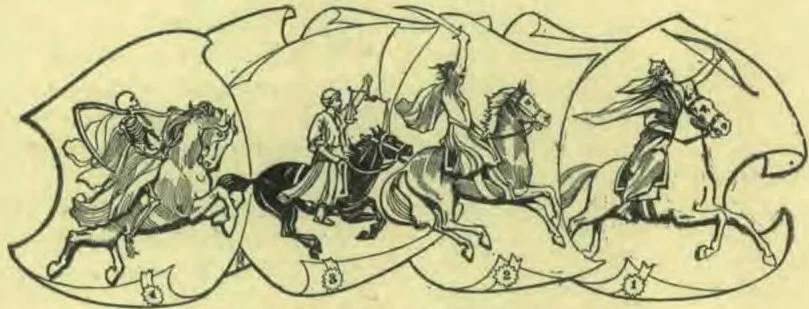
When Donald Hunter reached the tent on Friday night the first thing he noticed was another long chart, and on it were very strange pictures. There was a white horse, a red one, a black one, and another with rather a yellowish look. Then there was a picture of the martyrs, some being burned at the stake, and some being torn to pieces by wild beasts. There was another picture of a violent earthquake, and another of the rocks and mountains falling on the wicked, and the last picture on the chart was a wonderful picture of the second coming of Christ. Brother Harris had announced his subject as “The Seven Seals.”
THE FOUR HORSES OF THE SEVEN SEALS
“The most interesting of all the books of the Bible to the student of prophecy is the book of Revelation,” he began. “This book contains prophecies of surpassing glory and power regarding the last days, and yet it is perhaps the least studied of all the books of the Bible. In the very days when its wonderful predictions are receiving their fulfilment it is given but scant attention.
“This is due, no doubt, to the impression which prevails that it is a sealed book, a mysterious, hidden book. But when one reads the first words in the book, in Revelation 1:1–3, the idea is shown to be false. Instead of being a mystery this book is a ‘revelation.’ Its whole design is to reveal, not conceal, ‘things which must shortly come to pass.’ And a blessing is pronounced on the study of this book which is placed on the study of no other book in the Bible. It is a blessed thing to study any book in the Bible, but it is an especially blessed thing to study this book.
“Revelation contains a number of prophecies, such as the seven churches, the seven seals, the seven trumpets, and the seven last plagues. It is the prophecy of the seven seals which we shall study tonight. This prophecy deals with the religious history of the world from the beginning of the Christian era to the end of the world, and, with the other prophecies, divides the period into seven periods of time.
“When the first seal is opened, Revelation 6:1, 2, John sees the white horse, whose rider goes forth conquering, wearing a golden crown. This is a symbol of the triumphs of the Christian church during the first century of the Christian era, during the days of the apostles. The color of the horse—white—represents the purity of the church in that period. It was pure, both in life and doctrine. What it believed was the truth, and this truth was manifested in the outward life of those who believed.
“In such a condition the church was victorious. And it can be said with assurance that when the church returns to that purity of faith and life which was seen in the days of the apostles, the same victories for the truth will be again seen. The time covered by this seal is from Christ’s time to about the year 100 A. D.
THE SEVEN SEALS
“The second seal is described in verses 3, 4. Here a red horse is seen, whose rider has a great sword, and is given power to take peace from the earth. This seal covers the succeeding stage of the church just after the days of the apostles. At this time the church became corrupted, and this change is indicated in the prophecy by a change in the color of the horse. Errors came into the church. Worldliness prevailed to an alarming extent. The church sought an alliance with the state. The result was trouble commotion, strife, and bloodshed in the church. This seal covers the time when the Papacy began to take the place of the pure gospel of Christ, from 100 A. D. to 323 A. D., when Constantine, the emperor of Rome, professed conversion.
“At the opening of the third seal, in Revelation 6:5, 6, the prophet is shown a black horse, and hears a voice which says, ‘A measure of wheat for a penny, and three measures of barley for a penny.’ The time of this seal is from 323 to 538 A. D., and covers the time when Catholicism became fully established. The church was fully corrupted. Superstition took the place of faith. Prayers to the dead began to be said. Images and shrines began to be placed in the churches and elsewhere, and received worship. It was during this period, too, that Sunday took the place of the true Sabbath of the Lord, the seventh day. The exaltation of the bishopric placed the bishop of Rome at the head of the church as pope, the supreme pontiff. The Papacy with its false doctrines took the place of the pure gospel of Christ in the minds of the people. The light and glory of the gospel was blotted out by a thick pall of heathen darkness and error. This is what is signified by the black horse. The Papacy is just the opposite of the gospel.
“When the fourth seal is opened (verses 7, 8) the prophet sees a pale horse, ‘and his name that sat on9him was Death.’ This seal covers that time of papal supremacy, from 538 A. D. to the beginning of the Protestant Reformation of the sixteenth century, during which between fifty and one hundred millions of the people of God were put to death in every way known to the ingenuity of men and demons. The Roman Church attempted to blot the truth of the gospel from the earth by destroying the people of God and perverting all the truths of the gospel.
“The fifth seal (verses 9–11), deals with the time of the Reformation. Those who had been slain under the preceding seal as the vilest criminals were at this time seen to be true, faithful, and loyal people of God; their characters were cleared of the apparent disgrace put upon them by their death, and thus ‘white robes were given’ to them.
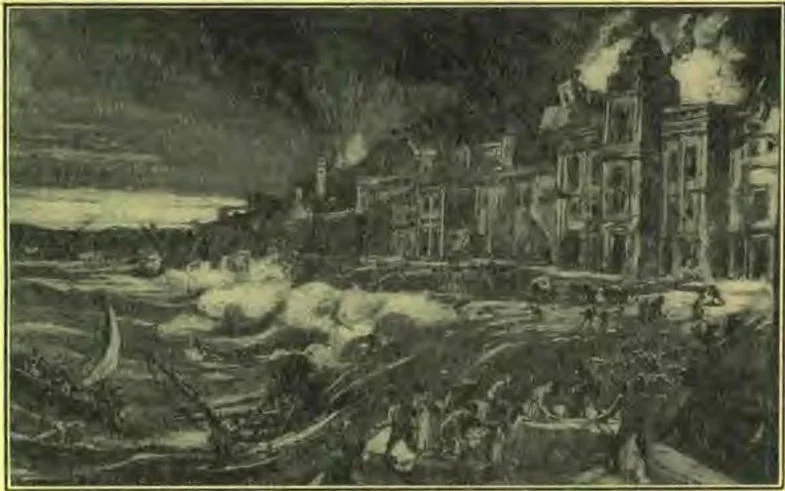
THE LISBON EARTHQUAKE OF 1755
“The event which opens the sixth seal, described in verses 12–17, is a great earthquake. Undoubtedly this was the great earthquake of Lisbon, on Nov. 1, 1755. This was the greatest earthquake in the history of the world, extending, as it did, over 4,000,000 square miles, and destroying between 30,000 and 40,000 lives. The shock was felt from Scotland to Asia Minor.
“The next event under the sixth seal is that ‘the sun became black as sackcloth of hair, and the moon became as blood.’ This was fulfilled on May 19, 1780, in the remarkable dark day of that date, which we have already studied here.
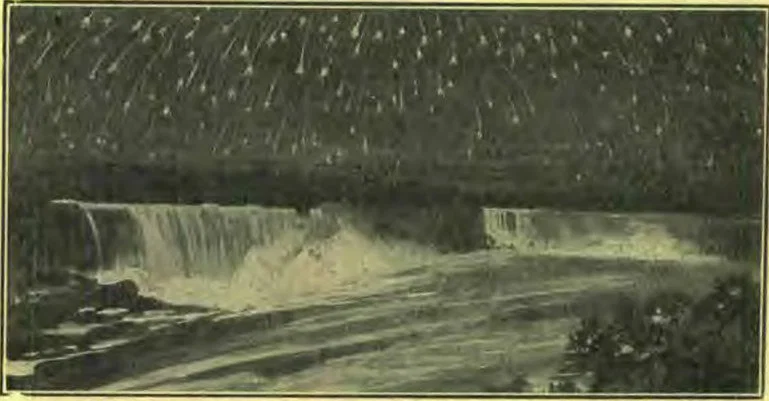
“‘And the stars of heaven fell unto the earth.’ This is the third sign of the sixth seal. It was fulfilled in the great meteoric shower of Nov. 13, 1833. As these signs have been described and studied at length in our previous meetings, we shall not deal with them further here.
“‘And the heaven departed as a scroll when it is rolled together.’ This event takes us into the future. It has not yet taken place, and will not until the breaking up of the earth in connection with the coming of Christ. This seal closes with the lost of the earth realizing and acknowledging that the great day of the wrath of God has come. The sixth seal brings us to the coming of Christ, but does not include that event.
“Let us all note well that at the present time we are living between the thirteenth and fourteenth verses of the sixth chapter of Revelation. The great earthquake of Lisbon is past; the dark day of 1780 is past; the falling of the stars of 1833 is past. We are now facing the next event in this line of prophecy, the departing of the heaven as a scroll. We are facing the end of all things. Are we ready for that day, and prepared to meet the Lord in peace, or shall we stand among that throng who call for the rocks and the mountains to fall on them and hide them from the face of him whom they have rejected?
THE FALLING OF THE STARS AS SEEN AT NIAGARA ON NOV. 13, 1833
“The close of the sixth seal is the close of the sixth chapter of Revelation. The seventh seal is not opened until the first verse of the eighth chapter. Thus between the close of the sixth seal and the opening of the seventh seal the entire seventh chapter of Revelation comes in. This chapter contains a prophecy of certain additional events which are to take place in connection with the sixth seal, and before the seventh seal is opened.
“Under the seventh seal there is ‘silence in heaven about the space of half an hour.’ As this is prophetic time, in which a day represents a year, and as half an hour is a forty-eighth part of a day, the actual time represented here would be the forty-eighth part of a 360-day year, or seven and a half days.
“Silence in heaven for seven and a half days! What can this mean? Consider this: About the only way silence can be obtained in heaven is to empty heaven of all its inhabitants. But is there ever a time when the angels of heaven leave there? Yes, just this occurs when Christ comes the second time. We read in Matthew 25:31: ‘When the Son of man shall come in his glory, and all the holy angels with him, then shall he sit upon the throne of his glory.’
“Hence at the second coming of Christ there will be silence in heaven, for the angels will come with him. They will come with Christ to gather together his people (Matt. 24:31), and then they will all return to heaven together to spend the thousand years of the millennium. Evidently from the time that Christ leaves heaven with his angels to come the second time to the earth, until the time when he returns to heaven with his redeemed people, will be a period of seven days and a half. May all who are here tonight be among that great company of people who will be taken to heaven under the seventh seal.”
“Lisbon, Portugal, a city containing 150,000 inhabitants, was almost entirely destroyed. The shock of the earthquake ‘was instantly followed by the fall of every church and convent, almost all the large public buildings, and one fourth of the houses. In about two hours afterward, fires broke out in different quarters, and raged with such violence for the space of nearly three days that the city was completely desolated.’ The earthquake happened when the churches and convents were full of people.
W. S. CHAPMAN
By W. S. Chapman
How to Make Things — No. 2
W. S. CHAPMAN
A BOY should have a workshop. Without a place in which to “tinker” he is robbed of half the enjoyment of being a boy. So if you have no such place and there is a corner anywhere that could be given to you, say in the woodshed or some outbuilding, ask for it, and construct a “shop.” In it you can spend many a happy hour at this tinkering, and best of all, be kept out of unwholesome company and much mischief, while no doubt making some things really worth while.
Tools Needed
A crosscut saw, a brass-bound two-foot rule, and a square of some kind will now be required. If you are able to buy a carpenter’s square buy a good one. Under no consideration be satisfied with a cheap iron square. They are never accurate; they will bend and twist and get out of shape and are unreliable as to measurements, so that good work is not possible with their use. Wait until you can afford to buy the very best you can find, for next in importance to the hammer or hatchet comes the square. You will need a six-inch try-square, so buy one and it will answer for all that is needed until you come to build a workshop.
The Workbench
A bench needs to be solid and not easily moved out of place, hence must be constructed of heavy material. As you are not yet capable of working in heavy hardwood, your table must be made of pine. If your shop has a window (or you can put in one), then build the bench under the window and fasten the back to the wall. This will make it almost immovable.
The End Pieces and Legs
Procure two fairly good-sized drygoods boxes and place them about six feet apart. Lay upon them your piece of studding. This comes two inches thick and four inches wide, that is, this is the size when sawed out of the log, but afterward the pieces are run through a planer, which takes off a shaving that reduces the size about a fourth of an inch in width and thickness. In some classes of work it is important to remember this, but in coarse work, like the building of this bench, it is not necessary to make allowance for this loss in size. Planing this way is called “dressing” the lumber, and the finished product is called “dressed lumber.”
In building this bench it is not necessary that the ends of the pieces should all be absolutely square, but it pays to strive to be accurate in even the simplest details, so always try to square the ends. Place the square on the studding about two or three inches from the end, hold it firmly against the side, and draw with a carpenter’s pencil a straight line across the top. Next place the point of the pencil on the line at the inside edge near to you, tip the square over so that the blade hangs down the side, and slide it up to the pencil point; then holding the square steady, draw a line down the side of the studding. Do the same on the other side, and then you will have three lines—on the top and each side—to guide you in sawing. To saw straight, remember to keep your saw upright and at right angles to the material through which you are sawing. Accuracy in sawing is of the utmost importance, and it should be your aim to become a good sawyer. You will never do fine work until you become accurate in this particular, so practice, practice, practice, until you are expert.
Having now a “square end” in your studding, with your two-foot rule, or a steel square if you have one, measure off exactly 5 feet 10 inches, and before sawing it off, square the end as you did before. This piece is now to be spiked to the wall with the top at precisely 28 inches from the floor. In doing this use about four spikes.
You will now need two end pieces of one-inch stuff to be nailed to this wall piece, on which the top of the table is to rest. The other ends of these pieces are to be nailed to the front legs. Before cutting off these pieces you must decide how wide a table top you are to have. The front board should be the widest, as you will do most of your work on it, the back part being used mainly for tools and pieces of boards that you are using in your work.
A board 12 inches wide would be preferable, but as wide boards are expensive it had better be 10 inches, so a board 12 feet long when cut in two will give you the two front boards, and a six-foot piece 6 inches wide will make the back. This will give you a table top 26 inches wide, an ample width for all the work you are likely to undertake. Don’t forget to square the ends of all these boards. As the table top is to be 26 inches wide, the end pieces are to be cut that width, one for each end.
These end pieces must be nailed to the legs before being attached to the wall piece, as they are to be fastened to the legs, which are to be made of studding. As the wall piece is just 28 inches from the floor, the legs must be that length so that they will reach to the top of the wall piece. Remember that the apron is to be nailed to the legs, so that its face comes even, or flush, with the end of the side pieces. Therefore mark off one inch from the end on the end pieces and place the leg back of that mark. Have the wide side toward you, nailing through the side that is two inches wide. Then, too, remember to put the legs inside the pieces you nail them to, so that the board will be outside at each leg.
Lay the leg down on the boxes with the narrow edge up and put the end piece over it so that the side will come to the mark. Use five nails and drive one at each corner and one in the middle, not all the way through. Better do this before attaching the legs. When you think that you have the end piece in proper position, drive one of the corner nails fully, then take your square and lay it on the edge of the leg so that its other blade will be up against the edge of the end piece. If you cannot see light through the places where the blades touch the wood, drive another nail home, and try the square a second time. If all is right, drive all the nails, but if you can see above the blades any streak of light, pull out the second nail and try again until you do get them to square up.
Bracing
Next fasten the end pieces to the wall piece, and nail on the front top board, then the apron to the legs and the end pieces. After this nail the edge of the front top board firmly to the edge of the apron with nails driven about six inches apart. Now finish the table top by nailing on the other two boards. The purpose of having an apron will be explained farther along, as will also that of the bench vise.
If the bench is well put together it should need no11bracing, but it will be safe to nail on strips from the legs, an inch or two from the bottom, diagonally to the wall strips near the wall. Six feet of strips will be ample for the purpose. If you are expert at toenailing nails into wood, fasten the legs that way to the floor. If you do not understand this way of nailing, ask your father to do it for you, or better perhaps, ask some carpenter to fasten them for you. You may learn something new from him. Be always on the watch to learn from carpenters at work.
The Lumber Bill
From the beginning you should practice getting out lumber bills. A lumber bill covering all the lumber that will be needed for your work is to be carried to the lumber dealer, and from it he selects in his yard what you want and delivers it at your house or shop.
The contents of lumber, that is, the number of board feet, or running, or linear, feet in a certain quantity of lumber, is ascertained by multiplying the number of pieces by the thickness, width, and length, finally dividing by 12 to reduce the sum to feet. For instance:
One piece of studding twelve feet long would be expressed as follows: One piece 2 × 4 × 12 = 96 ÷ 12 = 8 running feet.
An inch board 12 feet long would be expressed: One piece 1 × 12 × 12 = 144 ÷ 12 = 12 feet.
A plank 2 inches thick would be just twice the number of feet of a board 1 inch thick, and would be expressed this way: One piece 2 × 12 × 12 = 288 ÷ 12 = 24 feet.
In making out a bill for the lumber dealer it is best to lump all the pieces of a kind, as all 2 × 4’s, all 1-inch dressed boards, that all pieces of the same thickness and same width may be together.
You will need three pieces of studding, one 5 feet 10 inches, and two 2 feet 4 inches each, making 10 feet 6 inches in all. But as lumber does not come in this length, we will call the total 12 feet. So of the boards, you will call for three boards 10 inches wide and 6 feet long. In the bill it will be one board 18 feet long, one board 6 inches wide and 6 feet long, and one 5 inches wide and 6 feet long, so the total bill would look like this:
One piece 2 × 4 × 12.
One piece 1 × 5 × 6, dressed.
One piece 1 × 10 × 18, dressed.
One piece 1 × 6 × 6, dressed.
Leave the lumber dealer to figure out the total his way, as each has some notion in doing it. All but the first item in the bill is what is called dressed lumber, that is, has been planed down by machinery at the mill, generally on both sides, and is what will be sent you. Unplaned lumber is called rough lumber. Studding comes under this head even though it is now usually planed. It formerly was delivered in the rough, so retains its name.
Any boy who may have difficulty in understanding the making of a bill of lumber from what is written, may write me concerning his trouble, and I shall endeavor to set him right. Address me at St. Petersburg, Florida.
What Hilda Saw
“COME, Hilda! Time to dry the dishes and dust the parlor,” mother said from the doorway, as Hilda skated up and down the smooth concrete walk.
Hilda frowned and angrily took off her skates, saying, in an injured way, “It’s always the way when I’m having the best sort of time! It does look as if a little girl ought to have a good time and not have to be called in. There’s Mamie Helm, who never lifts her hand. Nobody calls out, ‘Come, Mamie,’ to her.”
Mother sighed. She had not been able to make Hilda see that every one must work; that life was more than just hours of play.
Hilda sulked, did her work hastily, and was off to school.
“I want to speak to you after school,” Miss Hedrick, the teacher, said when school was out. “I am going down on what they call ‘Red Row,’ to distribute some clothing some friends have given me. Would you like to walk down there with me, Hilda?”
She did not say that she thought what Hilda would see on Red Row would help her.
Red Row was a row of long, narrow houses in which the woolen-mill hands lived. They were in wretched repair and there were no yards at all. The children fought and tussled in the streets, and the mothers, many of them, gossiped over the back fences or worked in the mill near by.
Red Row was a sad little row, to be sure! Hilda had heard it discussed in the meetings she sometimes attended with her mother.
“Why don’t they call it some other kind of row—a white row?” she would ask her mother. And her mother would say that it seemed nothing could be done for “Red Row” to make it a white row.
The first house at which Miss Hedrick stopped was one that seemed most desolate of all. Window lights were broken and old quilts stuffed in, which made the rooms dark and gloomy. Today the doors were opened wide and the visitors heard a splashing of water and a child’s voice singing cheerfully as she scoured the dingy, worn floor.
“Mary seems to be busy today,” Miss Hedrick said, smiling, as she tapped at the door.
“Yes’m. Mammy said the sun was shining and I’d better give things a good cleaning. I’ve got the twins to playing store in the back yard, so I could clean out the litter better. Sorry I can’t ask you in.”
“That’s all right. I only wanted to leave a bundle for your mother. I’ll drop in again,” Miss Hedrick said.
“You see, Mary is housekeeper. She is only eleven, but she takes care of her twin brothers, Billy and Bob. Their mother goes to the mill at six in the morning and stays until six in the evening. Mary cannot go to school; she has to be ‘little mother’ all the long day, and she is always cheerful and bright.”
“Ugh! What a dirty room she was cleaning, and what puddles of water everywhere,” Hilda said, with a little shudder, and thought with shame of her complaints of the morning. “Just think what a lovely room I had to dust, and such pretty dishes to dry,” she said to herself.
She was very quiet as she walked home with Miss Hedrick. She was thinking very hard how she could help little Mary Sawyer, who could never go to school.
“You remember the little play, ‘Cradle Songs of Many Lands,’ the children in our music class gave last year?” she said to Miss Hedrick as she turned in her gate. “Well, I’m going to see if we can’t give it again for Red Row—and Mary,” she said at last.
“That is a fine idea,” Miss Hedrick said with enthusiasm. “Let me know and I’ll help all I can.”
The next morning Hilda did not have to be called12to dust, and to dry the dishes. To her mother’s surprise, she was busy long before she had thought of calling her.
“If Mary Sawyer can keep house and scour and cook for her mother, I guess I can help mine some,” she said, decidedly. “Before many months things are going to look different on Red Row. They are going to forget there ever was a place so bad. Mr. Mason, who owns the houses, has promised Miss Hedrick he will paint the houses white. She telephoned him last night. And Mary Sawyer is going to school, too!”
“There’s nothing like seeing the other side of things, my dear,” her mother said, happily. “I’m sorry there is such a thing as Red Row, but glad my little girl saw it, and can now count her blessings, one by one.”— Baptist Boys and Girls.
Ragpickers’ Hill
By W. S. Chapman
W. S. CHAPMAN
FIFTY-NINTH Street in New York City marks the southern boundary of what is known as Central Park. When the writer was a boy all that region was a granite hill some two hundred feet in height. Since then the granite has been blasted out, and used in the construction of the park buildings and for other purposes, while one of the big holes resulting from the blasting has been turned into a beautiful lake, bordered by winding roads and planted to trees, shrubs, and plants, until it is a lovely spot and forms a fitting beginning to the beauties within.
In bygone years this hill was known as Ragpickers’ Hill. At that time the methods of caring for garbage and the ever-present nuisance of coal ashes, were very crude. Occupants of houses were obliged to furnish barrels and place their ashes and waste material in them at certain hours, and then bring the barrels to the sidewalk fronting their homes. Along would come huge two-wheeled carts into which the “ashman,” as he was called, would dump the contents. Most of the refuse would reach the cart, but much of the ash dust would be carried down the street and settle upon the garments of the pedestrians. So accustomed to this treatment had the citizens become that little complaint was ever made, they taking the proceeding philosophically, as does the Londoner when the drops of soot fall gently upon his immaculate linen.
In those primitive days when even the word “hygiene” was unknown, when germs were not dreamed of, and the festive fly and the well-meaning mosquito had not been accused of evil practices, when it was considered a mother’s duty to regularly dope the children in the family with doses of sulphur and molasses to clear the blood and ward off “the ager,” the citizens owed much of their protection from malefic influences to the faithful and persistent labors of these humble people of Ragpickers’ Hill.
In the far Western States there have been some remarkable cities arise from strange and primitive beginnings, scores of them starting as mere shanty towns without a structure in them that could be dignified by being called a home. Today, even, in the mountain coal fields of Pennsylvania can be seen settlements of foreign coal miners occupying houses so small and so low as to be more fitted for dog kennels than for human habitations; but I question, if in all the United States, there has ever been so remarkable a settlement as the village of ragpickers on Ragpickers’ Hill in the city of New York.
As newcomers would arrive, building material being always scarce, their first attempts at erecting a dwelling would be extremely modest, to say the least. It would be barely possible to crawl within and lie down, standing being entirely out of the question. As the families would prosper, their first one-room house would be enlarged, and built upon, and added to, until it was not an uncommon thing to see the home expanding until it numbered three, four, and even five rooms.
Next, the women would pre-empt small patches of ground around their homes and surround them with picket fences. This much accomplished, they would venture to keep a few chickens, then a pig, and finally become the proud possessor of a goat and enter into the additional business of supplying mothers of young children with milk. In this capacity they could be seen on the streets with their small tin pails of milk fastened to a wooden yoke around their necks. Many of the well-to-do were among their customers.
At first they would ply their trade as ragpickers with a long wire hook in their hands and a coarse sack across their shoulders, in which they placed their findings. These women, and often old men, could be seen daily tramping the city, hook in hand and bag on their shoulders, raking over the ash barrels, appropriating everything found in the way of rags, metal, glass, and occasionally a stray silver spoon carelessly thrown out by the hired girl. They were known to have made some valuable “finds,” and always carried them to the police station, where it was seen to that they were suitably rewarded for their honesty.
Lugging their trophies home, they would there sort out the contents of the bags into piles, the rags by themselves, the metal, glass, and last, but not least, the coal and cinders. The metal and glass went to the junk dealers, the rags to dealers in rags, and the coal and cinders were peddled out in the tenement districts at so much a bucketful, being first freshened up by having water poured over them, which made them appear more like fresh coal.
Most of this work devolved upon the women and the old men, the able-bodied men being at work in the city street department or employed at stores in various capacities, mostly as porters. As every member of the family old enough and able to work found employment in some form, the weekly wage money amounted often to a neat sum, and was carefully stored away biding the day when the family, having become rich, would return to their native land to rest in ease the remainder of their lives.
It was always the wife’s ambition to become the possessor of a cart and dogs to assist in her work of ragpicking. The dogs needed to be large, big-boned fellows, as the work was heavy, but this kind of animal was not easily found. Occasionally one or more families living on the hill would sail away to their native land, first holding an auction of their earthly possessions, including their home and the animals to go with it. In this way the animals became permanent residents, spending their lives among this people.
The carts were small two-wheeled affairs, with side strips projecting in front with a crosspiece connecting them. The ragpicker would get inside these strips and press her body against the crosspiece, so pushing it along. This is why these carts were sometimes called “pushcarts.” Each side of the woman a dog was harnessed back to the axle, and they would pull in unison with the woman’s efforts, being so well trained to keep time to her steps that their combined weight would be effective together. This was a necessity often when the load would be unusually heavy, and in climbing Ragpickers’ Hill.
Early in the morning, just as the rising sun would begin to streak the heavens with its coming rays, hundreds of these women and men, some with hooks and bag only, many with carts, could be seen descending the hill in one or the other of its many paths. The motley crowd dressed in its rags of many colors, was a sight worth getting up early to see. As they would reach the street each would debouch and pass out to his allotted location, for to each was assigned a certain district and street. They seldom ventured to infringe on one another, but occasionally there would be a13trespass, which quite likely resulted in a desperate knife fight.
Notwithstanding its crudeness, this city of ragpickers had a charm or attraction even to blasé travelers. Hardly an hour of a pleasant day would pass but one or more would be exploring the place. They were always welcome, and left many a coin behind as reminders of their visit; also the goat’s milk sold to these visitants brought a goodly price. The little homes and their surroundings were always kept in scrupulous cleanliness, while every part that could be whitewashed was daubed at stated intervals with the white paint, until in many places it lay thick until a heavy rain would displace the surface load. These scores of white homes with their white surfaces glinted in the sunshine, while the people in their quaint costumes made a diversion that lent a peculiar charm to the homely scene. It seemed like a foreign village lifted and transported bodily to its American setting.
What became of them when finally dispossessed by the city authorities is not known. There was not in any other part of the city a plot of ground sufficiently large to contain them as a body, which the owners would have permitted to be used for such a purpose, or in which they would have been safe from attack by hoodlums, as they were on the hill. They simply faded away out of sight — vanished — like hundreds of other old landmarks have done before the merciless inroads of modern progress.