MANY schemes, devices, programs, and pleas have been used in efforts to create interest and to arouse sympathy in missionary work and the financing of such propaganda. All have met with more or less success, but one of the simplest yet most effective, came to my notice in a young people’s rally in the interior of China.
Children are always quick to imitate their elders. How important that worthy examples are always set before them.
After a most enthusiastic program given before an audience of about five hundred persons, two small boys — small as Chinese children are — walked up on the platform. In the very best Chinese they knew, they repeated the words: “Go ye therefore, and teach all nations, baptizing them in the name of the Father, and of the Son, and of the Holy Ghost: teaching them to observe all things whatsoever I have commanded you: and, lo, I am with you alway, even unto the end of the world.”
The older boy faced his companion, and with eyes beaming full of joy over his happy thought, said, “What is to be done?” The little fellow answered, “The gospel is to be preached to all the world.” “How is it to be preached?” “Why, by men, of course.” “How are we to send men to all the world?” “We must have money.” The older boy said quickly, “Have you any money?” “No, only a few cash.” “Well, let’s go and get some.” With this introduction the boys picked up the baskets, and the people intuitively thrust their hands into their money-bags. While the boys gathered the cash four little girls marched to the front and sang, “Hear the Pennies Dropping.”
Both boys then came forward with the money, and pleased with the results, made a low bow and shouted, “Kamsia.” Truly those boys thanked the audience, but some of us thanked God for the privilege of being among the men who are sent into the world to preach the gospel.
D. E. REBOK.
What Good Men Are Matters Most
By Phillips Brooks
It is not what the best men do, but what they are, that constitutes their truest benefaction to their fellow men. Certainly, in our little sphere, it is not the most active people to whom we owe the most. It is the lives like the stars, which simply pour down on us the calm light of their bright and faithful being, up to which we look, and out of which we gather the deepest calm and courage.—Phillips Brooks.
Nests of Pleasant Thoughts
By John Ruskin
Make yourselves nests of pleasant thoughts, bright fancies, satisfied memories, noble histories, faithful sayings, treasure houses of precious and restful thoughts, which care cannot disturb, nor pain make gloomy, nor poverty take away from us — houses built without hands, for our souls to live in.—John Ruskin.
Shadows Cast by Standing in Our Own Sunshine
Most of the shadows of this life are caused by standing in our own sunshine.—Emerson.
Love Thyself Last: Shakespeare's Counsel on Honesty
By William Shakespeare
LOVE thyself last: cherish those hearts that hate thee;
Corruption wins not more than honesty.
Still in thy right hand carry gentle peace,
To silence envious tongues. Be just, and fear not:
Let all the ends thou aim'st at be thy country's,
Thy God's, and truth's; then if thou fall'st, . . .
Thou fall'st a blessed martyr!
—William Shakespeare.
Our Counsel Corner
HOW many foreign missionaries have Seventh-day Adventists? What fields are now most needy?
B. A. E.
As given at the close of 1916, the latest authentic report, we have listed as laborers outside of the United States and Canada, 3,082. Of this number about 2,000 may safely be classed as “foreign missionaries,” including native workers laboring in non-Protestant and non-Christian fields.
It is difficult to state what fields are now most needy. One might reasonably conclude that those where no representative of the third angel’s message is found present the greatest need; and yet the most urgent calls for help come from fields already entered, and that have quite an assignment of laborers. China, with her 329,618,000 souls; India, with 315,133,000; Africa, with its vast expanse of territory and 119,131,000 people; South America and her 50,579,000 inhabitants, surely present a mighty appeal. Then there are such neglected fields as Central America, also the American Indians in the United States, as well as the unentered countries of Afghanistan, Arabia, Abyssinia, Greenland Madagascar, Siam, South Borneo, Portuguese East Africa, Morocco Liberia, and many islands of the sea. Truly a great unfinished task still lies before us.
T. E. BOWEN.
If the prayer meeting is dry and uninteresting and wearisome, do you think that we young people should be expected to attend?
L. E. A.
By all means! Your presence will help to bring life into the prayer meeting. Bright, cheerful singing, earnest testimonies, prayer for God’s Spirit in the meeting, cordial greetings at its close—these are important factors in making an interesting and helpful meeting. Do your part, and be assured you will receive a blessing.
E. I.
What are the duties of the assistant leader of the Missionary Volunteer Society?
K. I.
He should be the leader’s right-hand man, ready to respond cheerfully whenever called upon. He should become so familiar with the work of the society and the duties of the leader, that he could step in at a moment’s notice if necessary, and act as leader. During the meeting it is well for the assistant to sit at the front with the leader, sharing with him in its conduct. The assistant should also help to plan the programs and take an active part in the missionary work of the society. The leader will assign to his assistant the special duties for which he is to be responsible. It is best always to have a definite understanding in regard to the division of responsibility. In the absence of the leader, the assistant will, of course, assume his duties.
E. I.
Just for the Juniors
By Matilda Erickson
TAKOMA PARK, WASHINGTON, D. C., January 6, 1918.
MY DEAR JUNIORS: This morning I woke up early, and began to think about you and the brand-new year God has just given you. Finally I decided to write you a letter; for I want you to know that here in the office we think of our Junior boys and girls often, and are anxious that this shall be your happiest and best year.
But what will make this your happiest and best year? That is what I have been asking myself. I think I know the answer, too, and oh, I wish I could give each of you just what will make this year all that it should be.
Can you guess what it is? No, it isn’t lots of money. Of course, we all like money; for even the things we really need cost a great deal. No, it isn’t a big shelf full of the best Junior books for boys and girls. No, it isn’t a trip to the Coast. Of course, I should like for you to have these and many other nice things, but the one thing that I want you most of all to have is different.
Do you know why I am not anxious that you should have lots of money? Well, it is because money does not make folks happy. Many who have lots of it and most everything that money can buy are very unhappy, so unhappy that they don’t even want to live. And now, let me tell you something else. Of all the persons who have learned to know Jesus, and have really made him their best Friend, I have never yet known one who was willing to give up this Friend for anything or everything that money can buy.
Now can you guess what it is that I want you most of all to have? Yes, I want you most of all to have Jesus for your dearest friend during 1918. I hope you15will read your Bibles, that you may get acquainted with Jesus. I hope you will let Jesus talk to you through the Bible, and then you talk to him in prayer. That is just the way to get acquainted with your best Friend.
You know who Abraham Lincoln was. Well, his mother said: “I should rather my son would be able to read his Bible than to own a farm, if he can have but one.” She knew that it was more important for her boy to know the Bible than to be rich. And so it is for you, my dear Juniors; for reading your Bible will help you to get acquainted with Jesus, and to know Jesus, to have him for our dearest friend, is the most important thing in life.
The other day I read of one Junior who was determined to get acquainted with Jesus. She made this New Year’s resolution: “I will try to read my Bible every day this year.” One day she forgot to read her chapter until she was snuggling down into bed. I suppose she was tempted to leave it till the next day, but she didn’t. In a minute she was out of bed, reading the neglected chapter. Just here I want to tell you about a plan we have to help our boys and girls to get acquainted with Jesus. This plan is called the Junior Bible Year. It is just what you need. It selects the chapters of the Bible that are of special interest to boys and girls.
Will you not determine with me to try to read your Bibles every day during 1918? I hope you will; for most of all, you and I need to know Jesus. And now, Good-by. Praying that 1918 may be your happiest and best year, I am,
Always your friend,
MATILDA ERICKSON.
P. S.—I should tell you that there is a Junior Bible Year leaflet, which gives the chapter to be read each day. Every Junior should get one of these leaflets and keep it in his Bible. Your conference Missionary Volunteer secretary will be glad to send it to you.
M. E.
All and All to Me
HE is not a disappointment! Jesus is far more to me
Than in all my glowing daydreams I had fancied he could be;
And the more I get to know him, the more I find him true,
And the more I long that others should be led to know him,
too.
He is not a disappointment! He is coming by and by;
In my heart I have the witness that his coming draweth nigh.
All the scoffers may despise me, and no change around may
see,
But he tells me he is coming, and that's quite enough for me.
He is not a disappointment, for he satisfies indeed.
Saviour, Sanctifier, Healer; the Unchanging Christ is he!
He has won my heart's affections, and he meets my every
need;
He is not a disappointment, for he satisfies indeed.
— Consecration and Faith.
Morning Prayer
ONE night some years ago two young lads came to a cottage in the middle of a Scottish moor. They asked for shelter, but the owner of the place told them that he had no room for any one, and said that they would have to tramp to town. Next day the man learned that the boys he had turned away from his door were the sons of the king. They came to him, and he would not receive them. But every day God comes to us. He comes first of all in the morning when we open our eyes. Some people do not understand this any more than the Scotch peasant understood that the king’s sons were before his door; so they do not think of God and do not pray. Prayer in the morning is saying “Good morning” to God. It is asking his guidance, seeking his aid, trusting his love. Let us thank him for the new day, and ask blessing on it.—Selected.
Do the Work That's Nearest: Kingsley Verse
By Charles Kingsley
Do the work that's nearest,
Though it's dull at whiles,
Helping, when we meet them,
Lame dogs over stiles;
See in every hedgerow
Marks of angel's feet,
Epics in every pebble
Underneath our feet.
—Charles Kingsley.
Learning as the Ally of Genius
“LEARNING is the ally, not the adversary, of genius.”
How long did Noah live after the flood? How old was he when he died? Gen. 9: 28, 29.
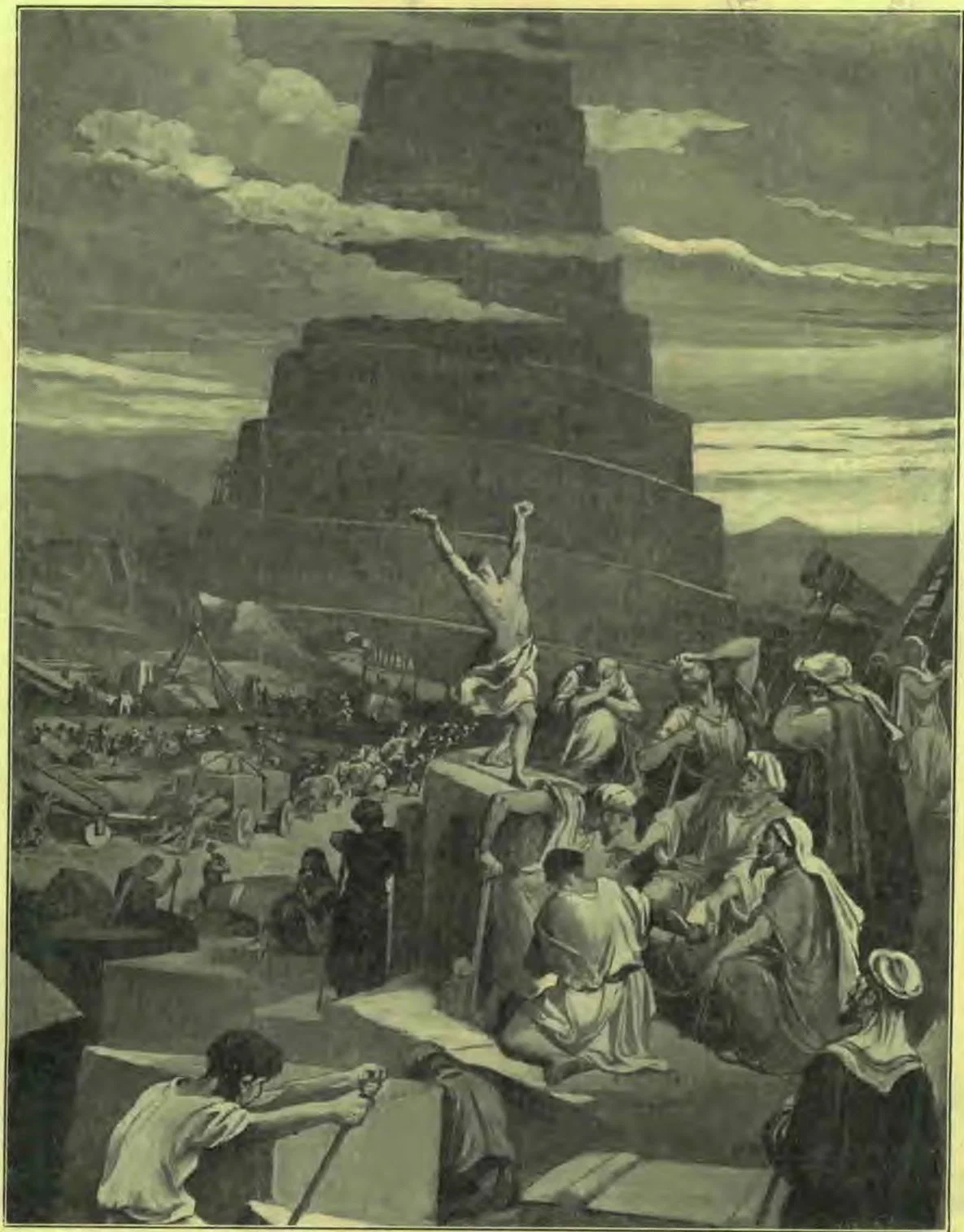
How many languages were spoken at this time? Gen. 11: 1.
As some of the people journeyed, to what land did they come? Verse 2. Note 2.
What did they say to one another? What was their plan? What did they wish to make for themselves? Vs. 3, 4.
What reasons were in their minds for trying to build such a tower? Note 3.
Who visited the tower as it was being built? Verse 5.
What did the Lord say? By what means was the work stopped? Verses 6, 7.
Did the people succeed in making themselves a name? Note 4.
How did the building of the city and tower end? Verse 8.
What name was given to it? What is the meaning of the name? Verse 9, margin.
What is connected with confusion? Memory verse.
Something Interesting
According to a baked-clay tablet discovered in 1876 in the ruins near Babylon, the Tower of Babel was built in seven stages.
First stage, 300 feet square and 110 feet high.
Second stage, 260 feet square and 60 feet high.
Third stage, 200 feet square and 20 feet high.
Fourth stage, 170 feet square and 20 feet high.
Fifth stage, 140 feet square and 20 feet high.
Sixth stage, 110 feet square and 20 feet high.
Seventh stage, 80 feet square and 50 feet high.
Edersheim says: “The small burnt bricks, laid in bitumen, are still there; not only in the tower, but in the still existing ruins of the ancient palace of Babel.”
Notes
1. The three sons of Noah were men of very different characters. Shem and Japheth respected their father and reverenced God. Ham became an evil-minded, wicked man. In the line of Shem Abraham was born. From him descended the children of Israel, through whom the Saviour was to come.
2. “For a time, the descendants of Noah continued to dwell among the mountains where the ark had rested. As their numbers increased, apostasy soon led to division. Those who desired to forget their Creator, and to cast off the restraint of his law, felt a constant annoyance from the teaching and example of their God-fearing associates; and after a time they decided to separate from the worshipers of God. Accordingly they journeyed to the plain of Shinar, on the banks of the river Euphrates. They were attracted by the beauty of the situation and the fertility of the soil; and upon this plain they determined to make their home.”—Patriarchs and Prophets, p. 118.
3. “The dwellers on the plain of Shinar disbelieved God’s covenant that he would not again bring a flood upon the earth. Many of them denied the existence of God, and attributed the flood to the operation of natural causes. Others believed in a supreme being, and that it was he who had destroyed the antediluvian world; and their hearts, like that of Cain, rose up in rebellion against him. One object before them in the erection of the tower was to secure their own safety in case of another deluge. By carrying the structure to a much greater height than was reached by the waters of the flood, they thought to place themselves beyond all possibility of danger. And as they would be able to ascend to the region of the clouds, they hoped to ascertain the cause of the flood. The whole undertaking was designed to exalt still further the pride of its projectors, and to turn the minds of future generations away from God, and lead them into idolatry.”—Id., p. 119.
4. Wherever the Word of God is read the foolishness of the Babel builders is made known. They are of the class referred to in Romans 1: 21, 22.
What's the Use?
The activity of mind and body of the boy of junior age is a source of pleasure and astonishment to older persons. He can do things. To him life is full of worthy possibilities. Youth is the habit-forming period, and a boy by wholesome exercise of his will can make of himself what he wishes. He should therefore be alert to every opportunity for self-improvement, and should be determined in his effort to form right habits of life, mentally, physically, socially, and spiritually. He can do it if he will.
Hollow-chested and Round-shouldered
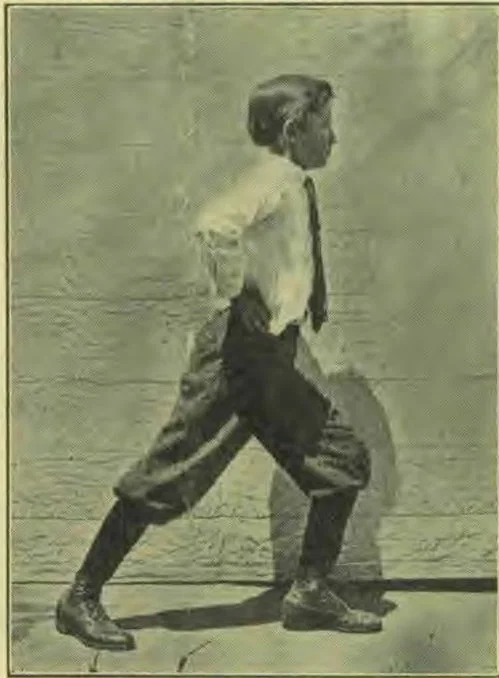
What's the use of his being hollow-chested, round-shouldered, or poorly gaited when by a proper mixture of determination and effort he can readily secure a physique of which he will be proud, and which will insure health under ordinary conditions? A good system of physical culture exercises daily persisted in will give him a normal physique with an admirable carriage of the body.
Older people can do much to correct ungainly and unwholesome habits, but it is not easy for the adult to make such changes. The body in youth, however, is as clay in the hands of the potter. A vessel of honor can be easily molded if the potter so determines.
New Year Counsel
Mr. Macfadden, the famous physical culturist, wisely counsels boys upon this point as follows:
“See that this new year brings you all that should be yours. Whatever may have been your shortcomings in the past, turn into a new path now. Imbibe the spirit of determination.
“My life shall be a power. I will dominate myself. I will master my weaknesses. I will shun bad habits.”
“Make these statements to yourself over and over again. Repeat them a hundred, a thousand times. And act up to your affirmations.
“I WILL MASTER MY WEAKNESSES, I WILL SHUN BAD HABITS.”
“By merely saying, ‘I am strong,’ you cannot become strong. But by saying, ‘I am going to work for strength,’ you impress the idea upon your mind so forcibly that the thought results in action; and action always counts for something.”
The first requisite for overcoming wrong habits is really to want to get rid of them. This is half the battle. A boy can do what he wants to do, and in this age of opportunity and high ideals, the bright boy, the boy with high ambition, will want to keep himself free from every habit that will prevent his being at his best in any phase of being.
Courtesy Essential
What's the use of a boy allowing himself to grow to manhood without the knowledge and habits of the well-bred? Politeness is now regarded as the chief requisite of successful business, of successful salesmanship. So true is this that one's business success or failure can be predicted quite accurately by the fact that one is habitually courteous or discourteous.
A boy should study books on proper conduct; he should imitate the habits of the cultured, and should be constantly on the watch to show courtesy to others. A boy who has good manners, who never allows himself to be uncouth, insolent, or indifferent to the rights and comfort of others, has climbed up far on the ladder of success.
Masters Not Slaves
What's the use of a boy so giving up the mastery over himself to the extent of forming at the suggestion of other boys a health-and-soul-destroying habit, like drinking, gambling, or smoking? Such a boy's moral backbone is warped; he will take up other undesirable habits, finally becoming a derelict. When a boy knows a thing will injure his health, how is it that he can get his own consent to take it up? Perhaps this is an unsolvable mystery.
No boy will become a slave to evil habits if he determines in his heart, “My life shall be a power. I will dominate myself. I will master my weaknesses.” It is the boy with this determination who later becomes an example of high manhood and real success.
Winter's Lesson
By C. P. Bollman
STERN winter has its lesson,
With its biting frost and snow:
The blessedness of summer
It makes us all to know.
The mightiest of nations,
The noblest sons of men,
Are found where reigns the Ice King
For months o'er hill and fen.
The very best of hardwoods,
Of pines the tallest trees,
Are found where in the winter
The Frost King rides the breeze.
So God withdraws his shining,
That we the cold may feel,
May come to him in penitence
And find eternal weal.
C. P. BOLLMAN.
“The Lord did there confound the language of all the earth.” Gen. 11:9. THE TOWER OF BABEL