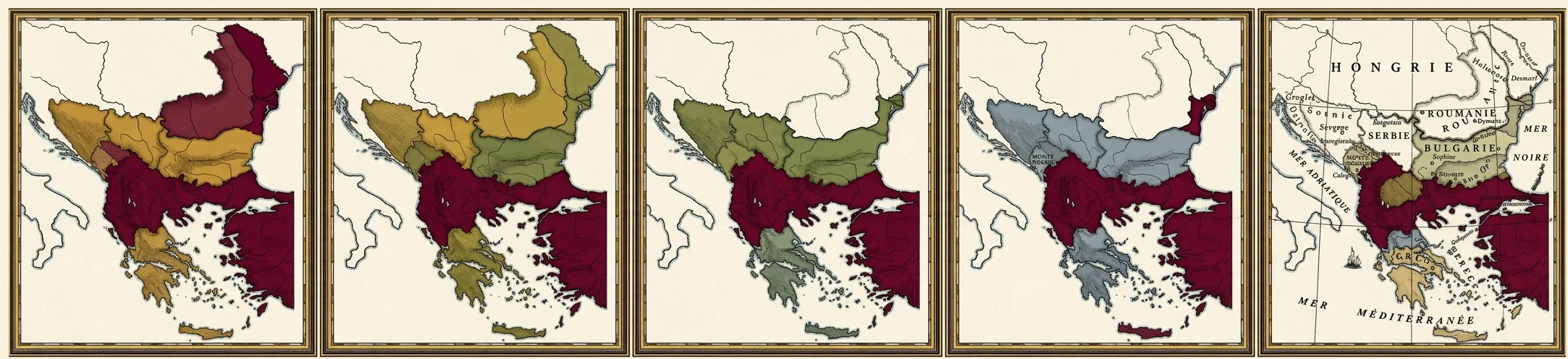
I doubt if the world understands at all adequately what a change has taken place in Turkey. Within the course of a few weeks it has passed from being the most absolute despotism to being one of the freest countries in the world, and the people have given themselves up to enjoying their newly acquired liberty to the utmost.
Newspapers have been greatly multiplied. It is stated that over two hundred newspapers have appeared here. I have no means of verifying the statement, but I seldom go to town without seeing a new paper. And the people on the steamers often have each three or four newspapers and magazines, which they read with great interest. Among these are several papers which abound in cartoons, and they show a keen sense of humor and great skill in hitting off the political situation. . . .
Some Innovations
Another activity of the public mind finds expression in a series of public gatherings in which music, theatricals, gymnastic exercises, and the like are followed by addresses on political subjects. Sebaheddin, the son of the late brother-in-law of the sultan, has been addressing a series of such meetings, and expounding his political views.
Another new thing is the appearance of the members of the royal family in public. The sultan himself has not yet ventured outside of the palace grounds, but his sons have appeared at the Moda Regatta and other public gatherings, and the heir to the throne, Prince Rechad, has shown himself in public repeatedly.
Incoming travelers are no longer vexed with useless restrictions. A Young Turk entering the country was reproved by the custom-house officials for offering to open his trunk for inspection, and the censorship of the custom-house has been abolished.
In the interior the tribal chiefs who have for many years levied their taxes upon villages, taken toll from caravans, and terrorized the people, have been subdued, for the most part. One of them is now being pursued by the troops. There is disorder in the government of the provinces, but there is a manifest determination on the part of the government to have order and good government. It shows an energy which promises well.
Policy of the Young Turks
One of the most striking features of this movement to those who have lived long in the country is the moderation shown by the Young Turks. The régime which has been overthrown was oppressive in the extreme, and all the people have suffered terribly from it. The Turks have often said, “We suffer more than the Christians.” Many have predicted a day of terrible retribution, when the old régime should fall into the hands of its victims. But there have been no reprisals. Officers of the army were killed in order to gain control of the army, a few spies fell into the hands of the people and were killed, the notorious Fehim Pasha was torn to pieces by the mob at Broussa; but most of the rascals have been held for regular trial, and the leaders of the new movement have firmly insisted that it is no time for vengeance or for the gratification of personal animosities; only one consideration can be admitted, and that is the good of the country. Their eyes are upon the future, not upon the past. This is wonderful. If one could have expected a reign of terror anywhere, here was the place to expect it, but it has not come.
The Young Turks have shown a practical wisdom in dealing with the various parties and in solving the questions which have arisen, which commands the admiration of all. A friend who is very well acquainted with the leaders in this movement said, the other day, “The most wonderful thing of all is the committees.” Properly speaking, there are no committees and no tangible organization. There are men who stand behind the present government, and practically guide and control it, but they are content to be unknown and to work in silence. They say, “It is the work of God;” “Do not congratulate us: thank God.”
Difficulties to Be Met
The difficulties which these men have to face are enormous. There is the difficulty of financing the government, which is aggravated by the fact that some of the provinces have understood liberty as meaning freedom from taxes. Then there is the difficulty of forming a program for the new régime. There have been two parties among the Young Turks: the Committee of Union and Progress, and the Party of Decentralization headed by Sebaheddin. As I said above, Sebaheddin has been explaining his program to popular audiences. His plan is to have local assemblies in the provinces, to which shall be relegated11many of the functions which have been centralized in Constantinople under the old régime. There is nothing new in this proposition. Such assemblies now exist, although they have been robbed of their power. But Sebaheddin has been understood by Christians to favor such a method of representation as will make these assemblies wholly Christian in districts where the Christians are in the majority. Many Christians have hailed his proposals as a step leading toward autonomy for certain regions. Of late, however, Sebaheddin has announced that the two parties have united, and the Young Turks are agreed upon the plan to be followed. It is essentially this: that representation in the provincial assemblies shall be according to the numerical proportions of the different races in these provinces. This means that in Macedonia the Turks will be in the minority, in Asia Minor the Christians will be in the minority, in the provincial assemblies.
The Educational Problem
Another difficulty is the educational question. Strange as it may seem, one of the first questions to push its way to the front was that of the education of women. Women have taken a large part in the work of the Young Turks, by which they prepared the people and the army for this revolution, and they have kept the secret well. Now the women are demanding their share in the progress which all the people expect. They say that their husbands have hitherto denied them the right to education and to labor. They claim for themselves all that they see of good in the homes of European peoples. They ask to be educated so that they can train their children aright, and make the homes of their husbands well ordered and happy, and they demand admission into useful employments for women, as in other lands. Naturally, these claims throw consternation into the ranks of the old-time Turks, and they have produced reaction in some places, notably in Smyrna. Sebaheddin told the Mohammedan women who were present at one of his public conferences that their claims were right and just, and not contrary to the spirit and teachings of Islam; but he exhorted them to be quiet and patient—they would obtain satisfaction in time.
Another educational question is that of language. The Turks would make Turkish the language of instruction, at least in the higher schools, as it is the language of the land and of the government. The Christian communities, however, are very tenacious of their mother tongues. Probably the Turks will allow all these languages to be taught, but they will require such a knowledge of Turkish for holding office as will put a premium upon the schools where Turkish is best taught.
The Young Turks will undoubtedly put forth every effort to establish schools of their own, which shall be the equal of any schools in the land, and it has already become apparent that there are more well-educated men in the country prepared to teach such schools than was supposed. Under the old régime, knowledge was dangerous, and men hid it. Now it is coming to light. Some of the Young Turks advocate the sending of such men abroad to study the educational systems of other countries. A high official said the other day that they should look to America for help in organizing their educational system, and he especially praised the American schools of agriculture, which he said “would be very useful to us.”
Turkey before 1812 1812 1878 (Treaty of San Stefano) 1878 (Treaty of Berlin) 1908
The Two Governments
There is another difficulty which the Young Turks have themselves created. There is now an abnormal state of things. Behind the government is another government, invisible but powerful. This invisible government hinders the actual government in the exercise of its functions. Sometimes it does this by direct interference, sometimes it is only the fear that the committee may interfere, which hinders the officials in charge; but official work is impeded; business also has suffered. Yesterday a man said, “We cry liberty, but we feel poverty. Liberty and poverty!” The Committee of Union and Progress are aware of this difficulty, and they are urging the officials to go ahead and discharge their functions without any fear of interference, and they are striving to do everything through the actual government as far as possible. But there will be a state of tension until the National Assembly has met, and put things in their normal course.
There are many problems connected with the election of this assembly, but they can not be treated in this article. We shall watch the acts of this assembly with intense interest.
Enough has been said to show that the situation in Turkey is a very difficult one, and I hope that I have also made it apparent that there are men here working with great wisdom and splendid self-abnegation for the best interests of their own land. It is a spectacle which ought to shame self-seeking and partizan politics out of sight. Unfortunately, these, too, are in evidence, and the Christian communities afford striking examples.
Questions to Be Settled
There is a different question brought to the front by these changes, and that is the question whether Islam can accord the rights demanded without being unfaithful to its own religious constitution. Can Islam, for example, satisfy the claims of its own women, in accordance with the teachings of the Koran? It is a question often debated whether women have souls. Much evidence can be found from Mohammedan writers to show that they understood the prophet to teach that women do not have souls.
Can Islam accord equality of privilege to Giaours [non-Mohammedans]? Historically, it is quite evident that it has not done so. Now the question has arisen, Is it right for her to do so, according to her own religious laws? I do not intend to express any opinion upon either of these points; but I wish to point out that the claims which have been made already by various writers that the constitution of Islam is even more liberal than the Young Turk party, afforded a strong evidence that Modernism has found its way into Islam as well as into the papacy. These claims are rather an evidence that the spirit of the times has influenced the thinking of modern Mohammedans than that Mohammed taught these principles. Liberty, justice, equality, fraternity, are splendid words; but it is open to doubt whether the Koran inculcates these great principles in the treatment of women or of subject races of Christians. It is a question of interpretation, and we ought to apply scientific principles in interpreting the Koran. Whatever answer Mohammedan scholars may finally give to this question, I do not believe that there will be any arrest of the march of the great ideas just named. It must be clearly evident to all that men are moving toward the light of truth in all lands; and when we look toward the sun, we forget the night.—C. Frank Gates, President of Robert College, Constantinople, in The Outlook.
Give the Best
By Madeline S. Bridges
THERE are loyal hearts, there are spirits
brave,
There are souls that are pure and true;
Then give to the world the best you have,
And the best will come back to you.
Give love, and love to your heart will
flow,
A strength in your utmost needs;
Have faith, and a score of hearts will
show
Their faith in your words and deeds.
— Madeline S. Bridges.
Neal’s Moving Day
By Hilda Richmond
“If I could only live in a tent or the barn,” grumbled Neal, “it would suit me lots better than here in the house.” Neal had been sent from the table to wash his hands, and he came back pouting. “I just wish I was an Indian.”
“It would be very nice in some ways to be an Indian or a tramp,” remarked papa, pleasantly. “I always enjoyed camping out when I was a boy.”
“I wish I could do that now,” said Neal, letting a little of the frown fade away. “The new corn-crib would be a dandy place.”
“Why don’t you try it?” asked papa, as if living in a corn-crib were an everyday affair with small boys. “We won’t put any corn in it till cold weather comes.”
“Mama wouldn’t let me,” said Neal. “Please let me do it, mama. It would be such fun.”
“Well, you might try it,” said his mother, easily. “When do you want to begin?”
“This very day,” cried Neal hurrying down his food. “I’ll have this for my moving day.”
No one seemed to notice that he hurried through with his dinner, or that he left without saying, “Excuse me.” He hurried to the play-room, and began selecting things to move to his new home. It took only a little while to get all the things out that Neal wanted. By one o’clock all were in the corn-crib.
“I—I guess I’m hungry,” said Neal to himself after he had tried the blanket in which he was to sleep, and had arranged his playthings to his liking. “I’ll go and see if Mary has some cookies.”
“So you are a tramp, are you?” asked Mary, looking him over as he rapped at the back door. “I never feed tramps unless they earn what they get. You can carry in all those kindlings, and I’ll see about something to eat.”
Neal had seen the real tramps splitting wood for Mary many a time before13she gave them anything to eat, but he did not know how they felt doing the work before eating. Long before the wood-box was filled, he thought he must take one of the nice fresh cookies; but, when the last stick was neatly piled in the box, Mary was ready with a tin of milk and some bread and butter.
“Sit on the step,” she said.
“Please, Mary, I’d like to have a cooky,” said Neal, timidly. “I’ll wash my hands before I take it, if you’ll only let me.”
“Beggars mustn’t be choosers,” said Mary, grimly. “If I fed cookies to every tramp that comes this way, I wouldn’t have any for my folks.”
Neal was very glad for the bread and milk, but he could not forget the smell of the warm cakes. Mary always saved the big corner cakes for him when he washed his hands particularly clean, but to-day he scrubbed and soaped to no purpose. After the little lunch he wandered forlornly to the new corn-crib, and wrapped himself in his blanket to cry. It was twilight when he awoke, and he went to the house to find the family eating supper, just as if they had forgotten all about him. He could stand it no longer, but rushed in, and sobbed out his troubles.
“I want to move back,” he wept. “I—I don’t like the new corn-crib a bit.”
“All right!” said papa and mama together. “Come right up to the table, now.” But Neal would not come until he had washed his hands and brushed his hair, and from that very day there was no more pouting about being clean. Two movings in one day have been all Neal has ever wanted.—Hilda Richmond.
The Picnic
By MRS. EDITH E. BRUCE
MRS. EDITH E. BRUCE
After talking things over, and consulting with the other members of the church, the Good Housekeeping and Cooking Club decided to hold the picnic on the fourth of July. That would furnish recreation for the children and young people, and at the same time take them away from worldly amusements.
Every one was ready bright and early on the appointed day, with a basket of lunch, and happy anticipations for their little outing. A program of singing and other exercises was rendered by the children, and Dr. Goodhope, who had joined the company, gave an interesting talk.
The dinner, which always figures so prominently in a picnic, was a success. Mrs. Brown, who had now become an expert housekeeper, made the sandwiches after the following recipe:—
Cut white bread very thin, and trim off the crusts. Butter the slices smoothly, placing a tender lettuce leaf between, with a filling of hard-boiled eggs. To prepare the filling, boil the eggs one hour, then press through a colander, and season with a little celery-salt and lemon-juice. Each sandwich may be cut diagonally.
One of the sisters from the country had thoughtfully made a dish of cottage cheese. When complimented on her cheese, she said: “Although I have always lived in the country, I did not know how to make cottage cheese until I joined the cooking club. I always threw away my sour milk, but I have learned to make the cheese, and we all like it. I find that it is not easy to make good cheese. Most people heat the milk too long, which makes the cheese hard and dry. It is much better to let it heat slowly till it will just separate, then pour into a cheese-cloth bag, and let it drain till quite dry. I season with a little celery-salt or parsley minced fine, or some kind of mint, and add a liberal amount of cream, then beat thoroughly till the cheese is nice and light.”
Cottage cheese made in this way can be formed into balls, or pressed into a mold, and garnished with parsley.
Some one else had made a dish of potato salad after the following recipe:—
Take sound potatoes boiled in salted water, and cut into dice about one-half inch square. Chop onions,—not too strong, and just enough to give flavor,—and mix with the potatoes. To this add a mayonnaise dressing made by beating together till well blended two large eggs, one-fourth cup of butter or olive-oil, a little less than half a cup of lemon-juice, and half a teaspoonful of salt. Put into a double boiler containing warm water, and heat, stirring continuously until it begins to thicken. Remove, set in a dish of cold water, and stir until partly cooled.
Aunt Mary made a simple cream cake, which proved good, and contained no harmful ingredients. The recipe follows:—
Four eggs, one cup of sugar, one tablespoonful of lemon-juice with a little of the grated rind, and one cup of white flour.
“Success in making this cake depends upon putting it together,” said Aunt Mary. “Beat the yolks of the eggs until very light and thick, then add the sugar little by little, beating it thoroughly; add the lemon-juice and grated rind. Beat the whites of the eggs until perfectly stiff and firm, and fold them lightly into the yolk mixture. Sift the flour little by little over the mixture, and fold it carefully in. On no account stir in either the white of the egg or the flour, since stirring will drive out the air which has been beaten into the eggs. Bake in shallow pans in a rather hot oven for about fifteen minutes.
“For the cream filling stir into one-half pint of boiling milk two teaspoonfuls of corn-starch, rubbed smooth in a little milk. Take out a little of the hot milk, and mix gradually with a well-beaten egg and two tablespoonfuls of sugar; return to the rest of the custard, and cook, stirring constantly until quite thick. Cool, and flavor with vanilla or lemon.”
Aunt Mary had also prepared some simple sweets, which she had done up in white tissue-paper, and tied with red and blue baby ribbon,—one package for each person at the table,—and in each package was found a health proverb. This furnished a cheerful part of the dinner, as each one was requested to read his proverb.
The report of this picnic is only a suggestion of the good things that they enjoyed, and all went home feeling refreshed and happy.
Mussoorie, India.
Don't Make the Wrinkles Deeper
In father's eyesight growing dim,
His form a little lower?
Is mother's hair a little gray,
Her step a little slower?
Is life's hill growing hard to climb?
Make not their pathway steeper;
Smooth out the furrows on their brows,
O, do not make them deeper!
There's nothing makes a face so young
As joy, youth's fairest token;
And nothing makes a face grow old
Like hearts that have been broken.
Take heed lest deeds of thine should make
Thy mother be a weeper;
Stamp peace upon a father's brow,
Don't make the wrinkles deeper.
In doubtful pathways do not go,
Be tempted not to wander;
Grieve not the hearts that love you so,
But make their love grow fonder.
Much have thy parents borne for thee,
Be now their tender keeper,
And let them lean upon thy love;
Don't make the wrinkles deeper.
Be lavish with the kindly deeds,
Be patient, true, and tender;
And make the path that ageward leads,
Aglow with earthly splendor.
Some day, the dear ones, stricken low,
Must yield to Death, the reaper;
And you will then be glad to know
You made no wrinkles deeper.
—Selected.
_A Trip to Hokkaido_
By W. D. Burden
W. D. BURDEN
HOKKAIDO is the northernmost of Japan’s five large islands, and the second in size. Until recent years but few Japanese lived in Hokkaido, and even yet there are large areas where bears and other wild animals abound, and it is unsafe for one to travel alone.
The Ainu, the aborigines of Japan, being crowded out of the southern islands by the Japanese race coming in from the south, took refuge in Hokkaido; but they, like the American Indians, are a dying race.
In recent years the government has been doing all it could to develop the resources of Hokkaido. Here, on the main island, there were thousands who, because of the overcrowded condition, could get no land to farm. The government persuaded a number of young men, after they had served three years in the army, to go to Hokkaido and settle. As an inducement each man who would go was given a small tract of land, about twelve acres, a house was built for him, he was given a horse and wagon and a gun, and was kept supplied with ammunition, and he and his goods were moved there free of charge. These people settled14in the center of the island, and have become quite a strong colony. The ice thus broken, others followed to get a smaller bait that was held out to them. They were given the land only, and that on condition that they clear and cultivate it all within five years. This has proved a great help to many poor families. Doubtless in all this Japan has been watching the eastward progress of Russia, and feared she would lose Hokkaido if its resources were not developed so as to make it possible to defend it.
At the present time there are over five hundred thousand persons living on the island. These must all hear the third angel’s message; and although in some respects that island is not the most inviting place to live, yet for some time we have been anxious to get our work started there. In view of our plan to open up work there next spring, I made a trip through the island recently, in company with Brother Kuniya.
It was about the middle of July when we landed, but it was still quite cool. We had been warned that it would be cold, so we put on extra clothing for the trip; but notwithstanding that, at times we had hard work to keep warm, even when walking. The great drawback to this island is the long and severe winter. From what we could see and hear, the summers are very pleasant, though short. For six months of the year, so the people told us, they are snowbound, the snow piling up from four to ten feet or more in depth. The government is building quite a system of railways through the island. There is also a more or less regular steamship service all around the coast, and to the main island, so gradually conditions for living there are made more agreeable.
The island of Hokkaido is quite rich in forests, as compared with the main island, and that necessitates a steamship service between the two. At one place that we visited, a sawmill has recently been built, which employs two thousand men. Of course the output is small compared to what that number of men would be expected to accomplish in America.
The fishing industry of the island is of considerable importance, salmon and herring being the two main products. The latter are used for fertilizer mainly, though a great many are also dried and used for food.
Apples constitute the chief fruit, and are quite good, but other fruits are not grown to any great extent. This year the caterpillar and other insects have given the orchard men a great deal of trouble.
Very little rice is grown, but other grains, such as wheat, oats, barley, and rye, do well, and are grown quite extensively. Satan has taken note of this also, and at Sopporo there is a large brewery, Sopporo beer being renowned all over Japan. Beans and onions are grown in abundance, and are among the chief exports.
Last, but not least, is the stock industry. It was a great pleasure to me to see cows and horses, oftentimes fifty or more in a herd, feeding in large pastures. Having been accustomed to stock all my life till coming to Japan, I have missed them very much. There are cows and horses in and about Tokyo, but one never sees them in a pasture. The cows are kept in sheds, and are turned out in a little yard each day for a short time. They know nothing about feeding upon sweet grass in a pasture. They are fed on chopped straw mixed with beans and potato skins and a little bran, and the milk we get tastes accordingly. Grass grows quite well in Hokkaido, and grazing land can be had at a moderate price.
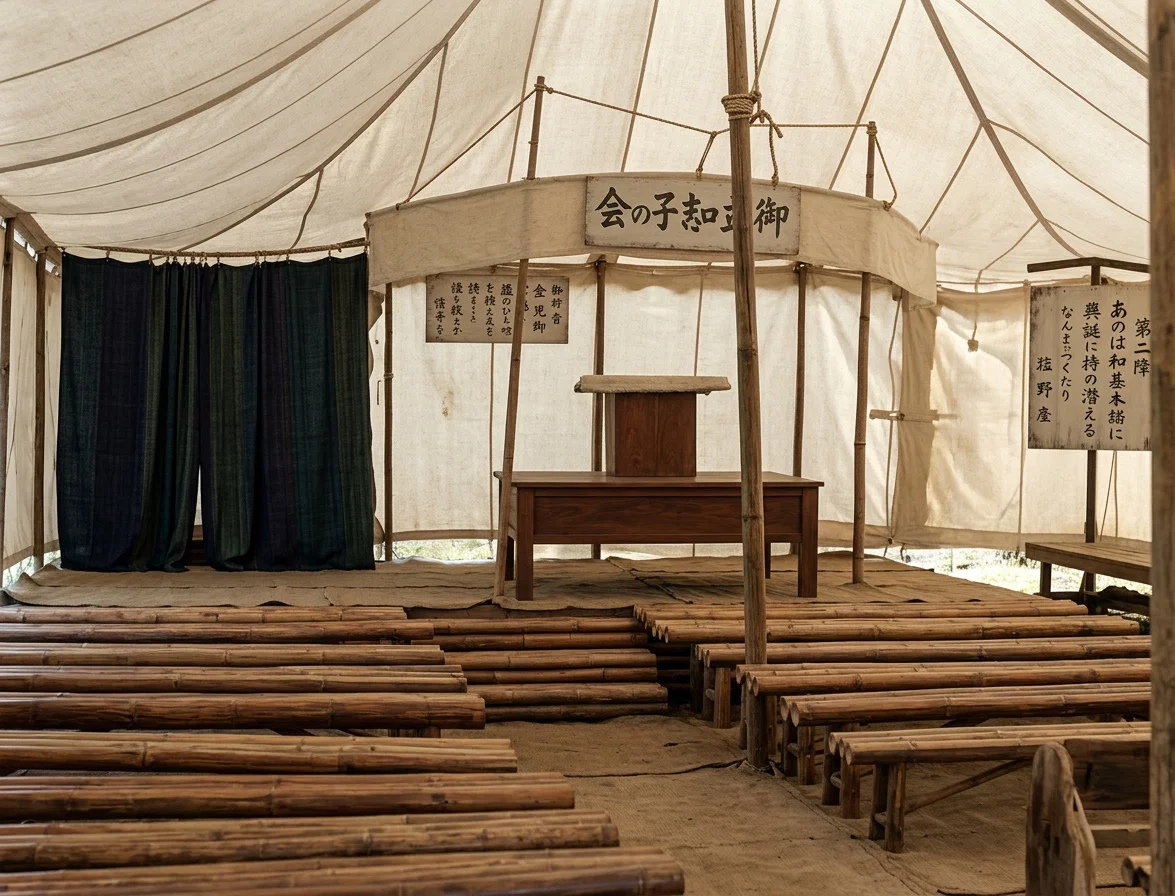
INTERIOR OF KOZU MEETING TENT
The people of the island are not generally of the best class; nevertheless they are of value in heaven’s sight, and in some ways I believe this will be a good field for missionary effort. The people, in moving there, broke away from their home ties and surroundings, and are more independent than on the main island, where they have lived for generations in one community, and where, if one becomes a Christian, he must do so against all the people of his village, and they all are his relatives.
The Ainus are generally uneducated and uncultured. They do not mingle much with the Japanese, but prefer to live in the mountain woods, in miserable huts, and to live easy. They are not lazy, neither are they industrious. They till the ground but little, preferring to hunt, fish, and pick up nuts for a living. They have an abundance of hair, not only on their heads and faces, but all over their bodies. They make good servants, and endure a great deal without seeming to tire. They are very peaceable and quiet in their manner. Surely some one should be working for them. There is nothing in particular being done for them at present, except by the Episcopal and Catholic churches.
We now have two believers living on the island, and one of these is training as a worker. Brother Suzuki, one of our workers, will soon join this brother, and help spread the truth in that island.
Tokyo.
Malamulo Teachers’ Institute and School Opening
By Joel C. Rogers
JOEL C. ROGERS
Our last year’s session closed at the end of April, when we arranged for a teachers’ institute to begin the first of July and continue four weeks. At the appointed time fourteen of our native teachers were present, two not being able to come on account of sickness. It was our plan to instruct these teachers how to teach the Bible and the common branches. This was the first attempt to hold a school especially for teachers, so it was a matter of some curiosity to them. But the classes were soon in order, and each boy was studying the lessons assigned. There was no lack of interest. The interest may have been increased by the fact that three teachers had brought urgent requests for new schools in places where they had visited during vacation. One chief came here from a place more than two hundred miles north of our stations to present his plea personally. At first I supposed he had come as a native would come to any mission to ask for a school, but I soon learned that he wanted a Sabbath-keeping teacher. It was not easy to tell him and others that no teachers could be spared at present. The chief patiently said: “I can wait.” I hope to visit his villages in Chipeteland before the next rainy season, and if the prospect is favorable, send him a teacher later in the year.
Before the close of the institute, the members of the church were called together for the ordinances. Of the sixty-one who have been baptized, nearly forty were present. A few have died, and the others are scattered. On my last visit to Matandane I found two of them who showed their love for the truth by bringing their tithe to me. We are thankful that the institute and ordinance service seemed to give the teachers a new inspiration for the work, and to bring a spirit of unity into the church.
During the institute all of us spent at least half of each day working on the new church building and preparing for the opening of school on August 1. July 31 all hands put the thatch roof onto the church. The next day was Sabbath, and as many boys were now back for school, we held the first service in the new building, though it had no windows or doors. But as the weather is fine, we are using the building every day for school and service.
On the night of July 15, we welcomed Brother and Sister Konigmacher to our mission. They arrived in good health and spirits, though Brother Konigmacher has since had a run of fever. He is now quite busy caring for the sick and helping to look after the boys. We are sorry that Sister Konigmacher is not strong enough to take up work for a while. We are hoping that after a few months they will be able to take charge of the Matandane out-station. At that place we have a good brick dwelling-house and a brick school building. The altitude is higher and the climate cooler there. We are fortunate in securing such a place for only forty pounds.
The Malamulo School opened on August 3. We have prayed constantly that God would send us boys from the different tribes, who could be trained for teachers. These have come to us. Four days after opening we have sixty boys in the boarding-school besides five girls. One hundred and twenty-six are already enrolled in the school, many coming from villages. This is about as many boys as we can accommodate at present. The larger part of the boys are young, and some give good promise of future usefulness.
While making brick for the church, we made enough for other improvements, one of these being the building of two walls between the dormitories, making a good dining-room, with very little expense. Then the wide verandas were walled in for sleeping-rooms. The day after school opened, eight teachers left to take charge of out-schools, many prayers for their success accompanying them as they entered upon their work.
Nyassaland.
The Man of Cheer
WE love the man with a smile, the man with the roses on his tongue, the man who sees your boy’s dirty face but mentions his bright eyes, who notices your shabby coat but praises your studious habits, the man who sees all the faults but whose tongue is quick to praise and slow to blame. We like to meet a man whose smile will light up dreariness, whose voice is full of the music of the birds, whose hand-shake is an inspiration, and whose “God bless you,” is a benediction. He makes us forget our troubles as the raven’s dismal croak is forgotten when the wood-thrush or the brown thrasher sings.
There is plenty of trouble here, but we need not increase it. There is a lot of dying done ahead of time. There are living men who have already crossed Jordan two or three times, and, unfortunately, they are not of the type who “cross the river of Jordan happy in the Lord,” but who sing, if they sing at all, the dismalest, dreariest, deadliest music. The very tone is fatal to happiness. If you have faith, preach it; if you have doubts, bury them. If you have joy, share it; if you have sorrow, bear it. Find the bright side of things,—God’s side,—and help others to get sight of it also.—Zion’s Herald.