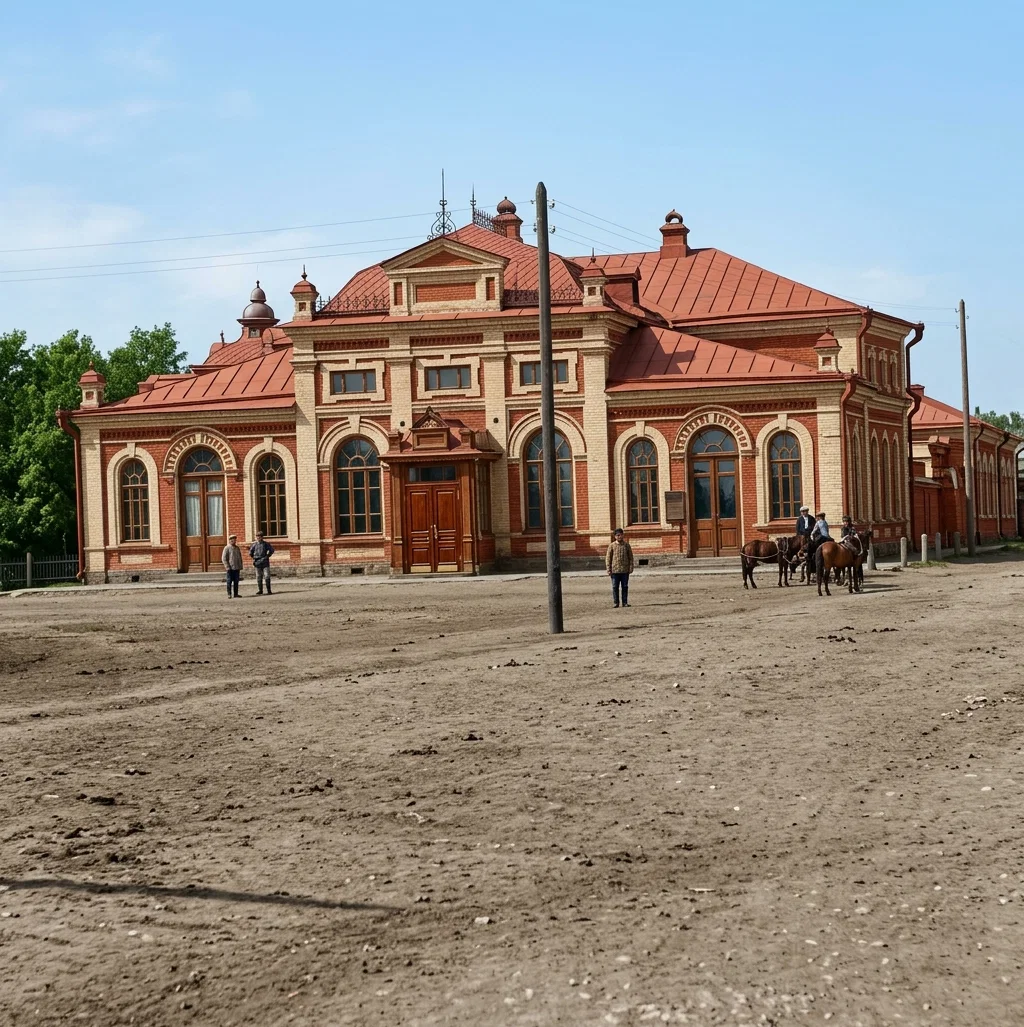
October 4 Elder J. T. Boettcher and the writer bade adieu to the eighty-five representatives who were assembled in Kamischin, September 30 to October 4, for the second annual meeting of the workers and members of the East Russian Mission—one of the most interesting and the largest of our world fields. Seventeen of the twenty-one churches and companies of this mission field were represented at this meeting. We were pleased to greet one young brother and Elder K. A. Reifschneider, of Siberia. We have believers in four cities in Siberia,—Omsk, Semipalatinsk, Akmolinsk, and Kouratof,—about eighty in all. One brother, accompanied by his wife, had come from our company of believers in Chaltowar, located among the mountains about three hundred sixty miles south-east of Tashkend, and four or five days’ drive from the border of India. They had been en route to the meeting twelve days, six of which had been spent in the wagon, four and one-half days by rail, and a day and a half by boat. I could but wonder how many of our people in other parts of the world, and more favorably situated, would care to undertake such a long, tedious, and expensive journey to attend one of our annual conferences. This brother and sister gave an excellent testimony, showing how fully they felt God had rewarded them for the sacrifice incurred in coming to the meeting—the first of its kind they ever enjoyed. Elder D. Isaak, of the South Russian Conference, was also able to co-operate with the visiting and local workers.
The outside interest was good. In Kamischin (which is located on the Volga, about twelve hours’ ride on the fast steamer below Saratof) there are about eighteen thousand persons, nearly one third of whom are of German parentage. From two hundred to three hundred twenty-five persons not of our faith attended each evening, when the lecture was delivered in German and translated into Russian. The city authorities kindly rented us the hall in the People’s Building—a building owned by the city, and occupied by a public library and by a commodious tea-room in front, with the lecture-hall, accommodating from five hundred to six hundred persons, in the rear. The governor of the department,15and the chief official and the police of Kamischin, were very kind to us, and our meetings were undisturbed.
It was a cause of great joy to see the manner in which the Spirit of God impressed the hearts of our brethren with the determination to serve him actively in spreading abroad a knowledge of the message, as contained in the printed page; for plain, unlearned, hard-working farmers and artisans came forward, ordered, and paid for in advance, a number of books and publications that during the less busy winter season they might have a part in the distribution of our precious, truth-filled literature.
A hearty response was made to the resolutions brought forward, and all felt thankful for the blessing of God which had given eighty-four new members as a result of the efforts put forth here the past year; nor were they unforgetful of the fair harvests this season. They were glad to see steps taken to give us a new mission field, beginning with Jan. 1, 1909, when Siberia will be organized as a mission, under the direct charge of the Russian Union Conference.
One of the most important subjects considered in the business sessions was that of providing funds for the proposed Russian union school, which we hope to locate not later than the autumn of 1909. Three hundred ten rubles (a ruble is about fifty cents) was given in cash and pledges toward this enterprise. Considering the financial condition of the majority of those who gave, this is a liberal contribution, and required a sacrifice on their part. A vote of thanks was also passed for the help rendered by the German Union Conference in complying with the request of the General Conference Committee that Elder K. A. Reifschneider, of the Hungarian Mission, engage in work in Siberia.
The East Russian Mission further requested the Russian Union Conference to supply a permanent worker for central Asia, where there is a large and inviting territory, containing a population of eleven million, but no laborers. In this district we have two other companies, besides the one at Chaltowar, mentioned above. One of these is at Aschabad, only four miles from the Persian border. We have about thirty members in this field—a good nucleus for future work, but not very many, after all, among the millions of various nationalities in central Asia.
The Sabbath meetings were especially blessed of God. Elder Boettcher spoke in the forenoon, and all responded to his appeal by reconsecrating themselves to the Master. After the good social meeting in the afternoon, a thank-offering of about seventeen rubles was made, to assist in paying the expenses of the meeting.
A profitable five-days’ workers’ institute was conducted by Mrs. Boettcher and the writer, in Saratof, just preceding the conference. Such subjects as church organization, methods of work, the spirit of prophecy, reporting, etc., received careful attention.
All left this conference of good courage, and determined heartily to assist their superintendent, Elder H. K. Loebsack, and his coworkers in their efforts to carry the message to the twenty-two million people in the territory now occupied by the four hundred sixty members of the East Russian Mission. We know they will have the prayers of all our readers in their work.
* En route to Caucasian Conference.
Persia
It is more than a year since I wrote to the Register concerning “Conditions in Persia;” and, as I take up my pen again, it is sad to think that I can not say a word about any improvement in things here. Instead, there is a great deal to say about the ruin and desolation of the land and the iniquity of man. Of late Persia has been moved and shaken by internal as well as external troubles.
WHERE OUR MEETINGS WERE HELD IN EAST RUSSIA
One year ago, when the American papers were glowing with full columns speaking of the new Persia, and about its transition from an absolute monarchy to a government of deputies, I was quietly laughing at the idea. And then I took courage enough to write to the Register, giving some pessimistic views of the change. I say pessimistic from the point of view of others, since I myself believed that what I wrote was so.
There have been two strong forces working to destroy the parliament and ideas of reform all over the kingdom; first, the reactionary force headed by the king of Persia, which has constantly been trying to undermine the anjuman (government by the people), and to establish the old régime; second, the corrupt and unready state of the people. Any deep-thinking man will know that republics are not mushrooms, to spring forth and grow in one night; but they are oaks, which take centuries to get a full growth. But in Persia there is little hope for a development in centuries, since the people have not the idea of liberty. What can we expect from a nation of liars, pickpockets, bribe-takers, and fanatics? Did space allow, I could give many examples showing the backward falling of the government, and the increase of cruelty and injustice during the past year over what there was under the old form of government. That was bad enough; but, after seeing and testing how democratic ideas work in such untilled ground as Persia, the people got sick of such liberty, and now they cry from everywhere, “Crucify it! crucify it!” As I have said, I say again, that I would be the first one to see Persia fall in line with countries which have constitutional governments. But, knowing well the frame of mind the people have, and the awful influence that Islam has over them, I say that under such conditions, hope for reforms is distant.
But the greatest trouble in which Persia is involved to-day is the threatening Turkish invasion. The Turks have come to our western borders, and taken possession of a considerable territory, and in many places they are claiming the country and collecting revenue, etc. There are parts of Kurdistan, a province west of Urumiah, from which Persia has not derived one penny’s worth of profit. The Turks have complete control over them. By what authority?—No one knows. It is simply a matter of force,—a strong power against a weak state. Russia and England, having an agreement to keep the integrity and independence of Persia, are doing their best, in a diplomatic way, to send back the Turk. The matter is being much prolonged, as it is extremely difficult for Russian and English diplomatists to cope with Turkish lies. While they violate the international law in subjecting these borders and molesting poor subjects, when the reports are sent to St. Petersburg, London, and Constantinople, the porte denies everything done, and it takes several months to confute one Turkish lie.
Stealing, highway robbery, pillaging, and the destruction of villages, are not done by the Turks themselves, but by the hostile Kurds, who, being Persian subjects, are set free by the Turkish officials to ruin the land. The latter believe this to be one way to bring the Persian subjects to deliver themselves to Turkish control. And the Persian government16is unable to punish its own Kurdish subjects, fearing they will be assisted by the Ottoman soldiers. In this small space I can not give a full description of the robbery and manslaughter going on every day all over the plain of Urmiah. The plain is fifty miles long, and about thirty wide, containing, perhaps, no fewer than three hundred villages. I can say that of all these towns there are not ten which are able to hold their peace, and whose inhabitants are not trying to run away from Kurdish attacks. The poor peasants, who now should be busy in working and tilling their farms, have utterly given up their work, and are busy moving to the larger centers for safety. One can see nothing on the public roads but wagons, horses, donkeys, and camels, all loaded with household goods being taken to the city to be saved from further robbery. How many thousands around us have lost their home comforts! They have rugs, but they sit on mats; they have teakettles, but drink their tea in earthenware vessels; they have silks, but wear rags. All this is done because everything is either hidden or taken to the city. Every morning we hear of a Moslem or Christian village attacked by forty or fifty Kurds. The cattle are carried away, property is taken or destroyed, and a number of men, women, and even children, are killed. It is pitiful to see men, women, and children come to the governor, with heads covered with mud, barefooted, and beating their breasts, complaining concerning their stolen property and slaughtered people.
The most interesting but deplorable thing in all this state of affairs is that the country is suffering as much from the government troops who have come for the protection of the subjects as from the Kurds. These soldiers are supposed to go out on the highways to protect caravans, and to the villages to assist the people in their sufferings. But these very soldiers who have come to protect us are the ones whom we fear the most. They rob and steal as much as the Kurds. In a certain sense, they can not be blamed for doing so, since they are so poorly fed and clothed. Imagine an American soldier living on five cents a day! A large share of what is allowed to each soldier is kept by the high officers, and that is the reason the high officers do not punish their troops for molesting the people.—Correspondence of the Christian Register.
ED. F. FORGA
By ED. F. FORGA
A Plea for the Inca Indians of Peru — No. 4
ED. F. FORGA
The best men of the country, and part of the press, have at all times tried to fight against this iniquitous régime. The government, influenced by public opinion, and by the views of many periodicals in the country, and by the appeals for mercy from the Indians themselves, recently sent a lawyer to investigate the outrages related in the previous article, and other similar cases. His report, written after a careful investigation, confirms the truth of the charges made by the Indian deputations. His document was never entirely published, as it contains things which could not be given to the public. But the part that was published, shows that the Indians fear the whites and regard them as enemies; that they are, in fact, slaves to the priests, and oftentimes to officials of the government; that they are not free to marry as they choose; that they are often obliged to spend money which represents the labor of months or years to provide religious feasts for public dances, or to celebrate the anniversary of every possible saint, etc.
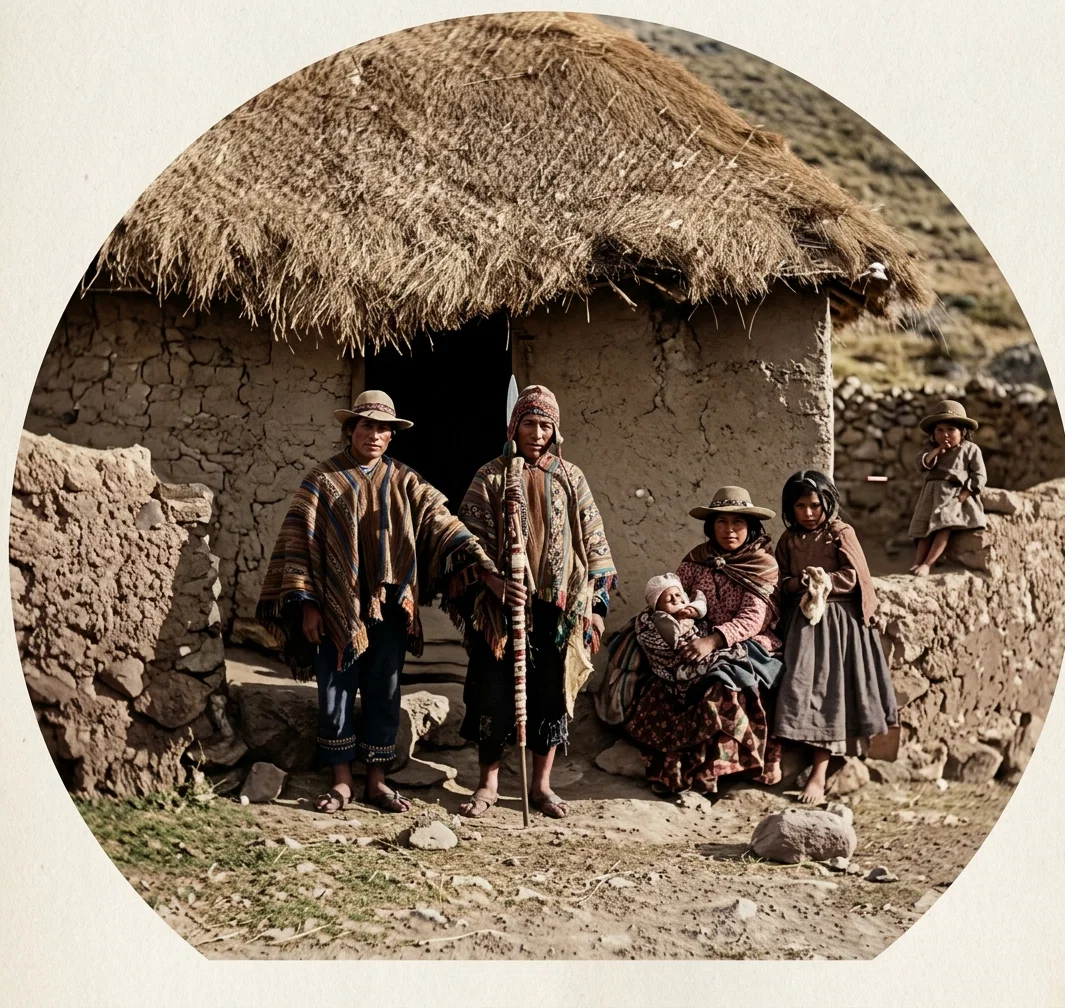
A GROUP OF INCA INDIANS IN FRONT OF THEIR HUT
To this people the gospel message must be given
The government has, it is true, frequently tried to improve the already good democratic laws, but these laws have not a reformatory power. They do not reach the hearts and the consciences, and they do not eradicate the evils which are nourished by the antichristian teachings of the state religion. They are mere dead-letter laws.
Before I left my country, three years ago, the extraordinary climatic changes and long-continued droughts, added to the already existing unfavorable social conditions, had caused the poverty of the Indians to become so great that families from the highlands came into the towns to sell their children, preferring to have them in unknown hands rather than to see them perish of starvation. In Arequipa, several children were sold for about fifteen dollars each.
Francisco M. Chuquihuanca Ayulo, a pure-blood Indian, and a descendant of one of the emperors of the Inca dynasty, has felt a heavy burden for the uplifting of his race. In a document recently written, he speaks as follows:— “As day by day we see their sorrowful condition becoming worse, and that rapidly, can we not say, regarding the actual régime of the pseudo-republicans toward colonization, what the eminent Spanish jurist, Polo de Hondigardo, said in 1571,—that the Spaniards did more harm in four years than the Inca kings in four hundred?—Certainly! And in His support of this we have countless deeds and reasons too numerous to mention. From an economic point of view, we see that every day that the source of the substance of the Indian, the foundation of his individual liberty,—his small territorial holdings,—are disappearing with such rapidity that at the end of a decade it will be impossible to find one free Indian in his own home, on his own land. Religiously, we can all see that Catholicism is synonymous with the greatest superstition and unbridled bacchanalian idolatry.”
In another document Mr. Ayulo says of his race: “We need schools; we need teachers; we need apostles. Yes, we need apostles to teach our Indians by word and example; to make them feel their individuality, to know their duty and understand their rights as human beings; to convince them that there is a bright future awaiting them if they fall in line and become intelligent and virtuous. And these apostles who will persuade by word and deed—where are they?”
Many are now able to see that the only hope for the bettering of conditions among this unfortunate race is to be found in the dissemination among them of the principles of the gospel.
In response to an appeal to Christian people in England, about ten thousand dollars has been raised, and steps have been taken for the purchase of a large farm as a place of refuge where many may be educated.
Recently there has been organized in Arequipa a society for the protection of Indian children, under the leadership of Mr. F. M. C. Ayulo, already mentioned. Its object is to alleviate, so far as possible, the pitiable condition of the young Indians and others frequently torn from their homes, and treated as slaves. An effort is made to educate these children, and turn their lives into useful channels.
Bible Translated into Persian
JOSEPH WOLFF, in his notes written in 1831, gives the following interesting account of how the Bible was given to some of the Persians: “Mullah Meshiakh is in possession of a defense of the Koran, written by Hajee Omeen, a Jewish renegade. He has translated the whole Bible into Persian, with Persian-Jewish characters and notes, in order to convince the Jews that Moses and the prophets have predicted that both Jesus and Mohammed should be sent by God with prophetic power.”
The Philippine Islands
By R. A. Caldwell
ONE of our most recent mission fields is the interesting Philippine Islands. When the burden of working the great Malaysian field was laid upon the Australasian Union Conference, it included the eight million inhabitants of the Philippines. The first worker to visit the field was Elder G. A. Irwin, while on his way to attend the General Conference in 1905. An effort of a temporary nature, in the way of circulating our literature, was made in the closing months of the same year. A few months later the work was permanently established by the arrival of Brother and Sister J. L. McElhany, who are now laboring in New Zealand. The writer and his wife arrived early in 1908. Thus far the work has been distinctly seed-sowing. Thousands of copies of the Signs of the Times have been mailed to many of the Filipino school-teachers, who number six thousand; also to a number of American teachers. The past six months, two hundred fifty copies of “Patriarchs and Prophets” (Spanish) have been circulated, mostly among the Filipinos; and about five hundred more are likely to be required in Manila. As only about five per cent of the population can read Spanish, it will be necessary to prepare literature in some of the leading dialects. For this we are praying.
R. A. CALDWELL.
The Virginia Conference
By L. F. Starr
The twenty-fifth annual session of the Virginia Conference was held at Richmond, November 3-8. The churches were well represented by delegates. From the first, we were impressed that the people had come to seek God, and to learn all they could.
The work has moved slowly in this field, but a conviction is taking possession of the people that the cause must advance rapidly, and the message be given in all parts of this State. There is much unworked territory in this conference, and a great work must be accomplished in a short time. The believers there are beginning to realize that all must heartily join the workers in sounding the warning message. The conference was unanimous in laying aggressive plans, covering the different phases of the work, to hasten the time when many would be brought to a knowledge of present truth.
The conference laborers were present, and good reports were given concerning the work the past summer. The reports from the different departments of the conference showed some advancement. The academy located at New Market received considerable attention. The brethren have done nobly in raising money to pay for this institution.
Elder A. G. Daniells was present, and rendered valuable service in the business sessions. His talks on missions, and the great things God is doing toward the speedy finishing of the work, filled the hearts of the hearers with courage.
Prof. M. E. Kern gave some instructive talks on the Missionary Volunteer movement. Too much can not be done to help the youth to enlist in the service and work of God.
Brother I. D. Richardson gave some stirring talks in the interest of the canvassing work. The Lord has greatly blessed in the revival of the canvassing work in the Columbia Union Conference the past year.
Daily studies were given by the writer, on the subject of the Church, Its Order and Organization. Considerable interest was manifested, and many questions were asked on different phases of church work.
Another interesting feature of the meeting was a temperance rally, which had been planned and well advertised. Mr. D. D. McAlister, secretary of the Anti-saloon League of Virginia, delivered a sensible and logical address, Elders A. G. Daniells and D. E. Lindsey following with appropriate and timely remarks.
Elder H. W. Herrell was unanimously re-elected president of the conference, and the other officers remained about the same as last year.
The Lord's Spirit is working in many of the needy fields, and if the brethren and sisters in Virginia will walk humbly in the footsteps of the Master, the times of refreshing now at hand will lead them into greater fields of fruitfulness than they have yet entered. The providence of God is going before them, and with some financial assistance, and additional faithful ministerial and Bible workers, Virginia will soon become a strong conference. Let us pray that the work in this territory may rapidly advance, and that many souls may be garnered in before probation closes.
L. F. STARR.
India
By L. J. BURGESS
MUSSOORIE.—Several months have passed since I last sent a report to the REVIEW, and it is only due to the Lord's mercy that I am now able to write a few words to express my gratitude to him for having spared my life in answer to the many prayers of brethren and sisters. On the first of April I was attacked with typhoid fever, and for about two months there was a close combat between life and death, but the Lord heard our cries, and redeemed my life from destruction.
On the first of June we began a course of Bible studies with a number of Hindustani men and women who came here from various places on the plains. They had heard something of present truth, and being convinced that there was light in it for them, were willing to leave all and come for further study of the message. By the Lord's help we were able to give them some new truth each day until they had studied all the special features of this message. As we met together each morning for our study, we felt the presence of the Holy Spirit to impress the truth upon every heart, and we have never seen any persons advance more rapidly than these Hindustani brethren and sisters.
On the twenty-second of July we had the pleasure of seeing twelve of these souls follow the Lord in baptism. The service was conducted by Elder J. L. Shaw in a beautiful spot on the mountainside. It was a solemn, yet glad and impressive occasion, one which we believe marks a new era in the Hindustani work. Surely there shall be delay no longer in giving this message to the millions in India, as the Lord is ready to co-operate with every one who gives himself to this work.
Several of these brethren and sisters have now returned to their homes, and we expect soon to hear of many others becoming interested through their efforts. Two of these brethren who have been studying with us, not many years ago were in the darkness of Hinduism, and were bowing down to idols of wood and stone; but through the reading of the Scriptures they were converted, and have been led on, step by step, until now they are rejoicing in the light of present truth.
One of these new converts has entered the nurses' course at the sanitarium, and we trust he will make a useful worker. Another also expects to begin this work the first of August.
Brother and Sister H. B. Meyers joined us in July, and assisted in giving the Bible studies. Their help and encouragement were appreciated by all. I trust the readers of the REVIEW will remember us at the throne of grace.
L. J. BURGESS.
Florida
By Page Shepard
PALATKA.—Our camp-meeting (colored) came to a close Sunday, October 11, the celebration of the ordinances fittingly binding off the ten days of holy convocation. Some present had never been in a meeting of this character; others had not had the privilege of taking part in the ordinances for years. To these were opened as never before the wonderful lessons the Saviour desired to convey to his little band of trusting disciples on that eventful night in which he was betrayed. The happy faces, the moist eyes, revealed the effect this service had upon our people, the warm handshakes bearing witness to the presence of God's Spirit.
During this meeting eight dear souls were added to those who look for the soon-coming Saviour. Nearly one hundred dollars was taken up in cash and pledges to meet the demands for giving the message. The sum is small indeed, but we hope to increase it many times more. Brother J. W. Manns was set apart to the work of the gospel ministry, Elder R. W. Parmele delivering a discourse on the order and sacredness of the work of God, and Elder W. A. Westworth giving the charge. The writer was granted ministerial credentials for this field at the conference session held in connection with the camp-meeting.
The State agent found a live interest in the canvassing work, and twelve decided to devote their time to it. A canvassers' institute lasting ten days was conducted in their behalf. The practical instruction and the deep spiritual counsel received by these intending workers will,18I believe, do much to encourage them to be alert and faithful. The outside attendance continues to be encouraging, while talks with some convicted ones lead to the belief that still others will join themselves to this company.
PAGE SHEPARD.
Dedication of the New Church at Altoona, Pa.
By K. C. RUSSELL
SABBATH and Sunday, November 7, 8, were important days for the Altoona church. For a long time the members of this church have looked forward to the dedication of their church building. The work was started in this city by the writer, assisted at first by Elder Charles Baierle, and later by Elder W. H. Smith, when, in 1894, a tent-meeting was held, which was attended with excellent results, and in January, 1895, the Altoona church was organized. Although fourteen years have elapsed since the church was organized, we were gratified to see that, notwithstanding the inroads which have been made upon the membership by removals, deaths, and to some extent, we regret to say, by apostasy, so many still remain to hold up the standard of truth in this city. A number of those who originally accepted the truth and became members of this church, are now faithful laborers in the third angel's message.
During the past few years Elder W. F. Schwartz has had charge of the work in Altoona and vicinity, and the Lord has greatly blessed his labors. The Altoona church building, which was somewhat involved financially, has been freed from its indebtedness.
On Sabbath, November 7, there was a good attendance, and the meeting assumed the nature of a revival. This was indeed a fitting introduction to the dedicatory service, the members first dedicating themselves to the Lord.
THE NEW CHURCH AT ALTOONA, PA.
Sunday, November 8, the dedicatory services of the building took place. The house was filled to its utmost capacity, and the services were most interesting. An orchestra from the city rendered excellent help in the music. The dedicatory sermon was delivered by the writer, and was based upon John 4:24: “God is a spirit; and they that worship him must worship him in spirit and in truth.” Elder F. D. Wagner, president of the West Pennsylvania Conference, offered the dedicatory prayer.
At the close of this service, the members of the church voted to deed the church property, which is valued at six thousand five hundred dollars, to the West Pennsylvania Conference. This is a wise course for every church to follow; for much property has been lost to the cause by having church buildings deeded to a church board, whose members have moved to some other place, or apostatized.
On the evening following the dedication, the writer spoke to a full house on the subject of religious liberty.
At this meeting, we were pleased to meet Brother J. D. Mulhollen, who was formerly engaged in preaching this message.
We are glad to report that the outlook for the work in the Altoona field is encouraging, and we believe that there will be a continual growth in the membership of this church. Our prayer is that God may greatly bless Elder Schwartz and his colaborers in building up the work in that important field.
K. C. RUSSELL.
The New York Camp-Meeting
By F. N. JOHNSON
THE annual camp-meeting and conference for New York was held at Norwich, September 10-20. This was one of the very best camp-meetings ever held in this State. The deep moving of the Spirit of God was seen from the very beginning of the meeting, and the first Sabbath services were characterized by solemnity and a response to the work of the Holy Spirit in confessing and putting away sin.
Elder E. W. Farnsworth, our union conference president, was with us almost the entire time, as were also the usual number of workers from outside our own field. The labors of these brethren were blessed of the Lord, and were appreciated by the brethren and sisters. Twenty-four persons were baptized at the close of the meeting.
The temperance rally held the first Sunday afternoon was excellent. The Woman's Christian Temperance Union and local churches joined in this meeting, and an excellent influence went out from the camp; still the outside attendance at the public services was not large. However some interested ones were found, and Brother and Sister H. F. Taylor remained to continue the work for a time with these.
It was encouraging to see the unity prevailing as the items of business were brought before the conference. While no newly organized churches were admitted to the conference, several new companies have been formed, which, it is hoped, will soon be prepared for permanent organization. The financial condition of the conference is good, and every minister and Bible worker has been encouraged to see fruit of his labors the past year.
F. H. DeVinney was unanimously re-elected president of the conference, with J. G. White, D. E. Wood, F. N. Johnson, and F. C. Webster associated with him on the executive committee. Sister F. C. Webster was elected Sabbath-school secretary, in place of Sister L. M. Calkins, who was unable to continue her successful work on account of the continued illness of her husband. W. W. Wheeler was elected educational secretary, and A. J. Clark, religious liberty secretary.
Resolutions pertaining to the work at home and abroad were freely discussed and adopted. The Thanksgiving Ingathering and ten-cent-a-week plan were heartily approved. A resolution was adopted which determines the attitude of the conference regarding local church property. There are instances in our territory where church buildings have been erected, and through death and apostasy the numbers were reduced till there is danger that these buildings will be lost to the cause. The resolution provides that all church property shall be deeded to our legal association, and the deed be deposited at the office.19
The many good lessons drawn from God's Word will be treasured up in the hearts of the dear children of the Lord who have returned to their homes, and we trust that all who were at the Norwich convocation will meet face to face around the throne of God. All were greatly strengthened, and seemed determined to do more active work among their friends and neighbors.
F. N. JOHNSON.
South Carolina
By Sydney Scott
It has been one year since I came into this conference, having been transferred from the Alabama Conference to South Carolina last November. I have enjoyed my labors in this field, and the work is moving on nicely. Many new Sabbath-keepers have been gained since the beginning of the year. Since Dec. 1, 1907, we have doubled our colored membership in this conference. Our tent-meeting, which was held in the city of Greenville, was a success, about twenty-five taking a stand from this effort. We are preparing to erect a building inside of fifteen months. The South Carolina Conference has had one tent for the colored people this year, but it may be that we shall have two next year if the money can be raised. Our pavilion tent, which was purchased last May, has been paid for with the exception of about thirty dollars. Our hearts have been encouraged and made glad by what the Lord has done for us.
SYDNEY SCOTT.
Jamaica
By U. Bender
Six thousand dimes, twelve thousand nickels, only sixty thousand pennies, and the thing is accomplished. “What is accomplished?” you ask. I answer, The raising of six hundred dollars to assist the brethren in Kingston, Jamaica, to complete their church building.
Like all good things, this work takes time and lasts well; but it is about finished, and will soon be completed if a little aid can be given now. I will not attempt to stir you to emulation by recounting the noble efforts put forth by the brethren and sisters in Jamaica. They are doing what they can, and the Lord is blessing them. We are very sorry to have to make this call, especially when the needs are so pressing in other places; but we must look to our brethren for help.
May the Lord reward the liberal in heart, and command his blessing upon those who are willing “in the day of his preparation.”
Be sure that all donations to this work are plainly marked, “For Kingston church building,” and sent to Elder I. H. Evans, Takoma Park Station, Washington, D. C. U. BENDER.