Recently the receipts of a special day at the Oakland, Cal., race-track gates were given to a popular charitable institution in this city. E. R. Dille, D.D., pastor of the First M. E. Church, Oakland, speaking in regard to the matter on Sunday evening, May 8, said:—
“I am sure that I need advance no argument to-night to prove that gambling is a vice that is doing more to destroy our young men in California than any other, with a single exception—the drink habit; and that the worst form of gambling to-day is that connected with the race-tracks and pool-rooms. Betting is the soul of horse-racing, and a thievish desire to get money without earning it is the soul of betting. . . .
“The truth is that vice in all its forms—drunkenness, lying, cheating, stealing—are inseparable adjuncts of the race-course. Human birds of prey flock to it from under the whole heaven, and gorge themselves to the full. Hundreds of millions of dollars are invested in the race-tracks of this country and the gambling enterprises connected therewith. . . .
“Why, at some of the great race-courses, the starters and judges receive larger salaries than do the judges of our State Supreme Court. The book-makers at the tracks pay the racing associations $100 a day, and the telegraph and telephone companies pay $1,500 a day for the privilege of sending news from the track to the pool-rooms all over the country.
“Now, as a crime breeder, I unhesitatingly affirm that race-track gambling, in and out of pool-rooms, is the worst gambling evil in the land.
“The Louisiana lottery, with all its ramifications, its vast wealth and power, constituted no such menace to the public morality, no such source of private and political corruption, no such burden upon the commercial prosperity of the country, as does the racing interest. . . .
“But, according to the New York Times, the enormous sum of $2,898,372 was stolen in one year with which to play the races, to say nothing of the honest money wagered. It is estimated that $200,000,000 is staked annually and lost upon them.”
This is certainly a very severe arraigning of the race-track profession; and who will say that Mr. Dille has made his statements too strong? Indeed, is it possible, with all the facts in mind in regard to the evils of racing, to make the charges against it too extravagant?
The wickedness that the inspired Word tells us is to make the “last days” “perilous” is being greatly augmented by the combined evils of the races and gambling. From whatever side this world is viewed to-day the picture is only dark. But when these dark things are seen in the light of the Word of God, they clearly appear as signs of the approaching end of time. And only from that standpoint do we see gleams of light. If our hearts are made sad by the evils of this time, we should look to the Life-giver. His coming is near. T.
The Church as a Beehive
EVERY church of Christ should be as a beehive, in which every single bee is actively engaged in making honey. And the honey made should not be selfishly appropriated, but divided and distributed to sweeten the lives of others.—The Evangel.
Happiness in Little Things
By Louisa M. Alcott
THE happiness of life depends very much on little things; and one can be brave and great and good while making small sacrifices and doing small duties faithfully and cheerfully.—Louisa M. Alcott.
The Wise Man Knows Useful Things
“He that knows useful things, and not he that knows many things, is the wise man.”
CHRYSANTHEMUMS
By Frances Eugenia Bolton
(Concluded.)
A Change of Name.
“Yes, I am to leave Washington next week,” said Mrs. Carew to Mrs. White. “My heart is almost broken over it, but it is the only thing to do. Of course, I have grown to love the people; but duty seems to point in another direction at present. Brother’s wife feels that she can not be bothered with father any longer. He is as weak and helpless as a child, poor old man, and needs a great deal of attention. Husband’s mother is getting old and feeble, too. She is on the old farmstead in Pennsylvania. My son and wife have been keeping up the farm, and Charlie, Fred, and Flora, my children, have been helping them, but Belle is not well, and wants to go home for awhile. Then Auntie Campbell wants to live with me. Poor auntie! She was once a beauty, wealthy and popular; but after her husband died, she had a stroke of paralysis, and she is quite helpless still. She is willing to pay for the attention that I can give her, and as long as I have to go home anyway, and shall be glad of every penny, I do not know as it will materially add to my burdens.”
“Will your husband go with you?”
“No. He must stay in the field, and he will miss me, poor dear! but there is no other way but for me to go.”
“We shall all miss you, and feel so sorry that you are going. O, by the way, where is that young colored girl, Sukey, that you took such an interest in a couple of years ago?”
“We do not call her Sukey now, but Chrys—Chrysanthemum. She has gone to a missionary training hospital, and is doing splendidly. I have a letter from her every week, and the way the girl is advancing is marvelous.”
“So she is getting her heart’s desire. I remember what a desire she had to be a nurse.”
“Yes, when she left the hospital after her sickness, her mind was fully made up. I happened to know the director of this training school, and wrote him something of her history. The ladies furnished her with a nice little wardrobe, and she looked really charming in her neat new costumes. She went off joyfully, and I know that she is going to make a splendid woman.”
“You call her Chrys—how is that?”
“Well, she said that chrysanthemum just meant to her what she wanted her life to mean to God and to those with whom she should come in contact—‘something with a flower on it when everything else is dead,’ she said; and so I said, ‘We’ll call you Chrysanthemum instead of Sukey.’ So everyone calls her Chrys now. She will graduate in a year, and then go south to her own people. She says she wants to gather in the poor black lambs and sheep, and lead them to the great Shepherd. She is a true little lamb.”
Things at the Farm.
Mrs. Carew went to her home, and she said it was certainly time Flora went to college. This was Flora’s one great desire. “No matter how hard I have to work,” she said to her daughter’s faint protest, “your young life is not to be spoiled.” It was evident Belle needed a change and rest. How pleased grandpa seemed to get home again; and auntie’s joy could be expressed only by tears and broken utterances of thanks.
“I hope I can spend the rest of my days with you,” she sighed. “God grant they may not be many; yet, many or few, God give me grace to endure them with patience. My lot is much brighter than that of many another invalid.”
So it came about that Mrs. Carew was soon loaded up with burdens that had slipped from other people’s shoulders. Herbert went with Belle to her home for a change. Grandpa and auntie came to the farm. Grandma laid all her cares upon her burden-bearing daughter-in-law. Flora went to the academy, and Fred, and Charlie, and the hired man had the care of the farm, while Mrs. Carew undertook the care of the household and the invalids. It was a good deal for her, tho she reckoned herself a strong woman. But it was evident to herself, long before it was to others, that she had reckoned beyond her strength. As the months went by, she said: “It will be easier when Florrie comes from school. If I can keep up until vacation, I will have a little time to recuperate. It would be too bad to break into Florrie’s school year.”
Herbert and Belle had decided to keep house for themselves. Fred and Charlie were the only ones to help, and they were slow to notice how pale and thin she was getting; but toward the end of June Fred said one day:—
“I tell you, Charlie, mother is overdoing, and it is about time to call a halt. I went into the wash-house, and caught her looking as white as death. If she hadn’t groaned, maybe I wouldn’t have noticed that; but I tell you mother’s sick, and we have been fools for letting all this burden fall on her.”
“Ask Chrys if she can come for a little while,” Mrs. Carew had whispered, “and send for Florrie right away.” So Fred wrote “Miss Chrysanthemum Daily” on a neat letter, containing a few brief words to the effect that mother might die, and that Chrys would find a hospital at Rosewood farm, and a corps of raw hands to turn into nurses.
Chrys received the letter just when she was planning for the graduation night. The director had found her a good post in the south, under the supervision of a dear, unselfish woman, who, like herself, intended to devote her life to work among the poor and sick; and this news was something of a shock to her plans. Still, when she came out of the director’s office, after telling him that she must pack up and set off immediately for Rosewood farm, there was a shiny look in her teary eyes.
“It’s all nipped off now,” said Chrys, speaking half aloud.
“Nipped off? what is?” said a patient standing near.
“O, only superfluous buds.”
“So sorry you are not going to graduate now, and with us,” said the nurses, as they stood bidding Chrys good-by.
“Never mind,” retorted Chrys brightly; “I have decided to take a higher course, and graduate when the Teacher thinks best.”
“Bless her unselfish heart,” they said as they wiped the tears away to see the last of Chrys’ waving handkerchief. “There is a real chrysanthemum for you, and I shouldn’t wonder if the rare flower would be found on her.”
The telegram for Flora met with something of a different reception. For the eleventh time she had laid out her white dress that she expected to wear on commencement day, and was full of plans for vacation; for she intended writing home that very day for permission to stop at Sarah Cooley’s for a couple of weeks, before plunging into the drudgery of housework. The preceptress had handed her the telegram that read, “Come home as soon as possible. Mother is very sick.” Flora threw herself on the bed and sobbed.
“Poor child,” said the kind preceptress. “It’s awful news. But after all it may be nothing serious.”
“Of course it’s nothing serious,” sobbed Flora, “it’s those foolish boys who think that if mother has a headache she is going to die. Something always comes to spoil everything, anyway.”
So it happened that two very different faces gleamed in the darkened doorway of Rosewood farm. One was dark, yet bright; the other white, yet dark.
“Nothing very serious, as I can see,” said Flora to her brothers. “If Chrys was coming, I should have thought you might have let me stay through graduation week anyway.”
Chrys heard this murmur and shook her little head. “It’s very serious, dear. Maybe you may realize it when it is too late. But I would rather be her than you. She is not thinking of herself, but is so worried over your moody face. Come, do cheer up for her sake. Forget yourself, let the old buds be nipped off.”
“Chrys is the most curious girl,” said Flora. “Of course she couldn’t care as I do about being disappointed. I am going to ask her what she means about the buds. I suppose, tho, she thinks I am selfish, and want things, when I ought to be good and sweet whatever happens.”
Flora was washing the dishes, and the bitter tears fell into the pan unheeded. She rattled the plates, slammed the pantry door. “I hate this work,” she said, scraping the porridge out of the pots with a look of disgust. “I hate the whole thing. There’s auntie. What on earth did mother want to have her here for? She might have known that it would break her down. Grandpa ought to be in some old man’s home. Grandma isn’t so helpless. Mother always would take on burdens she had no need to.”
“Flora, dear, you are making an awful clatter. Maybe you don’t know how it jars on your poor mother and auntie. Of course, grandpa and grandma can’t hear very well, and what a blessing it is that people get deaf as they get old and feeble. Here, dear, let me set the dishes away for you.”
What was it that made Flora feel so cross?10Not that little, springy, quiet step, surely. That little dark face lit up so? What was it?
She said to herself, “It was the impertinence of some folks who think they know too much.” Whom did she mean? Not that little humble nurse, surely, who rung out hot and cold flannels for her suffering mother, who drew down auntie’s blinds, and chased the flies out so that the helpless muscles would not need to twitch in vain to get rid of them, who laid rugs all over the hard floor to deaden the steps of the boys, and who prayed that God might spare Flora an orphan’s sorrow.
“Do you think you can stand it, Miss Daily?” the doctor said. “I fear it will be a heavy strain on you; but I shall have to ask you to care for Mrs. Carew almost day and night until the crisis is past. It is the only hope for her life.”
“She saved mine,” said Chrys, “and I’ll save hers, if the Lord is willing.”
Well, no one knew what Chrys went through. She scarcely slept at all. She kept up untiring vigilance. She soothed Mrs. Carew’s delirious fancies. She knew nothing save her responsibilities to the suffering. When the doctor left, after giving her directions to have everything quiet, she called a council.
“Boys and dear Flora,” she said with tears in her eyes, “your mother is very low. The only hope for her life is to keep everything quiet. I shall have to ask you to take off your boots at the door, to keep in the back room, to not shout, or even sing. You said I would find a hospital, and a hospital is a sacred place. It’s a place where love and selfishness, life and death, battle for the mastery. Now all of you must turn nurses.”
“What can we do?” said Fred, with a pale, set face.
“Be cheerful and pray. Take care of grandpa as if he were the only one in the world, and he your sick mother. And you, Charlie boy, look after auntie. You are her boy, you know. I shall not have much time to give her. And Flora, you must be the woman of the house. O, what a chance God has given us all to grow into the image of His Son right here. Now let’s let the Gardener nip off the superfluous buds, and He will see that our strength is sufficient to bring forth the flower of pure love.”
’Twas almost pitiful to see how they all tried to follow out Chrys’ orders. What a little general she proved to be! After a while Mr. Carew came home, and relieved Chrys a little in the dark chamber.
Flora’s heart was broken with the realization of the danger that threatened her mother’s life, and with a view of her own selfish heart. All looked on Chrys, who was not thinking of herself at all, as a light in the dark.
One night the doctor patted her on the back.
“Well done, good and faithful,” he said. “You’ve saved her. She’ll get better.”
Chrys nearly broke down and cried from sheer gladness and weariness; but O, there were toilsome days yet to go through. There were the long hours of the convalescence, when the rest grew a bit careless; but at last mother was queen again of her own household.
“And now,” said Chrys, “is my mission done?”
“Not if the court knows itself,” said Mr. Carew. “It is time now to take care of you. I am going to take mother, and you, and Charlie up to the mountains, just to revel in sunshine, and to drink it in, and to boil it down for winter.”
“Ha, ha!” laughed Chrys; “you want us all to be yellow chrysanthemums.”
“Yes, winter is coming on. But you are not to go south till the birds do, and, O, how we shall miss you!” Mr. Carew’s voice was a bit husky.
“How we all shall miss her!” quavered auntie’s voice out of her invalid couch. Charlie, Fred, and Flora all looked ready to cry, and the tears did slip down Mrs. Carew’s cheeks.
“This will never do,” laughed Chrys. “Don’t cry till I am gone. ‘Don’t cross de riber till you git’s dar.’ Perhaps I won’t miss you—no, not at all.”
So the party went to the mountains, and Flora and Fred stayed at home with grandpa, grandma, and auntie.
“I wish they would let me stay and you go,” whispered Chrys to Flora.
“No, indeed. Do you think you are the only one who wants to have the flower? I wouldn’t go for the world. The Gardener wants to cut off some of my superfluous buds, and I want Him to, too.” Flora’s voice was a bit trembly. “Pray for me, Chrys. I am so hateful and selfish, and you have been a chrysanthemum to me.”
Six weeks in the mountains! O, how delightful it was! Chrys came home with a tint of rosy color in her brown cheeks, and Mrs. Carew was her old self again.
“O, look at the chrysanthemums!” exclaimed Chrys, jumping from the carriage. “What a beautiful sight!”
The windows were all aglow with their nodding plumes. The neighbors around had sent the flowers when they heard how the children wanted to decorate up for the home-coming.
But winter came, the birds went south, and with them went Chrys. The director had held her post for her, and sent her her diploma. Chrys opened it with great awe and tearfulness, as tho the great Master Himself had sent it to her from heaven. With a new sense of life’s glorious meaning, she got ready for her chosen work.
“I shall see mother and Bob, and his wife and baby,” said Chrys joyfully. “O, if I can only bring in some of those dear lambs of His, as you brought me in through the Shepherd’s love, I shall be so happy, so blessed!”
There was a tearful company on the steps as Chrys stepped out of the door of Rosewood farm.
Auntie was there, and with her trembling hands blessed Chrys. “Your quieting presence,” she said, “has brought such comfort to me. My poor nerves were so tired when you came. The Lord bless thee, and make thee a blessing.”
“We will never slam the doors again, auntie,” said Fred. “If we do, you must just say Chrys, and that will remind us.”
“This is for you to take with you;” said Charlie, handing Chrys a potted chrysanthemum with one huge, beautiful flower on it.
“That’s you,” pointing to the flower; “all the little buds have died for the big one, and that’s the love that God put into you. May it go with you always. Wish there were more girls like you.”
Then came the tender parting between Mrs. Carew and Chrys, and then the carriage started for the station. They strained their eyes down the road, and saw Chrys and the yellow blossoms disappear round the corner at the end of the lane.
“Wish there were more girls like her,” said Charlie, plunging through the house; and the door slammed, but it slammed to drown the sound of a sob.
FRANCES EUGENIA BOLTON.
35 Champion Street, Battle Creek, Mich.
SMILES
Smile a little, smile a little,
As you go along.
Not alone when life is pleasant,
But when things go wrong.
Care delights to see you frowning,
Loves to hear you sigh;
Turn a smiling face upon her,
Quick the dame will fly.
Smile a little, smile a little,
All along the road;
Every life must have its burden,
Every heart its load.
Why sit down in gloom and darkness
With your grief to sup?
As you drink fate’s bitter tonic,
Smile across the cup.
Smile upon the troubled pilgrims
Whom you pass and meet;
Frowns are thorns and smiles are blossoms
Oft for weary feet.
Do not make the way seem harder,
By a sullen face.
Smile a little, smile a little,
Brighten up the place.
—Anonymous.
JOTTINGS FROM PALESTINE.
By H. P. H.
Nazareth.
And now let us walk about Nazareth! What a delightful privilege! In the enthusiasm of the moment all else is forgotten, and our minds rest on the scenes that were here enacted nearly nineteen centuries ago. But our fellow passenger, the Jewish professor, does not share our enthusiasm; he still holds to the tradition that nothing good could come out of Nazareth.
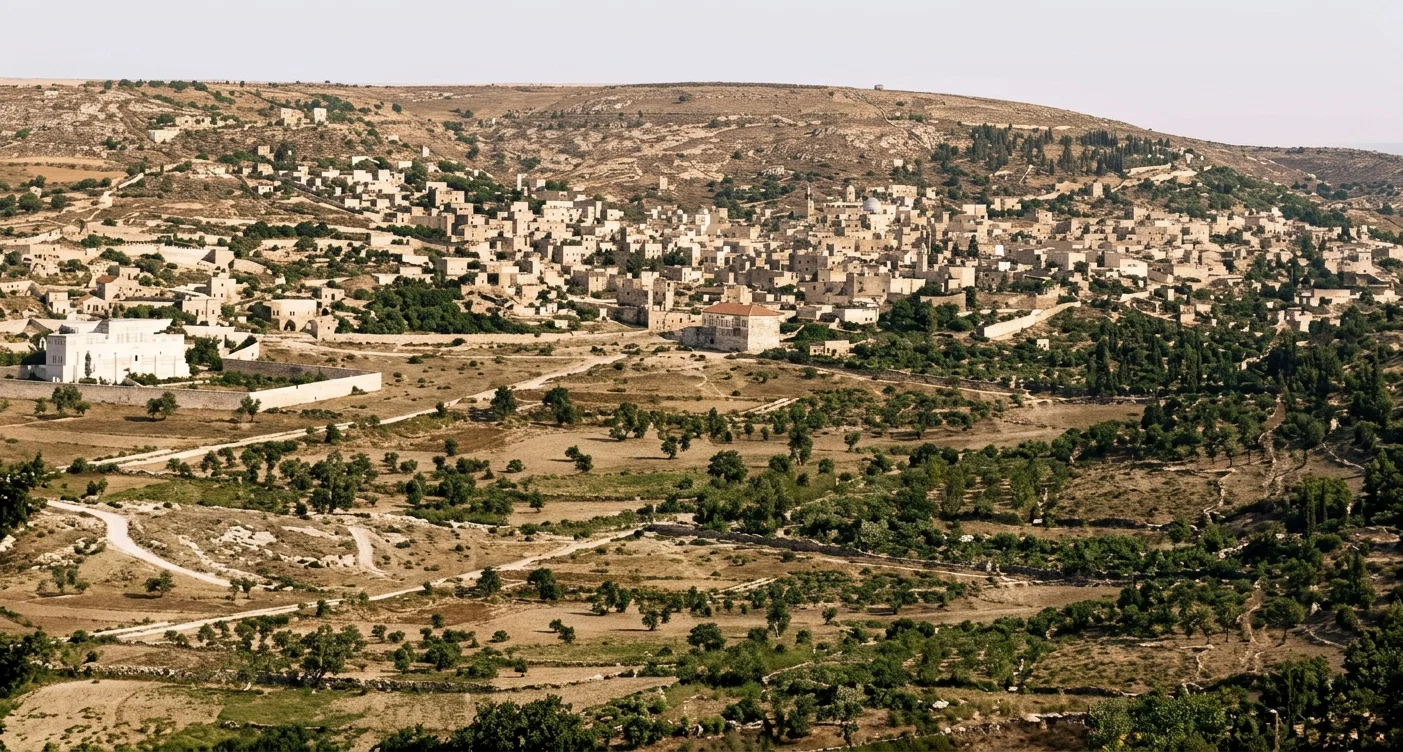
First, let us ascend the hill on which the city is built; in half an hour, we are on the top, above the city. From here, we have a fine view of the whole town, and a wide range of the surrounding country. Nazareth itself presents a pleasing picture. Many of the buildings are quite new. The houses are mostly white. While, as in ancient times, the majority have flat roofs, some have the more modern tile roofs. The scene is enlivened by fig, olive, and cypress trees. Church spires, domes, and minarets speak of a population of Christians, Jews, and Moslems; while in the various styles of architecture we observe that there are Latins, Greeks, and Protestants here.
The hills round about Nazareth are mostly rocky and barren; in the valleys, there is fertile soil. Quite a large portion of the population of Nazareth is engaged in farming and gardening; the chief articles of trade are grain and cotton. Looking beyond the immediate surroundings of the town, we see to the east the round dome of Mt. Tabor, so long held to be the mount of transfiguration; in consequence of this belief, three churches were built on its summit, in execution of the proposition of Peter; but recent investigation tends to show that the transfiguration took place on some part of Mt. Hermon. Back of Mt. Tabor, we see the indentation which indicates the valley of the Jordan, and just beyond, the hills of Gilead. To the southeast, we can see the hills of Gilboa, and southerly, the great plain of Jezreel, lined on the south by the mountains of Samaria and Carmel.
As we stand looking over this interesting and varied scene, we remember that in outline the view was the same when Jesus spent His childhood days in Nazareth. He may, perchance, have many times climbed the same hill; He certainly viewed these surroundings during the larger part of His life on earth. As He studied the Scriptures, He could, looking out from the hills of Nazareth, see many of the places where the Old Testament scenes took place. But the picture then was much more pleasing than now. Then Galilee was in its prime; it was perhaps the most densely populated then of any period in its history. Regions now barren and bleak were then green with verdure, olive and fig orchards, and vineyards;11places now lying in desolate ruins were then teeming with life.
While we are on the hill, there is one more point to be noticed; to the south of us is the spur of a hill with one side almost perpendicular; it is claimed that it was from this cliff that the people of Nazareth endeavored to precipitate Christ. Let us now descend into the city and view some of the many institutions located there. Here is an orthodox Greek Church, dedicated to the angel Gabriel, in memory of his visit to Mary at the time of the annunciation. Then there are also the Greek monastery, the Russian boys' and girls' schools, the Russian teachers' college, and the Russian hospice.
Near the center of the town, we see an object of special interest; it is the Latin (Roman Catholic) church of the annunciation. It is claimed that on the spot occupied by the church the angel appeared to Mary, and hence it is held most sacred by the Latins. But whether it be the exact spot or not, the blessed fact remains that the angel did appear to Mary, and that Jesus Christ was born of the flesh and dwelt among us,—took our nature upon Him that He might impart His nature to us.
NAZARETH AS SEEN FROM THE SOUTHEAST.
Besides the church of the annunciation, the Latins have a monastery with a school, a hospice, a nunnery, an orphanage and school. Protestants also have several institutions, of which may be mentioned the church and mission school, a hospital, an orphanage and girls' school, and a Bible depot.
In the Catholic and Greek institutions are shown many things connected with the life of Christ, such as the kitchen of the Virgin Mary, the workshop of Joseph, the rock on which the house of Mary stood, the table of Christ, and the remains of the synagog in which Christ stood up to read on the Sabbath. But without stopping to question the authenticity of all these claims, let us descend to the lower and central part of the town, to a large fountain.
This is called Mary's well. It is the only spring in the town, hence it is quite certain that it is the one from which water was drawn in the time of Christ. Doubtless Jesus, as child, often accompanied His mother to this well as she came to draw water. As in those days, so to-day, the women carry the water from the fountain to the home. A short distance from the spring is a large stone basin to collect the water; at its side is a trough for watering the stock. At this basin or fountain, the women and girls come from all parts of town with stone or earthen water-jars on their heads. When we were at the fountain, there were about twenty there filling their jars. It is a rare thing for a man to carry a jar of water; perhaps this is why Christ gave to His disciples the sign of a man carrying a pitcher of water, as an easy means of finding the one who was to show them the house where they were to eat the passover. Mark 14:13.
The clothing is loose and flowing, as represented in pictures of Bible scenes. The modern daily newspaper does not exist in Nazareth, but the ancient one does; at the fountain the news of the day is passed about. One might conclude that without the daily paper and the telephone, the people of Nazareth would know but little of what is transpiring; but the fact is, this fountain gossip is more than equal to a journal with but one edition daily; here are several editions daily. The village fountain seems to be a sort of bureau of information. When Abraham's servant desired to find a wife for Isaac, he went to the fountain; likewise did Jacob when he desired to find his relatives; and Moses when he fled to the land of Midian.
The population of Nazareth is about eight thousand, three-fourths of these are Christians and the remainder mostly Mohammedans. Each confession has its particular quarter of the town and its own government. The people of Nazareth are noted for their turbulent disposition. And as these Oriental towns maintain much of their ancient character, it is likely that the people were of this temperament in the days of Christ. This fact adds an additional charm to the meek and lowly spirit of Christ. He not only took upon himself our nature, but grew up in a town which had such a bad reputation that it was said even as far away as Jerusalem that nothing good could come out of it; and was surrounded by a people of specially tempestuous character. That they were of this stamp is evident from the manner in which they treated Christ when He read in their synagog; one moment “all bare Him witness, and wondered at the gracious words which proceeded out of His mouth;” but the next moment they “were filled with wrath, and rose up, and thrust Him out of the city, and led Him unto the brow of the hill whereon their city was built, that they might cast Him down headlong.” Luke 4:22–29. The fact that Christ could, among such a people, develop such a mild disposition in sinful flesh, should be an encouragement for all, specially those placed under peculiarly unfavorable circumstances. With this lesson deeply impressed on our minds let us close our day's visit in Nazareth. We will return to the German hotel and seek rest for another excursion on the morrow.
H. P. H.
TRUST HIM.
By Paul Gerhardt
COMMIT thy way to God,
The weight which makes thee faint;
Worlds are to Him no load,
To Him breathe thy complaint.
He who for winds and clouds
Maketh a pathway free,
Through wastes, or hostile crowds,
Can make a way for thee.
—Paul Gerhardt.
OUR WORK AND WORKERS.
A LOCAL camp-meeting has been appointed for Alton, Humboldt County, Cal., June 23 to July 3.
BROTHER A. J. OLSEN has opened a Gospel mission at Marquette, Mich., and reports encouraging success.
BROTHER J. F. HANSEN reports the addition of six members to the Scandinavian Church of Brooklyn, N. Y.
SEVEN candidates were recently baptized by Brother W. Zeigler, and added to the church at Fort Collins, Colo.
THREE persons were recently baptized at Grand Rapids, Mich., the fruit of Bible readings given by Sister Amy Rogers.
A CANVASSERS’ institute is now in progress at Ford’s Store, Md., conducted by Brethren F. L. Mead and J. F. Jones. There is a class of twenty.
A CHURCH of fifteen members and a Sabbath-school of twenty-two members are results of the labors of Brethren J. W. Scoles and E. A. Curtis at Mattoon, Ill.
THE mission in Detroit is receiving fruit of the labors put forth, in the way of converts. Brother Burrill reports the baptism of four one evening after a service conducted by Sister S. M. I. Henry.
BROTHER J. C. STEVENS reports the baptism of nine candidates in Newark Bay, seven from the Jersey City church and two from New York. And still others are waiting the opportunity to follow their example.
THE last note from Brother W. C. Grainger, dated Tokio, Japan, April 19, states that he had been suffering from influenza, the first sickness he had experienced since going to that field. But he had recovered, and all were then well.12
A CLASS of prospective canvassers has been formed at Healdsburg (Cal.) College, and Brother H. H. Hall, of the Pacific Press Publishing Co., is giving the instruction.
BROTHER GEORGE W. REASER, a member of the California Conference Committee the past two years, has been requested by the district council to labor in the Upper Columbia Conference. In harmony with this request, he started from this city for that field on the 9th inst.
A NEW post-office has been established near the Oakwood Industrial School in Alabama. All mail for Brother S. M. Jacobs and family should now be addressed to Chase, Madison Co., Ala., instead of Huntsville. Their shipping point, money order, express, and telegraph office still remains Huntsville, Alabama.
A LABORER in the Iowa Conference, speaking of using the SIGNS OF THE TIMES in mission work, says: “Some of the most interesting experiences of my life have been gained in this work upon the paper. I consider it the best and most certain way of finding interested parties who will appreciate Bible readings.”
THE work in the Australasian field is in great need of funds. There are urgent calls for means to carry out plans for the school work near Sydney, besides establishing medical mission work in Melbourne, Perth, ChristChurch (N. Z.), and in Tongatabu. Of course these are but a few of the many places, but they are enterprises at present in hand and in pressing need.
THE managers of the St. Helena (Cal.) Sanitarium have made arrangements for a summer school, to begin June 15 and continue two months. Instruction will be given in anatomy and physiology, sanitary science, Christian temperance and Bible hygiene, healthful cookery, healthful dress, mothers’ work, simple remedies, nursing and emergencies, physical culture, Christian help work, etc.
THE Colorado Conference paper, Echoes from the Field, says: “From letters which have lately been received at the office, we are convinced that the message of the Holy Spirit has been going from church to church throughout the conference, and the power of God is being manifest in many localities. May the good work go on, and God be praised.” The message, “Receive ye the Holy Spirit,” has been especially proclaimed in some of the leading churches, by Brother A. F. Ballenger, a general field laborer, with excellent results. Echoes further states that “a local elder of a church, who attended only one meeting in Denver where the subject of the Holy Ghost was presented, returned to his own church and delivered to them the same message, which resulted in the power of the Holy Ghost.”
Niagara Vapor Baths
We Are the Original Manufacturers of Portable Vapor Baths.
We have during the last ten years supplied thousands of our Baths to physicians, hospitals, sanitariums, etc., and we are now for the first time advertising them direct to the general public.
In Buying a Vapor Bath
Get one with a steel frame that stands on the floor. If a manufacturer does not show you a cut, you may take it for granted that his “steel frame” is a wire hoop that rests on the shoulders of the bather.
Get one that is covered with proper material. Insist on seeing a sample of material before ordering.
Get one with a thermometer attachment. Don’t go it blind. A bath that is too hot or not hot enough will be of no benefit to you.
Get one that you can return and have your money back, if not satisfactory in every way.
Send for sample of material and interesting booklet that will tell you all about Vapor Baths.
Price of Niagara Baths, $5.00
Jones & Co. Manufacturers
DEPARTMENT K. T.
Niagara Falls, N. Y.
When you write, please mention the SIGNS OF THE TIMES.
Delicious Bromose
The New Nut Food
The Food that Is all food
Delicious, healthful, easy to digest. A Perfect Food for Children
Makes double the rich blood of ordinary food.
Thin people gain two pounds a week on a half Bromose diet.
Our Booklet, “NUT FOODS,” free, tells all about our Nut Products
A Luncheon of Bromose for a 4c Stamp. Seven Samples for 25c. Full line of samples, 50c
SANITAS NUT FOOD CO., Battle Creek, Mich.
When you write, please mention the SIGNS OF THE TIMES.