Said the Master: “And ye shall hear of wars and rumors of wars; see that ye be not troubled; for all these things must come to pass, but the end is not yet. For nation shall rise against nation, and kingdom against kingdom; and there shall be famines, and pestilences, and earthquakes, in divers places. All these are the beginning of sorrows.” Matt. 24:6–8.
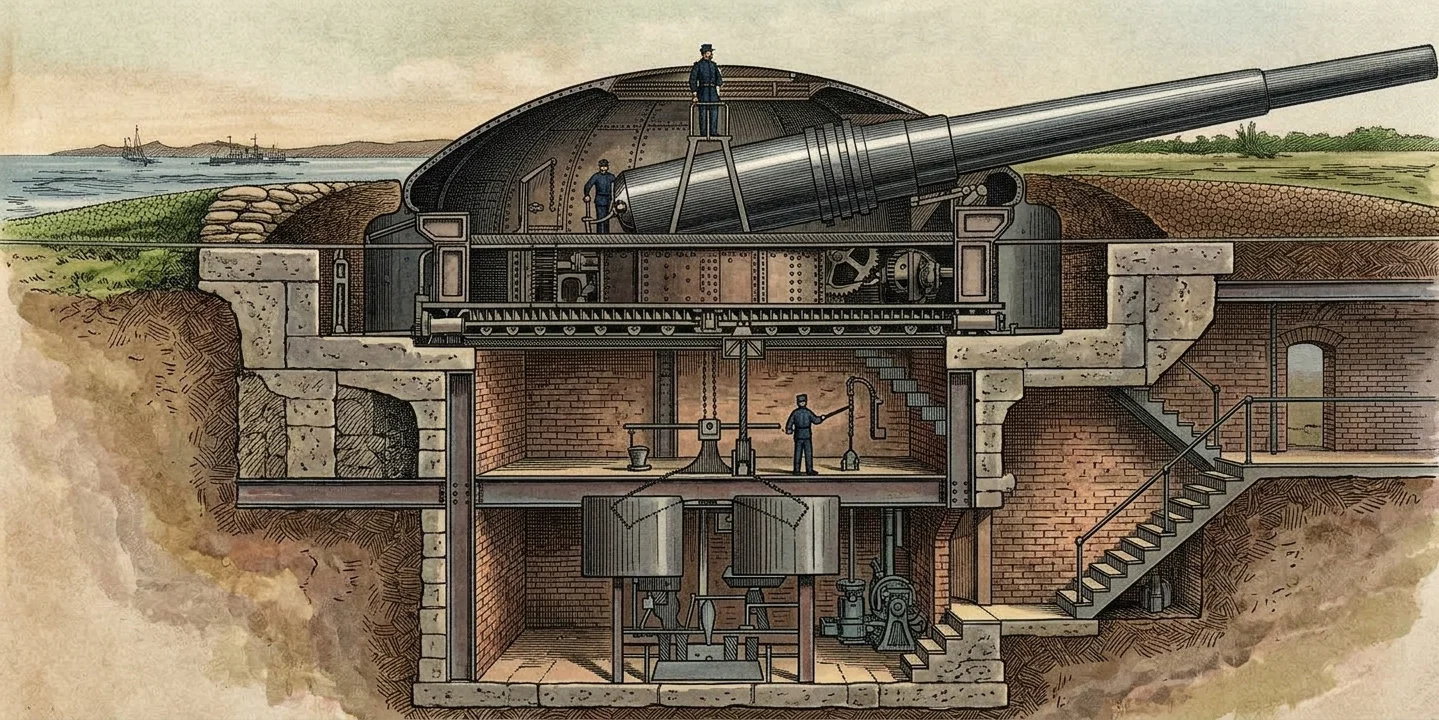
The largest gun ever built, now being completed at Watervliet Arsenal.
There, in the plainest language, stand the imperishable words of our Lord. “Ye shall hear of wars and rumors of wars,” He says. And He adds further that “nation shall rise against nation, and kingdom against kingdom.” There is no intimation in these words of Scripture that this present world will ever be free from war. Neither is there any promise in all the divine Book that this world, made up as it is of sinful men, can ever settle down to the enjoyments of peace. It will be filled with bloody wars till time shall close.
The Lord could see in advance what would take place in this world, and He has plainly written its history beforehand. Not only would the world hear of “wars and rumors of wars,” as we are informed by the words of prophecy, but it is also stated that “the nations were angry, and Thy wrath is come, and the time of the dead, that they should be judged, and that Thou shouldest give reward unto Thy servants the prophets, and to the saints, and them that fear Thy name, small and great; and shouldest destroy them which destroy the earth.” Rev. 11:18.
Thus there comes a time when the simple statement that “ye shall hear of wars and rumors of wars” is not strong enough to express the actual situation. And so the Lord tells us that the “nations were angry.” This language would indicate a spirit of war that is intense in the extreme. And anyone needs only to read the foregoing text from the book of Revelation to see that it brings to view “the time of the dead, that they should be judged,” and that it is at the time of the judgment day when the “nations are angry.”
The prophet Jeremiah had a view of the military scenes among the “angry nations” at the time of the judgment, for he says: “My bowels, my bowels! I am pained at my very heart; my heart maketh a noise in me; I can not hold my peace, because thou hast heard, O my soul, the sound of the trumpet, the alarm of war. Destruction upon destruction is cried; for the whole land is spoiled. Suddenly are my tents spoiled, and my curtains in a moment.” Jer. 4:19, 20.
Here is a scene of warfare described by the prophet, such as the world has never beheld. As his vision opens to him this clashing of arms, he says, “My heart maketh a noise in me.” The sight of the terrible battle that is here passing before him is no ordinary warfare. As he views the horrible carnage and destruction, it is such that his every emotion is heightened to the greatest possible tension. “My heart maketh a noise in me,” says the divine seer. It is only when the most alarming terrors takes possession of one, that every faculty and fiber of the body seems to be a great sounding-board for the heavy drumbeats of the heart.
“I can not hold my peace,” continues the prophet, “because thou hast heard, O my soul, the sound of the trumpet, the alarm of war.” And it is evident that this graphic language is drawn forth by the scenes of war that will be produced by the powerful weapons that are being forged in these last days. For it is added in the following verse that “destruction upon destruction is cried; for the whole land is spoiled.”
Then in connection with these judgment-day scenes not only is there to be “destruction,” but “destruction upon destruction.” And note the further expression, “for the whole land is spoiled.” Language that is so powerful in its description of great battle scenes could not be confined in its application to anything found in the past. And it must be very evident to the student of the Word of God that Jeremiah was permitted to view the awful destruction that is to be wrought in that great and final battle of Armageddon.
And when we take into account the weapons of warfare to-day, is it any wonder that such strong language should be drawn from the inspired pen? The great 16½-inch gun that is now being built at the Watervliet Arsenal, and shown in our accompanying illustration, gives some idea of the power and destructiveness of modern arms. This gun is 49 feet long, the diameter of the breech is 5 feet, and it weighs 126 tons. The cost each time it is fired is $1,000. It uses a charge of 1,500 pounds of powder and throws a shell weighing 2,350 pounds a distance of 16 miles. This huge shell is thrown through the air with a velocity of 2,000 feet per second. In going one mile it would require less than three seconds of time. The crushing blow of such a cannon ball may be imagined, but hardly described. This great gun is soon to be mounted in a Gruson turret in the Romer Shoal to guard the entrance to New York harbor. The modern “machine gun” will discharge 400 one-pound balls per minute, and it will shoot 700 rifle balls per minute; the “rapid fire” guns will throw shells weighing in the neighborhood of 250 pounds at the rate of from four to eight per minute; while the six-pounder “rapid fire” guns will shoot as high as forty times per minute.
In this article we have only space to make the merest mention of this wonderful power and effectiveness of some of these guns. But enough is known of the present preparations for war to make the bravest hearts tremble. And what does it all mean? For surely the development in the field of war implements has been alarmingly remarkable within the last few years.
There is an irresistible impression being made upon the minds of men that these unprecedented war preparations portend a great calamity to this world. What it will be they hardly know. But if the Word of God is carefully studied we will find that in the place of a calamity overhanging the world, this battle-cry all over the face of the earth is one of the evidences of the soon coming of Christ. And His coming is a joy to the righteous and a calamity only to those who cling to the evil of their ways. Are you ready for the coming of the Just One? T.
Abuse Is Glory.
By Rabbi Krauskopf
It is the grandest compliment to be spoken ill of by some kinds of men. Their abuse is your glory and their shame. It is their unconscious and unwilling acknowledgment of your sincerity and courage.—Rabbi Krauskopf.
“THE FOUNTAIN OF LIFE.”
“The Fountain of Perpetual Youth” is not the product of a vain dream. Its original source is the eternal Godhead. That it has been misunderstood is true. Men have sought it in corrupted nature, in alchemy, in magic, in philosophy; and because they have not found it they have called the hope as vain as the quest. The Fountain of Perpetual Youth is not a myth; the quest is vain because men have sought in the created instead of in the Creator; in the changing “its” of the world instead of the great unchangeable I AM; in the human instead of in the divine; in earth and man instead of in heaven and God.
Seeking it in the former, the quest is vain. Seeking it aright in the latter, the quest is as eternally sure as the fact.
Many have died in seeking it in the past, died hopelessly hoping; but, reader, we present before you the true Fountain, and we know that you may find its life-giving waters.
Where Is It?
This is what the Word says:—
“But Jehovah is the true God, He is the living God, and an everlasting King.” Jer. 10:10.
“For with Thee [God] is the Fountain of Life; In Thy light shall we see light.” Ps. 36:9.
“For He is thy life, and the length of thy days.” Deut. 30:20.
“For in Him we live, and move, and have our being.” Acts 17:28.
Here is the Source of Life—the great Creator and King of the universe.
It is characteristic of a living fountain that it flows. The great flowing Fountain of Life is with God. Even as the light bursts forth from the sun, radiating in all directions, penetrating and banishing darkness with its flooding, pervasive effulgence, so life flows out from God to all parts of the created universe, banishing death and chaos and establishing a living cosmos of beauty, filling dark voids with light, and peopling barren wastes with order, joy, and beauty.
The pulse-beats from the great Heart of Existence throb with life in every part of His great creation.
His life encompasses all. “Do not I fill heaven and earth? saith the Lord.” Jer. 23:24.
As with God is the Fountain of Life, it is evident that all life sprang from Him. There is no “spontaneous generation,” no springing up of life from “fortuitous combinations.” The life of each and every atom, every molecule, every living thing in rock, or plant, or tree, or fish, or fowl, or beast—from the lowest animalculæ of the pool to the shining cherub before God’s throne—came from Him.
Reader, sinner, “He is thy life, and the length of thy days.” Even now you live because He lives. Will you not receive your life as from Him, and recognize Him as the One to whom you owe all? Look to Him for life, eternal life.
Next week, the Lord willing, we will consider “The One Life” in all living things.
IS IT RIGHT TO GO TO WAR?
By Editor
A correspondent voices the sentiments of many in the following:—
The SIGNS teaches that it is wrong to go to war, and it also seems to be the New Testament teaching. Were, then, the Revolutionary War and Civil War wrong? If not, and they were justifiable, why might not another war be justifiable for the same reasons? . . . And if war is ever justifiable, would it be fair for Christians to sit still and let sinners fight for them? E. A. B.
The SIGNS has never taught, so far as we are aware, in its abstract sense, that “it is wrong to go to war.” What we do say is that it is wrong for Christians to go to war, and our correspondent admits that the New Testament seems to teach this. Then why not accept the teaching of the New Testament? In other words, why not believe Jesus Christ?
Is war ever right?—From a civil standpoint, yes; but from the Christian, no. Civil government is necessary, because men are sinners. The worst government that ever existed is better than anarchy. It is the object of government to restrain the evil passions of men. In order to do this, in order to exist, it is necessary that civil governments should use force and sometimes engage in war. Civil government can not be Christian in the very nature of the case. Imagine a civil government carrying out the instructions in Matt. 5:39 and Luke 17:3, 4. Its days would soon be numbered. Of necessity, having no faith, it would be obliged to defend itself by force. Hence often comes war, which God overrules for the good of men and the furtherance of His cause; for however man may plot or plan, “the Most High ruleth in the kingdom of men, and giveth it to whomsoever He will.” Dan. 4:17, 25, 32. “The wrath of man shall praise Thee; the remainder of wrath shalt Thou restrain.” Ps. 76:10. God, by His all-wisdom, will use the base passions of men, the wrath of men, against each other, to His glory and praise. He will work everything for good to those who trust Him. Rom. 8:28.
So much for the unconverted world with no faith in God. What of His children?—His Word is their guide, Jesus Christ is their example. “Who, when He was reviled, reviled not again; when He suffered, He threatened not; but committed Himself to Him that judgeth righteously.” See I Peter 2:19–23; 3:9–17; 4:12–16. Surely Peter had just cause to draw his sword at the persecution of his Master, but Jesus said, “Put up again thy sword into his place; for all they that take the sword shall perish with the sword.” Matt. 26:52. In the sword, in the power of force, is the hope of the continued existence of civil government. He who anchors in this, must perish with his hope.
The hope of the Christian is on high. “But he may die?”—Well, what of it? Jesus Christ died. But beyond the grave there is absolutely righteous judgment and eternal life. The most justifiable war that was ever planned by man resulted in the suffering, in the loss of life and property, of the innocent. In God’s final adjustment all will be right, and he who trusts God now will not then be ashamed.
Sinners do not fight for Christians. Christians have One and only One to fight their battles for them, and that is the Lord of hosts. If He wishes to use men, well; but He has given His children but one conflict, “the good fight of faith;” but one power, that of the love of the Spirit; but one weapon of offense, that born of the sword of the Spirit, the Word of God; but one armor, and that God-given with its shield of faith, its helmet of salvation, its girdle of truth, its breastplate of righteousness, its greaves of peace.
If all the professed Christians of the world were true Christians, their united prayers according to God’s direction (1 Tim. 2:1–3) would do more for the peace and stability and betterment of the world than all the wars ever waged. But those who trust in the sword do not trust in Christ. We are not judging the world; their hope is here. If we are with them in their aims, ambitions, objects, and hopes, let us not call ourselves Christians.
The real question to settle is, Do I believe in the Word and example of Jesus Christ, or is my hope in the sword of man?
A MARVELOUS MONUMENT.
Coeval with the most ancient nations mentioned in the very beginnings of history, do we find the name of Abraham. Abraham was the father of a great nation. And while the Assyrians, Egyptians, Babylonians, Medes, Persians, Carthagenians, and Romans, have disappeared, the Jewish nation—the literal descendants of Abraham—is still among us, as a distinct and separate people. The records of history are the only evidences left us of those mighty nations. But the Jew has watched each one as it declined and fell; he has seen all those peoples as distinct and separate nations become lost or buried in the heterogeneous mass of mankind.
Where are the Egyptians, Greeks, or Romans that have mingled among all the various nations of earth and still refused to intermarry or in any way to obliterate their national characteristics? When men of any nationality aside from the Jews, whether as individuals or in colonies, have moved away from their native country, it has only taken a few generations to destroy all traces of the nativity of their fathers. Not so with the Jew. Through all the changes of the old dispensation, there the Hebrew race and nation stood as a distinct people. Their characteristics had such a strong hold upon them that whether they were backslidden into the grossest idolatry, or were under Babylonian, Persian, or Grecian servitude, they nevertheless clung to their national customs and kept themselves a distinct people.
Neither has their history in this respect changed during the Christian era. Driven from their native land, persecuted, outlawed, and despised in the early centuries; hunted out and killed by different nations and at different times during the Middle Ages, and still the object of execration and contempt in later times, nevertheless, wherever you may find him, he strictly preserves his Jewish nationality. In short, we find in the Jew the striking peculiarity of being able to mingle, for thousands of years, among all nations, in every clime, and still preserve7in sharp, clear distinctness the peculiarities that identify his race.
This fact that the Jews so tenaciously preserve their nationality is one of the greatest marvels of the world. And it seems clear that any one who is in doubt as to which day of the week is the true seventh day or Bible Sabbath, could have his difficulties completely removed by just reflecting for a few moments on this marvelous tenacity of Jewish national life.
The Jews have been scattered to every corner of the globe. And no more striking is the fact that they have preserved their peculiar nationality, than that they are absolutely and entirely united in regarding the seventh day, commonly called Saturday, as the sole and only Sabbath of the Bible, whether they observe it or not. Such a complete and overwhelming testimony as to which day of the week is the true seventh day, and consequently the only Bible Sabbath, can not be lightly set aside. God has made it perfectly plain in His Word that He has instituted but one abiding weekly Sabbath, the seventh day of the week, and has also preserved among us a nation whose tenacity for their national peculiarities is simply marvelous. They have clung to the seventh-day Sabbath as tenaciously as to any of the rest of their distinctive national features. And while they have rejected their Saviour, and their religion has degenerated into a lifeless formality, nevertheless it must be acknowledged that they point with unerring accuracy to the day which marks the weekly rest of Jehovah. And if there was no other evidence, there is sufficient in this alone to completely and conclusively show which is God’s holy Sabbath day.
God bore long with the Jewish race; but finally He had to turn away from them because they refused entirely to follow in the path so clearly marked out by divine love. And what God gave to the Jews, and designed through them to give to all the world, He now presents to you and me, regardless of the failure of this great race to carry out the plans of the Father in heaven. And, anticipating that the enemy of all truth would make an effort to cover up His great Sabbath day of rest, our Lord has preserved a great monument—even the whole Jewish nation—to witness with one accord to the exact day that is the Sabbath. Are you honestly seeking to know the truth of this great Sabbath question? If so, turn to Ex. 20:8–11 and read the Sabbath commandment. Observe that the command plainly reads that the seventh day is the Sabbath. This command has never been changed, as any one who is familiar with his Bible knows very well. If you are in honest doubt as to which is the true seventh day, just consider all this Jewish nation, as in every part of the world they stand, pointing to the correct seventh day. You should make no mistake; you can not if you are honest with yourself before God.
“REPENT ye therefore, and turn again, that your sins may be blotted out, that so there may come seasons of refreshing from the presence of the Lord.” The apostle affirms that our sins are to be blotted out in order that there may come seasons of refreshing. The latter follows the former. Are they a matter of individual experience? or do they pertain to the church in general? What is meant by the “seasons of refreshing”? and when do they come? J. N. A.
More than all else, all God’s precepts and promises should be matters of “individual experience.” His blessings will avail us naught if this be not the case. The “blotting out” of sin comes even closer home than in the books of heaven. God would have His law written on the heart; but He will not write it where sin is written. Repent, turn from transgression, and God will blot the sin from the heart’s tablets, and write thereon His law. Or, to change the figure, He will pour out the rain of His Holy Spirit on the erstwhile dry, barren, thorny soil of the heart, and cause fruit to spring up to His glory. Refreshing comes from water, from food. These are provided in the Spirit and Word of God. See Isa. 44:3; Zech. 10:1; Joel 2:22, 23; John 6:51-58, 63; Acts 20:32. This refreshing will be true of His whole church when Christ appears, but it will become true of them by its being true of individuals first. “Seasons of refreshing” always await him who puts away sin, feeds on God’s Word, and drinks in of His Spirit.
PLEASE explain Isa. 58:13: “And shalt honor Him, not doing thine own ways, nor finding thine own pleasure, nor speaking thine own words.” Does this last expression mean that we should not speak our own words in a business way on the Sabbath? or does it mean we should not come together to gossip on the Sabbath and tell what we have done through the week? C. J.
The last part of Isa. 58:13, quoted above, refers not only to the Sabbath, but to all the time. The Christian should be the Lord’s, seven days in the week. Of course conversation about every-day business is not proper Sabbath conversation. But the real thought is that in all our doing, our seeking, our speaking, we should “honor Him.” He who thus does will keep the Sabbath as it should be kept, “holy to the Lord;” for he will seek to know God’s will in God’s Word. He will find the Sabbath all too short for talking and meditating and praying over the things of God; and he will “remember the Sabbath day, to keep it holy,” all through the week.
“CONSECRATED FARMERS.”
“There Are Diversities of Gifts.”
A BROTHER writes us from Kansas that he can not do colporter work or preaching, and intimates that neither of these is his calling. He says that he was taught by his father all about farming, and that he holds this knowledge in trust as so many talents. In his own words:— Shall I not use them to the honor and glory of God? If I by farming support the laborer in the field, will it not be rewarded? We should give all our time and means for the service of the Master, by denying self, and using all but the necessaries of life for the support of the Gospel. GOD WANTS CONSECRATED FARMERS, and may He help us to see this and to realize that it is as much His work to haul the wood and draw the water as it is to preach or do colporter work.
There is more to the same effect; it is all good and to the point. We do need “consecrated farmers,” and consecrated carpenters, and consecrated teachers, and consecrated herdsmen, and consecrated workers in every department of life. And God accepts the consecration and will use the ability and knowledge and talent consecrated to Him. We read in His Word of the farmer, or tiller of the soil, “For his God doth instruct him to discretion, and teach him.” See Isa. 28: 23–29. Of an artificer in metal and stone and wood, the Lord said, “I have filled him with the Spirit of God, in wisdom, and in understanding, and in knowledge, and in all manner of workmanship.” See Ex. 31:3–5. God has given no more precious promises to preachers than he has to artisans or farmers. There should be no printers, or bookbinders, or farmers, or carpenters, or coopers, or blacksmiths, or any other kind or class of workers, equal to the Christians in these lines. The work of consecrated workmen will be square, honest, ever improving, and blessed of God. They will heed the divine injunctions: “Be diligent;” “Whatsoever thy hand findeth to do, do it with thy might.”
But alas, there are professed Christians in all legitimate lines of work who say, “My wisdom is my own,” and who plan for themselves. As a result many ever remain poor workmen and poor witnesses for the Lord. Many never have aught to give for the cause of God—a needy cause, so as to give God’s professed children the privilege of co-operating. They do not plan for God. They make, and use what they make, and give to God what is left, which is often little or nothing. “He that earneth wages, earneth wages to put it into a bag with holes.”
The Lord does not want it thus. May we offer to our farmer, carpenter, blacksmith, etc., Christian readers, a few suggestions? Not that we would take the place of the great Master, who gladly instructs all His servants, but we would offer what we have to say in the words of one of old (Ex. 18:23), “If thou shalt do this thing, and God command thee so, then thou shalt be able to endure.”
1. Plan for God. Plan your work for the sake of His cause; plan that you may be able to invest more in it; that you may make larger deposits in the Bank of Heaven, which never breaks, closes, or suspends payment.
2. If you have in the past been unable to pay the Lord His tithe, to say naught of giving to His work, try a different plan this year. Set apart a piece of land for the Lord. Estimate it honestly, what would be equal to a tenth of your products. Set apart another portion for freewill offerings to foreign missions, to home missionary work, to city missions, to periodical work, to the poor. Prepare the soil of these portions of land for God. Sow or plant them for God. Cultivate the crop for God. Care for it for God. Reap and thresh, and garner and market for God. Pray continually that God’s blessing may rest upon it. Do not neglect it that you may care for your own. If you have boys, encourage them to do the same. Give them a piece of land that they may work in partnership with God.
3. Are you a carpenter or mechanic? How would it do to devote the profits of every tenth job to the Lord’s work, giving the first tenth to Him, not the last, dealing honestly and liberally?
Will such methods prove a success? If you are living up to the light God has given you, they can not prove otherwise. Try it, brother. How many will?
One thought more: Do not think because you are farmers or mechanics that you can not do personal missionary work. You can not afford to lose the blessings, the freshness of heaven, which personal contact in ministry to the needy gives you. It brings Jesus Christ to your side. The water of life makes you a channel, refreshing and vitalizing every power of your being.
Consecrated Christians—there are no others—are needed everywhere. Such will labor for God; such will share in the blessings here and the reward hereafter.
WAR DOGS.
By T.
AMONG the four million men in Europe that General Miles tells us are devoting their lives to the one work of preparing fighting implements for the armies and navies of the Old World, there are some who are making special studies of the services that dogs may render to the army. Germany shows the greatest advancement in this field of dog-soldiery.
The dog is used on outpost duty, where he is trained to warn the sentinel on guard, but is not allowed to bark or make other sound that would attract the enemy. He is also used in bringing up ammunition, as well as in carrying despatches and letters of all kinds. Then, too, the dog is not left out of the “merciful side of war,” for he is also used in finding the wounded and bringing them relief.
For outpost duty the dog is said to be especially valuable, for he can detect the approaching enemy long before a man would. And for carrying despatches he is quite as fleet as the horse and does not furnish anything like so large a target.
The genius of man is certainly very fruitful in devising appliances and facilities for war. All the old methods are diligently studied and improved upon, and new ways for the destruction of life and property in battle are continually being invented. Even the domestic dog must be educated for military service.
And yet in the blazing presence of everything that is going on, men will indifferently tell us that all this military preparation means only peace. All such will do well to remember the revelries at Waterloo on the eve of the great Napoleon’s downfall, and the abandoned and debauching feast of Belshazzar on that fatal night when he was compelled to hand over his kingdom to Darius the Mede.
The German dog-soldier bringing up messages and ammunition.
Men are to be pitied when an enemy stealthily comes upon them under cover and deceives them into ruin. But when the foe is seen marching up with noisy parade and one voluntarily closes all the senses as a means of hiding his approach, the feelings of pity are turned into indescribable astonishment at such unnatural acts. The Bible plainly designates the “last days” as a time when the “nations are angry,”—the war spirit will be running high. And if any one of our senses is awake we can see, or hear, or feel the presence of such a military spirit as the world has never before known. We should not allow ourselves to be deceived as to the portent of these things. T.
The Rumshop of the Holy Brewers
“The Rumshop of the Holy Brewers.”—This is what Martin I. J. Griffin, editor of Griffin’s Index (Catholic), calls, in the Catholic Citizen of April 16, 1898, St. Vincent’s Brewery, run by Catholic monks, near Latrobe, Pa. He says: “I can openly protest against a clerical scandal in my native state. I know it will be effective some time in closing up the rumshop of the Holy Brewers at Beatty [St. Vincent’s]. We Catholics are so overawed about our clergy that I wish the New York Voice would expose this Holy Brewery as it has the Protestant Colleges.” The Voice has done this. Here is its first paragraph:—
“A mile and a half to the west of this place is the famous St. Vincent’s arch-abbey, college, monastery, theological seminary, cathedral, grist-mill, and brewery, an unholy combination that has scandalized the Catholic Church for upward of half a century. Three hundred and ten students are here, 50 of whom are students of theology, preparing for the priesthood; more than 30 professors, nearly all of whom are doctors of divinity; and 75 monks, including an extensive collection of abbots, friars, priors, chaplains, and priests. Everything is the property of the abbey: 600 acres of land drained by the Loyalhanna Creek, with mills, stables, brickyard, and the famous brewery. The brewery is owned by the monks, the beer is made by the monks, it is sold by the monks, and much of it is drunk by the monks of holy Vincent. If you want to make arrangements to have your boy educated for the priesthood, you address a letter to ‘The Reverend Director.’ If you wish a carload of beer, you write to the same official. The yearly output of priests and beer is extensive. More than 500 American Catholic priests have been trained here for their work. The annual crop of beer is not so large. Until recently, the output has been upward of 3,000 barrels per year. Since the work of building the new $250,000 cathedral was begun some years ago, this has been increased so as to provide beer for the big church pow-wows which are held for the benefit of the construction fund.”
It was about fifty years ago the Bavarian monks built the brewery, under Father Boniface Wimmer. The Voice says:—
“Father Boniface had been very materially assisted in securing the property by Bishop O’Connor, the first bishop of the diocese of Pittsburg, who had no idea that he was thereby assisting in establishing a brewery. He felt that beer and grace were a bad mixture. Accordingly he protested long and loudly. But just as stubbornly did the monks fight for their beer. The matter was finally laid before Pope Pius IX., and Father Boniface, with his famous red nose, journeyed all the way to Rome to protect his brewery. He brought most powerful influence to bear before the Holy See. The claim was made that the monastery finances were such that they were unable to continue the education of priests unless they made beer. Even King Ludwig of Bavaria, a patron of Father Boniface, interceded with the pope in behalf of the brewery. The result was that Pius IX. not only told Father Boniface to go on making his beer, but raised the brewery monastery to the dignity of an abbey and made Father Boniface an abbot. A few years later, Pope Pius gave the brewery another boost by making it an arch-abbey, and Boniface became an arch-abbot. As the arch-abbot is abbas nullius, the bishop of the diocese has no jurisdiction over him, and none can interfere ecclesiastically but the pope. Bishop O’Connor was therefore completely routed.”
Further steps in the history of the thing were the utterances of the Third Plenary Council of Baltimore (1885) on the temperance question, and of Leo XIII., in a letter to Archbishop Ireland, dated March 27, 1887. Based on these a petition was sent to Satolli against the Benedictine monks, but the brewing of beer still continues. Here is another paragraph:—
“For nearly half a century this brewery has debauched the Catholic life of this diocese and scandalized the church abroad. In former days, services at the church were invariably followed by an adjournment to the brewery, where old Brother Englebert was kept busy raking in the nickles and dimes and pouring out the beer. Catholic picnics were the scenes of drunken fights and disgraceful carousals of all sorts. I have it on the authority of a devout Catholic, who has lived here all his life, that he has witnessed with his own eyes from 100 to 150 people drunk on ‘holy beer’ at one time at these picnics, besides from ‘10 to 15 fights during the day.’ While the practice of adjourning from mass to the brewery has somewhat subsided, the practise of drunken carousals at church picnics is in no wise abated.”
There is much more in reference to carousals and picnics, to “the great annual drunk carouse” on July 4, at Idlewild, not far away, and to other means to promote beer-drinking and the augmentation of the cathedral construction fund. This cathedral is a magnificent one, costing $250,000, with an altar 150 feet long, granite pillars imported from Scotland, an auditorium with ceiling 100 feet high, and spires and towers without number. Surely this is not the church of Christ which indulges or permits these things.
“WAR BETWEEN TWO CHRISTIAN NATIONS.”
By T
Says Rev. A. K. Glover, rector of the church of the Nativity, Wells, Minn.:—
“The expected has come. War between two Christian nations is a fact. But notwithstanding the horrors of war, it appears that all the greater historic reforms have been realized only through war. There seems to be a holiness to warfare that all its horrors can not obliterate. If the present conflict does not develop into one of far greater proportions we will be thankful. We can not tell just what monarchial Europe may do before we finish the fight. Let us hope and pray that the conflict may be short, decisive and humane.”
If there was a nation on the face of the earth to-day all the inhabitants of which were Christians in fact, and not in name merely, that nation would not be found engaged in carnal warfare. For He whose words will be respected by every man who is a Christian indeed has said, “Put up again thy sword into his place; for all they that take the sword shall perish with the sword.” Matt. 26:52.
Those few short words contain the explicit law of the Prince of Peace upon the subject of war. They are so plain that they can not be misunderstood or evaded. Christians will heed them. And of course they will see nothing either “humane” or “holy” in the cruel butchering of their fellows. T.