“And when they shall say unto you, Seek unto them that have familiar spirits, and unto wizards that peep, and that mutter: should not a people seek unto their God? for the living to the dead?” Isa. 8:19.
Spiritualism may be called the great delusion. The great religious bodies of the world have no safeguard against it. Receiving as one of the fundamental doctrines of the church the idea that the dead are conscious, what is more natural than to think that they should in some way cross the abyss of silence, and seek to make their presence known? Last week a friend said to me, “One of my best friends died seven years ago, and on her death-bed she said, ‘Carrie, if the dead are conscious, I will find some way to let you know it.’” She continued, “I have not heard from her yet, but I am expecting to.” There are thousands waiting with that same desire. This longing makes the deception easier.
Church-members and infidels are alike gathered into the ranks of Spiritualism. A relative of mine, active in church work and in the Sunday-school, one evening attended a séance. She had buried her mother three weeks before. That mother had a peculiar voice. Soon a strange voice sounded in the room, and bursting into tears, the lady cried, “That’s mother’s voice, it is her voice!” A conversation followed, and she returned to her home a confirmed Spiritualist.
The mayor of a town in Missouri was an infidel, a hard man. It seemed that the only tender spot in his nature was his love for his wife. When she died, he was nearly insane. Soon after her death, a medium came to the town, and arranged for a sitting. He visited the mayor, and gave him an invitation to attend. The man responded, angrily, “They couldn’t fool me with the Bible, and you can’t deceive me with any of your nonsense.” “Well,” said the other, “do as you like; but if you do come, take two slates, make the inside clean, and then put a small pencil between them, screw them together at the corners, and bring them with you.” He went away, and at first the mayor had no thought of going, but the longing to hear from his wife was irresistible, and he went. The slate was laid on the table, and a circle was formed. In a short time the scratching of the pencil was plainly heard. No hand was near, and the room was in semi-darkness. The medium called out, “There is a communication on that slate.” Catching up the slate, the mayor hurried home, going to his own room. A screw-driver soon separated the slates, and one of them was found to be filled with writing. At the first glance, he said, “That’s her writing,” and he read the message eagerly. It assured him that there is a future life, and that she was with him almost continually, and added: “You remember that you couldn’t find the clock key, and had to buy another.12The last day that I was on my feet, I wound the clock, and carried the key to my room. I was not able to go back down-stairs, but put the key in the lower bureau drawer, in the front left-hand corner.” He walked to the bureau, opened the lower drawer, and putting his hand in the corner indicated, brought forth the missing key. Spiritualism had gained one more adherent.
Far be it from me to add to the burden of the anguished heart, breaking beside the open grave; but I would say to such, “I show unto you a more excellent way,” and that way is God’s way. “Should not a people seek unto their God?” Thousands, by neglecting to do this, have been led astray. We will now go to him whose “word is truth” to learn the condition of the dead. “For the living know that they shall die: but the dead know not anything.” Eccl. 9:5. “Also their love, and their hatred, and their envy, is now perished; neither have they any more a portion forever in anything that is done under the sun.” Verse 6. “His sons come to honor, and he knoweth it not; and they are brought low, but he perceiveth it not of them.” Job 14:21. “His breath goeth forth, he returneth to his earth; in that very day his thoughts perish.” Ps. 146:4. “For in death there is no remembrance of thee: in the grave who shall give thee thanks?” Ps. 6:5. “The dead praise not the Lord, neither any that go down into silence.” Ps. 115:17. We could multiply texts in harmony with this plain declaration of God, “The dead know not anything.”
The existence of Spiritualism depends on all these scriptures being false. If the Bible is true, the claims of the Spiritualists are false; and those impersonating our dead friends are impostors. They are well named, “the spirits of devils, working miracles.” Rev. 16:14. No wonder they can repeat private conversations, and tell secrets, when it suits their purpose to do so. They are invisible; when we think ourselves alone, there are unseen auditors and witnesses to our words and acts.
The Jews were God’s favored people. “To whom pertaineth the adoption and the glory, and the covenants, and the giving of the law, and the service of God, and the promises.” Rom. 9:4. The pillar of cloud and of fire protected them. The manna fed them. In all things God worked for their welfare. Here are some laws that he gave them concerning familiar spirits: “Regard not them that have familiar spirits, neither seek after wizards, to be defiled by them: I am the Lord your God.” Lev. 19:31. “And the soul that turneth after such as have familiar spirits, and after wizards, to go a whoring after them, I will even set my face against that soul, and I will cut him off from among his people.” Lev. 20:6. “There shall not be found among you . . . a consulter with familiar spirits, or a wizard, or a necromancer. For all that do these things are an abomination unto the Lord.” Deut. 18:10-12. The connection clearly shows that the nations before them, whose sins reached to heaven, practised all these abominations. God knew that those dealing with familiar spirits were antagonistic to him, and to his service, and for this reason he placed the ban of his curse upon them, “Thou shalt not suffer a witch to live.” Ex. 22:18. Now why did God place these prohibitions and these heavy penalties on Spiritualism? The answer is evident. He was trying to keep this people from a fearful evil. He knew that no man could serve two masters; and if they were deceived into seeking to the dead, they would become his enemies, and be destroyed. Hence the warning.
I will repeat (as showing the helplessness of the churches, in the presence of Spiritualism) a conversation that occurred in Peoria a few years ago. I asked a leading lecturer in Illinois the number of Spiritualists in Peoria. “Well,” she answered, “there are two hundred that claim to be, but if you will attend the funerals, and listen to the sermons, you will see that the ministers are nearly all Spiritualists.” I tested her words, and found that the larger part of the funeral sermons teach that the disembodied spirits of the dead are present and looking down on the bereaved living.
Spiritualism is the enemy of God from its very beginning. It is based upon the assumption that God is untrue, and his statements are false. Inspiration has declared, “The dead know not anything. . . . Their love, and their hatred, and their envy, is now perished.” God had an enemy in Eden, the one who said to man, “Ye shall not surely die,” and of whom Jesus declared, “He was a murderer from the beginning, and abode not in the truth, because there is no truth in him. When he speaketh a lie, he speaketh of his own: for he is a liar, and the father of it.” John 8:44. Satan is still true to his own nature, and charges the Creator of the earth with falsehood. What wonder that God desired to stamp out this element of evil from among his people!
God gave as a standard of character, his own perfect law. Spiritualism has no standard of right and wrong, and acknowledges no authority. What has it ever done but curse the man who was led away with it? Consider the case of Saul, as related in 1 Samuel 28. The armies of Israel and of the Philistines were confronting each other, and on the next day a battle was to be fought. God had not decreed that Saul should be slain, or Israel defeated: the result was uncertain. But Saul was afraid of the outcome. When he “saw the host of the Philistines, he was afraid, and his heart greatly trembled.” Timorous and fearful, he sought out one who had a familiar spirit, and asked for Samuel; yet he knew that if Samuel had been there, he would have obtained no response. 1 Sam. 15:35. Again, God had ordered that all mediums should be destroyed, and Samuel was loyal to his God. How unreasonable to believe that the dead did know; how insulting to think that he could be forced to communicate through this hated channel. But Saul had called for Samuel, and the same one who impersonates our dead friends was ready for the occasion. No visible form appeared to the monarch, but the appearance of the one who impersonated Samuel was given by the woman. The king asked, “What sawest thou? . . . What form is he of?” From her description, the king supposed that the unseen was the prophet.
Satan now had all that he could desire. He had made Saul believe that the unseen was really the prophet, and as such his words would be implicitly believed. Satan well knew what Saul was dreading and expecting to hear, and these are the words that he used: “The Lord will also deliver Israel with thee into the hands of the Philistines: and tomorrow shalt thou and thy sons be with me: the Lord also shall deliver the host of Israel into the hand of the Philistines.”
Before, Saul was apprehensive; now, he was defeated. Verse 20 tells his condition at the close of that fatal interview: “Then Saul fell straightway all along on the earth, and was sore afraid, because of the words of Samuel.” Satan delighted in breaking Saul’s heart, and taking away his courage. He always rejoices in adding to the sufferings of humanity.
With the king in this condition, there could be but one ending to the morrow’s conflict; and one more quotation ends the sad narrative of Israel’s first king: “So Saul died for his transgression which he committed against the Lord, even against the word of the Lord, which he kept not, and also for asking counsel of one that had a familiar spirit, to inquire of it; and inquired not of the Lord: therefore he slew him.” 1 Chron. 10:13, 14.
Chicago, Ill.
Wealth and Moral Deterioration
By Rev. John Grimshaw
MANY men are deteriorating with every sovereign they pile up.—Rev. John Grimshaw.
Needless Worry
By J. R. Miller
WORRY makes a great deal of unhappiness in the world, and does a great deal of harm. Jesus says, too, that we need never be anxious about anything. He gives reasons, also, why we should not be. We need not worry about food and raiment. God feeds the birds, and his children are of more value than his birds. He clothes the lilies in matchless beauty, and we are certainly dearer to him than the loveliest flowers.
Worry does not take away the things which trouble us. It unfits us for the best service. If our brain is feverish through anxiety, and our hand unsteady, we can not do anything well. If we are really God's children, we need not give ourselves any concern about the things we need. All we have to do is to seek God's kingdom and his righteousness,—that is, do our simple duty, as it is made known to us,—and then God will take care of us. We often concern ourselves about God's care of us, while we neglect our duty to him.—Rev. J. R. Miller.
Clothing for the Tropics
THE question of devising a suitable fabric for wearing apparel suitable to tropical climates, which shall shield the wearer from the actinic rays of the sun, is one that has occupied conspicuous attention during recent years. A thin white material is generally selected for this purpose, preferably white duck; and although it promotes a certain degree of coolness and comfort, it does not succeed in fulfilling health conditions. Discriminating nature has provided the native in the torrid belt with an effective protection against the sun in a skin pigmentation which absorbs the actinic rays, so that their dangerous effects upon the constitution are counteracted. Consequently, the native is able to continue his labors without the slightest signs of fatigue during the hottest time of the day, when the white man is practically prostrated, or, at any rate, refrains from carrying out his duties from motives of self-preservation.
Investigation has shown that the piercing actinic rays, striking the neck and back, exercise a highly dangerous effect upon the spinal column and the nerve-centers, which react upon the organs of the stomach, promoting such maladies as indigestion, which in turn react upon the brain, and in time completely undermine the physical condition of the body, until at last collapse results. Experiments have proved that if only the natural pigmentation of the native is artificially produced in the clothing of the white man, he experiences no more harmful effects than the former, since the long, or heat, rays are themselves quite innocuous, so far as any effect upon the constitution is concerned. The degree of protection secured by pigmentation has been decided by practical investigation, and it has been found to have strong absorption qualities in regard to the actinic, or short, rays, the degree of pigmentation being proportionate to the intensity of the light prevailing in the native’s accustomed environment. A thin layer of the skin was obtained, and the spectrum of an electric arc between two iron poles was photographed after the rays had passed through the layer. It was found that the dark-brown skin of the Hindu entirely absorbed all the rays of shorter length than thirty-six hundred. From the result of these observations, it is obvious that the white man, when in the tropics, should wear black, red, or orange-colored clothing, as it prevents the passage of the short rays.
The white man, however, has a strongly developed aversion to wearing aught but white clothing, which offers no protection whatever to the harmful actinic rays. Numerous efforts have been made to provide a non-actinic backing to such material; but the disadvantage of such a fabric is that its weight and thickness are unduly increased.
Recently, however, a British inventor has succeeded in devising a process in which the non-actinic material or thread is interwoven with the white or colored surface of the textile in such a manner that while the weight and thickness of the cloth are not increased, no evidence of the red material is observable on its external surface. The prevention of the threads of the red material penetrating the outer face proved the most difficult task, but this has now been successfully attained. These new fabrics, to which the distinctive name “solaro” has been applied, are either of wool, or cotton, or mixed, the former being preferable for cold or moist climates, and the cotton where a dry heat prevails.
By means of this invention, the resident in the tropics has the same facilities in the choice and patterns of textiles for clothes as those living in temperate climes. All the various cloths and latest fashionable styles can be reproduced in solaro with perfect success and comfort; and this facility is already much appreciated, as it enables one to secure a welcome relief to the monotonous white. Moreover, the material is also shower-proof, and has a remarkable capacity for resisting heavy thunder-storms, mists, and so forth. The waterproofing is not secured by means of rubber or chemical solution, but is due to a secret process in the manufacture of the yarns employed. In this way there is no interference with the ventilation of the cloth. Although an excellent sun-repellent fabric, it is equally applicable for winter wear, while it has a high standard of durability. It is suitable for all external garments for either sex, and it compares in price with the best qualities of cashmere. Its hygienic properties have been fully approved by the examining board of the British Institute of Hygiene, while, moreover, it is sealed at the British Colonial Office for officers appointed to the tropics.—Scientific American.
The Heart Where Kindness Dwells
By Nellie Heyer
There's beauty in the glorious sky
When morn her rosy hues displays,
And when at eve the western clouds
Reflect in gold the sun's last rays.
The star-bespangled heaven is fair,
But there's a beauty far excels
Night's brilliant gems or gorgeous clouds—
'Tis in the heart where kindness dwells.
A summer rose is fair to me,
With pearly dewdrops glittering bright,
And beautiful the sweet spring flowers,
Blue violets and lilies white:
They lend rich fragrance to the morn
(Of innocence and joy it tells);
I love them well, but dearer far
I love the heart where kindness dwells.
I love the songs of summer birds,
And murmurs low of rippling streams,
And fairy music which so oft
Comes softly stealing through my dreams.
But something hath a magic power
Surpassing music's sweetest spells;
'Tis the low voice whose gentle tones
Come from the heart where kindness dwells.
— Nellie Heyer.
A Father's Influence
By G. B. THOMPSON
G. B. THOMPSON
It is related of a certain man that he once started alone to climb a steep and perilous hill, purposely choosing a time when his children were at play, and when he thought they would not notice his absence. As he was climbing, making his way over a precipitous path, he was startled by hearing a little voice shout, “Father, take the safest path; for I am following you.” Looking around, he saw that his little boy was following him over the dangerous path. “Years have passed since then,” says this father, “but the little fellow’s cry has never left me; it taught me a lesson, the full force of which I had not known before. It showed me the power of our unconscious influence, and I saw the terrible possibility of our leading those around us to ruin.”
Parents, do you realize that your child is in all probability following you? The daily example you are setting before him will perhaps determine his destiny for all time. If family prayer is neglected, it leaves its impression; if unkind, fretful words are spoken, they will have an influence. Seeing you in prayer, and hearing you plead with the Lord for help, will never be forgotten. Let the words, “Father, take the safest path, for I am following you,” be kept in mind.
Takoma Park, D. C.
Keep Going Through Hard Times
“No, I wasn’t discouraged. ’Twouldn’t have been any use; I had to keep right on anyway,” simply answered a plain, practical woman to an inquiry as to the way she had won through a hard time in her life. “When you just have to do things, you don’t stop to think whether you have courage to do them or not; you go ahead because there is nothing else to do. I suppose the folks that get discouraged are the ones that have a chance to stop and study themselves to see how they are feeling. When something has got to be done, and you have to do it, you’re not watching your courage; you’re watching your chance.”
The West Russian Meeting
By GUY DAIL
GUY DAIL
Since the first of last January the West Russian Mission has been in existence. It was cut off from the territory of the former North Russian field. It contains Russian Poland, and the governments of Grodno, Kovno, Minsk, Vilna, and Volhynia. Of the twenty-two million people within its boundary lines, about fifteen million are Poles, five million are Jews, and the remaining two million are chiefly Russians and Germans. We have neither a Polish nor a Jewish laborer for the twenty millions comprising these two nationalities. Our efforts have thus far been put forth chiefly for the Germans.
The last of our general autumn meetings in the Muscovite empire was the first annual session of the West Russian Mission, which was held from October 30 to November 3, in Lodz, the rapidly developing center of the Polish textile trades. It is a city of about three hundred fifty-two thousand inhabitants, nearly one third of whom are employed in its factories. Foreign capital has been well repaid for its investments in this place, and Polish wares have found not only a good market in Russia proper, in Transcaucasia, in Siberia, and in China, but they are also making their way into Persia, Asia Minor, and the Balkans. The development of these industries is giving to Poland a middle class—a class between the feudal nobility, which earlier formed an oligarchy that was “splendid, wealthy, turbulent, oppressive,” and the peasants, who, before they obtained their freedom in 1807, were said to be among the “most enslaved and degraded of mankind.” Not a few of these peasants have now become land-owners, and are free to hire out as workmen in the large manufacturing establishments. The development of this middle class, and the various religious, political, and financial ambitions of the various classes and nationalities, are responsible for the frequent clashes between the people and the authorities, and between the workmen and their employers. There were abundant signs of the critical situation of affairs during our conference in Lodz. Brother J. T. Boettcher has already written of these conditions quite fully, so I need only allude to the strict martial law in force, and to our thankfulness to God for his kind care and protection.
Our meetings during the day were held in our local hall, but at night the public lectures were fairly well attended in one of the halls of the city. We were pleased to see the strangers who came bow their heads in silent prayer before taking their seats. This we had not noticed in other parts of Russia. There was no occasion for the presence of the police here—and none were at hand to offer their protection—during the entire meeting. Roman Catholics, Lutherans, Baptists, and Greek Catholics are represented in Lodz, so the people are accustomed to the religious gatherings of all these denominations. Owing to the interest awakened among the strangers who attended the lectures, it has been found advisable to continue our efforts still longer.
For a long time it was desired that we might enter Warsaw, and this was made possible recently. Warsaw is the third Russian city in size, and contains about seven hundred fifty-six thousand people, many of whom are engaged in the large iron and steel and engineering works, in the production of leather, and in the beet-sugar refineries. It is stated, however, that one must be very judicious in the distribution of literature, as even the Bible may not be freely and openly circulated by the British Bible Society in Warsaw. In our small hall a number of persons meet regularly in search of truth, and the German brother, whose wife speaks Polish, finds plenty of work to do among those who are interested in the message.
Several Jews have recently been converted in Vilna. We are thus getting a foothold among that people, and believe that the future will see no small number of Israelites joining the remnant who are waiting for the coming of the Lord.
During the first three quarters of 1908, thirty-nine members were received, and the net increase was twenty-two, making the membership, September 30, two hundred ninety-two. The tithe for the nine months was nine hundred eighty rubles. At the meeting, nearly three hundred forty-six rubles was raised in pledges and cash toward the proposed Russian union school. The various departments of the work received careful attention, special stress being laid upon the circulation of our literature, and the education of our youth to be laborers together with God. Brethren J. T. Boettcher and H. J. Loebsack were richly blessed in their efforts to be of use to the local workers in bringing in a deeper religious experience among the thirty-three delegates from the five churches and three companies represented at the meeting. As many as two hundred twenty-five were at the evening lectures—a satisfactory attendance in view of the other religious meetings that were in progress in the city at the time.
There was union in all the business transacted. The field has two ordained ministers, two licentiates, one Bible worker, and one colporteur. Brother D. P. Gaede was re-elected superintendent of the West Russian Mission. All go from this meeting to engage in the work more earnestly. In some respects, this is a hard field; but God is above difficulties, and through his power trouble and opposition may only make us stronger, and our victories the more pronounced. A partial failure in the crops of Volhynia for several years has worked hardship to many of the brethren, for the majority of our members in this field belong to the agricultural class. May God remember them all, and bless the work there as never before.
Hamburg, Germany.
The Central Polynesian Mission
By C. H. PARKER
C. H. PARKER
The progress that the third angel’s message is making in every field is indeed encouraging, and emphasizes the fact that this is the “loud cry” of the message, and that the night is close at hand when no man can work. How intensely in earnest we should be now! Before this message and its proclamation everything else should fade into insignificance. It seems to me that this is the only business that Seventh-day Adventists should have in this world at this time. If this conviction would be allowed to take fast hold of every one of us, it would not be very long before this message would sweep over all the earth.
I am just returning from a trip to the Friendly group, which is a part of our Central Polynesian Mission. Here we have been studying our educational work. Heretofore a school has been carried on in Nukualofa for both white and black, but this has not brought forth the lasting results that we would like to see. Last May an urgent request was made to us for a school on the island of Haabai, which is in the center of this group. After much prayer, Sister Ella Boyd offered to take up the school work there. She, with the help of God, has made a success of this effort. The work has been self-supporting, and the hearts of the people have been won. They ask now for our central training-school to be located among them. They have a great interest to hear the truth, and a number of their leading men are favorable to it. Brother W. W. Palmer, who is the superintendent of the Tongan Mission, is now at the place, and will soon begin a series of Bible studies with them.
After looking over the different islands, it seemed that God was leading us to make Haabai the center of our school work for Tonga, so we are laying plans accordingly. A piece of land is now under consideration, and with no hindering circumstances the school building will be under way by the time this reaches you. The building, at first, will be about eighteen by twenty-eight feet.
Brother and Sister Harold Piper will be in charge of this school, and they give evidence that they are called of God for this place. The school at Nukualofa is under the charge of Nellie Sisley. We look for a good degree of success under her management during the coming year.15
Ella Boyd has been recalled to connect again with the Avondale School. We are sorry to lose her help from this needy field, as through the educational work, we can see rays of the coming morn for our work in Tonga. It seems that this will be the leading feature in the presentation of the message to this people. Our school work has gained the confidence of the Tongan people, and they are looking to us for a correct system of education. May the Lord grant an abundant outpouring of his Spirit on the workers of his field, that they may faithfully bear their responsibility.
Sister Boyd, in returning to Australia, is taking a native girl, Vai (Vie) by name, to educate for the work. A Tongan boy, Willie Finau, was taken to our Wahroonga Sanitarium last July, to be trained for the medical work. We ask for your prayers on our Tongan work and workers.
Our Work in Fukien, China
By J. N. ANDERSON
J. N. ANDERSON
DURING the last two or three months it has been my privilege to spend some time with our workers in the Fukien province. In company with the brethren there, I visited all the stations, except one, where our work is being carried on. The one omitted was the smallest, and the work there has not developed as fully as at the other places.
The first station to be visited was the one at Dogang, some twenty or twenty-five miles southwest of the city of Amoy. It is very accessible, as there is steam communication to within a short distance of the station. Altogether, the trip one way requires only about five or six hours, and the expense is trifling.
Dogang is a village, or rather a market-place, situated in a fertile valley surrounded by large mountains. In this valley are scores of villages, representing thousands of people whose work it is to till the soil, which yields abundantly of rice and a variety of vegetables. Our brethren opened work in this valley some four years ago, and while one other mission has some work in this same valley, our people are practically in the field alone. Thus far they have only a chapel, though two years ago they also carried on a boys’ school. It was found better to conduct school work only where a more direct supervision can be maintained, and for this reason it was decided to carry on the work by means of a chapel only. It was my privilege to be there over the Sabbath, and I was much pleased to see seven or eight of the more intelligent class gather in from different parts of that valley to attend the Sabbath meeting. One man came across the mountains, a distance of about three or four miles. I was singularly impressed with the fact that these men are the first-fruits of that valley, representing widely separated parts of it, and in this way the light of truth is well distributed. These men have all been baptized, and seem to be fully enlisted in the truth. Two young men (one a married man) are located there, and by means of preaching and the distribution of literature carry on the work.
While there, we spent some time looking for a site on which to build a school, as it was thought well to plan for a school in that vicinity, which could receive all the children of believing parents in that province. Later this plan was indorsed by the general committee at a special session held in Shanghai in September. It is felt by all that to look after the children and young people of those parents who have taken their stand for the truth is of the very highest importance. This is one of the best means of solidifying our work, and of course it is the one way of securing trained and trustworthy native helpers for a larger and more aggressive work. Such a step is an absolute necessity, and the general committee has voted to allow the Fukien local committee to draw five hundred dollars with which to buy a site and begin building. No definite steps have been taken, and we may find it impossible to carry out our plans in just the way they have been formulated. But this is the end toward which we are working for that province for the immediate future. It is impossible to say just how much money will be required to buy land and erect buildings for such a work; but of course we must take one step at a time, and advance as far as we are able. This step of preparing for school work is but the logical result of the first step, the gathering of converts.
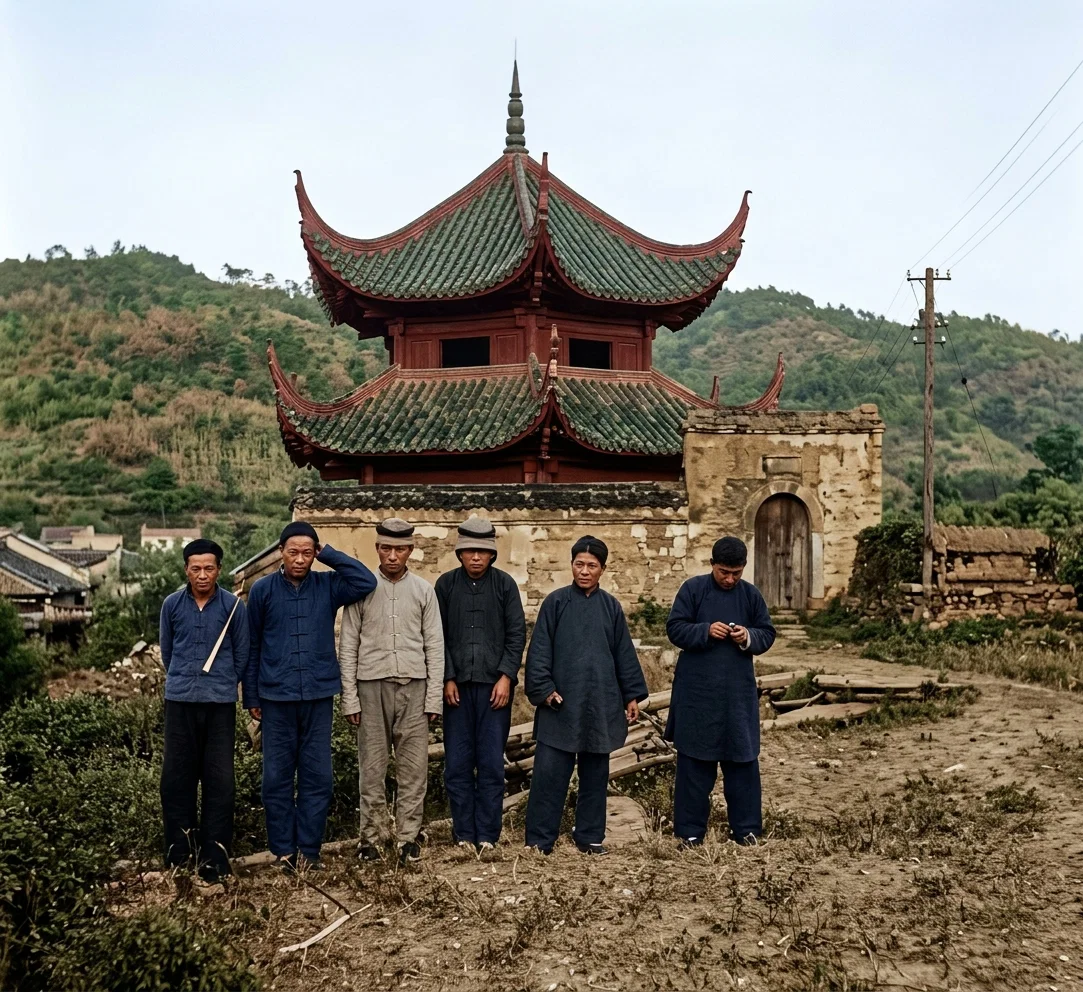
SIX OUT OF THE FOUR HUNDRED MILLIONS IN CHINA WHO ARE WAITING FOR THE MESSAGE
The visit to the other station, Tsuan Chiu, a fu city about seventy miles up the coast from Amoy, was equally interesting and profitable. This is a large city, representing quite a large district of country. In this city the English Presbyterians have quite large mission interests, and most of our converts came from that mission. They were convinced of the Sabbath truth, and so took their stand with us. A neat little chapel has been rented, and furnishes adequate convenience for all their meetings. It is situated within the walls of the city, and so stands as a light to the entire place. Here, too, there are some eight or ten baptized men. One evangelist is located there, and has charge of the work.
We all felt that both here and at Dogang a church could be organized almost any time, and accordingly it was decided that this step be taken sometime this fall. A small boys’ school is also being carried on at this fu city, largely the results of the efforts of the brethren living there who have children. I was much impressed with the work in this place, and I feel assured that it will spread out into the country and the adjoining villages and towns.
Kulangsu, the island just opposite the city of Amoy, which is the foreign concession, and where our foreign brethren and Elder Keh, with their families, reside, is really the center of our work. Here a church was organized some time ago, and until new churches are formed at the other two stations already mentioned, all the baptized members have their membership here. Regular Sabbath services are held, together with prayer-meetings, in a rented chapel.
Altogether, the work in that province is very promising. A good corps of native helpers has been enlisted in the work. These, from time to time, are called together, for institute work or workers’ meetings. And thus the work is forging on, under the blessing of the Lord, and to his glory.
Canton.
North Brazil Mission
By F. W. Spies
F. W. SPIES
Almost five weeks have passed since I came to Maceio, the capital of the province of Alagoas. About a week ago I visited the small town of Atalaia, about forty-five miles inland, where several Sabbath-keepers reside. There are, in all, twenty-one who are keeping the Sabbath in this province at the present time. But there still needs to be a great work done for nearly all of them. Most of those who have begun the observance of the Sabbath are very poor in every sense of the term. They are, first of all, poor in this world's goods; then they have little or no education. Some of them can not read at all, and the majority of those who do read read very little. Again, the religious education they have received all their lives is of such a confusing character that sacred terms can not suggest to them anything else than16common things. Almost daily in my work here I pass a little rumshop whose owner is pleased to designate his place as “Saint Peter’s Bazaar.” A boat, a street, a square, or anything else may be termed “Espirito Santo,” Holy Spirit. Thus those terms that ought to suggest the highest of spiritual things and relationships are not comprehended by the people, in the confusion which Rome has caused. And, as is natural, the less a people know of the real spirit of the gospel, the more tenaciously they cling to empty forms.
A few days ago “All Souls’ day” was celebrated. Human life is regarded here with astonishing indifference. A man’s life is often taken upon the most trifling pretext. Yet on “All Souls’ day” people are expected to go to the cemeteries to do honor to, and mourn over, the dead. And, as a formerly zealous and well-informed Catholic told me, one must not only go to the cemetery on this day, but he must shed tears over the dead, or he is not considered to do them due honor. How much these people need the true gospel that teaches them to love God and their neighbors, and trust in Jesus and his coming as the ground of their hope! 1 Thess. 4: 13-18.
On my trip to Atalaia, I learned that the capitalists and oppressors of the laborer do not all live in North America. On this trip I had the privilege of visiting the largest sugar and whisky manufacturing plant in the state. It employs many hundreds of men and women. A common wage for men doing ordinary work is twenty-four cents a day, and for women, twelve cents. The living, however, is rather higher here than in some places in the southern provinces. And this is only a sample, as there are many such establishments scattered throughout the province. This also accounts for the abject poverty one meets on all sides. It is not an uncommon thing that a family of from four to eight persons has to live on such a wage as that mentioned.
Our night meetings are still well attended. More than this, a goodly number of persons are interested in the truths presented. Some have confessed this to us, and through those who have acknowledged to us that they are interested, we have learned of others. But here again we see how the people are bound by customs and surroundings. Protestants are generally despised by the Catholics, and are called goats. I have not been able to learn how this term originated, or what it is really supposed to imply. Many are convinced of the truth, but to obey it means not only the turning of one’s back upon the Catholic Church, but upon all one’s friends and relatives. The one who does this stands suddenly alone; and not only that, but it is with difficulty that he can find employment.
But as we present the truth, we see that it is influencing the lives of those who hear it; and our trust is in the Lord, for we know that his word does not return to him empty, but accomplishes that to which it is sent.