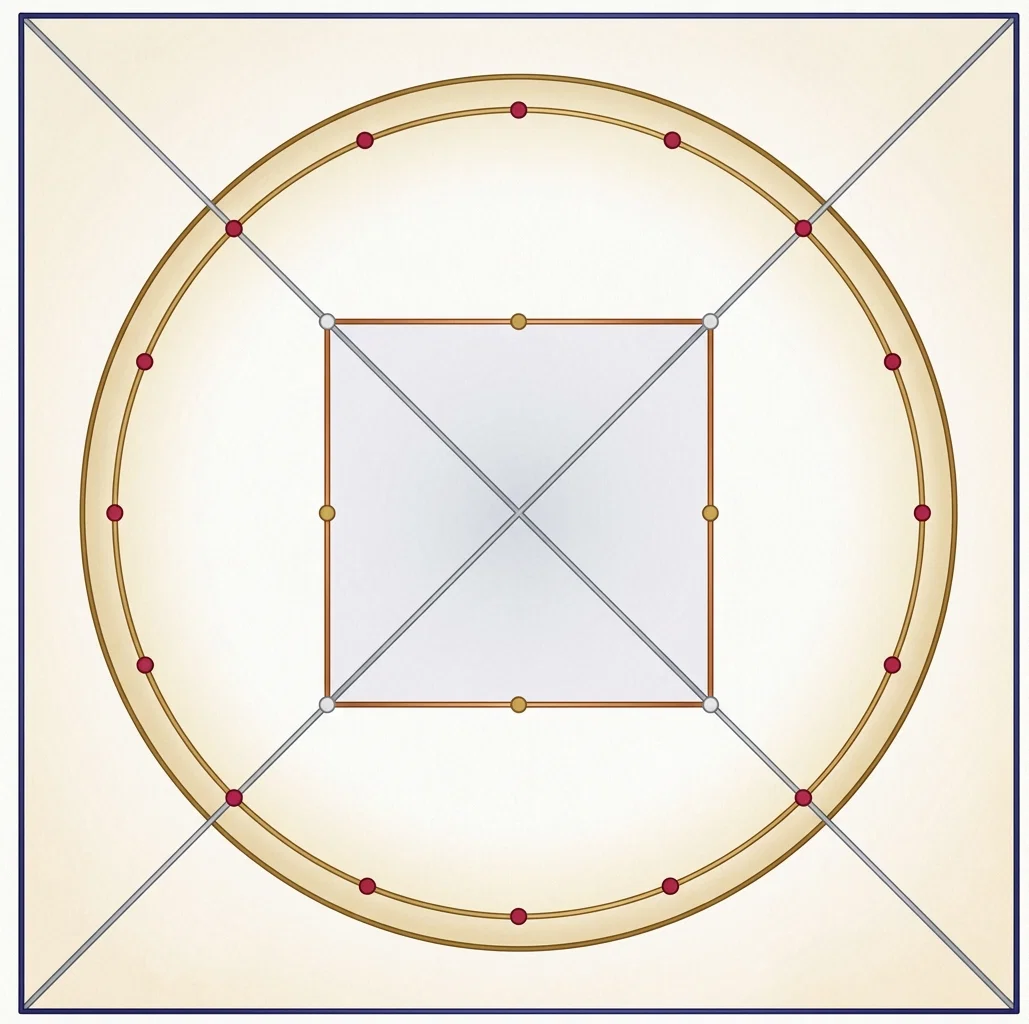
This is a toothpick holder. With a radius of two inches, draw a circle in the center of the paper. Make a point in the center of each side of the paper. Place the ruler across opposite points each way, and make points in the circle where the ruler crosses it, thus quartering the circle. Connect these four points. This square is the bottom of the holder. Place the ruler across the diagonals, as in finding the center, and make a point in the center of each side of the square. Prick these four points. Connect each corner of the square with the nearest two corners of the paper. Cut out the parts marked x. Fold the corners of the paper back so that the tip of each corner just touches the pricked point below it. Mark the places for tying, then fold the lines as usual. Lace the corners, and tie at the top.
MODEL NO. 19
Model No. 20
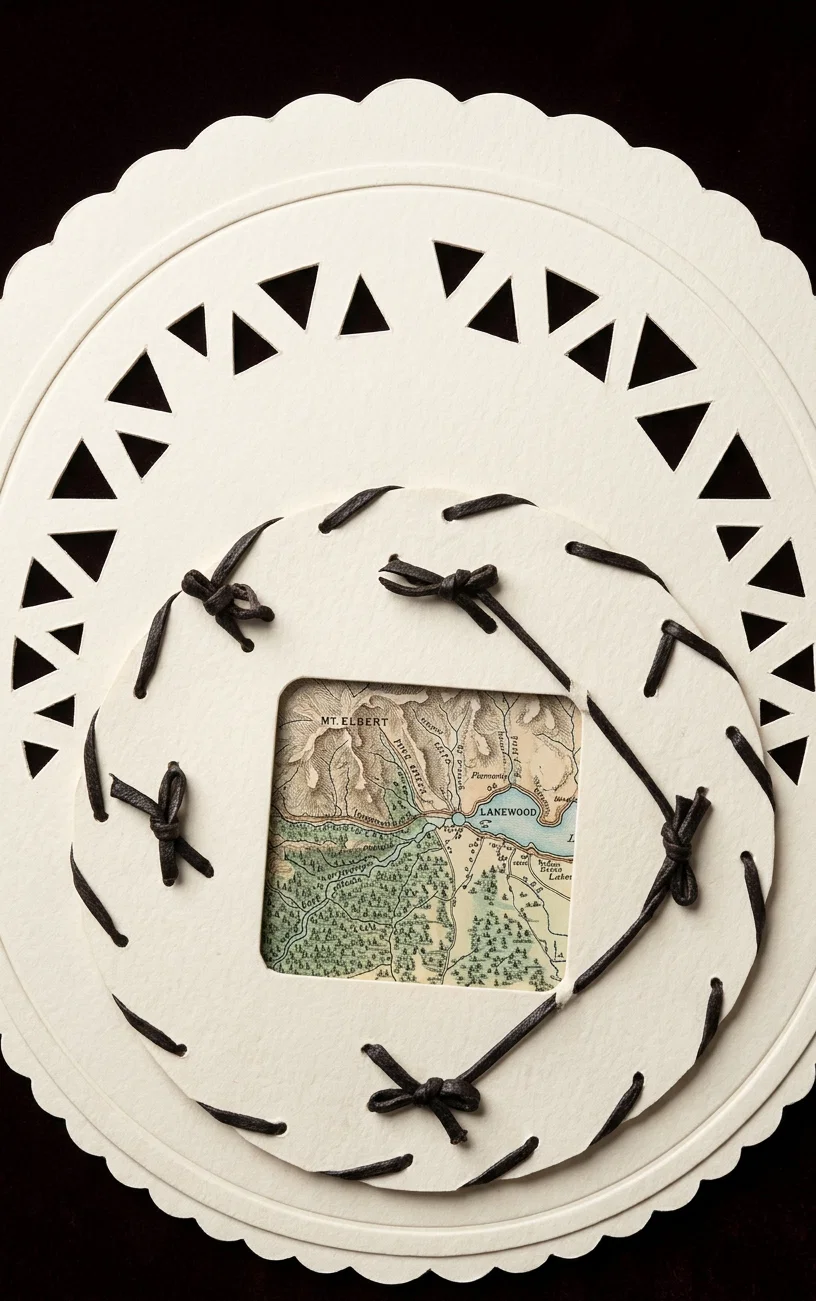
This is a picture frame. A and b show different ways of finishing. For the drawing for the frame (Fig. 2), draw two diagonal lines. Make points on these lines three and one-half inches from each corner of the paper. Connect these six points. This square outlines the opening26
for the picture. Draw two circles, one with a radius of three and one-fourth inches, the other three and one-half inches. With a radius of one and one-fourth inches, place the point of the compasses in turn at each of the points where the inner circle is crossed by the diagonal lines, and make a point each side of each line. Locate the point in the center of the wide space left at each side of the circle by using the same radius and four of the points just made, or by placing a point in the center of each side of the paper, and placing the ruler across opposite points each way.
MODEL NO. 20 (a)
Including the points made by the diagonal lines, you now have sixteen points on the circle. Pierce each of these with a pin so that it may be readily found on the under side of the paper. Place your drawing on a piece of cardboard or heavy paper, and with a sharp-pointed knife cut both diagonal lines through the length of the square in the center. Cut out the large circle.
To make a, fold the lines of the square, turning the triangular sides over upon the upper side of the paper, and folding down flat. To make b, turn the triangular sides over onto the under side of the paper. Do not fold; simply roll each over, and tie near the corner, right through the frame, making a small bow of the yarn or ribbon used for tying. The under side of the drawing is used for the right side of the frame, to avoid having lines on the outside.
To provide a place for the picture, as well as for strength, the frame must have a back. A sheet of the drawing-paper will suffice for this. Draw on it the two diagonal lines. Make a point on each two and three-fourths inches from the upper corners, and connect with straight line (Fig. 3). Cut this line with a knife in the same way that the diagonal lines through the square were cut. Through this slit in the back, the picture may be inserted after the frame is finished. Now place the back upon the table with the lines up. Place the frame which
you have cut out, upon the back, with the lines down. Locate it in the center by having the diagonal lines of the back fit into the square opening of the frame. Secure it in this position with a touch of paste under the four sides just at the edge of frame, so as not to interfere with the picture. Wait until dry, then cut the back to fit the frame.
If you have a small conductor's punch, use it at each pin-prick around the circle. If not, enlarge the perforations by passing a darning-needle through each. To finish as in a, thread your needle with about two yards of yarn or ribbon, and pass through each perforation, going around first forward and then backward. For b, work around in one direction only. Attach ribbon for hanging.
MODEL NO. 20 (b)
Model No. 21
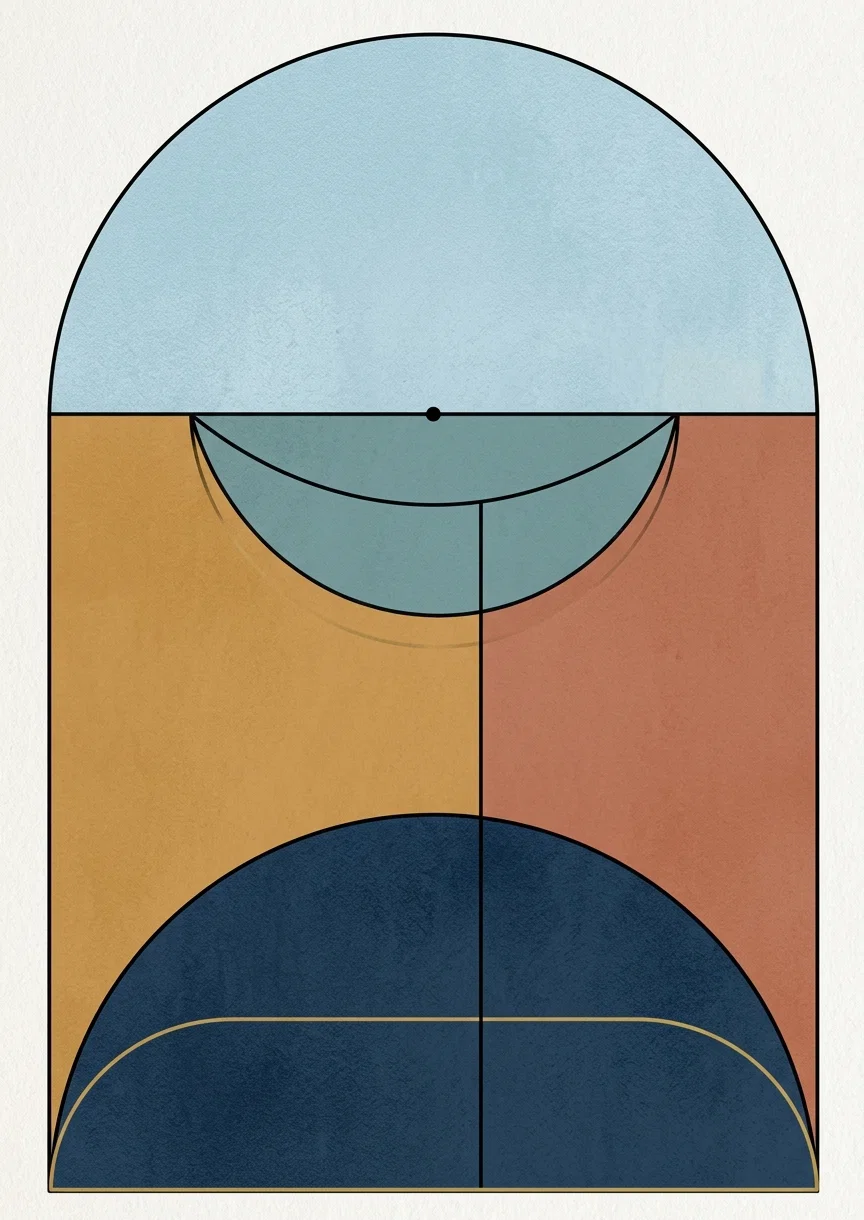
This is an envelope designed to hold the set of drawings just completed. It is nine inches square. For this envelope you will need a sheet of heavy paper, fifteen and one-half inches wide, and nineteen long. With one of the long sides of the paper toward you, make a point five inches from each corner on the upper and lower edges. Connect these points as shown. Make a point on each of the short edges two inches from the lower corners, and four and one-half inches from the upper corners. Connect as shown. One fourth of an inch above the lower line, make a point on each side of the paper, and draw a slanting line from each to the nearest point where the lower line is crossed by an upright one. Make a point on the upper and lower lines exactly in the center between the upright lines. Place the ruler across these points, and make a point one inch below the upper edge of the paper. Make a point on the lower line two inches from each of the upright lines, measuring toward the center. With a radius of two inches, place the point of the compasses in turn at each of the last two points, and draw the curved corners of the lower flap.
FIGURE 2
With a radius of four and one-half inches, place the point of the compasses at the point in the center of the upper line, and draw half a circle above the line. Be sure to have the half circle begin and end exactly at the intersection of the lines, as shown above. Cut away the parts marked x; also cut the slanting lines. Fold the upright lines. With a radius of four and one-half inches, place the point of the compasses at the point one inch below the center of upper edge, and draw a curved line on the folded side flaps of the envelope. Cut this curved line. Paste or glue the folded sides together. Fold the lower flap up over the side flaps and paste. Press until dry, then fold the upper flaps down, and your envelope is ready to receive the drawings.
Model No. 22
This shows another size and style of envelope made from a sheet of paper the same size as was used for the previous one. The finished envelope is seven inches wide and eleven and one-half inches long. It is sometimes called a portfolio, and is very convenient for class papers. The side flaps are two inches wide, and have a slant everywhere of one inch. The upper flap is five and one-fourth inches deep, and also has a one-inch slant. The lower flap is six and three-fourths inches deep, and has a side slant of one-fourth inch. Fold the lower flap up; then fold and paste the side flaps.
FIGURE 3
The work which has been given in this and preceding articles will, if properly27handled, prove a valuable aid in primary teaching. It is a never-failing source of interest to the children, and while they are delighted with the pleasing objects which a little patient effort has enabled them to make, the teacher is not only gratified, but her work is made lighter by the more lasting results apparent in improved neatness and accuracy in every line of work.
Of course it is not necessary to follow this or any other set course of models. After a little experience many practical things will suggest themselves, and each teacher should study to adapt the work to the needs of her own pupils.
MRS. E. M. LONG.
A Few Thoughts on the Progress of Education
By IDA FISCHER-CARNAHAN.
In order to view this important subject with a mind free from all prejudice, it is necessary to take a few steps backward, and glance over the pages of history, noting the rise and progress of this subject, which forms a foundation for all civilized governments. As we study the subject of education in Babylon, Egypt, Greece, Rome, and other countries, we can not help comparing their educational systems with those of the present time.
Babylon, which stood from about 606 to 538 B. C., traced her education and civilization to the Accad, ‘highlanders who came from the mountainous region of Elam on the east.’ Her youth were educated in the sciences and arts of the times; her system of education consisted principally in writing, composition, literature, and, during the seventh and eighth centuries, because of increasing trade with other nations some thought was given to mathematics.
Egypt boasted an educational system which not only educated the lower classes, and fitted them for the same positions as the wealthy; but her women enjoyed the same privileges, and occupied government positions.
The Greeks were the first to develop education into a science, although at first divided into two parts, classed under music and gymnastics; the former including all that was mental, the latter the physical. Under Socrates rapid strides were made in education, the highest efforts of the teachers during that time being in the direction of stimulating a craving for the unknown, and also to cause their pupils to be dissatisfied with opinions received, and at the same time to excite a curiosity over each successive mystery, which grew stronger and stronger with its revelation.
Rome knew no educational system save in oratory. According to their idea, each man was born a commander. Cicero took the position that a man could acquire enough education in one day to fit him for responsible positions in the government, but to become an orator, required a life-time.
As we come down to the first centuries after Christ, we find that ‘the literary education of the earliest generation of Christians was obtained in pagan schools, — those great imperial academies which existed even down to the fifth century, and which flourished in Europe, Asia, and Africa.’ The first attempt in providing an education for Christians was made at Alexandria, associated with Clement and Origen.
During the Middle Ages, education was found either in cloister or castle, the former making the monk, the latter the knight. Each fell short of that broad system which brings all the faculties where they can be developed for the best good of the individual and of his fellow men. All educators recognize the fact that there is something wrong in a system of education that fails to bring to the surface the best there is in an individual.
We do not forget the fact, but give due credit to the work done in keeping alive the ‘torch of learning,’ — work which was conducted in the monasteries of Monte Cassino, Fulda, and Tours; nevertheless we also recognize the fact that the discipline was severe, and they possessed a continual round of ceremonies, which implanted within the heart of the student a hatred of learning, bringing in a spirit of antagonism between teacher and pupil, and establishing a belief that no training can be ‘effectual which is not repulsive and severe.’ At the same time the education in the castles, while it taught the youth willing obedience and hardihood, simply taught the exercise of the physical powers, and left the mental powers dormant.
With the Reformation these forms of education disappeared, and in their place a system was developed which has brought light to the homes of millions. At the end of the twelfth century, universities began to spring up, and Bologna boasted of twelve thousand students of law. Salerno was set apart for the study of medicine, and Paris was thronged with students from all parts of Europe, anxious to devote themselves to a study of theology. During the fifteenth and sixteenth centuries, all Europe seemed to awaken from the sleep of ignorance, and arose to meet the needs of the time in providing universities for ambitious youths. Time and space will not permit of our dwelling long upon the rise of education during this period; but when we are brought face to face in history with the work of such educators as Erasmus, Luther, Melanchthon, and the three theoretical and practical teachers, Sturm, Ratke, and Comenius, whose influence is still felt in educational circles, we can not fail to see the advance which education has made. The principles which these men have introduced were the forerunners of the same line of thought which Pestalozzi, Froebel, and Spencer placed before the public.
IDA FISCHER-CARNAHAN.
_Opening Exercises That Count for Good_
By E. C. JAEGER
ONE of the chief duties of a Christian school is to inspire its youth with a missionary zeal, and then to see that that zeal does not retrograde. To be a missionary should be the highest ideal of every child. It will work wonders for him, give joy to his parents, and the spirit he has will help to put new life into the lifeless Sabbath-school.
The opening exercises can be turned to good account in cultivating this missionary idea. If the exercises are conducted according to the plan outlined in this article, they will never savor of routine, and because of their simplicity will lighten materially the teacher's burdens.
There is no class of biography more interesting than that which deals with our great missionaries. I have yet to see the child whose heart will not be thrilled and his whole being fired at hearing the story of the life of John G. Paton, or the history of the Boxer movement in China. Whether the children have read little or much, whether their reading has been of cheap fiction or of the choicest literature, they will all give closest attention.
As a basis for work in this line the book “Into All the World,” by Amos R. Wells (Review and Herald, 50 cents), is excellent. The biographical sketches are just about the right length, and contain the life incidents which will make a lasting impression on the memory. The work will not only be a source of education to the pupils, but also to teachers. Each morning after the song, read, or, still better, tell an account of the life of these notable men who dared for God. The study of these biographies should be preceded by a short geographical study of the mission field, and a fair-sized outline map should be placed upon the board. Beneath the map may be placed some of the most prominent facts or figures concerning the field. For instance, under the map of India we might place:—
About one half as large as the United States.
Population, 294,266,701.
Ruled by England.
300 distinct languages.
Two thirds of its people are Hindus.
60,000,000 Mohammedans
As each life is studied, the name of the missionary should be printed on the map over the portion of country where he labored. Have the pupils fix in mind some notable fact or saying connected with each name; as Carey, “the consecrated cobbler;” Heber, author of “From Greenland's Icy Mountains,” etc. Each morning give a hurried drill of these. As you point to the names on the map, let the children recite these facts.
If, like Heber, any of these missionaries have written a hymn, the children will delight to sing the hymn and memorize it. The map should remain on the board until the study of that field is finished, and then be copied in a note-book to be preserved. This device is a tried one, and in no sense a theory. After you have tried it, you will see that it brings results.
Only the most prominent missionaries' lives should be considered. Do not forget to mention where our own missions are located. (See “Outline of Mission Fields,” which can be secured gratis from our Mission Board.) Since the lives of these “apostles to the heathen” are so varied as to incidents mentioned, the children's interest never abates, and the course can extend over several months.
E. C. JAEGER.
Reviews
IN the prosecution of study by any class of students, frequent reviews are necessary. This is so, because the memory is very much aided by repetition and by association. But further, the understanding is often very much improved by a review. Many of the sciences can not be presented in independent parts, nor can all the terms employed be fully appreciated till these parts are again viewed as a whole. Many things which were but dimly seen the first time they were passed over, become perfectly clear to the mind when viewed afterward in connection with what follows them.
In conducting reviews, regard must be had to the age and character of the pupils, and to the branch pursued. In arithmetic, and indeed in mathematics generally, where so much depends upon every link in the great chain, very frequent reviews are necessary. Indeed almost daily it is profitable to call up some principle before gone over. In several branches, where the parts have a less intimate connection, as in geography, natural philosophy, and some others, the review may be at greater intervals. It would be well, I think, in every common school, to have a review day once a week. This, besides the advantages already indicated, will lead the children to study for something beyond the recitation. Nor is it enough, at the review that the questions of the text-book be again proposed to the children. If this be all, they will only exercise their memories. As far as possible the subject should be called up, and the application of principles to practical life should be dwelt upon. If this course is expected by the learners, they will think during the week, in order to anticipate the examination of the teacher; and this thinking is more profitable to them than the knowledge itself.
It is always well, besides the periodical reviews, to have a general review at the close of any particular study. This enables the teacher to detect any false conceptions which the pupil has entertained during the first course. He can now present the subject as a whole, and view one part by the light of another. In natural philosophy, how much better the law of reflected motion can be appreciated after the subject of optics has been studied, in which the doctrine of reflection in general has been fully discussed and illustrated. In physiology, what light is thrown upon the process of growth in the system, by the subsequent chapters on absorption and secretion. How much clearer is the economy of respiration understood when viewed in connection with the circulation of the blood. A general review then is an enlightening process, and it is always profitable, with, perhaps, one exception. When it is instituted with reference to a public examination, it is very doubtful whether the evil is not greater than the good. It then degenerates into an effort to appear well at a particular time; it is again studying in order to recite; and I look upon it as no small evil, that the mind should have any object in view which comes in between it and the grand desire to know,—to master the subject for its own sake, and not simply for the purpose of being able to talk about it on one great occasion.—Selected.
Our Schools
By E. H. WILBUR
Educational Work in Canton, China
WE have watched with deep interest the progress of our educational work in all the world, and are glad to report that we see the same encouraging omens in the work at Canton. Our schools this year have had a larger enrolment than ever before, and have been doing a higher grade of work. The study of the Bible has been given first place, and is bearing fruit to the glory of God.
The Bethel Girls’ School
The Bethel Girls’ School, which was opened in the spring of 1903, in a small room in the southern suburb of Canton, has, under the untiring labors of Miss Ida Thompson, continued to increase in attendance and interest. During the first half of 1908, the enrolment was about seventy. We now have our own building. With the help of the Wisconsin Conference and the Mission Board, a property was purchased from the Baptist Mission. This place was formerly occupied by them as a boys’ boarding-school. Thus far most of the students board and room at their own homes, but a few from a distance have been received into the school building on the payment of two dollars Mexican a month. This may seem to our American brethren like a small school fee, being less than one dollar in gold a month for board, room, and tuition. Yet, I am told, this nearly covers the cost of plain board. It must28be remembered that education for girls is practically a new thing in China. The middle and poorer classes, and, in fact, many people of all classes, do not as yet realize this need as they should. Well-to-do families, who wish to educate their girls, usually employ a private teacher. As a class these people are unfavorable to mission schools. Notwithstanding these facts, mission schools for girls in China are generally quite well patronized, and the same has been true of our schools for girls at Canton. For some reasons it is very desirable to have girls board in the school building, or confined, as this brings them more fully under the supervision of the one in charge, and the girls thereby receive a training that they would not get otherwise. Then, too, they are kept away from the idolatrous influence of their homes, and this means much. Some of our brethren and sisters in America have paid for scholarships in this school, thereby enabling poor girls and women to learn the gospel. Eternity alone will reveal the fruit of these gifts. May the Lord impress others also to have a part in this work.
Many of the readers of the REVIEW have heard of the terrific typhoon in Canton, on the morning of July 28, 1908, which caused great loss of life and property. One end of the Bethel School building was badly damaged by this storm; but fortunately Miss Thompson saw the danger, and she and her helpers escaped from that part of the building before the roof and walls fell in. Later Miss Thompson was stricken down with serious illness, but after several weeks of careful nursing, at a hospital on the mountain top at Hongkong, she was again restored to health. On this account the school was about six weeks later than usual in opening for the fall term; but when Miss Thompson took up her work again, about forty girls had enrolled, and others had sent word that they were coming. Four girls from this school have already been baptized and taken into the church. Still others are awaiting baptism.
The East Gate School
In March, 1907, a girls’ school was opened outside the east gate, in a good residence district. Miss Amanda Van Scoy has had charge of this work. The rooms are very small, but about thirty girls have been in regular attendance this year. All the girls spend a part of each day in the study of the Bible, and meet for Sabbath-school in the school-room.
The Boys’ School
In August, 1904, we opened our boys’ school in Canton. We planned to have the school hours about equally divided between the English and Chinese languages. A tuition fee of two dollars (Mexican) a month, was charged for English. For various reasons we found it difficult to get students for the Chinese department. Beginning with March, 1907, we employed a more experienced teacher for this department. Brother G. D. Wong, who had recently returned from America, had charge of the English division. The average attendance was only about twenty, but good work was done. Though the attendance was small, I was much encouraged, as I saw that after all our struggles we were really succeeding in establishing a Seventh-day Adventist boys’ school in the Chinese language. This year the same teacher has been retained in the Chinese division, but the time for the study of English has been cut down to one hour a day. As was expected, this change has not had a tendency to increase the enrolment. But I think the crisis is now past, and I am encouraged to see that we are gradually getting into our school a class of students who are regular in attendance at church services, and who are more inclined to learn the gospel.
The Bible School
In connection with the boys’ school, we have a Bible school. About half a dozen boys are in attendance in this class. It is made up of young men who have previously spent several years in school, and already have a good knowledge of the Bible. They join this class to learn Bible doctrines, and to fit themselves for a part in the work. In the past three years nine young men from this class have been baptized and taken into the church. Several of these are now engaged in the work as teachers, evangelists, canvassers, etc.
At our general meeting in Shanghai, in February, 1907, it was voted to ask the Mission Board to send us a good teacher and his wife to locate in Canton. Next to the call for a treasurer, this was really one of the most pressing calls that we had, and I regret to say that as yet no one has been sent to take up this work. Since our removal to Kongmoon in July, 1907, the work of Bible instruction in the Bible school has fallen principally upon Elder J. N. Anderson, and the general work frequently calls him from Canton. Brother J. P. Anderson lives in the boys’ school, and has a general oversight of the work. But thus far he is the only European laborer in our mission who has made preparation for the Hakka field, and should be released to give his time more directly to that work. We need a man who has had experience as superintendent of an academy or training-school, and who can help the teachers to plan for a good course of study, and otherwise thoroughly establish and strengthen this important branch of the work.
E. H. WILBUR,
Chairman Canton Educational Com.
Trampling on the Mind
O, woe to those who trample on the mind,
That wondrous thing! They know not what they do,
Nor what they deal with. Man, perchance, may bind
The flower his step hath bruised; or light anew
The torch he quenches; or to music wind
Again the lyre-string from his touch that flew;—
But for the soul, O, tremble and beware
To lay rude hands upon God's mysteries there!
— Selected.
The Closing Exercises of Bethel (Wis.) Academy
By A. W. Spaulding
BETHEL ACADEMY has its school year correspond with the agricultural year; that is, the school year opens in the spring, continues through the summer, and closes with the fall term in December. There is an extra term in the winter, in which also regular school work is done.
The closing exercises for the academy for the year 1908 were held in the Bethel church Sunday evening, December 20. The program rendered by the students was designed to emphasize the nature and importance of different parts of the message God has given this people,—a message which it has been the endeavor of the school to put into the lives of its students. God's purpose in giving us truth; how far we have spread it over the world; our responsibility as Christians in social life,—these were some of the topics treated. We believe that every one in the school has felt, to a greater or less degree, the impulsion represented in the focus of the decorative design that night,—a lance and a white shield bearing the motto, “God Sends.”
Following is the program:—
Organ Voluntary.
Prayer.
Remarks by the Principal.
Address: “Why God Gives Us Truth.”
Girls’ Chorus: “Stars O’erhead Are Softly Gleaming.”
Talk: “The Progress of the Message.”
Male Quartet: “Lord, I’m Coming Home.”
Paper: “God’s Purpose in Discipline.”
Ladies’ Quartet: “We Are Going Down the Valley.”
Dialogue: “The Relation of Diet to Life.”
Violin Solo: “Silent Watchers.”
Paper: “Dressing for Health.”
Talk: “God’s Word about Dress.”
Vocal Duet: “Rock of Ages.”
Address: “The Social Life of the Christian.”
Vocal Solo (with humming accompaniment by Girls’ Chorus): “Through the Shadows.”
Benediction.
We have had a good experience this fall, full of hard things, putting to the stretch all our energies. During the winter term, which is an extra session of the school, there is promised a very full attendance. We have planned our school homes to take no more than twenty-two or twenty-three each; for we wish to keep the home atmosphere. Thus the limit of attendance, aside from local students, is about forty-five. At present we are holding school in “The Castle,” the two-storied, tar-paper-covered structure which was erected on a part of the ruins, just after the fire, for a girls’ home the first year.
Next spring we shall begin the erection of our main school building, a block cement structure forty by forty-eight feet, which will contain the chapel and six class rooms, besides offices and cloakrooms. Now, while the sleighing is good, we are hauling sand from the river; we shall make the blocks in a steam-heated building during the winter, and shall begin the erection of the building as soon as the spring opens. We expect to complete it during the summer, so as to have it ready for occupancy at the beginning of the fall term. It has been proved, however, that a school does not consist of buildings, but rather of a company of teachers and students filled with a purpose to be fitted for the greatest possible usefulness in the cause of God. For such a fitting we are earnestly seeking, and in that work we are finding comfort and progress.
A. W. SPAULDING.
The Friedensau (Germany) Mission School
By Melita Trieger
At present there are one hundred thirty-six pupils here, an equal number of young men and young women. The following nationalities are represented: German, Dutch, Russian, Estonian, Finnish, German-Russian, Rumanian, Austrian, Hungarian, Servian, Slovakian, Polish, Norwegian, Italian, and Swiss; there are also representatives from Brazil and Argentina. So you see we have a cosmopolitan student body. Among these, sixty-nine Bible workers and sixty-seven nurses will finish29their courses of study in two years.
Brother G. W. Schubert, who is now president of our union field, takes a great interest in our school, and has inspected all the classes; in his report he expressed satisfaction with what he has seen and heard. He says that it is no easy task for the teachers to instruct the pupils of so many different nationalities.
At the last conference it was resolved to build another schoolhouse, as the present one is too small for so many. The building is rising rapidly. It will soon be roofed, and if the Lord pleases, it will be habitable by next June. It will contain four class-rooms and three other rooms, two of which will be arranged so they can be converted into one, to serve as a reading-room. We shall also arrange a museum and library. We are looking forward to the completion of this building, for the four class-rooms to which we are now confined are no longer sufficient for the number of pupils and subjects to be taught. Since the beginning of the new term the Greek language is forming one of the subjects, and will henceforth be a permanent one.
In our teachers' meetings, which are held once a week, at first we studied general questions of education, but for the last six months we have dwelt upon each of our branches of education from the methodical point of view. Thanks to the Lord, practical results have come from our studies. Our interest is now directed to the book “Education,” and at our last meeting we decided to refer to it in all the branches we may consider, so that its spirit may pervade all our instruction; we shall thus in truth be co-operating with our American brethren in the advancement of our Lord’s great message.