A LATE issue of the Christian Statesman contains an article by the Rev. R. C. Wylie, D. D., which sums up the argument for the necessity of Sunday legislation by saying:—
We can not maintain our free government without our Christian civilization; our civilization can not be preserved without the Christian religion; the Christian religion can not be perpetuated without the Christian church; the Christian church goes down without the Christian sabbath; the Christian sabbath needs the protection of law; the law needs a clearly expressed constitutional basis on which to rest.
Here are laid down certain premises, from which a conclusion logically follows. The Christian religion, Mr. Wylie says, depends on the Christian church; the Christian church depends on the Christian sabbath; and that in turn “needs the protection of law.” Without this “protection” the Sabbath is lost, it is argued; and when the Sabbath goes down, the church goes down; and when the church goes down, the Christian religion goes down. Conclusion: Without the Sunday law the Christian religion would go down; the Christian religion depends on the Sunday law. This is not only a perfectly fair conclusion, but the only one that can logically be drawn from Mr. Wylie’s statements.
And this shows what the trouble is with Mr. Wylie and all those who so earnestly contend for legislation to uphold the Sabbath. They have not a sufficiently high conception of Christianity. They need to learn more about the power of God unto salvation.
L. A. S
A Heart Song
Out of my heart I sing a song,
O world so great and grand!
But hearts are weak, and hands reach out
For the touch of a kindly hand.
O song that I sing, I pray you bring
To some sad soul its balm;
Fall soft, I pray, like the breath of May,
Or the touch of a loving hand.
I sing for hearts that ache and break,
I sing for the hearts that are true;
O world so vast, O world so wide,
I sing my song for you.
— Selected.
“Hold Fast That Which Is Good”
By Ellen G. White
MRS. E. G. WHITE
From Sinai, in awful grandeur, God proclaimed his law to Israel, that they might realize the high standard to which they were to attain. He presented to them the beauty and safety of obedience, declaring that only through obedience could they find peace and prosperity. He portrayed also the sure results of disobedience to his law. We who live in this period of the earth’s history see the fulfilment of his warnings to Israel. In the stormy scenes taking place in our world, we see the result of the transgressions of God’s law.
“Now therefore hearken, O Israel, unto the statutes and unto the judgments, which I teach you, for to do them, that ye may live, and go in and possess the land which the Lord God of your fathers giveth you. Ye shall not add unto the word which I command you, neither shall ye diminish aught from it, that ye may keep the commandments of the Lord your God which I command you. Your eyes have seen what the Lord did because of Baal-peor: for all the men that followed Baal-peor, the Lord thy God hath destroyed them from among you. But ye that did cleave unto the Lord your God are alive every one of you this day.”
It was in mercy that the Lord destroyed those who had been led away by Baal-peor. Had they been permitted to live, their influence would have corrupted the whole congregation of Israel. The judgment that came on them was a warning to others not to disregard the honor and glory of God. Often the Lord speaks in judgment to repress iniquity. He sees and rebukes the sins of those who disobey his laws, but he shows mercy to those who obey him. When their own inclinations would lead them into danger, he withholds from them that which they desire.
God chose Israel to be his own people, that, by adhering closely to his commandments, they might be to the world an illustration of the beauty of character, the moral power, and the virtue that might be attained through fearing and honoring him. He desired also to reveal through them the advantages that would come to those who, as his true sons and daughters, would walk in harmony with the principles of his law. In his dealing with men, God has often demonstrated that through the virtue obtained by obedience to the laws of heaven, human beings may gain a beauty of character that will fit them to be laborers together with him.
Purity of character will be distinctly revealed by all who truly follow Christ. In them will be seen the fulfilment of the promise, “I will be as the dew unto Israel: he shall grow as the lily, and cast forth his roots as Lebanon.” The psalmist thus describes the beauty and growth of the Christian: “The righteous shall flourish like the palm tree: he shall grow like a cedar in Lebanon. Those that be planted in the house of the Lord shall flourish in the courts of our God. They shall still bring forth fruit in old age; they shall be fat and flourishing; to show that the Lord is upright: he is my rock, and there is no unrighteousness in him.”
Striking its roots deep down into the earth, the tree gains strength to withstand the tempest. So the Christian is to be “rooted and grounded” in the truth, that he may stand firm against the temptations of the enemy. He must have a continual renewal of strength, and he must hold firmly to Bible truth. Fables of every kind will be brought in to seduce the believer from his allegiance to God, but he is to look up, believe in God, and stand firmly rooted and grounded in the truth.
Keep a firm hold upon the Lord Jesus, and never let go. Have firm convictions as to what you believe. Let the truths of God’s Word lead you to devote heart, mind, soul, and strength to the doing of his will. Lay hold resolutely upon a plain, “Thus saith the Lord.” Let your only argument be, “It is written.” Thus we are to contend for the faith once delivered to the saints. That faith has not lost any of its sacred, holy character, however objectionable its opposers may think it to be.
Those who follow their own mind and walk in their own way will form crooked characters. Vain doctrines and subtle sentiments will be introduced with plausible presentations, to deceive, if possible, the very elect. Are church-members building upon the Rock? The storm is coming, the storm that will try every man’s faith, of what sort it is. Believers must now be firmly rooted in Christ, or else they will be led astray by some phase of error. Let your faith be substantiated by the Word of God. Grasp firmly the living testimony of truth. Have faith in Christ as a personal Saviour. He has been and ever will be our Rock of Ages. The testimony of the Spirit of God is true.
Change not your faith for any phase of doctrine, however pleasing it may appear, that will seduce the soul.—
The fallacies of Satan are now being multiplied, and those who swerve from the path of truth will lose their bearings. Having nothing to which to anchor, they will drift from one delusion to another, blown about by the winds of strange doctrines. Satan has come down with great power. Many will be deceived by his miracles. Those who accept his science will be among those to whom Christ addresses the words:—
“These things saith he that hath the seven Spirits of God, and the seven stars; I know thy works, that thou hast a name that thou livest, and art dead. Be watchful, and strengthen the things which remain, that are ready to die: for I have not found thy works perfect before God. Remember therefore how thou hast received and heard, and hold fast, and repent.”
I entreat every one to be clear and firm regarding the certain truths that we have heard and received and advocated. The statements of God’s Word are plain. Plant your feet firmly on the platform of eternal truth. Reject every phase of error, even though it be covered with a semblance of reality, which denies the personality of God and of Christ.
Of the Saviour, John says: “He was in the world, and the world was made by him, and the world knew him not. . . . But as many as received him, to them gave he power to become the sons of God, even to them that believe on his name: which were born, not of blood, nor of the will of the flesh, nor of the will of man, but of God. And the Word was made flesh, and dwelt among us, . . . full of grace and truth.”
Jesus Christ is the Son of God. He was manifest in the flesh. What was his work in this world?—To put away sin by the sacrifice of himself on the cross of Calvary. He was tempted in all points as we are, yet without sin. By his prayers and strong supplications, he overcame. In his human nature, he perfected a character after the divine similitude. By a life of perfect obedience to every requirement of God, he procured redemption for all who will be obedient. The divine nature is imparted to those who receive and acknowledge him as their Saviour. They become partakers of the divine nature, overcoming the assaults of Satan and escaping the corruption that is in the world through lust. Christ energizes by his Spirit those who seek him with the whole heart.
Those who truly receive Christ are given power to become the sons of God. As they look to Jesus, they catch the divine rays of light, and are attracted by the loveliness and purity and goodness of the Saviour. They seek to copy his pleasantness, rather than the harsh violence manifested by those who disregard the laws of God. And as they keep before them the fear of God, and walk as obedient children, others will8mark their Christlikeness of character, and will be drawn to the Saviour by the revelation of their love, their justice, and their mercy. Yet some will refuse to come to the Saviour, choosing darkness rather than light, because their deeds are evil.
Christ and his righteousness,—let this be our platform, the very life of our faith. That which he taught, we are to teach. His commission to his followers is: “Go ye into all the world, and preach the gospel to every creature;” “and, lo, I am with you alway, even unto the end of the world.”
Egypt (Continued)
By M. E. KERN
M. E. KERN
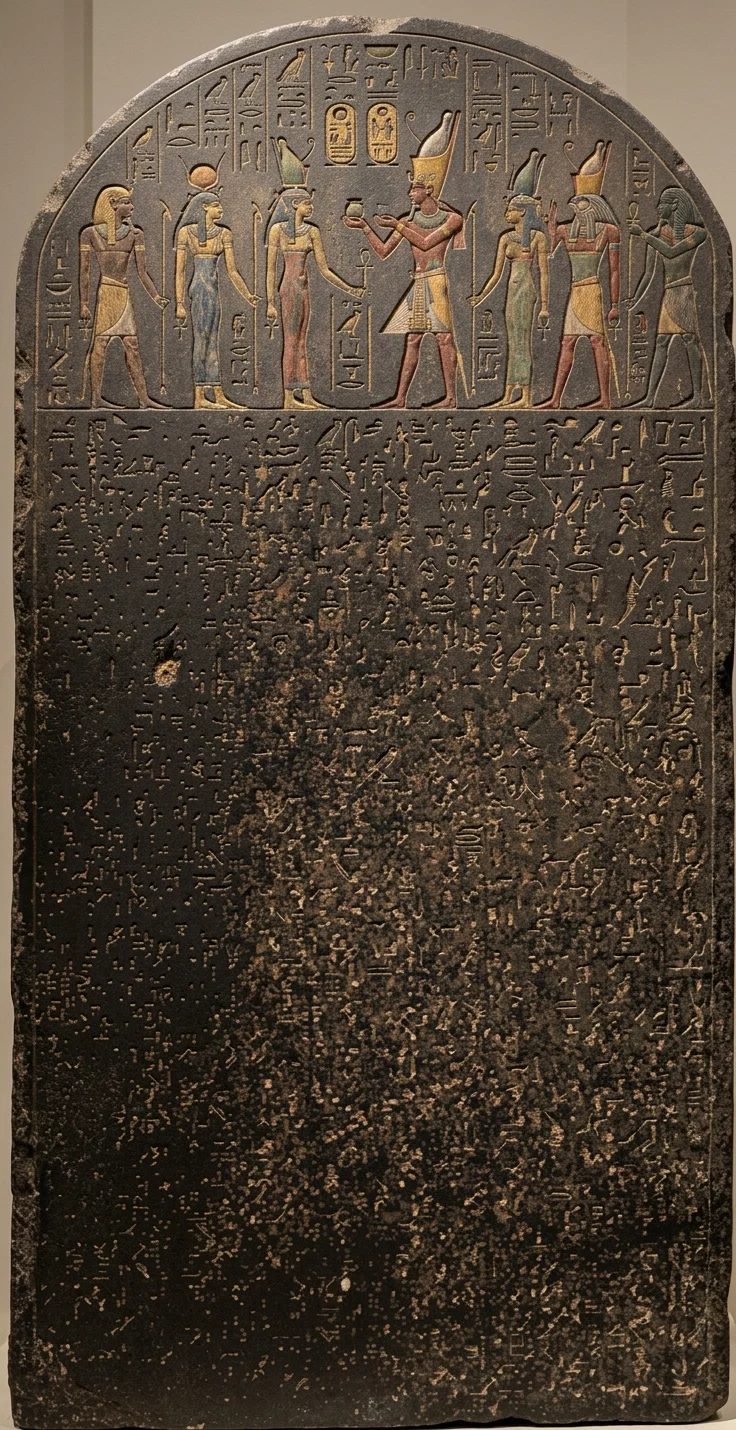
Menephtah’s Hymn of Victory
RAMESES was followed by his son Menephtah. At his accession the Libyans poured into Egypt, and the Greeks threatened the Delta. It seemed for a time that Egypt was lost, but a decisive battle nearly exterminated the invaders. To commemorate the king’s victories a hymn was composed by the court poet. This hymn was discovered by Professor Petrie in 1896.
We would hardly expect to find the name of Israel in the Egyptian inscriptions. Nor would they be apt to record the escape of a whole race of slaves in such a miraculous manner as Israel escaped. But what was not expected has really happened. Israel’s name is mentioned in Menephtah’s hymn of victory. It is in the middle of the second line from the bottom. The inscription reads,—
“Wasted is the land of the Libyans; the land of the Hittites is tranquilized; captive is the land of Canaan and utterly miserable; carried away is the land of Askelon; overpowered is the land of Gezer; the land of Innuam is brought to naught. The Israelites are spoiled so that they have no seed.”
This hymn is supposed to have been written after the exodus, during the period of wandering. Every nation spoken of is localized but Israel. The author seems to know no land to which to assign them. An effort had been made, you will remember, to destroy all the male children of the Hebrews. The author of this hymn seems to boast that this has been accomplished. “The Israelites are spoiled so that they have no seed.”
MENEPHTAH'S HYMN OF VICTORY, IN WHICH THE NAME "ISRAEL" OCCURS
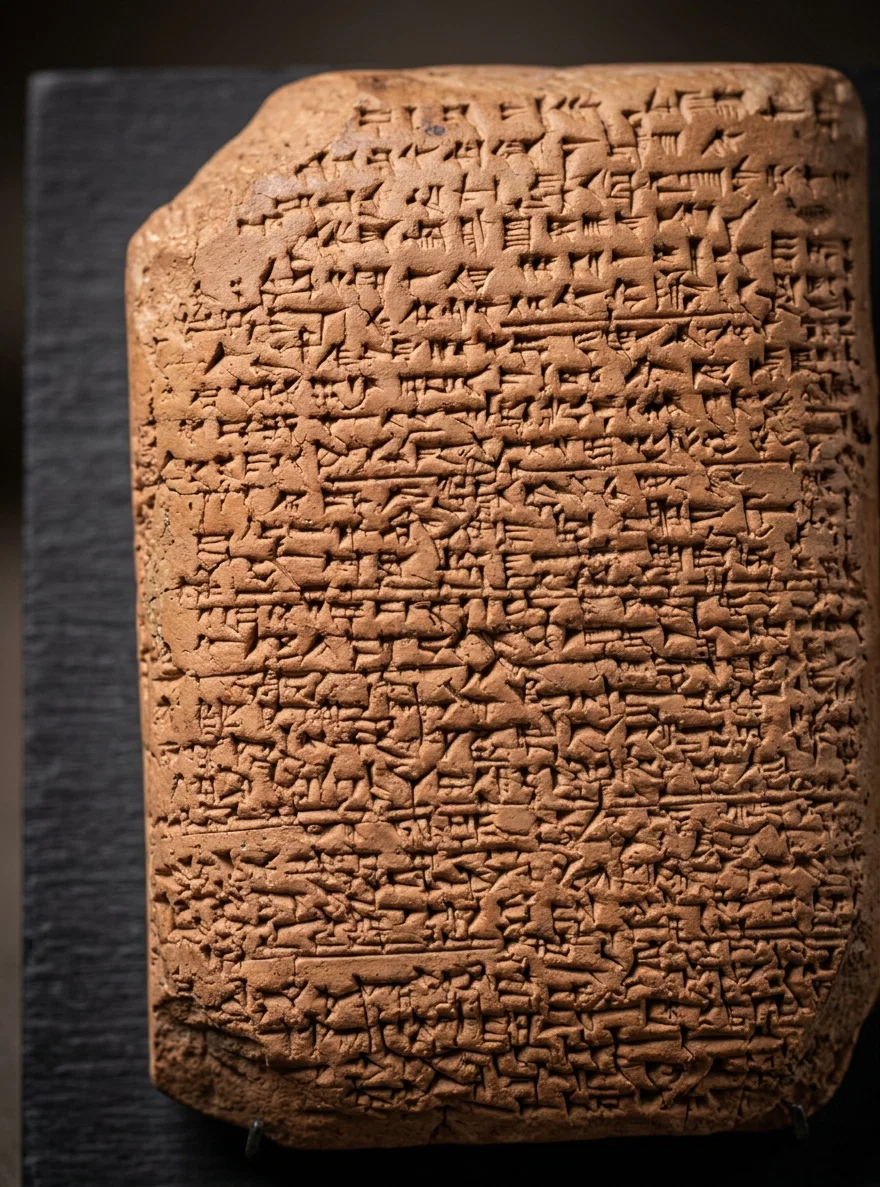
The Tel el-Amarna Letters
One of the most remarkable finds ever made in the East was the discovery in 1887, by a peasant woman at Tel el-Amarna, near Thebes, of over three hundred cuneiform tablets, or letters, written in the wedge-shaped characters of the Babylonian language. These are letters of correspondence between the Asiatic and Egyptian kings of the fifteenth century before Christ. Letters are here from Babylon and Assyria, from the states of western Asia, such as Ashkelon and Phenicia. These letters show that the Babylonian language was the language of diplomacy, just as the French is to-day. They bring to view a method of international correspondence which revolutionizes all our former ideas of this early period. There have been those who tried to prove that Moses could not have written the Pentateuch because the people of that time were illiterate and barbarous. But here is a whole volume of public and private correspondence written before a line of the Bible was composed. There are, among these tablets, letters from Abdi-Hiba, of Urasalim (or Jerusalem), and others which speak of a people called the Habiri, who are making inroads into the country, and imploring aid against them, saying, “If troops are not sent, the king’s land will be lost to the Habiri.” Some good authorities think these Habiri to be the Hebrews, and that the letters were written during the conquest of Joshua.
A TEL EL-AMARNA LETTER. FROM EBIMELECH OF TYRE TO THE KING OF EGYPT.
Sayings of Our Lord
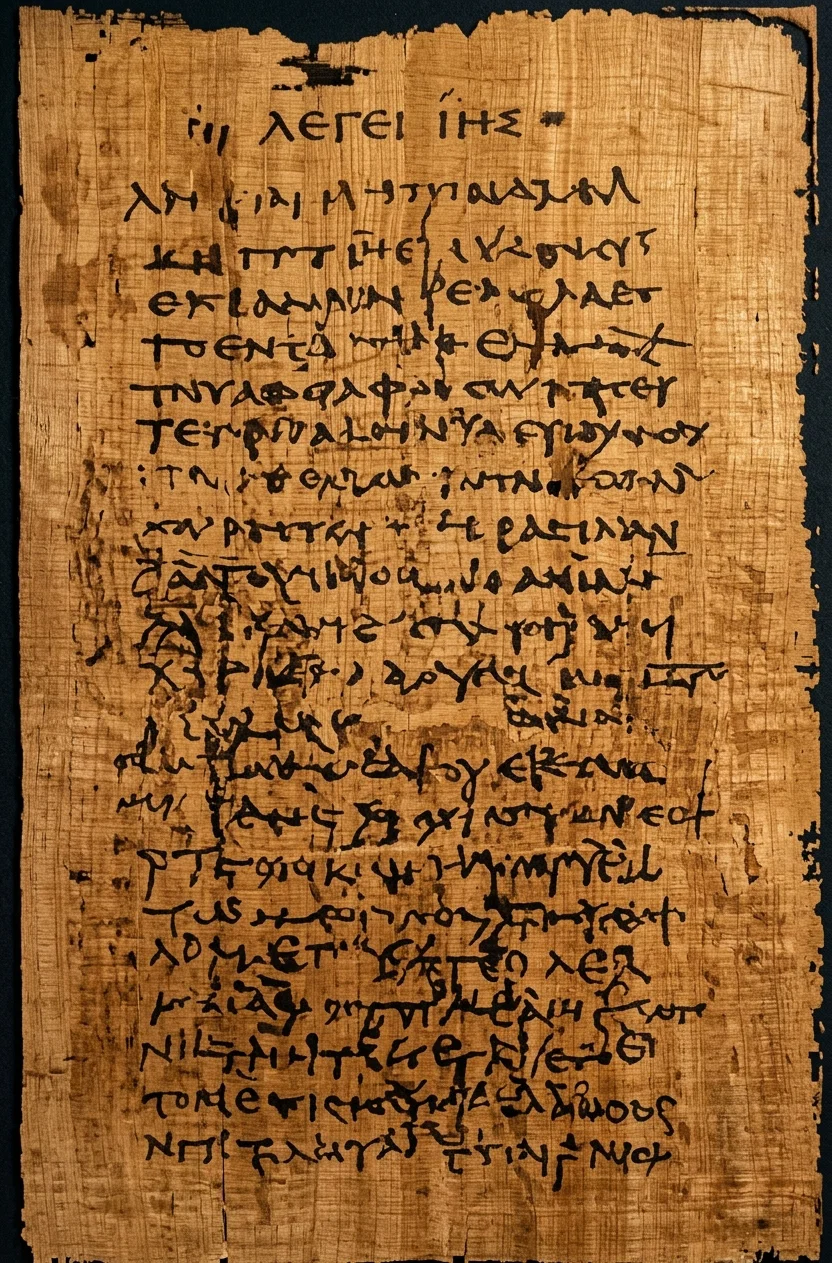
Not only have the excavations in Egypt thrown light on the old empire of Egypt, but they have brought to light many things that have increased our knowledge of the history of the early church, as well as Greco-Roman history. Alexandria was one of the centers of the early church, and there has been considerable Christian literature found in the old libraries attached to the monasteries, in the tombs, and even in rubbish heaps. There has lately been discovered a papyrus containing the Sayings of Our Lord, a picture of one sheet of which is given here. In England when Wycliffe made his translation of the Bible, extracts were published containing sayings of Christ, and many made great sacrifices to purchase them. So it was, probably, in Egypt. The writing, as you see, is in Greek. Two of these sayings are as follows:—
SAYINGS OF OUR LORD. OBVERSE
‘SIDE
“Jesus saith, I stood in the midst of the world, and in the flesh was I seen of them, and I found all men drunken, and none found I athirst among them, and my soul grieved over the sons of men, because they are blind in their hearts.”
“Jesus saith, Except ye fast to the world, ye shall in no wise find the kingdom of God; and except ye keep the Sabbath, ye shall not see the Father.”
College View, Neb.
The Judgment of the Righteous Dead
By J. O. CORLISS
The Final Adjustment of Human Awards—No. 3
The Judgment of the Righteous Dead
J. O. CORLISS
From previous Scripture references, it is clear that all the cases of the righteous are decided before the Lord comes to earth for them. It therefore follows that the tribunal at which their destiny is fixed is not located on earth. The prophet Daniel was favored with a distinct view of the judgment in session, from which we may draw a correct idea of its place of action. Thus he says: “I beheld till the thrones were cast down, and the Ancient of days did sit, whose garment was white as snow, and the hair of his head like the pure wool: his throne was like the fiery flame, and his wheels as burning fire. A fiery stream issued and came forth from before him: thousand thousands ministered unto him, and ten thousand times ten thousand stood before him: the judgment9was set, and the books were opened.” Dan. 7:9, 10.
In this scene Jehovah sits as judge. The millions of attendants ministering to his call are the angels, as explained in Rev. 5:11. The “books” here introduced are those out of which the dead are to be judged, as is made clear in Rev. 20:11, 12. One of these is the “book of life,” in which is written the names of those who enter the service of God. Phil. 4:3; Ex. 32:32. The other is the “book of remembrance” in which is recorded the life deeds of those who are to be judged. Mal. 3:16.
But this description does not complete the scene; for Daniel goes on to relate, in verses thirteen and fourteen: “I saw in the night visions, and, behold, one like the Son of man came with the clouds of heaven, and came to the Ancient of days, and they brought him near before him. And there was given him dominion, and glory, and a kingdom, that all people, nations, and languages, should serve him.” The “Son of man” here brought into the scene is no other than the Lord Jesus, who, being brought before the Father’s judgment-seat, is there crowned King, and receives his kingdom, preparatory to his advent to earth as King of kings, seated “upon the throne of his glory.” Matt. 25:31.
This is as the Lord himself has presented the matter. Upon a certain occasion in his earthly mission, when some were of the opinion that the kingdom of God would then be set up in the earth, he spoke the following parable in order to disabuse their minds of the false notion: “A certain nobleman went into a far country to receive for himself a kingdom, and to return. . . . And it came to pass, that when he was returned, having received the kingdom, then he commanded these servants to be called.” Luke 19:12, 15.
Approaching this point from another side, the conclusion will be the same. Thus, if the Father’s judgment-seat, before which Christ appears to receive his kingdom, is located on earth, it would necessitate the Father’s advent in majesty and glory, and the conveying of Christ from heaven to be brought before Jehovah’s throne. But we learn that when Christ comes to earth, God sends him (Acts 3:20), which implies that the Father remains in heaven during that time. So when Christ comes, it will “be in the glory of his Father.” Matt. 16:27. But be it remembered that he is then a King, seated on his own throne of glory (Matt. 25:31; Rev. 19:11-16); because his coronation had before taken place at the Father’s tribunal. See again Dan. 7:7-14.
Let us now briefly review a few of the points covered, connecting with them additional thoughts. We have already learned that the righteous dead who rise to immortal life in the “first resurrection,” are first accounted worthy of that honor before receiving it. Rev. 20:4-6. This reveals the fact that these could not have appeared personally before the Father’s throne to be judged, not having been raised to life until after their names were passed in review at the judgment.
How, then, were their cases examined? From Rev. 20:12 we learn that the dead are to be “judged out of those things which were written in the books.” The life deeds of the dead written in the open books of the judgment, reveal with distinctness the individuals therein represented, and are sufficient data upon which to base the decisions of that august occasion. “For though thou wash thee with niter, and take thee much soap, yet thine iniquity is marked before me, saith the Lord God.” Jer. 2:22.
The records of these books are kept by angels who attend the saints in life. Matt. 18:10; Eccl. 5:6. As an angel presents the record of one whom he attended through the time of probation, Christ appears as the faithful Advocate and High Priest of the soul whose case is under consideration. If the record shows that his Christian career has been consistent, the Saviour pleads before all, that the sins recorded be blotted out, and that the name be retained in the book of life. Thus is fulfilled this promise of our Lord himself: “He that overcometh, the same shall be clothed in white raiment; and I will not blot out his name out of the book of life, but I will confess his name before my Father, and before his angels.” Rev. 3:5. But not every name will be thus retained. As the text infers, some will be blotted from the holy page. Ps. 69:28. Those only will be accounted worthy to have a resurrection unto life when Christ comes, whose records show them to have been perfect overcomers.
Mountain View, Cal.
A Dangerous Precedent
By John S. Wightman
A Court Decision Which Shows That Exemptions Do Not Exempt
JOHN S. WIGHTMAN
POLICE JUSTICE CHADSEY, in Rochester, N. Y., August 9, rendered a decision in the case of the people versus Isador Tasker, a Hebrew charged with Sabbath-breaking by keeping open store on Sunday, to the effect that “because a Hebrew or person of any other than the Christian religion observes some other day than Sunday as his holy day, it does not legally entitle him to keep his store open on the sabbath.”
Attorney Whitley for the defense, admitted the act charged, and made a motion for the discharge of the defendant on the ground that the accused, having observed Saturday, was legally entitled to keep open on Sunday. Special attention was called to the Act of Assembly and the exemption clause provided for those who observe a day other than Sunday.
Though the law is very plain, granting to those who rest on Saturday the right to labor on Sunday, the police justice denied the motion, and in a sweeping decision affirmed the right of the legislature to define what constituted Sabbath-keeping as well as Sabbath-breaking, and that keeping open store was clearly an offense against the peace and dignity of the Commonwealth, a disturbance, and this brought the defendant within the meaning of the statute, which aimed to secure peace and quietness upon the Christian sabbath.
When the judge was questioned as to whether Sunday railway excursions in and out of Rochester were not as much and more of a disturbance than the offense charged, he replied: “That is a matter of law. The railroad has been given permission by the legislature to run such excursions.” He continued: “In order that the Christian sabbath should be preserved, the law specifies how far that day should be kept, and how it should be different from other days.”
Here is an exhibition of one of the strange anomalies of sabbath-keeping as regulated by legislation and jurists: railroads are engaged in trade the same as the shopkeeper, yet railways are exempt from obedience to the law, and may disturb the peace and quietness of the Sunday sabbath with impunity, while peaceful citizens may not so much as tie up a parcel of crackers or weigh out a pound of sugar, even though legislative exemption has been made for them, lest they be considered law-breakers and disturbers of the general peace.
Judge Chadsey’s decision indicates the real nature of Sunday laws and human sabbath legislation. It proves that exemptions do not necessarily exempt, and shows that Sunday legislation is religious legislation.
The defendant was convicted and fined. An appeal was taken.
It may be interesting to note in this connection that already the Supreme Court of the State of New York, in an opinion delivered by Justice Davy, Oct. 3, 1904, has decided that “the Christian sabbath is one of the civil institutions of the land; and that the legislature has authority to regulate its observance and prevent its desecration by any appropriate legislation is unquestioned. Orderly and decent respect should be paid to the religious institutions of the people.” “Those who hold Saturday and do not disturb others in the observance of the first day as holy time are exempt from the general provisions of the statute.”
From the tenor of this decision of the higher court it is plain that an appeal will prove fruitless. And just as certainly as the Supreme Court has made the sweeping decision that “orderly and decent respect must be paid to the religious institutions of the people,” chief of which is the “Christian sabbath,” just so surely will that court be forced by the circumstances to render a decision as to what constitutes a disturbance. Judge Chadsey has plainly indicated what, in his estimation, constitutes a disturbance.
This case is one of great importance, and is so regarded by the attorneys involved in its trial, because a precedent is thereby established. Clearly, those who religiously and conscientiously observe a day other than Sunday, will soon find10that the exemption clause of the Sunday enactment of the legislature allowing them to labor on the first day of the week, will not avail. Nor can their rights any longer be safeguarded by the laws of the legislature; for judges, we may infer from these proceedings, will interpret the meaning of these laws with little regard to the expressed and implied intention of the framers of them. Decisions are being made, and precedents are being established, that are fast making for the point where the views and rights of the minority in religious matters will no longer be respected. The courts pass upon the meaning of laws, and in this subtle way rights are being denied.
The sum of the whole matter, rightly understood, may be stated as follows: You may keep Saturday if you wish, but you must observe Sunday also; for it is one of the civil institutions of the land.
Nothing more was ever asked in the darkest of the Dark Ages than that legislatures and courts might see to it that 'orderly and decent respect should be paid to the religious institutions of the people.'
Because of decisions like this, came the Spanish Inquisition, the rack, and the thumb-screw, the torch, the bitter persecutions of the past. Such decisions gave birth to a condition of mind and society that produced such fearful scenes in the drama of the ages as the hanging of the Protestants in the Netherlands, the banishment of Roger Williams, the burning of Huss and Jerome, and the whipping of the Anabaptists, not to speak of the hundred and more persecutions called 'prosecutions' in the United States during the past few decades to secure a more orderly and decent and respectful obedience to the religious institution called Sunday.
When we see this setting aside of constitutional rights and privileges, and the inroads that unreasoning bigotry and religious intolerance are making upon the very bulwarks of the republic and the state, is it not high time for effectual religious liberty work to be done throughout the country? Will not those who prize human liberty, and who stand for the heaven-born principle of the right to worship God according to the dictates of conscience, be aroused to a realizing sense of the real danger that is imminent, and labor ardently to stem the threatening tide of religious persecution? May the God of Israel grant that those who stand for the right 'like the faithful three,' may accomplish much 'in his name.'
South Livonia, N. Y.
Rome's Triple Alliance
By GEO. W. SPIES
GEO. W. SPIES
The remarkable reception given the President of the United States by more than two hundred thousand enthusiastic visitors and residents of Wilkesbarre, Pa., on Thursday, August 10, was in some respects unprecedented. In character, significance, and spirit, if not in extent, this august gathering was one of the greatest demonstrations the State has ever witnessed. A leading daily says of it: “Not in this State alone, not in this nation alone, was the attention of thinking men attracted. This was an event which the whole world might watch with interest.” And this was true.
The distinctive feature of this assembly is thus referred to in the following quotation: “It is this triple character of the demonstration scheduled for to-morrow that makes it unique among those in which Theodore Roosevelt has participated. It is doubtful if any president ever was accorded a welcome and an audience in which were assembled so many diversified interests as will make to-morrow’s affair notable. Morality, labor, and patriotism must, perforce, be the dominant note to-morrow, and Wilkesbarre is proud of the privilege that has been granted her as a hostess.”
Seated together upon the same platform were President Roosevelt, representing America’s citizenship of eighty million; Cardinal Gibbons, representing America’s Catholicity of ten million; and John Mitchell, representing one of the important organizations of America’s sons of toil, the United Mine Workers of America. Mayor Kirkendall, of Wilkesbarre, was also present. Rome, with characteristic diplomacy, made known upon every suitable occasion the fact that she had been the means of bringing together this remarkable trio,—these representatives of dominant magistracy, religion, and labor.
On the eve of the president’s arrival, when the mining metropolis was filled to overflowing with an expectant multitude, Rome turned the occasion to good account for herself. Marshaling her adherents under the banner of temperance, she drew to herself, through the public press, the eyes of the nation and of a large portion of the world.
Pope Pius X, in a communication to the convention, bestowed “his apostolic benediction on this convention, and renewed for the members of the Catholic Total Abstinence Union of America all the indulgences, spiritual favors, and words of encouragement which were granted by his illustrious predecessors, total to the Pope Pius IX and Pope Leo XIII.” This message from the “Most Holy Father” and “Vicar of Christ,” was duly acknowledged by the union by a message of thanks, which also communicated the intelligence that “more than eighty thousand members” were represented at the convention, and that they were “honored by the presence of his Eminence Cardinal Gibbons and of President Roosevelt.”
In describing the cordial reception tendered the American cardinal, a daily says: “Cardinal Gibbons received the homage due his station.” “The sidewalks were crowded with men and women, who uncovered and bowed as the cardinal, riding without his hat, passed.” “Advancing, the waiting clergymen, bowing low, kissed the ring upon the cardinal’s right hand.”
Later in the day, in his speech to the convention, the cardinal urged strongly the importance of practising religion. He said, among other things: “I would wish to impress this thought upon you, that without religion the social edifice can not be constructed, and if constructed, can not remain long standing. . . . Let me, then, impress upon you the necessity and importance of practising religion. Not even temperance can avail unless sanctified by the blessings of religion.”
Mayor Kirkendall, of Wilkesbarre, eulogized the union in the following language: “Our city is honored by having you with us, and doubly honored by the success of your efforts in bringing to our home that most distinguished American citizen, President Roosevelt.” “Your organization is a credit to our country. . . . The men who . . . laid the foundations for such a benefactor as your organization is to-day, are deserving of the thanks of every American citizen. . . . The amount of good done our country can not be measured.”
How this national Romanist union of nearly one hundred thousand members will influence our country, is shown more clearly in the following statement of its principles by its president, Right Rev. Regis Canavan, Bishop of Pittsburg: “There is with us a mingling of religion and politics, because for the true Christian, for the members of the C. T. A. U., politics means the application of the gospel of Christ . . . to public affairs. The law which obliges man to love his neighbor as himself is the very fundamental principle of our patriotism and good government.”
No clearer statement of Rome’s church-and-state theory could be made than is affirmed in the preceding quotation. “The amount of good” that they will do America, however, can be read in the history of the now decadent, priest-ridden countries with which Rome has had to do.
In connection with the quotations given above, the following resolution, which was adopted among others by the convention, will be of interest to the reader: “As right living is made less difficult by salutary laws, all friends of total abstinence should initiate and support legislation for the promotion of temperance, and when possible, co-operate with non-Catholic organizations to secure and enforce such legislation.”
This is an interesting resolution. It contains a comment between the lines. Rome well knows that “non-Catholic organizations” have inseparably associated enforced Sunday observance with enforced temperance; and the resolution just quoted, means that Catholics will co-operate with apostate Protestantism, or any other organization, in establishing an image to herself, and in the enforcement of her mark, in the United States. With characteristic intrigue, Rome has ingeniously utilized the Wilkesbarre demonstration to strengthen her hold upon the labor unions and the American government.