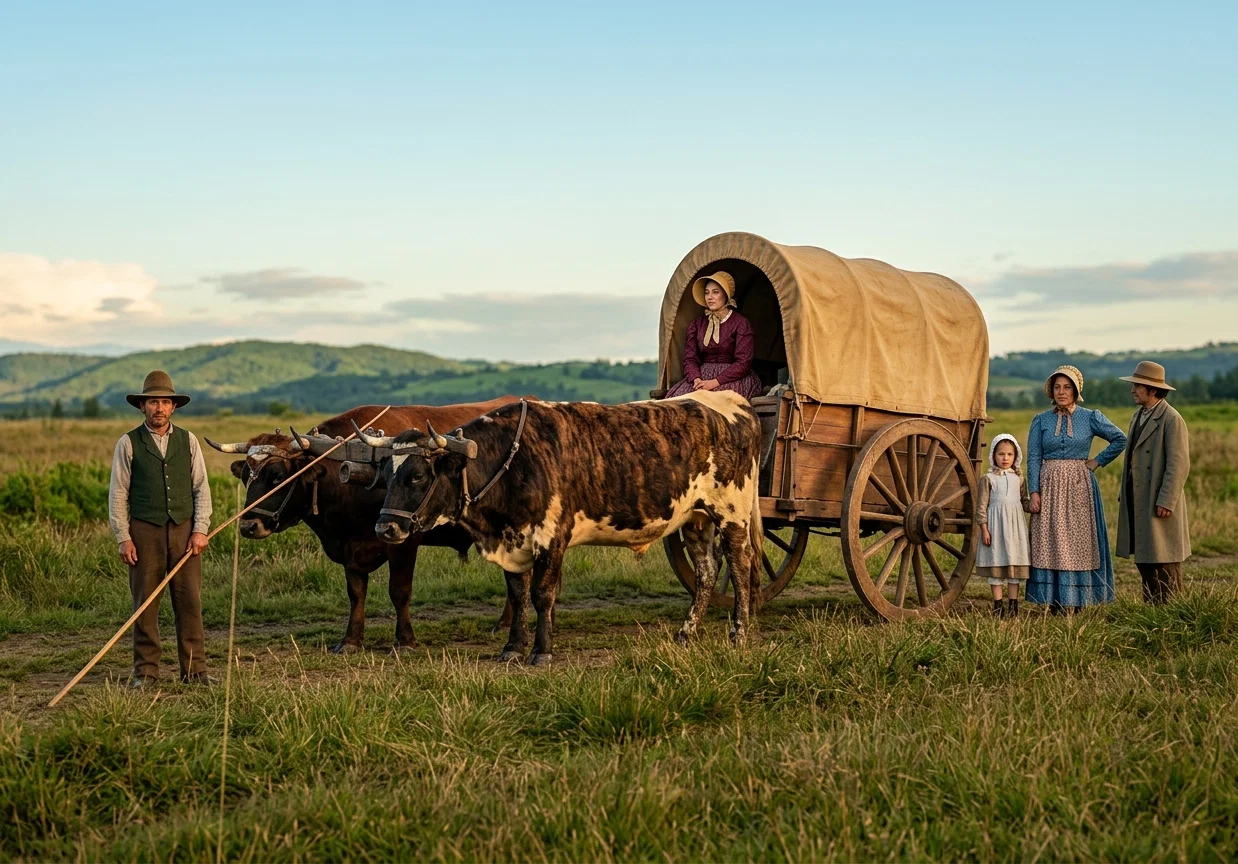
On Wednesday, Dec. 28, 1904, I left home to go farther south on the frontier of Chile to a town called Pitrufquien. The only believer there is a young girl fifteen years old, whom I had baptized a year before. Although her parents were Roman Catholics, I found her faithful to her baptismal vows, and living out the truth fearlessly before her acquaintances. Her parents had become favorable to the truth, and attended the meetings I held in the town. Her mother accompanied us to the river where we had baptism.
TRAVELING BY OX TEAM
On Friday we went to Nueva Imperial, where we had organized a small church two years ago. They are very much scattered, yet all were of good courage. During the two years since the organization of the church ten members had been added by baptism, all of whom were faithful, thus nearly doubling their number. We held quarterly meeting, celebrating the ordinances with this church. As Mrs. Ketring accompanied me with our little girl, it was a help in teaching some of the sisters.
The next Wednesday we went twelve miles by ox cart, to Carahue, several young sisters accompanying us, where we took the small river steamer “Chol Chol,” for Bajo Imperial. The steamer ride was much pleasanter than the cart ride. The accompanying illustration will give a better idea of the mode of travel on the frontier of Chile than I can. This is the cart in which we made the trip.
We reached Bajo Imperial about half-past five in the afternoon. At this place there are a few Sabbath-keepers scattered around the town, the only Protestants for many miles. Here I celebrated, nearly three years ago, the first Protestant baptism ever witnessed.
While there this time, I baptized four more, making ten in all I have buried in baptism there. We also celebrated the ordinance of humility and the Lord’s supper. All seemed much encouraged.
On Monday I went on horseback about twenty miles south along the seashore, to visit the Indian chief who nearly two years ago asked me to start a school on his land. He was getting tired of waiting on us, and had begun to build a house for a school, intending to ask a Catholic priest to start a school. But I arrived in time, and we made arrangements to furnish him a teacher. The devil seemed determined that we should not start the school, for while I was on my way, a police officer told me that the people were all drinking and carousing, and that the life of a foreigner was of little worth among them at such a time. He, with an American, urged me not to go; but feeling that it would be cowardly to turn back, I went on alone, trusting in Him who was my Companion, to protect me. The old chief received me kindly, and assured me of his anxiety to have the school.
The next day we returned to Nueva Imperial by steamer and cart, and the following Friday reached our home in Pua, having had a profitable trip. The work is moving forward as rapidly as possible in that field, and the laborers there need to be remembered at the throne of grace.
An Interesting City
By A. W. GEORGE, M. D.
A. W. GEORGE, M. D.
As one passes over the coast of the low mountain range which runs along the southern shore of the Sea of Marmora, there comes into view the beautiful snow-capped Olympus, a mountain rising seven thousand feet above the broad valley at our feet.
On the side of the mountain nature has leveled a wide terrace, and watered it well with springs and rivulets. Here, among acacia, cypress, and ancient sycamore trees, is the city of Brussa, founded in 185 B. C. This city acquired no great importance until it became, nearly six hundred years ago, the capital of Turkey. It now has a population of about one hundred thousand, more half of which is Greek and Armenian, although Turkish is the language spoken by all.
We may go a short distance up the mountainside into the park, from which we get a good view of the city and of the plain beyond. The most striking feature of the view is the forest of white minarets. Nowhere are they more numerous than in Brussa. It is in the little balconies which encircle the minarets near their tops that the priests stand and call the people to prayers.
In the center of the city is the Big Mosque, curious for its roof of many little domes, instead of the large one. If we go down to the mosque, remove our boots, and put on the slippers that are provided at the entrance, we may enter and walk about the carpeted floor, while the worshipers kneel or sit to read the Koran, or recite their prayers. The walls are richly decorated and covered with Arabic inscriptions, but there are no pictures. The Turks will not make "any likeness of anything that is in heaven above, or that is in the earth beneath." Consequently, their architecture consists mainly of geometrical designs, relieved only by the characters of Arabic writing.
A visit to the Dervish temple is of interest. The Dervishes have many curious ceremonies, which they execute with an air of serious devotion. But to the visitors who gather round their arena, they have the aspect of theatrical performers. The worship is a series of marchings and bowings and reciting prayers, and a lengthy reading from the gallery. Another interesting performance is the whirling march to a musical accompaniment by an orchestra. The worshipers, barefooted and clad in a white skirt, pass around the arena in a circle, while, with arms extended, they spin around with great speed, causing their skirts to take the shape of cones. This performance continues for half an hour or more, when the dancers become exhausted and quietly retire.
Beyond the Big Mosque is the citadel, situated on an eminence overlooking the city. At one time the palace of the sultan was here; but now all that remains of interest are the tombs of Othman I and of his son, Orkhan. As we look through the window at the grave of the great Othman, our interest is renewed in a remarkable prophecy; and we remember that, like Cyrus of old, this king was named by inspiration long before he was born. The name given to him in Scripture, however, is not Othman, but Apollyon, or Destroyer. See Rev. 9: 11. And history shows that this name was well merited, as like a scourge he came upon the apostate church of the Eastern Roman empire.
Bible Printing in Japan
The Bible is printed and bound in all parts of the world. Some of the best work is done in Japan. It is said that the Japanese are twenty-five years ahead of the Oxford Press in their printing appliances.
An Inland Trip in South China
By E. H. WILBUR
E. H. WILBUR
EARLY this year, in company with our teacher, Dr. Leung Kin Cho, I started to visit his native village, San Chuen, which is about one hundred and ten miles inland from Canton. We crossed the harbor in a steam launch to the depot of the new Canton and Sam-shui Railroad. As soon as we arrived at the wharf, there was a rush for the train, which is still quite a novelty, as the new railroad has been open only a few months.
The first- and second-class coaches are very comfortable, but the third-class, in which most of the people ride, are little better than cattle cars, and fully as crowded.
RICE FIELD AND COUNTRY VILLAGE
An hour's ride brought us to Fat Shan, a city of five hundred thousand inhabitants. The English Wesleyan mission has had a Chinese hospital here for about twenty years. The next largest city on the route—Sai Nom—has about three hundred thousand people. We were two hours going from Canton to Sam-shui, a distance of thirty-five miles, the train making fourteen stops on the way. Had we gone by the water route, more than half a day would have been required to make the journey.
At Sam-shui ("three waters"—the rivers coming together here) we transferred to an old-fashioned "passenger boat," and were towed up the West River by a steam launch. The boat was small and crowded, and the air foul with the fumes of opium and tobacco. Among the passengers were three Buddhist priests. I am told that in Quang tung Province alone there are about ten thousand of these priests, counting young and old.
At 4 P. M. we arrived at Shu Hing Fu, seventy-five miles from Canton. It has a population of about one hundred and sixty thousand. We were kindly entertained for supper at the Baptist mission, and attended their evening Chinese service, conducted by a senior missionary from Canton. This is one of their oldest churches in the province. The Church of England has also a mission here.
The next morning we crossed the West River, and were conveyed by a cargo boat up one of the smaller rivers. The water was shallow, and the boat was kept in motion by several men pushing vigorously with their bamboo poles, or running along the shore pulling with a long line, one end of which was attached to the top of the mast. When evening came, the boat was made fast, and we rolled up in our blankets for the night.
Early the next day we again started up the river. Frequently the boat became lodged on sand-bars, so our progress was very slow. Toward noon we decided that we could save one day's time by walking. Accordingly, we left our baggage on board, and Mr. Leung and I set out for a walk of seventy li, about twenty-three miles. The scenery was beautiful, and the weather as pleasant as June.
Arriving at a village called Eau Goo, we were glad to refresh ourselves with a drink of boiled water and a dish of rice. Many people were attracted by the presence of the fan kwai,—"foreign devil,"—as they called me, and as soon as we had eaten, I went out and sold tracts to them. At 8 P. M. we arrived at our destination, San Chuen, where we received a cordial welcome by my friend's mother, a strong, active woman of sixty years.
The next day, Friday, was market-day in a neighboring village, and we again had an opportunity of scattering the printed page. That evening we began a series of meetings, which we conducted for five nights in my teacher's house. I talked to the people a short time about the true God, who created all things, and about his love for us, and was followed by Dr. Leung, who showed the foolishness and sinfulness of worshiping idols. We were assisted in these services by a native Bible woman, who has had an interesting experience. She first heard the gospel at a distant village market-place. It required a whole day to go and come, with only a short time to listen to the sacred story. Afterward a Christian preacher accompanied her to Canton, to attend a mission school. Then people said she had been taken to Canton and sold as a slave. Since leaving school she has spent about six years in the gospel work. While many native Christian workers prefer to live in Canton or Hongkong, she feels a special burden for the people of her native country. She has become interested in our work, and will come to Canton soon to learn more about the truths we hold.
On Sunday we walked about three miles to San Hing, a city of one hundred thousand people. There is only one mission chapel here. This is under the direction of the Congregational mission. About half a dozen believers came together, and we were invited to speak. The presence of a foreigner (myself) drew a crowd of about fifty, but the idolatrous parades and shooting of fire-crackers kept up such a din that it was very hard for the people to hear.
Coming back through the city, I sold tracts and portions of the Gospel. (We have a good tract on the ten commandments, and a new edition of "The Sinner's Need of Christ," from "Steps to Christ.") We went again on Monday, and sold more tracts. Some of the people seemed glad to get the literature, while others looked at me in a fierce manner, and told me to move on. I did not venture to remain long at one place in the street, as the people gathered thickly around me, and I feared there might be trouble. Twenty years ago Dr. Leung and his father and brother opened up mission work here, but were attacked by a great mob, and would have been killed had not the officials protected them and helped them to get away. Later, a native Baptist tried to begin work, but no one would come to see him, or sell him anything to eat, and he was thus forced to abandon the work. I feel a special burden for that city, and wish the way might open for me to do more for the people there. I hope to be able to visit them again next summer.
This city is three miles from San Chuen, my teacher's home village. In the latter place there is a good interest to hear the gospel, and our teacher is anxious that some one be sent there to carry on the work, using his house to live in and for meeting purposes, or for a mission school, but at present we have no one to send.
After a ten days' sojourn, we returned to Canton. We had had a pleasant and profitable journey. Many foreigners find it difficult to live on Chinese food; but without using any flesh foods, I gained in strength during my absence. As it was New-year, when many return to their native villages, bringing money with them, the country was infested by robbers. One place where I sold tracts was, four days later, visited in the daytime by a band of four hundred robbers. Surely the Lord was good to us, protecting us in our journey, and blessing our efforts to bring light to those who sit in darkness. On our homeward way we came by water entirely, passing many large villages, some of which have one hundred thousand inhabitants and no mission chapel. The field is large. But the Saviour has promised that "this gospel shall be preached in all the world." Pray for us.
Canton, China.
The Study of Missionary Activity
“THE study of missionary activity is perilous for one whose ears are closed to a call for service.”
British West Indies
By Philip Giddings
ROSEAU, DOMINICA.—A few days ago I went to the windward of this island, to prospect as it were. It rained so much that I could hold but one meeting—on Sunday afternoon—at which about two hundred persons were present. I visited during the week, selling our Watchman and other literature.
With such contented ignorance of what the Bible says, and such satisfied indifference as to what they know it does say, we have here a field that needs the earnest prayers of God’s people everywhere, and the thorough consecration of those immediately connected with it. Remember us. Some walk no more with us. A minister of the town has been going around warning his people not to attend our meetings. However, some come. We are sowing the seed, watering it with our prayers. We are of good courage.
PHILIP GIDDINGS.
Central America
By A. N. ALLEN
LA CEIBA, SPANISH HONDURAS.—Last Thursday I returned from Bonacca, where I had been to take eleven children from this coast up to Brother Evans. I left my family on the mountain for a while, to recuperate. Brother Smalley returned with me for a month’s vacation. He is improving the time by studying Spanish.
The work is progressing here. Sabbath I heard of two more families that have begun to keep the Sabbath, about thirty miles up the coast. Word comes that a Spanish woman, two-days’ travel back of Truxillo, who has never heard of Adventists, has begun the observance of the seventh day. So the work of sealing goes on.
Our friends in Utilla donated enough to buy a fine young horse, so now I can get around easier. I also have some cash on hand toward buying a pack animal, to carry Bibles, books, etc.
We have two Sabbath-schools here on the coast, in both of which the lessons are studied in Spanish and English.
A. N. ALLEN.
Chile
By F. H. WESTPHAL
NEGREIROS.—In our journey north we find that there is much to do, and there are no men to do the work. We found a brother here who was once in the employ of the Methodists as a colporteur, but was dropped because he accepted the Sabbath. We found that he could sing well, and play the guitar, and was apt to teach, and had had a good influence for the truth for several years, and that quite a number embraced the truth through his influence, and are now firm. We selected him to do Bible work here in the pampas. I think this will help the situation. There are many here in the pampas who are interested, but they are left as sheep without a shepherd. The only industry there is the saltpeter works. Towns have grown up of from two to five hundred inhabitants, and in these there are tailors, merchants, and bakers. But the country is a desert, for it never rains. The dust is from one to three, and in some places even six, inches deep, and there is no green grass to be seen. This condition of things makes it favorable for the saltpeter. If it should rain a few times, the saltpeter would entirely disappear. It is said that the saltpeter fields will continue but a hundred years more, at the rate they are now working them.
We have held meetings in different places, and everywhere we have had good, attentive audiences. Many books have been sold among the people, and our colporteurs are making many friends. We are glad that the Lord is sending us these colporteurs. We expect another one in about a month. The brother is trying to close up his contract as soon as possible, and then enter the work.
I have been reading the reports of some of the first meetings of the General Conference session. I am glad that there is a sound of agoing in the mulberry-trees. The Lord has gone before us, and soon the work will be finished.
F. H. WESTPHAL.
Entering Amoy, China
By W. C. HANKINS
AFTER a visit of nearly two weeks with Brother and Sister Wilbur and Sisters Anderson and Thompson, during which time we learned many of the Chinese customs and habits, we are now in our future home, Kulangsu, which is a sort of suburb of Amoy. Kulangsu is a very pretty little island, about two miles long by one wide, about half a mile from Amoy. The population of the latter place is largely Chinese, while that of the former is, to a certain extent, European.
Kulangsu is said to be one of the prettiest places in China, while seafaring men tell us that it is one of the most healthful ports in this country. The situation is such that we get the sea breeze direct, without its passing over other land, and especially from the south, from which comes most of the breeze in summer. As the result of this, the temperature here is cooler in summer, and warmer in winter, than at Shanghai, which is nearly three hundred miles north. For this reason, and because of its beautiful scenery, fine beaches for sea bathing, and its freedom from the clamor and dirt of most Chinese cities, it would be an ideal spot for a sanitarium.
A sanitarium would be patronized by people from Hongkong, Canton, Manila, and many other places north and south. It is quite common for the Europeans during the summer months to seek a change of climate, to recuperate their strength. A little judicious advertising would draw the people here to regain their health.
The island abounds in beautiful trees, boulders, grass, flowers, rugged hills, and little valleys. The Chinese have hundreds of small farms, where they raise rice and vegetables, scattered all over the island.
Brother Keh met us at Canton, where he came to counsel with the workers. He and Brother Wilbur accompanied us to Amoy, and have been busy ever since our arrival, helping us to get settled. This is a much more difficult task than those living in the States would suppose. Brother Keh has learned some Cantonese, so he and Brother Wilbur can talk. When we do our shopping, we tell Brother Wilbur what we want. He tells Brother Keh, who tells the shopkeeper, who tells his assistant, while he notifies the boy to get the article asked for. And many times all this is vain, and we must go to another shop for what we desire. Quite often the article must be made to order, or can not be had at all.
Slowly but surely we are getting settled in our new home, which is a rather modern Chinese house, shaded by two large trees. Brother Keh and his family live a few yards away, as do also14the other Chinese preacher and family who have accepted the truth. This man is preaching for us in a small country village. His and Brother Keh's family, with a few interested outsiders and ourselves, made quite a little congregation last Sabbath for Brother Wilbur. People interested in the truth are daily coming and going, while on some days quite a number are here at the same time. We hope that in a few months we shall be able to talk to these people without the aid of an interpreter.
Sabbath afternoon we crossed over to Amoy, and held a Bible reading with an interested family. We found them eager to learn more of God's will. We feel that our first Sabbath in Amoy was profitable, and contained much of the blessing of God.
On Sunday the head bookkeeper for the Standard Oil Company in Amoy came to see us. He speaks very good English, so he kindly interpreted for us while Brother Keh and we studied the nature of man. The result was two-fold: Brother Keh gained some new thoughts, while this young man learned and accepted the truth of this important subject.
God is working here in China, as well as in other places, and we are glad to have a part with him in carrying the good news of the kingdom to this needy field. We are daily praying the Lord to send forth laborers into the vineyard, that the ripe harvest may be quickly gathered into his garner. Remember this field in your prayers.
W. C. HANKINS.
Argentina
By N. Z. Town
BUENOS AYRES.— Our hearts have been encouraged as we have watched the progress of events in connection with the work in Washington. What a blessed experience it must have been for the brethren who led out in the matter of moving to Washington, to see such clear evidences that the Lord was guiding. It is evident that the Lord is preparing to cut his work short in righteousness.
Here in this field there has never been such a spirit of willingness to give to the work as we have seen this year. Just yesterday I received a letter from a brother enclosing a check for $477.70, paper, the most of which is tithe. He writes that he could no longer resist the conviction that he ought to give the tithe. Another brother sent fifteen hundred dollars, paper, for tithe, not long ago. So you see the good Spirit is also working here among us.
Our tithe thus far this year has amounted to over thirty-five hundred dollars, gold. The whole of last year it was only a little more than thirty-seven hundred dollars.
N. Z. Town.
West Africa
By J. M. HYATT.
FREETOWN, SIERRA LEONE.—This leaves us in good health. I have taken much interest in the people of this place. I am holding a very interesting Bible reading on Thursday evening, at one of the houses, and prayer-meeting on Wednesday evening at my home. There are nearly a score of persons who are more or less interested. Some of these are leading native ministers. But I dare not press the investigations too far until I am sure that an effort will be made here.
For our part, we have no desire to leave Africa, but rather to push the work when it lies in our power to do so. J. M. HYATT.
(This letter was written before Brother Hyatt had word that Elder Babcock and his wife were on their way to the West Coast of Africa.)
West Indies
By D. E. WELLMAN
ST. JOHNS, ANTIGUA.—We spent seven weeks in St. Thomas on our church building. We pushed forward the work as rapidly as possible, so as to leave the building in a safe condition for the time it will have to stand unfinished. I was the only workman, aside from our brethren, who know very little of the trades. The building is twenty by thirty-six feet.
While there, I held four services each week. The interest increased from the first, with ever-enlarging crowds. We felt regret at having to leave them for a time, for I am sure there are souls to be garnered in that city. I baptized one person in St. Thomas.
What we shall be able to do for our needy field, is a most trying question. We have three places for every man, and the number of calls is increasing, and our hearts are made to bleed as we learn the crying need everywhere. Since returning to Antigua I have had hardly a moment to myself. Work here in the city and country has been constant. Yet our hearts are glad, and we rejoice as we see souls liberated from the bondage of sin to serve the living God.
Brother Mathews has been doing good work in developing those who had signed the covenant before we went to St. Thomas, and three others signed while I was absent. Most of these new ones are the result of our tent effort at Johnson’s Point, Antigua. One was baptized before I left. Eight were baptized Sabbath, July 1, in our font here at the city church, eight more in the country, in the sea, Sunday, July 2. A promising young lady united with us on profession of faith, having previously belonged to the Christian mission. The interest is still good at Johnson’s Point. The crowd present at the baptism was the largest I ever saw. While some were amused, a far larger number were deeply impressed, and some were in tears. Of those receiving the rite at Johnson’s Point, nine were men.
D. E. WELLMAN.
South Africa
By O. O. FORTNER
KENILWORTH, CAPE.—We enjoyed Brother Anderson's visit here at the Cape very much. He is now on the site of the future mission, preparing a temporary place in which to live. Sister Anderson and Brother Anderson's mother will leave Buluwayo soon, for the north. Brother Shone and Brother Moko are working for the Kaffir natives in the vicinity of King William's Town. Brother Chaney and his wife are doing all the good they can among the Basutos. They are selling a great deal of our literature to those people. Brother Sturdevant is largely engaged in harvesting the crops, and finding a market for them, in addition to his school work. Sister Hyatt is at the Somabula Mission, with Brother Albert White and his wife. Elder Armitage is very slowly recovering from his recent severe illness. He is at the sanitarium, but hopes to leave soon. Elder and Sister Hankins have been visiting the churches in the eastern province, and will now go into a new place, where they will endeavor to teach the truth to the people. Elder Edmed is directing the work in Natal and the Transvaal from the new office of their conference. They have recently erected a neat and substantial church building in Maritzburg, with a wing on each side for the office and church-school.
O. O. FORTNER.
THE NEW CHURCH, SCHOOL, AND OFFICE BUILDING IN MARITZBURG
The following interesting description of the new church appeared in the Natal South African Witness of May 27, 1905:—
“The building is situated in Stranack Street, on the left-hand side going down, and occupies two building sites which were recently sold for the purpose by the municipality at a cost of four hundred and fifty pounds. The plan of the whole structure is cruciform in shape, with the arms of the cross elongated to include, on the one side, the tract society's office and the vestry, and on the other side a schoolroom. Each of these has a separate entrance from Stranack Street, with communication to the church. The schoolroom forms one arm of the cross, and is placed on the low side of the site, and is separated from the church by folding doors, which can be thrown open so that the schoolroom may be used as part of the church during special services.”
“The church itself is placed in the center of the building, with a main entrance through a porch situated on one side of the building, which is approached directly from Stranack Street.
“The exterior of the edifice is very pleasing, and forms an exceedingly good group when seen from the opposite side of the road. It was the design of the architects that this building should have a special and distinctive character, and they have treated the plans on simple lines. The building possesses a deep base of pointed brickwork, with the walls rough-casted above, tinted a pale color, and separated from the base by a string course, supported on corbels. The steeply pitched roof, painted red, with its broken, overhanging, and half-timbered gable in front, and overhanging eaves, casts a welcome shade on the tinted rough-cast.
“The whole scheme bears evidence that an attempt has been made to depart from the stereotyped, and often mutilated, so-called Gothic style of architecture, usually adopted for buildings of this description. The architects have thus departed from the ordinary course, and presented something at once distinct and uncommon, yet in keeping with the purposes for which the building is intended.
“The interior of the church is enhanced by an open timber roof, lending it a lofty and cool effect, the roof trusses being supported by neat corbels. At the eaves' level, cross ventilation is provided across both ways of the building by opening the dormers at the sides, and by windows at each end. A neatly painted dado of wood lines the building, with the walls treated in three simple colors above, presenting a restful appearance to the eye. A baptistery is provided under the rostrum, with steps leading to the same from the church; and a motto with the words, “Enter His Courts with Praise,” is suitably inscribed in gold and red lettering over the rostrum.
“The church will comfortably seat two hundred persons, but by using the schoolroom, seating can be arranged to accommodate three hundred and fifty people. The building of this handsome edifice undoubtedly marks a new era in the history of Adventism in Natal, as it gives permanency to their work as a Christian denomination in our midst.”
The Missouri Camp-Meeting
By G. A. IRWIN
THIS meeting was held August 6-13, at Sedalia, Mo. Sedalia is a beautiful city of about twenty-two thousand inhabitants, and is located on the Missouri Pacific Railroad, ninety-five miles southeast of Kansas City, and one hundred and eighty-eight miles west of St. Louis.
The meeting was held in Liberty Park, the use of which for the camp was granted free by the city council. There were about four hundred of our own people encamped on the ground. From the very beginning a good interest was manifest in the meeting, both by our own people and by others. Each night the tent was full, and a large number were standing on the outside, or sitting in buggies, listening to the preaching of the plain message. The three daily papers published in the city gave quite full and complete reports of all the sermons, in some instances as much as three columns.
The various reports rendered in the conference showed a healthy increase both in the tithe and in the general offerings during the past year. Two new churches were added to the conference, making fifty-five in all. Sixty new members were reported as the result of the year’s work. At the present time they have twenty-eight canvassers in the field. While Missouri is the smallest conference in the Central Union in point of numbers, yet the reports show that they have sold more books than any of the others. They have a live, wide-awake general agent, who goes right into the field with his men, and assists and encourages them where they need help. Five tent companies have been in the field this summer. Their present corps of workers consists of thirteen ordained ministers, two licentiate ministers, nine Bible workers, and sixteen church-school teachers. The tithe the past year reached nearly thirteen thousand dollars.
Brother Porter was re-elected president, thus entering upon his third year in this capacity. There seems to be a good feeling among the brethren and laborers composing the conference. There was a manifest loyalty upon the part of all toward the general work, and a decided interest in favor of the missionary work in foreign fields. The conference voted to send one of their ministers to Arkansas and support him for the coming year, besides expressing a willingness for the General Conference to draw from their force of laborers, with the assurance of support consistent with the other obligations of the conference. The offerings for missions during the camp-meeting in cash and pledges amounted, in the aggregate, to $250.08. This was taken up after they had raised nearly $600 for the local conference work.
Quite an interest was manifest in the sale and distribution of Sister White’s forthcoming book, “Ministry of Healing.” Nearly three hundred copies were subscribed for as a starter. The brethren also expressed a willingness to co-operate with the suggestions of the Relief Bureau by donating twenty-five cents per copy of their income from the sale of the book toward helping to pay the indebtedness on the Boulder Sanitarium.
Elder E. T. Russell, president of the union conference, Elder K. C. Russell, and the writer were the representatives from outside the conference. Elder E. T. Russell was present at the beginning of the meeting, but left toward the middle to be present at the Nebraska meeting. Elder K. C. Russell remained until the evening of the last Sabbath, and I came at noon the last Friday of the meeting, and remained over Sabbath and Sunday.
Professors Lewis and Kern, of Union College, were present during the entire meeting, and rendered acceptable service in laboring for the young people, and in presenting the importance of Christian education and the advantages and facilities possessed by Union College for obtaining such an education.
Elders Porter and K. C. Russell did most of the evening preaching, Elder Scales and others assisting toward the last. I think arrangements were being made to follow up the interest created by the meeting.
The crop prospects throughout the State were never better; and the general desire manifest upon the part of the brethren as they went to their homes to do more than ever to spread the message, betokens a rapid advancement in the work in the Missouri Conference the coming year.