1. What vision was given Daniel in the third year of Belshazzar?
The vision of the ram, the goat, the division of the goat's kingdom, and a little horn which waxed greater than all. See Daniel 8.
2. What is said of the ram?
He "had two horns; and the two horns were high; but one was higher than the other, and the higher came up last. . . . He did according to his will, and became great." Dan. 8:3, 4.
3. What did this ram with its two horns represent?
"The ram which thou sawest having two horns are the KINGS OF MEDIA AND PERSIA." Verse 20.
NOTE.—In the first year of Belshazzar Daniel (chapter 7) was given a vision of four beasts, representing so many great dynasties, beginning with the winged lion, Babylon, and ending with Rome. In the vision of the eighth chapter Babylon's career was run, and Medo-Persia was about to take her place, hence Babylon is not mentioned. Medo-Persia succeeded to Babylon in world-empire in B.C. 538.
4. What symbol succeeded and overcame the ram?
"An he-goat came from the west;
and the goat had a notable horn between his eyes; . . . and [he] smote the ram, and break his two horns; and there was no power in the ram to stand before him; . . . and there was none that could deliver the ram out of his hand." Dan. 8:5-7.
5. What empire does the goat symbolize?
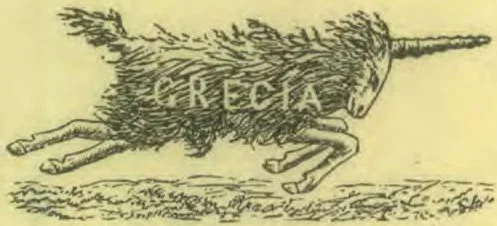
"And the rough goat is the king of Grecia; and the great horn that is between his eyes is the first king." Verse 21.
6. In comparison with the ram what did the goat become?
"The he-goat waxed VERY GREAT." Verse 8.
7. What change took place in the goat?
"When he was strong, the great horn was broken; and for it came up four notable ones toward the four winds of heaven." Verse 8.
NOTE.—The angel declares that "the great horn . . . is the first king." Verse 21. "That being broken, whereas four stood up for it, four kingdoms shall stand up out of the nation, but not in his power." Verse 22. Alexander conquered Medo-Persia, and reigned gloriously for eight years. Within a few years after his death in B.C. 323, the Grecian empire was divided into four parts, Macedon, Asia Minor, Syria, and Egypt, ruled over respectively by Cassander, Lysimachus, Seleucus, and Ptolemy.
8. What change did the prophet see take place among the horns?
"And out of one of them came forth a little horn, which waxed EXCEEDING GREAT, toward the south, and toward the east, and toward the pleasant land." Dan. 8:9.
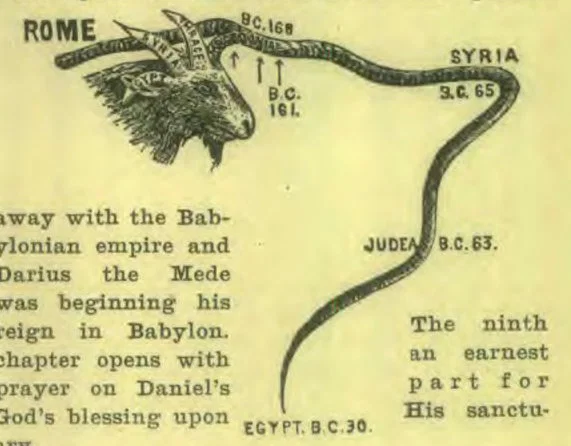
NOTE.—The ram became "GREAT," the goat "VERY GREAT," and the little horn "EXCEEDING GREAT." It must therefore symbolize a power greater even than Medo-Persia or Grecia. This in the very nature of the case could not be one of the divisions of the Grecian empire, but must be a power which becomes greater than all parts of the Grecian empire. But one power answers this; namely, Rome, which beginning small, conquered the Macedonian horn of the goat, gaining its prestige from that victory which it could not have had without it, and seeming to the prophet's vision to come out of one of the horns. This occurred in B.C. 168, and Rome came into connection with the people of God in 161, seven years later.
9. What specifications are given of the little-horn power?
It would oppose God and His work, would magnify itself against the Prince of Princes, Christ, would pervert the continual service of God, would be mighty, would destroy wonderfully the holy people, and should prosper thru craft. All this was true of Rome in her various phases. See Dan. 8:10-12, 23-25.
10. What question did the prophet hear one holy being ask another?
"How long shall be the vision concerning the daily sacrifice, and the transgression of desolation to give both the sanctuary and the host to be trodden underfoot?" Verse 13.
NOTE.—That is, How long shall this oppressive power pervert God's service and truth and oppress His people? The word "sacrifice" is supplied by the translators. The word "daily" is applied to various parts of the service of God, and evidently stands for the continual, living, connecting service between God and His people. How long shall that true service be obscured and the truth hidden?
11. What answer did the holy one give to Daniel?
"And he said unto me, Unto two thousand and three hundred days; then shall the sanctuary be cleansed." Verse 14.
12. What instruction was given the angel after Daniel had seen the vision?
"Gabriel, make this man to understand the vision." Verse 16.
13. Did Gabriel respond to this?
"He said unto me, Understand, O son of man; for at the time of the end shall be the vision." "Behold, I will make thee know." Verses 17, 19.
14. What did the angel then explain?
The ram, the rough goat, the horn which waxed greater than both ram or goat. Verses 20-26.
15. What did Daniel say at the end of this explanation?
"I Daniel fainted, and was sick certain days; . . . and I was astonished at the vision, but none understood it." Verse 27.
NOTE.—This must have had reference to the TIME of the vision, as the symbols had been explained. Therefore we would expect that when Daniel was able to endure the rest of the explanation, Gabriel would explain the time. This came a few months later. In this little space of time Belshazzar had passed away with the Babylonian empire and Darius the Mede was beginning his reign in Babylon.
16.7While he was praying, who came to him?
"Gabriel, whom I had seen in the vision at the beginning." Dan. 9:21.
17. What did he say to Daniel?
"I am now come forth to give thee skill and understanding. . . . Therefore understand the matter, and consider the vision." Verse 23.
18. What did he first declare?
"SEVENTY WEEKS ARE DETERMINED UPON THY PEOPLE and upon thy holy city, to finish the transgression, and to make an end of sins, and to make reconciliation for iniquity, and to bring in everlasting righteousness, and to seal up the vision and prophecy, and to anoint the Most Holy." Dan. 9:24.
NOTE.—The verb "determined" is from the Hebrew chathak, meaning to "cut off," to mark off. The conclusion is inevitable that the seventy weeks are cut off from the time left unexplained, the 2,300 days of the beginning of the vision. As the short-lived ram and goat represent long-existing empires, so the short period of time, a day, represents a longer period, a year. That is the rule which God Himself has given,—"I have appointed thee each day for a year." Eze. 4:4-6; Num. 14:34. The seventy weeks are therefore seventy weeks of years, or 490 years, cut off upon the Jewish people, during which time they would fill up their cup of iniquity, and Christ Jesus should be manifest to make reconciliation for iniquity and bring in everlasting righteousness. This seventy weeks would also seal up, or make sure, demonstrate, the vision and the prophecy. As the events of seventy weeks were fulfilled, so may we know that all will be.
19. Where do the seventy weeks, and therefore the 2,300 days begin? and what subdivisions were there in the seventy weeks?
The Two Thousand Three Hundred Days of Dan. 8:14.
"Know therefore and understand, that FROM THE GOING FORTH OF THE COMMANDMENT to restore and to build Jerusalem, unto the Messiah the Prince, shall be SEVEN weeks, and THREESCORE AND TWO WEEKS: the street shall be built again, and the wall, even in troublous times." Verse 25.
20. When did this "commandment" go forth?
"In the seventh year of Artaxerxes the king." Ezra 7:7.
NOTE.—There is one decree given by Artaxerxes Longimanus (Ezra 7) which meets all the requirements of the prophecy in the restoration of Jerusalem with its civil polity and complete government, even to the extent of administering capital punishment. That decree went forth in the seventh year of Artaxerxes Longimanus, who began his reign in B.C. 464. The seventh year of his reign fell, therefore, in B.C. 457. Seven weeks of years, or forty-nine years, ended in 408, in the last act of reformation under Nehemiah. From B.C. 408 to Messiah the Prince is sixty-two weeks, or 434 years, or 483 years from B.C. 457. Messiah means anointed, and Jesus was anointed with the Holy Spirit at the time of His baptism, and was thus manifested as the Messiah, or Christ. See Matt. 3:16, 17; Luke 4:18; Acts 10:38. His baptism occurred in the autumn of A.D. 27; 483 years beginning in the autumn of B.C. 457 would extend to the autumn of A.D. 27.
21. What occurred in the last week of the seventy?
"And AFTER threescore and two weeks shall MESSIAH BE CUT OFF, but not for Himself: and the people of the prince that shall come shall destroy the city and the sanctuary; and the end thereof shall be with a flood, and unto the end of the war desolations are determined. And He shall confirm the covenant with many for ONE WEEK: and in the midst of the WEEK He shall cause the sacrifice and the oblation to cease." Dan. 9:26, 27.
NOTE.—For one week Jesus would confirm the covenant with many of the Jews. This He did by His own ministry for three and one-half years. In the midst of that week, A.D. 31, He was crucified, causing effectual sacrifice and oblation to cease; invisible hands rent the veil which screened the holy things of the sanctuary from the multitude, showing that the earthly temple had served its purpose; the shadow had reached the substance. Hale's Chronology, on thirteen creditable authorities, places the death of Christ in A.D. 31.
For the last half week of the 490 years the apostles continued their ministration to the Jews. Heb. 2:3, 4. Then came the second rejection of Christ in the martyrdom of Stephen, the scattering of the disciples to all parts in the persecution which followed, and the raising up of Paul the apostle to the Gentiles. See Acts 7, 8, 9. Thus are we brought to A.D. 34, the end of the 490 years. See the diagram.
Dreams of the priest, the high priest, and the Levite, reading from left to right.
22. How much remained?
If we deduct 490 years from 2,300 years, we have left 1,810 years, which added to A.D. 34 brings us to 1844. Then our Lord entered upon the last stage of His ministry in the sanctuary on high. That work is the finishing of the mystery of God (Rev. 10:7); the examination of all the cases of those whose names are written in the Lamb's book of life (Dan. 7:9, 10; Matt. 22:11; Luke 20:35); the blotting out of all remembrance of sin recorded on the books of heaven against those who have proved faithful (Acts 3:19); and the blotting out of the names of those who have proved faithless (Rev. 3:5). In 1844 ends the longest and last prophetic period of the Bible in probationary times. In the full light of this prophecy, one can never set times for the Lord to come.
The ark of the covenant, called also the ark of His testament, and the ark of the testimony. The very center of God’s worship, containing His own transcript of His holy law, the transgression of which is sin, overshadowed by His mercy-seat.
23. When that work is finished, what decree will go forth?
"He that is unjust, let him be unjust still; and he which is filthy, let him be filthy still; and he that is righteous, let him be righteous still; and he that is holy, let him be holy still." Rev. 22:11.
24. What will be done with the antitypical scape-goat ("Azazel," the strong one who revolted)?
"And I saw an angel come down from heaven, having the key of the bottomless pit and a great chain in his hand. And he laid hold on the dragon, that old serpent, which is the devil, and Satan, and bound him a thousand years, and cast him into the bottomless pit, and shut him up, and set a seal upon him." Rev. 20:1-3; see Lev. 16:21.
25. What will then take place?
"And, behold, I come quickly; and My reward is with Me, to give every man according as his work shall be." Rev. 22:12.
Search the Scriptures.
By J. H. Wilson
THERE is a ship at sea. A heavy fog has come on; there is nothing to be seen all round about; the very stars are shut out of view, and no longer serve to guide the vessel's course; and as the man at the masthead hoarsely cries out, "Breakers ahead!" and the crew furl the sails and the helmsman turns the wheel, what is the captain about, old sailor as he is, now poring over his charts, and now glancing at the compass, and now loudly giving his orders? What can he mean by looking so often and so eagerly at that map-looking thing of his?
That is his chart by which his course is guided; and he is searching it to find where he is, and how he may steer his ship in safety, to keep clear of a rock here, and a shallow there, and make a good passage thru the channel, and to save his crew and his cargo, and at length gain the harbor. So says the great Teacher, "Search the Scriptures."
—J. H. Wilson.
How Are You Treating the Word?
WOULD we have faith? It is not based on imagination, or feeling, or experience. "Faith cometh by hearing, and hearing by the word of God." Rom. 10:17. Hope is based on God's immutable promise. Heb. 6:17, 18. God's promises of eternal salvation are based on conditions, that is, we must comply with certain conditions if we would inherit them. We can not receive the blessing unless we comply with the requirement. All this is revealed in the word of God.
But it is a sad fact that many, yes, even the majority of professed Christians, not only do not study the word of God, but show a positive disinclination to do so. Men of intelligence, who know all about farming, mining, politics, and many other matters, know little, so little, about the word of God. Thousands from week to week sit under so-called expositions of the Scriptures, or what are called Bible sermons, and which consist either of perversions of Scripture texts and doctrines, or the mere opinions of man upon some passage, and call it all good doctrine, simply because they are ignorant of the Bible. And if they have doubts of what they hear, they are too indolent or indifferent to look the matter up. They would treat no worldly matter of importance in that way.
OUR study in Romans last week closed with the eleventh verse of the second chapter. The lesson presented was the testimony of the scripture text concerning the source of life and immortality. Those who are to have the eternal life that brings the joys of immortality in the eternal world can not secure it unless they “seek” for it. Eternal life is not bestowed unconditionally upon all regardless of their own desires. Such is the plain lesson of the verses that were quoted from the book of Romans a week ago.
The next verses to be considered are the following:
“For there is no respect of persons with God. For as many as have sinned without the law shall also perish without the law: and as many as have sinned under the law shall be judged by the law; for not the hearers of the law are just before God, but the doers of the law shall be justified (for when Gentiles that have not the law do by nature the things of the law, these, not having the law, are the law unto themselves; in that they show the work of the law written in their hearts, their conscience bearing witness therewith, and their thoughts one with another accusing or else excusing them); in the day when God shall judge the secrets of men, according to my Gospel, by Jesus Christ.” Rom. 2:11-16.
“There is no respect of persons with God.” As expressed on the occasion of some of the first Gentile conversions that took place under the apostles’ ministry, “God is no respecter of persons: but in every nation he that feareth Him, and worketh righteousness, is acceptable to Him.” Acts 10:34. God is seeking to implant righteousness in men. He desires to find men who will come to the right and stand for the right. It is only when men do right that they can have true joys, and hence our heavenly Father’s solicitation for us to come to Him for His righteousness.
Says the text quoted above, “As many as have sinned without the law shall also perish without the law,” and then follows the further statement that “as many as have sinned under the law shall be judged by the law; for not the hearers of the law are just before God, but the doers of the law shall be justified.” The second of these statements is clear and reasonable to every one, but some have thought that the first one was not so reasonable, neither was it so clear. But if the statement is studied in the light of what is thrown into the text in parenthesis the reasonableness of it will become apparent.
“As many as have sinned without the law shall also perish without the law,” is the statement of the text in question. The parenthetical statement explains this by saying, “For when Gentiles that have not the law do by nature the things of the law, these, not having the law, are the law unto themselves; in that they show the work of the law written in their hearts.” In other words, the heathen nations that do not have the written law of God as we have it in our Bibles have enough light on what is right and wrong to lead them into right-doing if they would only follow the light which they have.
There is a very notable example of what a heathen may do who follows the light that comes to every one, even in the remotest intellectual and spiritual darkness. Reference is made to the case of Abraham. Any one who has studied the life of Abraham knows that his father Terah was an idolater, and consequently he was born and had his early life and training amid heathen surroundings. We read:
“And Joshua said unto all the people, Thus saith Jehovah, the God of Israel, Your fathers dwelt of old time beyond the river, even Terah, the father of Abraham, and the father of Nahor; and they served other gods. And I took your father Abraham from beyond the river, and led him throuout all the land of Canaan, and multiplied his seed, and gave him Isaac.” Joshua 24:2, 3.
“Patience in well-doing” was shown by the study in Romans last week to be the plan upon which God gives eternal life to men. And a study of the life of Abraham shows very clearly that God made no exception in his case while his character was being developed. So persevering was Abraham in his work of well-doing that he reached the point that “he was called the friend of God.” James 2:23. He also became the “father of all them that believe” (Rom. 4:11) or, as is often expressed, “the father of the faithful.”
No religious character among all the children of men in all times and in all ages has exerted so wide an influence as “faithful Abraham.” The Jews with great pride point to the fact that they are the literal descendants of Abraham. The Christian world accepts Abraham as the spiritual father of all who have been adopted into the great family of Jehovah. And even the Mohammedan has been so impressed by the character of the “friend of God” that he lays superstitious claim to the benefits that come to the children of men thru the “father of the faithful.”
But after we have acknowledged all these facts in regard to the wonderful height of spiritual power that Abraham reached, we should recur to the further fact that he was born of a heathen father; his childhood was spent under the mythical influences and amid the degenerating surroundings of idolatry. And right in the midst of these untoward environments he heard the gentle, entreating, and winsome voice of his heavenly Father; he heard the same voice and had the same evidences that come to every man that is born into the world. No matter how deeply the individual may be sunken into the idolatrous worship of those who bow before the man-made shrines of heathen lands, yet does the Lord call to him and seek to draw him into the ways of righteousness.
Thus does the Lord set before the world a towering monument of what His grace will do for even those who may be born amid the uninviting conditions of darkened heathendom. By studying the life of Abraham we learn that he was not a well-rounded-out Christian as soon as he commenced to believe. He had to meet the same trials that we meet. He had to have his faith tested at every step. In passing thru this trial we find that he failed at various points as men fail to-day. But he pressed on and on in the conquests of faith. He reached height after height until the Lord’s own record tells of him that he “believed God.” He learned to take God’s word for just what it said, and to rest upon it fully. Thru thus learning to trust in the promises of our Father he became intimate with the Lord; he became His friend.
The Lord has given us this object-lesson of what He can and will do for a man born in heathenism; the Father in heaven certainly would not do less for those who are born under more favorable conditions. “For there is no respect of persons with God.” Then is it not plain that Jehovah is fair and just when He says, “As many as have sinned without the law shall also perish without the law; and as many as have sinned under the law shall be judged by the law; for not the hearers of the law are just before God, but the doers of the law shall be justified . . . in the day when God shall judge the secrets of men, according to my Gospel, by Jesus Christ.”
God’s dealings with the children of men, as expressed in His word, are so sensible and fair that they should appeal to every one.
T.