[The first part of this article presented the contrast between the Babylonian and the Biblical systems of education, and the results of each. It notes the likeness of present-day systems to the Babylonian, and points out four great defects in modern education. This article continues that subject further and points out the remedy.]
Defects in Education.
THE remedy for these deplorable results is a properly balanced education—a religious education which shall take into account the self-evident fact that a religion, to be of worth, must possess the whole man and be a motive power in every act of his life.
All this, in a dim sort of way, is recognized by many. In an editorial on the "Sources of Corruption," the Independent of Jan. 17, 1901, declares that—
"The wickedness and bribery and wholesale stealing from taxpayers for the benefit of the few lies almost wholly at the doors of men who move in what are called the 'well-to-do' or 'exclusive' circles. It lies at their doors to-day, and it has lain there from the beginning of human government."
These men are those who have received education in the schools of their country—an education lacking in what the Independent calls "the training of the satisfactions." It further says:
"Who will show us how to make children learn from actual experience that duty, truth, and honor yield the only satisfactions that may with us? His will be an educational philosophy worth talking about. When its clear, dry light arises in the moral firmament, the paths of wisdom will be easier to follow than they are at present, under the dancing will-o'-the-wisps of 'free election,' and the moon-shine of 'pedagogy,' both of which too often make worldly success look like the only thing worth living for."
In its issue of May 30, 1901, the same journal, under the heading of "Gospel of Wealth," refers to the address of Mr. Charles M. Schwab, president of the United States Steel Corporation, before 200 boys in a trade school in New York City, and who sets forth himself as "an example of the rewards of right living;" to the address of John D. Rockefeller, the Standard Oil magnate, to a Bible class of young men, in which he lauded his pleasure of doing good in employing 70,000 men; to Mr. Andrew Carnegie's book, "The Gospel of Wealth," and asks:
"What is the effect on the public of this 'Gospel of Wealth'? What is the influence of these men of vast fortunes, who, on several occasions, have stood forth as examples of right living?"
Apart from the means of getting this wealth, assuming them to be entirely legitimate, the Independent answers:
"This influence tends strongly to degrade the common morals. Let them amass their wealth; let them enjoy all the material good this earth permits; let them exert their power for weal or for wo in the markets of the world; but in the name of all that is good and precious to the human heart and imagination, let them not be set up before our young men as the great models of conduct to be imitated.
. . . There has been wealth in the land before now; but the riches of these men is so colossal as to obtain an entirely new force. It acts with hypnotic influence on the imagination; it benumbs the senses; and in its vast glitter the eyes are blinded to all the simpler and purer attainments of life. . . . We are stricken down by these men with a delirium of material drunkenness, and they allow us no escape from its fascination."
It is all true, and its spirit dominates popular education everywhere. The education of the world has not protected us from wealth's engulfing tide; and now that it has assumed the throne, it will not save us from slavery to its imperial demands.
A Sense of Need.
The remedy, the only remedy, is right education and training in religious lines from infancy. As one has expressed it, "The whole man must be educated; the whole man must be trained." This training must be from the Bible. And men feel this.
Professor Huxley, skeptic tho he was, felt it. This is what he says:
"I have always been strongly in favor of secular education, in the sense of education without theology, but I must confess I have been no less seriously perplexed to know by what practical measures the religious feeling, which is the essential basis of conduct, was to be kept up, in the present utterly chaotic state of opinion on these matters, without the use of the Bible. The pagan moralists lack life and color, and even the noble stoic Marcus Antonius is too high and refined for an ordinary child. . . . By the study of what other book could the children be so much humanized and made to feel that each figure in that vast historical procession fills, like themselves, but a momentary space in the interval between two eternities, and earns the blessings or the curses of all time, according to its effort to do good and hate evil, even as they also are earning their payment for their work?"
Dr. Lyman Abbott has voiced the same thing in the Outlook recently, and declares that the state should teach the Bible as the history of a people and a religion. But this will not do. It must be taught as it was taught to Daniel and his fellows—as the eternal living truth. Taught in this way, souls will see its glorious beauty. They will see God's hand in history, molding and shaping the nations of earth, despite of sin. They will see God working in nature despite the curse. They will long for His creative and regenerative power in them. They will learn how to obtain it. They will see true worth to be more than wealth, faithfulness more than fame, ingenuousness more than ingenuity, purity more than mere power, character more than coin, the service of God and to mankind more than to be served of Him and to rule His creatures. And O, how minds wide open on the Godward side will expand. In every branch of true science, in every useful occupation, they will excel; and this world will see again, in modern Babylon as in Babylon of old, that those taught of God in "every matter of wisdom and understanding," are "ten times better" than mere secular teaching can produce. Men are needed. This is the education which will make men. It made one man then that served grandly as prime minister under Babylon's greatest monarch, and was called to the same post and as effectually served under the succeeding Medo-Persia dynasty, because he served his God; and if parents will return to God's method of education, trusting in that alone, unwarped, unpermeated by heathen or medieval tradition, or by an infidel science, it will again make men more precious than the golden wedge of Ophir, or the combined wealth of the world.
The first chapter of Daniel is God's object-lesson in education, with the world's education at its best and His education at the worst, with the comparative results. Who will heed the instruction and be taught of God?
[The next article will be entitled, "God the Revealer," an exposition of Daniel 2.]
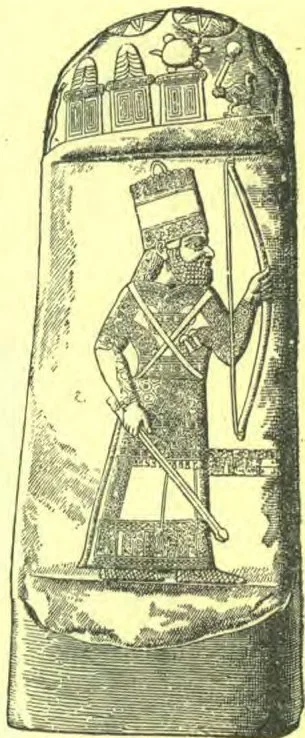
Babylonian Landmark; inscribed with the purchase-dead of a plot of ground, about B.C. 1100. (British Museum.)
The Pope’s Interdict Against Modernism
The pope has issued a further interdict condemning those who will not accept his Encyclical on Modernism. He earnestly exhorts those in official positions in congregations and seminaries that should they find any employees in these institutions who are “imbued with the errors of the modernists, and eager for what is new and noxious, or lacking in docility to the prescriptions of the Apostolic See, no matter how they may be published, let them absolutely forbid the teaching office to such; so, too, let them exclude from sacred orders those young men who give the faintest reason for doubt that they hold the condemned doctrines and the pernicious novelties.” He exhorts them also to “take diligent care to put an end to those books and other writings now growing exceedingly numerous which contain opinions or tendencies of the kind condemned in the encyclical letters and decree above mentioned; let them see to it that these publications are removed from Catholic publishing houses, and especially from the hands of students and the clergy.” Surely this is sweeping enough to suit the most orthodox.
The Religious Situation
The General Outlook.
NEVER before in the history of Christendom were more souls in doubt and perplexity than now. The prophet truly described the situation when he declared as a part of his vision of the last days, "Multitudes, multitudes in the valley of decision! for the day of Jehovah is near in the valley of decision." Joel 3:14. WHAT IS THE REAL SITUATION?
Not in Numbers.
Shall we depend upon numerical statistics? If so, there is evidence of mighty progress, for the membership INCREASE to Christendom during the last century was more than the entire aggregate at the close of eighteen centuries.
This means the rapid spread of the Gospel thruout the world. Praise God for that. But may it not also mean, in the language of Dr. Burrell of New York, that "the church has possibly been cultivating hospitality at the expense of some other and more heroic graces"? The Scriptures clearly intimate that strength is not in numbers, and speak of times when the more the Lord's people increase the more they sin against Him. Hosea 4:7; 10:1-3. Numbers are therefore no evidence of spirituality.
Three Divisions in Christendom.
The so-called Christian world is divided into three general classes, the Roman Catholic, the Greek, or Orthodox Church, and the Protestant.
The first of these, the Roman Catholic, is strong, vigorous, aggressive, waging stronger propaganda among all outside peoples, and wielding an ever-growing political influence.
The Greek Church is practically dead, droning11her ancient forms, bowing before her icons, with but little to separate her from her ancient Roman sister.
The Protestant church, notwithstanding congresses and federations and great display, is hopelessly divided into numerous sects, many of which have no reason for existence save the maintenance of their name and organization. And there is no prospect of life-union. Worse than all, the basic principles of Protestantism—the Bible as the word of God and that word as a guide—are repudiated by large numbers in Protestant communions, so that many indeed are living on compromises.
What a Noted Preacher and Author Says.
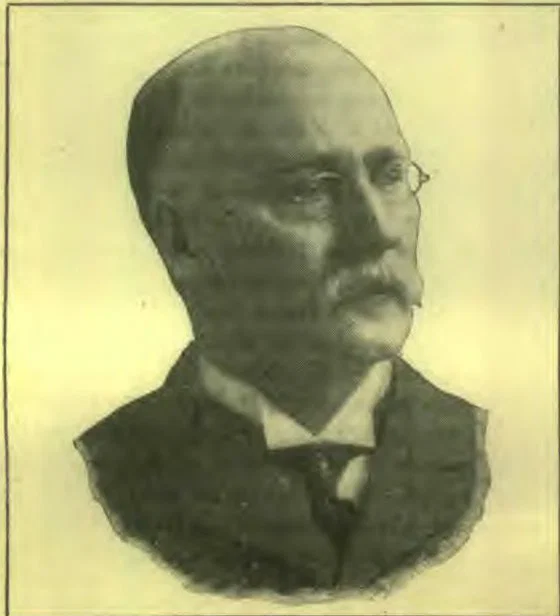
The Condition of a large section of the Protestant church is well set forth by the Presbyterian preacher and author, David James Burrell, D.D., LL.D., of New York, in the "Homiletic Review" of July, under the heading, "The Tendency of Current Theological Thought." Dr. Burrell says:
"'The examination for church-membership is, as a rule, far less searching in these times than that to which candidates for Free Masonry are subjected. The 'fencing of the tables' is quite out of fashion; and there is practically no such thing as church discipline.
"'And men are received into the ministry in the same loose way. No matter what they believe, gather them in! The process known as 'The Examination of Candidates for the Ministry' in ecclesiastical courts is usually a diaphanous farce. A theologue who is prepared to say that he is more than half inclined to believe that two and two make four or that a straight line is the shortest distance between two points is morally certain to get in. And once in, nothing but death or adultery (and this only when the public detect him in flagrant delicto) can put him out. Heresy-hunting is as preposterous as hunting the dodo. In many quarters church symbols are a dead letter; and ordination vows are trifles light as air.
"'What is the result? The Trojan horse is lodged within the gates. There are no notable and avowed infidels in the outside world to-day. The last of the old guard were Bradlaugh and Ingersoll. Brave men, they! On the heights above Elah they took their stand, brandishing spears like weavers' beams and shouting, 'We defy the armies of the living God.' TO-DAY THE ONLY INFIDELITY WORTH RECKONING IS THAT WHICH MASQUERADES IN THE LIVERY OF HEAVEN. Out of the belly of the Trojan horse come men in canonicals, regardless of oaths, laughing at creeds, explaining away the supernatural, flouting the ordinances of Zion, and demanding the right to be let alone while they unbolt the gates.'"
Three Classes in Protestantism.
This is the true situation set before us by an honored minister of Christ. He divides the church into three classes, the liberals, the conservatives, and a "middle-of-the-road" class. Of the first he says:
"'First, as to the 'liberals' of our time. Whither are they drifting? When a fragment of a heavenly body leaves its orbit the possibility of its return is infinitesimal; it wanders lawlessly evermore in boundless space. Truth is a circle; error is a tangent; wherefore, as Paul says, it increases unto more unrighteousness, it waxes worse and worse. This is one of the planetary laws.
"'The course of liberal thought is in evidence. It seems but yesterday when the boldest of free-thinking clergymen in evangelical pulpits could scarcely summon courage to deny the entire truth of any portion whatsoever of the Scriptures; to-day there are many who flout in toto the three miracles on which Christianity rests, to-wit, the Incarnation, the Atonement, and the Resurrection of Christ. There is nothing strange in the denial; the strange thing is that the deniers are ministers of Christ, under oath to preach and maintain the very doctrines which they deny. This is not 'liberalism;' it is infidelity. It is not merely infidelity; it is mendacity. It is not mere mendacity; it is a FLAGRANT VIOLATION OF COMMON HONESTY, and would be instantly branded as such in any of the common walks of life.
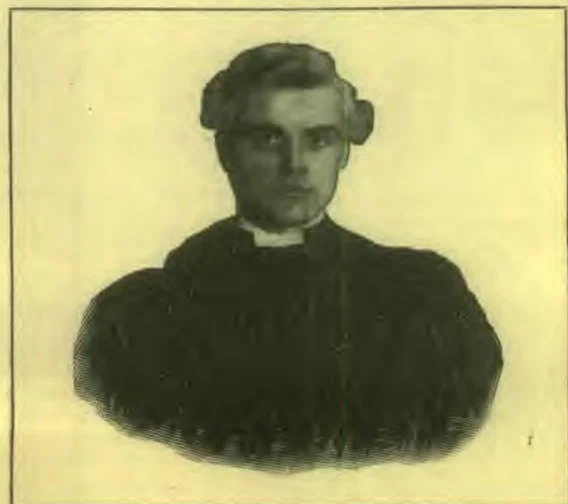
"'The pastor of the City Temple in London recently said: 'We believe that Jesus is and was divine; but so are we. His mission was to make us realize our divinity and our oneness with God. . . . The virgin-birth story has a beautiful meaning in it. It showed the action of the divine spirit on humanity; but to say that Jesus was born without a human father is untrue. . . . Sin is simply selfishness—an offense against the God within. We reject wholly the common interpretation of the Atonement, that another is beaten for our fault. . . . Every sin involves suffering, suffering which can not be remitted by any work of another.'
"'The man who uttered those words is the successor of Dr. Joseph Parker, who, not long before his death, said to the congregation of the City Temple: 'We have had our opportunities of meeting God here, of reading the holy word, and besieging, as an army might besiege a fortress, the altar, known by its crimson hue; and yet some day a man may arise who will deny the Lord that bought him, who will preach a Gospel without a Saviour, a salvation without a Cross; then write "Ichabod" upon the portals of this place, and let it be forgotten as a thing of shame, a memorial of unpardonable treason against the throne of God.'
"'It is clear that the 'liberals' have been moving rapidly. Their watchword is 'The New Theology;' but it would take an expert microscopist to detect the difference between this New Theology and the old infidelity. To-day Thomas Paine would find himself at home beside the occupant of the pulpit of the City Temple, London. His denials of Christian doctrine were scarcely so extensive as those which are advanced in some of our theological seminaries. But in the interest of common morals it12should be added that Thomas Paine, were he to return, would have the advantage over many of our preachers and theological professors in one particular; namely, he would frankly acknowledge himself an infidel. And all of us, whether admitting the truth of Scripture or not, will probably agree that 'an honest man's the noblest work of God.'"
Referring again to the ministry in particular, Dr. Burrell says:
"'It is matter of common fame among ministers that some are accustomed to make statements sub rosa which they never make and probably never would make in the presence of those who furnish the loaves and fishes. Is it possible to imagine a blacker form of turpitude than this? Welcome the day when the drawing of the lines shall force all such from cover! For there is really no neutral ground in the territory of truth and righteousness.'"
He refers to the conservatives as those who are dwelling on "the rudimental facts" of the Gospel and less and less upon the non-essentials. But aiming to do this very thing is what has brought many into the "liberal" fold. When men assume to judge in God's revelation what is and what is not essential, they place themselves upon the ground of the "higher critic," and will sooner or later be forced by the inevitable logic of the situation to reject the word. Dr. Albert Barnes well said that there is no command of God so small that we may ignore it, and he who does this is unworthy of God's kingdom.
Referring to the efforts at union, Dr. Burrell remarks:
"'The one great obstacle to such unity is unbelief within the church, unbelief in the pulpit, unbelief forcing its uncongenial presence into the fellowship of believers: for 'what concord hath Christ with Belial? or what part hath he that believeth with an infidel?' "
The Third Class.
The middle-of-the-road class are a very numerous class. They generally do not have knowledge enough of God's truth to enable them to decide among the rival standards floating, flaring, or hanging limp from the flagstaffs in the religious field.
Whatever may be said to the contrary, every one who observes knows that the great drift in Protestant churches is toward "liberalism," infidelity. There once was decided and country-wide protest at the utterances of the noted liberals; now they are tolerated by nearly all, regarded favorably by many, and acquiesced in silently or espoused and defended openly by others. The church is honey-combed with infidelity till many see no steady, abiding, religious home save in the Roman Catholic Church. For instance, the Rev. Newman Smyth, D.D., pastor First Congregational Church of New Haven, Conn., author of several works on Christianity, and a member of Yale corporation, in his Christmas sermon, Sunday morning, December 22, declared, as reported in the San Francisco "Call" of December 23, "that THE AGE OF PROTESTANTISM WAS PAST and that it was NO LONGER NEEDED. He said the churches were split up and were becoming more so every day. THEY NO LONGER HAD POWER OVER THE PEOPLE or the state. He said that the time for a new Catholicism was at hand, and that the sooner people realized it the better."
The same day Rev. Artemas J. Haynes, pastor of the United Congregational Church of the same city, declared "that neither he nor his church would take any part in the coming $6,000 a week revival by J. Wilbur Chapman. These two sermons, and Rev. Thomas McKay's trial, have shaken New Haven, the stronghold of Congregationalism in New England, to its depths."
But Congregationalism or Protestantism ought not to be shaken at all by such utterances as these, nor would either be shaken if they had not lost faith in God's word, the only true foundation of Protestantism. Roman Catholicism STANDS FOR SOMETHING; and that is praiseworthy. Professedly she believes God's word, and holds to its integrity; but she makes it void by exalting human tradition above it. Tradition in her creed interprets the word rather than the word shedding light on tradition. But many in Protestantism have utterly repudiated the word, and are left drifting derelicts, each trusting in himself alone, or in some one else who is equally adrift upon an uncharted sea. Better is Roman Catholicism with a positive SOMETHING, than such a jelly-fish religion as the higher critics, the New Thought, and the New Theology offer us.
But, reader, there is still a Biblical religion, a Christian religion, a Protestant religion,
Which anchors in God's promises;
Which believes and obeys God's precepts;
Which holds that Jesus Christ, the Way, the Truth, and the Life, is our only hope;
Which is broad-based on the great, eternal, unchangeable government of God with its immutable law, and on the great facts of redemption,—the Incarnation, the Atonement, the Resurrection of Jesus Christ;
Which protests against the human assumption of endeavoring to crystallize God's warm, living truth in a cold, rigid, dead, human creed, or attempts to enforce that creed by civil law;
Which bears the marks of God's own designation, "the commandments of God and the faith of Jesus." Rev. 14:12.
To this religion we invite you. It will stand.
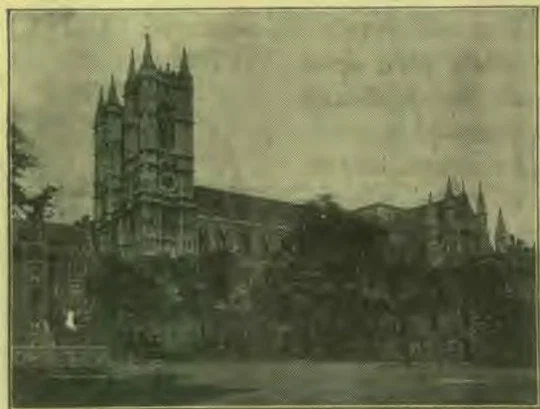
Westminster Abbey.
David James Burrell, D.D., LL.D.
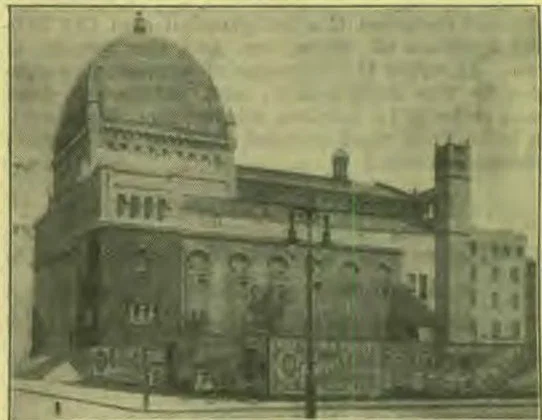
Temple Bath-el (Hideew), New York.
Rev. R. J. Campbell of City Temple, London.
Durham Cathedral.
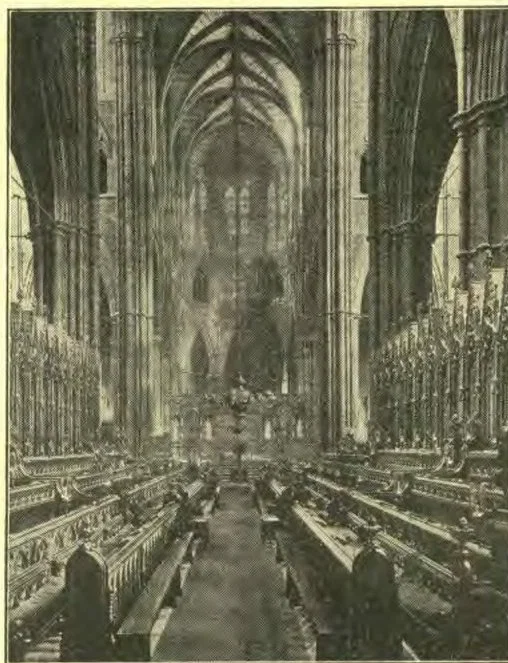
Choir, Westminster Abbey.
Union Against Union.
IN putting up one of the large business buildings in San Francisco a dispute has arisen over which of two classes of workmen are to put in the steam-pipes that belong to the elevators. One of the leading union-labor men claims that the job should be done only by members of the steam-fitters union; and the firm that has the contract for putting in the elevators claims that its elevator constructors should do the work. All the men working on the job are "union" men. All are agreed in regard to the wages being paid and the hours of labor and such like things.
There is no dispute between the owner, who is furnishing the money for the construction of the building, and the men who are doing the work for him. The dispute is between two of the unions that are engaged on the job. And the men who are working on the building from these two unions have no disagreement; they would all like to work, but the man who is at the head of the unions in San Francisco thinks that the work of putting in these pipes should be done by another class from the one that the contractors have employed. As a result of the dispute, 463 men are thrown out of employment till it is settled.
The men that are thus thrown out of work assemble each morning at the building, hoping to find that the difference is over with and that they can resume their occupation to earn the money that they need for the support of themselves and families. The men who have taken the contracts have agreed to have the building done within a certain time, and this delay is causing them much uneasiness.
The owner of the building, and the men who have taken the contracts for the construction of the various parts of it, agree to the demands of the union laborer; they have agreed to employ none but union men on the job. But two sets of men representing two different unions, yet men that affiliate with each other, have a difference of opinion, and not only are the owners and contractors put to great inconvenience and loss, but the whole of the 463 men employed are distressed by being thrown out of work. And this fact is further emphasized when it is known that there were only four men employed in the fitting of the steam-pipes for the elevator, and over which all the other 463 are made to quit work.
The purpose in giving the foregoing statement is to call attention to the fine distinctions that are being drawn in regard to how and by whom work shall be done. And the men who are making these distinctions claim that they are doing so because capital has such a strong disposition to grind down the laborer that they find it necessary in order to protect the working man. And while the laborer sets forth these claims, the capitalist on the other hand thinks that they are unreasonable. And so the conflict is on, and is becoming more and more bitter and determined on both sides.
It is not the work of this paper to take sides with either party in this controversy; neither is it our duty to inquire into the merits of the case to see which side is the greater offender. But in view of the conditions that exist in the world to-day we feel constrained to earnestly ask the reader to consider these conditions in connection with the following scripture:
"Go to now, ye rich men, weep and howl for your miseries that shall come upon you. Your riches are corrupted, and your garments are moth-eaten. Your gold and silver is cankered; and the rust of them shall be a witness against you, and shall eat your flesh as it were fire. Ye have heaped treasure together for the last days. Behold, the hire of the laborers who have reaped down your fields, which is of you kept back by fraud, crieth: and the cries12of them which have reaped are entered into the ears of the Lord of sabaoth. Ye have lived in pleasure on the earth, and been wanton; ye have nourished your hearts, as in a day of slaughter. Ye have condemned and killed the just; and he doth not resist you. Be patient therefore, brethren, unto the coming of the Lord." James 5:1-7.
The foregoing scripture plainly tells of a heaping together of wealth; it just as plainly tells us that this is for the last days; it tells of the cries of the laborers; and it also tells of the wanton, luxurious living of those who make a wrong use of their wealth. And this all occurs at a time when the coming of the Lord is drawing near, for we are exhorted to be patient till that time.
The coming of the Lord, then, is the one hope that is before the world. The coming of the Lord is the one thing, and the only thing, that can or will settle these disputes. For any one can see that the strife is growing deeper and more and more bitter. And once the conflict begins in earnest there will be such scenes of bitter strife stirred up that no power this side of the power displayed by the coming of the Lord can put an end to it. The sensible thing to do now is to prepare for the coming of the Lord, and keep clear of being a partisan to the strife and turmoil that is rising higher and higher in the world. For this strife will continue to get worse and worse till the end of time is reached.
T.
How to Tell the Birds from the Flowers
"How to Tell the Birds from the Flowers."
"A manual of flornithology for beginners." Verses and illustrations by Robert Williams Wood, published by Paul Elder & Co., San Francisco and New York.
A queer, curious, and unique little book, in which various plants are likened to birds, with the distinctive points brought out in a very unique way.
The drawings are decidedly grotesque. There is information given with the misinformation. As a child's book it is a long, long way ahead of the Old Mother Goose Melodies.