Your ShelfYour Projects

Signs of the Times, Vol. 38, No. 3.

Leading Articles in This Number

Signs of the Times

Jan 17, 1911

Pacific Press Publishing Association · Mountain View, California · Jan 17, 1911

Leading Articles in This Number

God's Law in the Patriarchal Age 3
Signs of Christ's Coming . . 4
The Identical Sabbath Day . . 5
The Seven Churches of Revelation
2 and 3 as a Whole . . 6
Equality Before God . . 8
"The First Day or Nothing" . . 9
The Christian Citizenship Conference . . 10
Reports from India (Missions) . . 14

Question Corner

"IF YE WILL INQUIRE, INQUIRE YE."
This Inquirers' Department is conducted for the purpose of helping those who are studying the Bible. The answers are oftentimes only suggestive. They are never to be considered infallible, only as they agree with the infallible Word. The writer who may answer them does not consider that his opinion is infallible. He will simply give the best that he has, and plead with the inquirer to search the Word. Such questions only will be answered as, to the editors, seem to minister to the good of the readers and to the mission of the paper. We can not answer repeatedly in the same volume questions upon the same scripture. The name and address must accompany question, not for publication, but as an evidence of good faith, and that answer may be made by letter if deemed advisable. No letters are answered which do not contain the name of the writer. It is well always to enclose stamp for reply.

3323.—Coming Near the Lord

Will you kindly explain Ex. 19:15 and 1 Sam. 21:4, 5? L. B. H.
What is meant in these scriptures is that men should not give themselves up to self-indulgence when they come before God in holy things. The teaching of pagan religions required from their devotees licentiousness. Persons devoted themselves to that very thing for the sake of their religion. God would teach His people that the true religion has nothing to do with nature-worship. Therefore when God was to manifest His glory to the children of Israel, His people were to abstain from everything that would turn their minds away from the preparation they needed in order to meet with God. So also when David was fleeing from Saul and came to the sanctuary to ask for something to eat, the priest told him there was no common bread on hand; there was only the showbread, which must be hallowed. David's answer was to the effect that the young men could eat that, because they had been temperate and continent. The bread was not mere common bread; that is, it was taken from the sanctuary, and new bread placed in its stead. We do not see that this text has any particular application to the Lord's Spirit more than this, that he who partakes of the ordinances of the Lord ought to do so with clean mind, and consecrated heart, cleansed from sin in the blood of Christ.

3320.—Genealogy of Christ

(1) Did Jesus descend through Solomon's or Nathan's line of descent? (2) Who was the father of Mary the mother of Jesus? W. H. W.
(1) The genealogy given in Matthew 1 is on the royal side through the legal father of Jesus, Joseph. In law Jesus was the child of Joseph, and Matthew traces that lineage through the royal family, showing that Jesus was entitled to the throne of Israel through David, Solomon, Rehoboam, etc. Jacob therefore of verse 16 is the father of Joseph, the husband of Mary.
(2) Luke traces the literal blood descent of Jesus from Adam to Mary the mother of Jesus; but as the descent was reckoned through the males, Mary's name is not mentioned, but Mary's husband's name, as in Luke 3:23. Joseph the father of Jesus is there called the son of Heli. The son-in-law was counted as the son, so that Mary's father was Heli, and Heli is traced back to Nathan. The one genealogy traces the royal line back to David, the other genealogy traces the lineage back to Adam, the father of the race. When the two lines are compared from David on, it will be seen that they meet in Zorobabel and Salathiel (Matt. 1:12; Luke 3:27), so that the blood of Solomon as well as the blood of Nathan was in both Joseph and Mary.

3321.—Creation of Fowls

Kindly explain why Gen. 1:20 says the fowls were made out of the ground and out of the water.
The text does not state that the fowls were made out of the ground. "God said, Let the waters bring forth abundantly the living creature that hath life, and fowl that may fly above the earth in the open firmament of heaven." We know no reason why God could not create fowls from water as well as from the earth. And Genesis tells us this, for that is just what He did. Many of the fowls, too, are amphibious. Elements which entered into fowls were doubtless in either the earth or the water. The Lord chose the water.

3322.—The Two Jehorams

Please tell us how it is that Jehoram's youngest son could reign in Jerusalem before his father.
We do not know to just what our correspondent refers. We know of no such difficulty as that which he sets forth. The predecessor of Jehoram was Jehoshaphat, who began his reign in 819 B.C. and reigned twenty-five years. Jehoram his son began his reign conjointly with his father in 796, probably at the time that Jehoshaphat left his kingdom and went over to help the king of Israel. Two years after that Jehoshaphat died. Jehoram reigned eight years from the time of his accession with his father Jehoshaphat, and Ahaziah began his reign in 789.
Or does our correspondent have in mind Jehoram son of Ahab? It is not a difficult thing to get the two Jehorams mixed. We would ask our correspondent to be a little more definite and give us the scripture where the difficulty occurs.

3324.—The Number of Women

According to John 19:25, how many women were at the foot of the cross? W. Z.
The text in John is not quite clear. There might be three and there might be four; the mother of Jesus, the sister of our Lord's mother, Mary the wife of Cleophas, and Mary Magdalene. It may be understood, however, that Mary was the sister of the wife of Cleophas. That there were probably four is indicated by Mark 15:40. Mark does not mention the mother of Jesus, but he does mention Mary Magdalene, Mary the mother of James the less and of Joses, and Salome, who was also the sister of Mary the mother of Jesus.

3325.—Loved and Hated

Kindly give me some little light on Mal. 1:1-3 and Rom. 9:11-13, "Jacob have I loved but Esau have I hated." These texts perplex and trouble me, and a little light would be greatly appreciated.
The Lord does not use the words "love" and "hate" in the sense humanity uses them. Hating in this sense is simply to love less. Jacob was chosen, Esau was not. The same thought is expressed in Luke 14:26: "If any man come to Me, and hate not his father, and mother, and wife, and children, and brethren, and sisters, yea, and his own life also, he can not be My disciple." Certainly the Lord does not want us to hate anybody, for He tells us to love our enemies; but the thought is to love Him more than we do any one or anything else, however close the relationship. This is fully explained in Matt. 10: 37: "He that loveth father or mother more than Me is not worthy of Me: and he that loveth son or daughter more than Me is not worthy of Me." The Lord loved Jacob, and gave him the place in the line of the promised Seed. He loved Esau less, and rejected him from that position, because Esau was not worthy.

3326.—"For Whatsoever Thy Soul Desireth"

Will you please explain Deut. 14:26 in the Question Corner? It seems to me as tho that is a very wide opening with no restrictions whatever. E. S. T.
God delights in the pleasure of those who are truly His, and are seeking His glory. If those mentioned in the text were truly His children, they would not desire that which would dishonor God. They would not eat the flesh of animals forbidden in that very chapter. The strong drink mentioned was doubtless the mildest of stimulants, or would be so considered now. God gives His children the same liberty now; but that it may not degenerate into carnal license, He emphasizes the principle which should ever control: "Whether therefore ye eat, or drink, or whatsoever ye do, do all to the glory of God." 1 Cor. 10:31. That is the true motive always.

3327.—Change of Sabbath

Is it right to say that the Sabbath was changed by Christ when He came to this earth, or was changed at His resurrection? J. E. M.
In the first place there is no Bible statement or record of a change of the Sabbath by Christ or His apostles. The Sabbath is ever known by that name; the next day by the plain term "first day of the week," which came the next day after the Sabbath. Matt. 28:1; Mark 16:1, 2. In the second place, Jesus declares that the law in which the Sabbath is guarded can not be changed in one jot or tittle. Matt. 5:17-20; Luke 16:17. See "Is Sunday the Sabbath?" Apples of Gold Library, No. 76, price 1 cent; "The Lord's Day the Test of the Ages," Bible Students' Library, No. 134, illustrated, price 10 cents. Address this office.
Schedule for Week Ending January 28, 1911

Lessons from the Book of Job

Six days more we linger in patriarchal times with Job, his three friends, Elihu, and God. Besides the lessons of last week regarding human suffering, we have noted the wonderful knowledge of God possessed by these men; their hope in a future life through the resurrection and the coming Redeemer; God's providence over all His tested and tried ones; for He is no respecter of persons. What a wonderful poem on wisdom is chapter 28: 12-28!
What a conception of the sidereal world had the old patriarchs! All that the eye could see of the garnishing of the celestial dome by the Spirit were but parts of God's ways, but the faintest whisper of the thunder of His power. In chapter 38 is the expression of a truth which men have learned by science during the generation just passing; namely, that Arcturus is so large that he holds by his attraction suns in his thrall, captives in his train as he sweeps on his course, that he does not seem to be regulated by law as do other suns. "Canst thou guide Arcturus with his sons?" Verse 32. God guides, holds, controls. The "sweet influences" of the Pleiades ought to be "the cluster," and the bands of Orion show that the suns and nebulæ of that mighty constellation are held and bound in relative position. These, with other expressions, such as the weight of the winds, witness to the divine inspiration of the book.

Exodus

EXODUS is the second book of Moses, covering a period of about forty years, from 1491 to 1451. The name comes from the Greek of the Septuagint, and means "going out," because it records the going out of the children of Israel from Egypt. The Hebrew name is the words, "These are the names." The first word connects it with Genesis. The two books are parts of one book. Exodus is really a book of redemption by the power of God. Keep this thought with you in reading its chapters. The Redeemer is manifest by name and act throughout. "A new king" is another dynasty, perhaps the Assyrian of Isa. 52:4. The word "Pharaoh" is a general title of king, such as "emperor" or "czar."

Bible Reading Schedule

| Day | Date | Scripture | | :--- | :--- | :--- | | Sunday | January 22 | Job 21-24 | | Monday | " 23 | " 25-29 | | Tuesday | " 24 | " 30, 31 | | Wednesday | " 25 | " 32-34 | | Thursday | " 26 | " 35-37 | | Friday | " 27 | " 38-40 | | Sabbath | " 28 | " 41, 42 | | | | Exodus 1 |

The Law in the Patriarchal Age

WHEN Adam and Eve were created, and placed in their Eden home, they had a knowledge of the law that was to govern them. Its precepts were imprinted on their hearts by Jehovah Himself, and they were acquainted with its claims upon them. When they transgressed that law, fell from that state of happy innocence, and became sinners in the sight of God, the dark future of the fallen race was not relieved by a single ray of hope. Because of the transgression of the divine law, Paradise was lost to man, the curse was pronounced upon the earth, and the reign of death commenced.
But Heaven pitied man, and the plan of salvation was devised. When the curse was pronounced upon the race, in connection with the curse there was given the promise of pardon through a Saviour who was to come. This promise was the star of hope that lighted up the gloom, that, like the pall of death, hung over the future of man, and of the world which was given him as his dominion. The Gospel was first preached to Adam and Eve in Eden. They sincerely repented of their guilt, believed the promise of God, and were saved from utter ruin.
Those who lived before the Flood were favored in receiving instruction from Adam, who had conversed with God and angels in Eden. He lived nearly a thousand years; and by his teachings, and his example of humble obedience, he exalted the law of God. He sought to turn his posterity from transgression to a life of obedience and faith in a promised Saviour; but he found from sad experience that it was easier to open the flood-gates of sin and wo upon the world, than to resist and press back the tide of moral wretchedness that was pressing in upon mankind in consequence of his transgression.
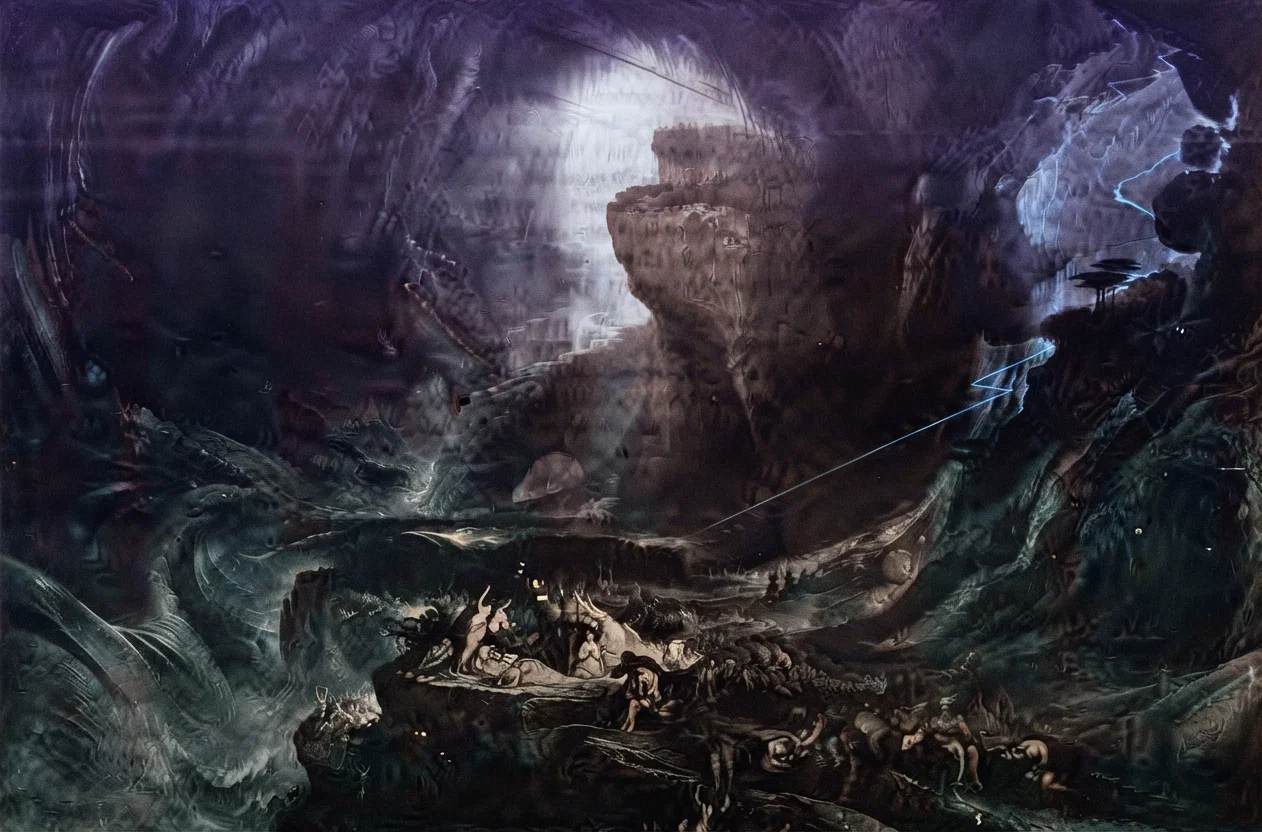
THE DELUGE John Martin
Enoch also was a preacher of righteousness, and sought to turn men from their evil ways. For three hundred years he walked with God, giving to the world the example of a pure and spotless life, one which was in marked contrast with the lives of the men of that self-willed and perverse generation, who openly disregarded God's holy law, and boasted of their freedom from its restraints.
But his testimony and his example were alike unheeded, because men loved sin better than holiness. Enoch served God with singleness of heart; and the Lord communicated to him His will, and through holy vision revealed to him the great events connected with Christ's second appearing. And then this favored servant of the Lord was borne to heaven by angels without seeing death.
At length the wickedness of man became so great that God could no longer bear with it; and He made known to Noah that because of the continual transgressions of His law, He would destroy man, whom He had created, by a flood of water which He would bring upon the earth. Noah and his family were obedient to the divine law, and for their loyalty to the God of heaven they were saved from the destruction that overwhelmed the ungodly world around them. Thus the Lord preserved to Himself a people in whose hearts was His law.
Noah warned the people. He believed that the threatened punishment would come upon the world, and he made every effort to turn that sinful generation from transgression to obedience. But he was unsuccessful. Only his own family at last received his message. The terrible judgments of God in the destruction of the antediluvians should be a sufficient warning to all who have since lived upon the earth, that God will surely punish those who disregard His law. But the human heart is prone to evil; and as people multiplied upon the earth after the Flood, they soon became bold in their transgressions. Idolatry existed, and increased to a fearful extent, until finally the Lord left the hardened transgressors to follow their evil ways, while He chose Abraham, and made him the depositary of His law for future generations.
Abraham was called out from an idolatrous family, and was appointed of God to preserve His truth amid the prevailing and increasing corruptions of that idolatrous age. The Lord appeared to Abraham, and said: 'I am the almighty God; walk before Me, and be thou perfect. And I will make My covenant between Me and thee, and will multiply thee exceedingly.' 'And I will establish My covenant between Me and thee and thy seed after thee in their generations for an everlasting covenant, to be a God unto thee, and to thy seed after thee.'
The Lord communicated His will to Abraham, and gave him a distinct knowledge of the requirements of the moral law, and of the salvation that would be accomplished through himself. It was a high honor to which Abraham was called, that of being the father of the people who for centuries were the guardians and preservers of the truth of God for the world,—of that people through whom all the nations of the earth should be blessed in the advent of the promised Messiah. But He who called the patriarch judged him worthy. This is the testimony of God concerning His chosen servant, as it stands registered on the sacred page: 'Abraham obeyed My voice, and kept My charge, My commandments, My statutes, and My laws.' And again: 'I know him, that he will command his children and his household after him, and they shall keep the way of the Lord, to do justice and judgment.'
Thus was the knowledge of the law of God preserved through successive generations from Adam to Noah, from Noah to Abraham, and from Abraham to Moses.

Signs of His Coming

By Roderick S. Owen

IV. The Earth Grows Old

IN the preceding articles we have shown that the great signs in the heavens, to wit, the darkening of the sun and the moon and the falling of the stars, have been fulfilled. But the Saviour said there should also be signs in the earth. In speaking of these the prophet Isaiah says, "The earth shall wax old like a garment, and they that dwell therein shall die in like manner." Chapter 51:6.
As the earth came from the hand of Jehovah, it was clothed with verdure and beauty, and over all its fair surface was found no trace of blight. Even the Creator, as He viewed it, pronounced it "very good." Joy and gladness reigned supreme. Man, the masterpiece of God's creative power in earth, was made in His image, and placed over the works of His hands. Crowned with glory and honor, he viewed with delight his God-given possession. No strain of sorrow or of death disturbed the melody of his soul. Peace and joy like the ebb and flow of the tide came into his heart to flood it with light and sweep out again to gladden and bless.

A Sad Change

But when sin entered, what a sad change was wrought! The miasma of vice, death-dealing, spread abroad everywhere. Blight and decay touched the most beautiful portions of all God's creation. This curse would soon have devoured the whole earth had not its ravages been stayed by the plan of salvation which God introduced at that time in the promise that the Seed of the woman should bruise the serpent's head. Nevertheless the curse has accompanied sin; and as the human family has plunged deeper and deeper into wickedness, the curse has fallen heavier and heavier upon the earth, and thus it is waxing "old like a garment," and they that dwell therein are dying or degenerating in like manner. As evidence of this last statement, contrast the average length of the lives of the early generations with those of the present time.
The average age of the first nine patriarchs, omitting Enoch, who was translated, is 900 years and more, while to-day the average age of those whom we count old men is not more than one tenth of that. The human family is certainly growing weaker and weaker. Idiocy and lunacy are rapidly increasing. To-day it is exceedingly difficult to find a healthy mother.

Extinction Predicted

In the face of these facts some scientists are predicting that the human species will become extinct from sheer degeneracy. The boasted improvement in prevention and treatment of diseases has not stopped the ravages of death; while medical science is taxed to its utmost to cope with the problems constantly confronting it in the development of new diseases. Thus God is permitting sin to run its full course and to work out through all its varied ramifications, so that the universe may clearly see its nature, and may learn that suffering, pain, and death are its inseparable attendants, and never can the universe be free until sin itself shall cease and all who can not be separated from sin shall be destroyed.
In Isa. 24:4 we read: "The earth mourneth and fadeth away, the world languisheth and fadeth away, the haughty people of the earth do languish." And this is just before the curse devours the earth, as shown in subsequent verses.
Joel, in speaking of this same time, calls upon the old men to bear witness to something which occurred in their day but was unknown in the days of their fathers; to wit, "That which the palmer-worm hath left hath the locust eaten; and that which the locust hath left hath the canker-worm eaten; and that which the canker-worm hath left hath the caterpillar eaten." Joel 1:2-4. This scripture teaches that there will be great ravages by destructive insects, one kind taking that which has escaped another, until it will be well-nigh impossible for man to save anything for his own use. All over the country this is fast becoming the prevailing condition. Man is compelled to keep up a constant warfare on the various pests, by fumigating, spraying, poisoning, in order to produce crops. Large areas which were once covered by fine vineyards, have been laid waste. To-day it is almost impossible to find an apple orchard of any age which produces apples free from worms. The average yield of wheat and other grains per acre has fallen from twenty-five or thirty bushels to as low as ten to fifteen bushels; while blight, pest, and failure have invaded all departments of agriculture. So Joel continues:
The field is wasted, the land mourneth; for the corn is wasted: the new wine is dried up, the oil languisheth. Be ye ashamed, O ye husbandmen; howl, O ye vine-dressers, for the wheat and for the barley; because the harvest of the field is perished. The vine is dried up, and the fig-tree languisheth; the pomegranate-tree, the palm-tree also, and the apple-tree, even all the trees of the field, are withered: because joy is withered away from the sons of men. Joel 1:10-12.
While the description here given doubtless applies to the time of the plagues, yet, who can not see that we are fast drifting to that end! Yes, when God shall withhold the blessings He has so bountifully supplied in the past from the people of earth who shall have ceased to be thankful for them, then shall all nations see the complete fulfilment of all that Joel has spoken.
The seed is rotten under their clods, the garners are laid desolate, the barns are broken down; for the corn is withered. How do the beasts groan! the herds of cattle are perplexed, because they have no pasture; yes, the flocks of sheep are made desolate. Joel 1:17, 18.

God's Purpose

In Amos 4:6-10 God teaches that His purpose in permitting such a state of things to exist is to lead men to Him, and to teach them to trust in Him instead of trusting in man and in false gods. Some are led to trust in Him; others pursue a wilful, disobedient course. The experiences of these two classes are contrasted in Isa. 65:12-14, which reads:
Therefore will I number you to the sword, and ye shall all bow down to the slaughter: because when I called, ye did not answer; when I spake, ye did not hear; but did evil before Mine eyes, and did choose that wherein I delighted not. Therefore thus saith the Lord God, Behold, My servants shall eat, but ye shall be hungry: behold, My servants shall drink, but ye shall be thirsty: behold, My servants shall rejoice, but ye shall be ashamed: behold, My servants shall sing for joy of heart, but ye shall cry for sorrow of heart, and shall howl for vexation of spirit.
Thus while the one class are forsaken of God and given over to those in whom they have trusted but in whom they can find no help, to the other class, their bread and water shall be sure, and their eyes shall see the King in His beauty, while they shall behold the country that is afar off. Isa. 33:16, 17.
All these signs clearly indicate that soon indeed we shall see the King in His beauty, for Jesus shall come in the glory of His Father and His own glory, and of the angels, and His glory shall cover the heavens, and the earth shall be filled with His praise. Reader, are you looking for Him? for to such shall He come a second time without sin unto salvation.

Studies on the Sabbath

II. The Identical Sabbath Day

REMEMBER the Sabbath day, to keep it holy," was proclaimed by Christ from Mt. Sinai, and traced by His own finger on tables of stone. Some seek to evade the obligation of the observance of the seventh day of the week as the Sabbath by the assertion that it is impossible to keep the identical seventh day of creation's week. In their effort to accomplish this the usual method is to object to the record given in Genesis concerning the creation of the world, asserting that creation's week was seven indefinite periods of millions of years of time.
Without entering into the discussion of the mazes and uncertainty of the evolutionary theories, which brush aside as of little consequence the plainest utterances of the great God, and instead accept the claims of science falsely so-called, we ask on what mathematical calculation these wise scientists get six or seven "indefinite periods," successively following one another. There could be but one indefinite period to cover the entire span of this supposed evolution; for as soon as we admit that there was a second, a third, a fourth, or a fifth period, longer or shorter, following those preceding, we have something definite, or ordinal numbers are meaningless.
He that is truly wise and scientific will acknowledge, with the apostle Paul, "If any man think that he knoweth anything, he knoweth nothing yet as he ought to know." 1 Cor. 8:2. The first step in true science is to believe what God says is true. We read: "By the word of the Lord were the heavens made; and all the host of them by the breath of His mouth. . . . For He spake, and it was done; He commanded, and it stood fast." Ps. 33:6, 9. To this record Christ sets His seal of approval with His utterance from Mt. Sinai; and later He wrote on tables of stone these words: "For in six days the Lord made heaven and earth, the sea, and all that in them is." Ex. 20:11.
I prefer to accept these statements as the most reliable knowledge or science upon the work of creation. Because men can not understand the power of God, they deny the birth, resurrection, and ascension of Christ on equally good authority. It was not by what is termed natural law, or the science of medicine or surgery, that Christ healed the sick and dying, or raised the dead; He spoke the word, and it was done.
It is written, "He sent His word, and healed them." Ps. 107:20. The centurion said, "Say in a word, and my servant shall be healed." To the lifeless form of Lazarus, the Master said, "Lazarus, come forth. And he that was dead came forth."

The Round World

Another objector says, "No man can keep the identical seventh day on all parts of a round world." In this the difficulty is imaginary, rather than real. If the Sabbath law required all to keep the same definite, simultaneous time, then there would be difficulty. However, the Sabbath law only requires man to keep the definite seventh day of the week, and not the same definite time.
The sun is God's great timekeeper. Every intelligent reader knows the day does not begin or end all around the earth at once. As a simple illustration which all may comprehend without entering into a more scientific explanation of the day-line, I call attention to the United States national law which requires a definite day of the month and week for our national elections to be held. The polls must open at six o'clock A.M. and close at six o'clock P.M. on election day. Under this law the casting of a ballot would be illegal on any other day except the definite day and hour named by the law. However, the voting begins in New York City one hour before it is lawful to cast a vote in Chicago, and three hours before it is lawful to vote in San Francisco; and the voters continue to cast their ballots in California three hours after it is unlawful to vote in New York City. It is strange that some wise man has not come to the rescue of one of the political parties and proclaimed before this that a large number of votes, sufficient to decide the election of one party or the other, have not been cast on the day specified by the law.
To carry the illustration a little further: Suppose the whole world were one universal republic, and the law applied on the opposite side of the earth the same as it does in the United States, would there be any difficulty in keeping the law? No man would want to show his ignorance by making such a claim. All could not vote simultaneously, but all could vote the same definite day.
Does the traveling public by land or sea find it difficult to recognize the day as it is measured by God's great timekeeper?—No, indeed! It is amusing to see how much trouble some have over keeping the seventh day; because the Lord made the earth round, while twenty-four hours later the difficulties have all cleared away, so that any one can keep the first day of the week in all parts of the earth on a round world without any trouble.

The Miracles of the Manna

Has the Sabbath been preserved during six thousand years as a blessing to man, and can we have the assurance that we can keep the original Sabbath, blessed and sanctified by Jesus Christ, at the close of Creation's week? Let us see: Just prior to the rehearsal of the law at Sinai, we have the instruction of God concerning the gathering and the preparation of the manna over the Sabbath:
And he said unto them, This is that which the Lord hath said, To-morrow is the rest of the holy Sabbath unto the Lord: bake that which ye will bake to-day, and seethe that ye will seethe; and that which remaineth over lay up for you to be kept until the morning. And they laid it up till the morning, as Moses bade; and it did not stink, neither was there any worm therein. And Moses said, Eat that to-day; for to-day is a Sabbath unto the Lord: to-day ye shall not find it in the field. Six days ye shall gather it; but on the seventh day, which is the Sabbath, in it there shall be none. And it came to pass, that there went out some of the people on the seventh day for to gather, and they found none. And the Lord said unto Moses, How long refuse ye to keep My commandments and My laws? See, for that the Lord hath given you the Sabbath, therefore He giveth you on the sixth day the bread of two days; abide ye every man in his place, let no man go out of his place on the seventh day. So the people rested on the seventh day. Ex. 16:23-30.
In this record we have a threefold miracle wrought each week for forty years, pointing out the original definite Sabbath day, sanctified at creation. In the record we find: First, On the preparation day of the week a double portion of manna fell; second, No manna fell on the Sabbath; third, Manna gathered on the sixth day kept sweet over the Sabbath, which it did not on any other day of the week. Therefore we have in this history more than six thousand distinct miracles performed by God, pointing out the original Sabbath day. Hence from creation to the giving of the law at Sinai, the original Sabbath was preserved. Has it been lost since then? Turning to the record of the crucifixion of Christ the apostle bears testimony:

The Witness of the Gospel Record

And now when the even was come, because it was the preparation, that is, THE DAY BEFORE THE SABBATH, Joseph of Arimathea, an honorable counselor, which also waited for the kingdom of God, came, and went in boldly unto Pilate, and craved the body of Jesus. . . . And he bought fine linen, and took Him down, and wrapped Him in the linen, and laid Him in a sepulcher which was hewn out of a rock, and rolled a stone unto the door of the sepulcher. Mark 15:42, 43, 46.
Here we have the inspired statement of Mark, that near the close of the sixth day, "the day before the Sabbath," Christ had been crucified and laid in Joseph's new tomb.
Again, we have the inspired statement of another apostle that the disciples of Christ kept the Sabbath "according to the commandment:"
And that day was the preparation, and the Sabbath drew on. And the women also, which came with Him from Galilee, followed after, and beheld the sepulcher, and how His body was laid. And they returned, and prepared spices and ointments; and RESTED THE SABBATH DAY ACCORDING TO THE COMMANDMENT. Luke 23: 54-56.
But the commandment refers to the identical day which Christ rested upon, or sabbatized, blessed, and sanctified, at the close of creation's week. See Ex. 20: 8-11; Gen. 2: 1-3.
Then surely we have good authority down to New Testament times that the memorial of the creating, sanctifying power of Christ was still preserved for man.
The assumption that the Sabbath has been lost prior to or since the days of the apostles has not a shadow of proof. The Sabbath was kept by the apostles. Thousands suffered and died for keeping it during the Dark Ages. The experience of the Jews from Christ's time to the present is positive proof of its identity.
The science of astronomy, as well as the testimony of every nation on the earth, attests to the fact that the cycle of the week, as given in the Bible, has been preserved, unclouded, through the ages, even to our own day. The seer of Patmos beholds the dragon moved against the remnant church, because their faith leads them to keep the commandments of God, which include the Sabbath. Rev. 12: 17.
Continue reading: THE REVELATION OF JESUS CHRIST