It was a strange scene that presented itself before the eyes of Matthias and Bar-jona. Surrounding the palace of Pontius Pilate was a vast mob, led on by the high priests Annas and Caiaphas, followed closely by many of the Jewish council.
The palace was an immense structure, and beautiful. Some forty years before, it had been erected by Herod the Great. Standing as it did on the hill of Zion, it commanded a fine view of the holy city, and formed a dwelling regal enough for even the haughty Cæsar himself.
But it was only upon occasion, that Pilate left his palace down at Cæsarea on the Mediterranean, and came up to Jerusalem. Had he dreamed of the tremendous responsibility that would be thrown upon him almost immediately upon his arrival, haughty though he was, his heart would have failed him. Little did he think that his were to be the lips that should consent to the murder of the Shiloh of the prophets; that his were to be the hands that would drip crimson with the blood of the Just One, the Desire of the Ages,—crimson hands that would be execrated through all time, and which, tho washed a thousand times in presence of the multitude, can never-more be innocent.
But if such can be said of Pontius Pilate, the heathen governor, what shall be said of the high priests, Annas and Caiaphas, and the haughty scribes and Pharisees,—the light-bearers of poor Israel?
The gorgeous palace where Pilate had taken up his temporary abode, was protected by three immense towers; while the roofs, says Josephus, “were a matter of astonishment” on account of their height and adornment.
It was in the fresh of the early spring morning; the dew still glimmered in liquid diamonds upon the quivering leaves of the palm and the juniper. Beautiful trees bordered the broad walks and driveways about the spacious grounds. The great yellow dome of the white temple on Mount Moriah sent back the golden glory of the sun, and the cloudless skies were reflected dimly in the dark waters of the Kidron — dark with the blood of a thousand sacrificial lambs.
The high priests had led the mob up to the very gate through which they must pass in order to gain access to the grounds of the royal residence. Annas and Caiaphas were easily distinguished from the others, by their beautiful garments of blue, and by the magnificent gem-covered breastplate which glittered in the morning sun, reflecting the gorgeous coloring of a hundred miniature rainbows.
"The procurator hath not yet left his bed-chamber!" responded the guards in answer to the insistent demands of the rabble.
But at last Pilate reluctantly descended the broad marble stairs, and took his position in the court, that he might hear the complaints of the high priests.
Astonishment as well as annoyance was written upon the stern face of the Roman governor; for he felt assured, by the very presence of the richly robed priests, that something of unusual import had called these dignitaries from the temple so early in the morning, even compelling them to mingle freely with the common people, or, more correctly, the rabble of the city. Upon ordinary occasions they were diligent to shun even the touch of the common people as defiling; but on this day mighty consequences were at stake, and neither the haughty Annas nor the pompous Caiaphas shrank from the touch of the riffraff of Jerusalem.
All this the procurator noted at a single glance, and his deep voice betrayed his annoyance as he addressed Caiaphas, sternly demanding the object of so untimely a visit.
Bar-jona and Matthias, having entered the gate with the others, stood near enough to hear the reply of the high priest plainly:
"Verily, O Pilate, we have brought this pestilent Fellow to thee, for we found that He was perverting the whole nation. Indeed, He refuseth to give tribute to Cæsar, and declareth that He also is a king."
As soon as Bar-jona had entered the gateway and discovered the Master, Matthias had great ado to prevent him from crying out, and throwing himself at the feet of his Lord.
"Look, Matthias!" he muttered hoarsely; "they are leading Him forward, even as a lamb to the slaughter — and — see! there is a cord about His neck — and how shall I endure the sight! O my Master! my Master!"
"List!" whispered Matthias, placing his hand upon his companion’s mouth; "list! the procurator is speaking to Him."
"Art Thou the king of the Jews?"
This question was asked by the governor in a haughty and derisive manner. The answer was given in the soft, musical voice of the royal Prisoner:
"Thou sayest it."
"If Thou art a king, then where are Thine armies?" muttered Pilate; then turning toward Annas, who stood nervously stroking his long white beard as he was wont to do when excited, Pilate exclaimed impatiently:
"Take Him yourselves, and judge Him according to your law; for I see no fault in Him."
"He is worthy of death, O Pilate!" roared Annas, "and yet we can not put Him to death ourselves, as thou very well knowest. Are not we and our nation under the authority of the Romans?"
"Ha, Annas!" exclaimed a deep voice from the midst of the throng, "then thou dost acknowledge that the scepter hath departed from Judah. Then hath not Shiloh already come?"
Both Annas and Caiaphas turned their heads toward the bold speaker, but did not reply save with a scowl of hate. But Matthias whispered to Bar-jona: "It is Nicodemus, the ruler; behold him! I knew not that he favored the cause of the Master. But see," he continued excitedly, "the procurator hath entered the palace again; and — list! he hath called the Man to enter with him. Surely, I believe he would talk with Him apart from these His accusers."
A few minutes thereafter, Pilate returned, the royal Prisoner by his side. A look of distress, almost akin to fear, was upon the dark, stern face of the governor.
"I find no fault at all with the Man!" he exclaimed earnestly, addressing the clamoring multitude. "He hath declared that His kingdom is not of this world; and why should even Tiberias Cæsar fear a rival from the kingdom of the unseen world? But ye have said that the Man is from Nazareth of Galilee; and behold, Herod Antipas hath rule over Galilee; I will therefore send this Prisoner unto him."
Not far from the palace of Pilate, and situated on an eminence just north of Mount Zion, was another palace, whither had come Herod Antipas, from his luxurious mansion at Tiberias, on the Sea of Galilee.
Pontius Pilate is in some degree a stranger to us; not so this man, this bloody ruler of Galilee, whose power we have come to fear, and whose weak and detestable character we have learned to abhor.
"Behold, O Bar-jona, the procurator hath sent the Master, with His accusers, to Antipas!" exclaimed Matthias, the last ray of hope fading from his kindly eyes, as, with many expressions of apprehension and dismay, they prepared to follow the mixed throng around the northern side of the hill Zion to the palace of the execrable monster who had murdered the prophet of the wilderness. And as Bar-jona and Matthias turn their white faces toward the north — for they must not lose sight of the Master — the memory of Matthias, son of Sylvanus, is busy with the scenes of the past.
Once again he hears the voice of the prophet Baptizer, as he, Matthias, his friend and disciple, visits him for the last time in his lonely cell in Tiberias, on the banks of the Galilee. Once again he hears the prophet’s never varying testimony, which rings true to the last: "Behold the Lamb of God, who taketh away the sins of the world!" Once again in fancy he hears that stern voice rebuking the sins of the rich Sadducee and the powerful Pharisee, and swaying the flocking multitudes with his burning eloquence. Faithful memory brings to mind the last words of undying faith and courage which fell from the heroic lips of the martyr prophet, and then — then the cruel sword of the executioner of Herod Antipas flashes in the afternoon sunlight. The memory of these scenes was brief, but so vivid that almost involuntarily Matthias shuddered.
While he still mused, those in advance had already halted before the imposing palace on the western side of the Tyropæon valley, which Antipas had chosen as his headquarters while in Jerusalem.
Scarcely waiting for a word of explanation from Annas or Caiaphas, and waving his hand to silence the noise of the people, Herod Antipas eagerly came forward and addressed the Godlike Prisoner:
"Verily, I am glad to see Thee, Thou Jesus of Nazareth, for I have heard many things of Thee, and that Thou doest many miracles. Ho! Rufus!" he exclaimed, turning toward a burly soldier of his guard whose face and form we remember too well. "Rufus, bring hither Bildad, the cripple, and Hermi, the blind man who sitteth at the gate. Behold, we also will see a miracle at the hands of this Nazarene. Unbind Him, Rufus!"
"Wherefore bringest thou these beggars!" whined Caiaphas, watching with bulging eyes the retreating form of the soldier, fearful lest, after all, the mighty power of the royal Prisoner might effect His release. But his fears were vain. The Miracle-Worker calmly regarded His persecutors, but no word escaped Him.
"Behold, O King!" cried Bar-jona, urging his way impetuously to the front, and pointing to the man Malchus, who stood by the side of the high priest his master, "behold this man whose ear hath been severed by my sword even last night. See! he hath been healed!"
Before any could reply, another voice was heard above the noise of the rabble. It was Abner, the lawyer:
"Behold, O King, mine eyes were blinded by the fingers of Varro, the madman of Gadara, who was once a centurion of thy father; and behold, this Jesus of Nazareth hath given me my sight!"
Then from the center of the dense throng rang another familiar voice. Head and shoulders above the rabble which surrounded him, stood the man Varro.
"I am Varro, he who once had his dwelling among the tombs of the Gadarenes. Thou hast heard of me, O Antipas, for the tombs where I dwelt were but across the Sea of Galilee — across from Tiberias, where thou dwellest; and verily I was possessed with a legion of demons, and no man could chain me — for I brake the chains asunder. But with one word of His lips, this Man, Jesus of Nazareth, hath made me whole. Now, therefore, O King, condemn not the Holy One of Israel!"
At sound of this voice, the soldier Rufus, who still stood by, threw up his hands, with a gesture of consternation. His swarthy cheek paled; and casting one glance at the pallid Victim, he turned and disappeared among the soldiers.
At once many voices were heard along the outskirts of the throng, shouting: "Jesus of Nazareth hath made me whole!" "Jesus of Nazareth hath made me whole!"
But the voices of Annas and Caiaphas and other of the chief priests and Pharisees rose to a shrill scream: "If He doeth miracles, it is by the power13of Beelzebub!" "By the power of Beelzebub!" echoed the rabble.
"Answerest Thou nothing, Thou Nazarene?" questioned Herod impatiently. "It is better that Thou shouldst not anger me. Fearest Thou not my power? Come, Thou art a king; we will array Thee in purple robes, and send Thee again to Pilate."
"Look, Matthias! See! the man Demas, who is servant of the high priest, hath fetched a branch of thorns from the mountainside, even as Herod commanded him, and he hath woven thereof a crown — and O my brother, see! They press it upon His head, and set Him upon a block of wood, and ah, they are bowing the knee to Him, and Jazer and his fellows smite Him with the reed which they have placed in His hand. Ah, my Master! my Master! Thou Man of Sorrows! How can I endure the sight!"
"Take Him again to Pilate!" briefly commanded Herod.
Back down the hillside, through the narrow, winding streets, on, on, and up again through the beautiful avenue of trees that led from the palace, up the northern slope of Zion, hurried the noisy mob. Again they are led on by the dignified Annas, with his long, white beard and his blue garments, followed by his son Jonathan the priest, and the young high priest Joseph Caiaphas, clad in his garments of beauty, his false heart throbbing under the rainbow-colored gems of the breastplate, and bearing in spite of him the brief message of Herod, "I find nothing against Him;" back again to the procurator, Pontius Pilate, who, with an expression of intense annoyance, watched the rabble hurry up the hill once again to his palace.
"Wherefore bring ye the Man again to me? Once have I found Him innocent. Now will I chastise Him and let Him go. But hold — I bethink me. Now ye know that it is our custom to release some one Israelite who hath been placed in prison, that he may be free at the time of your Passover. Now there is lying in prison a robber and murderer — one Barabbas — who hath for a long time escaped justice, and whom Marcus, a centurion of Capernaum, hath captured. Now let me release unto you this Jesus of Nazareth, who verily hath done nothing amiss, and punish Barabbas with the cross!"
It is vain.
Like the roar of a mighty tempest came the cry, which echoed from hilltop to hilltop: "Let the Nazarene be crucified! Crucify Him! Crucify Him! Release unto us Barabbas!"
In the meantime a young maid hurried to the chamber of her mistress, Claudia Procula, the bride of the governor, who had not yet left her bed-chamber.
"O my mistress! they will crucify the Man, and He is verily innocent — and He it is who hath healed mine uncle, even Bartimeus, the blind man, at Jericho!"
With a start, Claudia Procula rose from her couch, her eyes wild and staring.
"I have dreamed a dream!" she exclaimed briefly, as she stepped to the window and looked out upon the mob, raging and roaring like the waves of the sea in a tempest. She saw one calm face among the thousands that surrounded the palace — one only.
Then she stepped from the window, and seated herself at a small table. "Wait, Miriam; I will write a note to mine husband, and thou shalt carry it to him: for verily he shall not condemn the Man to death."
A few moments thereafter the face of Pontius Pilate grew ashen, as he read the brief letter:
"Have thou nothing to do with that just Man, or I have suffered many things this day in a dream because of Him."
Throbbing and distracted, the procurator turned to one of his soldiers, with a briefly spoken command:
"Bring hither the robber, Barabbas, that I may see him." In times of crises, the human mind works rapidly. A hundred plans, a hundred theories, are formed, discussed, and dismissed, in a moment, until something presents itself which seems feasible.
Barabbas, with firm step and defiant eye, having been brought by the guard, stepped upon the marble stair where stood the procurator. The Master, at a word from the governor, ascended the stair also.
Side by side, upon the marble platform, stood the two prisoners. The massive form and defiant attitude of the assassin were in strong contrast with the slender, graceful form and the humble, child-like demeanor, blended with the Godlike majesty, of the Nazarene.
The procurator stood for a moment, with his dark eyes fixed upon the two prisoners; then, with a slight wave of his hand in direction of the Nazarene, he exclaimed, in a voice of deep pathos, which was plainly audible above the clamor of the mad mob:
"Behold the Man!"
"Crucify Him! Crucify Him!" The words were taken up by a thousand lips, and were echoed by a thousand angry voices.
Meanwhile, the eyes of the prisoners met. The first glance of idle curiosity which the robber turned upon the pallid, blood-stained features of the Man by his side, quickly gave place to an expression of astonishment and awe.
Where had he seen that face before? When had those wonderful, unspeakably sad eyes looked into his own — eyes that seemed to read the dark secrets of his heart at a single glance — eyes which had haunted his dreams days and nights without number?
For a little moment, the ears of the robber are deaf to the babel of the angry multitude. The long, weary years which have brought him only evil, and which have been spent in crime and folly, melt away.
He is once more alone, wounded, and starving upon the hills of Judea, while a strange, fair-haired Lad, with sad, gentle eyes, has pressed into his trembling hand His own humble meal.
And so this was the Man for whose blood the frenzied rabble was crying.
The voice of the multitude swells loud and louder, like the roaring of the sea:
"Release unto us Barabbas!" And as the robber listens, a look of savage satisfaction overspreads his brutal features, and he, also, joins the cry, "Crucify Him! Crucify Him!"
"If thou let this Man go, thou art no friend to Cæsar; for He maketh Himself a king. He sayeth that He is the Son of God!" shouted Jonathan the priest.
At those words, the dark cheek of the procurator turned ghastly pale, his knees shook, and his deep voice trembled, as he turned to one of the soldiers who stood by.
"Bring me water in a basin!"
Bar-jona and Matthias stood until now, dumbly watching the scene of horror.
"See, Bar-jona, the governor hath called for water. What will he do? Will he indeed release the Master?"
Before Bar-jona could reply, the deep voice of the governor was heard, as he dipped his trembling fingers into the basin:
"I am innocent of the blood of this just Man. See ye to it!" Like the voices of ten thousand fiends from the abyss of darkness came the reply:
"His blood — His blood — His blood be upon us — upon us and our children!"
And as this savage cry rose and echoed and re-echoed in one awful chorus from lip to lip, Bar-jona, overwhelmed with horror and frenzied with grief, lifted up his hoarse voice in a mournful wail, as he rushed blindly forward toward his Master:
"O My Master! my Master! Say only that Thou forgivest the iniquity of my sin!"
The dense throng parted to allow the wild-eyed man to pass. But long before he reached the side of the pallid Victim still standing by Barabbas and leaning wearily against a pillar, a half dozen soldiers of the guard seized the man Bar-jona roughly, and bore him outside the grounds of the palace, to the foot of the Mount Zion.
An hour later, Matthias found him lying face downward upon the bare limestone rocks, heedless of the hot sun that beat upon him. Nor did he raise his head, until Matthias called him by name:
"Simon Bar-jona, up! for verily we must follow the Man our Master; for they are leading Him on to Golgotha; and I followed with them — but see; I have returned for thee; and behold, as we were on our way toward Calvary, at the foot of the Tyropæon Vale, we saw an horrible thing; the body of —"
"Tell me, man, tell me quickly!" interrupted Bar-jona, starting to his feet wildly. "Tell me of the Master! What did they unto Him after the soldiers dragged me from the accursed spot?"
"Come, and let us be going, and I will tell thee as we hasten." The strong man shook as he hurried forward, and his bloodshot eyes gazed inquiringly at Matthias, who continued his recital:
"What did they to the Master?" he repeated. "The procurator commanded that they scourge Him. Ah, Bar-jona, it is well thou wast not there; for they bound Him to the pillar by which He stood, and one Shaphan, the rabbi of Nazareth, did spit upon Him, even upon His pallid cheek. Then Jazer, one of the scribes of the holy temple, came rushing forward, with the look of a wild beast, and his eyes shone like to the eyes of a demon, and he took one of the Roman banners which hung upon the parapet, and covered the white, bleeding face of the Man, and cried, saying:
"Prophecy unto us, who smote Thee, Thou Jesus of Nazareth!"
"O my Master! my Master!" moaned Bar-jona, leaning more heavily upon the arm of his companion. "And yet I, Simon the son of Jonas, — even my lips have declared, with cursing, that I knew Him not!"
The multitude were still a long way in advance, when Bar-jona and Matthias reached the last bridge which spans a deep chasm down the Tyropæon Valley, when Matthias interrupted his companion, who was still continuing his lamentations, with a loud exclamation:
"See! Bar-jona, it is still there! the body — the horrible thing! for he hath fallen upon the craggy rocks — ah! Judas of Kerioth! and his bowels be gushed out — and behold also, the dogs are tearing him!"
Bar-jona turned his frightened eyes toward the cliff, and hastening to the edge of the chasm with Matthias, looked downward.
"See! See, Matthias! He hath hanged himself to the tree under which he lieth, and behold, the cord is still about his neck. Ah, Judas of Kerioth, thou son of Simon, the punishment of thy sin hath followed thee swift and terrible!"
(To be continued)
Notice of the Annual Meeting of the Members of the Pacific Press Publishing Association
NOTICE is hereby given to all whom it may concern, that the annual meeting of the members of the Pacific Press Publishing Association, a corporation, organized and existing under, and by virtue of, the laws of the State of California, will be held at the office of the association on Villa Street, in the town of Mountain View, county of Santa Clara, State of California, on Monday, the 23rd day of January, A.D. 1911, at 10 o'clock A.M.
The election of directors for the ensuing year, the advisability of amending, repealing, or adopting new by-laws, and such other business as may be necessary or proper to be transacted, will come before the meeting.
By order of the directors.
H. W. COTTRELL, President.
H. G. CHILDS, Secretary.
Large Ripe Olives
By A. E. Crist
5 to 25 gal. at 60c per gal.; 25 to 50 gal. at 55c per gal.; 50 gal. or more at 45c per gal.; extra large, 20c extra per gal.; medium size, half green, 10c less per gal. Also white or black figs, 45 pound buckets, at 7c per pound. Extra fine, hand picked, processed and pressed. Satisfaction guaranteed.
A. E. Crist, Chico, California.
Biennial Session of the India Mission of Seventh-Day Adventists
By George F. Enoch
THE biennial session of our Indian mission met in Lucknow, India, from October 21 to 30, 1910. There were more than ninety workers and delegates present, representing the various parts of India and Burma. Most encouraging reports were received from the mission stations already established in the Bengali, Tamil, Hindustani, Santali, and Marathi language areas and from Burma.
A very important item of our work in India that was brought prominently to the front was the need of more workers for the great English-speaking population scattered in all parts of the empire. Papers were read covering all branches of the work, ably discussing many of the perplexing questions facing us. At this session the work was more fully organized. Five local mission fields were organized; namely, the North India Mission, West India Mission, South India Mission, Bengal Mission, and Burma Mission. These were united to form the India Union Mission of Seventh-day Adventists, comprising all India, Burma, and Ceylon.
It was decided to locate the sanitarium work permanently in Mussoorie, and to take immediate steps to purchase property there. It was also decided to open a school for the children of our missionaries and others.
As the conference met day after day and considered the tremendous task before us, and the shortness of the time left us, all felt the solemnity of the hour as never before, and the consecration services of the first and last Sabbath days will long be remembered.
The area of India is one half that of the United States, but its population is four times as great, or twice that of North and South America combined. Any one of the three mission fields in India has a population nearly equal to that of the United States. Nine tenths of this vast population live in more than 700,000 villages, four fifths of which are inhabited by 500 people or less.
There are more than one hundred languages, twenty-three of which are spoken by more than one million people each. The people of one language number eighty-eight millions.
It seemed clear to the conference that well-equipped mission stations must be founded in at least seventeen of these language areas. Mission schools, training schools, the colporteur, the medical, and the evangelical work must be established in strategic centers throughout their territory with an army of teachers, colporteurs, doctors, nurses, evangelists, and a few able leaders to direct in organizing the work. For the most part, however, the natives of the country are needed who are filled with the Holy Spirit, whose hearts are burdened for the salvation of souls. It seems this must be realized before the work can be finished and Jesus can come.
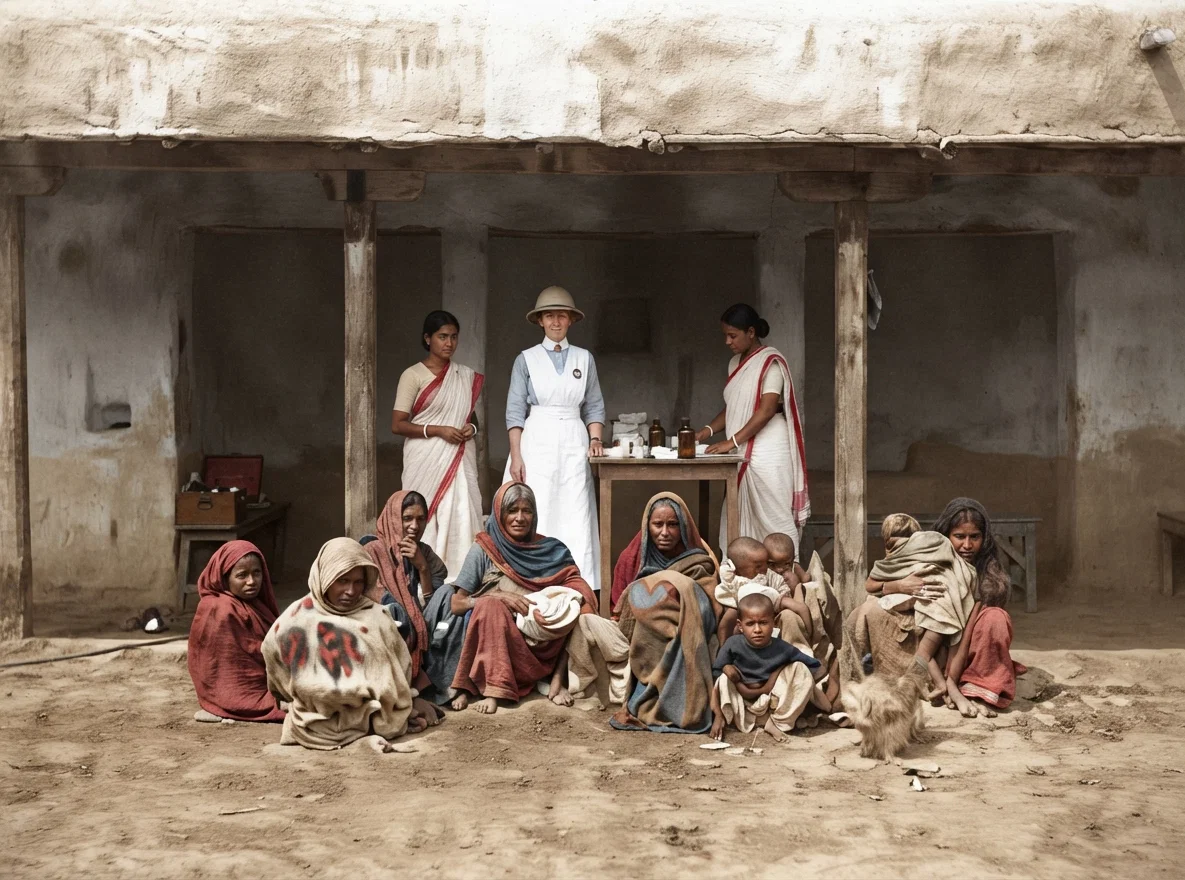
Our dispensary at Lucknow. Some of the patients may be seen in the foreground. In the back are Dr. Shryock and her two Bengali assistants.
Prof. W. W. Prescott from the General Conference was present, and gave most helpful Bible studies morning and evening throughout the conference. These studies particularly emphasized the strong, fundamental principles of Christianity and the necessity of a living experience in the things of God.
On the last Friday of the conference a memorial service was held in remembrance of our dear brother Elder J. C. Little, who died August 10 of cholera. The Lord drew very near, and altho we could not understand why our able young brother should be taken from the work he loved so well, still we closed up the ranks with courage, determined to work more earnestly than ever before for the finishing of the work. Elder J. L. Shaw was re-elected as superintendent of the field, and the workers returned home to work with renewed energy.
GEORGE F. ENOCH.
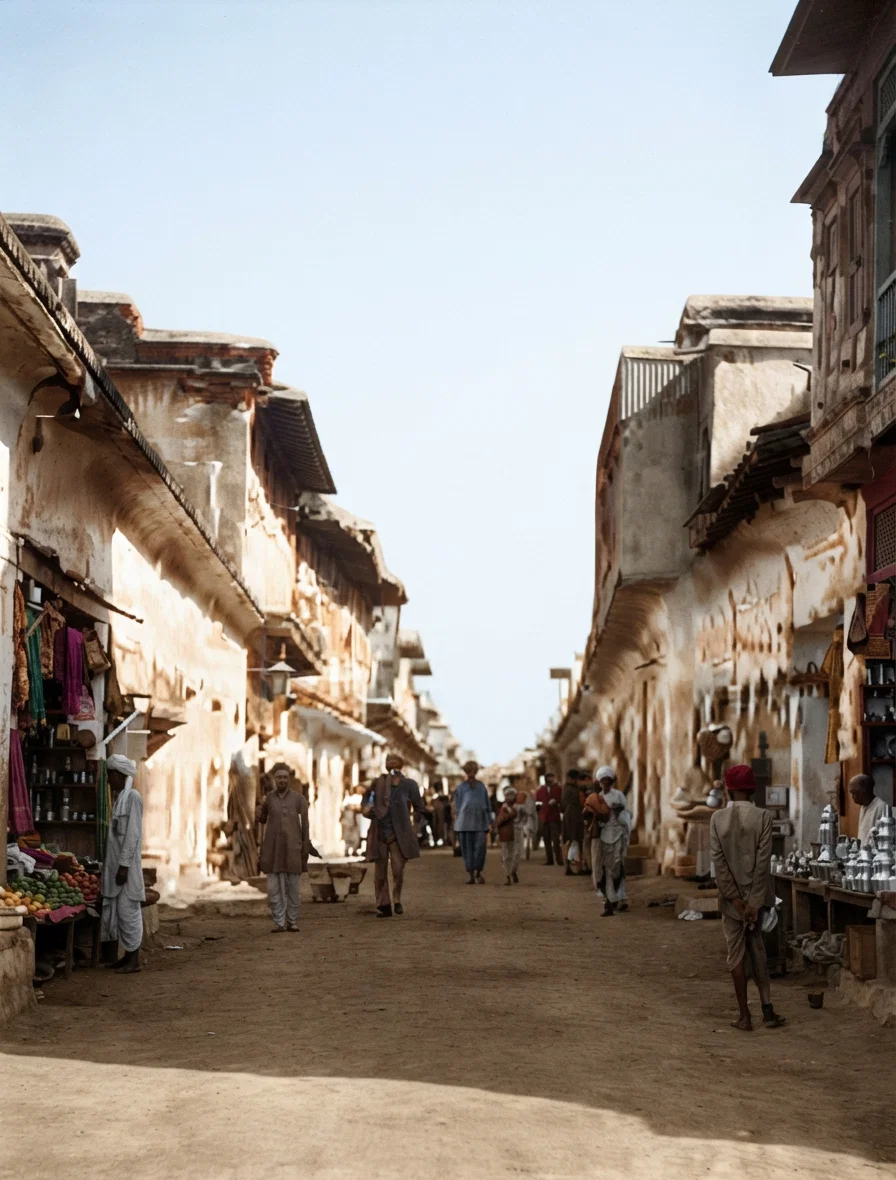
The main street in Najibabad. It is about one fourth of a mile long, and lined on either side with native shops. It is an exceptionally clean street.
More from India
By Editor
[The following is from Mr. Sterrie Wellman, of Lucknow, India, taken from a letter written to his uncle, Mr. George Wellman, of Mountain View.]
AT our conference this year the territory was divided up into five missions. Of these the one that we are working in is the largest, and the population of our portion is something over 120,000,000 souls. We have for the work in this part of the field at the present time just two European workers, with their wives, four lady workers, and seven native workers, five men and two women. This would not be considered much of a force in all the United States. We are calling for one more worker and his wife, and hope to have that much granted; but it should be ten at the least.
In this mission there are five languages, the Hindustani, the Rajasthani, the Banjabi, the Behari, and the Sindhi. The territory covers all the north of India, some of Central India, and well into the province of Bengal. So you will see that we have a large territory as well as a large population. In our territory are to be located the sanitarium and the school and the publishing work. These will, however, mean but little help to us except through influence, as the workers do not speak the language, and without it they are unable to do anything except for the European and Eurasian population.
In our work one of our best ways of presenting the truth to the people is to get a stereopticon and give them the picture of the Bible life and story and then talk upon the subject presented. This is done in many of the missions and with good success.
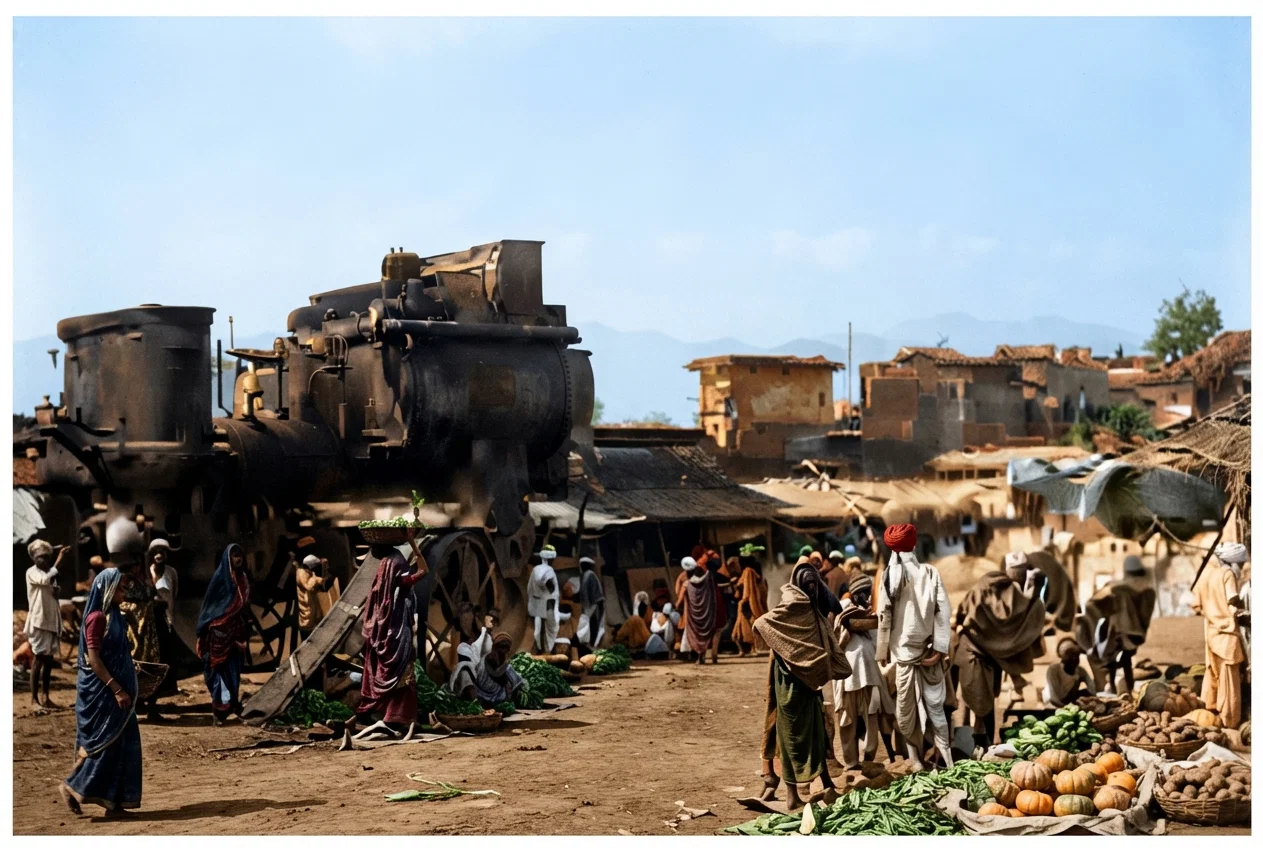
This is the vegetable market in Najibabad, United Provinces. It is a native city of 20,000 inhabitants, 364 miles north and west of Lucknow, near the Himalayas.
In this place we have a dispensary and a girls' school. The sisters that are connected with this dispensary are Miss Shryock and Miss Kurtz with their native assistants. They are in the midst of a plague-infected district. That is, this winter the plague is raging, eight and sometimes more dying during a day; and they are working on in the midst of it all, trying to relieve the suffering of the people and reach their souls. We had expected to be there also, but the brethren voted against it because of my sickness. You see the only house that we could get was in the midst of a native quarter, and surrounded, as is the case in all the native towns, with the homes of the people of the country. Filth abounds, and as a consequence disease also. It is very possible that before the winter is over the disease will become so bad that we will have to recall the young ladies as well from the station temporarily. If we had the proper quarters of our own, outside the town, where we would be able to control the surroundings and keep things clean, both ourselves and the other workers would have been able to remain for the entire winter. We are all anxious for the time to come when the $300,000 fund will be raised and we be able to have homes from which we can work safely, or that is, as safely as it is possible in this land, all the year round.