Putnam's Early Career—At Fort Edward—The Indian Ambush—Disobedience of Orders—The Result—The Burning Barracks—How Putnam Saved the Magazine—Putnam a Prisoner—Indian Barbarity—Saved from the Stake—Exchange at Montreal—Meets His Captor Again.
THE French and Indian War, while the most important event in the history of the American colonies, had nothing immediately to do with the history of the United States of America. It had much to do with it in its consequences, but we are here concerned only with those consequences, not with the events of the war itself. It had, however, its direct bearing upon the history of the great republic in introducing to the world some of the leading personages to whom that republic owed its origin. With the first public services of two of these, Benjamin Franklin and George Washington, we have already dealt. A third revolutionary character first sprang into notice during the French and Indian War. Israel Putnam, a man distinguished for boldness and daring, the hero of Horseneck in the Revolution, and of equally desperate deeds in the earlier war. The history of America has no romance surpassing that of Putnam's life, and we propose to tell here some of the events of his early career.
The romance of the war gathered largely around the mountain-girled, island-studded Lake George, one of the most beautiful bodies of water in the Atlantic States. Here was Fort William Henry, the scene of a memorable Indian massacre. Here was Fort Ticonderoga, the scene of a disastrous battle, and of the later striking exploit of Ethan Allen and his Green Mountain boys. The story of the vicinity of this picturesque lake is laden with romantic incident, and in this story Israel Putnam played a prominent part.
It was Indian warfare with which he had to deal, warfare conducted with all the cunning and treachery in which the dusky warriors of the American woods were such adepts. After the massacre at Fort William Henry,8and the concentration of the English forces at Fort Edward, on the headwaters of the Hudson, Major Putnam, in command of a corps of rangers, occupied an outpost on a small island near the fort. It was a location well suited for adventure, and adventure came.
A party had been sent into the neighboring forest to cut timber, for the purpose of strengthening the fort. They were guarded by a body of fifty soldiers, who were stationed on a narrow ridge, with a morass on one side and a creek on the other. Behind them lay the fort; before them the forest. As day was breaking one morning, a soldier who was stationed as a sentinel on the edge of the morass, saw in the misty light what seemed a flight of birds coming up from the leafy hollow. Over his head flew several of these objects, and at length one of them seemed to cling to a neighboring trunk. The drowsy sentinel opened his eyes wide in alarm. The bird was winged and pointed. It flew from an Indian bow. Below him lay an ambush of savages, who were trying to pick him off with an arrow without giving the alarm.
The gun of the sentinel instantly rang out its warning note, and, as if awakened by the sound, a host of lurking savages sprang up from bush and dale, and rushed fiercely on the unarmed laborers, shooting and tomahawking all within reach. The soldiers hastened to the rescue, but found themselves in the face of such numbers that the whole party was in danger of being cut off. A messenger was sent in all haste to General Lyman, at the fort. But the aid asked for was not sent. The cautious commander, thinking that the whole French and Indian army was upon him, hastily drew in his outposts, closed the gates, and left the wood-cutters and their support to their fate.
Fortunately Putnam, from his island, heard the musketry. His scouts brought him word of the danger of Captain Little and his men. In an instant the gallant major plunged into the stream, calling to his men to follow. They did so in all haste, and in a few minutes the rangers were hurrying past the walls of the fort towards the distant forest. General Lyman stood on the parapet. "Halt!" he cried. "Come into the fort. The enemy is in overwhelming force. We can spare no more men."
For once in his life Putnam disobeyed the orders of his superior. Muttering a vague reply, and waiting for no further order, he dashed on. Brave men were struggling for their lives with the savage foe. It was no time for prudence or delay. A few minutes brought the rangers to where the regulars were holding their ground with difficulty.
"They will shoot us down here," cried Putnam. "Forward, and rout them from their ambush."
Into the morass the party boldly charged, and soon found themselves face to face with the concealed foe. So sudden and fierce was their charge that the Indians, surprised in their turn, broke and fled in sudden panic, hotly pursued by the revengeful rangers. Many of them fell, and the chase was kept up for miles into the forest.
Putnam returned by no means easy in mind. He had openly disobeyed orders, and expected at the least a reprimand, possibly a court martial. Fortunately, General Lyman proved a man of sense. He saw that alarm had carried him too far, and was wise enough to meet the party with hearty praise, and to forget that Putnam had been guilty of a flagrant disregard of military duty. He doubtless remembered that this insubordination had saved him from the awkward charge of exposing a party of brave men to destruction.
An excitement of different character occurred shortly afterward, one in which the energy, promptness and decision shown by Major Putnam have become historically famous. The barracks within the fort took fire, and burned so furiously that they were soon past saving. Only twelve feet away stood the magazine stored with 300 barrels of gunpowder. The garrison was in a state of panic, little of service was being done; the fort and all within it were in imminent peril.
Putnam saw the flames and smoke from his island outpost, and hastened to the fort. It took him scarce a minute to organize a line of soldiers from the barracks to the river, each with a basket. Mounted on a ladder, he received the water as it came and poured it on the flames. He suffered severely while doing so. So intense was the heat that the mittens he wore were quickly burned from his hands. He called for another pair, dipped them into the water, and continued to fight the fire.
"Come down," cried the colonel. "It is too dangerous there. We must try some other means."
"There are no means but to fight the flames inch by inch," replied Putnam. "A moment's delay might be ruinous."
Despite his utmost efforts the fire spread. Only a few thin boards lay between the garrison and destruction. But Putnam worked with unflagging energy. His fearlessness gave courage and activity to the soldiers.
"If we must be blown up, we will all go together," said the colonel heroically.
Finally the rafters of the barracks fell in, the heat decreased, the timbers of the magazine, drenched with a continual stream, were saved from the flames; the danger was at an end.
But the indomitable Putnam was in a pitiable state. He had fought the fire for an hour and a half, and was seriously scorched and blistered by the heat. On pulling off the second pair of gloves the skin of his hands came with them. Several weeks passed before he recovered from the effects of the frightful exposure. But he had saved the fort and all within it, and had such solace in his pain as the heartfelt thanks and attentions of officers and men alike could give.
There is one further adventure of the gallant Putnam to relate. It is a thrilling example of the barbarity with which the Indians treated their captives. Putnam had the misfortune to be taken prisoner by his savage foes, and very narrowly escaped death at their hands.
In August, 1758, he and Major Rogers, while out on a scouting expedition, fell into an ambuscade of French and Indians. During the fight that followed his gun missed fire, and he was taken prisoner by a powerful Indian. He was disarmed and bound to a tree, while his captor returned to the fight.
Putnam's position was now one of great peril. As the battle continued the tree to which he was bound stood between the lines, and the bullets of both parties flew past him. The tree was frequently struck, and more than one ball pierced his clothes. In the end the provincials triumphed. But they failed to rescue Putnam. His captor untied him and forced him to accompany the retreating party. After they had gone some distance the most of his clothes were taken from him, he was loaded heavily with the packs of the wounded, and his wrists were tied very tightly behind him. Thus they walked for miles through the woods before the party halted to rest.
By this time Putnam was in a pitiable state. His shoes had been taken from him, and his feet were badly bleeding. His hands were so swollen with the tightness of the cord that the pain was intolerable. Afterward the Indian who had captured him, and who had been absent with the wounded, came up and expressed himself as indignant at his cruel treatment. He gave him a pair of moccasins, and seemed disposed to treat him kindly. Unluckily for Putnam, his captor was obliged to return to the wounded, leaving him in the hands of the other Indians. They resumed their barbarity, one of them striking him with a tomahawk and cutting a deep gash in his cheek. They purposed to burn him alive, stripped him of his remaining clothes, and bound him to a tree, and heaped fuel around him, and set it on fire. Fortunately, before the flames could spread far, a sudden shower poured downward through the trees, extinguished the fire, and dampened the fuel. The rain had no sooner ceased than efforts were made to kindle a flame again. The wet wood resisted, but at length the flames caught, and slowly made their way around the fatal circle. The captive soon felt the scorching heat, and moved his body to escape the pain, an evidence of nervousness that was greeted with exulting yells by the savage crew.
The last moment of the brave Putnam seemed at hand. He strove to bear the pain calmly, and to bring his thoughts to bear on higher things than those of earth. Luckily relief was at hand. At the critical moment a French officer burst through the exulting band, kicked the blazing brands aside, and with a quick stroke of his knife, set the prisoner free. It was Molang, the leader of the French, whom an Indian had told of the horrid purpose of his companions. With a severe reprimand to the savages, Molang led the prisoner away, and kept him by his side till he could restore him to his captor. This savage treated him with kindness, gave him some soaked biscuits to eat, his mouth being in such a state that he could not masticate food. But he took extraordinary care to prevent his escape. The next night the party reached Ticonderoga, where the sufferings of the captive came to an end. He was subsequently sent to Montreal, and was included in an exchange, the French supposing him from his pitiable condition to be old and useless. Had the French known the man they held, he would certainly have continued in custody till the end of the war.
Putnam afterward met his Indian captor at Montreal. The savage was delighted to see him, and treated him with the utmost hospitality. He met the old chief once more in the Pontiac War. He was now on the English side, and the ancient captor and prisoner now marched in amity side by side, the best of friends.
Watchfulness and Prayerfulness
By Alexander Maclaren
WATCHFULNESS and prayerfulness are inseparable. The one discerns dangers; the other arms against them. Watchfulness keeps us prayerful and prayerfulness keeps us watchful.—Alexander Maclaren, D.D.
Godliness with Contentment
"GODLINESS with contentment is great gain," and this particular source of gain need not be scheduled among the items of the income tax blank.—New York Observer.
UNITED STATES COURTS IN A NEW ROLE.
THERE is a remarkable tendency toward the centralization of the powers of our government in the courts. It is coming to be deemed anarchy to even criticize court decisions, especially the decisions of the United States Supreme Court. That tribunal is now quite commonly designated "the highest authority in the land," notwithstanding the basic theory of our government that the primary authority is vested in the people. A case has arisen in Georgia, which involves an entirely new feature of judicial prerogative. The case has grown out of a rate war between two transportation systems—the Seaboard Air Line and the Southern States Freight Association.
The details of the case are too lengthy and complicated for reproduction here. The cut rates being set on through freight to Atlanta, and not to other cities nearer the seaboard market, the merchants of that city had a decided advantage over those of Augusta and Macon. So, in addition to the quarrel between the transportation lines, the injured merchants also had a grievance. The Interstate Commerce law provides that it shall be unlawful for any common carrier subject to the provisions of the act, to give any undue preference to any particular person or concern or locality, or to any such undue prejudice or disadvantage. It also gives the Circuit Courts of the United States the power to issue writs of mandamus in cases where, according to the relation of parties concerned, a violation of the law has been made. While U. S. District Judge Simonton granted a temporary injunction against the cut rates, in a suit brought by the Port Royal and Augusta Railroad as a matter of self-defense, Judge Speer, of the District Court at Augusta, granted an injunction upon complaint of the Wholesale Grocers' Association, of Augusta.
The remarkable feature of the judgment is that the competing companies are ordered to raise the rates to Atlanta. This new and peculiar principle of judicial ruling is thus commented upon by the News and Observer, of Raleigh, N. C.:—
"Extraordinary Use of Power by the Courts.—It has never hitherto been even contended that the courts had any power to pass upon railroad rates except when it was complained that the rates fixed by statute, or by a railroad commission under authority of a statute, were oppressive. The only power claimed by the courts was to supervise the legislative action, and that power was so doubtful that in all the cases which have come before the Supreme Court of the Union, while the court has more or less plainly claimed this power of supervision, in not a single case has it ever in fact exercised the alleged power by holding the rates fixed by the Legislature (or by a railroad commission) to be too low. But the action of Judge Simonton and Judge Speer in granting temporary injunctions against a railroad fixing its own rates is an astonishing performance, and absolutely without precedent or reason to sustain them.
"Heretofore the corporations at first denied that even the people, acting through their representatives, could fix a maximum rate, but when that power was sustained, the corporations succeeded in getting the courts to hold that the courts had a veto or supervisory power upon the legislative action. Now, they go further, and the corporations get the courts to hold, not by way of passing upon the effect of a statute, but ex proprio vigore that a judge is vested with the power of passing upon rates fixed by a railroad for itself. If the judge can say such rates are too low, of course he is master of the whole subject, and can say they are too high. If this is true, then there is no need of railroad commissioners, and the Legislature itself is traveling out of its jurisdiction to fix rates. The power of fixing rates is also equally taken away from railroad boards and managers. The judges will hereafter say what rates are too high and what are too low, and we have in effect 'government ownership of railways.' It is already here if the courts have such power."
A SEPARATED LIFE.
By D. L. Moody
I BELIEVE that a Christian man should lead a separated life. The line between the church and the world is almost obliterated to-day. I have no sympathy with the idea that you must hunt up an old musty church record in order to find out whether a man is a member of the church or not. A man ought to live so that everybody will know he is a Christian. If there are certain things in your university which are detrimental to your Christian profession, you say, "No, sir."
In London they used to have a good deal of drinking among church members. Some time ago when I was there I was invited to a late supper at the house of a Christian man prominent in the Sunday school. I was going to meet some Sunday school friends, and I expected a real religious time. To my amazement they had seven kinds of liquor, and they drank until I should call them drunk, but they would have considered it a great insult if I had said so. There was a lady sitting next to me who kept refusing, and the deacon kept urging it upon her until her cheeks became quite red.
I finally said that they would have to excuse me. I left the table, and the host followed me upstairs. He wanted to know the trouble. I said:—
"There is too much drinking; I can't stand it."
He said, "You're not a gentleman."
I went out of the house, and the next time I went to London I heard it whispered around what an ungentlemanly thing I had done. But I tell you, when I had an opportunity10of speaking in London I thundered against that thing until they put it away—when I was about at least.
The Bible tells us to lead a separate life. You may lose influence, but you will gain it at the same time. I suppose Daniel was the most unpopular man in Babylon at a certain time, but, thank God, he has outlived all the other men of his time. Who were the chief men of Babylon? When God wanted any work done in Babylon he knew where to find some one to do it.
You can be in the world, but not of it. Christ didn't take his disciples out of the world, but he prayed that they might be kept from evil. A ship in the water is all right, but when the water gets into the ship, then look out. The world in a Christian is just like a wrecked vessel at sea.—D. L. Moody.
THE PRESS AND THE ROMAN CHURCH.
By W. N. G.
TEN years ago Henry F. Durant, founder of Wellesley College, predicted that in less than twenty years the leading journals of our country would be in the hands, or under the control, of the Papal Church. At this early day it may be said the prophecy is fulfilled. Professor Townsend, of Boston, says:—
'Recently there has been published the fact that the Catholic Truth Society is 'to beg, borrow or buy space in the secular papers, the dailies, weeklies and monthlies,' all over the civilized globe, that it may thereby defend and extol the Papacy. Another purpose of this society is to overrun newspaper offices with Roman Catholic employees. Another is to control, in a quiet way, the utterances of those publications which are owned and controlled by men who are nominally Protestants.'
The extended notice which is given to all Catholic matters in the leading newspapers, is a subject of general remark. That the doings of this church receive so much more elaborate press notice than all other churches combined, shows one of two things,—either that the Romanists have a greater influence with the press than other denominations, or that the Papal Church is more lavish in the expenditure of means for newspaper space. The secretary of the above-mentioned Catholic Truth Society said, at the World's Columbian Catholic Congress, that 'one of the objects of the society is the publication of short, timely articles in the secular press (to be paid for, if necessary) on Catholic doctrines.'
The influence of the Catholic Church with the press is in part accounted for in the fact that Catholics, of whatever standing or calling, always have in view the interest of the church. Protestant politicians and Protestant business men, often cater to the interests of the Catholic Church for political or business gain. But it is a rare thing for a Catholic in any position, to favor Protestantism in any way. Consequently Catholic patronage always, if possible, is extended to the individual or the institution that favors Catholic interests. Newspaper men know that Catholic patronage depends upon favors to the church, either in elaborate notice, or in suppression of disagreeable or deteriorating news concerning the church. They know that Protestant patronage is not so sensitive, hence the newspapers are made to cater to the Catholic good will. It was stated at the Catholic Congress, that on most of our great dailies there were Catholic writers and reporters, and Catholics in the business departments, who were ever on the alert to further the cause of Catholicism.
It is not only so in the United States, but also in nominally Protestant England. The London Weekly Register says:—
'There is not in London a single newspaper of which some of the leading reporters and one or more of the chief persons on its staff are not Roman Catholics.'
To this testimony may be added that of the Catholic Times, which is indeed significant. It says:—
'The number of Catholic journalists in London is very large. The anti-papal Punch has its F. C. Barnard, who was at one time on the point of entering the priesthood; and even the Standard, which was established with the special intention of attacking the Catholic religion, now includes Catholics on its staff. On the Times, Morning News and the Daily Chronicle, Catholic pens are at work; also on the Saturday Review, the Spectator, and lighter weeklies, such as the World. The monthly magazines have many contributors of the same creed.'
All of which is very significant. W. N. G.
BOYS THAT ARE WANTED
By Carlotta Perry
"That our sons may be as plants grown up in their youth that our daughters may be as corner-stones, polished after the similitude of a palace."
BOYS THAT ARE WANTED.
"WANTED—boys," this want I find
As the city's wants I read of.
And that is so,—there's a certain kind
Of boys that the world has need of.
The boys that are wanted are steady boys,
Unselfish, true and tender;
Holding more dear the sweet home joys
Than the club or the ballroom's splendor.
Boys who have eyes for the sister's grace,
Swift hands for the household duty;
Who see in the mother's patient face
The highest, holiest beauty.
Boys of earnest and noble aim,
The friends of the poor and lowly;
To whom forever a woman's name
Is something sacred and holy.
Boys are wanted whose breaths are sweet,
The pure air undefiling;
Who scorn all falsehood and smooth deceit
That lead to a soul beguiling.
Boys who in scenes that are glad and bright
Feel their pulses beat the faster,
But who hold each animal appetite
As servant and not as master.
Boys are wanted whose strength can lead,
The weaker upon them leaning;
Boys whose "No" is a "No" indeed,
And whose "Yes" has an equal meaning.
Who are strong, not only when life decrees
Its bitter and heavy trials,
But can practice its small economies,
And its every-day self-denials.
—Carlotta Perry.
Ministers and Public Affairs
Whether a citizen's views in regard to county affairs are entitled to more than ordinary consideration because he is a minister of the Gospel, is a question which the board of supervisors of Alameda County, Cal., are called upon to decide. That pool-selling at race-tracks is gambling, there is no doubt, but that protests against granting the privilege should have any more weight coming from clergymen than from the same men without reference to their calling, is an error. Yet the Methodist ministers, not only of Alameda County but of San Francisco, assume that the board of supervisors of said county should heed their protest because they are ministers. Admit this principle even in a good cause, and the door is open for ministerial rule in public affairs whether their demands be proper or improper.
DON'TS FOR MOTHERS.
Don't try to do two days' work in one, and, in your home making, beware lest you become a veritable fiend of neatness.
If work you must, simplify your duties, so that they will not prove a weariness to the flesh. Never stand when you can sit down. When waiting at the counter for change, why neglect the stool close at hand? It is only a matter of five minutes, perhaps, but it may be five minutes too long, and then, how your poor tired back rebels!
Don't save horse-car fare for the sake of taking home a bag of candy. It is a foolish woman who will squander her pennies on trash, and then walk her legs nearly off to make up the deficit.
Don't try to do without your lunch when the hour arrives, no matter how long and discouraging your shopping list may be.
In short, strive not to be an amateur in the art of caring for yourself, but in the details of life look well to it that they are made subservient to your womanly needs.—Selected.
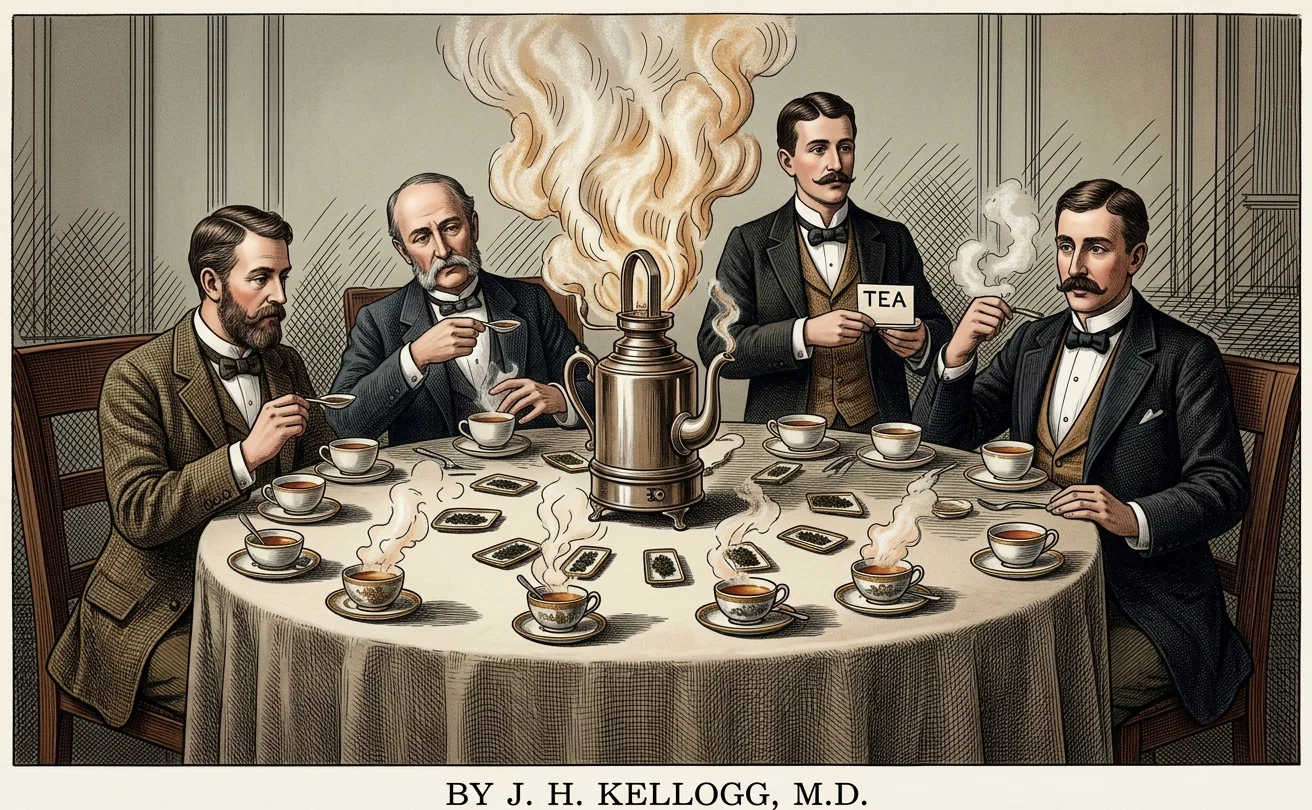
The Dangers of Tea-Tasting
BY J. H. KELLOGG, M.D.
The picture shows a number of men sitting at a table engaged in the business of "tea-tasting." When a ship-load of tea comes into New York from China, samples of all the different lots of tea on board are placed in the hands of professional tea-tasters. It is the business of these men to examine all these samples by making a little tea from each lot and tasting it.
Possibly some tea-loving reader is inclined to envy the tea-taster, who has nothing to do all day but sip his dainty cups of tea. Wait a moment and learn more about these tea-tasters before you wish yourself one of them. Some years ago, Dr. Morton, an eminent New York physician, investigated the business of tea-tasting and its effects upon those engaged in it. After some months' study of the subject he made a report of the results before a body of learned physicians, from which we quote the following:—
"The pernicious effects of tea-tasting upon many of its followers are well recognized by all their number. It seems to be accepted among them, without discussion, that many break down and are obliged to give up the business, or else pursue it with much caution and at constant inconvenience to their health. And those of the public who are at all familiar with the facts, entertain the same view. Indeed, I may say that if I were now to express an opinion, based upon my present, it is true not yet sufficiently extensive information upon the subject, I should feel inclined to say that no one engages for several years in the profession of 'tea-tasting' without suffering both immediate and permanent harm to health.
"This feeling is well illustrated in the remark of a prominent wealthy tea merchant, who said, 'I would rather give a hundred thousand dollars than have my son become a tea-taster.'
"At first glance, to witness the operation of tasting, it would hardly seem possible that the very small amount of tea used at any one time could result in harm. This amount is only equal in weight to a five-cent piece, about fifteen grains. About two ounces of well-boiled water are turned onto this, and the infusion is allowed to 'draw,' perhaps fifteen minutes. Of this infusion the taster takes but a few spoonfuls into his mouth, and often spits it out again; he also at intervals inhales the steam. But the harm comes, of course, from the constant repetition of these acts.
"The cases which I propose to relate exhibit the extreme physiological action of an infusion of tea. They are cases of acknowledged excess; and in this lies their interest, for by familiarity with the symptoms of excess, we shall be able to thread our way back to those of moderation, and to point out, it may be, that what many perhaps consider moderation is, in reality, abuse, and that certain symptoms put down as 'nervousness,' 'nervous irritability,' and 'nervous exhaustion,' as well as the more clearly-defined ailments of dyspepsia, hypochondria and hyperemia, may sometimes be attributed to the misuse of a common domestic beverage. Indeed, I am forced to think that many people, unconsciously to themselves and to their physicians, suffer from a train of symptoms due to tea (or its congener, coffee). We often find people taking tea to relieve the very set of symptoms which the abuse, as will be shown later, produces; and it is often the fact that patients date their recovery from a dyspepsia or nerve exhaustion from the time when they gave up their tea."
Dr. Morton gives the following description of a tea-taster, which portrays in a most graphic manner the acute and chronic effects of poisoning with this drug:—
"The immediate effects upon him are as follows: In about ten minutes the face becomes flushed, the whole body feels warm or heated, and a sort of intellectual intoxication comes on, much the same in character, it would seem, as that which occurs in the rarefied air of a mountain. He feels elated, exhilarated, troubles and cares vanish, everything seems bright and cheerful, his body feels light and elastic, his mind clear, his ideas abundant, vivid, and flowing fluently into words.
"At the end of about an hour's tasting a slight reaction begins to set in; some headache comes on; the face feels wrinkled and shriveled, particularly about the eyes, which also get dark under the lids.
"At the end of two hours this reaction has become fully established, the flushed, warm feeling has passed off, the hands and feet are cold, a nervous tremor comes on, accompanied with great mental depression. And he is now so excitable that every noise startles him; he is in a state of complete unrest and mental exhaustion; he has no courage to do anything; he can neither walk nor sit down, owing to his mental condition, and he settles into a complete gloom. His body in the meanwhile does not feel weary. Copious and frequent urination is always present, as also certain dyspeptic symptoms, such as eructations of wind, sour taste, and others.
"The above-described immediate effects follow a single afternoon's tea-tasting. They may be summed up briefly as: Excited circulation, intellectual intoxication, with actual increased vigor of mind power, increased urination; then a period of collapse indicated by cold extremities, tremulousness, mental irritability and anxiety. It will be several days before this condition of affairs is amended. And at this time the temptation to take alcoholic stimulants is very strong."
Dr. Richardson, the eminent English physician and sanitarian, speaks upon this subject as follows:—
"The extremely injurious effects of tea are best seen in some of those who are charged with the commercial duty of 'tea-tasting.' A professed 'tea-taster' who was so seriously affected by the process that he thought it proper to consult me on the symptoms induced, defined the symptoms very clearly as follows: 'Deficiency of saliva, destruction of taste for food, biliousness, nausea, constipation, an extreme and undefinable nervousness, and nightmare whenever sleep is obtained.'
"The symptoms from which habitual tea-drinkers suffer are identical in character, but minor in degree."
The tea-taster's experience should be a warning to all tea-drinkers. The fact that the use of weak tea does not produce all the effects described does not prove it to be harmless, any more than the same argument proves wine, beer, and hard cider to be wholesome and innocent beverages.
LEAN MEAT DIET UNSAFE.
IN view of the fact that not a few physicians, some of whom claim to be "advanced," or truly "eclectic," advocate the lean meat diet, we believe our readers will be glad to know what the Medical Progress has to say of the matter from a scientific point of view:—
The truth seems to be that a person subsisting upon a lean-meat diet, while he may manifest a greater amount of strength than upon more natural dietary, and may be unconscious of any abnormal condition, is like a person in a powder magazine—he is in constant danger of vital catastrophe. The poison-destroying functions of his liver and the poisoning-eliminating capacity of his kidneys are taxed to their utmost to keep the proportion of ptomains and leucomains in the tissues down to a point which permits of the performance of the vital functions. The margin of safety, which nature has wisely made very large in order to provide for emergencies, is reduced to the narrowest possible limit, so that anything which temporarily interferes with the functions of the liver or the kidneys, or which imposes additional work upon them, may be sufficient to obliterate the safety margin, and produce an attack of grave or fatal disease. Invasion of the body by ptomain-producing microbes, such as the typhoid bacillus, the bacillus of diphtheria, the pneumococcus of Friedländer, the shocks resulting from accident, and even the depression of a severe cold, may be sufficient to consume the meager emergency capital, and the result is acute inflammation of the kidneys, or death under chloroform or from shock following an operation under anesthesia.
THE QUILT'S MESSAGE.
A poor boy lay ill in a southern hospital. Over him was a quilt made of bits of calico and white squares, on which were written texts of Scripture. It was the gift of a northern woman whose son was in the army. The boy was seen to kiss over and over a bit of the calico, a crimson leaf with a dark background. They thought his mind wandered. After a little he asked: "Where did the quilt come from?" "It was sent by a good woman with a note pinned to it." At his request, they brought the note. His hand trembled and his cheek grew white as he saw the writing. "Read it slowly, please," he said, "it is from my mother; that bit of calico was part of her dress." When they finished he pointed to the text: "I have sinned, and am no more worthy." They read the parable to him. A few days afterward, he said: "I was a great way off, but God met me, had compassion on me, and his love fills me with peace."—New York Observer.
TO CLEAN A BRUSSELS CARPET.
FIRST have the carpet well shaken, then tack it down in the room where it is to remain, and sweep it as thoroughly as possible. Take a pail of hot water, put in two tablespoonfuls of powdered borax; wash the carpet all over the surface, using a flannel cloth. For grease-spots or very dirty places, use a scrubbing-brush freely, and a very little soap, taking care to rinse the soap off well after scrubbing. Change the water quite often. Rub the carpet well after washing, with a dry cloth, and open the doors and windows so as to dry it as quickly as possible.—Sel.
Alphabets
ALPHABETS.—The alphabets of the different nations contain the following number of letters: English 26, French 23, Italian 20, Spanish 27, German 26, Sclavonian 27, Russian 41, Latin 22, Greek 24, Hebrew 22, Arabic 28, Persian 32, Turkish 33, Sanscrit 50, Chinese 214.