ON account of failing health, Brother and Sister Kneeland have been compelled to return from British Guiana.
THE present officers of the Maine Conference are: President, H. C. Basney; secretary and treasurer, Eliza H. Morton.
A LETTER from London states that "Sabbath schools are springing up all over Great Britain; new ones are reported every quarter."
THE fact is being impressed upon our laborers that in the main more effectual labor can be done by house-to-house work and a judicious use of literature than by public services.
AS a result of labor among the Germans at Ackley, Iowa, by Brother Martin Stuckrath, seven persons have accepted the Sabbath of the Lord, and a Sabbath school has been organized.
IN the midst of the turmoil of local riots and the perplexity of nations regarding Turkey, a Seventh-day Adventist Bible school is being conducted in Constantinople, and, under the providence of God, is unmolested.
THE camp-meeting recently held at Sacramento, Cal., was not as conspicuous in the matter of numbers as some of the earlier meetings, but those who attended report a very profitable occasion. The outside attendance was larger at the close than at the beginning.
OUR Sabbath schools where this paper is received prior to Sabbath, the 24th inst., are again reminded that the donations for that day go to the support of the work of the International Tract Society. They are also reminded that there is need of a liberal donation, for the work is pressing.
OUR London paper, the Present Truth, says: "We hear that the medical missionary of our society in Rarotonga has been requested to take charge of the government hospital in that island, which will doubtless give him better facilities for carrying on his work for the suffering, bodily and spiritually."
FRIENDS of the cause in Des Moines, Iowa, have forwarded a large box to Oakwood Industrial School at Huntsville, Ala., containing sheets, pillows, pillow-cases, comforts, table-cloths, towels, clothing, and dried fruit; also a washing machine, cooking utensils, etc. We learn that the Davenport friends are doing likewise. The Iowa brethren have a special interest in the school, from the fact that Brother S. M. Jacobs, superintendent of the institution, was a former pillar in that conference.
CAMP-MEETING AT LOS ANGELES.
THE camp-meeting at Los Angeles will be held October 29 to November 8.
The prices for tents at this meeting are as follows: Tents 10x12, $2.50; fly, 50 cents; carpet, 50 cents.
Tents 12x16, $3.50; fly, 75 cents; carpet, 75 cents. Tents 14x19, $4.50; fly, 75 cents; carpet, 75 cents.12Those desiring tents for this meeting should order from Elder W. T. Knox, 1427 Temple Street, Los Angeles, Cal. Orders should be sent in at once.
One and one-third rates for the round trip have been secured for this meeting, over the Southern Pacific and Santa Fé railways, from all points in Southern California, on the certificate plan. Certificates, which may be obtained at all stations, should be called for when tickets are purchased. Pay full fare for the ticket to the meeting and obtain certificate. The certificate, and nothing else, will entitle you to one-third regular fare on return. For further information address Elder W. T. Knox as above.
Shining as the Stars
“AND those who have wisely taught shall shine as the brightness of the firmament; and those who have turned many to righteousness, as the stars forever and ever.” Dan. 12:3, Boothroyd.
MORE LIKE THEE.
By A. R. WILCOX
BY A. R. WILCOX.
EACH day of life I'd know
Full more and more of Thee,
Yet in myself alone
Not one good thing I see.
It is with Christ our Lord,
With every tho't intent,
That we must truly walk,
With hearts in meekness bent.
While traveling thus, we may
Our warmest love confess,
Receiving day by day
The Spirit's sweet impress,
New strength each moment find
To grow from grace to grace,
Be changed by his own life
By seeing e'er his face.
Athens, Vt.
PERSIA AND THE PERSIANS.
IN Persia, as in Turkey, work among the Moslems is practically prohibited by the government, and in consequence attention is chiefly given to the Nestorians and Armenians. The name "Nestorian" was given to them by their enemies as a term of reproach. They speak of themselves as Beni-Israel. The Jews residing among them acknowledge them as the descendants of the Ten Tribes, converted (the Jews say apostatized) to Christ, as a nation, in the time of Christ and his apostles. Their history and descent is unbroken from that time to this. The way they have been preserved in their mountain fastnesses, in the presence of and surrounded by their enemies, and kept a separate people, is one of the most marvelous and romantic chapters of history.
The first permanent work was started in Persia in 1871 by the Church Missionary Society. The only other society here is that of the American Presbyterians in the north. The Reformed (Dutch) Church has a station at Busrah, on the border of Persia, for work among the Arabs.
The Bâbi faith is an important element in the work of evangelization. The Bâbis are a Mohammedan sect, but friendly to Christianity, having borrowed many doctrines from it. Islam seems to be losing its hold on Persia. The increase in the sale of the Scriptures indicates a growing interest in the Gospel. Medical work plays a very important part in the work of evangelization. People flock to the mission hospitals in large numbers, but often their eagerness for spiritual instruction is greater than for medical aid. Belief in Christ as the only Saviour is spreading even among the Moslems, tho often secretly.
The condition of women, as in other Moslem lands, is pitiable in the extreme. There is no home life. Polygamy has destroyed the Persian morality, if there ever was any, and the children grow up accustomed to the language and scenes of a brothel.
It is still too early to predict the effect upon the mission work of the coming of the new shah to the throne. He is said to be less enlightened, but more indifferent, than his predecessor.—Missionary Review.
MOHURRUM CELEBRATIONS.
THE Indian Witness, published at Calcutta, June 20, says: "The din of the Mohurrum fills the air. Lamentations for the fate of two men who were slain in battle twelve hundred and sixteen years ago, and elaborate celebration of commemorative funeral rites, have taken complete possession of the Sheah Mohammedans. Sunni Mohammedans are supposed to have nothing to do with the Mohurrum celebrations. Yet such is the influence of numbers, and the contagion of feeling that many orthodox Mohammedans and a large number of Hindus are drawn into the current, and join in the wail of Hussain, Hussain, weep at the recital of the Mercia, and follow the tomb of Hussain to the grave. The tenth of the month Mohurrum is the date of Hussain's death, and from the first of the month until the tenth the commemoration of the said event completely absorbs the attention of the Sheah Mohammedans. It is an unanswerable and a perplexing proof of the vitality of Islam. Recent events in Asiatic Turkey have given painful proof of the strength of Mohammedan feeling. The one hundred Armenian young men deliberately sacrificed at Urpah, while the sheik recited verses from the Koran to inspire and direct the slaughter, shows us not only that Mohammedanism is terribly alive, but still retains characteristics which we would gladly suppose had no place in the Mohammedanism of the nineteenth century. These yearly commemorations are not only proofs of the vitality of Mohammedanism, but they help to keep it alive."
ARABIAN MISSIONS.
THE work in "the neglected peninsula," says the Missionary Review of the World, consists chiefly in medical treatment at the mission stations, and in the sale of the Arabic Scriptures to Jews and Moslems by native helpers. An interesting example of the way in which the Lord turns apparent misfortune into blessing is seen in a recent riot in Muscat. In a fight between two Arab chiefs the mission premises were looted and a large supply of Bibles were stolen. These were put up at auction and sold as foreign books to one of the Arabs. He, in order not to lose money on his purchase, sent his slaves all over the district, and they sold the copies of the Scriptures to hundreds of Moslems who could otherwise never have been reached directly by the missionaries. The work is progressing in the face of many difficulties, climatic, financial, and Satanic.
Persecution in the Kongo
REV. W. H. BENTLEY writes from Wathen Station, on the Lower Kongo: "To follow Christ out here at present means trouble and persecution; every death or sickness is ascribed to the Christians, and abuse and threats follow. It is very trying, but it tends to the deepening and strengthening of the spiritual life. So long as they abstain from actual violence it is a comparatively small matter; as the work increases and extends it will probably go further than mere threats, and the Kongo church will have its martyrs as the churches in all other lands."
Buddhism Losing Its Hold in Siam
A MISSIONARY in Siam writes that Buddhism, as a religious system, is losing its hold on the Siamese, as evidenced in the decay of temples and the increase of the crimes of violence; but the effects of Buddhism are seen everywhere in the indifference of the people to anything that is spiritual. Added to this are the effects of the climate, which is very enervating, weakening the self-control of the people.
Mission Destroyed in the Solomon Islands
NEWS has recently been received of the destruction of a mission and the disappearance of two English missionaries in the Solomon Islands. The reports are somewhat indefinite, but it would appear that the mission was attacked by the cannibal natives, and that, while some of the missionaries succeeded in making their escape to Sydney, two are missing, and it is feared that they have been killed and eaten. The inhabitants of the islands bear a bad reputation, and many white men, traders and sailors, have fallen victims to them at various times. The mission there belongs to the Protestant Episcopal Church, and was established by Bishop Selwyn in 1857. The islands lie to the east of New Guinea and northeast of Australia.
Baptisms and Gospel Prospects in Burma
REV. N. D. REID, of the American Baptist Mission, Henzada, Burma, writes: "The work in this field is doing fairly well. In the district and out-stations the people are anxious to hear. There are earnest seekers after Christ to be found in nearly all, if not all, the out-stations. Twenty were baptized March 1; one, March 8. There are nearly as many more who have applied for baptism, but who have not yet been examined. The prospects for a rich harvest of souls were never brighter."—Missionary Review.
21 "JESUS answered and said unto them, I did one work, and 22 ye all marvel. For this cause hath Moses given you circumcision (not that it is of Moses, but of the fathers; and on 23 the Sabbath ye circumcise a man. If a man receiveth circumcision on the Sabbath, that the law of Moses may not be broken; are ye wroth with me, because I made a man 24 every whit whole on the Sabbath?" Judge not according to appearance, but judge righteous judgment.
25 "Some therefore of them of Jerusalem said, Is not this 26 he whom they seek to kill? And lo, he speaketh openly, and they say nothing unto him. Can it be that the rulers 27 indeed know that this is the Christ? Howbeit we know this man whence he is; but when the Christ cometh, no one 28 knoweth whence he is. Jesus therefore cried in the temple, teaching and saying, Ye both know me, and know whence I am; and I am not come of myself, but he that sent me is 29 true, whom ye know not. I know him; because I am from 30 him, and he sent me. They sought therefore to take him; and no man laid his hand on him, because his hour was 31 not yet come. But of the multitude many believed on him; and they said, When the Christ shall come, will he do more signs than those which this man hath done?"
QUESTIONS.
What previous miracle did Jesus now mention?
What rite had the Jews received from Moses? Was it first known in the time of Moses?
Did they regard the work of circumcising as a transgression of the fourth commandment?
What argument did Jesus build upon this well-known fact?
What principle of judging did he command to them?
What inquiry did the people make concerning him?
At what did they express their astonishment?
What reason did they suggest for the course taken concerning Christ?
Did they really believe their own suggestion?
How far did Jesus declare that their knowledge of him extended?
With whom were they unacquainted?
Was Jesus acquainted with him? To what extent?
What were they desirous of doing? Why did they not carry their desire into execution?
How did the people respond to his teaching?
In what inquiry did they show their confidence in him?
NOTES.
1. IN speaking of the "one work," in verse 21, "Jesus referred to his act of healing the man on the Sabbath (chapter 5:8, 9), and showed that it was in accordance with Sabbath law. He alluded also to the custom among the Jews of circumcising on the Sabbath. If it was lawful to circumcise on the Sabbath, it must certainly be right to relieve the afflicted."
2. CIRCUMCISION did not originate with Moses. Gen. 17:10; Rom. 4:11. In fact, both the moral and the ceremonial law were given to Adam. "If man had kept the law of God as given to Adam after his fall, preserved by Noah, and observed by Abraham, there would have been no necessity for the ordinance of circumcision. And if the descendants of Abraham had kept the covenant, of which circumcision was a sign, they would never have been seduced into idolatry, nor would it have been necessary for them to suffer a life of bondage in Egypt; they would have kept God's law in mind, and there would have been no necessity for it to be proclaimed from Sinai, or engraved upon the tables of stone. And had the people practiced the principles of the Ten Commandments, there would have been no need of the additional precepts given to Moses. The sacrificial system, committed to13Adam, was also perverted by his descendants. Superstition, idolatry, cruelty, and licentiousness corrupted the simple and significant service that God had appointed. Through long intercourse with idolaters, the people of Israel had mingled many heathen customs with their worship; therefore the Lord gave them at Sinai definite instructions concerning the sacrificial service." So, altho it was repeated to Moses and by him given to the people, yet in reality it was not "of Moses but of the fathers."
3. THE boldness with which Jesus taught in the most public manner astonished the people and induced the inquiry, "Have the rulers come to know that this is the Christ indeed?" "Many of those who lived at Jerusalem, and were not ignorant of the designs of the Sanhedrin council against Jesus, were charmed with the doctrine that he taught and with his pure and dignified bearing, and were inclined to accept him as the Son of God. They were not filled with the bitter prejudice and hatred of the priests and rulers; but Satan was ready to suggest doubts and questions in their minds as to the divinity of this man of humble origin. Many had received the impression that the Messiah would have no natural relationship to humanity, and it was not pleasant for them to think of him whom they hoped would be a mighty king of Israel, as one who sprung from poverty and obscurity. . . . The minds of these men were closed to the prophecies, which pointed out how and when Christ was to come." "They thought they could account for Christ and trace him to his origin; and therefore they could not believe he was from God. This is the common difficulty. Men find it difficult to believe that one who was really born on earth, and did not suddenly appear, nobody knew whence, can in any peculiar sense be from God."
4. "THEY claimed a knowledge of what the origin of Christ should be, while they were in reality utterly ignorant of it, and were locked in spiritual blindness. If they had lived in accordance with the will of the Father, they would have known his Son when he was manifested to them. The words of Jesus convinced many of those who listened; but the rage of the rulers was increased by this very fact, and they made an attempt to seize him."
5. OBSERVE "the insufficient tests used both by the people and the authorities for ascertaining whether Jesus was or was not their promised king. The tests they used were such as these: 'Will Christ do more miracles?' 'Will he come from the same part of the country?' and so forth. . . . In all his conversations with the unbelieving Jews, he condemned them for their unbelief, ascribed it to moral defects, and persistently maintained that it was within the reach of any man to ascertain whether he was true or a pretender."
Suggestions for Further Study.
What was and is the true circumcision?
Who were "the fathers?" and why so called?
Study the evil consequences of resting our decision concerning Christ upon a knowledge of him which is merely human.
How is the unity of purpose between Father and Son in the plan of salvation shown in verse 29?
NEW COMBINATION OFFERS.
By Editor
Lincoln Fountain Pen has been used by us for some time, and we find it perfectly reliable and always ready for work. It contains a high-grade gold pen, and the barrel is beautifully chased. It is equal to any, and superior to many $2.00 pens on the market, and we can heartily recommend it. Sent neatly boxed, with filler and full instructions for using, with the SIGNS one year, for only $1.75.
Geikie's Life of Christ is just now a book of special importance while our Sabbath schools are studying the life of Christ as given in the Gospel of John. Our stock of the book is rapidly melting away, but as long as it remains, we make the following offer. Remember that this book contains over 800 pages of choice reading, in connection with the life of our Saviour, and has an excellent index, referring the reader at a glance to any particular incident made mention of in the book. This offer will never again be repeated. If your own subscription is not expiring, secure an order from some one else, as the book will be sent to one address and the paper to another; as will also the Lincoln Pen.
Geikie's Life of Christ and the SIGNS OF THE TIMES for one year, $1.40.
For five yearly subscriptions to the SIGNS, at $1.00 each, we will mail free the Lincoln Fountain Pen.
For three yearly subscriptions, at $1.00 each, we will mail Life of Christ free.
Address, SIGNS OF THE TIMES,
Corner of Twelfth and Castro Streets,
Oakland, Cal.
WHAT DO THESE THINGS MEAN?
By Editor
The above is the title of a tract published two years ago. Its aim was to give the true meaning of the then unsettled condition of "Capital and Labor," finances, etc.
Since then the condition has grown more serious, and these questions have demanded more attention, but the real import of it all remains the same. For this reason the tract is especially adapted for distribution just now. Price 2½ cents each, with special discount in quantities.
Pacific Press Pub. Co.,
New York City. Oakland, Calif. Kansas City, Mo.
"LAW OF GOD AS CHANGED BY THE PAPACY."
By Editor
This chart has been thoroughly revised, and contains some of the more recent utterances of this great apostate power.
The plan of the chart is the same as the old one. On either side are telling quotations from Catholic authorities admitting and boasting of the change, while the "Commandments as Changed by the Papacy" occupy a central position.
It is a forcible presentation of the subject, and will be a valuable help to Bible workers and ministers. Size 36x48 inches. Price $1.00. Printed on thin paper for inclosure in letters and miscellaneous distribution, 50 cents per 100.
Pacific Press Pub. Co., Oakland, Cal.
Kansas City, Mo. New York City, N. Y.
KEENE INDUSTRIAL ACADEMY.
By C. B. Hughes
The Academy opens October 28. This is favorable for those who were not prepared to enter school at an earlier date. The energetic young man can earn enough during the school year to reduce his cash expenses to about seventy-five dollars. The Academy offers Preparatory, Christian Workers,' Academic and Ministers' courses of study. Write for calendar.
C. B. HUGHES,
Principal.
NOTICE.
By Editor
We have secured a few copies of "Christian Temperance and Bible Hygiene," which will be sent by mail at regular rates, $1.25 for plain, and $1.50 for gilt. Pacific Press Pub. Co., Oakland, Cal.
CHURCH SERVICES.
By Editor
THIS column of church services, especially in our larger towns and cities, will be printed from time to time as we have room, for the benefit of strangers who may read the SIGNS OF THE TIMES, or brethren passing through. We have found it necessary to condense in the smallest possible space. The word "Sabbath" always refers to the seventh day of the week. These services consist of Sabbath school, preaching, Bible study, missionary, and prayer meetings. The first Sabbath service is, with one exception (Detroit), Sabbath school. The first address is that of the church, or place of meeting; the second, if printed, that of the pastor or clerk.
Toledo, O.—11th St. Christian Church, bet. Jefferson and Madison Sts., near center of city. Public services: Sabbath, 10 and 11 A.M., Wednesday 7 P.M., at Mission parlors, 1211 Collingwood Ave. E. J. Van Horn, Pastor.
Lynn, Mass.—Lee Hall. Public services: Sabbath 1:30 and 3 P.M.; Tuesday and Friday, 7:30 P.M. A. B. Jernegan, Elder. A. B. Felton, Clerk, 35 Union St.
Denver, Colo.—Cor. W. 11th Ave. and S. 11th St. Public services: Sabbath 10 and 11 A.M., Wednesday and Friday 7:45 P.M. D. H. Soggles, Elder.
Helena, Mont.—Room 8, Denver Block. Public services: Sabbath, 10 and 11 A.M., and Wednesday, 7:30 P.M. C. T. Shaffer, Leader, 818 Breckenridge St.
New Bedford, Mass.—Church at Willow St., west of Cedar. Public services: Sabbath, 10:30 A.M. and 12 M. J. B. Hall, Clerk, Box 72, Acushnet, Mass.
Garden Grove, Cal.—Public services: Sabbath, 10 and 11 A.M., Sunday, 3 P.M. Harriet A. Rainsey, Clerk.
Wilmington, Del.—Red Men's Hall, 515 Shipley Street. Public services: Sabbath, 10 and 11 A.M., Sunday, 2:30 P.M. Edwin F. Eckel, Clerk.
Bradford, Pa.—Ladies' Club Room No. 1 Chautauqua Place. Public Services: Sabbath 9 P.M. H. T. Morlan, Clerk.
Louisville, Ky.—Markers' Hall, cor. 17th and Main Sts. Public services: Sabbath 10 and 11 A.M., Sunday 7:30 P.M. J. W. Collie, Pastor, 2431 West Broadway.
Detroit, Mich.—424 Trumbull Ave., bet. Perry and Bagg Sts. Public services: Sabbath 11:15 A.M., Sunday, 10 and 7:30 P.M., Wednesday 7:30 P.M. A. O. Burrill, Pastor.
Chicago, Ill.—On 46th St. bet. Michigan and Wabash Ave. Public services: Sabbath 9:30 and 11 A.M. and 3:30 P.M., Tuesday and Wednesday 7 P.M.
St. Paul, Minn.—On Wacouta bet. 8th and 9th. Public services: Sabbath 10 and 11 A.M., Sunday 7:30 P.M. H. F. Phelps, Pastor, 470 Martin St.
St. Louis, Mo.—2955 Sheridan Ave. Public services: Sabbath 10 and 11:30 A.M., Wednesday 7:45 P.M. Mary S. Yener, Clerk.
Kansas City, Mo.—Cor. 12th and Woodland Ave. Public services: Sabbath 10 and 11 A.M., Tuesday 7:45 P.M.
St. Joseph, Mo.—Cor. 15th and Locust Sts. Public services: Sabbath 10 and 11 A.M., Wednesday 7:30 P.M. Mrs. Harriet W. Talbert, Clerk.
Omaha, Neb.—Cor. 18th and Cumming Sts. Public services: Sabbath 10:15 and 11 A.M., Sunday 3 P.M. J. H. Rogers, Pastor, cor. 27th and Steward Sts.
Salt Lake City, Utah.—Room No. 30 East 4th S. St. Public services: Sabbath 10 and 11 A.M., Sunday 7:45 P.M., Wednesdays and Saturdays 7:45 P.M. J. M. Willoughby, Pastor, 829 E. 9 South Sts., Salt Lake City.
New Orleans, La.—Pythian Hall, cor. 7th and Magazine Sts. Public services: Sabbath 10 and 11:15 A.M. J. E. Evans, Pastor, 1027 Delachaise St.
Jersey City, N. J.—Public services at church, 27 Oak St., Sabbath 10 and 11 A.M.; at hall, 242 Hancock Ave., Sabbath 2:30 and 3:30, Sunday 7:45 P.M. both places. Amos Mitchell, Elder.
Helena, Mont.—Room 8, Denver Block. Public services: Sabbath, 10 and 11 A.M., Wednesday, 7:30 P.M. C. T. Shaffer, Leader, 818 Breckenridge St.
Boston, Mass.—694 Washington St. Public services: Sabbath 10 and 11 A.M. George B. Wheeler, Pastor.
Richmond Va.—Meetings at 501 North 25th St. Public service: 10 and 11 A.M. J. P. Neff.
Alameda.—Foresters' Hall, cor. Santa Clara Ave. and Park St. Public services: Sabbath 10 and 11 A.M. and 2:45 P.M. W. N. Glenn, Elder.
East Portland, Or.—Cor. 11th and East Everett Sts. Public services: Sabbath 10 and 11:30 A.M. and 7 P.M., Wednesday 7 P.M.
Tacoma, Wash.—2917 S. K St. Public services: Sabbath 10 and 11 A.M., Sunday 6 and 7:30 P.M. Arthur Lister, Clerk.
Washington, D. C.—On 8th bet. F and G Sts., N. E. Public services: Sabbath 10 and 11:15 A.M., Sunday 6 P.M. Wednesday 7:30 P.M.
Brooklyn, N. Y.—Wurzler's Hall, 315 Washington St. near city post office. Public services: Sabbath 10 and 11 A.M.
Worcester, Mass.—118 Austin St. Public services: Sabbath 10 and 11:15 A.M., Wednesday 7:30 P.M. F. C. Bee, Clerk, No. 6 Furnace St.
Providence, R. I.—Olney St. Congregational (Unitarian) church. Public services: Sabbath 2 and 3 P.M., Friday 7:30 P.M. Wm. H. Warfield, Clerk, 27 Susan St., Providence.
Hartford, Conn.—Hall at 302 Asylum St. Sabbath 2 and 3 P.M., Sunday 7:30 P.M. O. M. Hatch, Clerk.
Philadelphia, Penn.—Hall, 1722 N. Broad St. Public services: Sabbath 9:30 and 11:30 A.M., Sunday 7:30 P.M. E. A. Merrell, Pastor, 1737 Edgely St., north of Diamond.
Baltimore, Md.—Bowen's Hall, 1718 Frederick Ave. Public services: Sabbath 9:45 and 11 A.M., Sunday and Friday 7:45 P.M., Wednesday 7:30 P.M. John H. Hunt, Clerk.
Cleveland, Ohio.—249 Cedar Ave., bet. Sterling and Hayward. Public services: Sabbath 10 and 11 A.M. (sun time), Sunday 7:30 P.M., Wednesday 7:30 P.M. Willard H. Saxby, Pastor.
Oakland.—Cor. 12th and Brush Sts. Public services: Sunday at 7:30 P.M., Sabbath 9:30 and 11 A.M., Wednesday 7:30 P.M.
San Francisco.—914 Laguna St. Public services: Sunday 7:30 P.M., Sabbath 9:45 and 11 A.M., Thursday 7:30 P.M.
Los Angeles.—145 Carr St., bet. Main and Hill Sts. Public services: Sabbath 9:45 and 11 A.M., Tuesday 7:30 P.M., Thursday 7:30 P.M. Belle P. Baker, Clerk, 926 Hill St.
Sacramento.—G St. bet. 18th and 19th Sts. Public services: Sunday 7:30 P.M., Sabbath 10 and 11 A.M., Wednesday 7:30 P.M.
Pasadena.—Cor. of Summit Ave. and Mountain St. Public services: Sunday 7:30 P.M., Sabbath 10 and 11:30 A.M. O. S. Smyth, Clerk, Box 261.
San Diego.—Cor. 18th and G Sts. Public services: Sunday 7 P.M., Sabbath 9:45 and 11 A.M., Wednesday 7:30 P.M. Mary J. Dimock, Clerk, National City, Box 136.
Stockton.—Cor. Miner Ave. and Stanislaus St. Public services: Sabbath 10 and 11 A.M., Wednesday 2:30 P.M. H. S. Guilford, Elder.
LESSON VI.—SUNDAY, NOVEMBER 8, 1896
"Take heed unto thyself; and unto the doctrine;" "that thy profiting may appear to all."
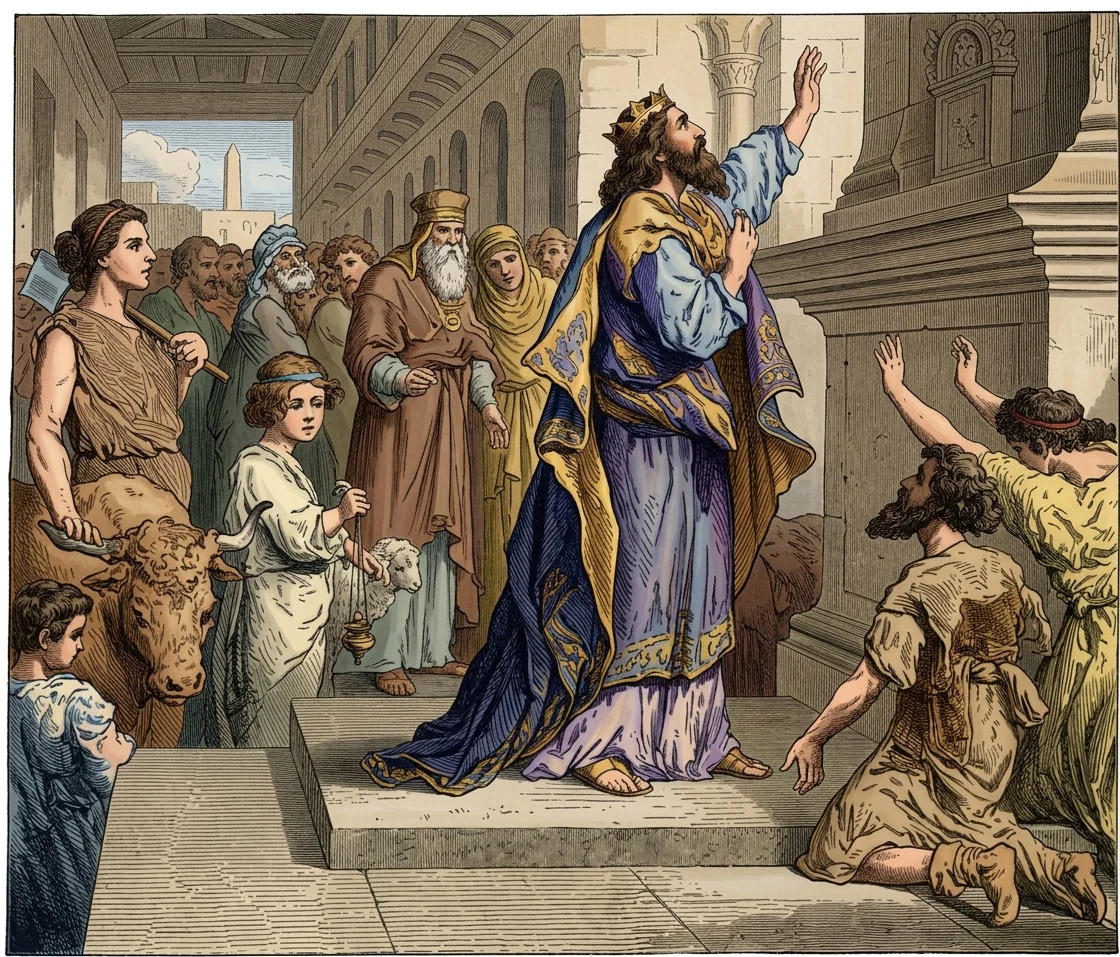
54. AND it was so, that when Solomon had made an end of praying all this prayer and supplication unto the Lord, he arose from before the altar of the Lord, from kneeling on his knees with his hands spread up to heaven. 55. And he stood, and blessed all the congregation of Israel with a loud voice, saying, 56. Blessed be the Lord, that hath given rest unto his people Israel, according to all that he promised; there hath not failed one word of all his good promise, which he promised by the hand of Moses his servant. 57. The Lord our God be with us, as he was with our fathers; let him not leave us, nor forsake us; 58. That he may incline our hearts unto him, to walk in all his ways, and to keep his commandments, and his statutes, and his judgments, which he commanded our fathers. 59. And let these my words, wherewith I have made supplication before the Lord, be nigh unto the Lord our God day and night, that he maintain the cause of his servant, and the cause of his people Israel at all times, as the matter shall require; 60. That all the people of the earth may know that the Lord is God, and that there is none else. 61. Let your heart therefore be perfect with the Lord our God, to walk in his statutes, and to keep his commandments, as at this day. 62. And the king, and all Israel with him, offered sacrifice before the Lord. 63. And Solomon offered a sacrifice of peace-offerings, which he offered unto the Lord, two and twenty thousand oxen, and an hundred and twenty thousand sheep. So the king and all the children of Israel dedicated the house of the Lord.
Golden Text: "The Lord is in his holy temple; let all the earth keep silence before him." Hab. 2:20.
NOTE.—The dedication of the temple took place a month before its full completion, at the time of the Feast of Tabernacles. Study for this lesson 1 Kings 8, and 9: 1-9; 2 Chronicles 5, 6, and 7. The place was Jerusalem, and the time the eleventh year of Solomon's reign, according to Hale and others, 1020 B.C.
SUGGESTIVE QUESTIONS.
(1) What was the principal burden of Solomon's prayer? (2) What attitude had Solomon assumed during this prayer? Verse 54. (3) What did he do when the prayer was finished? Verse 55. (4) For what did he bless the Lord? Verse 56. (5) In what words did he invoke God's presence? Verse 57. (6) If the Lord inclined their hearts to him, what would it lead them to do? Verse 58. (7) How much of God's care did he implore? Verse 59. (8) Why did Solomon ask all these things? Verse 60. (9) How did he admonish the people? Verse 62. (10) Of what did the dedicatory peace-offering consist? Verse 63.
NOTES.
1. All this prayer, etc.—The prayer was preceded by the placing of the ark of the covenant in the most holy place, and bringing into the temple the holy vessels that were in the tabernacle. When this was done the glory of the Lord, as a cloud, filled all the house, thus signifying that the Lord was pleased to accept this temple as the place on earth where he would manifest his special presence in his worship. The king then recounted God's promise to David, and the part he himself had acted in building the temple. The prayer itself follows. This remarkable dedicatory prayer is worthy of study. It is found in our lesson chapter, verses 23 to 53.
2. Kneeling.—This is the first instance in the Bible of a kneeling posture in prayer. For the occasion Solomon had built a raised platform or altar of brass before the altar of burnt-offering, on which he might stand in the sight of the people. The student will find it interesting to look up the various attitudes assumed in prayer by different Bible worthies.
3. His good promise.—The king referred directly to the promise through Moses, recorded in Deut. 12:10, 11, that when the people had rest from all their enemies, then a place should be established where he would "cause his name to dwell." Jerusalem was the city chosen, and the temple the immediate spot.
4. The earth may know.—The purpose of the Lord in choosing Israel from among the nations was that through them a knowledge of God might be given to the world. This was the design in giving them greatness and wealth, and this object Solomon recognized. It is not in God's plan that men or nations should accumulate riches for selfish ends. If such things are theirs, it is their duty to honor God and exalt his name in proportion to their means and opportunities. Not all are rich in goods or money, but there are riches of ability in other directions, and these all constitute the talents intrusted to man. This we are to recognize, and whatever our lot may be, our one chief aim should be to show forth the mercies and goodness of God to those who know him not.
5. Peace-offerings.—The flesh of the peace-offerings was eaten (Leviticus 7), and from the great number of beasts slain we gain some idea of the immense throng of worshipers that must have assembled at Jerusalem at this time. They came from "the entering in of Hamath [the extreme north] unto the river of Egypt." Not only the "elders of Israel, the heads of the tribes, and the chief of the fathers," but "all the men of Israel assembled themselves" (1 Kings 8:1, 2),—all who could possibly come. The feast usually lasted seven days, but this feast was continued fourteen days. Verse 65.
A NEW TRACT CATALOG
By Editor
"Descriptive Catalog of the Bible Students', Apples of Gold, and Religious Liberty Libraries" is the title of this 36 Page Catalog.
It gives a pithy description of each tract and pamphlet in the above Libraries, together with their size and price. It will greatly assist the reader to select such numbers as he may desire to read and circulate; and may be obtained free of charge by addressing your State Tract Society; the Pacific Press Publishing Company, Oakland, California; 39 Bond St., New York City, N. Y.; 18 W. 5th St., Kansas City, Mo.; or Review and Herald, Battle Creek, Michigan; Atlanta, Ga.
A HOLIDAY BOOK.
By Editor
Useful as Well as Ornamental.
Most children like picture books, and most people who have children buy picture books for them. But about holiday time many people buy picture books for other people's children.
A nice picture book is a nice present. A good picture book is a good present. An instructive picture book is an instructive present.
All these qualifications are included in the BOUND VOLUME of
OUR LITTLE FRIEND.
There is no use of buying books that teach children folly and nonsense. They learn too much of that incidentally. They get too much without buying it. Let the money be spent for something useful.