The Deliverer, published in Lincoln, Nebraska, by the Rev. Walter K. Williams, referring to the position of Seventh-day Adventists on the meaning of “Mystery, Babylon the Great,” etc., of Rev. 17: 5, says they believe that the Roman Catholic Church is the mother and “that we of other denominations are her daughters, because the Roman Catholic Church observes the first day of the week, which we also do,” and then the editor states:
“We do not keep this day as our Lord’s day because the Roman Catholics do it nor because Constantine made Sunday legally the Christian’s sabbath. We observe it because we are taught in the Scriptures to do so. Besides we know that the disciples of Jesus began to do this immediately or very soon after the resurrection of our Lord, and that it has continued to this day. Acts 20: 7; 1 Cor. 16: 1 and 2.”
Now we do not question the motive or belief of those who thus aver. We grant that they are honest, intelligent, conscientious. But it is true, nevertheless, that Protestants to-day are observing Sunday because they received it from the traditions of the past and not from the Word of God. Proof: (1) The texts cited above—the best, evidently, the writer could bring—make no reference to the holiness of Sunday, give no command for its observance, save in commanding a secular task on that day, refer to no law or commandment of God declaring the day holy. Acts 20: 7 records a remarkable night meeting on what would be our Saturday night, and the next day was spent in travel. 1 Cor. 16: 1, 2 refers to a private reckoning at home of one’s income after the week is over—a purely secular duty. If in these cases the second day of the week were mentioned, no one would take it as authority for second-day sacredness. Why not admit the fact, which many do, that there is not a scintilla of evidence that Sunday was or is designed to take the place of the Sabbath; that it is not in any sense a sacred day; that there is neither command nor example for it which would be considered of any worth if another day were mentioned; that it was many years, nay, centuries, before it was called a sabbath or considered sacred; that all the sacredness which attaches to it is in the application of scriptures to the Sunday which belong to the Sabbath alone; that it was preserved and passed on into Protestantism by the Roman Catholic Church; that every argument used by Protestants, with perhaps the exception of the unlearned one on the Greek, to support Sunday sacredness, is received from Catholics, even to the last, coercion?
Now, our friendly critic the Deliverer evidently believes he is observing Sunday as a Bible day, but unconsciously he is passing on the well-worn counterfeit coin of apostasy, which will not ring true to the government requirement. Let the Deliverer labor to deliver its readers from this child of apostasy also. The genuine is infinitely better. W.
The Importance of the Sabbath Question
By W.
SOME years ago a prominent advocate of Sunday laws said: "Approached on any side, a discussion of sabbath [Sunday] desecration opens up every living topic agitating the public mind." "In the Sunday question centers the problem of law enforcement and civic reform."
These words are quoted as the expression of a sentiment growingly prevalent among a religio-political class, which "will not down." We have again and again said, during a period of years, that one of the absorbing questions in religious and political life would be the Sunday question, and people laughed at the idea. We now see the beginning of the end. All the so-called civic, municipal, Christian citizenship, and temperance reforms are more or less tied up with the Sunday-law question. Pressure is brought to bear on politicians, or men seeking political preferment everywhere; and many of them who see its injustice, yield to pressure. Political parties make all sorts of promises to catch the Sunday-law vote, and the Sunday-law man pledges his candidate. How long will it be before such methods force upon statute-books a general Sunday law, hated by the very men who place it there, or under the Initiative placed there by men who are deceived, but who hope that the law will prove harmless? But, reader, place it there, and union of church and state is accomplished. Jesus Christ and His gospel are forsaken for the gospel of force, and the state assumes the place of God over conscience, and in doing that very thing, becomes antichrist. W.
A Spiritual Autobiography—III
By J. A. L. Derby
By J. A. L. Derby
The Immutability of the Law
NOTWITHSTANDING I had found abundant Biblical evidence—much more than I gave in my last article—to convince me of the perfection of the Decalogue, the same question remained concerning the whole ceremonial law. Did God ever give an imperfect law of any sort?
When a person begins to study the subject of the law in the Bible, he is very soon impressed with the fact that the time of technical definitions and distinctions had not arrived when the Bible was written. The term "ceremonial law" does not appear in Scripture. Neither does the term "moral law."
The word "law" is found with almost every shade of meaning, in the Bible; but the meaning has to be determined by the context. In no place does a Bible author designate whether he is speaking of moral law, ceremonial law, or of law in general. Paul uses the word in still other senses than these. For lack of space, the various uses of the word can not be here illustrated.
It is of course clear that the Old Testament contains a ceremonial law. But was not that law moral? The answer to this question depends on our definition of "moral." If we define it as "pertaining to duty or obligation," the law of ceremonies was certainly moral. If it was not, then God was guilty of the inconsistency of giving a law to which no obligation was attached. Further, to say that the whole Mosaic code, exclusive of the Decalogue, was ceremonial, would be to include many laws quite as "moral" as anything in the Ten Commandment code, as the law of tithes, of marriage, of slavery, etc. And again, in a theocracy, where God Himself is king, does not even the civil law become moral? After much thought and study, I concluded that to attempt to convince a prospective convert that only the law of the two tables is moral, and that the ceremonial law was non-moral or unmoral, would be difficult to do with an array of texts. Neither is it possible to give to the former law exclusively the title "law of the Lord," or "law of God." Such texts as Luke 2: 21-24, 39; Neh. 10: 29; 8: 8, 18; Ezra 7: 21 (compare verse 6), 10, 26; 2 Kings 18: 6, make this distinction of the two laws Scripturally impossible. Better to attempt to diminish nothing of the moral obligation attached to any command or law of God. If God commands baptism, or the Lord’s Supper, or foot-washing, it can not be neglected without sin.
What, then, are the facts with reference to the two laws?
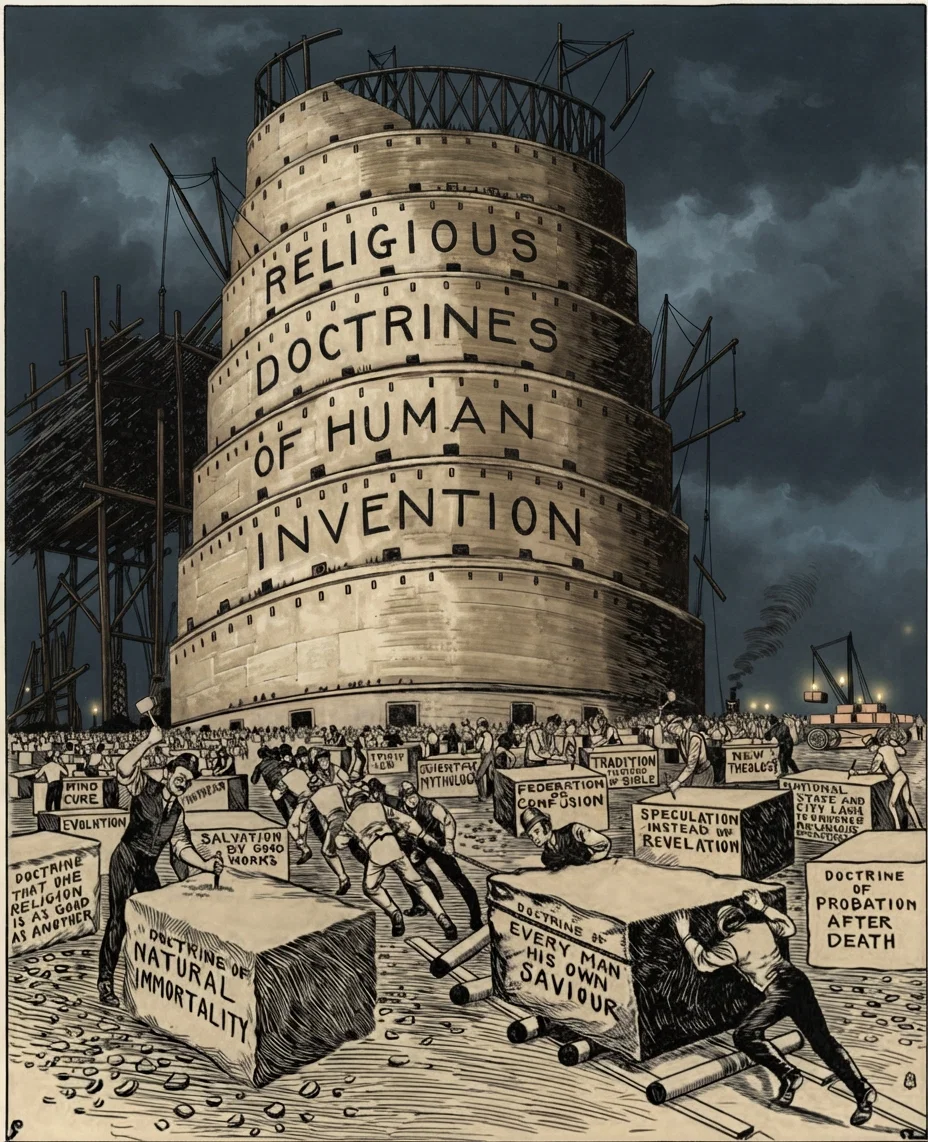
“LET US” Building the modern Tower of Babel. “And they said, . . . Let us build us . . . a tower, whose top may reach unto heaven.” Gen. 11: 4.
1. On the side of similarity:
(a) They are both the law of God, both moral;
(b) They were both unchangeable.
2. On the side of dissimilarity:
(a) God Himself made a clear and evident distinction between them by such facts as, that His own voice proclaimed the Decalogue from Horeb with a display of His glory most sublime and awful; that He wrote it with His own hand on tables of rock; and that He commanded a golden chest to be made for its preservation, invested this chest with the utmost sacredness, requiring for it reverence on pain of death; but the remainder of the law was given through Moses, written by him in a book, which book never attained the dignity of a place beside the tables of stone inside the golden chest. There were other things about the chest—called in the Bible the "ark of His testimony"—such as the "mercy-seat" and the cherubim, of a highly figurative character, but easy of interpretation.
(b) Much of the Mosaic law was typical. This fact is so well understood by every Bible reader that it need not be explained here.
(c) The typical law, tho immutable while it lasted, was TEMPORAL, limited to a certain time. The Decalogue is eternal. This last distinction is the one I desire to make clear in the present article.
Unchangeable but Not Eternal
A law expirable by limitation is not necessarily a changeable law. That God made many laws which were to cease to be in force when, being types, they met their antitype, was no indication whatever that, while they were in force, He would either change them Himself or permit any one else to change them. That no such power was delegated to kings or prophets after the time of Moses, will become evident by a mere reading of the Old Testament. The kings of Israel were executives; they were not legislators. In any way to alter the laws given by God and Moses was wholly beyond their authority. Even as late as the time of Stephen, death was considered to be the only fit punishment for one who should think to "change the customs which Moses delivered us." Acts 6: 11-14. Stephen himself was martyred on this charge.
It would seem that if any conditions would warrant alteration of the ancient law, such were afforded by the chaotic state of affairs after the return under Ezra from the Babylonian captivity. Yet no hint is given that he imagined such a thing possible. On the other hand, let us listen: "They clave to their brethren, their nobles, and entered into a curse, and into an oath, to walk in God’s law, which was given by Moses the servant of God, and to observe and do all the commandments of the Lord our Lord, and His judgments and His statutes." Neh. 10: 29.7
Not to Be Altered
We might quote here Ps. 89:34: "My covenant will I not break, nor alter the thing that is gone out of My lips." The third and fourth verses of this psalm read thus: "I have made a covenant with My chosen, I have sworn unto David My servant, Thy seed will I establish forever, and build up Thy throne to all generations." This makes clear what covenant is here referred to, as do also verses 35-37. It is not the one made with Abraham, or the one made with Israel at Sinai, or the Ten Commandments. The text can be available for our purpose only as it reveals the fact that what God does is never tentative, never a mere experiment. All His acts are final, conclusive. Which, we must remember, is a very different thing from saying they are unconditional, or absolute. It is precisely the failure to distinguish between "final" and "absolute" that has made the confusion in the matter of predestination. God has one unalterable, final plan of salvation. He has never had any other from the creation. But salvation is conditional. It is conditioned on faith.
All the words, statutes, commands, of God are final. He utters all with full knowledge of every relation, obstruction, and contingency that may arise through time or eternity. He does not have to try methods, plans, or schemes, to see how they will turn out. He has never made an experiment. Therefore every law He has ever given was a perfect law.
The text we have just quoted from the 89th Psalm evidently refers primarily to words spoken either through David himself or to David by a prophet, possibly Nathan. Yet God calls them words "gone out of My lips." This principle therefore applies as clearly to the law spoken through Moses as to the law uttered from Sinai. What is the purpose of all the law Heaven ever gave?—To keep His created beings in the way of life, and if they left it, to restore them. To this testifies the Scripture: "The law of the Lord is perfect, restoring [margin] the soul." Ps. 19:7.
When I had traced these truths out in the Scriptures, I saw conclusively that so long as the Decalogue remains, it is unalterable. It is final. It is not an experiment. It was not a type. It was not intended for a symbol. It is the condition of eternal life. If God broke it, He would destroy Himself—die. It is as eternal as the Eternal.
Whose is the impious hand that shall attempt to tear from the Decalogue a single precept?
Free-Will Beings
Not only men, but angels, are free-will beings. It is perfectly obvious that God could get no glory, no honor, and could experience no pleasure, from the servile worship of machines. Neither would a system of reward be other, in that case, than a ridiculous dumb show and pretense.
Both men and angels will be free moral agents to eternity. From this arises the possibility of their refusing obedience to the King of the universe, as Lucifer and a third part of heaven's host did once in heaven. Eternally, therefore, must stand the "royal" law, as a warning of the dire results of such a course. Sin will be sin a billion years from now, the same as it is to-day. God knows what is best for the universe, its peace and happiness. O that these six thousand years of wo, of the sad triumph of death, were enough to convince us of the results of disregarding the divine law! Brother, have we not seen and had enough of disease and strife, unhappiness and despair?
The law of God is a law of love, and liberty, and happiness, and life. Only obedience to this, by help of the Spirit from on high, can bring lasting peace and satisfaction. "This is a faithful saying, and worthy of all acceptation, that Christ Jesus came into the world to save sinners." "For God so loved the world, that He gave His only-begotten Son, that whosoever believeth in Him should not perish, but have everlasting life. For God sent not His Son into the world to condemn the world; but that the world through Him might be saved." Yes, Jesus came and died—died to take your place and mine under the violated law of Heaven; died—the King of the universe died—because His law could not be changed; died as the propitiation for our sins—to bring us to obedience. Shall we not avail ourselves of the wondrous plan?
Our Help in Times of Apostasy
By Mrs. E. G. White
By Mrs. E. G. White
GOD has made provision in Jesus Christ that we shall keep the commandments of God. In this age of the world the powers of apostasy are seeking in every way to entice men into disobedience. The very work that Satan did in Eden he is doing to-day. He persuaded Adam and Eve that God had withheld some great good from them, and while insinuating that God had not their welfare at heart, he pretended to have a deep interest in their advancement. Satan's falsehood prevailed; he succeeded in winning their confidence through promising them a greater breadth of knowledge than they had yet attained, even declaring that they should be as gods. God had placed upon them a very slight test. They were simply prohibited from partaking of one tree in the midst of the garden. Yet a violation of this one slight prohibition resulted in the fall of the human race. The action might be accounted small, yet it was disobedience and transgression; and when weighed in God's balances, it was seen to be a most heinous sin. Adam's disobedience to God was the result of unbelief and ingratitude, and led him to take his position on the side of the great apostate, in giving credence to Satan's statements rather than to the word of God.
The history of Adam's transgression is before the human family, and is written for our admonition and warning, that we may realize how terrible is the sin of violating the least commandment of God.
Adam's Transgression and Its Lesson
We have full light upon the fact of how the Lord regarded Adam's transgression, and yet men presume to violate the fourth commandment. After the Lord created the world in six days, He rested on the seventh day, and sanctified the day of His rest, and bade men observe the day of rest throughout all generations. And yet men are repeating Adam's transgression, and are entering into a confederacy with Satan to war against God, in trampling upon the Sabbath institution. The church and the world are choosing Satan for their god and sovereign, and setting aside the God that made heaven and earth and all things that are therein.
Man lost his righteousness through transgression, and "God so loved the world, that He gave His only-begotten Son, that whosoever believeth in Him should not perish, but have everlasting life." Through the righteousness of Christ, our substitute and surety, our obedience to God's commandments is made acceptable. Christ clothed His divinity with humanity, and endured the test upon the point of appetite, ambition, and love of the world, thus making it possible for man to keep the commandments of God through His imputed righteousness. Through faith in Christ, a man becomes partaker of the divine nature, and is complete in Him, as long as he walks in the light. But when light has come to a soul that has been in darkness in regard to the binding claims of the law of God, and the transgressor refuses to walk in the light, he is guilty before God, and is charged with apostasy. He chooses that sin shall have dominion over him, and therefore the penalty of the law is upon him. By his continued transgression he reveals the fact that he is at enmity with God, that his heart is carnal, and not subject to the law of God. He repeats the transgression of Adam, accepts the insinuations of the fallen foe, takes his place on the side of the man of sin, and exalts Satan above God. In refusing the light, he becomes one with the ranks of apostasy, and chooses to act with the confederacy of Satan.
It was necessary that Christ should take upon Him our nature, in order to prove the falsity of Satan's statements. The apostate cast contempt upon the law of God, and declared that it was impossible for men to keep God's commandments, which had been preordained in the counsels of heaven. Therefore Christ became man's representative and surety, thus demonstrating to heavenly intelligences, to unfallen worlds, and to the human race, that, through cooperation with divine agencies, humanity could be pure and holy. By partaking of the divine nature, they could meet the demand of a perfect and holy law. Of Christ it is written: "He is able also to save them to the uttermost that come unto God by Him, seeing He ever liveth to make intercession for them. For such an high priest became us, who is holy, harmless, undefiled, separate from sinners, and made higher than the heavens."
The Merit of Christ the Only Ground
The merit of the righteousness of Christ is the only ground upon which the sinner may hope for a title to eternal life; for Christ has given Himself for us, an offering and8sacrifice to God, as a sweet-smelling savor. An infinite price was paid for man's redemption, not that he might be saved in his sins, not to make void the law of God. Paul says: "Do we then make void the law through faith? God forbid: yea, we establish the law." For tho "by the deeds of the law there shall no flesh be justified in His sight," yet the righteousness of God, which is by faith of Jesus Christ, is witnessed by the law and the prophets.
How strange it is that the church and the world are joined together in a confederacy to do a work that God has especially prohibited! They disobey the commandments of God with impunity. The prohibition of God in the Garden of Eden was disregarded by Adam and Eve, and the most terrible consequences resulted. The Lord is placing the same test upon the human family to-day, and proving them by bringing to their attention the Sabbath, which is a memorial of God's creative power. In this memorial God testifies to the world and to heavenly intelligences that He made the world in six days, and rested—on the first day?—No, but on the seventh day. The same instruction comes to us to-day as when the Lord spoke to the children of Israel, saying, "Verily My Sabbaths ye shall keep: for it is a sign between Me and you throughout your generations."
The Lord sends messengers of truth to the people; but when He brings words of stern truth to bear upon their consciences, there are many who are in no way pleased or grateful. The message of truth disturbs them in their ease-loving service of God, and they do not like the rugged, thorny path that is pointed out to them. They do not wish to separate from the world, to practise self-denial and self-sacrifice, and to attain to the likeness of Christ. They desire to live at peace, and glorify self, and do not wish to identify their interest with that of Jesus Christ. They count that separation from the pleasures of the world, separation from the world's careless neglect of piety and devotion, is too heavy a cross for them to bear.
In rejection of light, the hearts of men are hardened, and they finally unite with the agencies of apostasy in a work of compelling the conscience of those who do not agree with them, in persecuting and putting to death those who love God and keep His commandments.
The Dragon and the Remnant
The remnant people of God are to endure persecution. "And the dragon was wroth with the woman, and went to make war with the remnant of her seed, which keep the commandments of God, and have the testimony of Jesus Christ." They are to give the warning message against the power represented by "the beast." The prophet says of this power, which represents the Papacy: "There was given unto him a mouth speaking great things and blasphemies; and power was given unto him to continue forty and two months. And he opened his mouth in blasphemy against God, to blaspheme His name, and His tabernacle, and them that dwell in heaven. And it was given unto him to make war with the saints, and to overcome them: and power was given him over all kindreds, and tongues, and nations. And all that dwell upon the earth shall worship him, whose names are not written in the Book of Life of the Lamb slain from the foundation of the world."
The remnant church of God are to give the warning of the third angel to the world: "If any man worship the beast and his image, and receive his mark in his forehead, or in his hand, the same shall drink of the wine of the wrath of God, which is poured out without mixture into the cup of His indignation."
The church of God, despised and persecuted by the world, are educated and disciplined in the school of Christ. They walk in narrow paths on earth; they are purified in the furnace of afflictions. For Jesus' sake they endure opposition, hatred, calumny. They follow Christ through sore conflicts; they endure self-denial, and experience bitter disappointments; but their painful experience teaches them the guilt and wo of sin, and they look upon it with abhorrence. Being partakers of Christ's sufferings, they are destined to be partakers of His glory. In holy vision the prophet saw the triumph of the people of God. He says: "I saw as it were a sea of glass mingled with fire: and them that had gotten the victory over the beast, and over his image, and over his mark, and over the number of his name, stand on the sea of glass, having the harps of God. And they sing the song of Moses the servant of God, and the song of the Lamb, saying, Great and marvelous are Thy works, Lord God Almighty; just and true are Thy ways, Thou King of saints."
Our Saviour and Lord
By George W. Reaser
Christ as Our Judge
A CAREFUL Bible student can readily discover three general judgments brought to view in the Word of God. Two of these are investigative and decisive, and one executive. The first of these in point of time, mentioned in Dan. 7:9, 10, takes place before the close of probation, and has to do with the members of our race who, having once been converted, have had their names registered by their guardian angels in "the Book of Life." Luke 10:20; Phil. 4:3. The second, briefly described in 1 Cor. 6:1-3 and Rev. 20:4, immediately follows the close of probation, and deals with the cases of wicked men and fallen angels, its session lasting a thousand years. The third and last is prophetically mentioned in Jude 14, 15, and consists in the execution of "the judgment written" (Ps. 149:9), upon the finally unrepentant and incorrigible.
The first two of these, or the courts of judgment, are held in heaven; the third—the execution of judgment—upon the earth. The latter really constitutes the work of gathering out of Christ's kingdom "all things that offend, and them which do iniquity," and casting them into a furnace of fire, to prepare for the setting up of His eternal kingdom in our world, when it is purified and cleansed from sin. The fact that the earth purified will be the eternally blissful home of the redeemed, and that the execution of judgment upon the wicked will take place in the earth, explains the statement recorded in Prov. 11:31, employed by some to prove the unscriptural doctrine of universal salvation. The text reads, "Behold, the righteous shall be recompensed in the earth: much more the wicked and the sinner."
In speaking of the premillennial judgment upon the cases of those whose names have been registered in the Book of Life, Paul informs us that some men's sins go beforehand to judgment, while other men's sins follow after (1 Tim. 5:24); and Peter states "that judgment must begin at the house of God." 1 Peter 4:17.
A few moments' reflection will show the wisdom of holding this judgment session before probation closes and Christ comes the second time. When He appears, it is not to hold a session of judgment to determine who are worthy to be the happy subjects of His eternal kingdom. Consider what that would mean. Suppose, reader, that you and I, living near the close of time, as we undoubtedly are, should be called personally before the court of heaven, and there, for a period of years, or until all previous cases from the foundation of the world had been decided, were compelled to wait for our names to be called up in chronological order. Can you imagine anything that would produce more excruciating mental anxiety? Can you think for a moment that the Lord will cause His people to pass through such a painful and unnecessary ordeal? The rejection of many as candidates for eternal life would make the mental strain tremendously more tense upon those who would still be in waiting for the reading of their names. How each one would tremble when his name9should be called by the court crier, lest he should be weighed in the balance, and be found wanting!
Be assured that Heaven has a better, a wiser, a more humane way of conducting the court investigation upon judgment-bound mortals than the one just described. As a matter of fact, none whose cases are pending will be physically present to respond to their names, nor will they know when their individual cases are tried. The great majority, having passed off the stage of action, will be sleeping in their graves while the judgment is in session; and many of those who have been registered as children of God out of the very last generation before the coming of the King, will be living and going about their regular avocations while their lives are passing the final searching test during "court week" in heaven.
The Purpose of the Pre-Advent Judgment
What is Heaven's better way of conducting judgment? This question will be answered by a consideration of the purpose of the judgment in the cases of those whose names have once been recorded in "the Lamb's Book of Life."
The fact that some "who were once enlightened," who had "tasted of the heavenly gift, and were made partakers of the Holy Ghost," and had "tasted the good Word of God, and the powers of the world to come," have fallen away beyond the possibility of being again renewed to repentance, is too patent to require proof. The names of such, altho once written by the recording angels in the Book of Life, will not be retained therein, but instead, will "be blotted out of the book of the living, and not be written with the righteous." Ps. 69: 28. While, on the other hand, those who fight the good fight, finish their life course victorious over sin, and keep the faith till the end, will retain their places, the registration of their names in the Book of Life.
Luke informs us that some will "be accounted worthy to obtain" homes in the future sinless world. Luke 20: 35. The judgment work is the accounting process by which the decision is reached concerning the righteous dead, that they are considered "worthy" of a part in "the first resurrection" (Rev. 20: 6), which is the resurrection to "life." John 5: 29. At the close of this investigative judgment, Christ will be escorted by the angels before the Father, to receive His kingdom. Dan. 7: 13, 14. How inconsistent, unthinkable, it would be to deliver to Him "the Book of Life," the register of the subjects of His kingdom, and some names still be found therein who had not been "accounted worthy" to receive eternal life! Heaven will not engage in any such procedure as that. The subjects of His kingdom will all be made up while He still acts in the capacity of intercessor and advocate for His disciples. And when the register, "the Book of Life," is delivered to Him after the declaration of His kingship, there will be no more names to be effaced from it. Coincident with His taking His kingdom, human probation closes, and hence a time of trouble for the children of men; but "at that time thy people [the subjects of Christ's kingdom] shall be delivered, every one that shall be found written in the book." Dan. 12: 1.
Jesus' Part in the Pre-Advent Judgment
In human courts, each person having a case pending secures an attorney, an advocate, to safeguard his interests. Frequently fabulous prices are paid to secure the best possible advocate. If the individual having a criminal case before the court is not financially able to employ an attorney, it is the duty of the state to provide a suitable counselor at law to plead the case of the accused.
Even so in the supreme court of the universe. Heaven provides the best, the wisest, the most sympathetic Advocate that it is possible to obtain. While the angels have faithfully performed their part in recording the thoughts, words, and deeds of each individual, which record witnesses either for or against the one on trial, angels could not consistently act as advocates for our race, for they were never members of our human family, having been created on a higher plane. There is but one in heaven who can consistently act as advocate for humanity. He is the member of the Godhead who was "made in the likeness of sinful flesh," who "was in all points tempted like as we are," who was in all things "made like unto His brethren," who is our elder Brother, and who paid the penalty for all pardonable sin. And so it is
written, "If any man sin, we have an Advocate with the Father, Jesus Christ the righteous: and He is the propitiation for our sins." 1 John 2: 1, 2. He knows by experience the terrible pressure of temptation brought to bear upon us; and having paid for our redemption from the curse of sin—from the sentence of eternal death—He gladly acts as our advocate. And if He has witnessed in us a fixed purpose to overcome sin, to develop characters like His own, He will plead in our behalf, and by His merits present us "faultless" before the Father, "with exceeding joy." The gift of His life upon the cross was an expression of His ardent desire to act as our advocate. The righteousness of His character, and as our substitute the efficacy of His blood, give force to His pleading in our behalf.
But there must be on our part a laying hold of His strength to overcome sin, as it is written, "He that overcometh, the same shall be clothed in white raiment [the righteousness of Christ]; and I will not blot out his name out of the Book of Life, but I will confess his name before My Father, and before His angels." Rev. 3: 5.
There will be no person present when the court is in session, to condemn; for Satan,10"the accuser of the brethren," was cast out of heaven after the triumph of Calvary, "and his angels were cast out with him." None of these will therefore appear in the investigative judgment. There is only one thing that will condemn; that is the unbiased record of our lives, kept by angels who were anxious for our salvation.
"What shall we then say to these things? If God be for us, who can be against us?" "Who shall lay anything to the charge of God's elect? It is God that justifieth. Who is he that condemneth? It is Christ that died, yea rather, that is risen again, who is even at the right hand of God, who also maketh intercession for us." Rom. 8: 31, 33, 34. Thus it is seen that Christ acts a special part in that judgment which we have reason to believe is even now in session, at the conclusion of which the subjects of His kingdom will be made up, the door closed which no man can open, with no possibility of admittance into the redeemed family thereafter. Those who will not permit Him to reign over them, and who have not by confessing Him secured His services as advocate, will be identified with the "things that offend, and them which do iniquity," to be gathered out of His kingdom, and "cast into a furnace of fire," that there may be nothing offensive, nothing impure, nothing to perpetuate sin and misery and thus mar the happiness of His eternal kingdom.
The Post-Advent Judgment
In the millennial judgment, which deals with the cases of wicked men and fallen angels, in which the redeemed members of our human family will all sit as jurors, there will be no advocate to plead. Why then this judgment?—In order that intelligent beings may be supremely happy in the worship
of Jehovah, they must know that He is absolute perfection of character. Hence this second session of judgment. When "the books are opened," and all hidden things are brought to light, it will be perfectly clear, to all survivors of the ravages of sin, that God has dealt in absolute justice with all His creatures; and when the judgment closes, this universal acclaim will burst forth from the hearts and lips of all the saints: "Just and true are Thy ways, Thou King of saints." If there were a lingering suspicion in the hearts of any that He was not "just and true," He could not be crowned in their hearts "King of saints." But no such suspicion will survive the millennial judgment.
The Final Execution of Judgment
There is but one Being in the universe that, in the wisdom of Heaven, is perfectly prepared by experience and knowledge to execute judgment upon the finally lost.
That one is Jesus Christ. Hear Him saying that the Father "hath given Him authority to execute judgment also, because He is the Son of Man." John 5: 27. Question: Why was not authority to execute judgment given to Him because He was the Son of God?—If Jehovah Himself should execute judgment, visit the death penalty upon lost men, there would be occasion for some rebellious voice to raise the cry of "injustice," because Jehovah has not condescended to take upon Himself human nature, and endure all of the temptations to which humanity is heir. Hence Jesus, as the Son of God, could not, in the wisdom of Heaven, execute judgment. But the charge of injustice can not be raised when Jesus executes judgment, for He partook of our nature in the fullest sense. He was made in all things "like unto His brethren," and yet He never was overcome by temptation, never yielded to sin. He maintained perfect, absolute righteousness of character while
dwelling in sinful flesh and while meeting the fiercest possible temptations from the prince of devils. He is the one member of our race who can condemn sin in the flesh. And being Himself sinless, He paid the full penalty for the sins of the entire human family, so that every one might escape condemnation in the judgment and go free. Surely He is the one best qualified, by experience, to execute judgment upon those who have spurned eternal life, offered at the price which He paid to take away our sins on the cross of Calvary.
Inasmuch as there is no true happiness apart from righteousness, no real joy divorced from the worship of Jehovah, in whose "presence is fulness of joy," at whose "right hand there are pleasures forevermore," so in the terminating of misery, rebellion, sin, the Son of Man will be the same personification of love as when, just before He expired upon the cross, He breathed the prayer for His tormentors, "Father, forgive them; for they know not what they do." It is the wisest, the best, the most merciful plan in the end, to have a clean universe, no sin, no rebellion, no cursing God, no temptation, no death, no weeping.
Cling to the Rock
By Clara Emogene Bowen
By Clara Emogene Bowen
While passing through a deep ravine,
Only the railway space between
The rugged rocks on either side,
Stretching out both far and wide,
'Twas there—I knew not what the cause—
The engine made a sudden pause.
A little child cried out in pain,
So frightened at the coming train.
She stood beside her brother there,
In meek appeal, in lost despair.
"Cling to the rock! Hold firm and fast!
The danger then will soon be past."
"Cling to the rock!" the young voice craved;
"Cling to the rock, and you'll be saved."
The children passed, the train was gone;
But in my mind the scene went on.
So like to life I thought her word,
The childish voice that I had heard.
I drew a solemn picture, too;
It is again before my view.
'Tis when a life so fresh and fair,
Unknown to grief, unknown to care,
Is on the track of sin's dark train,
That awful harbinger of pain.
I rush upon the heedless sight,
And cry and shout with all my might:
"Cling to the Rock, my dying friend!
Cling to the Rock till life shall end—
The Rock of Ages, pure and free!
Cling to the Rock eternally."