Your ShelfYour Projects

Review and Herald, Vol. 75, No. 10.

TRADITION

Review and Herald

Mar 8, 1898

Seventh-day Adventist Publishing Association · Battle Creek, Mich. · Mar 8, 1898

TRADITION

MRS. E. G. WHITE.
“THEN came to Jesus scribes and Pharisees, which were of Jerusalem, saying, Why do thy disciples transgress the tradition of the elders? for they wash not their hands when they eat bread.” Expecting to see Jesus at the Passover, the Pharisees had laid a trap for him. But Jesus, knowing their purpose, had absented himself from this gathering. “Then came together unto him the Pharisees, and certain of the scribes.” As he did not go to them, they came to him.
This deputation was sent from Jerusalem for the express purpose of watching Jesus, that something might be found with which to accuse him. The Pharisees saw that the disciples did not observe diligently the traditions of the elders. They did not practise the custom of “washing of cups and pots, brazen vessels, and of tables.” Hoping to provoke a controversy, the Pharisees said to Christ, “Why walk not thy disciples according to the tradition of the elders, but eat bread with unwashen hands?” They thought to draw from Christ words of which they could make capital. But he answered them with authority, while divinity was revealed with startling power: “Well hath Esaias prophesied of you hypocrites, as it is written, This people honoreth me with their lips, but their heart is far from me. Howbeit in vain do they worship me, teaching for doctrines the commandments of men. For laying aside the commandment of God, ye hold the tradition of men, as the washing of pots and cups: and many other such like things ye do.”
Christ gave them an example of what they were repeatedly doing, and had done just before coming in search of him. “Full well ye reject the commandment of God,” he said, “that ye may keep your own tradition. For Moses said, Honor thy father and thy mother; and, Whoso curseth father or mother, let him die the death: but ye say, If a man shall say to his father or mother, It is Corban, that is to say, a gift, by whatsoever thou mightest be profited by me; he shall be free. And ye suffer him no more to do aught for his father or his mother.” They set aside the fifth commandment as of no consequence, but were very exact in carrying out the tradition of the elders. The sayings of supposed great men had been handed down from rabbi to rabbi, nullifying the plain requirements of God, “making the word of God of none effect,” said Christ; “and many other such like things ye do.”
“And he called the multitude, and said unto them, Hear, and understand.” He spoke with no hesitation, but with authority, as one who would flash light upon all around him. “Not that which goeth into the mouth defileth a man; but that which cometh out of the mouth, this defileth a man.” These words, spoken in the hearing of the multitude, infuriated the ecclesiastical powers. The cavilers were seeking to destroy Christ’s influence over the people, but he flashed forth such divine truth that they dared not ask him further questions. Christ knew that if he could speak directly to the people, opening to them the Scriptures, he would be heard; for they were in a far more receptive frame of mind than were the leaders. The punishment would fall upon those who were leading them from the path of rectitude. The people listened eagerly to all that Christ said; for never before had they heard such words. They were plain, direct, forcible, and brief, and clearly defined the true meaning of sin and pollution.
The Pharisees had given expression to their hatred, but they dared not then carry out their full purpose. They slunk away, repulsed. They would not receive the light shining on their pathway. When the light shines forth, those who are unwilling to receive it begin to cultivate in the heart the seeds of bitterness. These they also plant in other hearts. This evil seed prepares a place for itself, and the unconverted heart sees everything in a perverted light. So it was with the Pharisees.
“Then came his disciples, and said unto him, Knowest thou that the Pharisees were offended, after they heard this saying?” Christ knows the hearts of all men. Nothing is hid from him. “He answered and said, Every plant, which my heavenly Father hath not planted, shall be rooted up. Let them alone: they be blind leaders of the blind. And if the blind lead the blind, both shall fall into the ditch.” “For the leaders of this people cause them to err; and they that are led of them are destroyed. Therefore the Lord shall have no joy in their young men, neither shall have mercy on their fatherless and widows; for every one is an hypocrite and an evil-doer, and every mouth speaketh folly.”
“Then answered Peter and said unto him, Declare unto us this parable. And Jesus said, Are ye also yet without understanding? Do not ye yet understand, that whatsoever entereth in at the mouth goeth into the belly, and is cast out into the draft? But those things which proceed out of the mouth come forth from the heart; and they defile the man. For out of the heart proceed evil thoughts, murders, adulteries, fornications, thefts, false witness, blasphemies; these are the things which defile a man: but to eat with unwashen hands defileth not a man.”
In this our day we meet the same false religious requirements upheld by the Pharisees. The fourth precept of the decalogue is set aside, as the Jews set aside the fifth commandment, while traditions are eagerly grasped and enforced. The Lord did not give the Jews their multitudinous traditions and ceremonies. He did not require them to occupy precious time in doing that which was of no benefit to any one, while they disregarded his commands; neither has he commanded men to observe the first day of the week.
To a large degree the religious world is following in the path of the Jews. The Pharisees taught for doctrine the commandments of men, making the word of God void by their traditions, and this the teachers of to-day are doing by upholding the first day of the week,—a day that bears not the divine credentials. They clothe their false Sabbath with a garb of sanctity, and many would compel its observance by imprisonment and fine. Under the enemy’s training, their zeal will grow until, like the Jews, they will think they are doing God a service by heaping reproach on those who have the moral courage to keep his commandments.
Those who do this venture to make of none effect a commandment instituted in Eden; for there, when the morning stars sang together, and all the sons of God shouted for joy, the foundation of the Sabbath was laid, and the seventh day was set apart to be observed as sacred. The Lord blessed this day as the day of his rest, and sanctified it, commanding man to “remember.” Do not forget it; keep it holy.
Man has no permission from God to nullify one precept of the decalogue. He has no permission to lead the minds of others to bow to an idol, or to make laws compelling God’s heritage to worship that which is false. Of those who do this, God says, “This people draweth nigh unto me with their mouth, and honoreth me with their lips; but their heart is far from me.” They place the commandments of men on a level with the divine requirements; yea more, they exalt a spurious Sabbath above the Sabbath of the fourth commandment. Their obedience to man-made requirements makes their worship null and void; but God bears with their ignorance till light comes to them.
The worship of a common working-day, and the multitudinous ceremonies connected with this false sabbath, are of the same nature as the wrongs pointedly exposed by Christ when he said, “And many other such like things ye do.” The plain evidence of truth is not discerned. Laying aside the commandments of God as altogether unimportant, men follow tradition. They reject God’s law, in order that they may keep their tradition. Common things are exalted above those things that are sacred and heavenly.
Satan has taken the world captive. He has introduced an idol sabbath, apparently giving to it great importance. He has stolen the homage of the Christian world away from the Sabbath of the Lord for this idol sabbath. The world bows to a tradition, a man-made commandment. As Nebuchadnezzar set up his golden image on the plain of Dura, and so exalted himself, so Satan exalts himself in this false sabbath, for which he has stolen the livery of heaven.
In this work the principles of the enemy are deep and deceiving, and Christ’s words are appropriate, “Laying aside the commandment of God, ye hold the tradition of men.” The heavenly universe is amazed that, in their credulity, men transfer the benediction given to the seventh day to the first day of the week. The Sabbath is God’s memorial of creation and rest, and at the beginning of the Sabbath command he places the word of warning, “Remember the Sabbath day, to keep it holy.” “Wherefore the Lord said, Forasmuch as this people draw near me with their mouth, and with their lips do honor me, but have removed their heart far from me, and their fear toward me is taught by the precept of men: therefore, behold, I will proceed to do a marvelous work among this people, even a marvelous work and a wonder: for the wisdom of their wise men shall perish, and the understanding of their prudent men shall be hid.” Thus it was with the Jewish nation, and thus it will be with all who, laying aside the commandments of God, teach for doctrine the commandments of men.

SEND ME.

Not mine to mount to courts where seraphs sing, Or glad archangels soar on outstretched wing; Not mine in union with celestial choirs To sound heaven's trump or strike the gentler wires; Not mine to stand enrolled at crystal gates, Where Michael thunders, or where Uriel waits: But lesser worlds a Father's kindness know; Be mine some simpler service here below,— To weep with those who weep, their joys to share, Their pain to solace, or their burdens bear; Some widow in her agony to meet; Some exile in his new-found home to greet; To serve some child of thine, and so serve thee. Lo, here am I; to such a work send me.
— Selected.

SUGGESTIONS TO MISSIONARY WORKERS.

M. E. OLSEN.
(Battle Creek, Mich.)
1. PRAYER is quite as important as work. Tracts and papers that have not been prayed over, are not ready to enter upon their mission of saving souls, any more than the unarmed soldier is ready for the battle.
2. Argument, whether by voice or pen, is seldom productive of good, and many times does a great amount of harm. We are told in the Testimonies that “not one moment of our precious time should be devoted to bringing others to conform to our personal ideas and opinions.”
3. It is the privilege of churches and individual workers to engage in well-rounded missionary effort. Attention should not be given to one particular branch of activity to the exclusion of other branches. Let there be a live missionary society, sending out tracts, books, and periodicals all over the country. Then let the same persons organize themselves into a progressive and enterprising Christian Help band, and make a vigorous onslaught on the poverty, distress, and sickness around them.
4. Faithfulness in doing the Lord’s work cannot be urged too strongly. Great interests are at stake. Carelessly putting off a Christian Help visit that ought to be made, or the sending of a missionary letter, may result in the loss, through all eternity, of a soul for whom Christ died.
5. It is not well to be impatient about seeing results of the papers you are sending out; continue in prayer, and let the Spirit of the Lord have a chance to work. When the farmer has prepared the soil, and planted the seed, he does not dig it up after a day or two, to see if it has sprouted.
6. The Lord’s fellow workers need to study adaptation. Each soul has peculiarities which must be taken into consideration in working for his salvation. In many districts there is strong prejudice against the doctrinal views held by our people. Sometimes the people who hold such prejudice would be greatly interested in the health principles. Hence the importance of being well informed on all points of the message, and able rightly to divide the word of truth.
7. It is the duty and privilege of those who are themselves engaged in missionary work to do everything in their power to get others in the church interested. Every converted person should be an active missionary. Even the children can help, and they should have a chance. Boys and girls can sell the Signs, Instructor, and Good Health to excellent advantage, and in this way earn some missionary money.

MY RICHES.

Folks are complaining now, I hear, about their poverty,— Of money scarce, and times as hard as times, perhaps, can be. But I am very rich; for I have raiment, food, and health, And multitudes of treasures,—yes, I’m rolling in my wealth.
I have two eyes to see with,—they are worth ten thousand pound,— A pair of ears to hear with, and feet for walking round; No one could purchase these from me for twenty thousand more; My hands, so useful, raise the sum of thousands to threescore.
My tongue, though oft unruly, yet to me is such a prize, I would not sell it cheaper than I would my precious eyes; My head, though somewhat empty, fits upon my neck so well, I would not part with it though you the price to millions swell.
I own a lifelong interest in that huge world, the sun; The moon is partly mine, also; my list is but begun, For I have stock in all the stars that seem to crowd the sky; They shine their dividends on me, although they are so high.
The clouds that gather in the sky, and shed on me their rain, And winds that bring them hither, are my servants, it is plain; I plant no fields, and yet I garner harvests full and grand, In eye-crops, rich and beautiful, o’er all our fruitful land.
I hold no houses in my name,—that is, they’re not called mine,— For to the cares of property I never did incline; But if I held by legal claim all dwellings ’neath the sun, I’d do as now,—let others have them all, excepting one.
I’ve had great artists painting for me very many years; For centuries before my name among earth’s sons appears, The masters, old and new, for my delight have done their part; I go to see my galleries, rejoicing in their art.
Romancers, poets, essayists, historians,—all have vied With one another zealously, their skill and genius tried, To offer me a literature, and let their very selves, From divers climes and ages, speak from the book-case shelves.
Astronomers are on the watch, like sentinels, to see The movements of the heavenly host, and they report to me The latest news received from constellation or from star, Or of the frisky comets plunging into space so far.
Inventors tax their brains for me,—sharp-witted men and keen,— To put in my possession some new, wonderful machine, By which toil is easy made, and I subdue, as king, The stubborn earth, and make it to me all its tribute bring.
The railways spanning our broad land, and managed with such skill, Are mine, to all intents at least; they take me where I will, My telegraph thrills through the world, down underneath the sea, And brings each distant country a near neighbor unto me.
And thus from every quarter, whether sea or earth or sky, My riches are enormous; and I cannot, if I try, Join in the murmurs of my friends, pretending I am poor, All things are mine,—God says it, and his word is very sure.
— Rev. E. G. Taylor, in St. Nicholas.

“THE LORD RULETH.”

H. F. PHELPS.
(St. Paul, Minn.)
“The Lord hath prepared his throne in the heavens; and his kingdom ruleth over all.” Ps. 103:19. Does God rule?—He says so, and it is for us to believe it. At least it was so when that word was written. But does he not rule now?—“He ruleth by his power forever.” Ps. 66:7. “Forever” has not yet passed; it never can pass away. Consequently, God rules to-day. Inasmuch as he does rule, and that to-day, is he able to care for his own cause? Will he take care of his own work?—“He ruleth by his power,” is the answer. But is his power sufficient for the task?—His own creative works declare that it is altogether sufficient.
“And to every man his work.” Mark 13:34. Inasmuch as God rules by his own power, and that power is sufficient to care for his own work; and inasmuch as he has given to every one a certain part of this great work, even a part of his own work, will he not help the “other man” to do his part of the work? or must I watch the man to see that he does his work exactly according to my ideas of how it should be done? Then if he does not do it according to my ideas (and of course, in the very nature of the case, he will never do this), shall I find fault with him and criticize him? “Lord, and what shall this man do?” and how shall he do it? The answer is: “What is that to thee? follow thou me.” John 21:21. Then as it is for us to follow Christ, suppose we let our brethren and sisters alone, and believe that God will guide them just as well as he will guide us. It may be a good deal easier, too; for it is evident that they may be much more submissive than we are. If it were otherwise, we would not find so much fault with the way they do their work. Leaving them in the hands of Christ to do the work that the Master has given them to do, and believing that they can do it much better than if we should continue to meddle with the matter, let us see to it that we follow Christ in the work he has given us to do.
Christ has been made wisdom to us (1 Cor. 1:30), in order that we (and this means the other man, too) may do the work assigned to us, each according to his several ability, according to the mind of Christ. More than this, he has promised to give his Holy Spirit to enlighten the eyes of each one of us, and to be in each one of us, guiding us in the work he has given us to do. Will he guide me aright?—There is no doubt of it if I will only let him. Will he not also guide the other agents of his own choice?—Is he not just as willing to guide the others by his Holy Spirit as he is to guide me? Does he not dwell in them as well as in you and me? And dwelling in them, to work through them to the doing of the work he has given them to do, will he not guide them in that work? Have you and I a sort of monopoly of all his favors and graces? Are we possessed of all wisdom, so that we know exactly how every one should do the work assigned to him? Now, my brother, my sister, the fact is that the Lord never can guide us, and never can and never will give his Holy Spirit to us without measure, in the fulness of the latter rain, until we really believe that he can and does guide the other man as well as us,—until we believe that he can and does work through others as well as through us.
In the time of Christ some of the disciples seemed to think that they were possessed of wisdom to judge as to how others should work, and therefore they peremptorily gave orders that these others should not do any more work in the name of the Master, because they would not follow them, and would not work according to their ideas. In so doing the disciples gave evidence that they were possessed of more of the human nature than of the divine, and were controlled more by human impulses than by the Spirit of Christ. If we pursue the same course, we shall give evidence to all the world, to men and to angels, that we are controlled by these same human impulses, and not by the Spirit of the Master. To us as well as to the disciples of eighteen centuries ago, are the reproving words of Christ applicable: “Ye know not what spirit ye are of.”

E. T. RUSSELL

CAPITAL AND LABOR.—NO. 3.

E. T. RUSSELL
(Oklahoma City, O. T.)
Not only does the Bible teach that relief will not come to the poor, but it also teaches that misery is in store for the rich: “Go to now, ye rich men, weep and howl for your miseries that shall come upon you.” James 5:1. “They shall cast their silver in the streets, and their gold shall be removed: their silver and their gold shall not be able to deliver them in the day of the wrath of the Lord: they shall not satisfy their souls, neither fill their bowels: because it is the stumbling-block of their iniquity.” Ezé. 7:19. Truly, trouble awaits the rich; and the storm will soon come in all its fury.
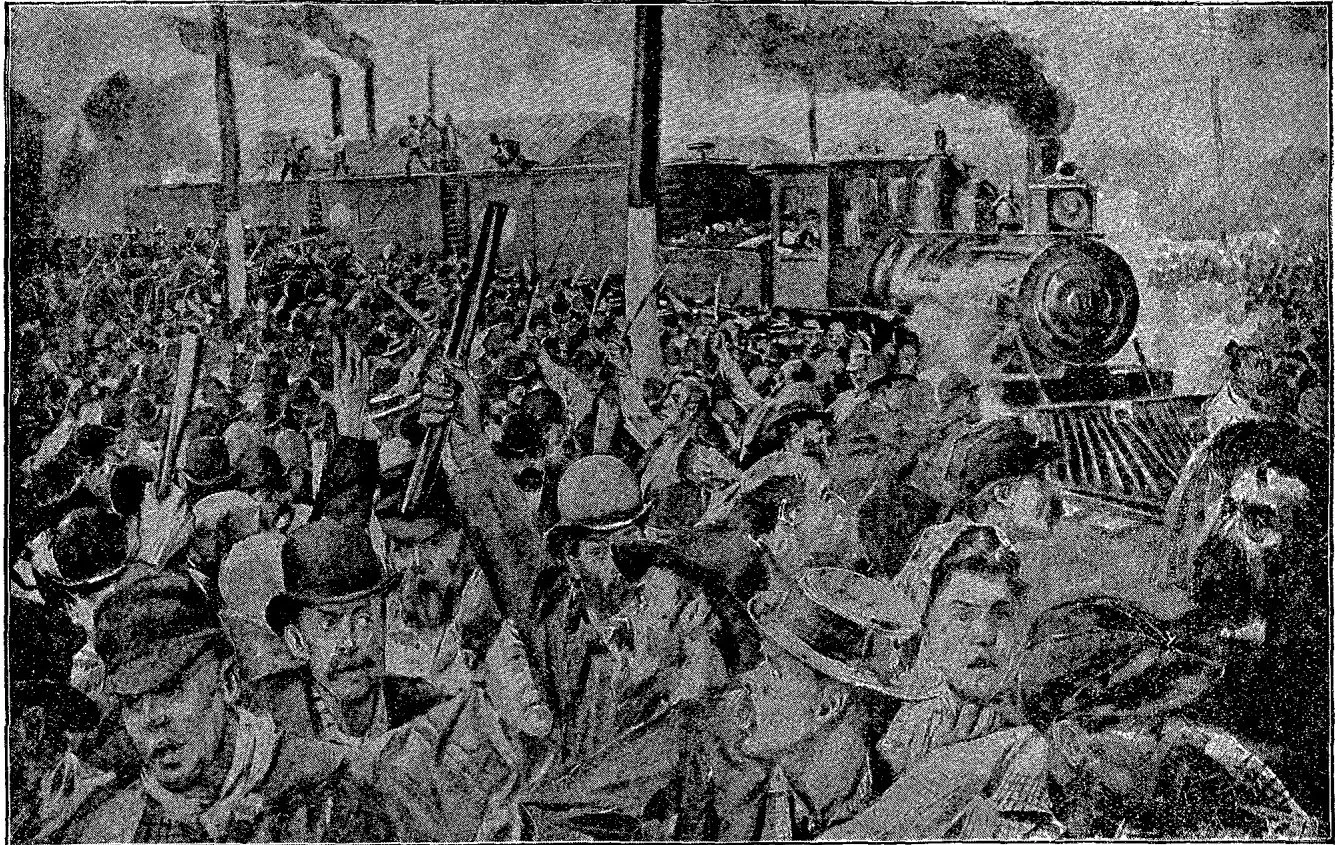
“THE CITY IS FULL OF VIOLENCE” — CHICAGO RIOT.
Through developing circumstances, the rich will be compelled to cast their silver and gold into the streets. The present condition of society will produce sure and sad results. Evil in the hearts of the downtrodden and oppressed will grow to a thunderbolt, that will burst with all the horror of an overflowing tempest upon the rich. Too late they will learn the sad lesson that “they that will be rich fall into temptation and a snare, and into many foolish and hurtful lusts, which drown men in destruction and perdition.” 1 Tim. 6:9.
In Ezé. 7:23 the Lord says: “Make a chain: for the land is full of bloody crimes, and the city is full of violence.” The chain will undoubtedly be made by the people as they associate themselves together, as expressed in Isa. 8:12. These associations are formed with the hope that relief will come through them, but their counsel will not stand, because “vain is the help of man.” Not seeking guidance from God in their endeavors to extricate themselves, they will be plunged more deeply into trouble. They will also realize, when it is too late, that by taking counsel of men instead of seeking wisdom of God, they have helped to forge the chain that binds them. It will be a chain forged in the workshop of Satan to deceive and mislead the masses, and plunge them into ruin. God’s method of reforming society and correcting abuses consists in improving the individual members of the community. That is liberty. Confederacy and régime only add to the tyranny of greed the more galling tyranny of envy.
That the land is full of bloody crimes, the following statistics of crime will show:—
Year Murders Daily average Year Murders Daily average
1886 1,449 4 1891 5,905 16
1887 2,335 7 1893 6,615 18
1888 2,184 6 1894 9,800 27
1889 3,567 10 1895 10,500 29
1890 4,290 12 1896 10,652 29
Between 1891 and 1896 there were 43,472 murders, 723 legal executions, and 1118 lynchings. The increase of murders in eleven years was more than seven hundred per cent. The increase of population during the same period did not exceed fifteen or twenty per cent.
There has been a corresponding increase of all other crimes. The late Judge Parker, of the United States Supreme Court, said: “The question before the people of this government is not the gold standard or bimetalism, but whether proper protection can be given to human life.”
At the present time a light estimate is placed by many upon human life. At the time of the Chicago riot I overheard a man say, “I wish a war would take place, and kill off about two thirds of the people. There are too many.”
The city is full of violence. The city is the center of civilization. It is also the place where the storm will undoubtedly break forth and rage in its greatest fury. Into the cities the masses gather. Thus Lazarus and Dives are brought face to face. Not owning their own property, the poor are forced, by want of employment, by meager wages, and the burden of rents and living, from the comfortable cottage to the miserable tenement, with its fetid air and its foul surroundings. There they form a hatred toward the rich, which ends in cruel plottings against them. Social dynamite is much more easily produced in the impure atmosphere of the city than in the more wholesome surroundings of country life.
At the time of the Reign of Terror in France, the trouble began at Paris and Versailles.
Paris became a sea tossed by the storm. . . . The most beautiful city of the modern world became a horror too awful to contemplate. The rage for blood was caught in other parts; and the cities of Meaux, Reims, Lyons, and Orleans imitated the work done in the capital.—Ridpath’s “History of the World,” Vol. III, pages 653, 656.
In the “Leading Facts of French History,” page 217, we read as follows concerning the period just before the Reign of Terror:—
While the Assembly was engaged in constitution-making, matters were fast growing critical in Paris. Bad harvests had caused great distress throughout the country. There was scarcity of bread in the capital, and to render the condition worse, thousands of desperate tramps had come into the city, eager for riot and pillage.
Before the fall of the Roman Empire, the pent-up masses in the city of Rome lighted the fires of revolution. The condition of the city of Rome, and also of the rural districts, was almost precisely the same as that described above; and the condition of both France and Rome was but the more complete development of what we see in the United States to-day.
Middleton thus describes the condition of affairs in Rome from the middle of the second century before Christ, onward:—
While Rome had been extending her sway westward and eastward, . . . while her nobles and merchants were amassing colossal fortunes abroad, the small freeholders throughout the greater part of Italy were sinking deeper into ruin under the pressure of accumulated difficulties. The Hannibalic war had laid waste their fields and thinned their numbers. And when peace returned to Italy, it brought with it no revival of prosperity. The heavy burden of military service pressed ruinously upon them, and in addition they were called upon to compete with foreign corn imported from beyond the sea. . . . Farming became unprofitable; and the hard, laborious life, with its scanty returns, was thrown into darker relief when compared with the stirring life of the camps, . . . or with the cheap provisions, frequent largesses, and gay spectacles to be had in the large towns. . . . Their holdings were left to run waste, or merged into the vineyards, olive-yards, and above all, into the great cattle-farms, of the rich.—Encyclopedia Britannica, Article “Rome.”

A GOOD PRAYER-MEETING.

It began long before the first bell rang. Indeed, it began several weeks before, as soon as the leader knew she was to lead it. And when to the eye of man it began, it started on time. On the last stroke of the bell fell the announcement of the opening song.
The meeting—this good meeting—touched at once the key-note of prayer. Not the leader’s prayer alone, but one person praying for fifty persons, and many of the fifty praying themselves, like children to a father, like brothers of one family. That prayer bound all hearts together, and at the same time raised them up where God is, so that for all that meeting they did not come down again.
The leader’s introduction introduced the subject—just introduced it. It did not introduce it, and then tell its family history, and then kill it, and take a death-mask of it, and, last of all, dissect it,—just introduced it, and then stopped.
There was song in this good meeting. You couldn’t drive a coach and four between the syllables of every word. They did not drawl and drag. The worshipers sang as children sing when they are happy, not as the wind sings when it howls among the ruins.
The young people spoke to one another about Jesus in this good meeting. They said he helped them. They told how he had helped them the past week. No testimony was long, because no one was conceited,—no, not one. Do you wonder I call it a good meeting?
And then at the close they shook hands with one another, and said how glad they were to see one another; and to the one stranger in the room it seemed as if he had been there before, so homelike did it all seem to him.
Do you doubt that this was a good meeting? Is there any feature of it that you could not incorporate into your next meeting? Is there any reason why we should not have such good meetings all the time everywhere?—Christian Uplook.

Now Is the Time to Be Saved

“Now is the time to be saved. To-morrow may be too late. Be wise, and set your house in order now. God bless thee.”

AM I A CONSISTENT CHRISTIAN?

CHARLES P. WHITFORD.
(Orlando, Fla.)
Surely this question is an important one. It demands careful thought and prayerful consideration. All Christians are consistent. There are no inconsistent Christians. A Christian is one whose profession and life correspond with the teachings and example of Christ. “For even hereunto were ye called: because Christ also suffered for us, leaving us an example, that ye should follow his steps.” Christ did no sin, neither was guile found in his mouth. Christianity is a life to be lived, and the life to be lived is the life of Christ.
It is possible to talk and preach about the life of Christ, and yet not know by actual experience what that life is. Those who know by actual experience what that life is, know by actual experience what it is to be a Christian, and what Christianity means. A Christian will not only preach the life of Christ; he will live the life of Christ, and the life of Christ lived out in his life, will be the loudest and most successful preaching he can do.
It follows, then, that a genuine Christian will practise the principles of Christianity, as well as talk of them and preach them to others. When a young man, I remember hearing a minister preach a funeral sermon, who was under the influence of liquor while he was preaching. My grandfather took occasion to reprove him for using intoxicating drinks. In reply, the minister said, “Oh, well! you should follow the light and not the lantern.” The query arises, Since the lantern and the light are both going in the same direction, how can we follow the light and not follow the lantern?
We wish to make an application of the foregoing principles, but before doing so, let us briefly consider a few points of profession of faith made by Seventh-day Adventists. It is claimed that since the days of Christ and the apostles, there has been a “falling away” (2 Thess. 2:3) from the principles taught in the ten commandments (Acts 20:29, 30); but that in these last days, God has entrusted this people with a special message, calling the attention of the world to the fact that they are required to obey every precept of the law of God. This message is recorded in Rev. 14:9–12, and is called the message of the third angel, because it follows two messages which have preceded it. Seventh-day Adventists teach that those who heed this message of warning by bringing their lives into harmony with its requirements, will be made ready for translation into the kingdom of heaven.
The claim is also made and taught that the gift of prophecy has been connected with this people and work since its beginning in 1845; and that the purpose of this gift, in connection with others, is the perfecting of the saints. Eph. 4:12, 13.
Seventh-day Adventist ministers, Bible workers, and lay members all profess to believe that the mission of the third angel’s message is not only to advocate every principle enunciated by Christ and taught in the law of ten commandments, but also to practise these principles in their lives; therefore it is claimed that the work of the third angel’s message is pre-eminently a reformatory work. The writer believes that all these claims can be abundantly substantiated by the word of God; therefore he has no disposition to question the correctness of these positions so far as the theory is concerned.
The question which he would invite every one who professes to believe in the foregoing principles to ask himself may be found at the head of this article; namely, “Am I a consistent Christian?” Has the message which I profess to believe, reformed me? Do I practise what I preach to others? or do I, in my daily life, practically deny the claims I make in behalf of the law of God, the third angel’s message, and the gift of prophecy?
These are important questions, and it would be well if each one would carefully and prayerfully examine himself, comparing his life with the word of God and his profession of faith. If, upon examination, it is found that we are not practising what we teach others, let us make haste to become consistent men and women. Let us not merely bear the name of Christians, but let us be Christians.
It will be conceded that every duty enjoined in the Bible is covered by some principle contained in the law of God. When Peter said, “Dearly beloved, I beseech you as strangers and pilgrims, abstain from fleshly lusts, which war against the soul,” he spoke in harmony with Paul, who said, “I beseech you therefore, brethren, by the mercies of God, that ye present your bodies a living sacrifice, holy, acceptable unto God, which is your reasonable service;” and both Paul and Peter spoke in harmony with God, who has given command, “Thou shalt not kill.” This command does not refer exclusively to taking the life of our fellow men, but it has reference also to the violation of physical law, the continued transgression of which results in premature death. Thus failing to heed the injunctions of Paul and Peter just quoted, we break the command, “Thou shalt not kill.”
It is a recognized truth among Seventh-day Adventists that the law of ten commandments enjoins obedience to physical law as well as moral. Then when we live contrary to the principles of physical law, we are not living in harmony with our profession, and are therefore inconsistent. It is also a recognized truth that God is speaking to this people through the gift of prophecy. Through this gift the Lord has said, “A continual transgression of nature’s laws is a continual transgression of the law of God.” When we say that we believe in the gift of prophecy, and then in our daily lives practise contrary to its teachings, are we consistent Christians? While we constantly violate nature’s laws in the matter of eating and drinking, as pointed out to us through the gift of prophecy, is the claim that we are keeping the commandments of God, and believe in the “testimony of Jesus,” a valid claim? Can we ever convince the world that we are Christians, so long as we do not practise what we preach? Yea, more, how will it fare with us in the Judgment if we do not walk in the light God is so mercifully giving us?
The Spirit of prophecy says: “Again and again I have been shown that God is trying to lead us back, step by step, to his original design,—that man should subsist on the natural products of the earth. Among those who are waiting for the coming of the Lord, meat-eating will eventually be done away with; flesh will cease to form a part of their diet. I cannot think that in the practise of meat-eating we are in harmony with the light which God has been pleased to give us.”
“Will the people who are seeking to become pure and holy, that they may be introduced into the society of heavenly angels, continue to take the life of God’s creatures, and enjoy their flesh as a luxury?—From what the Lord has shown me, this order of things will be changed, and God’s peculiar people will be temperate in all things.”
It is with sadness of heart that I am compelled to say that I am acquainted with some Seventh-day Adventists who profess to believe the Testimonies, and yet continue to take the life of God’s creatures and enjoy their flesh as a luxury. Let such persons ask themselves the question, “Am I a consistent Christian?”
The Lord is speaking to his people in no uncertain language in regard to the care we must take of our bodies if we would be preserved intact from the seven last plagues, and beyond the time of trouble be translated and made immortal. Read what the Lord says: “If ever there was a time when the diet should be of the most simple kind, it should be now.” Now does not mean next week, next month, or next year; it means the present time.
“Grains and fruits prepared free from grease, and in as natural a condition as possible, should be the food for the tables of all who are preparing for translation to heaven.”
Will those who do not heed this instruction, and yet claim to believe the Testimonies, continue to claim that they are Christians?
We are taught in the Bible that faith works (Gal. 5:6), and that it works the works of God (John 6:28, 29); but there are some who claim to have great faith in “the work of God for this time,” yet who do not show their faith by their works. They do not practise what they preach. Some claim that the righteousness of Christ has been imputed to them by faith, and yet they continue the use of coffee, pork, and tobacco.
“The effect of tea and coffee tends in the same direction as that of wine and cider, liquors and tobacco.”
What is the direction in which wines and liquors tend?—The Bible, the Testimonies, and science all agree that their tendency is to undermine the constitution, and hasten on those who use them to a premature grave. Therefore the Spirit of prophecy puts these evil things all together in a list, thus:—
“We bear positive testimony against tobacco, spirituous liquors, snuff, tea, coffee, flesh meats, butter, spices, rich cakes, mince pies, a large amount of salt, and all exciting substances.”—“Testimonies for the Church, Vol. III, page 21.”
In conclusion let me exhort all to live according to the light God has so graciously given us in these last days. If we have not in the past lived consistently with our profession of faith, let us hasten to live out every ray of light shining upon our pathway. If we do this, our reward will be everlasting life in the kingdom of God.
Continue reading: THE BREATH OF LIFE