PRESUMPTION may be classed among the greatest sins of this age. In all places, we find this evil blinding the eyes of both men and women to the light of Christian duty, and depriving them of the fullness of blessing proffered in the condescension of divine love.
The character of the over-secure and self-confident person is the most subject to presumption. This heinous sin grows thriftily in the soil of disrespect for authority, and irreverence toward things divine.
It has been said that “presumption is a firework made up of pride and foolhardiness. It is indeed like a heavy house built upon slender crutches. Like dust, which men throw against the wind, it flies back in their faces, and makes them blind. Wise men presume nothing; presumption is hope out of her wits.”
When God makes known a duty, prejudice or pride leads many to presume that it does not make much difference whether they recognize the authority of Heaven or not. When a spiritual obligation is clearly revealed in the Bible, and admitted by the student of the Word, too often artful Presumption whispers low: “It will be a cross for you to obey strictly this injunction. God is not extremely particular in this matter.” And “because sentence against an evil work is not executed speedily, therefore the heart of the sons of men is fully set in them to do evil.” Eccl. 8:11. A. C. GILBERT.
Plan of Salvation in God’s Eternal Purpose
By George W. Reaser
The Design to People the Earth—Sin Temporarily Halts the Plan—The Promise to Fill the Earth with the Righteous Still Holds—How It Is to Succeed
By GEORGE W. REASER
This is the second of several articles prepared by Elder Reaser on the general theme of the “eternal purpose of God” concerning this earth. His article last week gave some suggestions concerning the proper basis for Bible study. It also showed that God designed, in the beginning, that this earth should be peopled with righteous characters; and that this purpose will be carried out through Christ, notwithstanding the entrance of sin. Each article is sufficiently complete in itself to enable the reader to understand it without having seen what has gone before. But all who read the entire series will be well repaid, and get the greater benefit.
EDITOR.
JEHOVAH’S eternal purpose for our world, comprehended in the very first commission given to Adam and Eve in the garden, made it possible for them to have filled the earth with their own descendants, all sinless and deathless, fully sympathetic, supremely happy. Had it not been for the injection of sin, God’s plan for our planet would have gone forward to completion by the natural birth increase of the human family, without the inauguration of the plan of salvation and the consequent sacrifice of Calvary. After the injection of sin, artfully designed to defeat the eternal purpose, then the only way to save the situation was by the inauguration of the plan of redemption and the awful sacrifice of Calvary. But God’s plan being perfect, and His word having gone forth in the commission to Adam to replenish the earth, all heaven is pledged to carry the plan to completion, no matter how great the sacrifice to the Father and the Son, the originators of the plan.
PEOPLED WITH THE RIGHTEOUS
The plan of redemption, set in operation for the accomplishment of God’s eternal purpose, will, even under the adverse conditions of sin, finally develop and gather out of the human family enough characters to complete the commission given in Eden. The selections for the completing of this world family will be on the basis of perfection of character to fit into God’s all-wise plan. This fitness is simply the development of character in Christ Jesus, the restoration of the image of God in man, which image was lost in the dire calamity of the fall.
Thus the whole plan of redemption was set in operation to carry God’s eternal purpose to completion, by the process of the new birth and subsequent character development. Thus again we repeat, “He hath chosen us in Him [Christ] before the foundation of the world, that we should be holy and without blame before Him in love: having predestinated us unto the adoption of children by Jesus Christ to Himself.”
Concerning this eternal purpose expressed in the first commission given in Eden, it is written, “So shall My word be that goeth forth out of My mouth: it shall not return unto Me void, but it shall accomplish that which I please, and it shall prosper in the thing whereto I sent it.” Isa. 55: 11. Thus prophecy foretells the completion of the plan, notwithstanding the adverse conditions of sin.
About thirty-three centuries after the inauguration of Satan’s efforts to defeat the purpose of God for our world, Jehovah declared through His prophets: “But Israel shall be saved in the Lord with an everlasting salvation: ye shall not be ashamed nor confounded world without end. For thus saith the Lord that created the heavens; God Himself that formed the earth and made it; He hath established it, He created it not in vain, He formed it to be inhabited: I am the Lord; and there is none else.” Isa. 45: 17, 18.
Herr Gottlieb von Jagow, German minister of foreign affairs since 1913.
These inspired words clearly teach that Jehovah had a definite design in mind in the creation of the earth, and that it will be accomplished in behalf of His people, Israel. And again it is written, “Thy people also shall be all righteous: they shall inherit the land forever, the branch of My planting, the work of My hands, that I may be glorified.” Isa. 60: 21. And still again, “For the earth shall be filled with the knowledge of the glory of the Lord, as the waters cover the sea.” Hab. 2: 14.
THE FIRST RAY OF HOPE
The very first ray of hope held out to the human family after the fall, had to do with God’s eternal purpose. Satan had arrayed himself against God, to nullify His eternal purpose. In order to make that purpose effectual, the adversary must be reckoned with, and in some way defeated. The commission was, to replenish the earth. Sin perpetuated, and consequent death, would nullify it. The assurance of the carrying to completion of the divine commission, and also the defeat of the one who opposed the eternal purpose, was given in the very first gospel promise. This promise assured the birth of the God-man, the Seed of the woman, into the human family, who would finally defeat Satan. The substance of this promise was that the Seed of the woman would inflict a fatal wound upon the head of the author of sin. Gen. 3: 15.
Through one of the minor prophets, Jehovah more fully outlines the final outcome of this gospel promise, the completion of His eternal purpose, in these words: “And Thou [Christ], O Tower of the flock, the Stronghold of the daughter of Zion, unto Thee shall it come, even the first dominion; the kingdom shall come to the daughter of Jerusalem.” Micah 4: 8.
THE SONS OF GOD AND THE DAUGHTERS OF MEN
We must not overlook another thought recorded in Gen. 3: 15. By a careful reading, we discover that the Lord stated He would divide the race into just two classes,—the seed of Satan, and the seed of the woman. In the multiplication of the seed of the woman, God at first gave Eve two sons. By development of character, the elder of these became the seed of Satan, and the head of the ungodly line of the human family. The beginning of the genealogy of this line, and sufficient of the outline of their history to show their character, is recorded in Gen. 4: 5-24. The genealogy of the godly line, from creation to the Deluge, is given in Gen. 4: 25 to Gen. 5: 32. By character development, the line of demarcation is sharply drawn between the first two sons of Adam and Eve. It is evident that the third son, Seth, was positively godly in character; and the children of Cain having come to maturity, it became necessary, in God’s plan, for each class to be designated by some distinctive title. What was more natural than that the godly line should choose “to call themselves by the name of the Lord” (Gen. 4: 26, margin)—in reality “sons of God,” a descriptive expression common to later writers, as it is written, “Beloved, now are we the sons of God”? Those who were never “born again,” simply remained the sons and daughters of men, and in leadership the children of Satan, led captive at his will. This distinction explains the difficulty some have experienced over “the sons of God” intermarrying with “the daughters of men.” Gen. 6: 2, 4.
DEMORALIZING MARRIAGES
If the godly line had always contracted marriage in their own class, the dire calamity of the Flood might never have been essential. But of all the influences that swung the world to the ungodly line, and demanded the Deluge, the choosing of wives by “the sons of God” from “the daughters of men” was the most potent and pernicious. They thus placed the rearing of their children in the hands of ungodly mothers, and the mothers of humanity mold the character of the race. Among other influences to demoralize the race, these unholy matrimonial alliances finally produced a condition that made the destruction of “the ungodly world” imperative.454
GOD’S STRANGE ACT
When, as Jehovah, His ever watchful eye over the righteous line, with His eternal purpose in mind, saw that the earth was corrupt, filled with violence, and that at most only eight souls were left in the godly line, there was but one way to save the situation, and preserve the godly seed from being overwhelmed by the ungodly line. That way, drastic though it may seem to some, was, to sweep away the ungodly line, and start anew in the plan of carrying out His eternal purpose, the replenishing of the earth with the righteous. Had he not destroyed the ungodly with the Flood, how long would it have been before the few in the godly line would have been submerged in the ungodly, and His eternal purpose defeated? Again, how could the Seed of the woman, the God-man, who must come into the world in order to make Jehovah’s purpose carry, make His appearance in the human family, unless the righteous line were preserved?
The careful Bible student will discover that whenever, in the history of the world, God has performed “a strange act” in the sweeping away of the wicked, that act can be accounted for on the basis of making possible the completion of His eternal purpose.
THE COMMISSION RENEWED TO NOAH
If this great plan, to be eternally beneficial to all who will properly relate themselves to it,—and the only election for eternal life is on the basis of fitting into God’s eternal purpose,—is ever uppermost, always present, in the mind of God, and if that plan was comprehended in the first commission given to Adam and Eve, ought we not to expect the first commission to be repeated to the righteous line, the surviving progenitors of the race, after the Deluge? This is precisely what we do find. Immediately after the eight souls had landed from the ark, we discover the renewal, to Noah and his sons, of exactly the same blessing and the same commission given to our first parents before the entrance of sin. These are the words: “And God blessed Noah and his sons, and said unto them, Be fruitful, and multiply, and replenish the earth.”
The True Israel of God
By Clarence Santee
The Grafting-In Process—Distinctions Between Jew and Gentile Swept Away
By CLARENCE SANTEE
“AND so all Israel shall be saved.” Rom. 11:26. “And so” evidently means, and in this way.
The way has been given in preceding verses in this chapter from Romans, under the figure of the grafting process of the olive tree. There are three kinds of branches mentioned as finally making the complete olive tree. In verse 17 we read, “And if some of the branches be broken off.” “Some” were broken off, not all. Those which were not broken off remained as a part of the tree. He continued, “And thou, being a wild olive tree, wert grafted in among them.” This brings in a second part. Those from among the gentiles who, accepting of Christ, become new creatures in Christ, are “grafted in among them.” Then the branches once broken off, which “abide not still in unbelief, shall be grafted in.” Verse 23.
WHENCE DOES ISRAEL COME?
This lesson teaches that the true Israel of God will be composed of those Jews who were not broken off because of unbelief, of whom Paul said that he was one (verse 1); those who, from among the gentiles, accept and stand by faith; and those who, though broken off, accept of the gospel and are brought in again. This embraces all who accept the plan.
“And so,” says the apostle, “all Israel shall be saved,”—those who did not turn away in unbelief, those who accept and stand by faith, and those who turn from their unbelief to the faith. The decision rests entirely upon the acceptance by faith.
We found, in an article last week, that the faith which avails is a living faith, manifested by “works” in keeping the commandments of God. All will agree that the “all Israel” who will be saved, must constitute the true Israel of God. These, as we have seen, are to be taken from both Jews and gentiles, and are children of faith. John saw them standing out distinct from the world. He said, “Here is the patience of the saints: here are they that keep the commandments of God, and the faith of Jesus.” Rev. 14: 12.
DISTINCTION OF JEW AND GENTILE SWEPT AWAY
“There is neither Jew nor Greek [gentile—see Mark 7: 26, margin], there is neither bond nor free, there is neither male nor female: for ye are all one in Christ Jesus.” Gal. 3: 28.
The same is expressed in the anthem of praise that will fill the courts of the great temple of God. John heard the words, “For Thou wast slain, and hast redeemed us to God by Thy blood out of every kindred, and tongue, and people, and nation.” Rev. 5: 9, last part. “Go ye therefore, and teach all nations,” was the parting commission of the Saviour. “This gospel of the kingdom shall be preached in all the world for a witness unto all nations; and then shall the end come.” Matt. 24: 14.
When from all these nations, kindreds, tongues, and people, God’s scattered sheep are gathered in, the end will come, the subjects of the kingdom will have been made up. They are called by the apostle, “the general assembly and church of the first-born, which are written in heaven.” Heb. 12: 23.
THE VISIBLE CHURCH
That there is and must be a visible church in the earth, which will be known by the acceptance of the Bible standard of faith and Christian duty, is a Bible truth. A few texts of Scripture will make this plain.
“And let the peace of God rule in your hearts, to the which also ye are called in one body; and be ye thankful.” Col. 3: 15. The Lord has called His people into “one body,” not many bodies. This body is the church. “And He is the head of the body, the church.” Col. 1: 18. “For His body’s sake, which is the church.” Verse 24, last part.
The test of obedience is exercised here as elsewhere; and many who have not been willing to follow their Saviour in this call, will loudly assert that they can live as good a life out of the church as in it. This is impossible, as we shall see.
In John 10: 27 you will read, “My sheep hear My voice.” This is short, terse, positive. They do not hear that voice as a passing sound, but they hear it in the sense of heeding, or obeying. Many in this great dark world are hearing, and have heard repeatedly, the sound of the gospel call, but they have only heard without heeding. His sheep heed. They will obey. This will determine our right to claim a part with God’s sheep. He has called us into one body. That body is the church. Christ’s sheep will heed. Will you?
Bridling the Tongue
If any man offend not in word, the same is a perfect man, and able also to bridle the whole body.—James.
“Fearful Sights and Great Signs”
WHEN the Master was here in person, He frequently spoke of His second coming. Indeed, the great climax of all the history of this world centers in the second coming of Christ. Toward that momentous event inspiration has ever kept the eyes of the prophets turned. Hence it is not surprising to find that when the Saviour was here in person, He frequently spoke of His return to earth, when sin would be destroyed and His eternal kingdom established.
On one occasion, while telling of the things that would precede His coming, He said: “Great earthquakes shall be in divers places, and famines, and pestilences; and fearful sights and great signs shall there be from heaven.” Luke 21: 11.
It must be apparent to any one who is at all observant of the conditions in the world to-day, that physical disturbances are becoming more and more pronounced and terrifying. One day, for instance, he will read in the dispatches of “hailstones as large as baseballs” in one section of the country. The next day, the eye is greeted with the heading, “Two Dead and a Loss of Two Hundred Thousand Dollars, with Scores of Other Lives Imperiled,” by a terrific gale that sweeps down the coast. Another day, the reports tell of still a different section, where crops are damaged by a heavy storm. Still another day, the dispatches tell of two tornadoes sweeping through the South, with “twenty-one deaths, and a list of injuries that may run to one hundred.” Thus the record might be continued.
There is no denying the fact that terrifying storms, earthquakes, and disasters of this character are increasing more and more. And as these things appear, there is also no further denying the fact that they create the impression, despite ourselves, that some great calamity is hovering over this world.
But the event that is presaged and that creates these conditions, is in no sense a calamity, if we are prepared for it. The most glorious and most joyous day of all the ages is approaching. There are signs innumerable upon every hand, which show it. Prophecy after prophecy, fulfilled, and also in process of fulfillment, gives the unmistakable evidence that the great day is near. Our heavenly Father, who is all-powerful, and who loves every individual with an undying love, is creating a conviction upon our minds, in spite of ourselves, that some great event is bearing down upon the earth, irresistible in its power, and awe-inspiring in its character. This conviction that comes from God is one of the evidences, to each individual, that our Father loves him regardless of his sinful condition, and that He will do everything that a loving Father can do to save him. He will cleanse the individual from sin, and prepare him for the great day, if he will only permit of it.
Faith and the Commandments
By A. S. Booth
“HERE is the patience of the saints: here are they that keep the commandments of God, and the faith of Jesus.” Rev. 14:12.
The fourteenth chapter of Revelation reveals the last messages of mercy that will go to the world before the Lord comes the second time.
The foregoing text describes the people gathered out by the last warnings and admonitions to the people. These are not Jews, because they have “the faith of Jesus.” Jews, as a people, do not have faith in the Son of God. Neither are they Christians that reject the law of Ten Commandments; for they “keep the commandments of God.”
A. S. Booth.
The Succession of Empires
By Jean Vuilleumier
As Seen by Daniel the Prophet
The Medo-Persian Ram—The Prophet Sees Him Overthrown by the Grecian Goat—The Little Horn That Symbolized Rome
By JEAN VUILLEUMIER
In previous issues, Elder Vuilleumier has presented studies on both the second and the seventh chapter of Daniel. This is the first of several articles from him on the eighth and ninth chapters of that most wonderful and interesting prophetic book. Editor.
In the year when great Babylon fell into the hands of Medo-Persia, (538 B. C.), which was the third of Belshazzar, the last successor of Nebuchadnezzar, Daniel, then eighty-six years of age, shut within the doomed city, had another vision. For the third time, the prophet was called upon to behold at one glance the whole succession of worldly empires down to the time when the last of them is “broken without hand,” to make room for the everlasting kingdom of God on earth.
These visions, covering the same ground and confirming each other, are not mere repetitions, as we shall see. New aspects of history, new and startling elements in the age-lasting battle between truth and error, spring up before us in each successive revelation.
THE MEDO-PERSIAN RAM
In this vision, Daniel saw himself in Shushan, a royal residence “by the river Ulai.” “Then I lifted up mine eyes,” he writes, “and saw, and, behold, there stood before the river a ram which had two horns: and the two horns were high; but one was higher than the other, and the higher came up last.” Dan. 8:1-3.
The angel Gabriel himself made him understand the vision, and gave him the explanation, as follows: “The ram which thou sawest, that had the two horns, they are the kings of Media and Persia.” Verse 20.
The kingdom of Babylon, then on the verge of disappearing, was not included in the vision; but the second world empire was brought in, and—a novel thing in these prophecies—mentioned by its historic name. Thus Daniel and all the believing Jews in the besieged city knew that, in spite of all the boasting and scorn of the Babylonians, their apparently impregnable city would soon fall into the hands of the besiegers.
The vision exactly describes the new masters of the world—a twofold power, the Medes and the Persians—and refers to the fact that the Persians, who were the weakest of the two to begin with, finally had the upper hand in the monarchy, when Cyrus the Persian succeeded Cyaxares, or Darius the Mede. This will appear farther on.
“I saw the ram pushing westward, and northward, and southward; and no beasts could stand before him, neither was there any that could deliver out of his hand; but he did according to his will, and magnified himself.” Verse 4.
In the west, Cyrus defeated Croesus, the wealthy king of Lydia, then Babylon; while Darius I subdued Thrace and Macedon. In the north, Cyrus made war on the Massagetae, north of the Jaxartes River; while Cambyses, Cyrus’ son, went south to conquer Egypt and Ethiopia. “The triumph of Cyrus,” says Maspero, “marked a decisive era in history. All the kings of the east, the great ones as well as the smaller ones, understood that they were now at his discretion.”
THE GRECIAN HE-GOAT
“And as I was considering, behold, a he-goat came from the west over the face of the whole earth, and touched not the ground: and the goat had a notable horn between his eyes. And he came to the ram that had the two horns, which I saw standing before the river, and ran upon him in the fury of his power. And I saw him come close unto the ram, and he was moved with anger against him, and smote the ram, and brake his two horns; and there was no power in the ram to stand before him; but he cast him down to the ground, and trampled upon him; and there was none that could deliver the ram out of his hand.” “And the rough he-goat is the king of Greece: and the great horn that is between his eyes is the first king.” Verses 5-7, 21.
No more accurate, concise, and graphic description could be made than is found in this symbolic picture of the marvelous career of Alexander the Great. Placed, in 336 B. C., at the age of twenty, on the throne of the Greeks and the Macedonians, he started out at the head of only 35,000 soldiers, to conquer the Persian monarchy. Near the Granicus River, in Asia Minor, he obtained a first victory by defeating a Persian army 140,000 strong. After crossing Phrygia and Cilicia, and subduing the country, he met the Persian king, Darius Codoman, in the narrow gorge of Issus, and inflicted a signal defeat to his 600,000 men. Syria, Damascus, and rich treasures were the reward of this victory. Aradus, Byblus, and Sidon opened their gates to Alexander, while Tyre the proud refused to recognize him. The siege was begun under the greatest difficulties; and after seven months, the city was taken and burned.
From here, Alexander turned his face toward Jerusalem, resolved to treat this city with the utmost severity for having refused him any assistance during the siege of Tyre. But the high priest, being warned of God in a dream, went out to meet him in his sacerdotal robes, and with him the whole multitude clad in white garments. As Alexander saw the high priest, he recognized in him a personage whom he had seen in a dream at Dios in Macedon, who invited him to make the conquest of the world. To the astonishment of all, Alexander fell at his feet, and then entered into the city and went to the temple.
Here he offered a sacrifice to the true God, and heard the reading of the very prophecy which we are now studying, and which told him that a Greek would overthrow the Persian empire. Gratified and overjoyed with this prospect, says Josephus, who has recorded these incidents, Alexander granted the Jews all the favors they asked of him, among them the right and liberty to follow their own worship undisturbed.
King Darius now offered his powerful antagonist the possession of Asia to the Euphrates in exchange for his wife and children, who had fallen into his hands at Issus. Alexander refused. At Gaza he was detained two months. Then he entered Egypt, where he was hailed as a liberator. From here he returned to Damascus, crossed the Euphrates and the Tigris, and finally met the last Persian army in the plains of Arbela, not far from ancient Nineveh. It numbered 1,000,000 soldiers. With his 100,000 men, Alexander won a third victory over the Persians, a victory which made him the master of the world. Babylon, Shushan, and Persepolis opened to him their gates and their treasures.
Relentless, he followed Darius in the north of Media, went up into the territory of the Scythians, north of the Oxus and the Jaxartes, and then down into India. His exhausted army refused to follow him any further. He came back into Persia through the deserts of Gedrosia and Karmania, where he lost a good share of his troops. After escaping many dangers and undergoing extraordinary hardships, he returned triumphantly to the Persian capitals.
FIVE THOUSAND MILES OF CONQUEST
According to Rollin, in eight years his army had covered 1,700 leagues, or over five thousand miles, not counting his return from India to Babylon. How true the words written by Daniel that “none could deliver the ram,” the king of Media and Persia, “out of his hand,” and that “the he-goat magnified himself exceedingly”! Verses 7, 8.
At the gates of Babylon, Alexander hesitated, his mind clouded with dark forebodings. Did he perchance remember that in this same city, 195 years before, Daniel had written this sad warning: “And when he was strong, the great horn,” the first king, “was broken?” In this magnificent city, which he planned to make his capital, ambassadors from the remotest nations were waiting to present him their homages. Rest and frugality could have saved his constitution, shattered by too great exertions. But, surrounded by vile flatterers, who called him a god, he yielded to sensual excesses, and at the zenith of his power and glory, just as foretold, he suddenly died a victim to intemperance, at the age of thirty-two years and eight months, after having reigned a little over twelve years.
“And when he was strong, the great horn was broken; and instead of it there came up four notable horns toward the four winds of heaven.” “And as for that which was broken, in the place whereof four stood up, four kingdoms shall stand up out of the nation, but not with his power.” Verses 8, 22.
On his dying bed, Alexander said of his thirty-four generals, “I foresee that they will give me bloody funerals.” He spoke the truth.456For twenty years, in their mad rivalry, they turned the empire into a field of carnage. Eleven years after Alexander’s death, no heir was left him. His wife, his two sons, his brother, and his mother had all perished of violent deaths. In 301, after a great battle fought at Ipsus, in Phrygia, in which Antigonus was defeated, Alexander’s vast dominions were divided into exactly four kingdoms, just as stated in the prophecy. Ptolemy had Egypt; Seleucus had Syria and all the east to the Indus River; Lysimachus had Thrace and Asia Minor; Cassander had Macedon and Greece.
These four kingdoms were soon reduced to two, Syria and Egypt, which were called the kingdoms of the Seleucidae and of the Ptolemies. The prophecy goes on to describe the moral decline of these kingdoms, which lasted only about one hundred years: “And in the latter time of their kingdom, when the transgressors are come to the full.” Verse 23. The history of Egypt under the last Ptolemies and the last Seleucidae is one of moral corruption, infamous cruelty, horrible debauchery, cowardice, and imbecility. Then for their own good, and for the good of the world, these two remaining twigs were absorbed by a growing power soon to come upon the stage of action.
THE ROMAN HORN IN ITS PAGAN PHASE
“A king of fierce countenance, and understanding dark sentences, shall stand up.” Verse 23. This description is almost word for word the repetition of the one made a thousand years earlier by Moses when predicting the destruction of the Jewish nation by the Romans: “Jehovah will bring a nation against thee from far, . . . whose tongue thou shalt not understand; a nation of fierce countenance, that shall not regard the person of the old, nor show favor to the young.” Deut. 28: 49, 50.
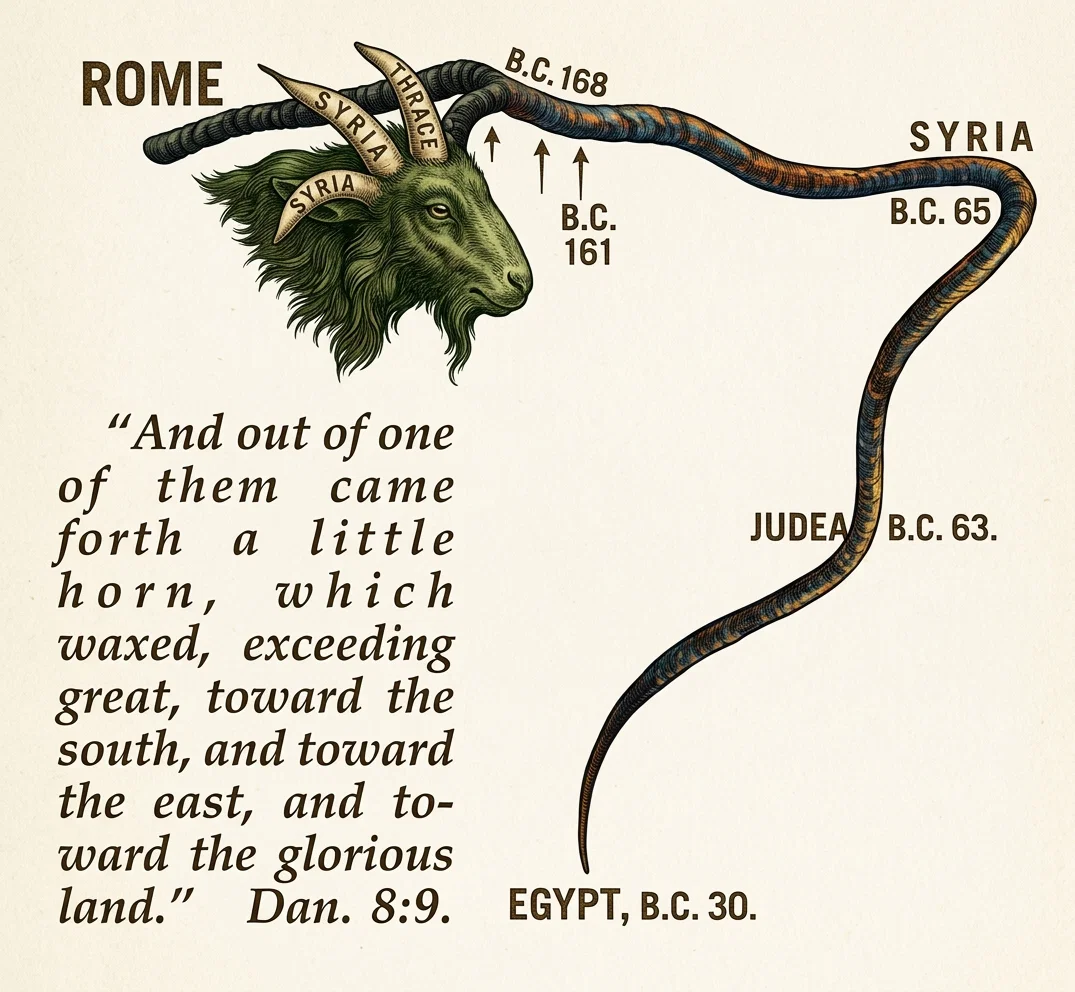
“Out of one of them came forth a little horn, which waxed exceeding great, toward the south, and toward the east, and toward the glorious land.” Dan. 8: 9. In 168 B. C., the Romans began the conquest of the Old World by conquering Macedon. Hence the Roman “horn” seems to the prophet to emerge from one of the four Grecian kingdoms. The Persian power is said by the prophecy to have “magnified itself”; the Grecian empire is said to have “magnified himself exceedingly”; and the Roman horn is now said to have “waxed exceeding great”—a gradual progression, which, with the whole description, shows this new “horn” to be a new world empire.
EXACTLY FULFILLED THE PROPHECY
The Romans exactly fulfilled the prophecy by extending their power to the south over Carthage 146 B. C. and Egypt 31 B. C.; in the east, by the conquest of Greece, Asia Minor, Syria, and Phoenicia, 65 B. C.; and over the glorious land, by the conquest of Judea 63 B. C.,—the land over which God’s protection had so long and signally rested.
“And it waxed great, even to the host of heaven; and some of the host and of the stars it cast down to the ground, and trampled upon them.” “And his power shall be mighty, but not by his own power; and he shall destroy wonderfully, and shall prosper and do his pleasure; and he shall destroy the mighty ones and the holy people. And through his policy he shall cause craft to prosper in his hand.” Verses 10, 24, 25.
NEVER IN GOOD FAITH
Craft, devastation, and persecution are here brought to view as leading characteristics of the Roman power. “The policy of the senate,” says Montesquieu, “was worth more to them than their armies even. . . . Their constant maxim was to divide. . . . They never concluded peace in good faith.” The wonderful destruction carried on by the Romans for six centuries is shown in the fact that in the nine years that Caesar spent in conquering Gaul, he took 800 cities, subdued 300 tribes, and defeated in battle 3,000,000 men, of whom 1,000,000 perished, and 1,000,000 were reduced to slavery.
When Titus came back from Jerusalem, he inaugurated the Colosseum in Rome by public fights which lasted 100 days, and in which 5,000 wild beasts and 2,000 gladiators were sacrificed. Rich Romans owned as many as 20,000 slaves, over whom they exerted the power of life and death. “Just think,” says the Belgian historian Laurent, “of the infinite number of men killed or sold as slaves in a permanent war which lasted 800 years!”
THE HOST OF HEAVEN
Verse 24 explains “the host of heaven” and “the host” and “stars” of verse 10, by calling them “the mighty ones” and “the holy people,” or “people of the saints,” margin. The nominal people of God were not altogether protected from the power of Rome. When Jerusalem was taken by Pompey, 63 B. C., 12,000 persons were slaughtered. In 70 A. D., under Titus, 1,100,000 perished. But the prophecy seems to refer more particularly to the true people of God, of whom 3,000,000 were tortured and killed by order of the Roman emperors during the second and third centuries of the Christian era. Some were burned, beheaded, strangled, racked. Others were burned above a slow fire, with the head downward. Some were roasted on iron grates, or dipped into boiling oil, or drowned in rivers. Still others had the whole body carded with iron combs. Many were devoured by wild beasts, to amuse the multitudes.