Signs of the Times, Vol. 32, No. 37.

FOLLOW CHRIST
Earlier text: FOLLOW CHRIST

OUR GREAT TREASURE-HOUSE

By MRS. E. G. WHITE

HOW TO STUDY THE BIBLE.

OUR heavenly Father, in giving His Word did not overlook the children. In all that men have written, where can be found anything that has such a hold upon the heart, anything so well adapted to awaken the interest of the little ones, as the stories of the Bible?
In these simple stories may be made plain the great principles of the law of God. Thus by illustrations best suited to the child's comprehension, parents and teachers may begin very early to fulfil the Lord's injunction concerning His precepts: "Thou shalt teach them diligently unto thy children, and shalt talk of them when thou sittest in thine house, and when thou walkest by the way, and when thou liest down, and when thou risest up."
The use of object-lessons, blackboards, maps, and pictures, will be an aid in explaining these lessons, and fixing them in the memory. Parents and teachers should constantly seek for improved methods. The teaching of the Bible should have our freshest thoughts, our best methods, and our most earnest efforts.
In arousing and strengthening a love for Bible study, much depends on the use of the hour of worship. The hours of morning and evening worship should be the sweetest and most helpful in the day. Let it be understood that into these hours no troubled, unkind thoughts are to intrude; that parents and children assemble to meet with Jesus, and to invite into the home the presence of holy angels. Let the services be brief and full of life, adapted to the occasion, and varied from time to time. Let all join in the Bible reading, and learn and often repeat God's law. It will add to the interest of the children if they are sometimes permitted to select the reading. Question them upon it, and let them ask questions. Mention anything that will serve to illustrate its meaning. When the service is not thus made too lengthy, let the little ones take part in prayer, and let them join in song, if it be but a single verse.
To make such a service what it should be, thought should be given to preparation. And parents should take time daily for Bible study with their children. No doubt it will require effort and planning, and some sacrifice to accomplish this, but the effort will be richly repaid.
As a preparation for teaching His precepts, God commands that they be hidden in the hearts of the parents. "These words which I command thee this day, shall be in thine heart," He says, "and thou shalt teach them diligently." In order to interest our children in the Bible, we ourselves must be interested in it. To awaken in them a love for its study, we must love it. Our instruction to them will have only the weight of influence given by our own example and spirit.
In daily study, the verse-by-verse method is often most helpful. Let the student take one verse, and concentrate the mind on ascertaining the thought that God has put into that verse for him, and then dwell upon the thought till it becomes his own. One passage thus studied until its significance is clear, is of more value than the perusal of many chapters with no definite purpose in view, and no positive instruction gained.
One of the chief causes of mental inefficiency and moral weakness is the lack of concentration for worthy ends. We pride ourselves on the wide distribution of literature; but the multiplication of books, even books that in themselves are not harmful, may be a positive evil. With the immense tide of printed matter constantly pouring from the press, old and young form the habit of reading hastily and superficially, and the mind loses its power of connected, vigorous thought. Furthermore, a large share of the periodicals and books that, like the frogs of Egypt, are overspreading the land, are not merely commonplace, idle, enervating, but unclean and degrading. Their effect is not merely to intoxicate and ruin the mind, but to corrupt and destroy the soul. The mind, the heart, that is indolent and aimless, falls an easy prey to evil. It is on diseased, lifeless organisms that fungus roots. It is the idle mind that is Satan's workshop. Let the mind be directed to high and holy ideals, let the life have a noble aim, an absorbing purpose, and evil finds little foothold.
Let the youth, then, be taught to give close study to the Word of God. Received into the soul, it will prove a mighty barrier against temptation. "Thy Word," the psalmist declares, "have I hid in mine heart, that I might not sin against Thee." "By the Word of Thy lips have I kept me from the paths of the destroyer."

THE HOUSEHOLDER'S RETURN.

III. Associated Events.

"THIS Gospel of the kingdom shall be preached in all the world for a witness unto all nations; and then shall the end come." Matt. 24:14. A time will come when every soul has heard the Gospel, the good news of salvation, and has either accepted or rejected the offer of mercy and pardon, the offer of life everlasting. From that day probation will be past. This presupposes another event, the judgment, for no man is adjudged innocent or guilty without trial.
We are not left in darkness or doubt in regard to this matter. Read Acts 17:31. God "hath appointed a day, in the which He will judge the world in righteousness by that Man whom He hath ordained." Again, in Heb. 9:27, "It is appointed unto all men once to die, but after that the judgment." Of necessity many will still be living, and will continue to live, after the day of pro-
bation passes. These will be judged before death, for "all shall stand before the judgment seat of God" (Rom. 14:10), "the quick and the dead." Acts 10:42. In all the ages of the past men have lived their lives—good or evil—and died. So far as their cases are concerned, all is settled, for in the grave where they have gone there is no wisdom, no knowledge, no repentance, no hope of salvation—their thoughts have perished. Their lives determined their future, whether it shall be life eternal or total annihilation. So also with the living; the life will be the test. It is a sad thought that many, many will come to the judgment hour, be weighed in the balance, and found wanting. Without doubt many upon whom the death sentence is passed will go on believing they are doing God's will, yet having grieved His Spirit away forever. Then the Master of the house will have risen up and shut the door, and knocking and seeking will no longer avail. Luke 13:24-26. Only those who have done the will of the Father will be safe.
When the aged seer had written the wonderful visions opened up before his view that Sabbath day on wind-swept Patmos, the angel said to him: "Seal not the sayings of the prophecy of this book, for the time is at hand;" when men see these things come to pass, let them understand that His coming is near. Down in the period when "the time is at hand," before the triumphant, grave-opening shout shall be heard in the heavens, the decree goes forth: "He that is unjust, let him be unjust still; he which is filthy, let him be filthy still; and he that is righteous, let him be righteous still; and he that is holy, let him be holy still." This is not long before the Lord's appearing, for He says: "Behold, I come quickly." Rev. 22:11, 12.
When the decree goes forth, the door of hope is forever closed to sinners, the day of repentance is passed. Then on the wicked who have clung to their sins, repelling every offer of mercy and pardon, there will fall the most terrible visitation of disaster that man has ever seen, when the vials of God's wrath are poured out. Only the saints of God live through that terrible time without suffering; while the wicked, having grieved the Spirit of mercy away, writhe under the unmingled wrath which their own course has brought upon them. Then "he that dwelleth in the secret place of the Most High shall abide under the shadow of the Almighty." "A thousand shall fall at thy side, and ten thousand at thy right hand; but it shall not come nigh thee. Only with thine eyes shalt thou behold and see the reward of the wicked." Ps. 91:1, 7, 8.
The closing of probation and the falling of the plagues are the first of a series of events to take place in connection with the coming of the Lord, which follows "quickly." The trumpet blast, the clarion shout, the blinding lightning flash that accompany the Saviour as He descends on the clouds of heaven, the host of angelic beings, will have two effects; the shout brings the sleeping saints from their lowly beds, together with the men who pierced the crucified Saviour (Dan. 12:2; Rev. 1:7), and the lightning destroys the wicked, they having vainly attempted to hide themselves in the caves and rocks of the mountains which they pray to fall on them. Then will the ransomed ones be caught up together with the risen saints on the sea of glass.

The Thousand Years.

Satan, alone in the earth with the dead men whom he has deceived and brought low, is bound in a prison-house as with a chain, having no one to tempt and destroy, for "the rest of the dead lived not again until the thousand years were finished." There he shall be shut up, with a seal set upon him, that he may deceive the nations no more, "till the thousand years shall be fulfilled." In the meantime the saints "lived and reigned with Christ a thousand years." This period begins at the first resurrection. Then at the second coming of Christ, and just previous, these events take place: Probation closes, the plagues fall, the wicked are slain, Satan is bound, the saints redeemed.
The thousand years pass, and then the final restoration of all things is effected. "And when the thousand years are expired, Satan shall be loosed out of his prison." How is this accomplished? Rev. 20:6 speaks of the resurrection of the righteous at the second advent as the first resurrection; the fifth verse speaks of the wicked living again when the thousand years are finished. So this is the second resurrection of the wicked. Being loosed from his prison once more, having living men to deceive, Satan's first work is to go out among the nations and gather them together to take the City, the New Jerusalem, which comes down to the earth at the close of the thousand years. For this a "little season" of time is granted him to gather and train his forces for the last attack against the government of God. If we consider Isa. 65:20 to refer to this time, when "the child shall die an hundred years old, but the sinner, being an hundred years old, shall be accursed," this "little season" may be a hundred years. All are raised at the time the New Jerusalem descends, the innocent child of ungodly parents and the hardened sinner. At the close of the period the child, being then a hundred years old, shall die; but the sinner shall be accursed.
About the beloved City will be gathered an army greater than any other army ever brought together, consisting of the rank and file of all the wicked of all the ages. With all the inventive genius of all the ages at their command, with an unnumbered host for support, and the leader of the legions of darkness in command, they march against the Citadel of the redeemed. But suddenly that mighty advancing host is checked, and those within the City see the fire of God poured out upon them. All go down in the holocaust of fire,—Satan, his angels, his dupes,—all are consumed. This is the second death. The redeemed in the City, and the universe of God, will then see the love and wisdom of the Creator in thus allowing sin to run its course. All shall see and know that He is just, and then "He
will make an utter end; affliction shall not rise up the second time" (Nahum 1:9), for Satan, the author of evil, shall be destroyed, and tho he has been the terror of the nations, he shall never be any more. Eze. 28:19.
From the refined and purified elements of this sin-cursed earth, the Lord has said: "Behold, I create new heavens and a new earth; and the former shall not be remembered, nor come into mind. . . . And I will rejoice in Jerusalem, and joy in My people; and the voice of weeping shall be no more heard in her, nor the voice of crying. . . . And mine elect shall long enjoy the work of their hands." Isa. 65:17-22.
These are the events of the closing of time, the ushering in of eternity: The New Jerusalem descends from heaven at the close of the thousand years; the wicked dead are raised, thus loosing the bonds of Satan, to whom a "little season" is given to more fully demonstrate his character of rebellion and usurpation; fire issues from God out of heaven and devours him and all the wicked; the earth is created new and pure; the government is given to Him whose right it is to reign, "the Alpha and Omega, the beginning and the end, the first and the last," the doing of whose commandments brings blessing, the right to the tree of life, and entry into the City. "Behold I come quickly!"
Whose heart does not echo the prayer of John, "Even so, come, Lord Jesus!" Rev. 22:20.

New Departures in the Catholic Policy for the Restoration of the Temporal Power

THE PAPACY AGAIN IN OPEN POLITICS.
THE world in general seems quite well persuaded that the Papacy has ceased its struggling and resigned itself to its present condition, and therefore does not any longer hope for a return of the temporal power. But those who have come to the conclusion that the Papacy has descended from the mountain of its ambition, and does not any longer turn its eyes toward the promised land of the temporal dominion, are not acquainted with the inner workings of the Vatican. For while the church is not agitating the question very much internationally, still she is working with a febrile activity within the confines of Italy itself.
In order to understand something of these efforts that are being put forth in the direction of reacquiring the lost prestige of the pontiff, I shall endeavor to give something of their modus operandi. As we are all aware, the Catholic Church in general has an organization probably unequalled by any other institution in the world. Here in Italy, for practical working purposes, the activity of the church is divided into groups. These groups are numbered as first, second, third, etc., and each one has a certain work apportioned to it. The first group deals directly with the spiritual interests of the church, while the second group interests itself in the political policy of the Papacy.
As we are here considering the Papacy in its relationship to the temporal power, I shall confine myself to the work of the second group, and endeavor to give some idea as to what is being accomplished by it.
In the first place, I might speak of the organization of the second group, that we may better comprehend the scope of its influence. The leading men of each parish are selected by the parish priest, and they constitute the active committee of the second group for their district. This committee is composed of about twelve to fifteen persons, and they represent each district of the parish. These men meet two or three times a month at the parish home, to compare notes and discuss plans of operation. However, in the plans formulated the priest has a deciding voice.
This committee, by means of public and private agitation, the organizing of young people’s societies and social benefits, tries to arouse every one in its community to take an active interest in the restoration of the lost prestige of the church. They found rural banks with a small capital, and by taking deposits and making loans endeavor to tie the people to the church. A person of the community that has need of some money can get it at these banks without so much security as is required at an ordinary bank; but as the priest is practically the head of the institution, he makes one of the conditions of the loan a faithful attendance on church duties. By this and many other social schemes the committee works to put the people under obligations to the church and the priest.
Then there is a committee for the diocese, which is appointed by the bishop and composed mostly of priests. This committee follows largely the same program for the diocese that the local committee does for the parish. The bishop has the power to annul any plan made by this committee, or to dissolve the committee itself, when to his mind it does not seem to accord with the best interests of the church.
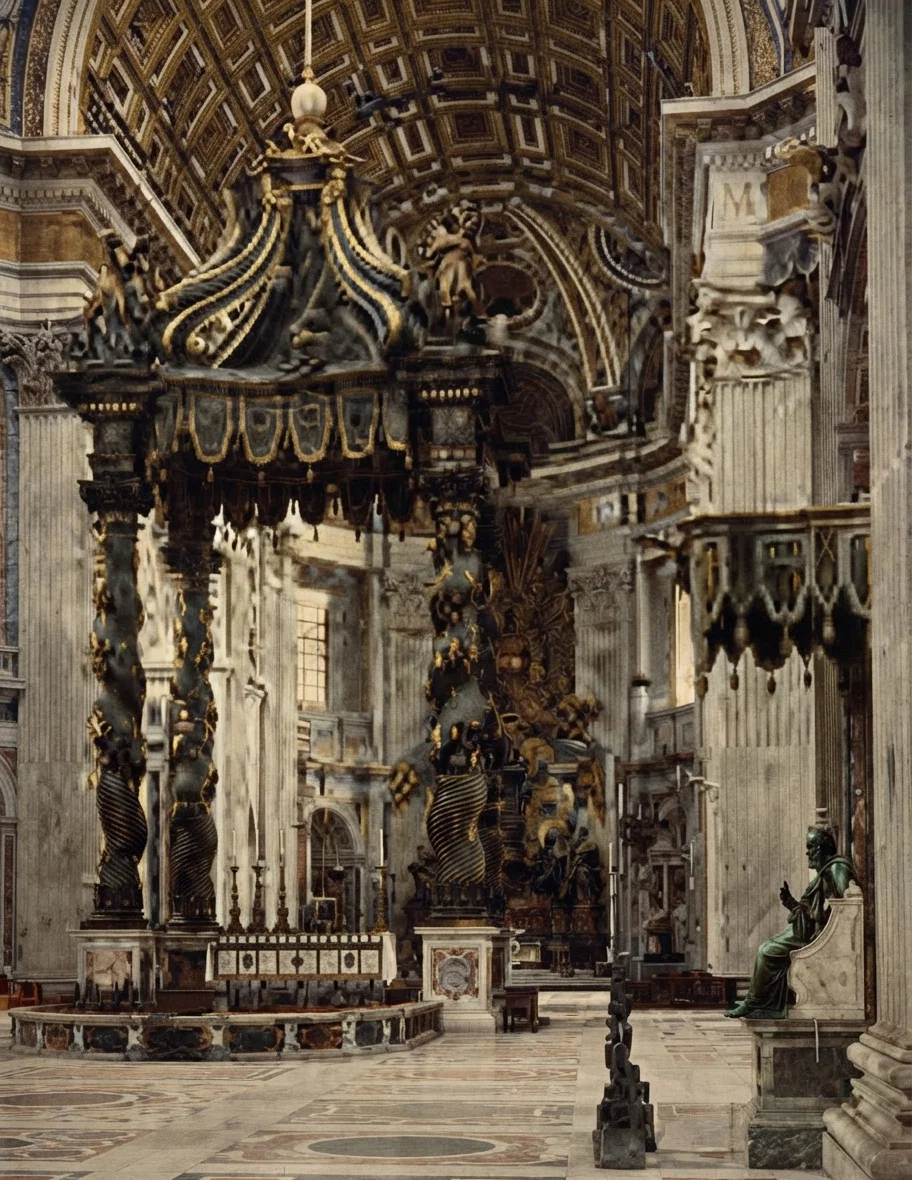
THE FAMOUS BRONZE STATUE OF ST. PETER ON THE RIGHT, AND THE GREAT ALTAR, ST. PETER'S, ROME.
Practical Abolition of the 'Non-Expedit.' Then there is a general over all who resides at Rome or may hold his residence in any large center.
At the present time the general is a layman. He visits the different dioceses, and helps to consolidate the movement and guide in forming plans for the better accomplishment of the general results aimed at by the second group.
Every two or three years is held a congress of the Catholic forces, to which delegates are sent representing the various groups of the church. In these congresses the past progress is reviewed and new plans are formulated for future activity. These programs of plans are first submitted to the bishops, and finally to the pope, who, if he find difficulty in accepting them, may annul them. After these programs have passed through this careful inspection, they are printed and sent out to the members of the respective groups, and they form the basis of operation.
The second group, in its present form and policy, has existed only about ten years, and has for its declared aim the restoration of the lost power and prestige of the Papacy. It proceeds along social and political lines in its endeavor to obtain the object at which it aims. Therefore one of its aims is and has been to cause the 'non-expedit' to be revoked. 'Non-expedit' is the title given to the order issued by the pope against the participation of the Catholics in voting for officers to public position. After the fall of the temporal dominion, the pope being asked about the matter of voting, said that it was not expedient to vote for the time being, hence the term 'non-expedit.' And while the second group has not as yet succeeded in having the 'non-expedit' officially revoked, yet at the last election, at least, it was practically a dead letter, and the Catholics showed great activity at the polls.
It is only a question of time when the church will consider it expedient to abolish this order. The second group, with this object in view, is preparing men that will be able to fill public offices and posts of responsibility. Therefore they have their own schools, literature, and journals whereby they are educating the people. They are working at the present in a special way to gain control of the municipal public offices, and in many places they have entirely succeeded. They are also playing their game for the Parliament, and it will not be long before we shall see many of their candidates elected to the House of Deputies.
As the sentiment of the people in general is turning toward liberalism and against the old conservative monarchical party, this movement goes under the name of Christian Democracy, that it may be in tune with the popular feeling. And as statesmen and politicians of the present are almost all actuated by self-interest rather than by principle, they naturally rush to the side that they see in the ascendancy. Already we see some very prominent men in the Italian Government, and even in the Cabinet, who were strong anti-clericals some years ago, and who to-day are working hand in hand with the Papacy. And it is certain that as soon as the Catholic Church returns to the political arena, with all of its forces well organized, it will form a party that will gather to itself a strong following and influence.
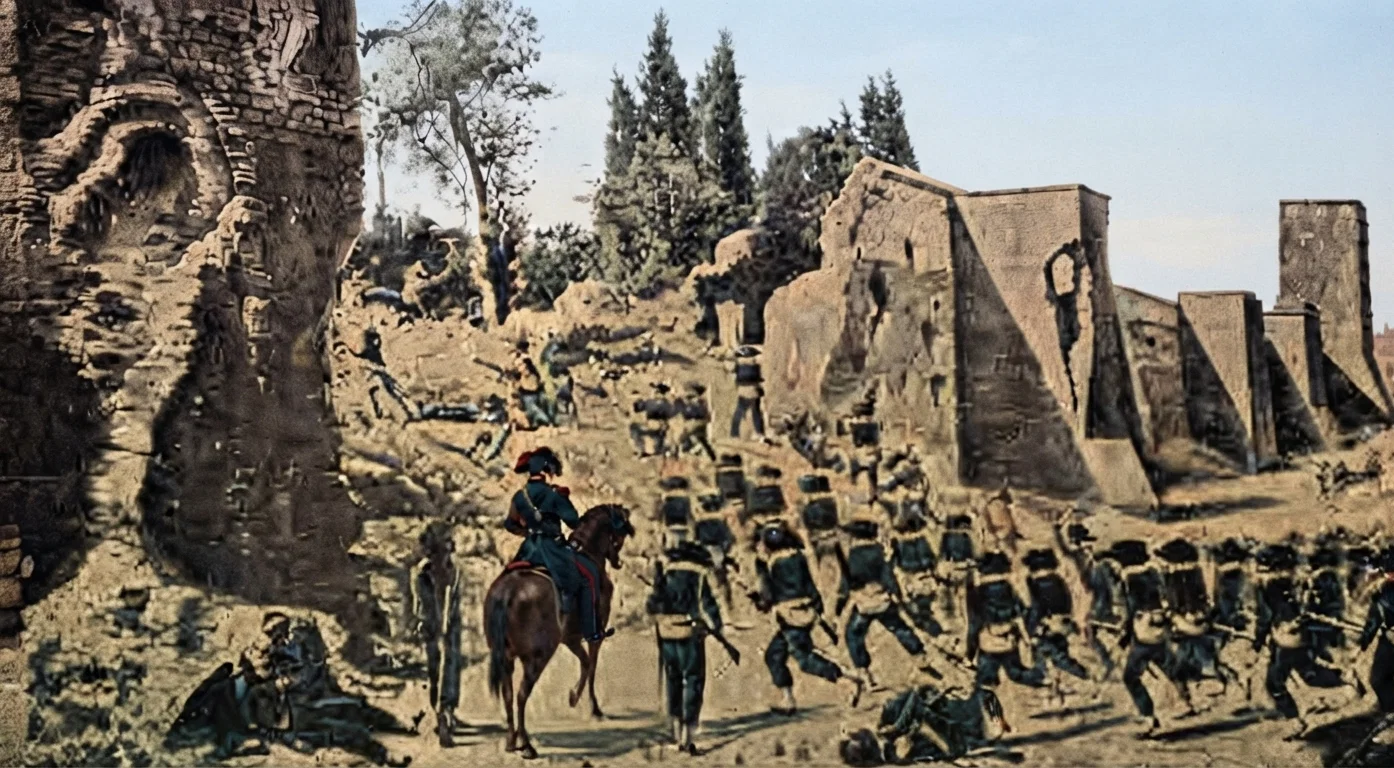
ITALIAN TROOPS ENTERING THE CITY OF ROME THROUGH THE BROKEN WALLS, IN 1870.
The turn that the Catholic Church has already taken in allowing its members to go to the polls has made a deep impression, and its results are in evidence all around us. The newspapers that before were hostile to the interests of the church are now actually fawning at its feet. The strong anti-clerical speeches in the Parliament are growing less very perceptibly. In fact, the government is almost linking arms with the church, so much so that at Rome one seeking an office or help from the government can hope for little without the signature of the parish priest to render his application of value.
The Catholic Church is likewise honoring the government in certain ways. The national flag, which in the past has been trailed in the dust by the church, has recently been hoisted over its convents in Constantinople. And a short time ago the entire country was scandalized by the action of the Duke of Aosta, who is the cousin of the king, and would be heir to the Italian throne should the king die without an immediate successor. The duke, in official array and attended by his entire court, assisted at the service held in the cathedral of Naples, and kissed the vessel that is supposed to contain the blood of St. Januarius which is said to liquify miraculously once every year. Had he gone as an ordinary citizen so much would not have been said, but going in his official capacity and accompanied by his court he certainly designed to show a special respect to the church, in spite of the position that he holds in the government.

Policy Gaining Favor.

For some time the Roman Curia was not exactly in favor of the work that was being attempted by the second group. But now that the pope sees how well their program is working out to the advantage of the church, he is taking a personal interest in it. And a short time ago he appointed some of the leading men of the party as a committee to investigate thoroughly the movement, and to form a new program that shall be more practical and certain of success. He has eliminated the revolutionary element from the party, and put the movement on a basis where its triumph will mean the triumph of the church. And it is quite certain that it will come out victorious. The triumph of this party will mean the restoration of the lost power and prestige to the pope. The question might be asked, Will it involve giving back to the pope the temporal power in Rome? This question I shall not endeavor to answer by a simple negation or affirmation. But I shall call attention to a few facts.
Not long ago, from a strongly Catholic source, and at least partly with the approval of the Vatican, a book, entitled 'The Papacy in 1915,' was published. Among other plans proposed, there was one that suggested the solution of the question of the temporal dominion in another way from those contemplated in the past. According to the Catholic Church, the temporal dominion is an absolute necessity, as the pope must not be subject to any government. But this writer suggests that in order to satisfy this precept of the church, the restoration of Rome to the Papacy is not absolutely necessary. He said that that part of the city of Rome which surrounds the Vatican and is cut off from the rest of the city by the Tiber River might be given over to the pope as his dominion. The part of the city of Rome in the immediate vicinity of the Vatican, at the time of Leo IV. (848), was enclosed by a wall forty feet high, and thus became known as the 'Leonine City.' It is this part of Rome that is proposed as a fit place for the pope to again exercise his temporal dominion.
This writer further says that the important offices of the Papacy might be transferred to that part of the city, and a large hotel might be built to accommodate the strangers and pilgrims that come to visit St. Peter's and the pope. I do not know that this plan will be adopted, but it is suggested as a possible solution of the much-discussed question dealing with the restoration of the temporal dominion of the Papacy. It might well be questioned, however, if the Papacy, like the camel of the fable, would not plot to enter in and take possession of the whole city if it were allowed to get its nose inside, and it should begin to smell the sweet savor of the temporal power. C. E. MILTON.

VII. TRAINING TO UNSELFISHNESS AND GENEROSITY.

"Mama, O mama!" The childish voice was eager and full of sympathy. "Mama, Jamie Brown hasn't any mittens at all, and it's awful cold. I've got two pair, can't Jamie have one? his hands are just as blue." "Well, well, child, I can't buy mittens for every ragged boy in town; now run away and don't trouble me."
"But, mama, they're already bought, and Jamie needs 'em, and —"
"Don't argue with me, Arthur," said Mrs. Martin. "I tell you, you may need them yourself sometime. It's only yesterday you wanted to give away the nice ball Uncle Charlie bought you last year."
"Yes, but he gave me another this year, and I don't need both."
"Well, you'll never be worth a cent if that's the way you begin,—you'd give away the very bed from under you, if I'd allow it. Now I don't want any more trouble about it."
But it was not long before trouble of the same kind arose again, for little Arthur was naturally a child of generous impulses; this time it was over some red-cheeked apples, which the child proposed to divide among his friends, but Mrs. Martin insisted that he might need them all himself.
Time passed on till Arthur Martin was about twelve years old. By this time, his friends began to notice a gradual change in his behavior. Usually generous and warm-hearted, he was becoming selfish, greedy, and unsympathetic. "I can't understand it at all," complained his mother; "Arthur was always such an unselfish boy; what can be the matter with him? Why only yesterday I asked him to divide his orange with Jennie; but he scowled and whined and insisted that there was no more than he needed for himself."
Poor Mrs. Martin! Was she so blind that she could not see? or had she forgotten the years of training she had given her boy—training for a life of the utmost selfishness; until now it is an easy matter to predict the future of the lad. The coming years will bring him but few friends and many enemies; for who can love a selfish, close-fisted, miserly man? Who can love so unlovely and unlovable a thing as a human soul steeped in the bitter dregs of selfishness, and whose heart has grown too hard and callous to respond to the miseries of his fellow-men?
I am afraid there are many Mrs. Martins in the world to-day. Have you ever known any? Are you sure your own mirror does not reflect her image?
"Well, I'm happy to say that I always have taught my children to divide with others. Sometimes they don't like to do it, but I always insist upon it."
But "dividing with others" is not all there is to it, my friend. Right here, again, example is better than precept. Selfishness is manifested in so many ways! It buries its ugly root down deep in the unregenerate heart. It obtrudes its hateful countenance upon the most joyous occasions, and no hall of mourning is dark enough or sad enough to hide from sight its glaring and hideous plague spots.
But how shall we get rid of it? and how may the hearts of our children be purged from its vile stains?—Ah! "the blood of Jesus Christ His Son cleanseth us from all sin." The blood of the supremely unselfish One, applied to the heart of the most supremely selfish, will purify and regenerate and—yes—it will recreate.
We may divide with others all our lives; we may even deny ourselves of comforts that we may share them with others; we may give liberally to the cause of Christ at home, and to the support of the missions abroad, and still our hearts may be as barren of the sweet blossoms of genuine love and unselfishness as the desert of Sahara is of the rose of Sharon.
Let us look very deeply into our inmost hearts; let us light a candle and peer into the dark depths.
"Well," says Sister A, "I never saw it in this light before, but I do believe that even my best deeds have been mixed very largely with selfishness. Last week I gave a new dress to poor Sister B. Of course I could hardly afford it, but Sister B was very needy—and, well, Sister B is such a hand to express her gratitude. Why the poor woman cried for joy, and said she could go to meeting now. She praised me for my generosity, and said the Lord would surely bless me; and, well, I must confess it did sound good to me. When I went home I told the children that I felt paid already, because Sister B was so appreciative."
So you told the children that, did you? I'm very sorry you did, for you could not have taught them a more effective lesson in selfishness if you had tried.
"I'm sure I don't know how that could be," declared Sister A with a smile of incredulity. "I'll admit I was selfish, but don't see how the children could see it. Why, I never saw it myself until now."
Probably not; and yet in less than five minutes after you had related this incident, your Johnie remarked that he had thought of giving poor little Paul Brown his last year's reader, but he was glad now that he didn't, for he was sure that Paul would not have appreciated it!
O how unlike the sinless, unselfish Pattern is all this! He came to His own and His own received Him not. He that did eat of His bread lifted up his heel against Him. Yet this deterred Him not for a moment. His great unselfish heart was touched with the feeling of our infirmities; and even for His murderers He prayed that wonderful prayer, "Father, forgive them."

TWO GIRLS WHO BECAME WIVES.

A VERY bright girl, by name Jane Ferrar, was married a dozen years ago. She was an able, ambitious girl. She was active in club work, and the clubs to which she belonged numbered some six.
When she married she preferred not to keep house. "I certainly shall not waste my life by giving it to housework," she argued. She said: "The class of women who once were housemaids are now pressing into higher occupations. Let us live in a hotel. The individual home takes too much out of a woman."
Of course, the care of babies does not easily accord with hotel and club life. So the Ferrars have no children. But Jane is a leader in reforms. Her husband has given his life wholly to business. He is a silent, moody man, of whose real character she knows little.
Her cousin, Nelly Ward, married about the same time. She was as able a woman as Jane, but with a sound foundation of common sense and that tender human sympathy which is the basis of character in the woman best beloved by men and by God.
Her family besought her not to keep house. All the arguments recently urged against the old-fashioned home were brought forward. No servants, it was asserted, could be found who were not dishonest, incapable, and insolent. American women had gone into the shops and mills, feeling themselves debased by domestic service. Americans had in effect given up family life, as was proved by the countless hotels and skyscraping apartment houses in all of our cities.
Nelly was daunted at first. "But," she argued presently, "the home and family lifewas a blessing sent in the beginning to women by God. I don't believe He means us to give it up. I must try the experiment, not by general laws, but in my own individual way."
Here, perhaps, was the secret of her success. She met all men and women, not as types or representatives of a class, but as individuals. The work of her house and kitchen was to her a fine art which she studied. The time which other women spent on lectures and "bridge" she gave to learning how to keep house, or to her husband, and her babies when they came.
The cook and the maid were not to her a class to be held down in its place, but two friends and helpers. She knew all about their "folks" and homes. She found work for the cook's boy who had taken to drink, and when the maid's father was in the hospital she visited him and paid his bills.
She has been a housekeeper now for many years. Some of her public-spirited friends wonder that she is able to keep up her happy home life. "She never has trouble with servants," they say.
She laughs and says nothing. She never argues. She just goes ahead and does.
—Ladies' Home Journal.

WHEN THE WORK IS DONE.

LET us take to ourselves a lesson, No lesson can braver be, Of the weaves of the tapestry weavers On the other side of the sea.
Above their head the pattern hangs; They study it with care; The while their fingers deftly weave Their eyes are fastened there.
They tell this curious thing besides, Of the patient, plodding weaver— He works on the wrong side evermore, But works for the right side ever.
It is only when his work is done And the web is loosed and turned, That he sees the real handiwork His marvelous skill has learned.
Ah! the sight of its delicate beauty! How it pays him for all its cost! No rarer, daintier work than his Was ever done by the frost.
The years of man are nature's looms, Let down from the place of the sun, Wherein we are weaving always Till the mystic web is done.
Sometimes blindly, but weaving surely, Each for himself his fate; We may not see how the right side looks, We must often weave—and wait. —Anon.

DR. BILLROTH'S JOKE.

THE eminent Viennese surgeon, Theodor Billroth, began one of his lectures by telling his students that a doctor needed, above all things, two gifts: He must be free from all disposition toward nausea, and he must be a good observer. "I want you to show me right away," he added, "whether you can meet these demands." He then poured a nauseous fluid into a glass, dipped one of his fingers into it and licked it off; whereupon he invited the students to follow his example. Without flinching they did so. With a broad grin, the surgeon looked at them and said: "You have stood the first test brilliantly. Not so the second, for none of you observed that I dipped my first finger into the glass but licked the second."

A CONTRAST.

WE hope all our readers will read this from a Columbus (Ohio) paper:
"Two horses stood, yesterday, hitched near each other on Gay Street. One of them was patient, comfortable, and in good temper; flies lighted upon his back occasionally, but he drove them away with a switch of his long tail. The other horse was impatient, restless, and in bad humor. He was stamping the ground and moving back and forth the vehicle to which he was hitched. Occasionally he would throw his head around angrily, and he had been champing his bit till his mouth was covered with foam. The flies alighted on him and stayed there. He could not dislodge them. He moved his tail, but it was only a stump. It had been docked, its usefulness destroyed in order that some person's foolish or cruel fancy might be pleased. There was in the contrast of those two horses a lesson that ought to have been sufficient to convince any person of the barbarity of docking horses' tails and leaving the animals at the mercy of insects. Any person who saw, and still could not understand, should try the experiment of sitting out in a field with arms bound and all means for keeping flies away removed. Docking is a blight on our civilization. The beauty and usefulness of the tail are destroyed, and the man who does it or countenances it is marked as thoughtless or brutal."—Our Dumb Animals.

INDIVIDUALITY IN THE WIFE.

In order to be a good wife and mother, it is not necessary that woman's nature should be utterly merged into that of her husband. Every individual being has a life distinct from all others, an experience differing essentially from theirs. God does not want our individuality lost in another's; He desires that we shall possess our own characters, softened and sanctified by His sweet grace.
He wants to hear our words fresh from our own hearts, and not another's. He wants our yearning desires and earnest cries to ascend to Him, marked by our own individuality. All do not pass through the same exercises of mind, and God calls for no second-hand experience. Our compassionate Redeemer reaches His helping hand to us just where we are. Tho Jesus has ascended to heaven, He has not lost His sympathy for you, mothers; He looks with tender love upon those whom He came to redeem.—Mrs. E. G. White.
Continue reading: YOUR OWN BOSS