Now and then I hear a boy say: "If I could only be my own boss, then I would be happy." Did you ever know any one who amounted to anything who was his own boss? The only one I ever read about was Robinson Crusoe, and he was glad to quit.
You have heard of the "independent farmer." He is dependent upon wind, water, and frost; he must be at home every morning and night to milk the cows. The physician must buy his clothes and groceries of his patients. Do you think that Marshall Field, the great merchant, was independent? Not a bit. He carried two great stores around on his back. He would have been unhappy if he had not been doing something for the thousands in his great army.
No one can be his own "boss," unless he goes out of the world into the wilderness, and then he will find himself dependent upon the berries and animals.
There is, however, one way of becoming your own boss. Let me tell you. It is to stay right where you are, and begin by ruling yourself. That is the first step. Then begin to help other people, and after awhile you will find them willing to do anything for you. Your workshop will become a throne.
—Selected.
EASY MONEY.
A. E. Loveland, Johnson, Vt., writes: "On Friday I sold six dozen E-Z Washing Tablets; my mother sold five dozen, and another friend sold four dozen,—fifteen dozen in one day! Nearly every one likes the Tablets."
Agents make a profit of over 100 per cent. Not necessary to canvass. Send 5 cents for samples and particulars. Either sex. Address, Alfred Mallett, Elkridge Station, Baltimore, Md., or to Clinch Mercantile Co., Grass Valley, Cal., Pacific Coast Supply House.
Bank of Mountain View
By Editor
If you haven't already done so, why don't you drop us a postal asking us to send you a copy of our monthly paper, "The Bank of Mountain View Journal." It is very interesting. It is full of good ideas, and it is free to you for the asking. If you live in the East, send for a copy and see how we do it in California. We still hold ourselves ready to furnish you with information about Mountain View. Write us.
Address
Bank of Mountain View
Mountain View, Santa Clara County, California
Southern Pacific
Whether going East or coming West, do not fail to take advantage of the most essential features of traveling
Speed,
Comfort,
Safety
Which are given the greatest attention in the equipment of the
Overland Limited
Running over the Southern and Union Pacific. Secure tickets and make reservations for berths from any
Local Agent
Southern Pacific Company
OR
City Ticket Office, Ferry Bldg., San Francisco, Cal.
Personally Conducted
Tourist Cars
ON THE
UNION PACIFIC
Operate daily between principal Eastern points and California. The route of the Overland Limited.
S. F. BOOTH, General Agent,
San Francisco, Cal.
E. L. LOMAX, G. P. A.
Omaha, Neb.
IMPORTANT TO TRAVELERS
The WASHINGTON-SUNSET ROUTE announce the opening of their through line via New Orleans. Personally conducted cars, San Francisco to Washington, D. C., via Coast Line and Los Angeles, tri-weekly. Tickets at lowest rates to Washington, Baltimore, Philadelphia, New York, New England, and all Eastern points. Through the Old South. Quick time. Best service. Write Phil K. Gordon, 1708 Filmore St., San Francisco, for full information.
The American Federation of Catholic Societies
By Editor
(Reported for the SIGNS OF THE TIMES.)
IV. HOPES OF THE FEDERATION.
It will be somewhat indicative of what Federation hopes to accomplish to give complete a story that was very generally circulated at the Buffalo Convention:
"Sometimes Catholics give as an excuse for not joining the Federation, that they do not want to offend their non-Catholic friends by becoming affiliated with an organization of this kind. An incident associated with the Chicago convention is here related to show how unfounded are the fears that Federation will excite the antagonism of non-Catholic denominations: After the convention, while several of the delegates were sitting in one of the hotels, a stranger, excusing himself for intruding, introduced himself. He said he resided in Kansas City; that by the merest chance he happened in, out of the drenching rain, to the convention. 'I am a Methodist,' said he, 'but if what I heard at this meeting correctly represents the Federation of Catholic Societies, you can’t let your fellow-citizens of other denominations know of it quickly enough. Educated Americans of all creeds are rapidly reaching the only logical and sensible conclusion, that in matters of religion, as everything else here, it is bound, sooner or later, to be the "survival of the fittest."' The Protestant gentleman’s thought not only contradicted the fear of bitterness, but it emphasizes the opportunities all about us for an apostolate of the laity to assist in winning America to the religion most consistent with the naturally broad and logical trend of the American mind."
Federation is, then, a power that must assist in winning America to the religion "most consistent with the naturally broad and logical trend of the American mind." And that trend, according to the Catholic view, is Catholicward! The struggle will terminate at last in "the survival of the fittest!"
A striking editorial appeared in the Buffalo Morning Courier of August 2. After referring to the declarations of the Federation as notable, arraigning Socialism as a menace to society, and quoting a portion of Mr. Gonner’s speech upon the subject, it said:
"It is a great work, a greatly needed work. The beneficent influence of the American Federation of Catholic Societies will be beyond measure. It is an organized, universal force acting in harmony with the spirit and principles of American social and political institutions. Arrayed with it will be other effective forces, religious, social, and political forces, all standing as a solid wall against which will beat in vain the intermittent waves of disorder, lawlessness, and anarchism."
Again, in its issue of July 31, the Courier said: "One of the most powerful organized bodies in this country is now in session in Buffalo. The American Federation of Catholic Societies represents a membership of a million and a half, united chiefly to oppose Socialism, anarchy, perversion of marriage, divorce, dishonesty in business, and corruption in politics. Next to the Catholic Church itself this Federation of Catholic Societies is the greatest organized conservative force in the United States, actively at work in opposition to movements and influences antagonistic to the principles of American institutions. It is a matter of supreme importance that this organization should continue to grow in strength and effectiveness; and it is entitled to the encouragement and the hearty good-will of all intelligent, law-abiding, patriotic American citizens."
The Catholic Union and Times, in its issue of August 2, editorially says:
"The good ship Federation has been fairly launched at the port of Buffalo. Its building has been perfected in these recent years; its probation period has passed; she has felt the 'thrill of life along her keel,' and now, with the 'wind sitting in the shoulder of her sail,' she leaps triumphantly on the trying waters of history. It is a great and magnificent organization that is bound to root out prevailing and ruining national evils. The Federation has no national fears, and it asks no favors."
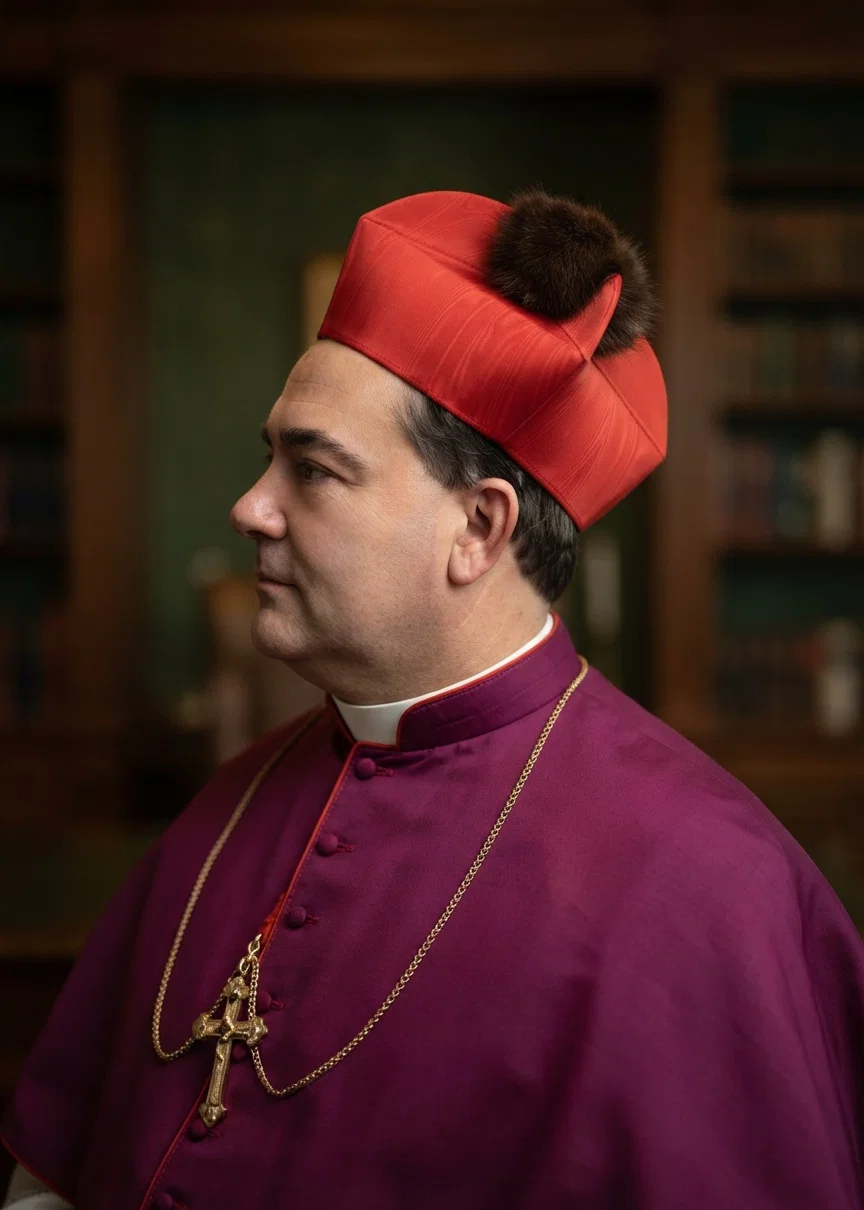
BISHOP JAMES McFAUL, OF TRENTON, N. J.
Catholics are not apologists for their presence in America. They are the true leaven of the body politic. Truth loves the sun, and who would dare impeach the excellence of those ends narrated by the Cardinal Secretary of His Holiness. Hear them: 'To extend a helping hand to the clergy in safeguarding Catholic interests; to strive for the Christian education of youth, which is the hope of the Church; to further peace and morality in families; to expound Catholic truth in books and periodicals; to combat errors; to foster established works of charity and found new ones; finally to endeavor to renovate public and private life in conformity with the teachings of Jesus Christ.'"
"History repeats itself" is an old and well-worn adage that must not be forgotten. Federation is not, after all, a new thing, nor an untried experiment. Far in the past federation had its day. We would review its history for a brief moment, and compare it in consideration and justice with the federation movement of the present. It was Patrick Henry who said, "We have no sufficient means of judging the future but by the past." And the following utterance by Macaulay is pertinent in this connection: "No past event has any intrinsic importance. The knowledge of it is valuable only as it leads us to form just calculations with respect to the future."
Just such a proceeding as the federation movement of to-day took place in the third and fourth centuries.
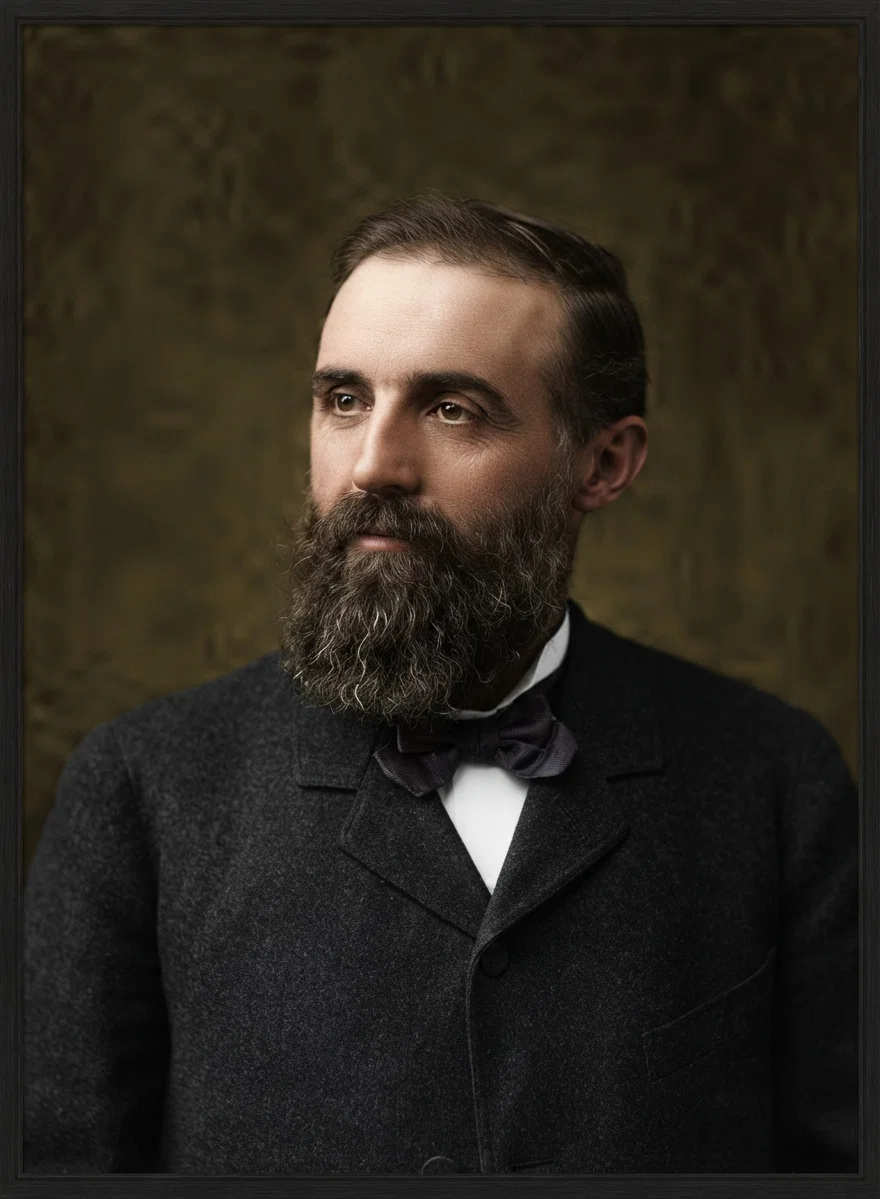
MR. J. B. OULKERS, OF NEWARK, N. J.
Various Christian bodies meeting in great ecumenical "councils," finally formed an organization, a great federal organization whose influence and territory was as far-reaching and universal as that of the government itself. Federation launched by Constantine was completed by Theodosius. The idea of that ancient federation, too, was "to renovate public and private life according to the teachings of Jesus Christ," and thus bring a visible "kingdom of God" upon the earth.
In order to facilitate its work in that apparently good, yet altogether bad, direction, the power of the civic government was invoked and secured. It was the prominent churchman, Augustine, who said:
"It is indeed better that men should be brought to serve God by instruction than by fear of punishment or by pain. But because the former means are better, the latter must not therefore be neglected. . . . Many must often be brought back to their Lord, like wicked servants, by the rod of temporal suffering before they attain the highest grade of religious development."
And in this purpose the government acquiesced. This was "civic righteousness" indeed, or "making men good by law." Collectivism, fully organized and despotic, with the mailed fist of bigotry and oppression, wrested from individualism the dearest of all earthly treasures—the right "to worship God according to the dictates of one’s own conscience." This was an egregious error, in which the state was made to actively participate and co-operate by compelling men to render obedience and do homage to that which was wholly and altogether heathenish. And all this was under anathema and temporal punishment! As Leander justly says:
"It was by Augustine, then, that a theory was proposed and founded, which . . . contained the germ of that whole system of spiritualism and despotism, of intolerance and persecution, which ended in the tribunals of the Papacy."
The world-church, formed and launched upon its fateful journey by combined influence of federation, holding firmly the reins of civil government in an iron grasp, rode triumphantly down through the ages; its pathway strewn all the way with hapless wrecks of heretical humanity, until a voice in Germany awoke the world from the sleep of "the midnight hour," and the march of ecclesiastical despotism was effectually checked. The iniquitous and13tortuous pathway of religious legislation, accompanied by a world of degradation and human wo, was the road over which the early church traveled in forming, and then fulfilling the wishes of a papal theocracy.
Who can possibly fail to see that the beginning of religious federation to-day is the same, the purposes alike, and the practical results in this twentieth century can not, and will not, differ from those of that great religious oligarchy of the past! Ostensibly for the purpose of bringing "righteousness to this nation," in fact, church federation and its legitimate offspring, theocratical government, can bring, and only bring, tyranny and oppression to its peoples. And, ultimately, it can and will bring only national disaster to the nation itself!
The seeds sown by this truly vast confederated power will surely result in a harvest of persecution to those who hold the principle of "the divine right of dissent," and who object to the plan and purposes that are alike altogether unchristian, altogether un-American, altogether unjust!
(Concluded next week.)
WHICH HORN OF THE DILEMMA?
By Editor
What a Secular Paper Has to Say About Sunday Laws.
The Rev. Clarence True Wilson, of Grace church, Portland, Ore., started what he calls a "Twilight Service," from 7:00 to 8:00 P.M., some time ago, and among other things he took up what he considered modern substitutes for Christ, Christian Science, Spiritualism, Theosophy, etc., etc., and among them Seventh-day Adventism. On this question he says that Seventh-day Adventists were opposed to Sunday laws, which Mr. Wilson thinks are necessary. A reply to this phase of the subject was given by Elder G. A. Snyder, printed in part in the Portland Oregonian of August 20:
"We believe in religious liberty, and are opposed to religious legislation of all kinds, including Sunday laws, which our critics think are so necessary to the welfare of our country. The Constitution of the United States declares that 'Congress shall make no law respecting the establishment of religion, or prohibiting the free exercise thereof.' As far back as 1829 a proposed Sunday law was turned down by Congress because our law makers considered Sunday legislation unconstitutional.
"Proposed Sunday laws have been defeated in the twentieth century for the same reason. In opposing Sunday legislation we are simply defending the Constitution from being overridden by those whose zeal for Sunday is greater than their regard for the Golden Rule.
"Our laws already give every man a right to rest and worship on Sunday or any other day if he chooses to do so. Seventh-day Adventists have no trouble in keeping the seventh-day Sabbath. They have all the protection from civil laws that they need. They do not ask for a law to compel others to observe the day which they regard as the Sabbath. If they did they would thus advertise to the world that they had more bigotry than liberty. The poet has well said:
"That they are slaves most base
Whose love for right is for themselves,
And not for all the race."
"Our opponents must admit one of two things: Either that Sunday is a religious day, and therefore not a proper subject for legislation under the Constitution, or else that it is not a religious day at all; only a political institution. We do not care which horn of the dilemma they choose on which to impale themselves. If they choose to go ahead and compel us by law to rest on Sunday, simply because they have the power, we can lay aside our regular work on that day and spend it in preaching the Gospel of liberty on the streets.
"Then I suppose the next thing in order would be a law to abolish free speech, and the freedom of the press."
In the same issue the editor refers to the sermon preached by Elder Snyder as follows:
"The advocates of Sabbath legislation will have to wriggle rather smartly to elude the dilemma in which Elder Snyder has entrapped them. If such legislation is enacted on religious grounds, the elder argues, it is unconstitutional, for Congress is expressly forbidden to make any laws respecting an establishment of religion or prohibiting the free exercise thereof. Since there are many people in the country who keep the seventh day instead of the first, and many more who keep no day at all, Congress would invidiously discriminate in favor of certain religious views were it to enact a law for the observance of Sunday. Such discrimination among sects and opinions is contrary to the very genius of American institutions. Our government, as a government, knows nothing of religious opinions or warring sects. Such matters, we have found, are best left to the individual to settle for himself, and so long as he violates no moral precept and disturbs no other worshipers, the law will not interfere with his preference, whatever it may be. He may keep the first day or the seventh, every day or no day, as he may choose. Concerning such matters the law should be a very Galileo; it should care nothing about them.
"Elder Snyder pertinently remarks that the Adventists, who keep the Scriptural Sabbath, or the seventh day, need no law to help them obey their consciences. Why can not other sects get along as well as they do? Why must they continually appeal to the state or the nation to assist them in doing what they think is right? The fact of the matter seems to be that they are more eager to compel others to conform to what they think is right than to walk in the straight and narrow way themselves. If every person were content to satisfy his own conscience about the Sabbath and leave the same liberty to others, we should hear very little about Sunday laws; but religious freedom is the last privilege which most men are willing to concede to their neighbors. Most of us are determined that our friends shall go to heaven in our way or not go at all.
"But the elder's dilemma has another horn. The Sabbath is either a religious institution or it is not. If religious, Congress has no right to meddle with it under the Constitution. If not a religious institution, why make such a fuss over it? Really, the elder's argument is rather neat. Of course the advocates of Sunday laws can answer him, but just at this moment it is not entirely evident what they can say."
We believe the above is certainly worthy of consideration. We hope our readers will note the argument made by the secular journal. We have printed it entire, just as it appears in the paper. As to the last sentence, we will say this, that the answer will be the urging of stronger repressive measures. It has ever been true that when unscriptural theological dogmas to which people will adhere can not be maintained by Scripture, the resort has always been made to the civil law. Really, above all others, the Christian ought to believe this simple proposition. If there is not enough inherent force and life in any religious institution, or in any religion whatsoever, let it die, the sooner the better, both for its adherents and for the world.
DEPENDENT ON HUMAN FORCE.
By G.
It is admitted by the man who is doing more than any other person to secure Sunday legislation in the United States, that there is no positive proof for Sunday sacredness; that the claim is based entirely upon circumstantial evidence. Yet he has for years been spending all his energies in the endeavor to compel all the people to recognize the sacredness of the day. And this man's efforts, backed by a number of influential organizations, are able to convince many members of Congress that it is to their political interest to enact laws to that effect.
The forces at work to secure religious legislation base their efforts and their hopes of success on the fact that so many legislators—national, state, and municipal—think more of securing their own re-election than they do of the welfare of the people. Even the liberties and rights of the people, which the government was established to defend, are too often sacrificed in the eagerness to secure continuance in office. Much of the success that has been gained in the way of Sunday legislation has been through playing upon this weakness of politicians. The head of the so-called Bureau of Reform at Washington has boasted that twenty men writing letters from a certain state made the Congressional delegation from that state believe that the whole state was favorable to certain measures. So while it is admitted that the claim of Sunday sacredness is based solely on circumstantial evidence, its observance is to be secured by coercing legislators to enact laws compelling the people to acknowledge a religious institution that has only a human foundation. Therefore, the hope of Sunday's general recognition as a sacred day is based on compulsory human legislation. This is admitted by its most ardent advocates. Such an institution has nothing in common with Christianity.
G.
TRUE HOLINESS.
By G.
HOLINESS is one of the principles of truth, one of the Scripture's doctrines, that is often perverted into a mere profession. The Church Herald is a holiness journal, as good as any, if not the best that comes to our table, and here is what the editor has to say of "holiness movements:"
"While in Memphis, Tenn., I met a holiness brother preaching on the streets. He told me that to his knowledge there were about twenty-five different kinds of holiness people, or little movements, in that city, and that they were badly divided among themselves, one holding to one thing, another to something else, and so on. Whether the brother has overestimated from the standpoint of numbers or not, I am not prepared to say, but one thing is true, and that is there are many more holiness movements and different kinds of holiness people than there are colors in the rainbow. It is too bad, but nevertheless true, that not a few of them have an ax to grind and a man-made creed to introduce, etc., and hence rents, divisions, splits, isms, etc., are everywhere apparent."
But this does not argue that the Lord does not desire His people to attain to a condition of "righteousness and true holiness." Eph. 4:24.14
If we would make sure of realizing the precious promises of God's Word, we must "cleanse ourselves from all filthiness of the flesh and spirit, perfecting holiness in the fear of the Lord." 2 Cor. 7:1. And David tells us how this process is continued, saying, "Blessed are the undefiled in the way, who walk in the law of the Lord." Ps. 119:1.
True, we can get into that way only by regeneration through Christ. We are "justified by faith" in Him, and even then "the just shall walk by faith." But "he that saith he abideth in Him ought himself also so to walk even as He walked" (1 John 2:6); and He kept His Father's commandments. He came not to destroy the law, but to fulfil it. Matt. 5:17, 18. Moreover, the Father gave His Son to do what the law could not do—that is, forgive our past offenses; and then, by the regeneration and guidance of His Spirit, so walk "that the righteousness of the law might be fulfilled in us, who walk not after the flesh, but after the Spirit."
By this means of grace we may be without condemnation—accounted as holy in the judgment of God. Rom. 8:1-4. This is the only kind of holiness that will stand the final test; for the Spirit says, "Like as He which called you is holy, be ye your selves also holy in all manner of living." 1 Peter 1:15. G.
ANOTHER SUNDAY VICTORY.
By G.
At last the Sunday institution is master of the day at our great national expositions. It has been a long battle, but politics in Congress settled it by making a large appropriation for the Jamestown Exposition in 1907 with an iron-clad Sunday-closing proviso. True, the decision has been made by the board of governors, whose legitimate province it was, but to say that the decision was not influenced by the conditions of the appropriation would be simple guesswork. Had the decision been made before the appropriation was voted, there would have been no question as to the volition of the board of governors of the exposition, and there would have been no call for a compromise of republican principle on the part of Congress in the way of Sunday legislation. But the organized forces that are working for the establishment of the principle of religious legislation will naturally esteem the action of Congress of far more importance to their cause than the voluntary closing of the exhibition by its local governors.
As a matter of far-reaching results, the Sunday-enforcement legislation by Congress is a much more important victory for the growing cause of church and state union than the closing of the Jamestown Exposition in 1907. This action by Congress was brought about by the political influence of certain religious bodies, whose representatives are boasting of their ability to influence Congressmen—such Congressmen as can be coerced by fear of threatened defeat when they come up as candidates for re-election. Every victory in that line is encouragement for the forces who are using that means to clinch their religio-political influence in the government. And every such victory is another step toward church-and-state union—the establishment of the "image of the beast," as portrayed in Revelation 13. G.
The Great Preparations for War
By Editor
It does not bode well for the ease of the world, the great preparations for war that are manifest on every side. The Anglo-Saxon nations may be foremost in arbitration; it would almost look sometimes as tho they were endeavoring to lull the other nations to sleep, while they prepare for war; but the same spirit is equally manifest among the other nations. England stands at the head of the world's naval strength, and presumably will keep there for a long time to come, as she feels is necessary; but the battle fleet which President Roosevelt reviewed the other day at Oyster Bay was with very few exceptions the most powerful that has ever been assembled at one place under one flag. Apart from the British, it has been well said that with the doubtful exception of France, no other nation has ever been able to gather a fleet that could cope with the forty-five vessels in Oyster Bay on Labor Day. The Springfield Republican pertinently remarks: "Thus far have we come since the day, scarcely a dozen years ago, when the advocates of a great navy charged that our fleet was the laughing stock of the world. To-day, counting ships soon to be commissioned and having a regard for actual fighting efficiency rather than for mere numbers of tonnage, the United States navy is second to that of Great Britain alone. We have come far enough."
The Nebraska Forest Reserve Fraud
By Editor
It seems almost incredible in these days of general travel across the country, and of general information on the part of men who have personally traversed the country in western Nebraska, that our public men should not know that there are not 300,000 acres of timber land in any one body along the North Platte River. Yet only last March a “forest reserve” of that dimension was set apart by the government. It has at last been “discovered” that there are hardly more than a hundred trees on the whole reserve, and that the cattlemen have leased it for grazing purposes. The very fact that such a vast body of forest in that country of plains should be almost void of settlers would of itself be a mystery; that it should have escaped the scrutiny of the systematic timber grabbers, would be a double wonder. This scheme of cattle barons to get hold of a lot of grazing land at a nominal lease is only one of the ways by which men scheme to become millionaires in these days when “the world is growing better,” and prosperity for the rich never had a parallel.
ROMAN CATHOLICISM AND THE PHILIPPINES.
THE Catholic Mirror of Jan. 6, 1906, prints a portion of a letter from Archbishop Agius, the Delegate Apostolic in the Philippine Islands, written to "the Very Rev. F. Henry, Superior General of St. Joseph's Missionary Society of London, England," describing the conditions in those islands. He says:
"There is a very large field of labor out here, hundreds of parishes are vacant, the whole population is Catholic, and entire provinces are at the mercy of schismatics and of Protestants who work with a zeal worthy of a better cause. I need not say, that the coming of your missionaries in sufficient numbers would be of great advantage to the Church here, and to our Holy Religion. It breaks my heart to see so many thousands of souls imploring for priests, and dying without the Sacraments. Your Fathers would have to come out at their own expense; at the present moment the Bishops can not afford to give any money as they have to struggle themselves to keep things going."
When the friars were forced to go they despoiled the Filipinos, taking about $7,000,000, what this government paid for the ecclesiastical property, which ought to have gone to the people. Not our word for this, but that of Father Phelan of the Western Watchman, who says:
"What a terrible chapter of Church history will be written when it comes to tell posterity how the poor church of the Philippines was despoiled by three religious orders. Far worse than the sack of the Church in England by the Tudors, or the plundering of the Church in Italy and France by the infidels is this spoliation of the Church in the Philippines by the Church's most favored sons."
Now is the time to preach a pure Gospel to the people of the Philippines.
Crime and Christianity
Once more Andrew D. White tells us that "simply as a matter of fact the United States is among all the civilized nations of the world the country in which the crime of murder is most frequently committed and least frequently punished." And yet presumably it would be considered the most Christian country on the face of the earth; but the statement regarding crime is a most emphatic denial of the country's Christianity. Individuals are Christian, not nations.
Grain Wasted in Alcohol
Notwithstanding all the calamities that have come upon various parts of the world, the earth still yields her fruit. In America alone the estimate of this year's crop is 2,713,104,000 bushels of corn, and 772,264,000 bushels of wheat, equaling in value all the gold produced in the world for thirty years. What a pity it is that so much of this corn and grain must be utterly lost to the world as food in the manufacture of poisons, which make demons out of men and bring suffering to thousands upon thousands of innocent women and children.
Why Scotland Honors Saint Andrew
The only reason that the Catholic Scotch have for making the apostle Andrew the patron saint of Scotland is that his bones are buried there, or what are supposed to be his bones, said to be taken from Byzantium by a monk in 368. Tradition says that he met martyrdom at Patræ in A. D. 70. There he was buried till the fourth century, Is it the supposition that he will specially care for Scotland because his remains are there? Poor Scotia. The Good Book says, "The dead know not anything."
Eastern Excursions.
The Chicago and Northwestern Railway's daily and personally conducted excursions to the East afford the greatest amount of comfort at the least cost. The cars are of the very latest pattern and are provided with every convenience. Daily cars leave San Francisco at 6:00 P. M. and personally conducted every Wednesday, Thursday, and Friday at 9:00 A. M. Ask Southern Pacific Agents or R. R. Ritchie, 435 14th Street, Oakland, Cal.
Where Reason Doesn't Prevail.
By Editor
A little bit of comment on the part of two newspapers gives us a significant sign of the times in which we live. The Willows (Cal.) Review says:
"The knowing ones predict that as soon as the temporary buildings are constructed in San Francisco no new contracts will be accepted until the labor market is more stable. No contractor wishes to figure on labor at $3.50 per man, and when the work is under way to have the men strike for $5.00 a day. . . . Let reason prevail."
To which the San Francisco Chronicle replies:
"We do not dispute our contemporary's statement of facts, but beg to assure it that its demand that reason should prevail is a vain one. In cases of the kind it is not reason which rules, but the principle of 'all the traffic will bear.' It may be a bad rule, but it is operative in every instance, and so long as contractors or men contemplating improvements will consent to the traffic imposed, just so long will it be levied."
The False Honor of Uniforms
Much criticism is heard of such governments as Germany, for instance, because of the lordship of the military class over the ordinary citizens. On this account one would hardly expect to hear even a hint of the propriety of such a principle in this country. Were it not for other evidences of our progress toward imperialism, one would be surprised to read in a leading San Francisco journal this sentiment:
“Evidently there is some sort of concerted move to compel respect to the uniform of Uncle Sam’s soldiers and sailors. It ought to succeed. There is no reason in the world why an enlisted man should not be treated with the same or even more consideration than the ordinary citizen,” etc.
The easy infatuation of the rising generation for uniforms is likely to cause the thought of “even more consideration” to become more than a newspaper suggestion in the near future, and such encouragement by the press is ominous. There was once a class of men whose “broad phylacteries” and enlarged “borders” on their garments were supposed to entitle the wearers to extraordinary respect. But the Lord rebuked the thought. That men should be deemed worthy of extraordinary respect because of conspicuous apparel, is neither true republicanism nor true Christianity.
How the Jesuits Elect Their Chief
How the Jesuits elect their chief is intimated in the following despatch from Rome, dated September 4:
"All the delegates to the Congregation of the Company of Jesus celebrated mass this morning. Later the bell rang, announcing the beginning of the quadrivium, or election of a general of the society, to succeed the late Father Martin, and all the delegates retired to the quarters set aside for them, where they will remain four days without any communication with the outside world. The whole personnel of the college is forbidden to give out even the most insignificant particular of what is transpiring in the quadrivium."
This "Society of Jesus" is the controlling order of the Roman Church. Its order of priests always put S. J. after their names. But just one expression of Jesus Himself shows that He is not the progenitor of such a society: He says, "In secret have I said nothing." The true society of Jesus is not a secret society.
The Lasting Costs of War
The wages of war are not only manifest at the time when the war is carried on. The great burden of debt and distress, penury and suffering, come after the war is over. For instance, the annual average expense of Japan for the three years preceding her war with Russia was 268,600,000 yen; but for the year since the war closed the expense has been 437,000,000 yen. And the debt which war saddled upon the Little Empire is 1,805,000,000 yen, and that loads down the little brown people with an annual burden of 32,000,252 yen interest; but there is no prospect that war will ever cease, with the mighty increase of the navies and armies, until Christ shall come.
VEGETARIAN CAFE FOR SALE
Or will lease. Furnished complete, and paying well. Food Store and Bakery in same building. Will sell it all if wanted. In city of 30,000. Write for particulars. Address, Box 607, Woodland, Cal.
"The road of Right has neither turn nor bend,
It stretches straight unto the highest goal;
Hard, long, and lonely?—yes, yet never soul
Can lose the way thereon, nor miss the end."