One of the best ways to prepare for a long journey is to make a short one. So we find that many birds, before they embark on their great air voyage which is to take them from their summer to their winter home, first make daily trips between their sleeping quarters and their feeding grounds.
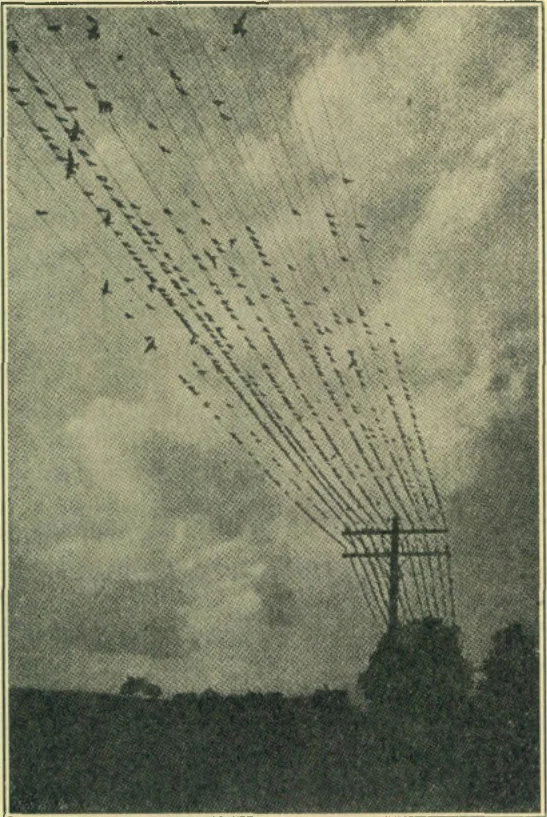
SWALLOWS RESTING ON TELEGRAPH WIRES
This is the habit of our robin. Robins raise two and sometimes three families in one season. When the first family leaves the nest, early in June, it is taken by the father robin to some dense, leafy growth of young trees to pass the night. To this place they return every night. Many other robins, sometimes thousands of them, come to the same woods. Such resorts are known as robin roosts. In flying to and from them the young birds learn to find their way.
Meanwhile, mother robin is patiently sitting on her blue eggs, from which in about two weeks’ time another little family will appear. In two weeks more they also will be large enough to leave the nest, and can join their brothers and sisters in the roost.
Grackles, or crow blackbirds, have the same habit. But since they have only one family, or brood, both the parent birds go to the roost with their young.
Sometimes the robins are joined by the grackles, and both by the European starlings, which, brought to this country and released in Central Park in 1890, have since become one of the most abundant birds in our Middle Atlantic States. Such a roost is visited nightly by many thousands of birds.
It is very interesting to watch them at sunset come streaming in from every point of the compass, and to hear their good-night chorus before they all go to sleep.
In the morning they begin to leave soon after day-break, and by sunrise few are left. The place which was thronged by myriads is deserted. Late in the afternoon they begin to return, and erelong the roost is again teeming with feathered forms.
The little journeys of swallows from their sleeping resorts to their hunting grounds begin in July and do not end until late September or early October. Swallows sleep in the reeds or cat-tails which grow in vast marshes. They are so hidden that you might pass very near them without seeing a bird. But suddenly, like exploding fireworks which fill the air with sparks, they burst from their roost, and there is a swarm of happy, twittering birds above you. A moment later they have gone, each one to hunt its breakfast.
At midday and in the early afternoon one may see them resting in long rows on the electric wires. Late in the afternoon they begin to return to the marshes, darting for mosquitoes and other insects as they go. During the day they have flown far. Thus they gain the practice which makes them ready for the great journey to the South.
How they know when it is time to start, who can say? But that they all know it, is certain. On that day all the swallows which have been roosting within miles of one another rise up in the air together. From a distance they look like a snowstorm of large black flakes. There seems to be much excitement. The great day has come! Soon they leave the marsh, not to return until the following spring.
Chimney swifts, in their daily journeys, scatter far and wide over the country. One may see a swift coursing through the air here, and another there. But in the evening they all come racing in toward the chimney in which they are to pass the night. Before this country was settled, the swifts nested and roosted in hollow trees. Now, as we all know, they use chimneys, and the roosting chimney is usually a large one.
The early arrivals do not enter the chimney at once. In fact, no swifts go to bed until practically all have come, when they fly in a great irregular spiral around and around in the air over the chimney. Then, like a whirling column, a part of them pour into the chimney. The others go flying madly onward. Again they approach the chimney, and another group of birds darts spirally into it. This performance is repeated until not a swift remains outside. What a singular appearance the walls of the chimney must present at this time, with hundreds, and often thousands, of soot-colored birds clinging to it!
In the morning the swifts leave in small parties, and at once separate widely over the country in search of food.
In southwestern Minnesota there is a small lake, about five miles long and three wide, called Heron Lake. It is the favorite resort in the autumn of the beautiful Franklin’s or prairie gull. There are many thousands of them there, and their daily journey from the lake to gather food out in the prairies is one of the most beautiful sights I have ever seen in bird life.
The gulls sleep near the center of the lake, all crowded closely together. They leave before sunrise. All rise at once, and the air is then so filled with birds that one can scarcely see the lake. Many drop back to the water; the others begin their day’s wanderings. Again they all rise; a part take leave, while those remaining return to the water. Within half an hour all have gone.
Some mornings they fly in one direction, on others in another direction. I think they are apt to fly toward the point from which the wind blows. Their favorite9feeding grounds are freshly plowed fields. Often they follow directly behind the plow, when it is a charming sight to see the snowy-plumaged birds hover over the plowman and alight in furrows to pick up grubs lying in the black earth. In this way they destroy many harmful insects.
The return to the lake begins late in the afternoon. At times they fly in even rows,—perhaps half a mile in width,—but not more than three or four gulls deep. Or they may come home in V-shaped flocks with as many as sixty-five gulls in each arm of the V. But whether in long, billowy lines or low-flying wedges, the flights of the gulls teach us in what an orderly manner birds perform these little journeys.
With the robins, grackles, swallows, swifts, and gulls, these daily trips to and from their sleeping quarters precede the real migration to their winter homes, where, in some cases, new flocks may be formed and new roosting places found.
There are other birds which gather nightly in certain roosting places, but which migrate little if at all. Among these are herons, which every evening gather in some marshy woods or thicket that perhaps has been used as roosts for many years.
A SPIRAL OF CHIMNEY SWIFTS
Crows flock together in great roosts in the winter. Some crow roosts have as many as two or three hundred thousand tenants nightly. When the birds leave in the morning, they fly low and search for food. When they return in the afternoon, they fly high, heading straight for the roost. Hence the expression “As the crow flies.”
Like the chimney swifts, crows do not enter their sleeping place until practically the last bird has arrived. In the meantime, they alight on the ground in near-by fields. As bird after bird returns and drops down among the others, the ground becomes black with crows. I have seen several acres covered with them. They seem to have very little to say about the day’s experience.
It is almost dark before they go to bed. Then they rise from the ground, and in orderly procession silently fly to their roost in the woods.
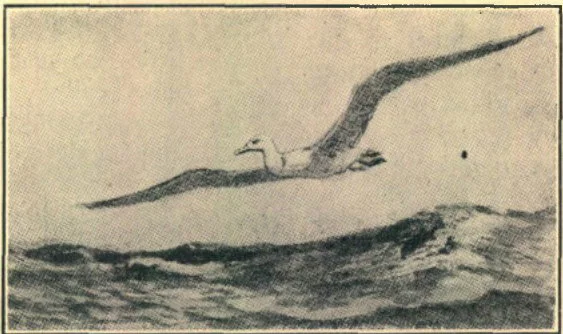
THE WANDERING ALBATROSS
Besides these daily journeys to and from their sleeping places, some birds wander about during the winter over land and sea. Their chief object in life at this time is the search for food, and they go almost anywhere that it is likely to be found.
So in the winter we may have visits from crossbills or pine grosbeaks. These birds feed on the seeds of cone-bearing trees. When there is an abundant supply of this kind of food in the far north, we see very few or none of them. But when the pines and spruces produce a small crop, then the crossbills and grosbeaks come to us in unusual numbers.
It is said that herring gulls have been known to follow a steamer across the Atlantic. They were not attracted by the steamer, we may be sure, but by the food which was thrown overboard from it.
The great albatross ranges so far over the southern seas that it is called the wandering albatross. In the museum of Brown University there is a mounted specimen of a wandering albatross which shows how well this name is deserved. When captured off the coast of Chile, on Dec. 20, 1847, the bird had a small vial hung on a string about its neck. This vial contained a piece of paper, from which it was learned the bottle had been attached to the bird Dec. 12, 1847, by the captain of a whaling vessel when it was about eight hundred miles off the coast of New Zealand. The bird therefore had traveled at least thirty-four hundred miles in eight days. But if a bird be a migrant, its wanderings, or daily trips to and from the roost, will end when the call comes for the great journey.—Frank M. Chapman, in St. Nicholas.
Submarine Mines
By John Randolph Rexford
ORIGINALLY all forms of apparatus designed to explode under water to destroy ships were called torpedoes, but this term is now applied only to the well-known naval weapon. Submarine mines may be divided into three groups:—
Buoyant mines, having a constant depth of immersion.
Ground mines, which are used in shallow waters and rest on the bottom.
Floating mines.
The mines belonging to the first and second groups may be exploded either from land by an electric current or by automatic contact with a ship.
Electrically controlled mines are employed only for the protection of harbors and channels, and may be divided into two classes: those which are entirely and those which are partially controlled from land. A mine consists generally of two perfectly water-tight metal casings made of suitable shape. One of them is hollow, and is intended to act as a float to maintain the mine at a required depth below the surface; while the other one is filled with the charge, which may be guncotton trinitrotoluene, or any other suitable explosive, and the detonator for firing the charge. In coast defense work where electric control is employed, mines are anchored permanently in suitable positions, where hostile vessels are likely to pass over them, and are connected by means of electric cables to the shore. Where mines are entirely controlled from shore, an observer on land can fire any mine or group of mines by closing the electric circuit the moment his optical instruments inform him that the enemy’s ship is over a mine.
Firing an Electrical Mine
Mines which are partially controlled from land are anchored only a few feet below the surface of the water. When a ship strikes such a mine, an electric contact is made which sends a signal to the shore station. The observer can then decide whether to fire the mine or not. An advantage of electrically controlled10mines is that neutral ships can be allowed to pass over such mine fields in perfect safety. The use of such mines has, however, been considerably reduced, chiefly because salt water is one of the greatest enemies of electrical apparatus, and makes it very difficult to maintain the electrical connections with the mine, and also because the permanent location of such mines could be discovered by spies.
The mines which have been chiefly used in the present war are automatic and mechanical, and are fired when the ship strikes against them.
It is by no means easy to design a satisfactory mine which shall have its firing gear carefully adjusted so as to insure explosion of the charge from the slightest shock produced by contact with the passing ship. At the same time provision must be made to prevent the premature firing of the mine, either on land, on the mine-laying ship, or when being launched into the mine field. Again, it is important that should one or two mines be exploded, the adjacent ones be not fired accidentally—a difficult problem, as the concussion of the water produced by the explosion tends to disturb other mines. Another essential condition is that the depth of immersion under the surface should be constant so far as the rise and fall of tides allows.
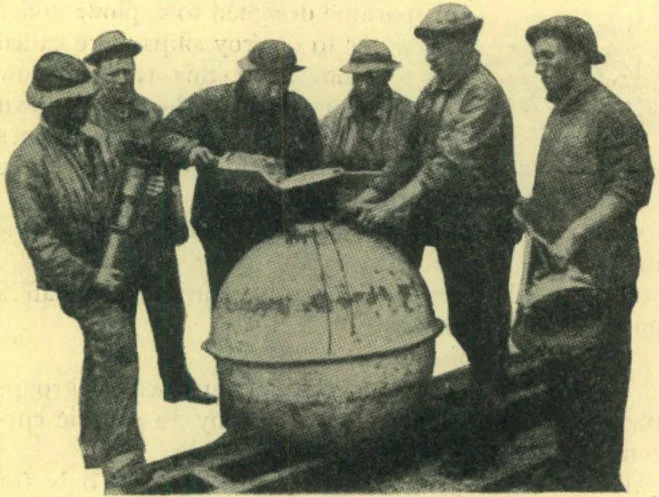
LOADING AN AMERICAN MINE
Parts of a Mine
A mine consists of three parts: (1) The chamber containing the firing mechanism, the detonator and explosive charge; (2) the flotation chamber to give buoyancy to the mine; and (3) a detachable anchoring chamber provided with a winch having a paying-out cable.
A mine is maintained at the desired depth in the water by means of an anchor in which the cable, one end of which is connected to the mine, is unwound from a drum suitably braked and mounted in the anchor casing. The rotation of the drum is controlled by a plumb weight attached to a short sounding line. When the plumb weight reaches the bottom of the sea, the rotation of the drum is stopped, and the mine is pulled down to the required depth. It is only necessary to determine at what depth below the surface it is desired to anchor the mine and to throw into the water the complete apparatus, namely the mine and anchor, whereupon the whole apparatus will take up its proper position, the depth of submersion being determined by the length of the sounding line.
In order to make a mine field as effective as possible loose ropes are sometimes connected between different mines, with the object of getting the ship’s propeller entangled in the rope, and thereby drawing the mine toward the ship and exploding it.
Mines Which Become Ineffective After a Certain Period
Unanchored automatic or floating mines must be dead in an hour. They are used to some extent in naval battles, and are very cheap in construction. In some mines of this type, clockwork is used which after an hour throws the firing gear out of action, while in another type delay-action devices for opening valves to admit water are employed so that the mine is sunk after a definite time interval.
To some extent chemical methods are employed to fire the charge in floating mines, but a disadvantage is that the explosion does not take place instantaneously, as is the case with a mechanically fired mine. A glass tube is attached to the mine, which is broken when struck by a ship; water enters, and by coming in contact with sodium or potassium, fires the charge. Other chemicals, such as sulphuric acid, have also been used to fire the charges in floating mines.—John Randolph Rexford, in Popular Science Monthly.
Electric Hand Invented for Wounded Soldiers
AN “electro-magnetic hand” has been perfected with which it is said to be possible to grasp even the heaviest metal objects and work with them as advantageously as with human hands.
This inventor has evolved an unusually powerful battery which can be carried by the operator, making it unnecessary for him to be near an electric current in order to magnetize the “hand.” The invention, it is said, can perform all the functions of the human hand, and others besides. The current is regulated by a switch operated by hand or foot.
It is hoped that the invention will solve the problem of livelihood for many crippled soldiers, enabling them to engage even in trades requiring considerable manual dexterity, such as carpentry. By its use the manipulation of knife and fork and similar instruments is a bagatelle.—Selected.
Kiss to Make Well
By Flora Huntley
THIS pretty custom is almost universal among mothers, and on first thought it seems harmless and satisfactory. But what are the consequences?
My little two-year-old boy had many tumbles and falls, some really quite serious ones; but he seldom cried. He got to his feet, and went on with his play as usual; and I noticed him as little as possible. But when his aunt came to visit us, she began the custom of kissing the hurt to make it well. Now every bump and scratch has to be kissed and kissed again. It is a game with the child, and he magnifies all his little accidents for the pleasure of going through this ceremonial. As a result, weakness and selfishness and pleas for sympathy are developed, instead of self-control, independence, and courage. A mother must study every act and almost every motion she makes, for habits are formed in the baby from just one observation. Good habits are formed as easily as bad.—Flora Huntley.
Do Only the Little That You Can
To all who say you can do but little, I would say, “Do only the little that you can. The greatest things have been done by the aid of the smallest.”—Baroness von Suttner.
(Texts for February 27 to March 4)
By M. E.
Meditation.— The texts for this week have strengthened my determination to be more like Him. I have enlisted in Prince Immanuel’s army of soul winners, and I want to be liberated from every selfish plan and desire that I may please him in whole-hearted service. I shall strive to avoid all amusement, all reading, and all talking that lessen my love for God and his service. If I put on the whole armor of God, I shall have to discard every thread of my own garb of selfishness. I ask him to make this exchange for me, for I cannot be victorious in the Christian warfare without the whole armor. Then with the weapons that come with that armor I shall be able to “bring into captivity every thought.” O the limitless possibilities before the young person who is fully surrendered to Christ!
Special Prayer.— Africa is the common burden of all our prayers this week. The Missionary Volunteer secretary of South Africa writes: “At the Maranatha Mission a society has been organized lately under the leadership of Sister Vickie Sutherland, the teacher there, and they have about fifty members. This is our first among the native races of this country, and as they are all bright, intelligent young people, we hope to see good results. They are putting in a missionary garden to raise funds, and are taking some tracts and papers each month to post out to help spread the message. I am sure this will make the hearts of our young people in America rejoice as they think that among the dark races of this land we are recruiting a band of Missionary Volunteers for the Master’s service.”
Surely we want to thank God for this society and pray that the Missionary Volunteer work may continue to grow until every mission station in Africa shall have a thriving young people’s society. M. E.
Christian Warfare
By Matilda Erickson
HAVE you been watching with as keen interest the daily records of the war waged in your own heart as those telling how Europe is being deluged in blood? Heaven is interested in the warfare conducted in your heart; Satan is acquainted with every movement; your friends are watching the results of the conflict within. Are you?
Your own heart is the battle field for which you are first and foremost responsible. God has given you control of it. You must determine who shall have possession. Look in now and make sure who is intrenched within the citadel. Is Jesus there? Others will know, for if he is there you will be pure, kind, courageous, cheerful, unselfish and eager to win souls. You will daily grow more like him.
If he is not there, the first thing to do in this Christian warfare is to demand of the enemy within, an immediate and unconditional surrender of your heart to Christ. If you sincerely request this, he must decamp, and Christ will come in. But remember this is just the beginning of the struggle.
Set it down as a fact that temptations will not cease. Your enemy is not dead. He is defeated, but he will besiege your heart, and try in every possible way to get you to prove traitor to the new Friend to whom you have given possession. Your part is not to fight the battle, but to study your new General’s orders, to obey them implicitly, and never to interfere with his campaign plans.
The enemy is ever changing his tactics. He has been at this infamous warfare for six thousand years, and you can never hope to keep him out of your heart alone. Do not regard any temptation as dead. Be on guard! And remember new and unexpected temptations are ever emerging from unsuspected sources. When certain temptations lose their power over you, he finds others to use. If he cannot lead you to do some great wrong, he will try to entice you to be careless in little things. If he sees you are determined to be a Christian, he will try to make you narrow and faultfinding; he will lead you to judge unkindly those who do not think just as you do; he may try to rob you of your humility by making you proud of being humble. He will be sure to work hard to make you believe that you cannot be a soul winner; and he will work hardest of all to make you feel that you are too busy to take time daily to be alone with God and his Word, for he knows if he succeeds here he has gained a strategic place in your heart.
So be on guard and keep up your courage. Satan sends temptations to discourage you; but the Lord permits them for you to overcome through Christ. Never dally with temptations, never invite them, but make each temptation an opportunity to gain a new victory, to reenforce yourself for greater struggles, to let Christ prove in your life that “he is able to keep you from falling.”
You may be victorious in every attack of the enemy. Christ overcame; he vanquished sin; and he will repeat that victory in every human heart that will admit him—in your heart and in mine.
Then remember three things: 1. When you ask the Saviour to come into your heart to vanquish sin, you must believe he does it, for he really does enter and remains just as long as you will let him. 2. The faith that keeps Jesus in the heart lives in the atmosphere of prayer, so you must spend much time in prayer. This communion with God will produce the faith that never gives up, but overcomes all things. 3. You must obey him implicitly, and in order to know what he wants you to do you must study his Word faithfully.
Then, my dear young friend, be of good courage. Other Christians will cheer and help you along the way; but now and then there will be battles that you and Jesus must fight all alone; so never let even one known sin separate you from him. Keep close to him always and your Christian warfare will be a series of unbroken victories.
“Why do we do ourselves this wrong,
And others, that we are not always strong;
When with us is prayer,
And strength and joy and courage are with Thee?”
MATILDA ERICKSON.
A Good Suggestion
By M. E. Kern
A YOUNG man whose health broke down in the mission field, and who is now endeavoring to recuperate, writes the following concerning his use of the Morning Watch,—a suggestion which is worth passing on to all our young people:—
“I have purchased a 1916 diary, with one full page for each day, and each morning I write the morning text at the top of the page, with some corresponding quotation from some other book or paper, or some thought of my own on the text. When I was first taken sick, I was writing two pages a day on each text. This greatly helped me to fasten the text in my mind, and it is interesting now to look over these thoughts written two years ago. It also gave me an experience in writing. But my physician made me stop everything. My present diary is much smaller, and I shall not write so much. There is nothing more important to record in our diaries than our religious experiences and thoughts.”
M. E. KERN.
Where are Our Young People Going?
By Crystal Knox
This is a question which interests every one who has been granted the great privilege of being a young person at this time.
John says, “I have written unto you, young men, because ye are strong, and the word of God abideth in you, and ye have overcome the wicked one.” This exhortation does not apply to young men only, but extends to young women also. Their youth does not excuse them from the responsibilities resting upon them. They are strong, and are not borne down with cares and the weight of years. Of what service might they be to the advancement of the message?
Solemn responsibilities rest upon us as young people, which we lightly regard. Did you ever stop to consider that the places of importance now filled by such God-fearing men of wisdom, the places held by our loyal brethren in the mission fields, and on the frontier at home, will soon be left for us to occupy, perhaps be intrusted to us until the Saviour appears? Did you ever stop to think what it would mean to gain a preparation for such a work before the end, to stand before princes and rulers, to give a reason for our hope, and having done all, to stand after the closing hours of probation? And we are told that our time for preparation is very short.
If we but realized how earnestly Jesus worked to sow the world with gospel seed, we who are living at the very close of probation would labor untiringly to give the bread of life to perishing souls. But are our youth in a position where they can with meekness and fear give an answer to every man that asketh a reason of their hope?
How many of the strong young men of whom John speaks, have entered upon their education with a partial intention of entering the Lord’s work? Some had this intention confirmed; others lost it. Some of these are today holding responsible positions in the message, but others have gone to the world to seek pleasure and riches for themselves. But how much better to lay up treasure that fadeth not away! by prayer and entreaty to win even one soul to Christ! What a noble enterprise! One soul to praise God through eternity! One soul to enjoy happiness and everlasting life! One gem in your crown to shine as a star forever and ever!
Those who have really tasted the sweets of redeeming love will not, cannot, rest until all with whom they associate are made acquainted with the plan of salvation. We should inquire, “Lord, what wilt thou have me to do?” Even those who are attending school can have an influence for the Saviour.
You may receive praise for your ability and talents, which will gratify you, and you may think that with such advantages and attractions it is a great pity for you to come out from the world and be separate. Satan tells you that with the advantages which you possess you could enjoy to a high degree the pleasures of the world. Here is where many of our young people become lost to the message. But consider that the pleasures of earth will have an end, and that which you sow you must also reap.
Tasks uncommended, labor without recognition, is the lot of most of the world’s toilers. With such a lot, many are filled with discontent. They feel that life is wasted. But the little rill that makes its noiseless way through grove and meadow, bearing fertility and beauty, is as useful in its way as the broad river. And in contributing to the river’s life, it helps achieve that which alone it could never have accomplished. This lesson is one needed by many.
Talent is too much idolized, station too much coveted. But are personal attractions, ability, or talents too valuable to devote to God? There are too many who will do nothing unless they are recognized as leaders, too many who must receive praise, or they have no interest to labor. What we need to learn is faithfulness in making the utmost use of the powers and opportunities we have, and contentment in the lot to which heaven assigns us.
Suppose all our workers were conference presidents, religious liberty leaders, medical or educational secretaries, or editors in our publishing work. Who would do the all-important work of the humble laborers, the Bible workers, nurses, teachers, bookkeepers, and even those who set the type and do the manual part of publishing our books and periodicals? We know that just as surely as there is a place prepared for each of us in heaven, so surely is there a place for us in the closing work. It may not be an exalted position, but God asks only that we render him perfect service wherever we are.
In the common walks of life there is many a toiler patiently treading the round of his daily tasks, unconscious of latent powers that, roused to action, would place him among the world’s great leaders. Such were the men who were called by the Saviour to be his co-laborers. And they had the advantage of three years’ training by the greatest educator this world has ever known.
Of the twelve disciples, four were to act a leading part, each in a distinct line. In preparation for this, Christ taught them, foreseeing all. James, destined to swift-coming death by the sword; John, longest of the brethren to follow his Master in labor and persecution; Peter, the pioneer in breaking through the barriers of ages and teaching the heathen world; and Judas, in service capable of preeminence above his13brethren, yet brooding in his soul, purposes of whose ripening he little dreamed,—these were the objects of Christ’s greatest solicitude. Will not the presence of the same Teacher in educational work today, produce the same results?
(Concluded from page twelve)*
After his life of toil, teaching his disciples, healing the sick, preaching the word, and living a perfect life for us, Christ committed the rest to his disciples. Would not the angels gladly have continued and finished the work which Christ had begun? But this privilege was not granted them. Now it has been intrusted to us, and what a privilege we should esteem it! May God help us as young people to decide which way we are going! CRYSTAL KNOX.
NOTE.—For helps and suggestions on this assignment, see the Review of February 24.
Missionary Volunteer Society Programs for Week Ending March 4
The programs for the Missionary Volunteer Societies, Senior and Junior, for this date, with notes, illustrations, and other helpful material, will be found in the Church Officers’ Gazette for March.
“So Many Grains of Wheat!”
By S. Roxana Wince
S. ROXANA WINCE
My husband was a careful, economical man. He did not like to see anything wasted; and yet, being of a kindly disposition, if rebukes came, they came in a way that would give no offense.
One day I had filled my gem pans, deposited them in the oven, and set my mixing bowl on the worktable, with enough batter sticking to its sides to fill a gem cup. His eyes fell on it as he entered the door, but all he said was, “So many grains of wheat!” Yet it was enough. I never mix batter, pie dough, cake, or bread, but I think of the phrase, “So many grains of wheat.”
I do not know why I was so careless that one particular time, for my mother had taught me to be saving, fixing the lesson in my memory by telling me a little incident that happened when she was a young girl living in central New York. A young man had two lady friends whom he highly esteemed, but which of the two he should pay court to, with the thought of making her his wife, was a question he could not settle. One day his pretty bay horse was found writhing in pain from a severe attack of colic. Something must be done quickly. He had heard that the scrapings from kneading bowls were a sure remedy.
He would “kill two birds with one stone;” he would find out which of his lady friends was the more economical, and at the same time save his horse. He hurried off. The mother of the first girl said: “La me, I don’t believe I can get you a tablespoonful, Katie cleans the bread trough so carefully!”
The next woman, in reply to his appeal, exclaimed, “Certainly, you can have all you want, if it’s a quart.”
I do not know what became of the horse, but Katie won the young man for her husband.
It was not the custom in pioneer days to wash the bread bowls, for people then knew nothing about microbes. If they had, the young man would have been still more particular as to the choice of a wife; but, anyway, I learned the lesson my mother intended the story to teach.
The third lesson was given me by my husband when I was helping to stack our winter’s wood, and paid no attention to the thick pieces of bark that now and then slipped off. At last, noticing my carelessness, he said, “I paid for the chopping of that bark.” I left no more bark on the ground; to throw it away was to throw away money.
Batter for one gem thrown away twice a week would make one hundred and four gems in a year, enough to feed a little child fifty times. A quart of dough wasted twice a week would make one hundred and four loaves of bread in a year, or $5.20 worth of bread; while the bark from twenty cords or more of wood would bring quite a sum.
Men and women laugh at the friend who drains the last drop of milk from the pail, saves the yolks of eggs and remnants of cloth, does not throw out scraps of bread and left-over pieces of meat; but all these little savings count, and help her to help others.
“I must not throw upon the floor the crust I cannot eat, For many a little hungry one would think it quite a treat,” is a stanza worth remembering in these troublous times. Don’t waste anything. Men, women, and children are starving.