DEAR YOUNG READERS: There are many very interesting places in the world, which you may never have an opportunity to visit; still you can not afford to miss becoming acquainted with them. You need to know the world, because the world needs your help; and unless you become familiar at home with the different countries and their people, how will you be able to help them? When the Bible speaks about our teaching the gospel to every nation, kindred, tongue, and people, we know this includes Burma, in far-away India. Still very little has thus far been done to proclaim the message of Christ’s soon coming to these precious souls.
No doubt all of you have learned something about Burma in your geography lessons; thus you know it is bounded on the west by India and the Bay of Bengal, and on the north by China. Look on your map, and see what is on the south and east sides. The country is divided into Lower and Upper Burma.
The whole of Burma is now under British rule. A chief commissioner presides over both provinces. The former native government of Burma was very despotic. The king was absolute master of the lives and property of his subjects, and regarded with a reverence amounting almost to adoration.
Lower Burma has an area of nearly ninety thousand square miles. It is intersected by chains of hills, running north and south, between which flow the principal rivers, the Irrawaddy, the Sitang, and the Salwin.
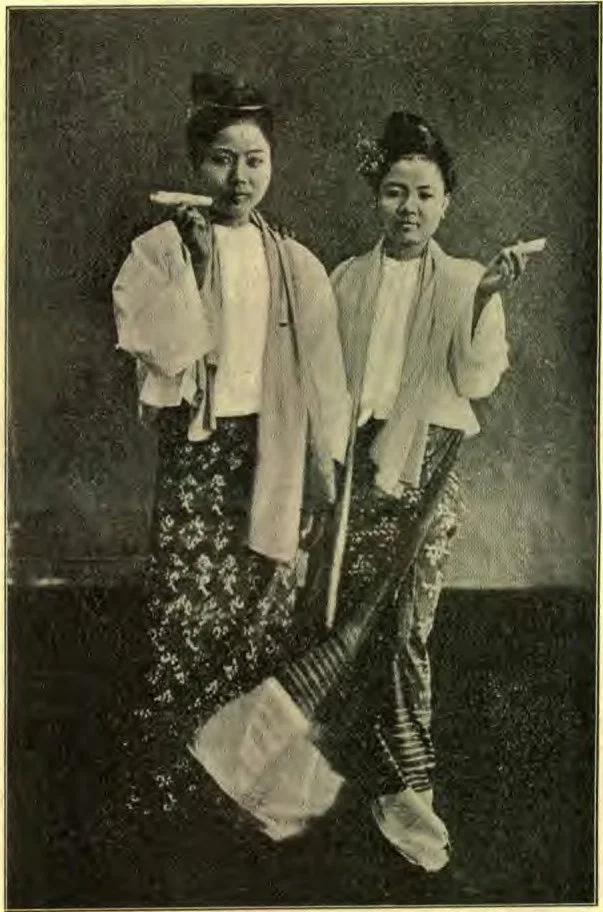
Burma is the most thinly peopled territory belonging to the Indian empire. There are only about twenty-nine inhabitants to the square mile. The Burmese belong to a race intermediate between the Chinese and Malays. Wild tribes are numerous, and in some cases independent. There are many Chinese settlers. The Burmese are short-headed, broad skulled, and flat-faced, with black hair and dark-brown complexion. Their dress is simple, but peculiar. The in-gie, a white linen jacket, is worn by both sexes. Wrapped round the lower part of the body, the men wear the put-so, a piece of cloth several yards in length. The women wear the termin, a scant garment of cotton or silk. Silks of all colors and valuable gold ornaments are worn on special occasions. Betel-nut chewing and cigar-smoking are largely practised, by both men and women. Indeed, in no other place have I seen women so attached to their cigars, which are from eight to ten inches long. In all their occupations, as well in the house as on the street and in the market-place, the weed is used. I found it very hard in my association with the Burmese to convince them of the danger of the smoking habit; however, they were much interested in the studies we had on Bible temperance. The Burmese are clever as carpenters and smiths, also as tailors.
I was much interested in the comfortable, large, cool houses in which the Burmese live. They are made of a framework of bamboo, thatched with the leaf of the water-palm, and invariably raised on posts several feet from the ground.
BURMESE WOMEN, WITH THEIR CIGARS
The women of Burma are much more industrious than the men; they buy, sell, weave, and attend to the domestic concerns. In one house where we made a visit, the women were all busy making cigars. We tried to show them the danger of living in such an unhealthful atmosphere.
Next time I will tell you something about what one Burmese sister did to interest the people of her city in the matter of healthful living.
THEKLA BLACK.
Little Jim
MARJORIE and Frances were hurrying to get to the lane before little Jim caught up with them; his legs were much shorter than theirs, and he was quite a distance behind.
“If we get past the turn of the road, we’re all right,” said Marjorie. “Jim’s three years younger than I am, and he’s the most awful tagger you ever saw. He might just as well go to school by the road. I’ve got a secret to tell you when we’re ’way in the middle of the lane, Frances, where nobody can hear. It’s about a party I’m going to have next week.”
“O goody!” said Frances, looking over her shoulder. They passed the turn of the road, and ran into the grassy lane that led to school by a roundabout way. There was no sign of little Jim behind them.
Somehow Marjorie did not feel quite happy, after all, when they were in the lane. Frances grew impatient for the secret.
“Hurry up and tell me!” she whispered, although there was nobody to hear her.
“Oh, ’tisn’t much,” said Marjorie. “It’s only that mother’s going to make a puzzle cake with different things in it. I don’t suppose Jim could fall off the bridge, do you? It’s sort of joggly, you know, and he’s so little and fat.”
“I suppose he could fall off,” said Frances, “but—O Marjorie, look at that great, big, dreadful darning-needle on that bush ahead of us! You go on that side, if you aren’t afraid.”
“Ow! I am afraid!” cried Marjorie, with a little shriek. “And there are two of them! And if we go back now, we’ll be late for school!”
“Marjorie!” called a little, breathless voice, and there was a sudden rush of short, fat legs that brought Jim close to them. “What’s the matter?”
“See those two horrid darning-needles!” cried the two girls together.
“Why, I’ll scare them off,” said little Jim. Then he picked a long spray of goldenrod, and marched ahead of Frances and his sister.
Two vigorous waves of the goldenrod, and a buzzing sound, and—the darning-needles were gone.
“I think I’d better walk ahead of you the rest of the way,” said Jim. Then he marched on, holding the spray of goldenrod just as a drum-major holds his baton, twirling it in the air, and sometimes turning around to face the two little girls, and walking backward.
Marjorie and Frances marched behind, and neither of them told him once that he’d better be careful, not even when he backed into a blackberry bush.
“How did you know we’d come by the lane?” asked Marjorie, just before they reached the end where it ran out into the road. “We didn’t see you when we turned in.”
“Why you dropped this little piece of paper out of your book,” said Jim, drawing a slip from his pocket. “I s’posed you did it on purpose.”
His brown eyes looked straight up into her blue ones, and Marjorie stooped and straightened his collar very gently.
“I will next time, Jim,” she said.
“That’s all right,” said little Jim, “’cause you might need me to look after you and Frances. Mother says that’s what boys are for, and then not to tell. Course I sha’n’t tell anybody ’bout those darning-needles; you knew that, didn’t you?”—Selected.
The Birds of June
Was there ever anything more inexpressibly jolly than the bobolink? “A brook o’ laughter,”—that is what Lowell calls him. What a dandy he appears in his sleek suit of black-and-white! but doesn’t he look odd with his breast black and his back white, as if he had changed the proper places of his vest and coat? It doesn’t seem possible that this elegant creature is the same one who, in rusty garb, shorn of his grace and beauty, will grow fat and aldermanic in the southern rice-fields by and by.
The king-bird is everywhere to be seen in June. He, too, is a rather handsome fellow, who wears his dark coat and white vest in the conventional manner. The head is black, and he can raise a crest in which is hidden, like some carefully concealed jewel, a spot of brilliant orange,—a jewel which, I warn you, unless you are a wonderful observer, you will never catch sight of. His tail is black and square, with a terminal band of white,—his most distinguishing mark.
There is a relative of our familiar Baltimore oriole, not quite so common, the orchard oriole, which, as his name suggests, we may find among the fruit-trees. He is dressed in black and chestnut,—a gleaming, metallic shade,—and, though inconspicuous, is quite elegant in appearance. The chestnut is on the breast and lower back; the head, neck, and upper back are black; the wings and tail are dark. He has a charming song, rich and sweet. His nest is the daintiest little affair,—pensile, like that of the Baltimore oriole, but made of grasses woven with wonderful neatness into a pretty cup-shaped basket.
Do you know the nest of the ruby-throated humming-bird? Was there ever anything more exquisite than that, made of lichens and down, and fastened so securely on the branch of the tree that it looks like part of the branch itself? What a wonder the humming-bird is! The tiniest of all our birds, only three and three-fourths inches in length, it is equaled by no other in power of flight. It is so emotional that fright alone has been known to cause its death, but so brave that it will defend its nest in the face of the most powerful enemies. There is no bird more easily or quickly tamed. It takes both honey and insects from the deep-hearted flowers about which we are most apt to see it hovering. The vibrations of the air caused by its swiftly beating wings produce the humming noise from which it gets its name. It has no song. The upper parts of the male are a bright metallic green, there are violet shades on the wings, and the throat—what words can describe that glowing, jewel-like brightness? The female lacks the ruby throat, but is otherwise not unlike the male.
There is no other of our birds quite so brilliant as the scarlet tanager, which looks like a tongue of flame as he flashes through the green leaves, or like a leaf which the frost has turned to scarlet as he perches quietly on a twig, high up among the branches. The body is all bright scarlet, in striking contrast to the black of the wings and tail. It is about the length of the bluebird and phoebe. The song is not unlike that of the robin, loud and cheerful.
Another very brilliant bird is the indigo bunting. He is much smaller than the tanager, measuring about five and one-half inches. Unlike our common bluebird with its chestnut breast, the indigo bird is blue all over,—a very deep, rich, gleaming color; he too flashes like a flame in the sun, a blue flame. The little wife is very unlike her brilliant mate; her general color is a soft, sunny brown. We ought to be especially grateful to the cheery little indigo bird; for he keeps up his happy song through all the heat of summer, when most of the other birds have long been silent.
One of the handsomest birds that visits New England is the rose-breasted grosbeak. He is related to the indigo bird, and both belong to the same family as the little brown sparrows. The grosbeak is fairly good sized,—eight inches long. The head, throat, neck, and back are black; the under parts and rump, white; the wings and tail brightly marked in black and white; and on his breast he wears a large shield of rose-red. The wings are lined with delicate rose-color. The bill is very large and strong. His song is a joyous carol; it seems like the very voice of the spirit of a glad summer morning.
Very unlike this joyous, caroling bird is the shy cuckoo. The yellow-tailed cuckoo is longer than the robin, smooth olive-breasted above, rufous on the wings, with a soft whitish breast and a long tail tipped with white. How stealthy is his flight through the trees, and how quietly he perches among the branches! He has no song, but a strange, loud call that resembles the sound of a hammer striking upon wood. “Stake-driver,” the boys call him.
We must not close our June record without a note about the goldfinches that are bounding over the sunny fields and singing their sweet little songs. In the winter we saw them in dull-olive plumage, but now they wear golden-yellow, in striking contrast to their black caps and wings and tails. They sing the whole summer through, and are as gay over the August fields of chicory as over the June meadows.
The meadow-larks, the blackbirds, the vireos, the orioles, and all of the birds which we have been welcoming during the spring, except the passing migrants, fill the woods and fields and gardens with life through the month of June. “Now is the high tide of the year” indeed.
There is a chance for study for the bird student all the summer through, and, for that matter, throughout the year; but July and August are filled with heavier cares of life for our bird friends, and no other season has quite the joyous inspiration of the spring and early summer. — S. S. Times.
What Snakes Do with Their Ribs
By F. A. Lucas
No doubt many young people, during their excursions to field and forest this summer, will come upon some of our many harmless snakes. If the readers are girls, they very likely will scream and run away; if boys, they probably will try to kill the snake, which is a poor return for the good it is doing by catching insects and field-mice. But do any of you ever wonder how it is that a snake can run so quickly without legs, or do you stop to watch one gliding almost imperceptibly along, without any visible means of locomotion? For, without having either hands or feet, a snake can swim, run, and climb better than some animals provided with four good legs. This so impressed the great English anatomist, Richard Owen, that he wrote: “It is true that the serpent has no limbs, yet it can outclimb the monkey, outswim the fish, outleap the jerboa, . . . and spring into the air and seize the bird upon the wing.”
Now any one who has looked at the skeleton of a snake—and it is really a very beautiful object—will have been struck by the great number of ribs, which may be as many as ten hundred and fifty pairs. In these lies the secret of the ability of the serpent to do some of these wonderful things. The lower end of each rib is connected with one of the broad scales that run along the under side of a snake, and when a rib is twisted slowly backward, it pushes on the scale, the edge of the scale catches on the ground or whatever object his snakeship may be resting on, and the body of the snake is pushed just a little bit forward. Of course each rib moves the body but a mere trifle; but where the ribs are so many, and they are moved one after another, the result is that the snake moves slowly but steadily ahead. If any one will watch a snake closely when doing this, he will see little ripples, as it were, run along the body, carried by the moving of the ribs. Better still, if he will let a snake crawl through his closed hand, this motion can be very plainly felt. It is in this way that a snake climbs directly up a tree, the scales catching on the little inequalities of the bark; but, sometimes in order to get a better hold, the body is bent back and forth into the shape of several letter S's joined together. One observer has even recorded that in this manner a black snake performed the apparently impossible feat of climbing some distance up the corner of a house.
When a snake is in a hurry, he moves by throwing the body into a series of curves, the ribs propelling, while the scales on the under side prevent the creature from slipping backward. If placed on a plate of glass, where there is little hold for the scales, it is somewhat difficult for a snake to crawl.
Other things, too, some snakes do with their ribs. All are familiar with pictures of the East Indian cobra with the curious hood just back of its head; but those who have seen the snake alive know that when quiet there is no sign of a hood. It is just the same with our little blowing-viper—which isn't a viper at all, but one of the most inoffensive of snakes: unless he is trying to frighten some one, his body is round and not flattened. Both the cobra, whose hood is a deadly threat, and the blowing-viper, whose wicked look is mere pretense, put on their threatening appearance in the same way. Each, but more noticeably the cobra, has a number of ribs which are much longer than the others; and when these long ribs are pulled forward, their free ends press against the sides of the body until it is stretched out wide and flat, and the snake looks as big and wicked as he can.
And thus it is that snakes make use of their ribs to get along in the world and to frighten their enemies.—F. A. Lucas.
The Silence of Brotherly Love
The silence of ignorance and dulness is pitiable; the silence of timidity is wasteful; the silence of poltroonery is shameful; but the silence of brotherly love is above rubies. The talkers are plentiful, the listeners few; the still sad music and the still glad music of humanity ever move through the staff of human speech. “He that hath ears to hear, let him hear.”—S. S. Times.
Out on the Ocean
By F. W. Field
THE sea, the sky, with waves and clouds,
The sun with all his light,
To guide the sailor on his way;
The moon and stars at night.
No land; the seagulls skim the waves,
The flying fishes gleam
For just a moment in the air,—
Like silver bright they seem.
No other sign of life except
The great ship with her load
Of human hearts, as she pursues
The ocean’s rugged road.
On the horizon, far to sight,
Waves mingle with the clouds;
Like endless drapery they roll,—
Old Ocean’s foam-trimmed shrouds.
How great the sea! Its bosom broad
Ten thousand ships doth float;
Its depths,—how dreary, how profound!
They hide full many a boat.
And yet our God is greater still;
In scales he weighs the land,
And measures out the ocean in
The hollow of his hand.
F. W. FIELD.
Tokyo, Japan.
INTERMEDIATE LESSON
XIII—Review
(June 27)
MEMORY VERSE: “In all their affliction he was afflicted, and the angel of his presence saved them; in his love and in his pity he redeemed them; and he bare them and carried them all the days of old.” Isa. 63:9.
Our lessons during the past quarter have covered a period of about forty years, from the time of the worship of the golden calf, at the beginning of the pilgrimage of the children of Israel, to the crossing of the Jordan and entering the promised land. In the study of these lessons, it is well to bear in mind that all these things were written for our learning upon whom the ends of the world are come. See if you can find the text that tells this.
Every experience of the children of Israel has a lesson for us which even the children may learn. We are traveling through the wilderness of this world to the Promised Land, which has been promised to all the children of Abraham; and this includes every child who is a follower of Jesus. The land of Canaan was a type of the inheritance which God has prepared for his children. One precious thought to us is that we may all share in this inheritance. All those who are faithful are to enjoy it together. We are very near the time when we shall enter this land of Canaan. Like the children of Israel, we have come up to the place from which we shall not again be turned back into the wilderness.
Let us study these lessons to know how to stand faithful during these last days, and prepare for an inheritance in the heavenly Canaan. We may not only enter ourselves, but point others to this way.
Questions
1. Why did the children of Israel want Aaron to make the golden calf? What promise had they made to the Lord just a short time before this?
2. Before the idolatrous ones were punished, what opportunity was given to all?
3. What did God tell the Israelites to build to teach them of his presence with them? How many apartments were there in the tabernacle? What was in the most holy place? What did the ark contain? What covered it? Of what was it a figure?
4. Describe the furniture of the outer apartment. What did the candlestick represent? Can you tell the meaning of the table of showbread? What was offered on the golden altar? What was John told that the incense is?
5. What was offered daily in the tabernacle? When one of the people sinned, what had he to do? What did this teach? Were there any other services besides the daily? What was taught by the yearly service?
6. How had the food been provided for the children of Israel since they left Canaan? For what did they complain after leaving Sinai? What experience did this bring to them?
7. Why was Miriam made a leper at the next place of encampment?
8. Tell about the twelve spies. What kind of report did Caleb and Joshua bring back?
10. Why did not the Israelites go right into Canaan when they left Egypt? How long were they in the wilderness? What became of nearly all who left Egypt? What did even their rebellion, that kept them so long in the wilderness, enable them to learn of God?
11. What trouble came upon the people because of their murmuring? How were they healed? Whom did the uplifted serpent represent? What were they thus taught of God?
12. Tell about the death of Aaron and Moses.
13. How were they at last led into Canaan? In all their wanderings, and in spite of all their sins, what had they proved God to be? Heb. 10:23.
14. Why do we especially need this story of Israel’s pilgrimage? Where are we, and where are we going? Who is leading us? How only can we enter into the Promised Land?
MEMORY VERSE: “But ye, brethren, be not weary in well doing.” 2 Thess. 3:13.
“Now we command you, brethren, in the name of our Lord Jesus Christ, that ye withdraw yourselves from every brother that walketh disorderly, and not after the tradition which they received of us. For yourselves know how ye ought to imitate us: for we behaved not ourselves disorderly among you; neither did we eat bread for naught at any man’s hand, but in labor and travail, working night and day, that we might not burden any of you: not because we have not the right, but to make ourselves an ensample unto you, that ye should imitate us. For even when we were with you, this we commanded you, If any will not work, neither let him eat. For we hear of some that walk among you disorderly, that work not at all, but are busybodies. Now them that are such we command and exhort in the Lord Jesus Christ, that with quietness they work, and eat their own bread. But ye, brethren, be not weary in well-doing. And if any man obeyeth not our word by this epistle, note that man, that ye have no company with him, to the end that he may be ashamed. And yet count him not as an enemy, but admonish him as a brother. Now the Lord of peace himself give you peace at all times in all ways. The Lord be with you all.
The salutation of me Paul with mine own hand, which is the token in every epistle: so I write. The grace of our Lord Jesus Christ be with you all.”—American Standard Revised Version.
Questions
1. What does the apostle command the brethren to do? By what authority does he make this command?
2. Whom did he say they should imitate?
3. What was Paul able to say concerning his own conduct and that of those who were with him?
5. Why had they labored so faithfully to support themselves? Verse 9.
6. What is commanded concerning those who will not work?
7. What is the sure course of the idle ones?
8. What are this class earnestly urged to do?
9. What was one of the blessings which God permitted man to retain after the fall?
10. What is the exhortation to the faithful ones?
11. What course is to be pursued toward those who fail to heed this instruction?
12. How are we to treat them?
13. What twofold blessing does the apostle pronounce?
14. How does he prove the genuineness of his epistles?
15. With what benediction does the epistle close? Note again the opening words of each epistle.
Notes
1. The apostle had the right to partake of their substance. He had given them spiritual food; surely they should be glad that he had the right to partake of their temporal food. See 1 Cor. 9:4-18. And yet in this very respect the apostle intimates that he did wrong in not teaching the church to bear burdens. If a minister of God or a parent bears too many burdens in the fulness of his heart, the children or members are strangely made selfish and thoughtless. For the best interests of all, it is good that each one learn to bear the yoke in his youth. There are some burdens which ought to be blessings to the children of God. See 1 Thess. 5:12, 13.—S. S. Quarterly.
2. What a God is our God! It is grace and peace at the beginning; it is grace and peace at the close. The first word and the last word are a message of his goodness to the undeserving; and all the intermediate words are instruction, which, if heeded, will yield us all the blessings of his grace. Do not let the study of these epistles stop with these lessons.—Id.
The Way, the Truth, the Life
By L. M. Montgomery
He is the Way. Through him are all things good
And pure and lovely found. Our feet will tread
The paths of God's divine beatitude
If we by him are led.
The noblest thoughts and aspirations high,
The calm, sweet strength of souls that watch and pray,
To light and peace and joy that can not die,
He is the Way.
He is the Truth. The world has doubt and sin,
And to our seeking can no answer give,
But we who know him hold our souls within
The grace by which we live.
In him are all things that the hungry heart
Of human life can ask in age or youth;
Who walks with him is from the world apart,
He is the Truth.
He is the Life—a life that knows not death
Or fear or darkness in this transient clay,
But has its birth where God illumineth
His own eternal day,—
Life whose unmeasured deeps of love profound
Are never troubled by this dark world's strife,—
Life whose surpassing bliss no thought can bound,
He is that Life.
—L. M. Montgomery, in Congregationalist.
What Is Happiness?
By William Jordan
HAPPINESS is the greatest paradox in nature. It can grow in any soil, live under any conditions. It defies environment. It comes from within; it is the revelation of the depths of the inner life, as light and heat proclaim the sun from which they radiate. Happiness consists not of having, but of being; not of possessing, but of enjoying. It is the warm glow of a heart at peace within itself. A martyr at the stake may have happiness that a king on his throne might envy. Man is the creator of his own happiness; it is the aroma of a life lived in harmony with high ideals. For what a man has, he may be dependent on others; what he is, rests with him alone. What he obtains in life is but acquisition; what he attains is growth. Happiness is the soul’s joy in the possession of the intangible.—William Jordan.
Our Faces Show What Our Lives Have Written
We write our lives upon our faces, deep,
An autograph which they will always keep.
Thoughts can not come, and leave behind no trace
Of good or ill; they quickly find a place
Where they who will may read, as in a book,
The hidden meaning of our slightest look.
Reach for the things above—to those who climb,
Steps ne’er are wanting; ever the sublime
Allures us onward, and our lives will be
Just what we make them, to eternity.
What they now are, the face will surely show,
Like footprints on a field of untrod snow.
Time deepens all the lines, or dark or fair—
Lines carved by grief or chiseled deep by care.
Thoughts into actions very quickly grow;
Actions are seeds which every one must sow.
They reap the richest harvest of good deeds
Who sow but loving words, most precious seeds.
—Presbyterian Banner.
The Gentle Art of Giving Up
NOTHING is more natural than the impulse to have one's own way; nothing harder to acquire than a cheerful willingness to give up that way, or allow it to sink out of sight when occasion demands. “Giving up”—what an accomplishment it is! How it oils the creaking wheels of the family machinery, smooths out the wrinkles from the faces we love, and sets the whole home life to music!
Not long ago it was my privilege to be a guest in a home that is blessed by a little daughter who, though young in years, is already unconsciously an accomplished little mistress of the art of giving up. She is a child of great positiveness of character and very decided opinions; yet again and again did I hear her pleasantly end a discussion which in less tactful hands might easily have become a dispute, by saying, “You're right, Ned; I only thought it was the other way;” or, “I must have been mistaken, then;” or, again, “O, was that the way it happened?”—just some little thoughtful sentence that never failed to restore an atmosphere of peace as soon as it was spoken.
Nor was it alone in thus cheerfully giving up her own opinions that this little girl taught me a lesson. At almost the last moment it seemed necessary to ask her to let some one else take her place in a pleasure in which plans had been made for her to share, and to which she had eagerly looked forward.
It was a real trial, and one in which many an older person might have failed to yield gracefully; but after the first moment's hesitation she accepted the substitute proposed, and accepted it so cheerfully and with such a radiant smile as to deceive most of us into thinking that, after all, she did not care so very much.
Later the plan was again changed, with the decision to carry out the first arrangement, and the child was found in a secluded place, bravely trying to get the best of the tears of disappointment that no one had suspected.
For this art, like every other, means something: it means giving up, and just what that means no one knows—except the givers-up. It is a very easy thing to admire this grace—in other people; it is comparatively easy, when we are allowed to have our own way, and to carry out our own plans at the expense, perhaps, of somebody else's comfort or convenience, to resolve that “next time” we will give up: the hard thing is to give up when that next time comes. And as likely as not, if the resolution is ever carried out, it is done so ungraciously as to create resentment or unpleasantness. For in giving up, as in everything else, there are always two ways,—the way that makes the personal sacrifice and discomfort so plain as to render the favor hateful to the receiver, and the way that is so free from every thought of self as to make it as welcome as the perfumed breezes of a spring day.
Do you sigh for “just one accomplishment,” as I have heard many a girl sigh? Here is one that you will not have to leave the four walls of your own home to acquire. It is always in demand, too, which is more than can be said of some accomplishments taught in schools.
Don't despise it as “too easy.” Try it first—try giving up the thing you want to do at the time you have set to accomplish it, the longed-for pleasure, the dearly cherished plan, in order that some one else, who, as likely as not, will not appear to notice that you have given up, may carry out his wishes. Remember, too, that this giving up must be done so willingly, so cheerfully, so much as a matter-of-fact, as to relieve that other of any sense of obligation.
And as you begin to pay the price, your respect for the accomplishment will increase. But you will find, if you keep on, that like all other sweet and precious things, it is well worth the price; and that the peace and happiness it will bring into your own heart and life, as well as into the hearts and lives of all around you, will be indeed “above price.”
The Great Divide
By E. R. P.
FAR up among the towering peaks and green-fissured glaciers of the Rocky Mountains in British Columbia, near the point where the Canadian Pacific Railway crosses the highest range, there is a pure, foaming little torrent, which leaps down the mountain-side in full view from the passing trains. It is fed by the melting snows of one of the highest portions of the range.
A few months ago, when crossing this range with my family, a fellow traveler called our attention for the first time to an interesting peculiarity of this dashing torrent. He said: “We are nearing what is called The Great Divide. Observe that the stream up which we have been traveling for several hours is continually becoming smaller. We shall soon see its source, which has a peculiarly interesting feature.” We watched on the south side of the train, and soon came in full view of the stream at the point known as The Great Divide.
Only a few feet from the train the stream flowed over a rounded ledge, and the waters separated, a part of the stream flowing toward the west, and the other part toward the east. The waters which flow toward the west, our traveling friend informed us, empty into the Pacific Ocean, while the other stream empties into Hudson Bay. Over the point of division are these words, in letters made of wreaths of twisted sticks: “The Great Divide.”
A little stream, pure and fresh as the air of heaven, and clear as the blue sky from which it appears to come, starts out upon its long journey. It talks and sings and prattles like a child, unconscious of its mission or destiny. Suddenly, without warning, and without realizing the result, it approaches The Great Divide, and its waters separate, some to flow down through the sunny valleys of the Pacific Slope and off to the blue waters of the Pacific Ocean, where it fulfils all the mission that the great, loving Father designed; others to wind their dreary course away to the frozen waters of the North, there to be shut up in eternal solitude and uselessness.
What a picture this affords of life’s journey! We start out with the innocence, the purity, the sweetness of childhood. We prattle and sing and dance our way along the sunny paths of youth, quite unconscious of the rapidly approaching hour when we shall, by a single decision or a single plan, determine whether our lives shall flow into the fresh, bright fields of honest labor and useful toil for our Lord and Master, or whether they shall glide away into selfish seclusion and frozen solitudes, and be lost,—lost to the world, and unfitted for helpful ministry.
“In the dawning of every life, there arises a star of hope. Whether that star sets over Sodom or Nazareth depends upon our purpose and our decisions in life.” At unexpected moments we stand at “the parting of the ways.” In an unguarded moment we find ourselves facing a definite decision relative to our life-work. With friends and home and happiness as our security, we come suddenly to The Great Divide,—that all-important, unlooked-for spot where the turning of a hand, the decision of a moment, the indulgence of a selfish desire, the fostering of a cherished ambition, may turn our feet away from the purpose for which the great God gave us a place and a ministry among his children.
These decisions, however, are not a matter of chance. The child or youth who leads a thoughtful life, who reads his Bible and studies the work of God, will be prepared at such important places to decide aright. Those who live for pleasure only, and study their selfish interests rather than the interests of others, will, unless the good Lord snatches them as a “brand from the burning,” make wrong decisions at such important crises.
My dear young friend, do not permit yourself to start out for one day upon life’s journey without reaching up your hands, and placing them in the ever open hands of your Father. He will lead if you would rather walk under his guidance than according to your personal wishes and ambitions.
The cause of present truth needs the strength, the energy, and tender sympathy of every youthful heart; but pleasures and honor and riches are beckoning with their enticements to the young people of our age. May God forbid that we should permit these glittering tinsels of time to prove a snare to our feet, whereby we shall become entangled at this important crisis of God’s work in the earth. E. R. P.
Autumn Peace: Verses on Nature's Gladness
The trees are full, the winds are tame;
The fields are pictures in a frame
Of leafy roads and fair abodes,
Steeped in content too large for name.
Across the narrow bridge of night
The luminous days are swift in flight,
As though ’twere wrong to cover song
And scent and greenness from the light.
The ways are thronged with angel wings,
The heart with angel whisperings;
And as it seems in happy dreams,
The bird of gladness sings and sings.
— Selected.
Mercy and Help Freely Given to All Who Ask
“MERCY” and “help”—mercy for our sins, help in the hour of temptation—these every one must have who hopes to conquer in the warfare against sin. And they are freely provided for all who desire them enough to ask for them. There is no condition except that the asking shall be the expression of the heart’s real longing. Asking thus, Heaven is pledged to give; if we desire, we shall obtain. “Let us therefore come boldly,” says Paul, “unto the throne of grace, that we may obtain mercy, and find grace to help in time of need.”
A Little Book on an Important Subject
We have received from Prof. D. D. Rees, of Union College, a copy of his new handbook on punctuation, entitled, “How to Punctuate.” In this work the author has made the grammatical construction of sentences the basis of classification, rather than the marks of punctuation themselves. The book also contains an Appendix, with general rules for spelling and the use of capital letters.
We cheerfully recommend this little book to all who are interested in perfecting themselves in the art of punctuation. For further particulars address the author, College View, Nebraska.