Your ShelfYour Projects

Signs of the Times, Vol. 39, No. 43.

The Somewhere Land
Earlier text: The Invisible Things of God

Rejoice

By Clara Edna Rosecrans
OPENING my Morning Watch calendar to see what the portion of daily food was, I read this admonition: “Rejoice.”
Now, I had been “laid up” for more than a week with one of my periodical lame spells. I was confined to my room, unable part of the time even to wait on myself. My nerves were a perfect jangle of contending forces, which made it hard even to be patient. But to rejoice — why, that seemed impossible! Yet there it was, clear and plain — “Rejoice.”
Now I have known times when it was not only a duty to rejoice, but also a pleasure and a privilege. When some great and unexpected blessing has come to me — when some soul, dearer to me than my heart’s blood, for whom I have prayed perhaps for years, has at last turned to the Lord and yielded all into the keeping of his Father and mine — then — ah, then I could and did rejoice. When some great and overpowering fear — something before which my soul has trembled and been afraid — has been removed, and the angels have stood between me and terrible danger, moral and physical — then I have rejoiced. Some great agony of temptation has been mine, when in wrestling with Satan my soul has drunk deep with its Lord in the wilderness — only my spirit has well-nigh yielded. Then the angels came, and happiness filled my heart. Then could I sing with Miriam, as with the shaken timbrel she led the women in that inspired song of holy triumph, “Sing to the Lord, for He hath triumphed gloriously.” But surely I was not expected to rejoice to-day.
Then my eye went still farther and took in another word — “alway”! The two words formed the first clause in this wonderful verse — “Rejoice . . . always”! Ah, then it was just now — right here in my present environment — right here when the pain was sometimes almost unendurable — that I was to rejoice.
But over what was I to rejoice?
Down through the ages came the words, ringing clear and plain, pulsing with deep, tender meaning — the warmth and fervor of the heart of him who wrote them — “That I may know Him, and the power of His resurrection, and the fellowship of His sufferings, being made conformable unto His death.”
Ah, here was something of which to get hold! Here was something real and tangible, about which to rejoice — “the power of His resurrection”! It requires almighty power to raise the dead. No man or set of men can do it; and yet Paul speaks as if he were certain of this power. He says, “I protest by your rejoicing which I have in Christ Jesus our Lord, I die daily.” And if he died, there must have been a quickening again from the dead — “that the life also of Jesus might be made manifest.” Then if we feel the power of His resurrection day by day, is not this something about which to rejoice?
“The fellowship of His sufferings”! We count it a blessed privilege to be admitted to the confidence of our friends — to share their sorrows and bear their burdens; and here is a grander and holier privilege than was ever before accorded to humanity — that of uniting with divinity in the work of redemption.
As we labor together with Him in bringing souls into the truth, as our very souls go out in an agony of entreaty for the lost, we enter upon and grasp something of His sufferings; and as we by participation enter more and more into the fellowship of His sufferings, so shall we become partakers of His joy; for it is a law of our being that pain and sorrow must precede joy. Unless we have drunk of His cup of anguish, unless we have sacrificed worldly comfort and ease, and given as He gave — soul, body, spirit — for others, we can not know the blessedness of heaven here and hereafter. For by this wonderful and mysterious union of God and man — this bitter sorrow and infinite joy commingled — is formed Christ within, “the hope of glory.”
We must love even as He loved, must give even as He gave — the heart’s blood, drop by drop, if we be called upon to make the sacrifice — or we can not be as He was in the world. It is only in this way that we can be made conformable to His death — holding ourselves ready not only to give up life for His sake, but to die that slower, more painful death, the death to self; to give up, one by one, the yearnings and desires of our natures — the love of home and friends, the desire for companionship and social pleasure — and take instead isolation, labor, care, ofttimes want and bitter heart travail.
Ah, friends, this is a test that must come to us all at some time in our life journey; and whether we meet it bravely, heroically, will make all the difference in the world to you and me. Jesus said, “I have a baptism to be baptized with; and how am I straitened till it be accomplished!” And yet while He longed for its consummation — for the joys of home and the Father’s love — yet over and over we hear Him saying, “Mine hour is not yet come.” Lovingly, prayerfully, patiently, He went down into the dark shadows of Gethsemane. Patiently He emerged again from its death-like gloom, to climb the steeps of Calvary; and with that triumphant cry, “It is finished,” was rounded out and completed a life wholly yielded, beautiful in its self-renunciation. And through it all there was joy and perfect peace. Even when the mob was hooting around Him and the dreadful cry of “Crucify Him” struck terror into the hearts of His followers, there was peace, and He could stand and answer nothing at all.
And down through the long centuries since then, this same mighty power, carrying the weak, human body above and out of itself, has caused the soul to triumph over the most cruel torture that wicked men or demons could invent, and made the heart strong to meet death without flinching — even to “rejoice” amid the flames.
This — ah, this is being made conformable to His death; and we know that if we are “planted together in the likeness of His death, we shall be also in the likeness of His resurrection.”
So, dear friends, let us suffer on just a little longer; and let us be cheerful, joyful, our faces reflecting the light from the city of many mansions just ahead; for even now we can see its battlements, rising tier on tier, until they reach the sunlit sky — this, the home of eternal peace.
— ★★ —
“It is right to be content with what we have, but not with what we are.”
— ★★ —

Our Bible Reading

The Second Coming of Christ

1. What promise did Christ make to His disciples while He was still with them and shortly before His crucifixion?
"Let not your heart be troubled: ye believe in God, believe also in Me. In My Father's house are many mansions: if it were not so, I would have told you. I go to prepare a place for you. And if I go and prepare a place for you, I will come again, and receive you unto Myself; that where I am, there ye may be also." John 14: 1-3.
2. At the time of His ascension, with what words did the angels affirm this promise of the return of Christ?
"And when He had spoken these things, while they beheld, He was taken up; and a cloud received Him out of their sight. And while they looked steadfastly toward heaven as He went up, behold, two men stood by them in white apparel; which also said, Ye men of Galilee, why stand ye gazing up into heaven? this same Jesus, which is taken up from you into heaven, shall so come in like manner as ye have seen Him go into heaven." Acts 1: 9-11.
3. What promise of the coming of the Lord is given through the apostle Paul?
"For this we say unto you by the word of the Lord, that we that are alive, that are left unto the coming of the Lord, shall in no wise precede them that are fallen asleep. For the Lord Himself shall descend from heaven, with a shout, with the voice of the Archangel, and with the trump of God: and the dead in Christ shall rise first; then we that are alive, that are left, shall together with them be caught up in the clouds, to meet the Lord in the air: and so shall we ever be with the Lord. Wherefore comfort one another with these words." 1 Thess. 4: 15-18.
4. In his old age, while under the inspiration that gave us the book of Revelation, what statement did the apostle John make concerning the second coming of Christ?
"Behold, He cometh with the clouds; and every eye shall see Him, and they that pierced Him; and all the tribes of the earth shall mourn over Him." Rev. 1: 7.

The Vices of Sodom

Their Significance
THE social vice that has become chronically epidemic in our large cities, and that is spreading so rapidly into our smaller places, is one of the great problems of the time. Investigations in the large cities have shown such an alarming condition of vice that an American Vigilance Association has been formed to work for its suppression. Eminent men and women are at the head of this association. For instance, Dr. David Starr Jordan, president of Leland Stanford Junior University, is the president; the vice-presidents are Cardinal Gibbons; Charles W. Eliot, president emeritus of Harvard University; and the Rev. Dean Walter T. Sumner, of Chicago. The organization publishes a monthly called "Vigilance," at 156 Fifth Avenue, New York.
A Vice Commission appointed by the mayor of Chicago in the early part of 1910, at the instance of the Federated Churches, conducted a very thorough investigation. This Vice Commission is affiliated with the American Vigilance Association, and it found that in Chicago alone the income from organized prostitution amounted to between $15,000,000 and $16,000,000 a year. They found that this organized vice was largely in the hands of men. They estimated very conservatively that some five thousand women were under the control of the organization. These five thousand did not include the many other individuals that they were satisfied were engaged in the wicked business. Their investigations gave them data from which they present in detail, conditions that are unspeakably vile. "For it is a shame even to speak of those things which are done of them in secret."
These brothels are supposed to be under certain restrictions and regulations. Physicians in many instances were supposed to give certificates showing that the women were not diseased. But the investigators of the commission found numerous cases where the prostitutes were decaying with syphilis, and because of this, it is stated, they are alarmingly spreading a plague that is worse than leprosy.
The men who own and conduct these vile resorts spend their time for the most part in gambling, and their work also lends itself greatly to such crimes as robbery and everything that is comprehended under the title of "grafting." The unfortunate women under their control are charged exorbitant prices for their clothing, their light and heat, and everything else that they require.
This system of vice keeps itself in touch with the country in every direction. It has a regular network of avenues through which it reaches young girls to entice them into its dens. Dance halls, boating on the lake, theatrical amusements, and the like are arranged so as to make the start on the way to ruin as glittering and enticing as possible.
It is strongly affirmed that the conditions in Chicago are in no wise worse than in any other city. But it is felt that if our civilization is not to go down before vice and crime, something must be done to stamp out the evil. It is with this matter in mind that the American Vigilance Association has been organized. It is to be the effort to embrace within this organization the American Purity Alliance, the oldest organization of the kind in the nation, together with any other groups or smaller organizations, so as "to concentrate forces for the complete suppression of the so-called 'white slave' trade and every other agency of commercialized vice."
TREADING THE WINE-PRESS OF GRAFT
A strong note of optimism is sounded by the organization. It hopes to suppress this gigantic evil. It may not do it in a year or even in a generation, so it is affirmed, but forces must be combined to put it down. Every good person should bid Godspeed to any true work for the drying up of the appalling flood of vice that is deluging the world. For as the Chicago Vice Commission has suggested, conditions in Chicago are to be taken merely as an index of what may be seen in all the other great cities of the world.
The conditions in New York have been kept too constantly before us in recent months through the Becker case to make a repetition necessary to refresh the mind concerning the vices and crimes that are sinking that great metropolis. Becker, a police lieutenant, was at the head of one of the worst gangs of criminals that has ever cursed any quarter of the globe. His control of the prostitutes, or his "vice trust," as it came to be called, was one of the leading departments of his infamous business. His boldness in requiring the murder of Rosenthal by one of his pals, led to his arrest, and the evidence was so overwhelming against him that the jury found him guilty of murder in the first degree. This means that he is to be sentenced to the electric chair unless he can get a stay of proceedings and a new trial. It is an exceedingly rare thing
for a man to be executed for murder when he did not actually do the killing himself. But the evidence that he demanded and required his subordinate to do the deed is so clear that the sentiment is quite universal that Becker should suffer the penalty.
Some hope may be held out to us in the fact that Becker is brought to justice so speedily. But he has not been executed yet. He is demanding a new trial; and following the usual custom, some technicality may yet be found that will keep him from the electric chair. But if this curse of legal technicalities and delays is swept aside by the overwhelming evidence in this case, it will be found that it will only drive the forces of evil to be a little more cautious for a time, and then the awful work of vice and criminality will sweep on again like a resistless torrent.
We are in times in which the evil forces have broken up the very foundations of stable government. And the large cities are the places where these armies of wicked men and women are entrenched. Corrupt men hold the balance of power, because there are enough of the apparently decent and moral element who are afraid to come out in the open and fight them. Some
business will be hurt, or something of the kind stands in the way of many men who see and deplore these conditions, and therefore they are just letting them drift. This has gone on until the cities of the world have become Sodom-like cesspools of corruption. There is no denying this open fact. We have taken the space in these paragraphs to speak only of Chicago and New York. Next week we may give in some detail what was recently found in Portland, Oregon, and other leading cities. Good people everywhere are becoming alarmed over these conditions, and well they may be. The reader will ask, What is going to be the outcome of all this tide of corruption? The vices of prostitution are becoming so widespread, and the frightful diseases that attend them are becoming so prevalent, that leading
reformers fear that the whole of society is doomed unless something can be done to stay it. Something will be done, and there is no question about it; for we read these words:
"My anguish, my anguish! I am pained at my very heart; my heart is disquieted in me; I can not hold my peace; because thou hast heard, O my soul, the sound of the trumpet, the alarm of war. Destruction upon destruction is cried; for the whole land is laid waste; suddenly are my tents destroyed, and my curtains in a moment. How long shall I see the standard, and hear the sound of the trumpet? For my people are foolish, they know me not; they are sottish children, and they have no understanding; they are wise to do evil, but to do good they have no knowledge.
"I beheld the earth, and, lo, it was waste and void; and the heavens, and they had no light. I beheld the mountains, and, lo, they trembled, and all the hills moved to and fro. I beheld, and, lo, there was no man, and all the birds of the heavens were fled. I beheld, and, lo, the fruitful field was a wilderness, and all the cities thereof were broken down at the presence of Jehovah, and before His fierce anger.
"For thus saith Jehovah, The whole land shall be a desolation; yet will I not make a full end. For this shall the earth mourn, and the heavens above be black; because I have spoken it, I have purposed it, and I have not repented, neither will I turn back from it. Every city fleeth for the noise of the horsemen and bowmen; they go into the thickets, and climb up upon the rocks: every city is forsaken, and not a man dwelleth therein. And thou, when thou art made desolate, what wilt thou do? Tho thou clothest thyself with scarlet, tho thou deckest thee with ornaments of gold, tho thou enlargest thine eyes with paint, in vain dost thou make thyself fair; thy lovers despise thee, they seek thy life. For I have heard a voice as of a woman in travail, the anguish as of her that bringeth forth her first child, the voice of the daughter of Zion, that gaspeth for breath, that spreadeth her hands, saying, Wo is me now! for my soul fainteth before the murderers.
"Run ye to and fro through the streets of Jerusalem, and see now, and know, and seek in the broad places thereof, if ye can find a man, if there be any that doeth justly, that seeketh truth; and I will pardon her. And tho they say, As Jehovah liveth; surely they swear falsely, O Jehovah; do not Thine eyes look upon truth? Thou hast stricken them, but they were not grieved; Thou hast consumed them, but they have refused to receive correction: they have made their faces harder than a rock; they have refused to return.
"Then I said, Surely these are poor; they are foolish; for they know not the way of Jehovah, nor the law of their God: I will get me unto the great men, and will speak unto them; for they know the way of Jehovah, and the justice of their God. But these with one accord have broken the yoke, and burst the bonds. Wherefore a lion out of the forest shall slay them, a wolf of the evenings shall destroy them, a leopard shall watch against their cities; every one that goeth out thence shall be torn in pieces; because their transgressions are many, and their backslidings are increased.
"How can I pardon thee? thy children have forsaken Me, and sworn by them that are no gods. When I had fed them to the full, they committed adultery, and assembled themselves in troops at the harlots' houses; they were as fed horses roaming at large; every one neighed after his neighbor's wife. Shall I not visit for these things? saith Jehovah; and shall not My soul be avenged on such a nation as this?" Jer. 4:19 to 5:9.
It will not do to pass this scripture off with the suggestion that it applies to old Jerusalem and the Jewish nation before the time of Christ. "Zion" and "Jerusalem" are terms that are frequently used to represent the church in all the ages. It is manifestly used in the foregoing passage to refer to the times just before the second coming of Christ, for it specifically states that "all the cities thereof were broken down at the presence of Jehovah, and before His fierce anger." This statement alone is enough to show that the wickedness in "all the cities" is to become so appalling that they call for the personal visitation of Jehovah for their destruction. And all the Scriptures show that His personal visitation for the destruction of evil is at the end of time.
But if the preceding were not sufficient to show when the Scripture text from Jeremiah applies, we have the following very positive statement from the apostle Paul. Speaking of the fornication and other sins that broke out and caused so much destruction among the Israel of old, he says:
"Now these things were our examples, to the intent we should not lust after evil things, as they also lusted. . . . Now these things happened unto them by way of example; and they were written for our admonition, upon whom the ends of the ages are come." 1 Cor. 10: 6-11.
Everything that was written by the ancient prophets is for our admonition in this very time. This is a principle that is clear. With these facts in mind, consider closely all the striking statements in the verses quoted from Jeremiah. Note what he says concerning the wickedness that will prevail. People are gasping for breath at the fear of the murderers; men are assembling in troops at the harlots' houses, etc., etc. The records of "vice commissions" in Chicago and many other cities show how true it is that "troops" of vice-laden men are assembling at the "harlots' houses" and thus literally fulfilling the prophet's words. Who will say that the graphic language of Jeremiah is not describing these conditions? And who can not see that the corruptions that are becoming so sickeningly gross and wide-spread must very soon call for the presence of Jehovah to visit them with destruction?
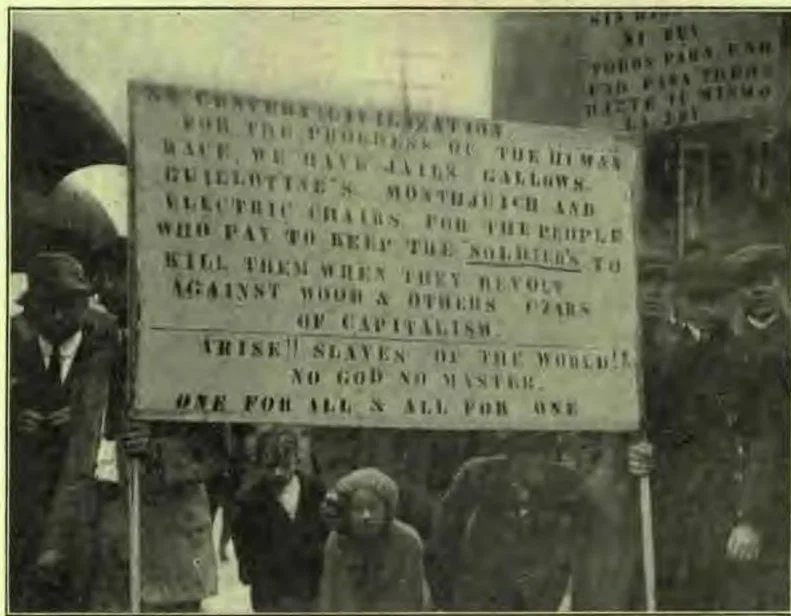
Banner carried by the strikers in Lawrence, Massachusetts. It is not necessary to say that such banners show a high tension of excitement, and that they will serve their purpose still further to inflame the public mind.
It is the duty of every good and true person to do all that can be done to hold in check the evil of this time. But the one duty that is paramount to all others is that of letting the whole world know what all these things signify. Forces of wickedness are let loose that are becoming so overpowering that nothing can possibly cope with them aside from the infinite power of Christ as displayed in His second advent. Let us get ready for the great and glorious day. T.

The Subdivided Factions of Reform

THE people who are illustrated on this page as marching with the banner before them believe that they are reformers. They are doubtless very sincere. They have grievances without any question. But they insist on reforming the country after their own notions of things. They are sure that any other plan would meet failure.
The country is full of other organizations, each of which is positive that there is something radically wrong with the nation, and all affirm with earnestness the importance of having their plan of reform adopted. Prominent among these organizations are the five great political parties—the two kinds of Republicans, the Democrats, the Prohibitionists, and the Socialists—that are bidding for our support and our votes.
Very inflammatory speeches are made on every hand. All seem to unite in saying that unless we can have some genuine reforms, we will have an awful revolution. As the days drag on, the utterances become more and more pronounced. We are addressed with ever-increasing vehemence. But there seems to be no getting together. The reformers are divided by factional strifes, and denouncing each other, as well as keeping up the common refrain, "We must have reform or revolution."
The logical outcome of this, following the philosophy of history, will be for an ecclesiastical organization to come forward with the claim that nothing can unite these forces except a strong intertwining religious sentiment. And this will give us the most ardent and most crushing religious despotism that the world has ever seen. The logic of the situation demands it, and it may not be amiss to say that the Word of God in several distinct instances tells us of just such a world-wide ecclesiastical despotism. And the divine words that make this prediction, specifically state that this despotism will be in the last days. We have made frequent reference to these scriptures, and they ought to be familiar to all our readers.
Lest the reader may think this a "dream" that could not come true in "this enlightened age," we ask him to consider the fact that this is an age of federations and combinations. Men have learned to "combine" in order to secure what they could not otherwise obtain. The times are federation and organization mad. It would hardly seem necessary to state that church federation is sweeping like a craze over the world. T.

Roman Catholics and Civil Government

As They Say It

IN a sermon by the Rev. Father D. S. Phelan, of the Western Watchman (Roman Catholic), of St. Louis, in its issue of June 30, 1912, we are told the reason why the Roman Catholic Church is feared. He says: "Why is everybody afraid of the Catholic Church? and the American people are more afraid of her than any people of the world. Why are they afraid of the Catholic Church? They know what the Catholic Church means. It means all the Catholics of the world, not of one country or two countries, but all the countries of the world; and it means more than that, it means that the Catholics of the world love the church more than anything else; that the Catholics of the world love the church more than they do their own governments, more than they do their own nation, more than they do their own people, more than they do their own fortunes, more than they do their own selves. We of the Catholic Church are ready to go to the death for the church. Under
God, she is the supreme object of our worship. Tell us that we think more of the church than we do of the United States; of course we do. Tell us we are Catholics first and Americans or Englishmen afterwards; of course we are. Tell us in the conflict between the church and the civil government we take the side of the church; of course we do. Why, if the government of the United States were at war with the church we would say to-morrow, To hell with the government of the United States; and if the church and all the governments of the world were at war we would say, To hell with all the governments of the world. They say we are Catholics first and Americans decidedly afterwards. There is no doubt about it. We are Catholics first, and we love the church more than we love any and all the governments of the world; we love the church more than we love our fathers and our mothers, we love the church more than we love our own children."
There is much more of the same import in this sermon. We would like to say just this, that the priest has the right idea of man's loyalty to God, but an entirely wrong conception of his church. All those sentiments would be perfectly proper if he held the church entirely separate and apart from the state. The true Christian always holds his Lord and his duty to his Lord above everything else, but those duties to his Lord do not lead him to antagonize the state, to manipulate the state, to do politics for state control. That is why men fear the Roman Catholics. It is not because of the conception of duty which the Catholic holds toward his God, or toward his church, but it is the wrong conception that the Roman Catholic has regarding his church and her relation to the state. Let him hold the same position that our blessed Lord did, "If any man hear My words, and believe not, I judge him not: for I came not to judge the world, but to save the world," and there would be no fear on any one's part toward the Roman Catholic Church. It is because she assumes to herself control of both church and state, the authority to define heresy and adjudge its punishment, that men fear. Give her the control now, and she will do as she did during the Medieval Ages. The very pivot of the thing rests in the wrong conception of the church.

The Importance of the Home

A Molder of Character

By Mrs. L. D. Avery-Stuttle
HOME! How the very word sets the heart-strings aquiver! What myriad memories cluster around it—what sweet, old-fashioned pictures! Interview any man or woman above forty years of age on the subject of his early home life, and almost without exception you will have a very fair index of his or her character. Of course there are exceptions, but hardly more than enough to prove the rule.
Call to mind almost any of our acquaintances. There is Auntie Willis. Her hair is white, but her cheek is pink and fresh, and her eyes are as blue as the skies in June.
She is halting at the gate.
"Come in, auntie. I wish you would tell us a little about your old home—when you were a child, I mean."
"When I was a child!" echoes the old lady dreamily, while her expressive eyes light up with a radiance that is good to see.
"If I could only see the old home again, just once! There never was another quite such a home, I think. And then, my mother—what a blessed mother she was! Her beautiful life and character have been my ideal from earliest childhood. I'm only sorry that I represent her so poorly.
"Tell you about my early home life? Well, there's not much to tell, except that ours was a happy home, a beautiful home, a Christian home. It was not stately or grand or luxurious. O, no; it was not the least bit like the modern homes of to-day,—just a quaint, old-fashioned farmhouse.
"But I can never forget the morning glories that climbed up at the windows, and the tall, stiff hollyhocks and the sweet-williams and marigolds in the front yard. Those flowers had a peculiar effect upon me as a child," continued Auntie Willis, "and I believe the effect has somehow lingered ever since. They were always associated with my mother, in my mind; they appealed to my love of beauty and purity, and had the effect of increasing my childish determination to emulate the good and the pure."
"But can you tell me, auntie, what particular influence—whether at home or elsewhere—had the greatest effect upon your early life in the molding of your character?"
Auntie Willis thought a moment, and replied slowly:
"I am sure that it was the godly example of my Christian parents, first and greatest; and after that, I think I would name the flowers, the music, and the books which I enjoyed in my childhood's home. The flowers I have already mentioned. We used to sing a great deal at home—my brother and I; and those old songs seem almost a part of myself, to this day.
"Then, the books! There was not a very great variety, I can assure you. But the good old Book was first of all."
“I wish you would tell us a little about your old home”
Well, the experience of Auntie Willis is not at all exceptional. Show me a home of peace and quietness and prayer—a home where love rules every member, and where discord and angry words are altogether unknown—and I will show you boys and girls who are not quarrelsome, who are gentle and thoughtful of the feelings of others, and who are loved and sought after by teachers and playmates alike. I will show you young men and young women who can be depended upon, whose word and whose promise are never held at a discount. And as they grow older, these young shoulders are those upon whom a willing public is very apt to place burdens.
Given an ideal home, and it matters not so much what the after-influences may be. I tell you, the old home life and the old home influences can not be shaken off.
"What!" exclaims some doubter. "Do you mean to say that children always turn out well, whose home influences have been good? Why, I've known ever so many sons of ministers to go wrong, and daughters, too, for that matter."
Well, that is quite possible. But it may be that even the homes of some ministers of the gospel are not always ideal. They should be, yes; but all of us make mistakes. Do not misunderstand me. An ideal home is not necessarily one where mistakes are never made. But when the mistakes are made, they are corrected as soon as they are seen—and even father and mother are not ashamed to acknowledge a fault.
I will tell you five little words which are wonderfully necessary for each member of the family to repeat upon certain occasions, if a happy home would be maintained. They are very simple words, and it would seem that they would be quite easy to speak; but they are the hardest words in the English language—or any other—for the most of us to repeat.
We can say almost anything else. We back around them, and jump over them, and dodge them. A child will sometimes prefer to take a whipping rather than to speak them. The older brothers and sisters will spend sleepless nights trying to coax an awakened conscience to let them off a little easier, or in trying to invent some other words which will do just as well. While father or mother—O, dear! they are so fearful that the expression of these simple words will detract from their dignity, and that discipline could never again be maintained, that they also are too apt to excuse themselves, and the magic words are rarely heard.
Here they are:
"I did wrong; forgive me."
Well, how often do you hear them? Are they as familiar to your ears as cross words or boastful words or hasty words? Does this beautiful sentence pass your lips as often, in presence of the family, as do foolish words or idle gossip?
If they were oftener used, the divorce courts would be robbed of a large percentage of their disgusting business, and even the criminal courts would be affected.
But all these things have their influence. O, believe me, there is nothing which is so felt in the after-life of the boys and the girls, as home influence, be it good or bad.
Good schools and good teachers are important, but good homes and good mothers are more so.
An excellent education is a splendid thing, but an excellent home and efficient home training are better. I tell you, the homes of the nation need to be jealously guarded; then the country will take care of itself.
Are battle-ships and standing armies necessary for the safety of the country? Good homes and good fathers and loving mothers are a hundredfold more so!
The teaching which a child receives at school, be it either good or bad, wise or otherwise, can be, and often is, almost or quite undone by the parents at home.
Ah, the home ought to be an Eden in miniature! Talk about Christianizing a nation! Let us be more sensible, and Christianize the home.
Good homes mean good citizens. Good citizens mean a prosperous community. And prosperous and healthy communities mean prosperous schools and industries, healthy and growing churches, and well-attended Sabbath-schools.

The Bible

Within that awful volume lies The mystery of mysteries! Happiest they of human race, To whom God has granted grace To read, to fear, to hope, to pray, To lift the latch, and force the way; And better had they ne'er been born, Who read to doubt, or read to scorn.
—Scott, "Monastery," chapter 12.

— ★ ★ —

— ★ ★ —
"The advice you don't like is often the best."

BOUND VOLUMES

SIGNS OF THE TIMES

can still be secured as follows:
4 leather 1907 at $2.00 each 9 paper 1907 at 1.75 each 1 cloth 1909 at 2.00 each 6 cloth 1910 at 2.00 each 1 paper 1910 at 1.50 each 18 cloth 1911 at 2.25 each
These prices are post-paid
Those desiring volumes of the SIGNS in this convenient form should write at once with remittance to

SIGNS OF THE TIMES

Mountain View, California

For Sale

Two-story, five-room house. Barn and chicken houses. Five acres in fruit, 200 apples, cherries, plums, peaches, and blackberries. Owner alone and 75 years old. Must sell. Address H. T. Hickok, Sebastopol, California.

The Law

That question of “Under the law? or under grace?” is a constantly recurring one. Bible Students’ Library tract No. 163 gives a careful answer from the Bible. Single copy, 2 cents; a hundred, $1.00. This office.

Bibles

Bibles.—Remember that we are headquarters for anything in the Bible line. We shall be pleased to send you our catalog of Bible selections on application. Pacific Press, Mountain View, California.
Continue reading: Immortality