“For the invisible things of Him from the creation of the world are clearly seen, being understood by the things that are made, even His eternal power and Godhead; so that they are without excuse.” Rom. 1:20.
“THE invisible things of Him”—what are they? We are not left in doubt.
We are not left to speculate. The scripture that speaks of “the invisible things of Him” also tells us what these things are. They are defined as “His eternal power and Godhead,” or as the Revised Version gives it, “His everlasting power and divinity.”
As a person, God is invisible to mortal eye. “No man hath seen God at any time.” Being invisible, it is not therefore strange that some of the things of God in this world of ours are also invisible.
And these “invisible things of Him” are classified by our text under two heads. They are “His everlasting power and divinity.”
Power Is Invisible
To the blind, all things are invisible. Morning and evening, day and night, are alike. The beauty of the spring, the radiance of the summer, and the glories of the autumn, are never seen.
But all men are more or less blind. There are many things that even to the seeing eye are absolutely invisible.
By means of our eyes, we learn most concerning the things about us. Without them, our ideas of things would be meager and miserable indeed. With our eyes, we may read the beauties of some flower at our feet, or view some gleaming star in the deep bosom of unfathomed space.
And yet beyond the piercing gaze of the sharpest eye, beyond all that we can see or hear or feel or taste, there lie all the invisible things of God — an unseen, unheard, unfelt universe whose merest fringes we are just beginning to explore.
Out from this world of the supersensual, a few years ago, came the revelation of the Roentgen, or X-rays. These rays are not visible to the eye; but by means of them and the fluoroscope, we may look straight into our bodies and see our bones. The rays are nevertheless invisible, and were utterly unknown through the ages until, by their action upon the photographic plate, their presence was made manifest.
Take an example of sunlight. Along with the rays of light from the sun are also other rays utterly invisible. And the same thing is true of light from other sources. Let us follow an experiment with the electric arc-light. Back of the light, the experimenter places a strong, concave reflector. This focuses the rays of the light to a given point a short distance in front of the lamp. The mirror produces at this focus an inverted image of the carbon-points of the lamp.
The experimenter now interposes a vessel filled with a solution of iodin in disulfid of carbon. This black solution cuts off all the visible light, and the image at the focus disappears. Place a piece of white paper at the focus, and the image, the invisible to the eye, is still there, for it chars itself out. If we use black paper, this invisible radiation, which is passing through the dark solution of iodin, will pierce two holes in it, corresponding to the image of the carbon-points of the lamp. Falling upon a thin sheet of platinum, this invisible radiation, or heat, is changed into light, and the image stamps itself in vivid incandescence upon the metal.
But the experimenter is not satisfied. He will go a step further.
The solution of iodin used in this experiment cut off every ray of visible light. It completely intercepted even the rays of the noonday sun. And so completely did it intercept the rays of the electric lamp that no rays from it were visible in the darkest room, even when a white screen was placed at the focus.
Placing the hand at this focus, the heat was found to be intolerable. A block of wood was placed in the focus, and dense volumes of smoke rose swiftly upward. Dry paper was instantly ignited; chips of wood were speedily burned up; lead, tin, and zinc were melted; and disks of charred paper were raised to vivid incandescence.
If the eye were placed at the focus, would the dark rays become visible? There is twofold danger in such an experiment. Either the heat rays might be intense enough to cook the humors of the eye, much as heat coagulates the white of an egg; or the dark rays might penetrate to the retina of the eye with sufficient force to destroy it.
Defying the danger, however, the eye of the experimenter was caused to approach the dark focus; but the heat, acting upon the parts surrounding the pupil, could not be borne. An aperture was therefore pierced in a plate of metal, and the eye, placed behind the aperture of this metal guard, was caused to approach the focus of the invisible rays. The focus was attained, first by the pupil and afterward by the retina.
Removing the eye, but permitting the plate of metal to remain, a sheet of platinum foil was placed in the position occupied by the retina a moment before. The platinum became red-hot. No sensible damage was done to the eye.
But remarkable to say, no impression of light was produced. The invisible remained still invisible. The optic nerve was not even conscious of heat.
The eye is made sensitive only to the effects of light. Of course, if our eyes were sensitive to these invisible heat rays as they are to light rays, we could see with heat just6as well as we see now with light. With such eyes, the day would be as bright as it is now; but we could also sit in a pitch-dark room with a warm stove and read as clearly by its dark heat as we do now with our ordinary lights. With such eyes, we could see through windows made of thin plates of hard rubber now to us entirely opaque; and we could view the heavenly bodies through telescopes having lenses of the same material. Imagine looking, with such eyes, through a black rubber comb, and seeing it to be as transparent as glass is now!
But this is not all. We may shut out all the visible rays of the sun, and yet, with a sensitized plate, take photographs with the entirely invisible rays. These rays, in the hands of the chemist, do many wonderful things. For example, they will turn one kind of phosphorus into another quite different kind. They will cause violent explosions, and make substances conduct electricity which otherwise do not. These rays are called the chemical rays, and seem to have considerable healing power, and cure many kinds of skin diseases. Their work in the vegetable world is very important, as they stimulate many of the activities of vegetable life and growth.
All this is but a fraction of the things that might be mentioned in this connection. But why go further into these regions of the invisible and the comparatively unknown? The truth of our text may be illustrated by more familiar things.
All forms of energy are invisible. Light itself, that makes most material things visible, is itself entirely invisible. It is known only by its effects in the material world. Acting as a vibration, it touches the optic nerve of the eye, causing it to vibrate in sympathy with the undulations of light. These vibrations of the nerve filaments of the eye, being communicated to the brain, give us the sensation of vision.
But seeing is one of the senses; it is not light. Sight is but the action of light upon the nerves of the eye.
Darken a room, and arrange a dust-proof box, with a glass side to reveal the interior. Allow a single ray of light to enter the box. Let what dust there may be in the box settle until the air in the box is clear. The ray of light will be entirely invisible save where it touches some material object and illuminates it. Agitate the box slightly. The rising dust, being illuminated by the entering ray, shows its path through the box. But it is the illumination of the dust particles — the effect of light upon them — that we see, and not the light itself.
Power is always invisible until it affects material things.
Electricity is another form of energy, or power; and it also is invisible. For ages, men were utterly ignorant of its manifestation. In water and air, in sky and earth, electric energy has throbbed and vibrated for centuries, at last to be recognized in these later years.
And so with the power of gravitation. Ever since matter first came into being, this mysterious power has been exerting its unending influence, atom attracting atom throughout all the wide universe. But not until Newton's time did men uncover the fact.
They knew, of course, that unsupported bodies on the earth tend to fall toward the surface; but this was all. They saw certain phenomena, it is true; but back of the visible was the mighty, invisible energy. That this force operates not only between all heavenly bodies, but also between all particles of matter whatsoever in all the universe, men had not so much as dreamed until one great mind, under God, led the way. And this ignorance was possible because gravitation is invisible, and its presence is at last known only by its effects upon the visible world of matter.
Heat, another form of energy, is also invisible. It may be felt; but this is its effect upon the skin. We may heat an iron until it is red-hot. We see, not the heat, but the effects of heat upon the iron.
Thus it is with all forms of power; always it is invisible. When one throws a stone, we may see the movement of the arm, the action of the hand, and the passing of the stone through the air; but we do not at any time see the power that produces the different motions.
What a strange world this would be if, by some sort of magic, we were enabled to see the undulations of the filmy waves of light which make visible to us the open scenery of the world! or the waves of sound which bear to us the varied notes and tones of nature! How strange a sight would greet our eyes if we could watch the twinge of pain or the thrill of pleasure as it travels along the sensory nerves!
But force itself can not be seen. It is one of the invisible things of God. B.
History of the Sanctuary
By Mrs. S. N. Haskell
THE typical service began at the gate of the Garden of Eden, where our first parents brought their offerings and presented them before the Lord. Abel showed his faith in the promised Saviour by bringing an animal. He not only presented the shed blood of the sacrifice, but he also presented the fat to the Lord, showing faith in the Saviour, and a willingness to put away his sins. Gen. 4:4; Heb. 11:4. The service was simple before the people of God went into Egypt. The old patriarchs lived near the Lord, and did not need many forms or ceremonies to teach them the one grand truth that sin could only be atoned for by the death of a sinless, innocent one. They needed only a rough altar and an innocent lamb to connect their faith with the infinite sin Bearer.
As the patriarchs journeyed from place to place, they set up their altars and offered their sacrifices, and God drew near to them, often showing His acceptance of their offering by sending fire from heaven to consume their sacrifices.
Abraham's Test
Of all the sacrifices recorded in the book of Genesis, none comes so near the great antitypical Offering as when God called Abraham to offer his only son. The test of faith was not simply the fact that Isaac was his only legitimate son; but Abraham understood that through Isaac's posterity the long-promised Messiah was to come, and in offering Isaac, Abraham was cutting off his only hope of salvation as well as that of the world. But his faith wavered not. He believed that the same God who had performed a miracle in giving him a son, could bring him from the dead to fulfil His promise. Gen. 22:1-19; Heb. 11:17-19. The Lord chose the spot for the offering of Isaac. He said to Abraham, "Get thee into the land of Moriah; and offer him there for a burnt offering upon one of the mountains which I will tell thee of." Gen. 22:2.
Upon this very spot where God tested Abraham, was the thrashing-floor of Ornan the Jebusite, where the angel of the Lord appeared to David. The prophet of the Lord told David to erect an altar upon the thrashing-floor, and there David made a special consecration to the Lord; and a few years later, the temple of the Lord was erected, without sound of hammer, on this same plot of land. God had conquered, and He designed that the place should ever be hallowed by His presence. Jer. 17:24-27. But His people were unfaithful; and when the Lord of Light came to His own temple, He was despised and crucified, and the holy city and the sacred site of the beautiful temple passed into the hands of the Gentiles. Upon this spot, Mount Zion (Moriah), made sacred by the consecration of God's chosen people, God's glorious, everlasting city will be placed, nevermore to fall into the hands of the enemy. God says, "I will set My sanctuary in the midst of them forevermore." Eze. 37:26-28; Rev. 7:15.
Having briefly outlined the subject from Eden lost to Eden restored, we will go back to the time Israel came out of Egypt.
“And let them make Me a sanctuary; that I may dwell among them.”
"That I May Dwell Among Them"
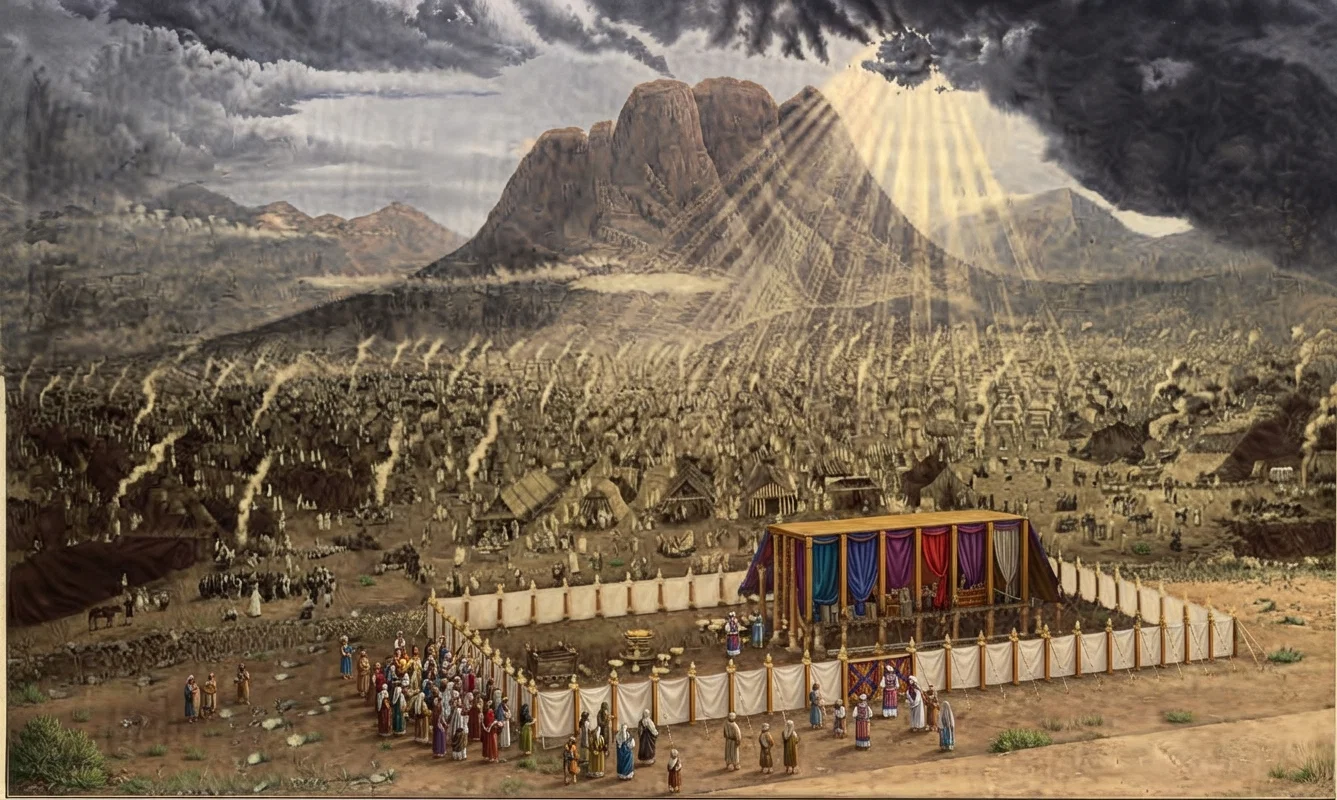
Subjected to a life of incessant toil, and surrounded by heathen darkness, the children of Israel lost sight of the significance of the simple sacrifices. On account of their servitude, they were deprived of the privileges enjoyed by the ancient patriarchs, of spending much time communing with God; and they drifted very near to Egyptian idolatry. When God brought them out of Egypt, He proclaimed His law from Sinai, and then gave them the same system of worship the patriarchs had followed. But God dealt with them as children; and just as we would illustrate to children by kindergarten methods, because they could not grasp, without the simple illustrations, a lesson which adults could easily comprehend, so God gave in kindergarten form to the children of Israel, the same system of worship that Abraham, Isaac, and Jacob had followed. They had drifted so far away that they could not comprehend how God could live with them, being invisible; so God said, "Let them make Me a sanctuary; that I may dwell among them." Ex. 25:8.
The pillar of cloud above the tabernacle, and God's visible presence manifested within, helped the Israelites to comprehend more easily the real abiding presence of the Lord with them. This sanctuary was a shadow of the heavenly sanctuary, and the service was so planned by the Lord that the work was a type or symbol of the work the Son of God would do on earth and in heaven for the redemption of the lost race. It was the most wonderful object-lesson ever given to mankind.
The sanctuary was completed while Israel encamped at Sinai, and during their forty years' wanderings in the wilderness the Israelites carried it with them. When they reached the promised land, it was set up in Gilgal for a few years (Joshua 5:10, 11),7and then removed to Shiloh (Joshua 18:1; 19:51), where it remained for many years. When David was fleeing from Saul, the tabernacle was in Nob (1 Sam. 21:1-6), for there the priests set the showbread before the Lord each Sabbath day. It was next set up in the high place at Gibeon. 1 Chron. 16:39; 21:29. The tabernacle remained in Gibeon until removed by Solomon to Jerusalem. Josephus tells us that Solomon had "the tabernacle which Moses had pitched, and all the vessels that were for ministration to the sacrifices of God, removed to the temple." (Book 7, chapter 4.)
The Temple of Solomon
David desired to build a house for the Lord; but on account of the many wars he had engaged in, the Lord directed that his son should build the house. When Solomon was established on his throne, he built a magnificent structure, and dedicated it to the Lord. God showed His acceptance by His glory filling the temple. Solomon did not plan the temple himself; God revealed the plan of the temple to David, as He had revealed the plan of the tabernacle to Moses. David was not to see it built; but when he delivered the plan for the building to Solomon, he said, "The Lord made me understand in writing by His hand upon me, even all the works of this pattern." 1 Chron. 28:11-19.
Vicissitudes of the Temple
The history of Solomon's temple is really a history of the religious experiences of the children of Israel. When they departed from the Lord, the temple was neglected and sometimes even suffered violence. It was pillaged by Shishak, king of Egypt. 1 Kings 14:25, 26; 2 Chron. 12:9. At the instigation of Jehoiada, it was repaired by Jehoash (2 Kings 12:4-14; 2 Chron. 24:4-13), who himself afterward robbed it of its treasures to propitiate the Syrians (2 Kings 12:17, 18). Ahaz, a little later, not only robbed it of its treasures, but also defiled its holy precincts. 2 Kings 16:14-18; 2 Chron. 28:20, 21. Under the reign of the good king Hezekiah, the temple was purified and its worship restored (2 Chron. 29:3-35); but even Hezekiah robbed it of its treasures to procure a treaty with the Assyrians (2 Kings 18:13-16). Again it was polluted by the idolatrous worship of Manasseh. 2 Kings 21:4-7; 2 Chron. 33:4, 5, 7. The "good king Josiah," when but a youth of eighteen, repaired and purified the temple, and again restored its worship. 2 Kings 22:3-7; 23:4-7, 11, 12; 2 Chron. 34:8-13. Finally, on account of the unfaithfulness of the chosen people of God, the holy temple was burned to the ground, and its treasures were carried to Babylon. 2 Kings 25:9, 13-17; 2 Chron. 36:18, 19.
It was seventy years before the rebuilding of the temple by Zerubbabel was completed and the temple dedicated with great rejoicing. Ezra 6:16-22. Herod spent forty-six years in repairing Zerubbabel's temple, until in the days of Christ it was a magnificent structure. John 2:20; Mark 13:1.
The Earthly Temple Forever Destroyed
God's presence abode with His people in the dwelling-places they prepared for Him, from the tabernacle erected in the wilderness, all the way down through the varied history of their spiritual wandering until that memorable day when the types celebrated for four thousand years met their Antitype on the cross of Calvary. Then with a great noise the glorious veil of Herod's magnificent building was rent from the top to the bottom as the Lord forever left the temple. Previous to this, the services were directed of God; henceforth they were but a hollow mockery. God had departed from the temple. The temple remained standing until 70 A.D., when it was destroyed by the Romans. To-day the sacred spot is covered by a Mohammedan mosque.
The Temple on Earth a Type
The epistle to the Hebrews shows that the leading apostle clearly taught the antitypical fulfilment of the types and shadows celebrated for so many years. It should not be forgotten that the gift of the spirit of prophecy and the Sabbath of the Lord were always connected with the sanctuary service. We have no reason to doubt that during the early history of the Christian church, the subject of the sanctuary and the antitypical work of Christ in heaven was clearly understood by Christians; but when we come to the time when the Bible was taken from them, the Sabbath of the Lord was hidden, and the voice of the spirit of prophecy was no longer heard directing the church, they lost sight of the beautiful antitypical work taught by the ancient sanctuary service.
But the time arrived for the opening of the great judgment in heaven; and the Father and the Son, with Their retinue of holy angels, passed in state into the most holy place of the heavenly sanctuary. No earthly pageant could in any way compare with that wonderful event. God designed that it should be recognized on earth; and He caused the first angel's message to be proclaimed to the inhabitants of earth, directing their attention to the movements of the Son of God. The attention of a large company was centered on the Saviour; but they did not understand the antitypical work, and expected the Saviour to come to the earth. Instead of coming to the earth, He went into the judgment. This company which had been gathered out by the message of the first angel, loved their Lord; and in their longing desire to find why He had not come to the earth, they drew so near that He, in answer to their earnest prayers, directed their attention to the heavenly sanctuary. There they saw the ark of God's testament, containing His holy law, and they acknowledged its claims upon them, and began to keep holy the Sabbath of the Lord. The sanctuary service, the Sabbath, and the spirit of prophecy were ever united in olden times; and when light from the antitypical sanctuary service came to the people of God, He gave them the spirit of prophecy in their midst, to open up to their minds the beautiful truths in regard to Christ's ministry in the heavens, that otherwise they would not have comprehended.
Summary
THE TABERNACLE
Built by Moses in the wilderness.
Stored in Solomon's temple.
THE TEMPLE
Built by Solomon.
Destroyed by the Babylonians.
Rebuilt by Zerubbabel.
Repaired by Herod.
Forsaken by the Lord.
Destroyed by the Romans.
"Me an' Jesus"
By L. E. Froom
By L. E. Froom
IN the sunny Southland not long ago, an old colored "auntie" was sitting in the door of her humble cottage, humming, "Jesus, Lover of My Soul." A passer-by thought to cheer, and asked, "Well, auntie, are you living here all alone?"
"Jus' me an' Jesus, massa."
She had found that the way to be happy is by living close to Jesus.
Reader, have you grown weary of bearing the burdens of life all alone? Have you bravely labored to perform your daily tasks, and failed because you worked all alone? Courage, friend! Hope sees a star.
"Come to Me, all you toiling and burdened ones, and I will give you rest. Take My yoke upon you and learn from Me; for I am gentle and lowly in heart, and you will find rest for your souls. For it is good to bear My yoke, and My burden is light."—Weymouth's translation.
It is Jesus that speaks. He offers rest to those who have tried all alone—and failed. He offers to help you bear the burden of life—for a yoke is made for two. What a thought! Yoked up with the Prince of Life, to bear life's burdens! Of course they will be light with such royal help.
The greatest problem in the world is how to bear successfully life's burdens. Each life has its sorrows and trials, its disappointments and hardships. Many have tried to solve the problem, and failed because they tried it alone. An unhelped cross is the heaviest thing a man ever carried; but a Christ-touched burden is the lightest one a man ever shared. A yoke is made for two. That is Christ's solution, and it is the only successful one.
Many think the yoke is some additional burden laid upon the Christian. Not so. Think of the familiar figure of the patient oxen. Without a yoke the load is intolerable, the task impossible. It is to make the burden bearable that yokes are used. They8do not take away the reality of the load, nor relieve one from bearing it. They help to bear it happily and contentedly, help to make a success of bearing it.
Jesus spent many years at the carpenter's bench. He used this striking figure because doubtless with His own hands He had often fashioned the wooden yoke.
He knew the difference between the ill-fitting yoke that galled, and the smooth one that fitted and rested easy. He knew how to make them fit right. That is what He is offering now.
Many fail because they try to yoke up to Jesus with their own yokes. But the Master says, "Take My yoke upon you." Somehow our yokes do not rest easy. But the great burden Bearer knows just how to fit us so the burden will be light and the yoke good to bear.
How are we to take Christ's yoke? — First, He must place it upon our shoulders, for He knows just how to adjust it.
Our part is to receive it. We must surrender ourselves to Him for service, meet life as He met it, think His thoughts after Him. This we can not do of ourselves; but He never asks us to bear a burden He is not ready to share, and to carry the heavier end.
Yoked up with Him, we will not say things we used to say, nor do things we sometimes did. Neither will we go into questionable paths — for Jesus is yoked up with us, and we know He would not go. We will not get ahead of Him and try to lead the way, nor drag behind; for then it is "side by side." Even when we "pass through the shadow," we need "fear no evil," for He is ever with us.
Thus will come into the life that sweet "peace that passeth all understanding." The burdens, too, will be lighter, for now it's "me an' Jesus."
Takoma Park, D. C.
When Thy Curfew Rings
By Worthie Harris Holden
If to-night unveils the portal
To the quiet Vale of Rest,
When upon its solemn threshold,
What will be thy last request?
Wilt thou value earthly treasure,
Or a mansion in the sky?
Wilt thou care for worldly plaudits,
Or a record clean on high?
Neither wealth nor fame can reckon
With the stern command of death,
For the summons of the angel
Testifies that God gives breath.
Live to-day as in the presence
Of Jehovah — Judge and King,
Since thou knowest not, at dawning,
When thy curfew bell may ring.
The Will Must Be Surrendered
By Mrs. E. G. White
By Mrs. E. G. White
CHRIST says: "I am the true vine, and My Father is the husbandman. Every branch in Me that beareth not fruit He taketh away; and every branch that beareth fruit, He purgeth it, that it may bring forth more fruit. . . . Abide in Me, and I in you. As the branch can not bear fruit of itself, except it abide in the vine; no more can ye, except ye abide in Me. I am the vine, ye are the branches: he that abideth in Me, and I in him, the same bringeth forth much fruit: for without Me ye can do nothing."
It is not enough that we believe a portion of truth; we must grasp truth after truth, and by both precept and example we must teach the truth as it is in Jesus. When sorrow comes, we may see the love of Christ in it all, and the fulness of divine love may keep the soul in perfect peace. If we abide in Christ, we must ever be searching after truth as for hidden treasures, in order that our apprehensions of truth may be quick and comprehensive. We shall not then be putting on the garments of resistance, and be prepared to be prejudiced against the very things which we need in our time. Christ is continually unfolding old truths in a new light. The only way in which we will be prepared to have a more perfect apprehension of truth, is by keeping the heart tender and subdued by the Spirit of Christ. We can not afford to cultivate hardness of heart; for if we are students in the school of Christ, we shall be continually growing in knowledge.
Jesus gives the invitation: "Come unto Me, all ye that labor and are heavy-laden, and I will give you rest. Take My yoke upon you, and learn of Me; for I am meek and lowly in heart: and ye shall find rest unto your souls. For My yoke is easy, and My burden is light." When we come to Jesus as humble learners, seeking to know the mind of Christ, we shall have no disagreeable surprises. That which we receive from Him will be to us light, and life, and salvation. We shall walk in the light of the Sun of Righteousness, advancing from light to a greater light, and at every step our hearts will well up with gratitude for the precious revelations of His love. We shall not walk in darkness; we shall behold Him who is our only help, Him who only has the words of eternal life.
New Truth to Be Received
We are never to feel that there is no more truth to be unfolded to us. The history of the past few years has taught us that the words which Jesus spoke to His disciples are appropriate to us. He said, "I have many things to say unto you, but ye can not bear them now." But I trust that we shall not have the experience of those disciples who, when new truth was revealed to them, walked no more with Him, but because of the word they were offended. Will the experience of these disciples be repeated that called forth from Christ these words? "There are some of you that believe not. For Jesus knew from the beginning who they were that believed not, and who should betray Him. . . . From that time many of His disciples went back, and walked no more with Him. Then said Jesus unto the twelve, Will ye also go away? Then Simon Peter answered Him, Lord, to whom shall we go? Thou hast the words of eternal life. And we believe and are sure that Thou art that Christ, the Son of the living God."
"Therefore seeing we have this ministry, as we have received mercy, we faint not; but have renounced the hidden things of dishonesty, not walking in craftiness, nor handling the Word of God deceitfully; but by manifestation of the truth commending ourselves to every man's conscience in the sight of God. But if our gospel be hid, it is hid to them that are lost: in whom the god of this world hath blinded the minds of them which believe not, lest the light of the glorious gospel of Christ, who is the image of God, should shine unto them. For we preach not ourselves, but Christ Jesus the Lord; and ourselves your servants for Jesus' sake. For God, who commanded the light to shine out of darkness, hath shined in our hearts, to give the light of the knowledge of the glory of God in the face of Jesus Christ."
The Conflict Between the Unseen Powers
Could our eyes be opened, and could each see the conflict of angelic agencies with the satanic confederacy, who are combined with evil human agencies, what astonishment would come upon the soul! The holy angels are working with terrible intensity for the salvation of men, because the destroyer of souls is seeking to make of no effect the salvation which has been purchased at infinite cost. Could our spiritual vision be opened, we should see that which would never be effaced from the memory as long as life should last. We should see souls bowed down under oppression, loaded with grief and pressed down as a cart beneath the sheaves, and ready to die in discouragement. We should see angels flying swiftly to aid the tempted ones who stand as on the brink of a precipice. These tempted souls are unable to help themselves, and voice the ruin which threatens them; but the angels of God are forcing back the evil angels, and guiding the souls away from the dangerous places, to plant their feet on a sure foundation. We should see battles going on between the two armies, as real as those fought by opposing forces on earth. When the power of Satan over souls is broken, we see men binding their will to the cross, and crucifying the flesh with the affections and lusts. It is indeed a crucifixion of self; for the will is surrendered to Christ. The will of man is none too strong when it is sanctified and put on the side of Christ. The will is a power; and as many triumphs are to be won in spiritual warfare, and many points of progress to be made in the spiritual journey, and many lessons to be learned from Christ, the great Teacher, it is necessary that the will should be sanctified. In9surrendering the will, the root of the matter is reached. When the will is surrendered, the streams that flow from the fountain will not be bitter, but will be as pure as crystal. The flowers and fruit of Christian life will bloom and ripen to perfection.
The Example of Sanctified Human Will
Jesus Christ is our Example in all things. He began life, passed through its experiences, and ended its record, with a sanctified human will. He was tempted in all points like as we are; and yet because He kept His will surrendered and sanctified, He never bent in the slightest degree toward the doing of evil, or toward manifesting rebellion against God. Have men and women who profess to be followers of Christ, been simply gratifying their own tastes, been confirming themselves in selfishness, in obstinacy, simply living to gratify their carnal propensities? Those who persist in living in this way will at some time in their experience become offended by the truth presented from the Word of God. They can not be one with Christ or abide in Him, because they refuse the terms upon which salvation is provided. They do not wear Christ's yoke or lift Christ's burden; for they will not learn of Him meekness and lowliness of heart. Those who have a sanctified will, that is in unison with the will of Christ, will day by day have their wills bound to the will of Christ, which will act in blessing others, and react upon themselves with divine power. Many cultivate those things which war against the soul; for their desires and their will are set against God, and employed in the service of Satan.
Cherish the Proper Will
Let us no longer gratify the enemy by complaining of the strength of our evil will; for in so doing we are feeding and encouraging our wills against God, and pleasing the evil one. Let us remember that we are children of God, pledged to cherish a holy will which comes to us from God. 'As many as received Him, to them gave He power to become the sons of God, even to them that believe on His name: which were born, not of blood, nor of the will of the flesh, nor of the will of man, but of God.'
When we resist the devil, he will flee from us, and we will rise above the human weakness in a way that will be a mystery even to ourselves. The judgment-day is not that which will decide our eternal interests; but it is the yielding to influences that either subject our character to the molding of Christ, or oppose our will to the will of God. The one absorbing aim of the life of Christ was to do the will of His heavenly Father. He did not become offended with God; for He lived not to please Himself. The human will of Christ would not have led Him to the wilderness of temptation, to fast, and to be tempted of the devil. It would not have led Him to endure humiliation, scorn, reproach, suffering, and death. His human nature shrunk from all these things as decidedly as ours shrinks from them. He endured the contradiction of sinners against Himself. The contrast between the life and character of Christ and our life and character is painful to contemplate. What did Christ live to do? — It was the will of His heavenly Father.
As God Will
There is a hymn of Benjamin Schmolke's whose true beauty can be understood only by knowing the circumstances in which it was written. This Lutheran pastor first suffered from a fire that devastated his parish; then from a bereavement that emptied his home; then from a paralysis that left him a blind and helpless cripple. It was on his bed, after these accumulated afflictions, that he dictated that hymn, in which are indicated all these forms of sorrow. How exquisitely pathetic, yet how gloriously triumphant!
My Jesus, as Thou wilt!
O, may Thy will be mine!
Into Thy hand of love
I would my all resign.
Through sorrow, or through joy,
Conduct me as Thine own,
And help me still to say,
My Lord, Thy will be done!
My Jesus, as Thou wilt!
Tho seen through many a tear,
Let not my star of hope
Grow dim or disappear.
Since Thou on earth hast wept,
And sorrowed oft alone,
If I must weep with Thee,
My Lord, Thy will be done!
My Jesus, as Thou wilt!
All shall be well for me;
Each changing future scene
I gladly trust with Thee.
Straight to my home above
I travel calmly on,
And sing, in life or death,
My Lord, Thy will be done!