WHILE it may not be possible to forecast with absolute certainty the outcome of the troubled conditions in China and the far East, as to divisions of territory and ultimate control, yet the history of governmental movements during the past fifty to seventy-five years, and notably the steady and resistless on-march of Russia, furnish a significant index to future changes. So quietly has the larger part of Russia's preparatory work progressed that the rest of the world has hardly realized what was taking place until some specially striking stage of her advances has from time to time called forth widespread comment.
Not so many years ago—within the memory of even the younger generation—Siberia was practically an unknown country, a wild and inhospitable region, covered with snow and ice in much of its extent the greater part of the year. But as the mists have cleared away, there has burst on the vision a picture of vast prairies and far-extending valleys, with growing grain and fruits, and flocks and herds, while stretching away four thousand miles, from Tcheliabinsk and Ekaterinburg in the Ural Mountains on the West to Vladivostok on the Pacific, is the shining track of the great Trans-Siberian Railway, with its many branches.
The extension of the railroad meant rapid strides toward China, the coveted bone of contention in the East. Then came the Chino-Japanese War, and Russian occupation of Port Arthur, and constantly-spreading Russian influence in Manchuria, until now this province is practically annexed. In her scheme of expansion and absorption Russia has planned with far-sighted wisdom. Her watchword has been conquest by peaceful means where possible,—victory by diplomacy, and she is gradually revealing herself to the world as a past master in this art. Money and force of arms will accomplish almost anything in this world. Both of these agencies Russia possesses, and besides is at the door and in the ground with them. And so, while other nations have either endeavored in vain to obtain concessions for railway building and promotion of other enterprises, or have gained a point only after long delay, Russia has quietly proceeded with marvelous energy, and, apparently, no hindrances, until at the present time she has nearly completed in Manchuria over twelve hundred miles of railway, as against about five hundred miles in all the rest of China, built by other outside enterprises.
Into these Eastern openings Russia has been and is pouring troops by rail and by water, until, it is estimated, there are in garrisons at Port Arthur, Talienwan, New Chwang, Moukden, and other near-by cities, and at Vladivostok, Khabarovsk, Nikolskoe, and other places, further north and east, and along the lines of the Manchurian branches of the Trans-Siberian system, more than two hundred thousand soldiers. Besides this force there can probably be relied upon to fall in with Russia the one hundred and seventy odd thousand Manchu soldiers, distributed throughout the various provinces, when it is considered that China's best regiments are officered by Russians. Add to these resources practical control already of Mongolia, the breeding-ground of all Chinese horses, and it requires no astute prophet to foretell some of the probable final outcomes of the far Eastern question.
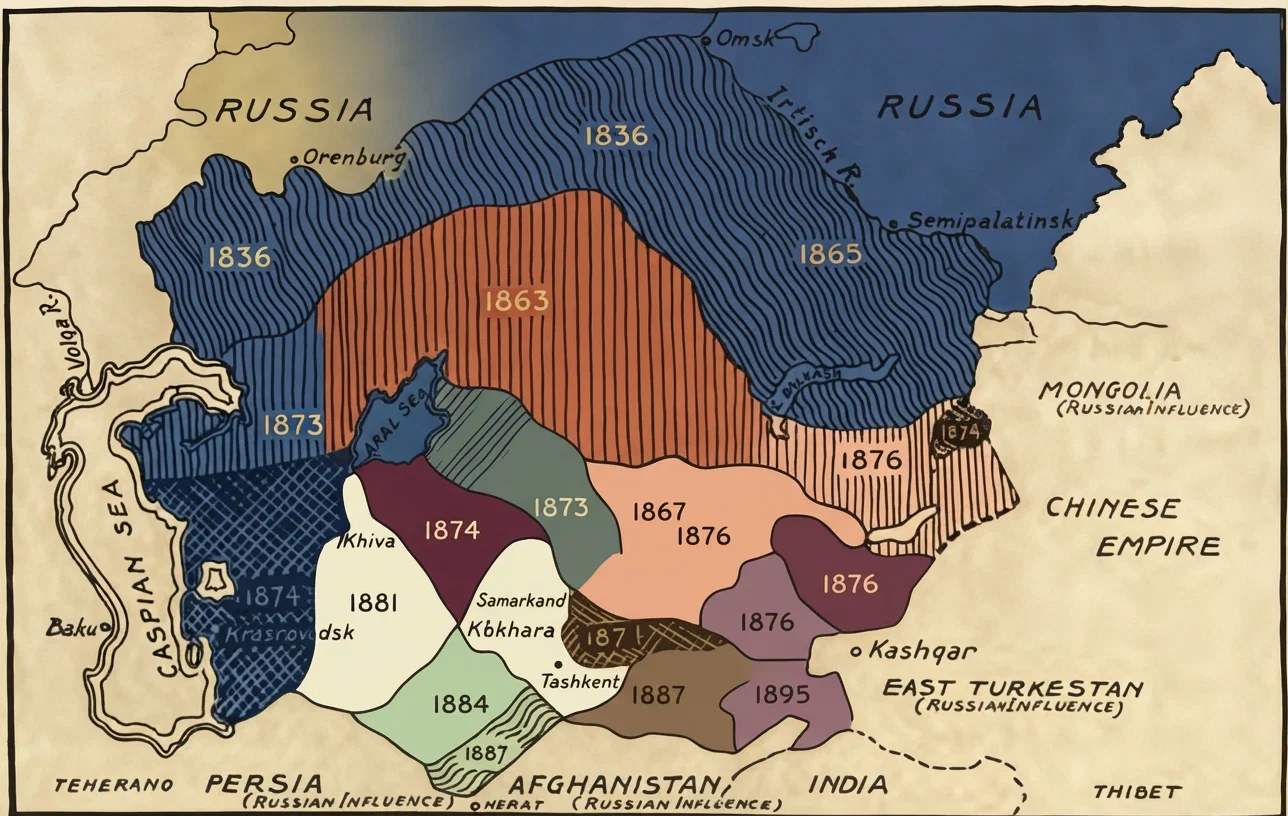
But this is only part of the Asiatic problem. It was Lord Charles Beresford who predicted that the Russian annexation of Manchuria would be followed by a successful invasion of India by the arms of the czar. The fear of this is England's nightmare, and the facts of the situation warrant the prediction. A glance at the accompanying map will show the stages of Russia's advances in Central Asia during the present century. Into lands for thousands of years barred to foreigners Russia has forced a path, and brought under her sway and to partial civilization at least, ten millions of lawless dwellers of the steppes of West Central Asia. Her southern boundary is the northern line of Persia and Afghanistan. Eastern Turkestan is under her influence, and between these two she touches India in the Pamirs.
From Krasnovodsk, on the eastern shore of the Caspian Sea, begins the Central Asian Railroad, already stretching fourteen hundred miles into the heart of Asia, with Peking ahead of it, and touching, among other cities, Askabad, Merv, Charjui, and Samarcand, once the seat of the world's civilization. At Merv a branch turns south to Kushk, forty miles from Herat, the capital of Western Afghanistan, and here, through her diplomatic tampering with the Ameer, Russia expects to establish a base from which a rapid descent can be made on India when the proper moment arrives.
Russian Advance in Asia.
Distributed at a dozen different points along the line of this great military road—for this is what it really is now—and at points easy of access from it, the czar has a force of over eighty thousand Cossacks, half of whom are at Kushk.
But this is only a small portion of the number he can call to his aid in this region in an emergency. The leading warriors and chiefs of the vast hordes subjugated in the interior are made mounted officers in the czar's service, and, with their followers, add thousands of ardent supporters to the man in St. Petersburg. So that along her Asiatic frontier Russia has stretched an army of fully five hundred thousand soldiers. For their transportation and for the carrying of provisions where the railroad fails, she has easily ten million horses and camels on the Kirghiz and Turkestan steppes. And the provisions are found in the valleys of this same interior region, made fertile and productive by canals and extensive irrigating works, constructed at an immense outlay of capital by the Russian Government. In fact, this has been planned as a vast commissary department, and its supply is inexhaustible.
This is not all. It is well known that Russian influence is dominating in Persia, and work is now progressing on the Trans-Caucasian Railroad from Tabriz in northwestern Persia to Bander Abbas on the Indian Ocean, which port is claimed by the czar as one consideration of a large loan to the Shah. When this line is completed, a steady line of troops can be poured into Persia from Batum on the Black Sea, even as forces in large numbers are now being hurried to the front via Baku, thence by large steamers across the Caspian to Krasnovodsk, thence to the frontier, ready for advance into Afghanistan, with India the goal.
A crisis is approaching. The "Boxer" trouble in China is only an incident, and when this is quieted there will still be the settlement of the greater question. England is at present handicapped by her South African affair, and under ordinary conditions could not possibly withstand Russia in China, so far as a land conflict is concerned, and it would be made such by reason of Russia's land advantages. In India, England could place in front of an invading force about one hundred thousand British soldiers, and four hundred thousand native troops, if the latter could be induced to fight for her.
In the southeast is France, crowding India and England's sphere of influence in China in the North. At present France and Russia are together in working against England, and Germany seems to stand in a friendly relation to her big neighbor. America's policy is not fully defined; but in the meantime her trade is multiplying enormously, for with Russia's advances go American railroad material and agricultural implements, which are supplied more cheaply and quickly than like material from Europe. England sees the situation and realizes that her chances are desperately shaky, as evidenced by recent utterances of her leading statesmen. And then Japan must be reckoned with, and she looks with unfriendly eyes upon Russia's operations in Korea.
Russia's long line of outposts from Bander Abbas to Port Arthur, has been likened to a seven-thousand mile drag-net. The question is, When the net contracts and the ends close in, what will be the fate of China and India, and, later on, what the fate of France in China, and of other possible allies, who may then stand in the way of the czar's complete domination of Asia? The Slavonic race dominant in Asia is the czar's dream. From a human standpoint it bids fair to come true. But, unless accomplished very quickly, there are other factors of mighty import—factors based in prophecy and hastening to fulfilment—that will prevent by precipitating a conflict sore indeed, and one that will be ended only by the speedy coming of Christ in the clouds of heaven.
L. A. P.
NOT A PEACEFUL PROSPECT.
By G.
SOME people, and especially heads of governments and their counselors, would have the world believe that the way to keep peace is to prepare for war. But nations are very much like individuals, because a nation is an aggregation of individuals, and the aggregation does not change the nature. Now it is true that many a murder has been committed on the spur of the moment, because an individual happened to have a weapon at hand, when otherwise a little more caution or a second thought would have avoided a deed which only brought costly trouble. Laying aside the possibilities of the warlike attitude in the Orient, in which all the so-called great Powers are interested, it is interesting to note the preparation of the United States Government for naval warfare—a preparation that was contemplated even before this Eastern complication took shape.
According to official reports, "warships aggregating a cost of $100,000,000 are to be built for our navy as soon as contractors are prepared to undertake their construction. The new program calls for eleven armored ships, which will practically double our present sea power in this class; and in addition to these there are to be three highly-improved cruisers of the Olympia type, and Congress appropriated $18,000,000 for the hulls and machinery of five battle-ships, and bids have been solicited for their construction. The plans for the six armored cruisers, which are to be more powerful than any ship at present in service, and are to cost for hulls and machinery alone over $25,000,000, will probably be finally approved next month. The Navy Department is also about to solicit bids for 35,000 tons of armor, the cost of which will amount to between $17,000,000 and $19,000,000. The complete program for the new vessels authorizes contracts for hulls and machinery amounting to $51,900,000. This includes five battle-ships at $3,600,000 each, six cruisers at $4,250,000 each, and three improved cruisers at9$2,800,000. The battle-ships are to be of nearly 16,000 tons displacement, which is over 5,000 tons heavier than the Oregon, and are to be 100 feet longer than that vessel, with at least three knots better speed. The cruisers are to be 14,000 tons, 23 knots speed, and 8,000 knots steaming radius, which is greater than that of any vessel of the same class at the present time. These vessels will be 5,000 tons larger than the Brooklyn, and at least three times as powerful for fighting purposes. The protected cruisers will be of 10,000 tons displacement, or about twice the size of the Olympia."
It is safe to say that most of this preparation for naval warfare is being made because other nations are doing likewise; for it is a fact that the European nations, as well as Japan, are going even farther in proportion to their ability than the United States. This can not, in the very nature of things, promote peace; for just as individuals armed will risk more, and be more obtrusive, and, on the other hand, be more ready to resent intrusion, the same is to be expected of nations. Be not deceived; war preparation is not a promoter of peace, nor does it augur an era of peace among the nations. G.
PARTITION OF CHINA.
WASHINGTON advices state that the partition of China is inevitable, and "the Powers" have tacitly agreed that it shall not continue as an independent, autonomous empire. The nations involved in the present embroglio have decided that steps must be taken, making impossible the recurrence of existing conditions. And each nation will insist upon money indemnity averaging $300,000,000 each; of course this is based on the confirmation of present reports, and a speedy victory for the allies. "Diplomatically, up to date, this country's demands are limited to a money indemnity and to the making of a treaty which will insure the open door in China and continue the commercial rights guaranteed to this country in Chinese treaty ports. Any changes in this program will be due to circumstances and the attitude of the other Powers. It is suggested that if the treaty asked for by this government should not be obtainable, a territorial indemnity may be forced upon the United States. The experts in the State, War, and Navy Departments began to-day [July 7] the preparation of the cases against China so far as the money question is concerned, and are basing their figures on the continuance of the trouble for one year, from May, 1900, to May, 1901. The Chinese custom-houses will be seized and held by the allied forces until each nation's bill is collected in full."
THE worst reports that had been received from China, seemingly confirmed, had not been after all even fully surmised. All the foreign consuls and missionaries, including their women and children, have been ruthlessly butchered. After enduring several days of bombardment and starvation, they made a sortie at night. The women and children were placed in the center of a hollow square, and the guards fought desperately. Finding escape impossible, the men killed their own women and children to save them from torture. Then they fought to the bitter end, which meant death and horrible mutilation. All the native Christians were also murdered, and "the streets ran red with blood." At Tien-Tsin, the foreign portion of the city has been besieged and bombarded. The British Admiral Seymour, who has been in command of all the foreign defense force, being compelled to retreat, killed all his wounded to save them being tortured. This was done, however, at the request of the victims themselves, who knew what had been done to some of their comrades who had been wounded and captured. And the end of the terrible situation is not even in sight.
A LATE press despatch from Shanghai says: "All China is now aflame with revolt against foreigners. Only in the extreme West is there quiet. Every port, even Shanghai, is menaced. In the provinces of Hu-Pe and Hu-Nan thousands of native Christians have been mutilated and tortured, the women being first assaulted and then massacred." Yet this is simply that sentiment called "patriotism" gone mad. Webster defines patriotism as "the passion which aims to serve one's country," and this is all that the poor, deluded Chinamen mean. With them, as with many so-called "civilized" and "Christian" people, "the end justifies the means." What the world calls patriotism knows no limit but the limit of power.
AN exchange says: "Seventeen good sober boys went from an Illinois town as soldiers to Manila. One was killed; the other sixteen met with a worse fate; they came home confirmed drunkards—army canteen drunkards."
CHIEF JUSTICE JOHN MARSHALL said in a judicial case of the term "United States" in the Federal Constitution:—
" 'The United States' is the name given to our great republic which is composed of States and Territories. The District of Columbia, or the territory west of the Missouri, is not less within the United States than Maryland or Pennsylvania; and it is no less necessary, on the principles of our Constitution, that uniformity in the imposition of imposts, duties and excises should be observed in the one than in the other."
And in the Dred Scott decision the majority of the Supreme Court held that "a power in the general government to obtain and hold colonies and dependent territories, over which they might legislate without restriction, would be inconsistent with its own existence in its present form." What would the Supreme Court decide now?
IN notifying President McKinley of his renomination, Senator Lodge said: "THE PEACE YOU HAD TO MAKE ALONE. Cuba, Porto Rico, the Philippines, you had to assume alone the responsibility of taking them from Spain. Alone, and weighted with the terrible responsibility of the unchecked war powers of the Constitution, you were obliged to govern these islands and to repress rebellion and disorder in the Philippines. No party creed defined the course you were to follow. . . . Thus you framed and put in operation this great new policy, which has made us at once masters of the Antilles and a great Eastern power, holding firmly our possessions on both sides of the Pacific."
UP to July 1 the total fire loss in the United States for 1900 was $103,000,000 against $65,000,000 for the corresponding period last year. There have been no less than fifteen fires with losses of over $500,000 each since January 1 last, and five of them have destroyed property reckoned by millions, the Ottawa conflagration heading the list with a loss of $12,000,000. Among the recent ones is the Standard Oil fire of $3,000,000; the Hoboken steamship fire of $5,350,000; and the Prescott (Arizona) fire of over $1,000,000; Newcastle, Cal., nearly the whole business portion, estimate not given. This shows the greater carelessness and recklessness of men.
A WASHINGTON, D. C., despatch says that "Secretary Root is preparing a bill for the reorganization of the regular army even more radical in its nature than the one submitted in the last session. It seems to be his opinion that the cavalry should be increased from ten to twelve regiments, in order not only to give a larger mounted force, but to make promotions faster among officials. An official in close touch with the secretary says it is the intention of the department to ask Congress for a standing army of not less than 75,000 men. An army of this size, it is estimated, will be needed to cope successfully with the situation in the Philippines."
WHETHER the uprising against foreigners in China has the sympathy of the government is uncertain. It is given out to the world as a revolution, but it is well known that the Dowager Empress is a foe to foreign influence and modern progress, and that Li Hung Chang was under the ban because of his progressive ideas. Rev. W. P. Chalfant, a prominent missionary, says that for two years the legations have been warned by the missionaries of the coming crisis; but they, in return, have been told by the government that the sentiment complained of was only local, and would be managed by provincial authorities.
THE continued seige of Tien-Tsin, occupied by allied troops, and the battles connected therewith have proved that the Chinese are not the insignificant warriors that they have been represented to be, and that their equipments include the most improved arms. Such conditions render their immense numbers an item of no small consideration. Heretofore they have been deemed unworthy of computation as opponents of "civilized" powers. From Tien-Tsin the Chinese are said to be rendering it difficult to navigate the river, by diverting its waters.
THE Kansas City Star notes that the Barton County, Kansas, poorhouse has been abandoned, as a result of prohibition of the liquor traffic. "The waving wheat grows up to the walls of the abandoned poorhouse and the empty jail." Prohibition is the only species of temperance legislation that is worthy the name. Sunday-closing never yet has accomplished anything practical as a temperance measure, and it never can be anything but a factor in enforced Sunday observance.
A BOSTON despatch of the 10th inst. says: "Francis Truth, who advertised himself as a 'divine healer,' appeared in the United States Circuit Court to-day, withdrew his previous plea of not guilty, pleaded guilty and was fined $2,500, which he paid. He pleaded guilty to seven indictments accusing him of using the mails to further a scheme to defraud, which involved his divine healing methods, and on five charges he was fined the maximum penalty, $500 each."
THE governor of Bombay telegraphs to the British home government that "there were 10,320 deaths from cholera and 6,502 other fatalities in the famine district during the last week in June. The total deaths among the number on the relief works in the British district were 5,324. The number on the relief works is increasing rapidly in consequence of the drought. The number on gratuitous relief is increasing throughout the infected districts."
THE Hotel Rowardennan, at Ben Lomond, in the Santa Cruz Mountains, California, draws the line on Jewish patronage. To all applicants of the Semitic race for accommodations the lessee says, "Owing to the terms of my lease, I am prevented from catering to members of the Hebrew persuasion." This is explained by the fact that many patrons of such summer resorts object to association with Jews.
THE idea of official service of the public has come to be in practise the veriest irony. Office is now most generally deemed an opportunity to serve self. A prominent example is the ice trust in New York City—an illegal combination by which ice was advanced 25 per cent. The World publishes a list of seven city officials who held about three million dollars' worth of the stock.
A LETTER from Atrato, Colombia, says Bocas del Toro has been visited by a terrific gale, which destroyed many buildings and banana plantations. Immediately after the gale a fearful fire swept the town, destroying its finest buildings. The situation is said to be desperate, the people being demoralized. The fire originated through carelessness in the Chinese quarter.
IT ought not to be possible to record acts of violent retaliation on innocent Chinamen in this country; but a press despatch says that a mob attacked a Chinese laundry in Kansas City on the 15th inst., on hearing the news of outrages on foreigners in the Chinese capital. The police were compelled to guard the place during the night.
IT is now asserted that old Li Hung Chang, who has for years been playing friendship for foreigners and modern progress, is really in sympathy with the Chinese uprising against everything foreign. His favor toward progress has been to learn and have his people taught how to use modern tactics against foreign aggression in the empire.
BRIGHAM H. ROBERTS, of Utah, who was denied a seat in the U. S. Senate because he is a practical polygamist, has been convicted in a Utah State court of violating the Anti-polygamy law. His sentence was a fine of $600 or six months' imprisonment. He hopes to escape on a technicality, and has appealed to the Supreme Court.
LATE advices state that "all the foreigners and missionaries have evacuated Wen Chau and have arrived at Ning Po. Large bodies of Boxers appeared at Wen Chau and threatened to exterminate the foreigners and Christians. They also distributed banners, badges and inflammatory anti-foreign appeals."
THE Salvation Army has started a competition in New York against the ice trust by supplying ice in the tenement district in one-cent quantities and disposing of it from handcarts at the rate of fifteen pounds for five cents. The trust decree that only ten-cent lumps should be sold has thus been smashed.
A MONTH ago the number of foreign war vessels of all classes in Chinese waters was given out as follows: Japan, 21; Russia, 20; Great Britain, 23; United States, 18; Germany, 9; France, 5. These carried 32,614 men and 2,034 guns. This naval force has been largely augmented since that time.
THE steamer Garoune, which arrived at Port Townsend, Wash., on the 16th inst., brings a report that smallpox is epidemic at Cape Nome. Consequently many will leave there as soon as possible, but thousands have not the means to get away.
AT Coleman, Texas, on the 16th inst., fifteen persons were drowned and much property destroyed by a cloudburst. On the same day a cyclone struck the town of Llano, in that State, doing much damage to property and injuring a number of people.
ITALY is also in the Chinese fray. A contingent of troops left on the 18th inst., says a press despatch, and the Tribuna says a second expedition is to go, raising the number to 5,000 in all. This makes eight nations pitted against one.
YOUNG Cornelius Vanderbilt figures as an inventor. He has succeeded in applying the principle of the marine boiler to the locomotive engine, a device which promises greatly to lessen the expense of running the locomotive.
THE Transvaal war is not over yet, the few Boers being still able to worry British outposts to a considerable extent, and escape capture. The British loss, in killed and disabled men, during the war foots up, at last account, 48,188.
THE town of Newcastle, Placer County, Cal., was almost entirely destroyed by fire on the 15th inst. The town is the center of a rich fruit region and a prominent interior fruit shipping point.
ON the night of the 14th inst., the city of Prescott, A. T., was visited by a destructive fire. The principal business portion of the city is in ruins, the loss being estimated at $1,000,000.
AFTER several years of diplomacy, Germany and the United States have agreed upon a reciprocity treaty, each granting to the other the "most favored nation" tariff rates.
THE strike of street-car employees in St. Louis is on again, accompanied by the boycott in the localities where the laboring classes mostly reside.
THE President has ordered two regiments—one infantry and one artillery—from Manila to China.
Its Relation to the Morals of the Young Man
By W. S. Sadler
DEMORALIZATION OF THE YOUNG MAN. No. 4.
[All rights reserved.]
Its Relation to the Morals of the Young Man.
The Importance of Proper Diet.
IT is a fact which is becoming generally recognized both by physicians and reformers that there is usually a physical basis for moral depravity. The young man of half a century ago had, as a rule, abundance of physical exercise. He lived on the most plain and simple diet, which, however, supplied all the nourishment required by the human system for purposes of repair, heat, and energy. But the young man of the present day has become dissatisfied with this plain, simple, old-fashioned dietary of his forefathers. He must have foods and drinks which stimulate and excite, and burn on their way down, all of which has a direct tendency to inflame the animal passions, enthrall the conscience, benumb the sensibilities, pervert the judgment, and otherwise make a slave of the soul that has thus abandoned itself to the gratification of appetite.
Stimulating Waste-Products of Flesh Foods.
Eminent physiologists have clearly shown that the waste products and other poisons contained in animal food have a direct influence in producing an appetite for tobacco, alcohol, and other stimulants. Upon the death of the animal, elimination of poison ceases, and the poisonous and stimulating matter which was in process of elimination is retained in the tissues of the dead animal, to be afterwards introduced into the human system, if the meat be eaten, there to do its pernicious work of exciting the tender and delicate nerves, and otherwise arousing a craving for stronger stimulants. Dr. Haig, an eminent English authority, in his work on Uric Acid, pages 256-7, says :-
"Like morphine, cocaine, and alcohol, of which we have been speaking, meat itself is a stimulant, and this is the real cause of the difficulty which so many experience in giving it up. Thus I have been told by a patient of mine, whose daughter, among other good works, has a Home for Inebriate Women, that her own experience has taught her that flesh diet is the very worst for them, and she does what she can to tempt them away from meat. But she says, 'You can really see joy in their faces if a large joint of meat is brought in;' just, I remark, as you would see joy in their faces, if a keg of whisky was placed on the table. I also hear from the same source that if the craving for alcohol is overcome, that for meat goes also. It is stimulation that is wanted, not nutrition. I would also point out that meat not only produces in this way a craving for stimulants, to overcome the rebound from its own stimulation; but it also produces thirst, so that those who use it are given to drink very considerable quantities of such fluids as beer, and thus introduce ever more and more of the stimulating acids and alcohol."
Thus it is, therefore, not merely a question of diseased meat, but a question of poisons manufactured within the animal, and which are being carried out of the animal at the time death ensues. The young man who would keep his morals untainted in this age of degeneracy should look well to it that his physical food is both untainted and non-stimulating.
Condiments, Spices, etc.
Anything that creates a thirst which water can not satisfy must be regarded as a foe to temperance and purity. If the appetite of the boy or young man is being trained to crave things unnatural and irritating, it will continue to crave something stronger and stronger from day to day. It is thus that the fond mother, who puts pepper in the food, flavoring extracts (tainted with alcohol) and spices in the dainties and delicacies, trains up the appetite of her son to crave alcoholic beverages, the terrible results of which in after years almost break the mother-heart, when she is forced to inquire, "O, where is my wandering boy to-night?" Condiments, as well as other unnatural and highly-seasoned foods, irritate the digestive organs, and fever the entire system.
We are aware that these small items in the diet question have received but little attention at the hands of temperance agitators and social purity reformers, and we believe it is largely because of inattention to these small but potent agents in the causation of intemperance that so little real success has attended their efforts. It is but an aggregation of these small causes of demoralization that by and by presents to our view such a fearful culminating Niagara of vice, crime, and intemperance. Let every parent feel the importance of devoting much time and study to the question of dietetics and their influence upon the future moral and physical well-being of their children.
Practical Illustrations of the Relation of Diet to Intemperance.
CASE 1.-A young man, aged 21, of splendid family connections and good education, staggered into the mission one night in a drunken condition. His father was a sober and industrious man. The boy had all his life partaken of a diet rich in flesh foods and condiments. As the result, such a keen craving for further stimulation was aroused in his nature that relief was obtained only by the use of some form of alcohol. A plain and simple diet of fruits and grains was prescribed for this young man. Within a few days the craving for alcohol had departed, and, continuing his simple dietary, he has been able to keep sober ever since.
CASE 2.-A middle-aged, successful business man, who had broken away from the drink habit almost a score of times, only to fall again. He did beautifully for months on a vegetarian diet, and it was not until one day when he decided to go out to a restaurant and get a "square meal" (beef-steak, mustard, pepper, etc.) that the fall came. Concerning the relation of diet to temperance, this is the testimony he gave: "When I finished that supper of meat, fried foods, and condiments, I got up from the table and went straight to the nearest saloon, where I drank beer, then whisky, and that is about the last I remember." The story is told. Up to this time this man had been skeptical as to the real value of diet in its relation to the liquor habit, but this experience was enough to convince him. Scores of cases similar to the above might be given did space permit.
Unsuitable Combinations and Unwholesome Foods.
Bad combinations of food produce in the process of digestion, or rather indigestion, alcohol and other fermentation products which create a clamoring for further stimulation. Unwholesome combinations of milk, sugar, pastry, etc., contribute their share in interfering with digestion and nutrition, and thus set in operation causes which serve as a direct influence in the production of the stimulant appetite.
Candy, Confections, etc.
The free use of sweets and other confections not only produces a catarrhal condition of the stomach, but also general digestive disturbances which invariably result in the setting up of unnatural cravings within the system. There is scarcely a natural flavor to be found in the God-given bounties of this world that the devil has not borrowed to add fragrance to the unwholesome and health-destroying soft drinks, confections, and knickknacks, which are dealt out to children under a variety of fascinating and appetizing names, such as chocolate creams, cherry drops, wine-cups, angel food, bonbons, etc. In an Eastern city a candy dealer was recently arrested on a charge of selling intoxicating liquors without a license,-selling to school children candy which contained a large per cent. of alcohol. That which is sometimes as sweet as honey in the mouth, in the stomach oftimes becomes as bitter as gall, and thus is developed into a potent cause of intemperance, effectually striking the most telling blows for the destruction of the health, strength, and happiness of the youth of the rising generation.
Late Suppers.
At the time of night when our forefathers were asleep, recuperating the energy of brain and brawn, their grandchildren of to-day are gormandizing and dissipating around some festal board, benumbing and destroying their God-given moral sensibilities, perverting their powers of reason and judgment, as well as robbing themselves of the rest so essential to the proper performance of life's duties the following day. These late dinners and suppers of modern social life interfere with sleep, which, especially to the growing youth, is "Nature's sweet restorer," and otherwise derange the nervous system, making invalids of hundreds and drunkards of thousands. Let the young man of to-day who would rise to eminence and usefulness in this world, make it his motto, "Eat to live," instead of, "Live to eat."
EVERY-DAY WORK.
By Fireside Teacher
A TORRENT sweeps adown the mountain's brow,
With foam, and flash, and roar.
Anon its strength is spent; where is it now?
Its one short day is o'er.
But the clear stream that through the meadow flows,
All the long summer on its mission goes.
Better the steady flow; the torrent's dash
Soon leaves its rent track dry.
The light we love is not a lightning flash
From out a midnight sky,
But the sweet sunshine, whose unfailing ray,
From its calm throne of blue, lights every day.
The sweetest lives are those to duty wed,
Whose deeds, both great and small,
Are close-knit strands of one unbroken thread,
Where love ennobles all.
The world may sound no trumpets, ring no bells;
The book of life the shining record tells.
—Fireside Teacher.
The Importance of Internal Baths
INTERNAL baths, when properly taken, are often more essential than external baths. The four avenues of elimination must remain unobstructed if perfect health is to be obtained or retained, thus being free to perform the functions that nature has intended.—Ladies’ Home Journal.
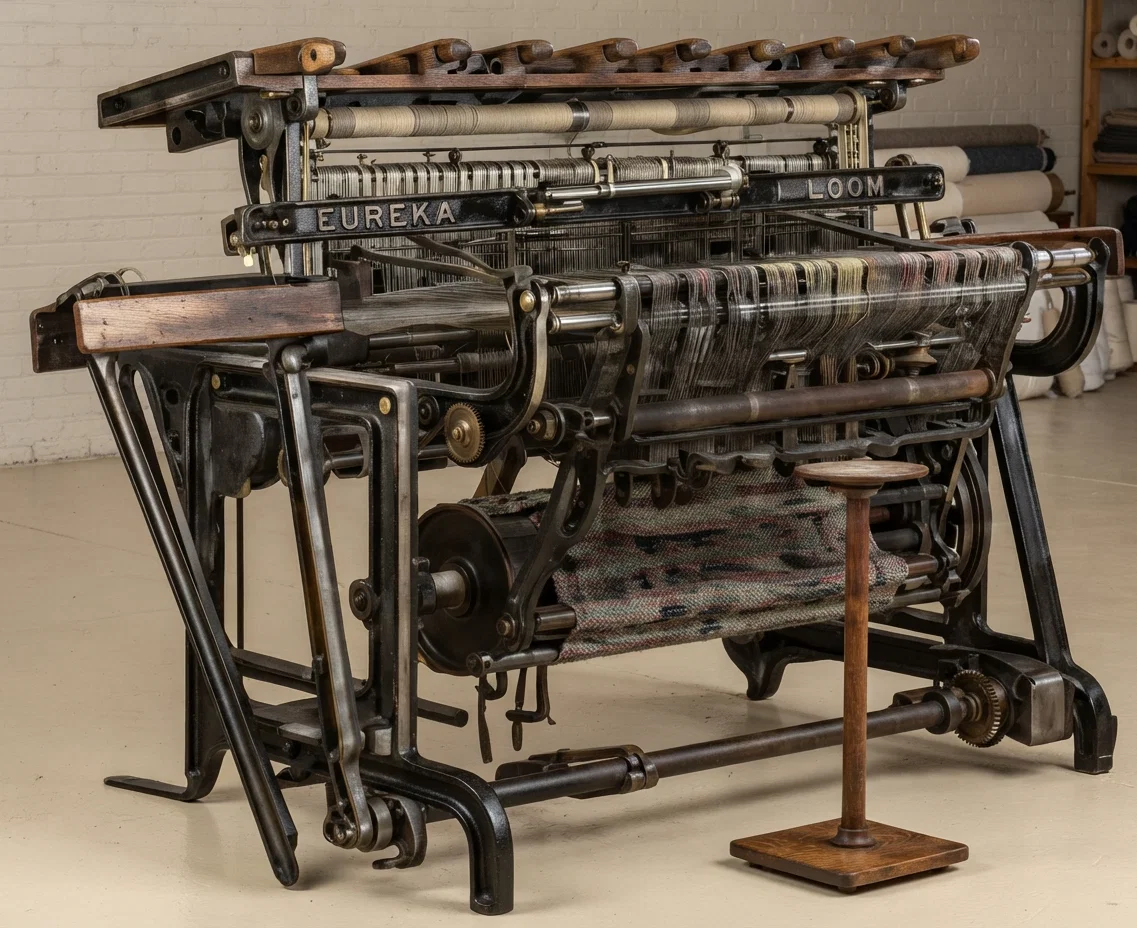
FLY SHUTTLE CARPET LOOM
The best, handiest, easiest running, cheapest, and most durable
FLY SHUTTLE CARPET LOOM
In the world,—100 yards a day. Catalogue free.
EUREKA LOOM CO.
5018 Main St., Battle Creek, Mich.
When you write, please mention the SIGNS OF THE TIMES.