“But God forbid that I should glory, save in the cross of our Lord Jesus Christ, by whom the world is crucified unto me, and I unto the world.” Gal. 6:14.
WHAT can I do for him who did so
much?
What can I give to him who gave me
all?
His was the kindly word, the healing
touch;
He died to save me from the tempter’s
thrall.
To save the lost he left his home on high,
Through devious ways he trod earth’s
thorns alone,
To share our lot he laid his glory by,
And then returned, to share his Fa-
ther’s throne.
No mists of doubt, between my Lord
and me,
Should hide the One whose wisdom
can not fail;
I am too blind unless my faith can see
Through all earth’s clouds to him,
“within the veil,”
His love I’ll cherish deep within my
heart,
And do his will through all the days
to come,
Till, like a dream, the woes of earth de-
part
And be forgotten in my heavenly
home.
Moline, Ill.
Debit and Credit
A LAD named Sydney, who had reached the age of ten, overheard a conversation about certain bills which had to be paid, and conceived the idea of making out a bill for what he himself had done. The next morning he quietly laid on his mother’s plate at breakfast the following statement: “Mother owes Sydney: For getting coals six times, 6d. For fetching logs lots of times, 6d. For going errands twice, 4d. For being a good boy, 2d. Total, 1s. 6d.”
His mother read the bill, but said nothing. That evening Sydney found it lying on his own plate, with the 1s. 6d. as payment; but accompanying it was another bill, which read as follows: “Sydney owes mother: For his happy home for ten years, nothing. For his food, nothing. For nursing him through illness, nothing. For being good to him, nothing. Total, nothing.” When the lad had looked at this, his eyes were dim, and his lips quivering.
Presently he took the 1s. 6d. out of his pocket, and rushing to his mother, flung his arms round her neck, and exclaimed: “Mother, dear! I was a mean wretch! Please forgive me, and let me do lots of things for you still!”
Jesus Christ has done everything for us; are we doing all we can for him? What he most wants us to do is to let others know that he died to save them.—Daily Bible.
The Sin of Envy
EVERY other sin hath some pleasure annexed to it, or will admit of some excuse; but envy wants both: we should strive against it, for if indulged in, it will be to us a foretaste of hell upon earth.—Burton.
The Day
When Mrs. King’s friends heard that she had had a stroke of paralysis, and, although she would probably partially recover, could never again be her old active self, they looked at each other in dismay. Rebecca King, who never had known sickness in her life, who had been for thirty years the most active worker in the church, the most hospitable and generous hostess in town! “How will she endure it?” they cried.
It was several weeks before she was allowed to see any one. When at last she had been promoted to an invalid’s chair, and the doctor said that her friends might go to her, they confessed to each other that they dreaded it greatly. “If it were any one but Rebecca King!” they said.
But they went at once. They returned, those first callers, with strange faces. When others asked how Rebecca “took it,” they only said, “Go and see her.” And the others, going in their turn, found exactly the same Rebecca King.
That was the marvel of it, that she should be just the same—just as full of good cheer and shrewd common sense, she whose very life had been, they supposed, bound up in her activities. Somebody asked her about it, finally. Rebecca King’s cheerful face became grave for a moment.
“O, I had my struggle,” she said. “I had all I wanted lying there those two months. But one day it came to me that I wasn’t fair. I had lived fifty-five years and scarcely known a day of sickness and only one great sorrow. Not many persons could say that. So now if God thought it was time to send me into battle, why should I complain?”
“Had I ever shown any particular gratitude for those years? Here was my chance now.
“Then, lying there, I thought of my grandmother who was blind for twenty years before her death, and when people asked her how she kept so bright and happy, she had but one answer: ‘I’ve made a real good friend of my memory.’”
“It came to me that I’d been too busy all my life to get much acquainted with my memory, but I had a chance now; and the more I think back, the more I realize how much I’ve had that I never took time to be grateful for before.”
She reached her good hand under her pillow and drew out a little book, from between the pages of which fell a newspaper clipping; she passed it over to her friend. “That tells it better than I can,” she said, “I believe I’m living that right along now.”
The friend read it; it was very brief—merely two short stanzas:—
“I know the night is near ’at hand,
The mists lie low on hill and bay.
The autumn sheaves are dewless, dry,
But I have had the day.
“Yes, I have had, dear Lord, the day.
When at thy call I have the night,
Brief be the twilight as I pass
From light to dark, from dark to
light.”
—Selected.
Visiting New Territory in Hunan, China
By P. J. Laird
P. J. LAIRD
December 17, a bitterly cold and windy day, Brother Chang, our colporteur, and I embarked on the small steam-launch for Hengchow. The passengers were packed in so closely that only our feet got chilled. However, we were glad to debark at Siangtan, and meet with the company of Sabbath-keepers there, with whom we stayed two days. Being providentially delayed, we met a Buddhist priest who had become somewhat interested in the gospel. He had recently abandoned opium smoking, but was still extremely weak from its pernicious effects. He readily consented to go down to Chang-sha for treatment, and while there he received a few weeks' instruction in righteousness. He has since left to arrange his affairs prior to leaving the priesthood.
Having secured passage on a small sailboat, Brethren Chang and Li and the writer embarked at Siangtan for Hengchow. At times it was so cold we were almost chilled to the bone. We could not stand up inside the boat, therefore I was very glad to wrap up in a fur coat, thick cotton quilt, and a heavy woolen blanket. Yet our hearts burned within us, and the brethren just reveled with delight, as we together studied the lines of prophecy pointing to our Lord's near return. Their prayers were as the voices of heavenly visitants as they cried to the Lord to make us all a blessing at Hengchow. Truly, “the work of righteousness shall be peace; and the effect of righteousness quietness and assurance.”
Long before we arrived at our destination, evidences were given of the Lord's presence and blessing with us. Boats ordinarily do not stop at Chuchow, but our boatmen became suddenly interested in a huge log of wood in the river bed, which they tried to secure. This enabled us to go ashore and meet two friends and encourage them to be faithful. Then the captain had business at Shihwan, giving us an opportunity to give a Bible reading to one who had previously been reading our literature.
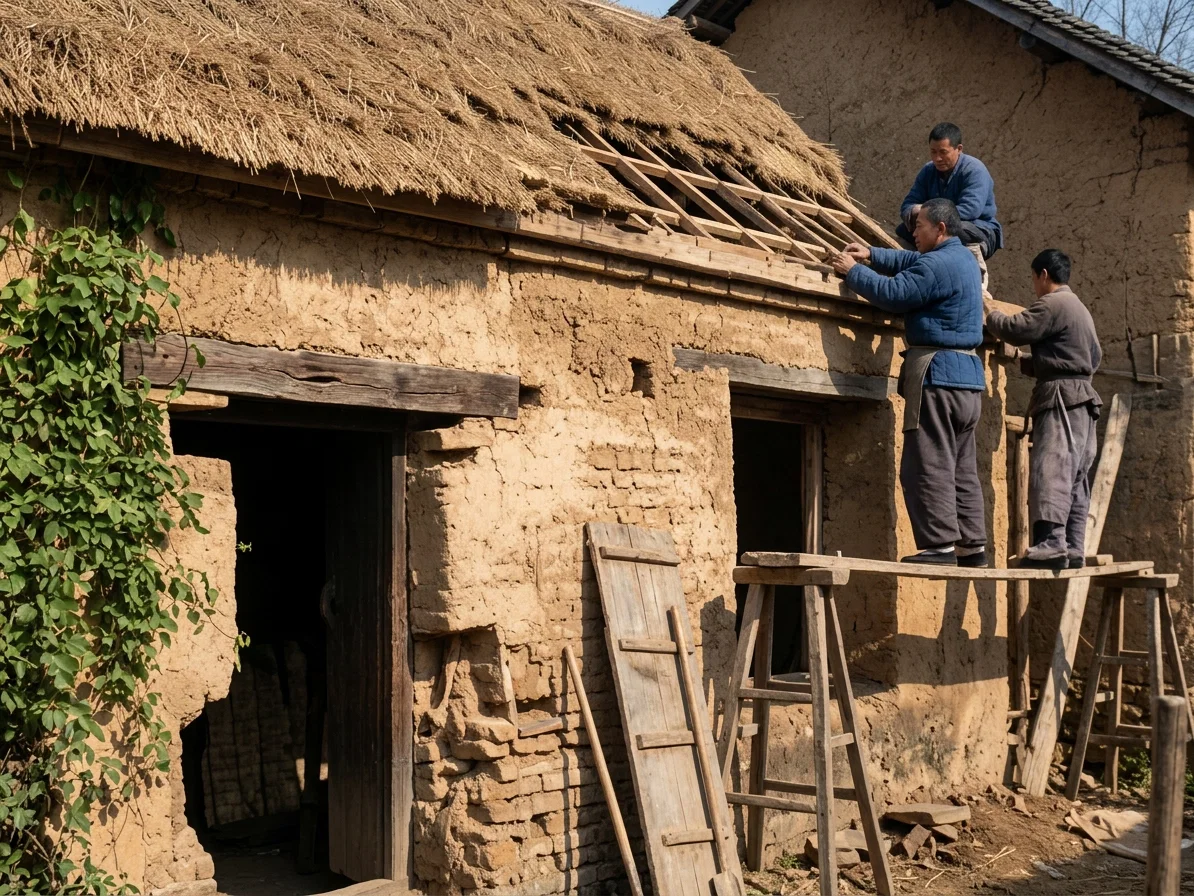
REPAIRING A CHINESE HOUSE
At Hengshan, our surly and swearing captain consented to our going ashore, where we gave another Bible reading on the faith once delivered to the saints. After prayer together, these people besought me to go over the Scriptures again as they jotted down the texts to study for themselves. They were loath to let us depart, but were cheered by the promise of a visit on our return journey. Thus meeting with so many interested hearers encouraged us greatly, and led us to expect great things from God at Hengchow.
The morning we arrived off Hengchow, the sun shone out warm and bright. We were fortunate in securing a fair-sized room containing three beds, consisting of planks on stools, in an old ancestral hall now used as an inn. We decided to bunk together. Shortly after, Brother Chang went out with his papers, and Brother Li and I called on his friends to acquaint them of our arrival.
Erelong they began coming in, until our little room was packed. Every available article, except the table, was needed for seats. That first meeting, which was typical of those that followed, lasted about four hours, and then they were quite ready to ply many questions. As these were special and not public meetings altogether, and owing to our limited space and inconvenient location, numbers were never very large, but they listened with unabated eagerness to the advent message.
Meetings were held twice daily, morning and evening. These were interspersed with gospel talks with visitors at the inn. The cold winds, sleet, rain, and the streets thick with mud, causing them to be splashed above their knees as they trudged along, seemed no deterrent to their keen desire to miss nothing of the truth for this time. The eldest attendant, a man of fifty winters, left his store and tramped about six miles daily. The youngest lad, about nineteen, went his rounds delivering milk, and then came to morning meeting. At night he would come, lantern in hand, to the Bible studies. Preachers, colporteurs, hospital assistants, teachers, and church-members from the three Protestant missions at Hengchow gathered with the heathen to hear the good news of the soon coming of our blessed Lord and Master.
One, a former preacher, had left his mission, and had become greatly discouraged, but Brother Li met him on his former visit to Hengchow, and bade him be of good courage until he heard these stirring truths of Christ's advent. Now, as he drank at the fountain of living waters, and saw how the great chain of prophecies pointed most unmistakably to the end of the world in this generation,9and the consequent need of preparation of heart and life to meet the judgment, his old-time energy revived within him. But as during the preaching of the advent truths in 1844, so now, “the presence of holy angels was felt in these assemblies, and many were added to the believers.” Men sought their homes with praises upon their lips, and grace renewed in their hearts. Mothers, wives, and daughters became greatly interested. When one brother told his aged mother, nearly seventy years old, concerning the things he had seen and heard at the meetings, she sent him to her foreign pastor, to tell him she could not now consent to be sprinkled. She must await the arrival of a Seventh-day Adventist minister so she could receive true baptism, like that of Jesus.
While we were visiting with the wife and the daughter of another man who had testified to his faith by closing his store the first Sabbath after our arrival, they said, with great emotion, that they would rather go out together and beg from door to door than that father should go back on God's commandments. The following Sabbath his store was crowded and the street blocked by the people who came to hear the preaching of the words of life in Christ only.
While Brother Li remained with me during the long morning Bible readings, Brother Chang was out selling his papers from door to door. The Lord so greatly blessed his labors that local church booksellers were surprised beyond measure when they were given infallible proofs of his sales.
Upon the receipt of important letters, I had to return to Chang-sha for a season, but we hope to follow up the advantage God has given the proclamation of present truth at Hengchow. Our greatest hope is that some of these men will see their way clear to take definite Bible studies with us, and become proficient workers in the regions beyond. At present we have but one Chinese evangelist, one Chinese colporteur, with a very scant supply of literature, and one foreign evangelist, for a population at least half that of the Japanese empire. Hence it is easy to see that God must work, and, praise his name! he is working. Sometimes we feel we are doing next to nothing, but let us encourage ourselves that God is preparing a world to receive the warning of the advent message. Friends, pray for needy China in general, and for Hunan in particular.
Chang-sha, Hunan.
Working Together for Good
By Worthie Harris Holden
WORTHIE HARRIS HOLDEN
If all the days were bright and clear,
If sorrow ne’er had caused a tear,
If life had not one shadow here,
Would we be glad?
The clouds reveal we miss the light,
The shadow bids us shun the night,
The tear befogs our earth-born sight
When we are sad.
While sin hath still his mighty sway,
So long will trials cloud our way,
Until we reach the realms of day,
For which we sigh.
God calls us through our blight and tear;
He knows our frame and calms our fear;
He solace gives, and hope, and cheer
When he is nigh.
And when earth’s sorrows all are o’er,
When day shall shine forevermore,
We shall rejoice on that glad shore
For trials past.
Portland, Ore.
Middle Russian Annual Meeting
By W. J. Fitzgerald
W. J. FITZGERALD
At noon, February 21, the writer had the interesting experience of entering Russia at Virballen. The railway station at that place is large and modern in appearance, and the Customs Inspection Hall is commodious and well arranged. The first act which occurred outside the station door impressed us with the austere character of the Russian passport system. The passengers were all required to surrender their passports to grim-looking police officers. The proper thing for all to do then was to pass into the Inspection Hall and await their respective turns. The inspection might be regarded as act number two. A fair degree of patience is required at that point in the proceedings, as the official actors move with remarkable deliberation. After considerable waiting, and more thinking in uncertain anticipation, it is exceedingly gratifying to see an inspector approaching with one's passport, and more than amusing to hear a Russian attempt to call out his name for the first time. Before five minutes had passed, in most cases, one's luggage was marked, and the way was clear for him freely to enter Russia. He then passed to a door opening into the booking-office and the main portion of the station, and there his passport was returned to him.
The writer, having about two hours to wait for the train to Vilna, leisurely enjoyed his first dinner in Russia. It seemed evident that German customs were somewhat commingled with the Russian at that gateway on the borderline between the two countries. Leaving Virballen, it was a real pleasure to be greeted at the station at Vilna by Brethren J. T. Boettcher, H. J. Loebsack, and P. Brandt. We at once drove in a characteristic Russian vehicle to our people's place of meeting, where, with Elder Boettcher as interpreter, I preached my first sermon in Russia, to a congregation composed of Seventh-day Adventists, Baptists, and Jews.
After hospitable entertainment at the home of Elder and Sister Loebsack, we proceeded by midnight train to Minsk, which is a large Jewish city, as is also Vilna. We spent about five hours in Minsk, being hospitably received into the home of the only Seventh-day Adventist family in that place of sixty thousand. Leaving Minsk just past noon, we continued our journey to Moscow, the former capital of the empire.
It was with keen interest that we passed through Smolensk, Borodino, and other places made familiar to readers of history because of Napoleon's disastrous march on Moscow. We remember that almost one hundred years ago, that great genius, impelled by a greater ambition, led one hundred thousand veteran soldiers into the heart of the great Russian nation. Then, by dint of arduous and painful toil, they marched toward Moscow. A great desire for shedding of blood, and conquest of territory and cities, burned terrible thoughts into their brains. Now, in a comfortable railway carriage, we moved rapidly along under the banner of the Prince of Peace. Then, Napoleon marched into the heart of Russia to find it frozen, and to meet with a humiliating disappointment. His tried and faithful legions marched into that frozen heart to be frozen, and starved themselves. Of the one hundred thousand men who entered Moscow, twenty-eight thousand perished before the retreat over the same road had begun.
As we approached the famous city, we inquired within ourselves what would be our reception in the city, and our experience there? Would we leave disappointed, or with our courage and hope increased? This report is being written while on the journey from Moscow to Kief, and we think of the meeting of the Middle Russian Mission which has just been held in Moscow with much pleasure and assurance.
Arriving in the city at 9:20 Wednesday morning, February 23, after thirty hours' travel in Russia by fast train, we drove at once to our meeting-hall. We rode in a sleigh, as there was abundance of snow and frost there. It was most interesting to see numerous sleighs in any direction one might look. Over twenty-five thousand licences are held by the owners of conveyances drawn by horses, and used in the public service. More than twenty thousand sleighs were in constant service during the time we were in Moscow.
We were somewhat surprised to find a special officer from the department of religion at St. Petersburg awaiting us at the hall. He had traveled from the capital (over four hundred miles) to observe our services from beginning to end. A few minutes after our arrival a head ward policeman entered the hall, and was quickly followed by a special police officer from the Moscow government. The trio questioned us very carefully as to our plans for the meetings, and assured us that two of them would be in regular attendance. The St. Petersburg officer and the special officer from the Moscow government attended every service from first to last. They were most alert, and observed everything with eagle eyes. One incident will serve to illustrate their vigilance: In the first business meeting the chairman outlined what items of business the session would take under consideration. As the meetings proceeded, just one item was omitted. At the close of the final business meeting, the St. Petersburg officer came forward, and inquired concerning that one item which had been mentioned in the first meeting, but had not been referred to subsequently.
The evening services for the public were well attended. On nearly every occasion it was necessary to close the doors, and hang out a sign, “No More Admitted,” about the time for the sermon to begin. This is as it generally is in Russia where public meetings can be held, and it seems remarkable when we consider that no printed announcements of services can be circulated.
Following the six o'clock Sunday evening service, at which the writer spoke, an ardent member of the established church shouted to the people in the hall that the church would conduct a service in the school building opposite (the Greek Catholics conduct opposition services there every Sunday night), and all of the true faith were invited to the opposition meeting, but it seemed that no one left our service, for notwithstanding this invitation, our hall was packed to its utmost to hear Elder Boettcher speak at eight o'clock.
There is a new law in Russia, which forbids the taking of collections in such meetings as the Socialists and other political societies hold. At the close of the first evening service, some persons placed coins in a plate on a table near the door. The police officer objected to this the second night, and absolutely forbade it on the third. We were forbidden to take an offering even in the Sabbath-school.
It is necessary to exercise the utmost care in all meetings lest anything should be said or done which could be construed as being opposed to the established religion or the government. One unfortunate or ill-advised statement might serve as ground, not only for stopping the one meeting, but also for involving our entire work in the empire in embarrassment. Many things which we esteem it important to say and do in meetings held in free countries, must be entirely omitted from our services in Russia. In general meetings in other countries, we consider it not only desirable, but also important, to tell of the progress of the work. This information is used as a means to encourage our people, but such references must not be made in our general meetings in Russia. They would be10interpreted as an evidence that we are carrying forward an active propaganda, and working in opposition to the established church.
The Middle Russian Mission has an enormous territory in that portion of European Russia which its name indicates. It has a population now of about sixty million. Not long ago the Little Russian Mission field was cut off from it, leaving only one church, with a present membership of less than forty for the sixty million inhabitants. It was reported at the meeting that over fifty are awaiting baptism. The membership, though small, is loyal, and supports the work liberally.
Moscow, with its one million two hundred thousand inhabitants, its famous Kremlin, its more than five hundred Greek Catholic churches, its many monasteries, and other things of striking interest to the traveler, is located near the center of the field. Among the many other cities of note may be mentioned Smolensk, Kursk, and Vishni Novgorod. The work has been recently opened in the last-named city, which is situated on the River Volga, and is famous for its great summer markets. It serves as the meeting-place of European (Western) and Asiatic (Eastern) Russian merchants and producers, with their enormous wealth of merchandise. Persian and Chinese merchants, as well as those of other nations, mingle with the thousands of Russians of all divisions of the vast empire in the midsummer markets in Vishni Novgorod. It is expected that before the present year ends, some companies will be organized near this very important center.
Elder O. Wildgrube, and the few workers associated with him in the great Middle Russian Mission, seemed encouraged by the general meeting in Moscow to press forward in the work in their vast territory, with an equally vast population. Will not all who read this report pray devoutly that many may be won to the truth, and that soon more workers may join the small force already in the Middle Russian Mission?
The Winter Conferences in Germany
By Ludwig Richard Conradi
L. R. CONRADI
From January 25 until February 6 there were four conferences in different parts of Germany, two being held simultaneously. The writer attended the East German Conference, from January 25 to 28. This conference was held in Frankfort-on-the-Oder, the chief city of the eastern part of the province of Brandenburg. There was a fair representation of the 42 churches, by 89 delegates. During the last year 323 members were received, while the net gain was 178 members. Seven new churches, with 172 members, were received, two of these being churches in the city of Berlin. There were, altogether, 24 workers in the field. Elder G. W. Schubert was elected president of the East German Conference. The tithe showed an increase of $2,000, amounting to $15,000 for 1909; $1,000 was subscribed for the Friedensau school, $240 was given for the mission fields, and $125 for the educational fund. One minister was ordained.
Sabbath and Sunday I spent in the Rhenish conference, at Elberfeld. There were 103 delegates present. Last year 261 members were received, and three new churches. This was the largest of all our conferences. There were about 500 present on the Sabbath; and as this is the cradle of our work in Germany, it was inspiring to some of the aged pioneers to see such a large congregation. About $800 was given for the school at Friedensau; $350 for mission fields, and $120 for the educational fund. One minister was ordained. Elder J. G. Oblander was chosen president of this conference.
February 2-4 I attended the North German conference, in Bremen. A large hall in the central part of the city had been secured, and it was well filled. From the 28 churches, 53 delegates were present. During the past year the membership has been increased by 103, bringing it up to 621 members. Two new churches were added, one of these in Mecklenburg. It was interesting to hear the report of our worker in that field.
Although the whole of Mecklenburg is entirely Lutheran, yet there reigns such intolerance that a minister of any other denomination is not allowed to preach or to perform any church functions. He can not give out a text or read Scripture, but only give a lecture. Yet in spite of all this difficulty, two good churches, with about fifty members, have been raised up in that field, and we were happy to ordain the good brother who had done the work. The tithe in this field last year was especially good, and the brethren were glad that they could give a part of it, some five hundred dollars in all, to needy mission fields. They also gave another five hundred dollars for Friedensau. Elder C. Sinz was unanimously chosen president for the coming year.
Sabbath and Sunday I spent with the Middle German conference, in Halle. Sixty-seven delegates were present, and six new churches were received. The present membership is 574. Elder L. Mathe was chosen conference president. The tithe last year was $8,000, and they gave about $750 to needy mission fields, besides paying the two tithes to the union conference. About $500 was given to Friedensau. There was a good outside attendance in the evening services.
From here all our German union committees, both eastern and western, hastened to Friedensau, where from March 8 to 10, we finished our auditing for the old German Union Conference, and fully brought about the separation between the East and West German unions.
Though our brethren dealt liberally with their workers in the different mission fields, yet when their audit was finished, they were ready to give $2,400 to the General Conference, to help in the expenses for 1910, and they voted another $3,500 to the educational fund. As these two unions each have a population of about 70,000,000 people, and large provinces are just about to be entered, every one present felt that special attention must be given to developing all the promising young people who could be secured as workers for the great, needy field. While Germany proper, with its 64,000,000 people, has now 8,000 members, and the work is fairly established and well organized, if one considers the population of these fields, the present membership is really only but a handful.
Hitherto, Hungary, with 613 members, had been a conference, but it was rather weak financially. Its tithe last year was not quite $3,000. But the main financial strength, and the strength of membership, lie in the eastern portion of that field, so it was decided at this meeting to have two general meetings in Hungary this year, and have an East Hungarian Conference, which will be in itself self-supporting, and a West Hungarian Mission field. Austria, on the other hand, is now divided into three separate mission fields—the Austrian proper, with 148 members; the Galician, or Polish portion, with 46 members; and the Adriatic, or Slovenian portion, with 25. While we are thankful that in Austria-Hungary we have now over 800 members, yet when we remember that it has a population of over 50,000,000, we realize that the work has only been begun. There are many indications of God's providence in preparing the way for us in that large field. Openings present themselves now for the canvassing work, and also to hold meetings, while a few years ago it seemed almost impossible to do either.
As we reviewed the report of the German union conferences during 1909, and found that 2,014 members had been received, also that the tithe had been increased by nearly $23,000, and the offerings by over $4,000, we felt truly thankful. Yet, on the other hand, we were by no means satisfied. Not less than 869 members had to be dropped, by death, apostasy, or removal; and a resolution was passed to consider carefully the bearings of this. The membership of the old German Union Conference at the time of the division at the beginning of 1910 was 9,774, and its tithe $115,000. This will give each new union conference nearly 5,000 members. The two unions will even then be the two strongest unions, both in tithe and in membership, in Europe. Henceforth, these unions will have their gatherings every two years; the West German will begin in July this year. The East German meeting will be held next year. The closing meetings were held separately by each union committee. Thus the two unions are now fully launched. Each has a good, solid membership and financial backing, and is well manned; and we have every reason to believe that the year 1910 will witness a still greater growth in both these fields.
We were glad that there were also such good reports from our union institutions. The school has about 200 students11and serves as an educational center for three union conferences (the East and West German and the Russian), with a population of 300,000,000 people. It closed its annual record with a small gain. The new building came none too soon. For the farm, which has been added to Friedensau at the very favorable price of $8,000, we were able to pay cash from the donations which have come in during the summer and winter meetings. Our sanitarium has a fair patronage, and there are about 50 nurses now in training. The Old People's Home has 26 inmates. Not only is the building paid for,—amounting to about $22,000,—but we have in legacies $75,000. There was about $2,000 help needed for the inmates, besides the interest of the legacies, and this was fully met by donations and the interest from our union and conference funds.
Hamburg.
Remarkable Mission Deliverances
By W. C. Walston
W. C. WALSTON
IN THE REVIEW AND HERALD of Dec. 23, 1909, I noticed, under the heading “Daily Providences in Mission Wilds,” some extracts taken from the book, “The Cobra’s Den,” written by the missionary, Dr. Jacob Chamberlain.
It may be interesting to the readers of the REVIEW to read of some of the experiences of the workers here at the Somabula Mission, in Africa.
One day when Elder F. B. Armitage was out in the forest with some of the native boys, he was making his way through a thick underbrush. His foot struck something which caused him to look down suddenly. What was his astonishment to see a large snake, about twelve feet long, and as thick as his arm. The monster sprang at his leg, and caught in its mouth the loose part of his trousers below the knee. A wild struggle ensued for a short time, but he succeeded in pulling away. Then, as the reptile endeavored to crawl away, he recovered sufficiently from his sudden fright to raise his gun and shoot it. The native boys came running up, and saw what had taken place, and said, “Teacher, if the snake had bitten you, you would never have lived to get home.”
At another time later, one night, there was a disturbance among some of the fowls roosting in a tree near the mission home, and Brother Armitage went out to investigate. He found there was something in the tree besides the fowls. He called for his gun and a light, and then discovered a large snake, about fourteen feet long, and nearly as thick as his leg, with its head up among the branches, while a part of its body rested on the ground. He raised his gun, fired at its head, and brought the robber down. Its skin was kept as a trophy for a long time.
Last year Brother C. L. Butterfield went to the shed where our fowls roost, to gather the eggs, and on reaching his hand into a box over his head, put it on something that did not feel like eggs. He stepped onto a box and looked into the nest, and there lay, all coiled up, a snake about nine feet in length, and quite large in size. Brother Butterfield took a long pole and a shotgun, and tipped the box onto the ground. When it struck the ground, the viper raised its head, and opened its mouth, nearly as large as my two hands. It then darted out at the back of the shed, and ran into the cattle kraal. The boys drove it out, and as it came out on my side, where I was waiting for it, I shot its head nearly off. We found it had swallowed raw eggs for breakfast, without breaking the shells.
A few months ago one of our boys was going into Gweelo with the mail. After crossing a small river about four miles from the mission, right in the path before him sat a lion. He stopped and looked at the lion, and it looked at him, neither knowing what was best to do. The lion concluded he had better give the right of way, and backed into the tall grass, and fled.
Only two weeks ago, while Mrs. Walston and I were sitting at our table, just before retiring, we looked up, and above our heads, on the window casing, we saw a snake gliding slowly down from between the cloth ceiling and the partition, only four feet from us. We sprang up, and it drew up out of sight. A few days afterward we discovered a venomous serpent about five feet long, just outside our door, in the passage, and I shot it. We think it was the same which had had quarters, a few days before, among the rafters, over our sleeping-room.
As I read of Dr. Chamberlain’s experiences, I could not help but think of some of the escapes which the workers here have had, and of the words of the Scripture, “He shall give his angels charge over thee, to keep thee in all thy ways.”
Gweelo, Rhodesia.
Kim’s Conversion
DURING one of our classes I asked each member to tell how he found Christ. Kim stood up and said: “My story is a common one, but I’ll tell it. My wife and I made it a rule to worship every spirit we knew. So we had our home and yard full of shrines to the Spirit of the Mountain, the Spirit of the Back-yard, the Spirit of the Kitchen, the Spirit of the House-site, and all the others. Our rooms were so full of shrines that I feared to enter at night to sleep lest I should bump my head against a shrine, offend the spirit, and bring catastrophe on our family.
“Then I noticed that the Christians had no such fear of the spirits and paid them no such attention, and still prospered, and I wished that some one would give me the secret of this liberty. Some of the Yon Mot Kol men invited me to the church. I attended for several weeks. Finally I said to one of the deacons: ‘My wife and I are afraid to touch the spirit shrines in our house, but you have no fear of them, and we have concluded that if you will come and clear them all out, we will let you do it, for we want to trust and serve Christ now.’ They came and gathered all the shrines together, put them in the fireplace and burned them up. That night I dreamed that I saw Satan go over the back wall of our yard, and since then we have had no more fear. When we had sickness and our mother wanted to call in the sorcerers, we said: ‘No, Christ has more power than the demons; we shall trust him. Whatever he gives is good.’”
As I sat in Kim’s clean house in a heathen village, and saw how carefully his children are being brought up, how pure his home life is, I wondered at the power that could plant such a lighthouse in that sea of dense darkness.—The Korean Mission Field.
The Dancing Girls of India
By Rev. J. P. Jones
ONE of the most significant and dramatic acts of legislation enacted in India for many a year is that of the native state of Mysore in abolishing the dancing-girl curse from the Hindu temples of its territory. The dancing girl is a product of the grossest and the most debasing custom of Hinduism. It may have originated, like the old Roman vestal-virgin system, from noble religious ideas, but it has become one of the most hideous blemishes upon that faith of many evils. It is a dedication by mothers of their infant daughters to “temple service.” They are “married to the gods.” The mother and temple authorities know that the child, thus dedicated, is forever and inevitably doomed to a life of shame. Many thousands of girls now living have thus been dedicated, in the name of that religion to this life of infamy and degradation.
The best men of India have, during recent times, been vainly struggling against this system, and trying to overthrow it. It was too deeply entrenched for their efforts to be of any practical utility.
But now, with one stroke of the pen, that most progressive native state in India, Mysore, has prohibited this whole custom within its own territory. It has made illegal and criminal the whole dancing-girl system. Hereafter, within the Hindu temples of that state, no mother shall be permitted thus to dedicate her daughter; nor shall a temple recognize such an offering. Doubtless the Indian government, which has thus far feared to interfere with this religious custom, because of its pledge to religious neutrality, will note this action of a Hindu state, take courage, and abolish this accursed evil within all its territory. It is an encouraging fact that some of the most advanced native states of India are moving on lines of progress with more fearlessness and determination than the British government itself.—Rev. J. P. Jones, D. D., in The Congregationalist.