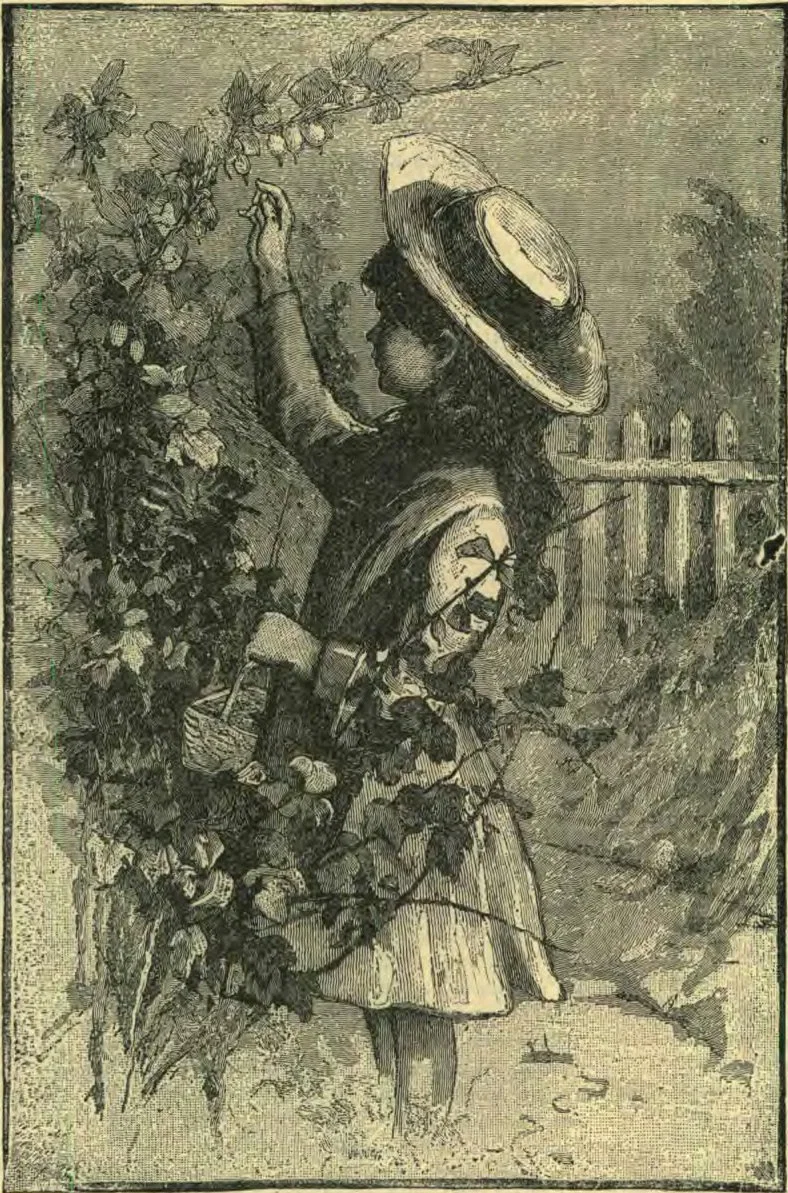
“Pshaw! you are always tired nowadays,” said Harry Long, impatiently; “I wish you were like Jenny Dent; she’s the kind of a girl I like—no whining or fretting about her.”
Edith’s pale face flushed, and picking up her bag of books, she started again, saying wistfully, “I suppose I am a trouble to such a bright, healthy fellow as you, Harry. How I wish we had a little pony-wagon, so you could drive me to school!”
Her gentle answer made her brother ashamed of his words.
“Here, give me your bag, Edie,” he said more kindly. “If you’re not so strong as Jenny, you’re a deal better natured; I heard her scold Tom and Bob awfully yesterday.”
But though Edith bore the unkind words so sweetly, they made a deep impression upon her. “I mustn’t complain,” she said to herself, “no matter if I do get tired, or Harry will grow weary of me, and I want him to love me dearly.” So, day after day she walked the mile to school and back, never asking to rest, or in any way complaining. Harry, never thinking she was tired, would walk fast, run races, or go home by a roundabout way. One morning Edith had started on before her brother, that she might walk more slowly, and Harry, as he ran down the lane, heard the servant calling,—
“Come back and get Edith’s rubbers and umbrella; it’s going to rain.”
“Nonsense! It won’t rain. Besides she’s not made of salt,” said Harry to himself, as he ran on. He caught up to Edith, and the two heard each other’s lessons as they walked on, Harry never once thinking of the rain. But they had hardly started for home when a storm came on, and the two were both thoroughly wet before they reached the house.
“I say, Edie, get in the back way if you can; for mother sent Bridget after me with your rubbers and umbrella, and I didn’t go back for them. If she sees you so wet, I’ll be punished.”
Edith, always ready to shield her brother, went quickly up to her room, changed her clothing hurriedly, not taking the care to rub herself, off and went down stairs chilled and tired. Harry was a little anxious, but never had Edith’s cheeks been so red or her eyes so bright.
“I am so glad you didn’t take cold!” he whispered; but Edith did not tell him her throat was sore and her head aching. By midnight the poor girl was so ill that her father went in haste for the doctor, and for days she lay almost unconscious.
“The wetting finished the business,” said the doctor, “but the girl has been going beyond her strength for some time.” Harry heard his words, and thought with shame and dismay of his carelessness.
“I teased her again and again about her tired ways, and she has kept up; and maybe she’ll die.”
But Edith grew slowly better, and after she was out of danger, Harry had to go back to school. Jenny Dent was very willing to run races and “carry on” with him, but he longed for Edith’s gentle sympathy and forgiveness. Now, without her, he felt how much better she was than many stronger girls. “Dear Sister Edie!” he thought, “I ought to take care of her, and save her from fatigue. Oh, if she only gets well, I’ll show her what a good brother is!”
But Harry was not easy until he told his father of his impatient ways, and asked him if he could think of anything he could do to make it easier for Edith to get to school.
“Could you not pull her in a little wagon?”
“Yes, indeed; part way, anyhow.”
“Well, I’ll buy you four strong wheels, and you can make a box for the wagon.”
So, for several afternoons, Harry worked hard in the barn, and when Edith was strong enough to go to school, she was invited to get into her own carriage, which was painted dark blue, with “Sister” in white letters in front.
“There, Edie, I’ll never tease you about getting tired any more, but draw you more than half way to school, at least. I’d rather have you than any sister in the world.”
Years after, people used to say, “What a true gentleman Harry Long is! He is so careful of any one who is weak or ailing. What makes him so different from most men?” And Edith grown into a strong and beautiful woman—thanks to her brother’s loving care—would say to herself: “I know.”—Selected.
BERRY TIME.
By S. Isadore Miner
Berry time,
Merry time,
For all the birds the very time;
No more hunting bugs and flies,
Nature now their wants supplies;
Banquets fit for kings are spread
In the luscious pendants red,
Ripening in the glowing sun.
Hark the songster's happy trill
Ere the day has scarce begun.
As they swing and eat their fill
Till the day is fairly done,
Swing and eat,
Sing, "Sweet, sweet,
Merry time,
Berry time."
Berry time,
Merry time,
For boys and girls the very time;
Now from books and tasks set free,
Forth they troop in childish glee,
Till they reach the friendly shadow
Of the oaks that skirt the meadow:
Here the bushes, thick and tall
As those against the garden wall,
With the largest fruit are laden;
And each busy lad and maiden,
Vying with the greedy thrushes,
Soon have stripped the bending bushes,
Filled themselves and dinner-pails
And their baskets woven of rushes;
They heed not the brush and brier,
Of this sport they never tire,
And its pleasure never fails,
Till summer past
Ends, at last,
Merry time,
Berry time.
S. ISADORE MINER.
Letter Budget.
THERE are many letters and but little space, but we will crowd in as many as possible, for we know how anxiously some are waiting to see theirs in print. First are four letters from the “Sunny South.”
Here we have three letters in one from Orange Co., Florida. They are from EMMA, LOULIE, and PAUL HORN. Emma, whose age is twelve years, says: “I’ve never seen but one letter from Florida, so I thought I would write one. Mamma and us children have kept the Sabbath about a year. Papa knows it is the right day, but does not keep it yet. My sister and I like to read the INSTRUCTOR so well that we are always glad to see it come. We study Book No. 1.”
Loulie, whose age is nine years, says: “We live twelve miles from Sabbath-school, so we cannot attend very often, but we have school every Sabbath at home. We attend day school, and love our teacher very much. We have two cows and calves, a horse and colt, some chickens, and a dog named Joe.”
Paul, who is seven years old, says: “Mamma has a missionary strawberry bed, but it is not bearing yet. We think we will have a railroad through here this year, then we want to go to the coast, to see the ocean. Our little dog is very useful in driving the pigs and chickens out of the door-yard. We walk two miles and a half to school, and like to go very much. Nobody else in the neighborhood keeps the Sabbath except my mamma, two sisters, and myself. Mamma gave all the Christmas money to the cause, but that is all right.”
MARK BICKFORD writes a letter from Manatee Co., Fla. He says: “I get the INSTRUCTOR every week and like to read it. I go to Sabbath-school every Sabbath. All of our family, which is father, three sisters, one brother, and myself, keep the Sabbath. I study in Book No. 2, and have good lessons. Our Sabbath-school numbers sixteen. Our school of three months closed last Tuesday. I went every day, and improved a great deal in reading, writing, and arithmetic. I like to go to school. I like to read the letters of the boys and girls who keep the Sabbath. We live on the south shore of Tampa Bay, and have a very pretty place for sailing and fishing. All the boys and girls here are fond of sailing. I have a hen and a garden of my own. I am nine years old.”
Two letters came in one envelope from Peoria Co., Ill., written by JOHNNIE BLISS and BERTIE SANTEE. Johnnie writes: “I am a little boy twelve years old. I keep the Sabbath with my parents. My papa is superintendent of our Sabbath-school, and I study in Book No. 6. We live on a farm about half a mile from town. My uncle gave me a little sheep, and when it grew big, I traded it for a calf, which is now a nice cow. I have a big pig, which is very cross, and sometimes eats chickens, so I don’t like it. I am going to sell it. I have kind parents, two brothers, and two sisters, all living. I am thankful for the many blessings God has given me, and I want to please him, and so be able to meet the INSTRUCTOR family in the new earth.”
Bertie writes: “My Cousin Johnnie has written a letter to the Budget, so I will write one and send with his. I am a little boy ten years old. I keep the Sabbath with my parents and sisters. I was born in Labette Co., Kan. We came from there a month ago. On our way here, when we crossed the Mississippi, I sat where I could look down the river, and I could see the steam-boats sailing up and down the stream. My papa did not come back with us. He is preaching in Kansas. He will come soon after the Kansas spring camp-meeting. We are living on the place where my grandfather used to live, and where he died. I think it is a real nice place. My grandma is living with us. I am trying to be a good boy, that I may be saved when Jesus comes to reward the faithful.”
Love Makes the Home
Love makes the home, and makes the spot
It stands on warm and fair;
The bleakest hut or lowliest cot
Is glorified if love be there.
He misses not earth's grandest art
Who carries Eden in his heart.