THE drug stores have numerous remedies for nervousness, both in the way of patent mixtures and medicines that are to be mixed according to the prescription of the practising physician. Among doctors there are specialists who devote their whole time to the study of nervous diseases. The papers are full of advertisements that recommend this and that medicine as a sure cure for the various nervous ailments, and it is very common to hear of persons who have been stricken down with nervous prostration. All of which serves to show that this generation is very rapidly breaking down its nerve force. And when the nerves are broken down, a person is a general wreck. He is totally unfit for any of the practical and necessary duties of life.
If one asks for the causes of all this nervousness, they are not hard to find. Drunkenness is increasing every succeeding year. The city of Chicago alone during 1897 drank $80,000,000 worth of beer. It is estimated that the same city drank $20,000,000 worth of other kinds of alcoholic drinks in the same year. And there is no evidence that Chicago is materially worse than any other large city. The wine, beer, and spirits consumed in the United States have more than doubled in the last twenty years. The amount of strong drink used in this country averages about thirteen and one-half gallons for each person. Any honest physician will affirm that strong drink is a great destroyer of the nerves. Any one who habitually uses it must of necessity become nervous, and therefore irritable.
Nearly every man or boy that you meet uses tobacco, and in many localities it has become very popular for the women to use the "filthy weed" also. The physicians tell us that tobacco is as bad if not worse than strong drink in destroying the nerves.
Tea and coffee are almost universally used. And the facts as presented by physiologists show that the poisons in these beverages are also nerve irritants. For, altho they seem to soothe the nerves, in reality they simply stimulate the nervous system, while they are actively at work breaking it down.
The foods that the majority eat are highly seasoned and stimulating rather than strength giving. Pickles, mustard, pepper, ginger, horseradish, and all kinds of hot stuffs that irritate, and abnormally and unnaturally stimulate, the delicate tissues of the stomach are freely mixed with the foods.
The excitement that prevails in the world in driving business and running after pleasures and follies has the tendency in itself to break down and wear out the nervous energies most rapidly. But the use of liquors, tobacco, tea, coffee, and the like, precipitate the ruin. And with all these agencies working so intensely it is a necessary result that men are becoming more and more irritable, excitable, and impatient. It could not be otherwise. If the hand is placed in the fire it is bound to be burned. There is no possible escape from this result. It is true that some remedial agents may be employed and the burn healed, but burning must surely follow contact with the fire. And even if the burn is healed, there usually remains a scar.
If you have any doubts as to the impatience and irritableness of the people of this generation, just watch them as they are jostled in a crowd, accidentally brushed against in the street, or unexpectedly required to wait a few moments for the car, and see how they will act. Notice them as their path is crossed in any way and see how instantly they manifest their impatient, irritable, and ugly dispositions. And by the sure and unmistakable workings of physiological law we know that this condition of things must keep getting worse and worse. For the habits and manner of life of the people of this age can not produce anything else but greater and ever still greater havoc in the nervous system. And with the nerves all broken and unstrung any one knows the results that invariably follow. The Lord can and will deliver every one who will let Him. But there are so few comparatively who yield themselves to God except as a matter of form, that the prospect at best is not the brightest.
Now did you ever think that it is just such inflammable material as comprises the people of this generation that men would try to have us believe are getting better and better, and that this excitable and impatient age is to bring about a universal peace? You might as well talk of peace and calm in a nursery, where nothing but fretful and irritable children were caged, as to talk of a reign of peace among a people so devoid of the elements that combine to make peace.
The outlook from every standpoint is war and not peace. Not only do the gigantic preparations for war among all the nations show this, but the very condition of the people shows that it could not be otherwise. The only way of escape is for the people to be changed. But there is no prospect on which to base such a hope. The elements that combine to make things worse are strengthening their hold upon men day by day. And all of this is in harmony with the Bible prediction that "evil men and seducers shall wax worse and worse, deceiving, and being deceived." 2 Tim. 3:13.
THE OUTLOOK
THE WHITE MAN'S WAR.
By C. M. Snow
HARK to the clank of the saber and lance,
And list to the thunderous tread
Of the hurrying hoofs where the chargers prance
Over the dusky dead,
Down in the desert's darksome lands,
Or down where the sea-winds blow,
The white man stands with crimson hands
Over his fallen foe.
List to the scream of the shrapnel shell,
And the song of the Maxim gun,
As rank on rank the dark men fell,
The white man one by one.
Look on the scene as the sun goes down,
And count them, ye who can—
The ones who scoffed at the white man's frown
And fell in the battle's van.
Sullen and silent and low they lie,
And pierced and shattered and bare;
But the breath of the hurt one's moaning cry
Is rising everywhere.
Stern is the face of the detailed squad,
Lantern and spade in hand,
As they hurry to hide from the world and God
Their work in the dark man's land.
Dig for them deeply, tumble them in,
Bruised and bloody and bare;
For this is the burden of those who win
As you are winning there.
Then Mother Earth will bathe the wound
Your surgeons can not reach,
And gather to her sodden ground
The sorrowing hearts of each.
Such is their fate, and such of yore
The folly of their stand,
When white men try the white man's war
Down in the dark man's land.
But judge ye not, O men who seek
The cannon-studded field;
That earth holds only foes so weak
As those ye've taught to yield!
Over the nations and to and fro
There spread the clouds of hate,
And their armies grow with the hate they show,
And the hour of the strife is late.
Their forts are stored with shot and shell,
Their ships are riding low
With their weight of mail, and loaded well
To meet an equal foe.
Earth is agroan with burdens now
To fill the tented field
With men of war and teach them how
Her deadliest arms to wield;
And what the white man there has done
The white man yet will do
When earth's great battle is begun
And whites are facing you.
Sound if ye will, but must you know
That when the blast is blown,
'Tis not the arm that bends a bow
That's matched against your own.
The serried ranks of other lands
Will hasten to the fray;
And, win or lose, more skilful hands
Will battle in that day.
Think of it not as vacant dream,
This conflict yet to be,
When Armageddon is agleam
With tramping soldiery.
No holy form will go before
To stay the slaughtering hand
When white men try the white man's war
Up in the white man's land.
C. M. SNOW.
SOME SEE IT.
By T. E. Bowen
It is refreshing to note that some influential men in our nation see the evils of drifting away from the sure principles of the Constitution, and have the courage to present powerful arguments against the widespread ideas of expansion and imperialism. Ex-senator George F. Edmunds, Senator Geo. F. Hoar, and others have spoken out in clear, ringing arguments against this evil tendency of our nation.
In concluding a speech of two and one half hours' length before the Senate, January 9, Senator Hoar, of Massachusetts, a staunch Republican, said:—
“Shall America begin the twentieth century where Spain began the sixteenth?
“The Monroe doctrine is gone. Every European nation, every European alliance, has the right to acquire dominion in this hemisphere when we acquire it in the other. The senator's [Platt] doctrine put anywhere in practise will make of our beloved country a cheap-jack country, raking after the cart for the leavings of European tyranny.
“Our fathers respected above all the dignity of labor and rights of human nature. The one thing created by God a little lower than the angels was a man. And they meant to send abroad the American flag, bearing upon its folds, invisible perhaps to the bodily eye, but visible to the spiritual discernment, the legend of the dignity of pure manhood.
“That legend, that charter, that fundamental truth, is written in the opening sentences of the great Declaration, and now the senator from Connecticut would repeal them. He would repeal the great character of our covenant. No longer, as the flag floats over distant seas, shall it bear on its folds to the downtrodden and oppressed among men the glad tidings that there is at least one spot where that beautiful dream is a living reality.
“The poor Malay, the poor African, the downtrodden workman of Europe, will exclaim as he reads this new doctrine: ‘Good God! Is there not one place left on earth where in right of my manhood I can stand up and be a man?’ Will you disregard every lesson of experience? No tropical colony was ever yet successfully administered without a system of contract labor strictly administered and enforced by the government.
“Beneath the great dome to which the pilgrim from afar first repairs when he visits the capital of this country hangs the great picture which delineates the scene when the nation was first baptized into immortal life. Shall the scroll first be stricken from the hand of Jefferson and another put there which shall read: ‘Governments derive their just powers from the consent of the governed—some of them. Men are created equal—some of them. Taxation and representation go together—for us, not for other men. Life, liberty and the pursuit of happiness are held in the Philippine Islands at our will, and not at the will of the people?’
“And then shall we turn the picture with its face to the wall and put instead of it a representation of some great battle where the guns of our navy and our army are turned on the men struggling for their liberty at Iloilo?”
Mr. Hoar quoted Abraham Lincoln's declaration, “No man was ever created good enough to own another,” and added:—
“No nation was ever created good enough to own another.”
Surely such sterling truths as these are worthy of earnest study and careful consideration. If the United States has the right to “benevolently assimilate” one group of islands on the other hemisphere, what will restrain it from entering any other port, and subjugating by force of arms any other tribe or nation? If it can enter the Philippine Islands as a “friend to protect the natives,” what shall restrain it from entering any other foreign land where natives may need a friendly power to protect them from the aggression of France, England, or Russia? If its profession of “friendship” to Filipinos is sincere, then, as a friend should, why shall she not leave their dominion when her presence is not wanted? It is not friendly to enter another's possession, ransack about, and force one's presence where it is not wanted.
T. E. BOWEN.
THE CHINESE.
By Mrs. Susan Birdsall Roberts
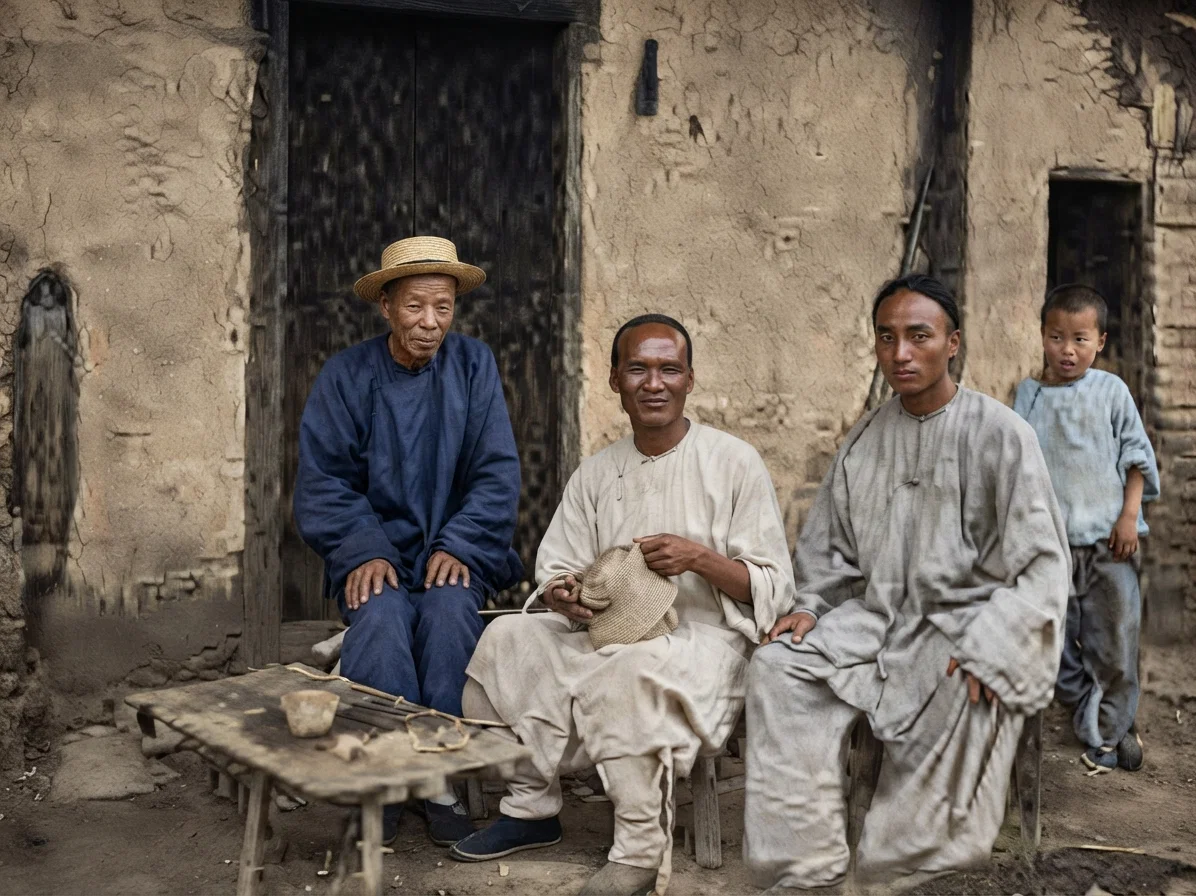
Typical Chinese. The Central Figure is a Hat-maker.
WHAT a difference there is in people about communicating what they know! Some possess a natural gift for imparting interesting information, while others pass over facts and incidents which they might have made most entertaining and profitable.
It was my pleasure to listen to a returned missionary from China recently, and I should like to tell some things he said. You have no doubt seen Chinese idols, and have been sad to think there were people so ignorant of the knowledge of the true God. This missionary said that these idols are all over the country in China, not only in homes and shops, but by the roadside. In some places there are many together, the middle one the tallest, and the smaller ranging along down the row. A Chinaman will not enter a ship where there is no idol. Superstition covers the whole empire like a pall. They do most absurd things to appease evil spirits. They have no horses, mules, or beasts of burden of any kind, the men and women being their own burden-bearers; consequently they have no roads, but only footpaths, which they make very crooked and circuitous indeed, in order to cheat the evil spirits, who they think are ever on their track.
Now, would you not like to tell them the true way to escape evil, that is, to keep in straight paths morally, and close to the side of the dear Redeemer in prayerful living? I am sure I hear you say, "Yes, indeed." You can tell them by denying yourself some things, and thus saving the money, which is so much needed to send the Gospel to them. Some of you can go yourselves and teach them when you are older. They are eager to learn, and when converted make very earnest Christians. They believe in a great spirit, that he is omniscient and omnipresent, but they know so little about Him! How pleasant it seemed to this missionary to break to them the bread of life, to explain to them the truths of the Bible as he journeyed with them in their boats to and from market, and sat in their shops, mingling with them and seeking opportunities to do them good, as did the Saviour when He was here among men!
Only a few years ago China kept her doors closed against foreigners, and the Gospel could not reach her. Now missionaries may preach and teach without let or hindrance.
O, how white the fields for the harvest! The Chinese are reverential, but so superstitious! If they find a stone that they can fancy bears any resemblance to a human being with arms folded, they count it good luck, and make it an object of worship. Only think of the difference the Gospel makes in our condition. To it we owe the best that we have—schools, churches, and all the blessings of a Christian civilization. Even the common comfort of a bed the Chinese do not enjoy. A lady physician says they sleep on shelves, almost packed in, and one smokes his pipe of opium until he drops asleep, when another takes it up and smokes it, and so it passes on. Not very fastidious, you say. No, no. With the Gospel, they receive our ideas of cleanliness and sanitary habits, as well as of morals and religion.
A missionary said long ago that when a man was converted the first thing he wanted was a clean shirt. The refining, elevating tendency of the Gospel is felt in all lands wherever known. Is it not, indeed, heaven born? Yet so condescending, ever reaching down to the poor and degraded, but ever to lift them up, to bring them into a higher life, a life above mere animal enjoyment—even eternal life, already begun in the soul, with all its sweet and hallowed influences, joys, hopes, anticipations, and expectations!
How anxious we should be to bear some humble part in this great work of spreading the Gospel, and cheerfully give up some of our superfluities! If half these, and the diamonds, and other jewels went into the treasury of the Lord, how soon would the heathen world rejoice, and blossom as the rose!
MRS. SUSAN BIRDSALL ROBERTS.
Elmira, N. Y.
A Few of the Ways in Which Missionary Work Can Be Done
By B. F. Richards
FROM THE HELPING HAND MISSION, SAN FRANCISCO.
A Few of the Ways in Which Missionary Work Can Be Done.
A LITTLE boy from Fields Landing, California, writes us: 'I am a little boy ten years old. My papa pays me fifty cents a week to drive the cows for him, and I send one dollar, which is to buy one book of meal tickets to be used at the Helping Hand and Medical Mission to help feed the poor; and may God's blessing go with my mite.
'WILLIE G. WILSON.'
Chinese Confucian Temple.
Some of the boys at the Healdsburg (Cal.) College have organized what they call the "Boys' Missionary Society." During their spare moments they come together and make small ornamental, useful household articles, then sell them from house to house. The money thus received is sent to the mission for the purpose of furnishing and endowing a bed.
One sister in Santa Barbara, Cal., who is seventy-two years of age, while lying in her bed for about a year, with a broken hip, pieced several quilts, and then, with the assistance of another sister, who is seventy-four years old, the quilts were put together. The material for the quilts was purchased, together with sheets and towels, by another sister, and they were sent to us to be used in the mission.
We have come to a time when gardens will be planted. Would it not be an excellent time for father and mother to teach the children at home how to work for God? Have you a farm, or garden spot? then let the children have a portion of it, furnish them with suitable seeds for planting, then give them instructions in preparing the ground, tell them that they must take care of it, and whatever it brings forth let them give to the Lord's poor. As you deal out the seed to them, just before planting, gather the household together and ask God to bless the seed, that it may bring forth10a crop to His glory. Encourage the children to do little deeds of kindness, and parents will be richly rewarded by beholding noble men and women as the children grow older.
The other day I called at the San Francisco Morgue. Here I saw the remains of four men and one woman; two of the men were unknown, and as I looked into the face of each, I was sure I had seen their faces a few days before at the mission. But when I came to the third bier, I was not mistaken, for I was looking at the face of poor Donnelly, a man with whom I had prayed and labored so many times, and each time he would say, "Sometime I will turn; sometime I will be a better man." But I said, Donnelly, sometime you will let the chance to be saved go by just once too often. And so he did, for one morning, after a long-protracted spree, while walking in the park near the mission, the poor man fell to the ground dead,—life's race over, and what a record!
At the evening meeting in the mission, after the visit to the morgue, I had been telling the men what I had seen, and had been urging them not to wait, for there was danger in every moment spent in waiting. I then turned the meeting over to the men, and among the first to rise to his feet was a tall, fine-built, well-educated man, who said: "I am thankful that I am alive, for I have been with poor Donnelly many a night drinking in Chinatown. He is dead, and I am alive, and I will live to work for others from this time on. God has done a most remarkable work for me, and I praise His holy name."
One young man came to the mission, gave himself to the Lord, and for about a month had the privilege of speaking a word in praise to God, when he was taken sick and died in a few days. With this brother we can say, "Blessed are the dead who die in the Lord," for we expect to meet him in the "first resurrection."
Brother Whitney, who had been known by our people in this State, and in Kansas, was a member of the mission family for several months. He was faithful in his testimony for the Lord every evening in the meetings. He, too, was taken sick with pneumonia and lasted only a few days. We expect to meet Brother Whitney also when the Master calls to His sleeping ones to come forth.
B. F. RICHARDS.
"NOT FIT FOR SERVICE."
By Mrs. Jennie M. Daly
ONE night—'twas a Saturday evening—
I sat alone in my room,
Watching the fading daylight
And the steadily-gathering gloom.
I longed and watched for an opening
A word for my Master to say,
Ere the twilight gave place to darkness
And the week had passed away.
I knew that there had been moments
Afforded me through the week
When I might have witnessed for Jesus,
But I hadn't the heart to speak.
And now, when I would have spoken,
The privilege was denied.
So I went with my sorrow to Jesus,
And why was this? I cried.
Ah! the Master knew all about it,
And He said (and I knew it was right),
"The tool is too blunt for service;
I can not use it to-night."
The shaft to be used must be polished,
Must be hid in the Master's hand.
The arrow while hid in the quiver
Must be sharp to perform His command.
Then polish and sharpen me, Master,
Tho painful the process may be,
And make me an instrument fitted
To be used any moment by Thee.
MRS. JENNIE M. DALY.
ROMANISM AND CHRISTIANITY IN CHINA.
WE have before spoken of the serious difficulties imposed upon Protestant missionaries in China, by the Catholic propaganda of Rome. This propaganda has achieved, in appearance at least, important successes. But it may be well to examine somewhat more closely the value of these successes, for many of them will be found to be far from resembling moral triumphs. Le Missionaire gives this view of the case:—
'This very often is the way in which the question presents itself to the heathen Chinese. It is in vain that they have entrenched themselves in the citadel of Confucianism. The most intelligent of them begin to perceive its weakness. The late political events have dealt the power of the old philosopher a stroke from which it will probably never recover. The literati, the 'readers of books,' the obstinate disciples of the sage so long held divine, have not known what to do to save their country, or to shelter her from the keenest affronts.
'They begin now to allow that it might not be so bad to give over this decrepit system, and to borrow some new principles, perhaps even a new religion, from these abominable foreigners, these men so long condemned or even driven out with stones. In a word, missions may well be looked into as, perhaps, a means of saving the empire.
'But which missions? There are two, Roman Catholic and Protestant. Which shall be preferred?—Naturally, they think that which lays on its disciples the less burdensome yoke; that which puts up with the least costly conversion, or is even not unwilling to dispense with conversion, provided that certain outer forms, and these not too numerous, are taken up in outward practise. Very well. These more convenient requirements are those of the Roman mission. And the Chinese have that old and easy beat of the human heart which inclines them to this side. 'The Catholics,' say they, 'render Christianity more easy.' And they add, with a naïveté of which they are not always conscious, 'The Evangelicals have the truth, but the Catholics have the power.''
'But the two chief obstacles to Protestant missions in China are these:—
'In the first place, the power of Chinese heathenism resides at present, not in the worship of idols, but rather in the worship of ancestors. The false gods have decidedly lost their influence. The worship of them becomes colder and colder; facts have shown, only too well, their utter good-for-nothingness. But ancestors! In them is gathered up all the family and thereby all the commonwealth. Not to give them homage any longer, not to offer prayers to them—in short, to give over treating them as divinities, would be to shake the pillars of the state. And there are Chinese who have received baptism, having strong claims on our confidence, who are still entangled in these meshes, which are so incredibly strong.
'Secondly, a considerable number of former disciples of Confucius are to-day ready to embrace Christianity, not by reason of a real conversion, but by enlightened self-interest. They have not come to this willingness through a feeling of sin; genuine repentance may have grazed their souls, but nothing more; Jesus is not in their view as the one Saviour. Ask them why they wish to become Christians. They will placidly answer you, 'Because Christianity is good.' Only, this adjective good has for them a meaning wholly earthly, nay, grossly earthly. It means with them that the Gospel opens the way to good places and good friends: in other words, is a fairer road to prosperity than idolatry. We must, at all costs, stand for a deeper Christianity in our churches and give to our flocks guides thoroughly surcharged with the Spirit of God. This is now one of our chief duties.'—Missionary Review.
OUR WORK AND WORKERS.
DURING January four persons were baptized and united with the church in Denver, Colo.
A CANVASSERS' institute was begun on the 22d ult. at New London, Wis., to continue four weeks.
THE addition of four members to the church at Cañon City, Colo., is reported by Brother G. W. Anglebarger.
IN the Oklahoma Gleaner we note a report of Brother E. T. Russell which mentions the organization of a church at Watonga, O. T.
THE collections of the fourth Sabbath in January throughout the Sabbath-schools of New Zealand were devoted to the work of furnishing the Health Home in Christchurch.
A LETTER from Sister Vesta J. Farnsworth, of January 19, notes that fifteen persons had accepted the doctrines of our faith at Wanganui, N. Z., as a result of labor subsequent to the camp-meeting held at that place in the autumn. There was still a good interest.
FOUR general meetings are announced for Montana in April: Livingston, 4-9; Great Falls, 11-16; Missoula, 18-23; Butte, 25-30. The last on the list is to be a laborers' and canvassers' institute.
THE new sanitarium building at Keene, Texas, is said by the Reporter to be "progressing finely." The building is three stories high, and when completed will have accommodations for an extensive patronage.
NEW YORK CONFERENCE seems to be taking on new life; there is a manifest disposition to give the "pioneer" a chance to do its work in that great and important field. The SIGNS list has more than doubled in the last two months.
GOOD reports of sales of the Quarter-Centennial SIGNS still reach us from various localities. Brother O. S. Ferren sold 700 copies in Cheyenne, Wyo., and was continuing the work in other places at last report, although he often "wallowed through snow knee deep." At the doors he would say, "I can't wait for pleasant days; my business is urgent." He has sold to all classes of people, from the governor down. Other brethren were also meeting with success in the work.
BROTHER C. McREYNOLDS says of the work in Galveston, Texas: "The mission that has been running under the care and management of Mrs. Yates, and which receives the fostering care of the popular churches, has been turned over to our workers. The various departments of work carried on are Gospel meetings, a mission sunday-school, free kindergarten, free dispensary, treatments for both men and women, a free reading-room, and they hope to start a lunch counter soon." Brother H. Menkel has charge of the work.
OUR general agent for Wisconsin, Anna M. Jensen, writes to the Reporter: "Some of our brethren are taking a great interest in the SIGNS' work. Also our church schools are having good success in selling the Quarter-Centennial number. One school writes me that they have sold about 400 copies, and feel it has been a great blessing to them. Another, 200 copies. Still others tell me they are going to take up the work. Why should not all our schools take hold of this work and thus be gaining an experience in missionary work? It was my privilege to spend a few hours at Fort Atkinson in selling the special number, and in 25 houses I sold 22 papers. I fully believe this paper will sell right along till another comes out. Brethren, let us not become weary in this good work, but continue till all have been warned, and the dear Lord will take us home."
REPORTING to the Workers' Record of February 1, Brother L. W. Felter says:—
"The first year's existence of the Kansas City Mission is in the past. One year ago to-night a number of those who were interested in the work assembled at the mission, and the building, which had been used for a saloon, gambling den, and immoral purposes generally, where men and women were debauched, degraded, and dragged downward toward eternal destruction, was dedicated to the work of arresting souls in their downward course, turning their faces Zionward, and assisting them in their efforts to be restored to the image of their Maker. The first day the mission was opened, we served 3 or 4 meals, but it soon became known, and soon we were serving 100. This winter it runs from 130 to 180 per day, and during the year 30,300 have been served. Of these about 500 have been worked for and 250 given away. The first night we had 2 beds; at present we have 65, and the total number furnished during the year is 12,500; 240 pieces of clothing have been distributed, and 35 families helped."
A LETTER from Sister Mina Braucht, dated Apia, Samoa, January 18, to Sister Cora Chapman, of Oakland, Cal., gives this bit of information, which will be of interest to many of our readers:—
"The Samoan governmental affairs are in rather a sad condition just now, and we have been passing through a civil war. You may have seen something already in the papers about it. One party had threatened to exterminate the white people, so we have not known what a day or a night would bring forth. But we did not fear, for we knew that the angels of the Lord were encamped round about us. The first battle was fought one week ago Sunday, and our house was in the midst of the battle-ground. The bullets were flying all about us, some hitting the iron roof, and one knocked the arm off a rocking-chair that stood on the upper veranda. Tho the natives have been looting and burning all around us, thus far ourselves and the property have been unharmed. 'We are,' the natives say, as they went by, that this place is sa (forbidden). It seems that they have been forbidden to touch anything here. The experiences through which we have just passed have drawn us nearer to the Lord, and we have learned lessons of trust. The promises of God never seemed so precious to me as during this time of danger and excitement."