Your ShelfYour Projects

Signs of the Times, Vol. 25, No. 9.

DOOM OF SODOM; ITS LESSON FOR TO-DAY

Earlier text: THIS IMPATIENT, NERVOUS GENERATION
The Sabbath School International Series

LESSON XI.—SABBATH, MARCH 18, 1899.

THE BAPTIST'S LAST TESTIMONY OF CHRIST.

Various Parts of Judea, A.D. 28. (John 3:14-36; 4:1-6.)
14 "And as Moses lifted up the serpent in the wilderness, even 15 so must the Son of man be lifted up; that whosoever believeth 16 in Him may have eternal life.
17 "For God so loved the world that He gave His only 18 begotten Son, that whosoever believeth on Him should not per- 19 ish, but have eternal life. For God sent not the Son into the 20 world to judge the world; but that the world should be saved 21 through Him. He that believeth on Him is not judged; he that 22 believeth not hath been judged already, because he hath not 23 believed on the name of the only-begotten Son of God. And this 24 is the judgment that the light is come into the world, and men 25 loved the darkness rather than the light; for their works were 26 evil. For every one that doeth ill hateth the light, and cometh 27 not to the light, lest His works should be reproved. But he 28 that doeth the truth cometh to the light, that his works may be 29 made manifest, that they have been wrought in God.
30 "After these things came Jesus and His disciples into the 31 land of Judea; and there He tarried with them, and baptized. 32 And John also was baptizing in Ænon near to Salim, because 33 there was much water there; and they came, and were bap- 34 tized. For John was not yet cast into prison. There arose 35 therefore a questioning on the part of John's disciples with a 36 Jew about purifying. And they came unto John, and said to him, 37 Rabbi, He that was with thee beyond Jordan, to whom thou 38 hast borne witness, behold, the same baptizeth, and all men 39 come to Him. John answered and said, A man can receive 40 nothing, except it have been given him from heaven. Ye your- 41 selves bear me witness, that I said, I am not the Christ, but, 42 that I am sent before Him. He that hath the bride is the 43 bridegroom; but the friend of the bridegroom, which standeth 44 and heareth him, rejoiceth greatly because of the bridegroom's 45 voice; this my joy therefore is fulfilled. He must increase, but 46 I must decrease.
47 "He that cometh from above is above all; he that is of the 48 earth is of the earth, and of the earth he speaketh: He that 49 cometh from heaven is above all. What He hath seen and 50 heard, of that He beareth witness; and no man receiveth His 51 witness. He that receiveth His witness hath set his seal to this, 52 that God is true. For He whom God hath sent speaketh the 53 words of God; for He giveth not the Spirit by measure. The 54 Father loveth the Son, and hath given all things into His hand. 55 He that believeth on the Son hath eternal life; but he that 56 obeyeth not the Son shall not see life, but the wrath of God 57 abideth on him.
1 "When therefore the Lord knew how that the Pharisees 2 had heard that Jesus was making and baptizing more disciples 3 than John (altho Jesus Himself baptized not, but His disci- 4 ples), He left Judea, and departed again into Galilee. And He 5 must needs pass through Samaria. So He cometh to a city of 6 Samaria, called Sychar, near to the parcel of ground that 7 Jacob gave to his son Joseph; and Jacob's well was there. 8 Jesus therefore, being wearied with His journey, sat thus by 9 the well. It was about the sixth hour."
NOTE.—The texts inclosed in marks of parentheses, while not essential to the lesson study, will be found to throw much light upon the lesson, and are suggested for those who wish to study further.

SUGGESTIVE QUESTIONS.

  1. In His discourse to Nicodemus, by what familiar illustration did the Saviour reveal His mission to earth? John 3:14, 15. (Num. 21:9; John 12:32.)
  2. What motive gave Christ to such a work? Verses 16, 17. (2 Cor. 8:9; Rom. 8:32.)
  3. By what do men escape condemnation from sin? Verse 18. (John 3:24.)
  4. What proves the condemnation of man? Verses 19-21. (John 1:9-12; Eph. 5:13, 14.)
  5. After finishing this discourse, where did Christ and His disciples go? What did they do? Verse 22. (John 4:2; Acts 10:37.)
  6. Where was John the Baptist working during that time? Verse 23. 1
  7. During a dispute which arose between John's disciples and some Jews, what report was brought to John concerning Jesus? Verse 26. (John 1:15.)
  8. By what magnanimous reply did John reveal his greatness? Verses 27-30. (Mal. 3:1.)
  9. What did John thus say was to be the nature of Christ's testimony? and why? Verses 31-33. (John 3:11; 8:26.)
  10. In His testimony to the world, whose words was Christ to speak? and for what reason? Verse 34. (John 7:16; Col. 2:9.)
  11. When Jesus knew of this report having been carried to John, what did He then do? John 4:1-3.
  12. By what route did He attempt the journey? Verse 4. 2
  13. At what city of that country did He make a halt? Verse 5. 3
  14. In His weariness at noonday, where did Jesus seek rest? Verse 6.
  15. While Jesus sat there, who appeared at the well? Verse 7.
  16. In order to engage her in conversation, what favor did the Saviour ask of her?
Side Lights.—"Desire of Ages," pp. 167-182; "Spirit of Prophecy," vol. 2, pp. 68-74.

NOTES.

THE INTERNATIONAL SUNDAY SCHOOL SERIES

LESSON XII.—SUNDAY, MARCH 19, 1899.

CHRIST THE GOOD SHEPHERD.

Lesson Scripture, John 10:1-16, R.V. 1 "VERILY, verily, I say unto you, He that entereth not by the door into the fold of the sheep, but climbeth up some other 2 way, the same is a thief and a robber. But He that entereth 3 in by the door is the Shepherd of the sheep. To Him the porter openeth, and the sheep hear His voice; and He calleth 4 His own sheep by name, and leadeth them out. When He 5 hath put forth all His own, He goeth before them, and 6 the sheep follow Him; for they know His voice. And a 7 stranger will they not follow, but will flee from him; for they 8 know not the voice of strangers. This parable spake Jesus 9 unto them; but they understood not what things they were 10 which He spake unto them. 11 "Jesus therefore said unto them again, Verily, verily, I say 12 unto you, I am the door of the sheep. All that came before 13 Me are thieves and robbers; but the sheep did not hear them. 14 I am the door; by Me if any man enter in, he shall be saved, 15 and shall go in and go out, and shall find pasture. The thief 16 cometh not, but that he may steal, and kill, and destroy; I 17 came that they may have life, and may have it abundantly. 18 I am the good Shepherd; the good Shepherd layeth down His 19 life for the sheep. He that is a hireling, and not a shepherd, 20 whose own the sheep are not, beholdeth the wolf coming, and 21 leaveth the sheep, and fleeth, and the wolf snatcheth them, 22 and scattereth them; he fleeth because he is a hireling, and 23 careth not for the sheep. I am the good Shepherd; and I 24 know Mine own, and Mine own know Me, even as the Father 25 knoweth Me, and I know the Father; and I lay down My life 26 for the sheep. And other sheep I have, which are not of this 27 fold; them also I must bring, and they shall hear My voice; 28 and they shall become one flock, one Shepherd." Golden Text.—"I am the good Shepherd; the good Shepherd layeth down His life for the sheep." Verse 11.

SUGGESTIVE QUESTIONS.

(1) What does Jesus say of those who try to enter the sheepfold by some other way than the door? V. 1. Note 1. (2) What is the character of Him who enters by the door? V. 2. Note 2. (3) Who opens to Him? How do the sheep regard Him? What does He do for the sheep? Who is the porter? V. 3. Note 3. (4) How do the sheep manifest their regard for the Shepherd? V. 4. Note 4. (5) How do the sheep regard a stranger? V. 5. Note 5. (6) How did the Jews regard the parable? V. 6. Note 6. (7) What then did Jesus say of Himself? V. 7. Note 7. (8) What of all who ever came before Him? V. 8. Note 8. (9) What will result to those who enter in by the door? V. 9. (10) For what purpose does the thief come? And for what did Christ come? V. 10. (11) What else did Jesus say of Himself? V. 11. Note 9. (12) How does a hireling differ from the good Shepherd? And what is the result? V. 12. (13) Why does the hireling flee? V. 13. (14) In what other way is the good Shepherd distinguished? V. 14. (15) What is His knowledge of the Father? What spirit of sacrifice is emphasized by repetition? V. 15. (16) What is said of "other sheep"? V. 16. Note 10.

NOTES.

1. "He that entereth not by the door."—The first five verses of this lesson constitute a parable. Primarily it is to show that Christ is the Shepherd of God's flock, or people, in the earth; in other words, that He was the Messiah. He is the "chief Shepherd." 1 Peter 5:4. As His ministers on earth are under shepherds, or assistants (verses 1-3), the parable applies, secondarily, to them. They must enter the fold by the door, and do their work in a legitimate manner. They are selected from the flock, and are part of the flock; therefore they, as well as the flock, must follow the Word and example of the chief Shepherd. Whoever will not do this is a destroyer, and not a true shepherd.
2. "He that entereth by the door."—Christ came according to the Scriptures (Luke 24:27; John 5:39), which had been indicted by His own Spirit (1 Peter 1:11); therefore He had entered "by the door." So the under shepherd who acknowledges the authority of Christ, and follows the directions given in His Word, also enters "by the door." He enters upon the work in a legitimate manner, having only the interest of the Master and the welfare of the flock at heart. Every one claiming to be a shepherd must be tested by the Word and example of Christ.
3. "The porter."—The Holy Spirit is the porter. Christ was begotten by the Spirit; and was anointed and set apart to His office by the Spirit. By this He was given power, and when He was about to leave the earth, committing the work to human agents, He commanded them to tarry at Jerusalem until "endued with power from on high." Luke 24:49. They were to have this power when the Holy Ghost should come upon them, and that would give them authority to witness for Him in all the world (see Acts 1:8), and to feed the flock (John 21:15-17; 1 Peter 5:1-4).
4. "His voice."—Christ was the Word of God (John 1:1,14), therefore His voice was the voice of God (chap. 14:24), and "he that is of God heareth God's words" (chap. 8:47). They follow because they know the voice. "And this is life eternal, that they might know Thee the only true God, and Jesus Christ, whom Thou hast sent." Chap. 17:3.
5. Will not follow a stranger.—Why?—Because they do not know his voice. He may wear the outward garb of a true shepherd, and might be able to deceive the eye; but God's sheep "walk by faith, not by sight." 2 Cor. 5:7. Despite all appearances, they follow the rule which the Scriptures give as a protection against false teachers: "To the law and to the testimony: if they speak not according to this Word, it is because there is no light in them." Isa. 8:20.
6. "They understood not."—For the reason that they were not His sheep, notwithstanding their loud profession of being the children of Abraham.
7. "I am the door."—Christ is not only the "chief Shepherd," but He is the door through which all other shepherds, as well as the flock, must enter the fold. "Neither is there salvation in any other; for there is none other name under heaven given among men, whereby we must be saved." Acts 4:12. The Holy Spirit opens this door to the fold for the sheep.
8. "All that came before Me."—This does not refer to prophets and teachers generally, but to all who had made claim to Messiahship, all teachers of false methods of salvation. No matter how many followers they may have had, the true sheep did not follow them.
9. "The good Shepherd layeth down His life for the sheep."—The same obligation is laid upon all His disciples: "Hereby perceive we the love of God, because He laid down His life for us, and we ought to lay down our lives for the brethren." 1 John 3:16.
10. "Other sheep."—Out among the Gentiles were sheep to be gathered in. They were scattered to the uttermost part of the earth. Hence the commission to be witnesses to the farthest limit. See Mark 16:15; Acts 1:8. "Not of this fold."—He does not mean the Jewish fold as the Jews understood it, but the fold or flock of the true Israel, the true people of God. The people are the flock; the fold is the true church, or spiritual kingdom.

A FAIR OFFER.

I will lease my fruit farm one year to prove that it will pay 10 times as much as a grain farm—short winters, climate mild and healthful. Will sell cheap, in order to invest means in a Gospel enterprise.
W. W. GILES, Occoquan, Virginia.

THE ATONEMENT.

AN EXAMINATION OF A REMEDIAL SYSTEM, IN THE LIGHT OF NATURE AND OF REVELATION.
BY ELD. J. H. WAGGONER.
THIRD EDITION, REVISED AND GREATLY ENLARGED.
This work is a critical and exhaustive treatise on the plan of salvation as revealed in the Scriptures, showing its harmony with the principles of justice and mercy, its consistency with reason, and its final results as affecting the destiny of the human race. 368 pp.; cloth, $1.00.
Address, PACIFIC PRESS, Oakland, Cal.

A BOY WANTED.

A GENTLEMAN said one day, "One of the oldest legends in London is to be found in the shop windows every day; it is only a legend, for the want can not be supplied."
"What is the want," asked a friend, "that is set forth?"
"'A boy wanted'—but there are no boys now."
"O, come, that is hard on the boys! Just come to my place to-morrow, and you shall see. I have advertised for a boy, and they will come in swarms. You shall be umpire," said the friend.
So, on the morrow, Mr. Bean seated himself at his table and awaited the arrivals; his friend, who prided himself on his discernment of character, and who judged a boy by the way he opened a door, or held his hat, and many other little things, was posted behind a screen, where he could see but not be seen.
The first boy came in, and to the question, "Not afraid of work, are you?" answered, "'Fraid of work!—not I. You just try me."
"No, thank you," said the voice from behind the screen.
Number Two could not look you straight in the face; he had three places in two months.
"What was the cause of your leaving?"
"O, the guv'nors didn't suit me—not liberty enough."
"Well, you are free now—go and enjoy your liberty," said the voice.
Number Three would do anything.
"I've only one fault, sir, I says, when I speaks for myself, and that is, I does too much."
Again the voice spoke:— "One fault is enough. You can go." Presently the door handle was seized firmly, the door was opened fully, yet respectfully, and before the boy was well in the room the voice whispered, "Here's the successful candidate."
An honest-faced boy entered. His answers were just "yes" and "no" at first, but when the merchant told him the wages given, he said:—
"That is a shilling more than I have been getting, and my mother will be very glad of it, sir. We are very poor, so poor mother has to work hard until I can earn enough to keep her."
"When can you begin work?"
"At once, sir. I brought an apron and a few things with me."
The merchant laughed. "That was rather premature, was it not? You are one of hundreds after the place; do you know that?"
"Yes, sir, but mother and me had it out before I came, and she very seldom goes far out, does mother, sir," said the boy.
"Had it out? What do you mean, boy?"
"Mother just prayed about it, sir; mother loves praying."
"Well, the son of a praying mother ought to be some good, so I'll take your name and that of your late employer."
Mr. Bean and friend had a good laugh at the voice. "I'll never forgive you, Brooke, if your discernment is at fault to-day, tho I like the looks of the boy, I confess."
The references were found to be quite satisfactory, and John Sears entered the merchant's office to do anything he was bidden. And he did not leave that office until all under him did as he bade them. He became head of the firm, and a successful Christian merchant. He would say, "Ah, it was all my dear, praying mother, and when a praying mother makes a praying son, the business is sure to prosper!"
John Sears was right. There is a worldly saying, "Nothing succeeds like success," but to the Christian nothing succeeds like prayer; for it is the telephone between the soul and God, and has been known to move mountains. You, my boy reader, must be a praying boy and a praying man if, as a Christian, you would be a prosperous man. Remember, there is always "a boy wanted." Be that "boy." Be so obliging, so honest, so reliable, so pure, so unselfish, so truthful, such an enemy to meanness, such a hater of the wrong, and such a champion of the right, that you will be always "wanted." The law says a man is "wanted" when the police are looking for him because of theft or other misdeeds. May you be wanted because, like John Sears, you "have set the Lord always before you," and in life's contest you will be the successful candidate.—Our Own Magazine.

THE STOMACH NOT TO BLAME.

A PATIENT once said to his physician, "Doctor, I believe there is something wrong with my stomach."
"Not a bit of it," replied the doctor. "God made your stomach, and He knows how to make stomachs. There may be something wrong with the stuff you put into it or something wrong with the way you stuff it in and cram it down; but your stomach is all right."
Another patient said, "The stomach has come to be a curse to the human family." This man evidently longed for an iron-clad stomach, devoid of nerves.
The truth is, the stomach is not the offender; like every other involuntary organ, it is under the direct and constant control of its Maker. Like every other organ, it has a specific work to do, and will do that work faithfully and well, without pain or inconvenience, providing it is properly treated.—D. H. Kress, M.D., in Good Health, February.

How to Live a Century

HOW TO LIVE A CENTURY. No. 5.

"CAN I not do as I please with my own?" is asked. Perhaps you can, but wait a moment. Who told you you were the rightful owner of this wonderfully constructed piece of machinery called the body? Where are your papers to prove your ownership? When, where, and of whom did you buy it? Can you tell the amount of the purchase price? and do you hold the receipt for the money paid?
"Ye are not your own." "Ye are bought with a price." "I have redeemed thee, I have called thee by thy name; thou art MINE." "Ye have sold yourselves for naught; and ye shall be redeemed without money," are the words of the rightful Owner. His title to the property in question is beyond dispute. He holds the deed, and has had it faithfully recorded in the books of heaven. Millions of angels witnessed the transaction, and know of the price paid, so let us settle it forever that we do not own the body we now occupy.
We are simply tenants, dwelling in property that belongs to another; therefore the greater becomes the necessity of giving more attention and concern to it, so that we can keep it in good repair, habitable and presentable.
The apostle Paul says in his letter to the Romans, chapter 12, first verse, "I beseech you therefore, brethren, by the mercies of God, that ye present your BODIES a living sacrifice, holy, acceptable unto God, which is your reasonable service." The owner of property is always pleased when it is brought before him in a presentable condition; therefore present your body sound, well, healthy, holy, and let the Owner look upon it.
"Know ye not that ye are the temple of God, and that the Spirit of God dwelleth in you? If any man defile [destroy] the temple of God, him shall God destroy; for the temple of God is holy, which temple ye are." 1 Cor. 3:16, 17. This is another reason for giving the body the best of care, for it is a temple in which the holy God would dwell. He would come home and help us keep house. If we destroy His property, His house, or temple, He will destroy us.
How we can defile the body is the next thing for us to consider. "But Daniel purposed in his heart that he would not defile himself with the portion of the king's meat, nor with the wine which he drank; therefore he requested of the prince of the eunuchs that he might not defile himself." Dan. 1:8. Here we find that the knowledge Daniel had of his body taught him that if he ate or drank unwholesome or improper food he would defile his body; therefore he made up his mind that he would not do it; and as Daniel had a body subject to disease and death, the same as we have, whatever would defile his body will do the same for ours.
In the conversation that took place between Daniel and Melzar, the reader can easily see that the steward insisted that Daniel would be obliged to eat the food ordered by the king, and if he would not, and should in time get sick, the king would ask what he had been eating, and if the king should learn that Daniel with his three brethren had not eaten the food prescribed, he would cut Melzar's head off; but Daniel reasoned with Melzar and said: "Prove thy servants, I beseech thee, ten days; and let them give us pulse [peas, beans, and grains] to eat, and water to drink. Then let our countenances be looked upon before thee, and the countenance of the children that eat of the portion of the king's meat; and as thou seest, deal with thy servants." What a fair test this is—a trial for ten days! Daniel is willing to leave the question of diet to the honest judgment of the steward; a test case is to be made, and Melzar alone must decide and settle the question whether the grains and vegetables that Daniel, Hananiah, Mishael, and Azariah proposed eating contained sufficient nutriment to keep the bodies of those men strong, hearty, robust, and well, without resorting to the flesh of dead animals, or drinking the king's wine.
A careful selection had been made in the young men of Babylon, for we read in the fourth verse, "Children in whom was no blemish, but well favored, and skilful in all wisdom, and cunning in knowledge, and understanding science, and such as had ability in them to stand in the king's palace, and whom they might teach the learning and the tongue of the Chaldeans." The brightest and smartest young men in the land are called to join the king's class; the opening day for the school has come; the four Hebrew captives are placed in the same classes, and given the same studies as the bright young men of Babylon received. No partiality is shown; but when the time for eating and drinking came, the four Hebrews were permitted to adhere to their vegetarian principles, but the others were placed at the king's table, where they ate his meats and drank his wine. This regimen was continued for ten days, and read the verses which tell the result: "So he consented to them in this matter, and proved them ten days. And at the end of ten days their countenances appeared fairer and fatter in flesh than all the children which did eat the portion of the king's meat." Dan. 1:14, 15.
Melzar became satisfied after the examination that the vegetarians had the best food, so he permitted them to continue as they had been living, till the close of the school. When the whole school was brought before the king for final examination, the text says: "And the king communed with them; and among them all was found none like Daniel, Hananiah, Mishael, and Azariah; therefore stood they before the king. And in all matters of wisdom and understanding, that the king inquired of them, he found them ten times better than all the magicians and astrologers that were in all his realm." Verses 1:19, 20.
Daniel, with his three companions, lived on the foods originally provided by the Lord when He first told man what he was to eat. "And God said, Behold, I have given you every herb bearing seed, which is upon the face of all the earth, and every tree, in the which is the fruit of a tree yielding seed; to you it shall be for meat." Gen. 1:29.
Those schoolboys believed that He who made and prescribed their diet knew what was best for them. So they took Him at His word, and we have seen the result by the decision rendered: Countenances fairer and fatter in flesh; in matters of wisdom and understanding ten times better. What a victory this was! Melzar saw it, so did the king; but do you, dear reader, see it?
Benjamin Franklin once said: "A vegetable diet promotes clearness of ideas, quickness of perception, and is much to be preferred by those who labor with the mind."
Dr. De Neville says: "Four classes of substances are necessary for the maintenance of life,—the albuminoids, the carbohydrates, the fats, the minerals. Now meat contains but three of these, while the vegetables contain all four. Vegetable food is also necessary for our intellectual life; the phosphorus contained in vegetable food is almost double the amount contained in animal food. . . . Those who believe that meat gives the rose color to the cheeks and lips are in error. As Professor Mussa has shown, the amount of iron oxide contained in vegetable food is much greater than that found in meat."
Linnæus, the distinguished botanist, who lived in the eighteenth century, when speaking on the natural dietetic character of man, says that his organization, when compared with that of other animals, shows that fruits and esculent vegetables constitute his most suitable food. And says Sir Henry Thompson, "It is a vulgar error to regard meat in any form as necessary to human life."
B. F. RICHARDS.

GOD SHALL BE MY TRUST.

WHEN o'er my brow the evening shades are falling, And dreary storms unceasing round me blow, Then, may I hear the voice of God still calling Where He would have me go.
In that glad home my footsteps shall be pleasant, For nothing there shall in that land decay, And Christ shall be my helper ever present, My portion and my stay.
Then when the sands of life above me drifting Shall shut me from the peaceful, sacred light, May floods of sunshine, with their rays uplifting, Burst on my clouded night.
And may I feel my Father's blessed Spirit Forever calming all my troubled fears, Altho no sacred gift, no boon I merit In this sad world of tears.
O, grant me, Lord, a place among those mansions, A shade and shelter in that goodly land Among those living fields of green expansions Alway at Thy right hand!
When o'er my heart earth's heavy clouds are stealing, Then, I would breathe to heaven a contrite prayer, And long for Thy dear presence, ever healing My troubled life from care.
When all my earthly days at last are numbered, May I behold, O Christ, Thy loving face! Thus freed from earth, and all things that encum- bered, I'll rest in Thine embrace. MRS. ALICE M. AVERY HARPER. Laingsburg, Mich.

THE CORRECT SITTING POSITION.

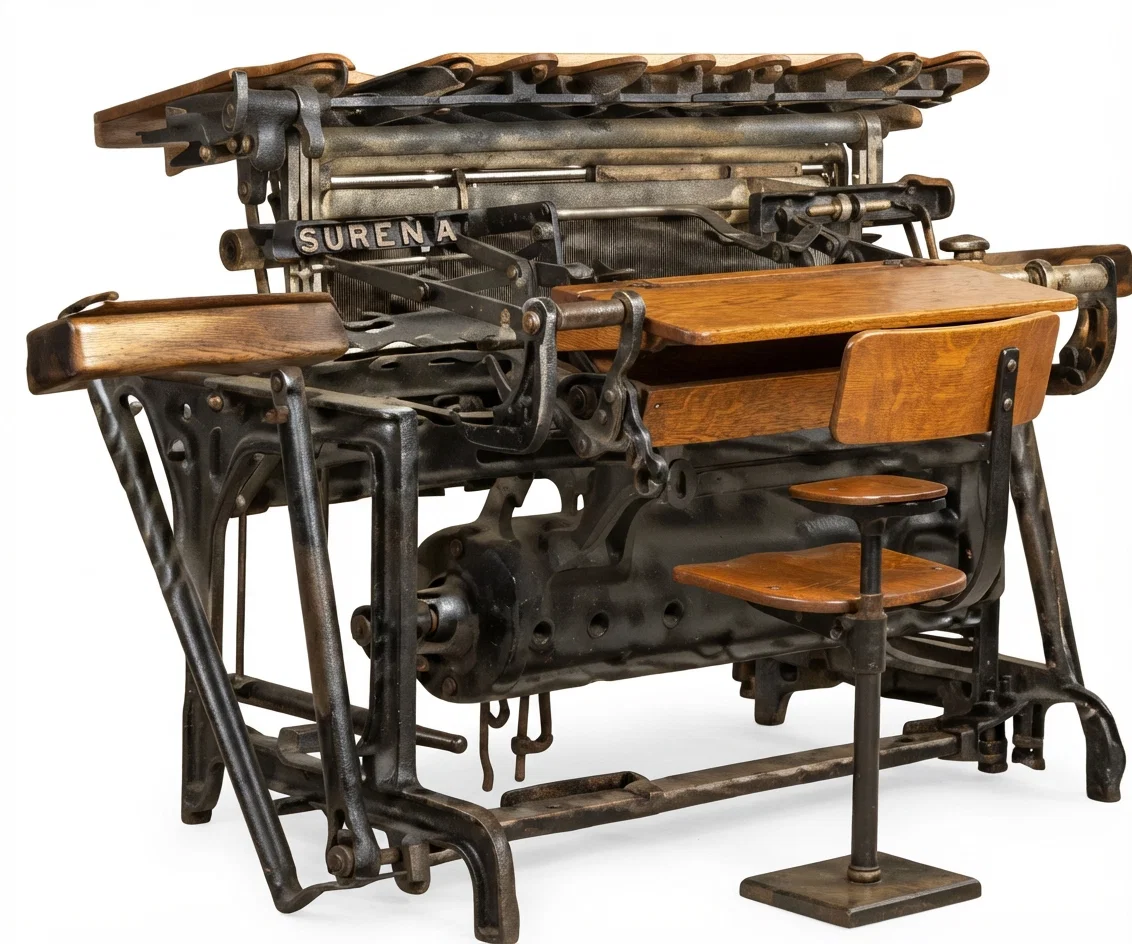
A CORRECT attitude in sitting requires proper height and width of seat, a desk or a table of the proper height, when desk work is required, and care upon the part of the pupil to sit upon his seat in a proper position. The height of the seat should be such that the feet may rest squarely upon the floor without undue pressure upon the large nerves and blood-vessels at the bend of the knee. A high seat not only produces undue pressure upon the nerves and vessels, thus causing cold feet, numbness, and other unpleasant symptoms, and possibly also a deficient development of the legs, but has the effect to drag the trunk forward, thus creating a tendency to relaxation of the muscles of the trunk and posterior curvature.
The seat should be of such width that the hips can touch the back of the seat while the soles of the feet are still resting squarely upon the floor.
The relation of the person to the seat should be such that while the hips and shoulders touch the back of the seat (the back of the chair should be of sufficient height to reach the shoulders), the center of the back remains free from the seat, owing to its concavity. The center of the back can not touch the back of the seat without relaxation of the muscles and resulting flatness of the chest and waist, unless, of course, the seat back has a forward curvature. —J. H. Kellogg, M.D., in Good Health.

The Kellogg Sanitas Bath

EVERY SICK AND DESPAIRING MAN OR WOMAN CAN GET RELIEF BY USING

The Kellogg Sanitas Bath

BE GOOD TO YOURSELF, quit taking poisonous drugs and use Nature's remedy. Booklet treating on Health and Hygiene mailed to you free. There are any number of men and women who are sick from some disease. They have struggled for years, perhaps, to find some remedy that will release them from the pain and torture of Rheumatism, Liver and Kidney Troubles, Sciatica, Neuralgia, Eczema, Obesity, Night Sweats, and Indigestion.
The use of the Sanitas Cabinet Bath makes a healthy skin and beautifies the complexion. Recommended by leading physicians; managers of agencies and bath parlors wanted. Enclose 2c stamp for booklet and full information. Address,
The Kellogg Sanitas Co.
Battle Creek, Mich. U. S. A.

Lessons by Mail on Medical Electricity or

How to Use the Battery

By Prof. G. L. Abell
Member of the Board of Directors of the Electro-Medical Society of San Francisco.
Learn how to use the battery and treat yourself. Many diseases are quickly cured by the proper application of electricity. The course embraces the treatment of every organ and part of the body. The lessons are written in plain language and are illustrated. Course, five dollars. Send for circular. Address,
PROF. G. L. ABELL, School of Chemistry and Electro-Therapeutics. 22½ Geary St., San Francisco, Cal.

NUTS

EASILY and cheaply made in any household by the use of our complete equipment for grinding and emulsifying nuts. The production of our mills is unsurpassed. Full directions and a booklet containing many valuable nut food recipes, free with each mill.

NUTS

Shelled and unshelled, of all kinds at reasonable prices
For further information, catalog, price-list, etc., write to
JOSEPH LAMBERT Battle Creek Michigan
When you write, please mention the SIGNS OF THE TIMES.
Healthful Delicious Nut Foods
Continue reading: You Have Been Wanting