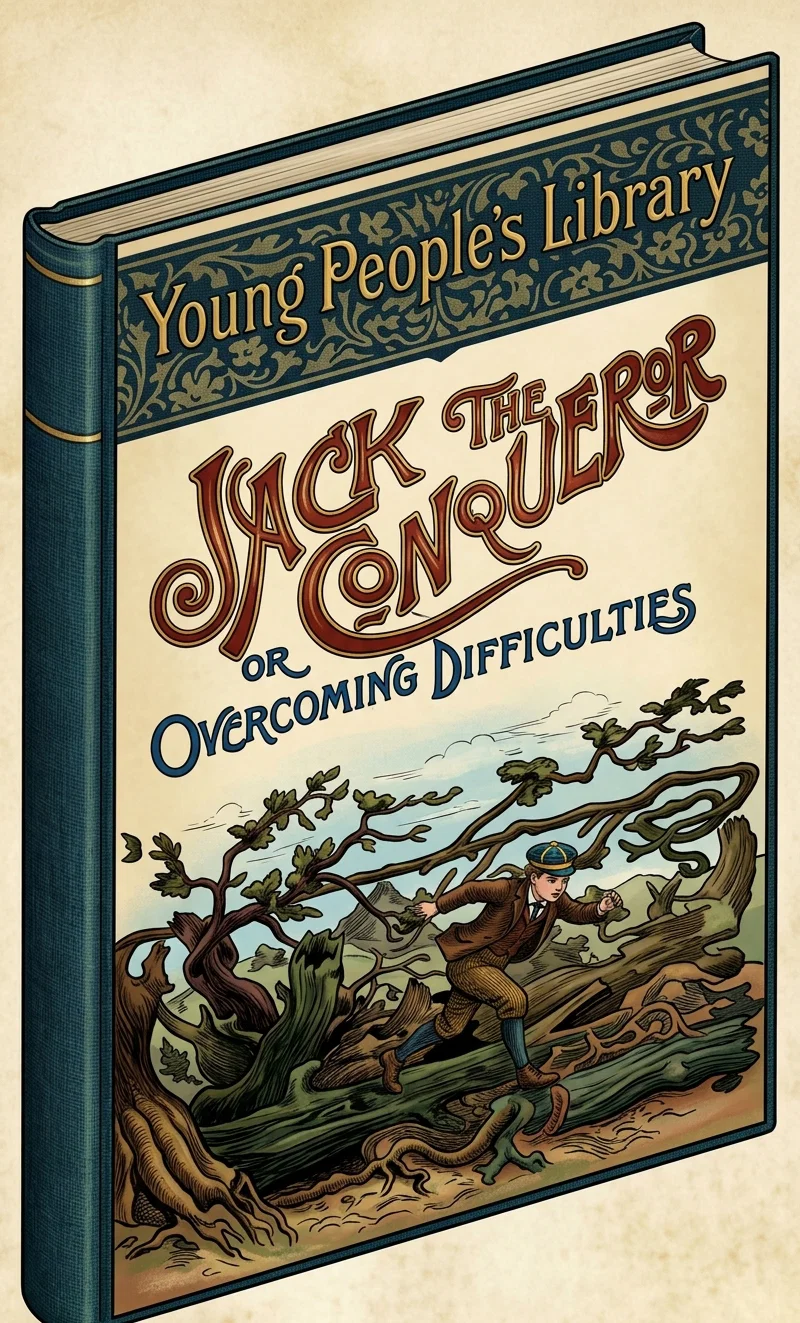
Each book is bound in attractive and durable cloth
What $1.00 will do
For one dollar cash and one dollar each month for SIX months, we will send you twelve books and three periodicals mentioned below
Each book is bound in attractive and durable cloth
Jack the Conqueror . . . $0 50
Left with a Trust . . . . 50
Letters from the Holy Land . . . 50
Fiji and Samoa . . . . . 50
Tonga Islands . . . . . 50
Two Cannibal Archipelagoes . . . 50
Life on the Kongo . . . 50
Among the Northern Icebergs 50
Native Life in India . . . 50
Life of Martin Luther . . . 50
Life of John Wycliffe . . . 50
Life of Savonarola . . . . 50
SIGNS OF THE TIMES one year 1 50
GOOD HEALTH “ ” 1 00
SENTINEL OF LIBERTY “ ” 1 00
Regular Price - $9 50
Or you can get the same books, bound in paper, with the periodicals, for $1.00 cash and $1.00 each month for four months.
Or if you want to pay cash down, the price will be $6.75 for the cloth-bound books, and $4.75 for the paper-bound. The papers will be sent one year in each instance.
The Books
These books have been prepared especially for the young, and combine real entertainment with genuine profit. They each contain 160 pages, are all illustrated, and are well printed and bound. The rate of 50 cents each in cloth is very low; in fact this binding has sold for 60 cents each until last year, when we had sold a sufficient number to enable us to reduce the price to 50 cents per volume.
A detailed description of the books will be sent on request.
The Papers
Although the most of our readers are familiar with the three papers included in this club, a few words concerning them may be in order.
The SIGNS OF THE TIMES is a 16-page weekly Gospel paper, covering a field entered by no other periodical in the United States. A consideration of the Bible prophecies which point to this time is its one great mission.
The GOOD HEALTH MAGAZINE stands, and has ever stood, for that which is most practical in diet and health reform. A year’s subscription—twelve numbers—will prove of incalculable benefit to any family not acquainted with its principles, and will be a continual source of help to those already familiar with its ideas.
SENTINEL OF LIBERTY—Heretofore this great Sentinel of the Liberties of the American people has been published weekly, but plans are now being laid to issue it monthly in magazine form, greatly improve it in every way, and publish it in New York City. Price will remain the same, $1.00 per year.
BOOKS TO ONE ADDRESS AND PAPERS TO ANOTHER—All the books must go to one address, but the papers may be sent to different names and addresses if desired.
BOOKS SENT WITH FIRST PAYMENT—Books will be sent and subscriptions for papers entered on receipt of order, accompanied by $1.00. EVERYTHING PREPAID—You do not have to pay a cent more than we have mentioned. Mail or express is fully prepaid by us.
ONLY ONE THOUSAND SETS—This offer is good to old and new subscribers alike. If you are already taking the papers your subscription will be extended one year. The only limit is the quantity of books we have on hand—one thousand sets.
ORDER BLANK
PACIFIC PRESS PUBLISHING CO.
OAKLAND, CAL.
*Gentlemen: Please send me by express the twelve volumes of YOUNG PEOPLE’S LIBRARY in ................. binding, and the SIGNS OF THE TIMES, GOOD HEALTH, and SENTINEL OF LIBERTY, each one year, for which I enclose $1.00, and promise to pay $1.00 a month for ................. months.*
Send the BOOKS to ................................................
The SIGNS OF THE TIMES to ................................................
The GOOD HEALTH to ................................................
The SENTINEL OF LIBERTY to ................................................
My Name and Address ................................................
THE MAORIS.
By J. E. Caldwell, M.D.
[An address before the Union Conference held at Cooranbong, New South Wales, July, 1901.]
THE Maoris are widely scattered in New Zealand, and on this account it is rather difficult to work among them. One man worked a year and then left, owing to discouragement, as they were so scattered. There are 40,000 Maoris in New Zealand. The recent census, while it shows an apparent increase, at least shows that they are not diminishing very fast. But even where they are found in largest numbers, there are still not many in any one place. In Whakatani County one may ride all day, and only see one or two natives. There are not more than two hundred in any one place. Maybe the Lord has ordered it so, that they may not be corrupted by living together in large companies.
The evangelized natives are chiefly Anglicans and Wesleyans. The Mormons have done much work among them, but the effect is not lasting.
We first visited the Urewera country. This part of New Zealand is perhaps the least known of any, owing to the hostility and jealousy of the natives. The Urewera tribe is that in which the notorious Te Kooti did most of his work. These people made the most violent attacks against the government troops. They are the most hardy and warlike of all the native tribes. They live in the mountains, and are said to number 900 or 1000. Until two years ago they were very jealous of the attentions of the whites. The climate where they live is the severest in the North Island. Their chief crop is potatoes. Some time back these failed, owing to frosts, and the government had to ship potatoes there to keep them from starving. The mountains are high and cold. It was in these regions that Te Kooti planned all his raids.
The Hauhaus include the bitterest enemies of the government. They follow Te Kooti’s religion. There is not the least doubt that he made a religion. He obtained some education, and possessed unusual strength of mind; and possibly this helped him to exercise a sway over men. He went over a good part of the North Island, and secured as many Ringatus as possible. He saw that as long as the people adhered to the Anglican religion, he could do nothing with them. They would not fight against their friends. He therefore made His own religion by mixing up various beliefs. He invented a ritual, and the Maoris have learned this ritual by heart. They are called Ringatus (those of the standing hand) because, whenever their ritual calls for “Amen,” they say it standing and holding aloft their right hands. Te Kooti taught them that the seventh day is the Sabbath, and they observe it as well as ordinary Sunday-keepers observe Sunday. Their moral condition is very deplorable, but perhaps they are not worse off than the evangelized natives.
Entrance of Whangaroa Harbor, New Zealand.
Two years ago when the government was surveying a road to Gisborne through their country, they made armed resistance. Troops were sent up, but the friends of the natives persuaded them to let the work go on. Now they are helping to build the road themselves. Along this road, which is made in many places by cutting into the hillsides, there is the most beautiful scenery. Here one may see mountains clothed in forests towering above his head, and deep precipices at his feet. Twenty-five miles of road still remains to be done. It is most delightful to ride along this road, and see the Lord’s wondrous hand in nature.
The time for the isolation of this people is past.
Their habits have changed, and now is the time for some society to enter and do the work. They are not friendly with the English Church; they are prejudiced against it, and no one of that body could work among them. They believe the seventh day is the Sabbath, and they look with suspicion upon any one who brings them Sunday. There is no regular religious effort made for the people of that tribe at the present time.
The point now is this: Shall we go on now, or wait till some other society has gone in and won their confidence? (A voice: “Now is the accepted ‘time.”) Yes; and now is the day of salvation for them. I believe it.
Mr. Allen, an agent of the British and Foreign Bible Society, visited these natives several times. He walked through their country alone to learn about them. He first visited Matatua, the old home of Te Kooti. He asked them to let him speak, but they refused. He asked them a second time, but was only allowed to read a few texts. When we went there, they asked us to speak to them right away. As we came up the hill toward them, “Haere mai! haere mai!” greeted us from all directions. Old and young were calling to us, “Welcome, welcome! Come, come!” We spoke to them that day in their best house. This was ninety feet long, and thirty feet wide. The corner posts were exquisitely carved and adorned with the images of their ancestors. There was no hole, or chink, or crevice anywhere, except a small door and window. The house had an earthen floor and an iron roof. They had a fire in the center of the building. Unwisely, I stood up to speak. Moses Shepherd stood beside me. As I was going to the door at the close of the meeting, I staggered and reeled. I had been poisoned by the bad air. There were a hundred there. (Pastor Gates: “Yes; and they were all smoking, ‘too.’”)
Their ordinary dwelling-houses are made of raupo. The sides and roofs are thatched with this, leaving an opening in front. Everything is done to make the sides as air-tight and warm as possible. They build a fire in the room, and the smoke is awful. They lie on the floor to avoid it.
In their services a lay preacher does the reading. He reads a few verses, and they respond with part of the ritual, and so on till their service is ended.
I wish to impress this fact: The Maoris are pleased to find a people who keep the seventh day. They were very glad to see us, and treated us very well. The Seventh-day Adventists have a special mission to go to the Maoris with the Gospel. But it must be done at once. The first who go there will have the advantage.
(A voice: “What Bible do they use?”)
The Bible used is the Anglican Bible somewhat revised. Many of them object to the few new words in the revision. They prefer the old copy. (Pastor M’Cullagh: “Have other societies made any efforts ‘among them?’”) The Salvation Army made a small effort for two years, but left for want of support. Their missionary asked the natives in vain for ten acres of land. This question of land is a burning one with the natives. Some time ago the government forced a missionary society to disgorge 30,000 acres they had obtained from the natives. When this missionary asked for land, the natives said, “What is the ‘matter? The old missionaries wanted land, the government want land, this man wants land. We don’t ‘want him.’” It is not wise for us to ask for it. Let the Lord move upon them to offer it if it is needed.
Let me tell now of my visit to the King country. It is situated in the valley of the Waikato River, and to the westward of it. Here is found more advanced civilization among them. They welcomed us as readily as the others. They are more intelligent, as there are more schools among them. The children are being taught the English language. We visited Brother Hill at Raglan, where we were kindly treated. Here we find a native school taught by two sisters who are Roman Catholics. They invited us to have lunch with them, which we did. We asked one of the sisters, “How do the natives ‘spend their Sundays?’” “O,” she replied, “they ‘work all day.’” “What,” we said, “don’t they ‘keep any day?’” “Yes; they keep Sunday on ‘Saturday.’” “Why do they do that?” we asked. She answered, “To show their contempt for the ‘white man’s ways, I suppose.’” Now, how is it that these people were observing the same day as ourselves? (A voice: “They had been reading the ‘same Bible.’”) Exactly. God has a people there for us to work among, and we must do it at once.
Around Kawhia there are 750 natives living in their own places. One old man there said to me, “If you do not stay with us, we shall all die.” And13that is true physically and spiritually. Well, we are so pleased with the prospects that we have agreed to recommend that our first effort be made in the north of the King country.
There are some natives in the Waikato country, but they are very scattered. In Kawhia there are 1,440 natives, and these can be reached in half a day’s drive round there. We must have both a boat and a horse, however, to work among them. Some time ago the government started to survey Kawhia South, in order to establish a town there, but the natives objected. Maybe the time will come when the country will be opened up.
Let me tell you one reason why we proposed to start at this point. In the Urewera country there is a lawsuit on about the land. It might be that if we built there, soon the people would leave, and we should have no one to work among.
A Tree Fern.
A Bush Scene in Whangaroa.
Their literature is very limited. They have a Bible. Mr. Allen, the missionary I spoke of, has sold them more. Besides this they have no other literature. I have heard that there is a small native paper published on the eastern coast. We are having prepared one tract on the coming of Christ. There is also in the hands of the translator a tract on health. “Christ Our Saviour” is now being printed at the Avondale Press. This literature will open the way for the living preacher. We want a few young people to go among them selling and giving this literature. About one-fifth of the Maori children can read English.
There is abundant evidence that the harvest is ripe. Now is the time to begin. There is a most remarkable opening. J. E. CALDWELL, M.D.
“DOE YE NEXTE THYNGE.”
By Alice Armstrong
[Alice Armstrong, in the Baptist Argus.]
The mysterious thread of life,
Which lies in a tangled skein
Of duties and joys and voiceless hopes,
All knotted at times with pain,
Will untwist its vexed string
As you “doe ye nexte thynge.”
The duties of every day
Coil closely from head to feet,
Till, throbbing with pain, the heart and brain
Against the dread meshes beat:
Would your heart soar and sing?
Only “doe ye nexte thynge.”
Ambition, with mighty greed
For riches, or fame, or place,
Entwines round the soul its web of lust
And strangles each heavenly grace:
Would you live by the Word?
Give “ye firste thynges” to God.
With peace in the heart and mind,
Life’s skein, in its tangled maze,
Unravels its mysteries one by one,
E’en down to the end of days:
Then “ye laste thyngge” will be
To pass over Death’s sea.
MINDINAO
By G.
CONGRESSMAN HULL is reported to have said that it will be "bad policy to send missionaries to Mindinao Island, in the Philippines, because the people are bigoted Moslems, and will resent any interference with their religion." And because he has been on a tour of that region, some others who profess to believe the Word of God are inclined to accept his judgment in the matter. But it should be remembered that his judgment is based on sight not tempered with faith. The Gospel commission is, "Go ye into all the world, and preach the Gospel to every creature." Also in the very end of probationary time we have the revelation of an angel flying in the midst of heaven, "having the everlasting Gospel to preach unto them that dwell on the earth, and to every nation, and kindred, and tongue, and people." The angel represents the missionaries of the Gospel, by whom alone the good tidings is preached among men, and the flying represents the rapidity with which this message must go; for it is joined by another flying messenger proclaiming that Babylon is fallen; also by a third announcing the doom of those who reject the invitation and warning of the first and second angels. See Rev. 14:6-12. So, however observing men may be, and however pessimistic as to the probable results, the servants of God must not shrink from their appointed work. The results belong to God. We know that the Lord will save some in Mindinao; for the same prophet saw a vision of "a great multitude, which no man could number, of all nations, and kindreds, and people, and tongues," who "stood before the throne, and before the Lamb, clothed with white robes, and palms in their hands." Ch. 7:9. This vision is a prophecy, and will not fail of its fulfilment, for the Word of the Lord can not fail. Another prophet said of Christ, "He shall not fail nor be discouraged, till He have set judgment in the earth; and the isles shall wait for His law." Isa. 42:4. The adversary of the Gospel would be glad to see Mindinao let alone on any pretext, and would be much pleased if this neglect could be accomplished by means of a representative of a "Christian nation." But let the representatives of Christ "not fail nor be discouraged" until the isles have received His offer of salvation, Mindinao and all.
G.
OUR WORK AND WORKERS.
At East London, South Africa, there is a Sabbath-school of twenty members. Brother D. F. Tarr is laboring there.
The sanitarium work at Paducah, Ky., is said to be prospering under the management of Dr. L. J. Otis, a former California boy.
In Field Echoes Brother L. N. Lane notes the baptism of two candidates at Charlotte, Mich., on the 7th inst., and six at Grand Ledge, on the 22d.
At Bozeman, Mont., under the ministration of Brethren J. C. Foster and W. A. Gosmer, ten persons have decided to obey the voice of the Lord as heard in His Word.
Prof. F. W. Field, who for the past eight years has been connected with the academy at Mount Vernon, Ohio, has been assigned to the Japan field, and expects to sail from San Francisco October 15. Preparatory to this mission he has been ordained to the Gospel ministry.
August 17 two candidates were baptized at the Kolo Mission, South Africa, being the first baptism at that place. Brother D. Kalaka writes to the Review that there was a large gathering, and the people were quiet and attentive. The workers have erected a small service building, and some of the people donated grass for the thatching.
A meeting-house, dimensions 30x40 feet, is being erected at Uitenhage, South Africa. The work there is under the supervision of Brother Herbert J. Edmed. There is also a good interest among the German population, with whom Brother Ernst is doing Bible work. There are also Sabbath-schools at Cambridge, Graham’s Town, and Sharon.
At Boonesboro, Mo., fifteen persons have covenanted to “keep the commandments of God and the ‘faith of Jesus.’” This is the result of labor by Brethren W. S. Cruzan and L. W. Terry. A Sabbath-school has been organized.
Brother W. S. Hyatt, president of the South African Conference, says that a large amount of our literature has been scattered over Africa. Thousands of papers have been placed in the hands of soldiers and sailors, and distributed in hospitals and Boer prisons and camps.
On the 10th inst., Brother C. H. Jones, manager of the Pacific Press Publishing Co., left for New York City, to transact business connected with the New York branch of the institution. He will also attend the fall council of the various committees of the General Conference at Battle Creek, Mich.
Under date of August 29, Brother D. P. Gaede, writing to the Workers’ Bulletin concerning his work in Russia, says: We are all well, and enjoy much of the blessing of God. Some twenty joined the people of God, as I made my last trip. Now we are on our way to Riga, a city in the north, about twelve hundred miles from our former location. At our last general meeting in Germany, our field was divided, and I am to have charge of the northern part. My address is now Dorotheen Str., 2 F. Wohnung 24, Treppe 1 St., Riga, Russia.
Of the work in Denmark, Brother P. A. Hansen writes, September 18, to the Workers’ Bulletin: You will remember that at the time of our Conference meeting in Odense, Fyen, twenty-two were baptized. Sabbath before last I had the privilege of baptizing six more at Ringe. The place of baptism was about three miles from the city. A great many people went out, some with teams, others on foot, and scores on bicycles. Brother Raft addressed the assembly, and the Spirit of God made the Word “quick and powerful.” Following this was the baptismal service. Our hearts were filled with joy. The daily papers of Copenhagen gave a good report of the occasion. The truth is taking root on the island of Fyen. At Ringe we expect to organize a church soon. There are about sixteen Sabbath-keepers there, as the result of the efforts of Brother P. Christensen and wife.
Here is a hint to our church choirs. May they always be careful not to sully this good report. Their example has a decided influence on the reputation and efficiency of the cause. After the camp-meeting in Oswego, N. Y., Brother A. R. Hyatt called on a gentleman who had become somewhat interested in our work. During the interview the gentleman said: I have been very favorably impressed with your people. From what I have seen of them, they are a people I would not be ashamed to be found associating with. I am not a church-member. I have repeatedly been invited to join churches here as a full member without probation, but I can’t do it. I can not believe some things they teach, and do not like many things they do. I do not like to see anybody and everybody engaged to sing in church choirs, and then to see them, during service, whispering and giggling. If I had seen any of that in your choir at the camp, I would never have gone near your service again. But I am thankful to say that every member of your choir deported themselves as Christian men and women, and I was very favorably impressed with them.
In the Southern Watchman of the 2d inst., is a notice of the new Southern Publishing House, by Brother R. M. Kilgore, from which we take this information: It was my pleasure this week to spend some time in counsel with the managers of this institution at Nashville, Tenn. The new building, now nearing completion, is a model, and its large, well-lighted, airy rooms are nicely planned, and well adapted to the purpose for which the structure is dedicated. The motto of the managers is, “No debts—pay as we go.” Throughout the building everything gave evidence of life, thrift, and push. Their orders are crowding them. More necessary new machinery is called for. This demand is imperative and this calls loudly for more money, and our good brethren everywhere should take shares of stock, and lift now with those who are struggling against odds to make this institution what it should be. . . . This house is publishing two periodicals, the Gospel Herald, designed for the missionary paper, and the Southern Watchman, our conference paper. It is the plan to make this paper the organ for all the conferences in the Southern Union Conference. Instead of each conference having a State paper, all will unite in making this one a paper of which we may feel justly proud. Brother C. P. Bollman is the editor, and we all know that he will make it a first-class conference paper.
FIFTY TESTAMENTS AND THEIR EFFECT.
By no means all of the missionary work is reported in the missionary magazines, numerous though they are. A year ago a lady was living near a town where fifty Italians came to work. She became very much distressed at the heathenish way in which they lived, for she discovered that they never went to church, and that the nearest Roman Catholic priest had not taken the trouble to look them up. Most of them could speak no English, and she could speak no Italian, so she was at a loss to know how to help them. Discovering that almost all of them could read in their native tongue, she purchased copies of the New Testament in Italian and gave one to each man. It was not long before one of the leaders came to her, and asked if there was a church where they could go and hear that Book read. He said most of the men were reading it, many of them with much interest. She consulted with her pastor, and they arranged to have a man come from the neighboring city and preach to them in Italian. The men were so interested and grateful that other meetings followed until now that church has what might be called an Italian annex, and the results of the work are most gratifying. It is needless to say that the priest is now indignant over what he considers an encroachment upon his territory.—The Congregationalist.
Religious Liberty in Russia
In the land of the czar there are about 6,000,000 Protestants. To these, religious liberty is accorded, “with the stipulation that they must be born of Protestant parents, and must not proselyte.” For “Russians do not like people to change their religion; they think that to do so shows a lack of any strong conviction. They are, in fact, perfectly tolerant to the Protestant religion, and intolerant only when it touches the Greek Church.” Every Sunday, in the Protestant churches of St. Petersburg, preaching is heard in nine languages.