A CERTAIN rural school teacher recently exhibited with considerable pride, to a visitor, a glass case on her desk containing a toothbrush, as a mark of the school's devotion to hygiene, for every morning all the members of the school took their turn at the toothbrush.
While this use of the toothbrush is hardly to be commended, it is desirable that every child be taught to care properly for his teeth; and this means a great deal more than merely brushing them three times a day. That one's teeth may be sound and healthy even in middle life, one must from childhood daily give them the best of care.
One may use the toothbrush with powder or paste three or four times a day and yet the teeth not be clean. Good tooth paste and powder should be combined in washing the teeth. And this treatment should be followed by a thorough rubbing of the teeth inside and out with a piece of cloth, preferably Turkish toweling. Some dentists regard the cloth treatment as more effective in the cleansing process than the toothbrush. At any rate it should always supplement at night the use of the toothbrush. The tongue and gums should receive the same attention as the teeth. The cleansing of the teeth is not complete till by the use of dental floss or wooden or quill toothpicks every particle of food is removed from between the teeth. To complete the cleansing process, it is well to use often some antiseptic mouth wash. Your dentist will recommend a suitable wash.
The Unclean Mouth
Dr. Woods Hutchinson, noted professor and author, says:
“Not only should the teeth be kept thoroughly clean and sweet for their own sake, but also for the sake of the stomach and the health of the blood and the whole body. The mouth, being continually moist and warm and full of chinks and pockets, furnishes an ideal breeding ground for all kinds of germs; and the average, uncleansed human mouth will be found to contain regularly more than thirty different species of germs,8each numbering millions! Among them may sometimes be found the germs of serious diseases, such as pneumonia, diphtheria, and blood poisoning, just waiting, as it were, their opportunity to attack the body. In fact, a dirty, neglected mouth is one of the commonest causes of disease.”
Tartar, the dark, hard, calcareous substance that collects between and at the base of the teeth, is now thought to be caused by a germ. Decay often occurs under this tartar. Therefore it should be removed at least twice a year by the dentist.
“Among other germ diseases of the unclean mouth may be mentioned inflamed gums, abscesses of the teeth, blood poisoning, and pyorrhea, or Riggs's disease. The last-mentioned is caused by pus-forming germs that lodge under the gums and around the roots under tartar or other hard deposits. The membranes of the roots and their bony sockets become infected, the teeth become loose, and pus flows from under the gums. This often causes foul odors to come from the mouth. Thorough cleanliness is a preventive of Riggs's disease as well as of other diseases of the mouth and teeth.”
Boys and girls, if you do not want the little sac, or membrane, that surrounds the roots of your teeth to become filled with the little wriggly germ-animals that characterize Riggs's disease, if you do not want your teeth early to loosen and fall out, if you do not want the little pus sacs to discharge their contents into your mouth, giving to your breath a sickening, foul odor, you must care for your teeth just as carefully as this article indicates, today, tomorrow, and every day.
— Thomas Westwood
By Thomas Westwood
Turncoats
SAID a little black tadpole to another,
That happened to be his elder brother,
“Pray, what strange creature is that I hear
Croaking so loud?” “A frog, my dear,”
Said the brother, “and there he sits.” “I ne’er
Saw an uglier monster, I declare,”
Cried little Taddy, wriggling his tail
In an offhand fashion that could not fail
To show his contempt. “It’s really a pleasure
And satisfaction no words can measure,
To think that we are so smooth and slim,
So handsome, so—very unlike him.”
“To be sure,” said his brother, bobbing and blinking,
“To be sure, I’m just of your way of thinking.”
The air was mild, and the sun was strong,
The tadpoles were turned to frogs erelong;
The little one croaked, the big one croaked.
At last said the younger, “Of course, we joked
That day in the ditch; for there’s no denying,
And in fact it’s a truth past all replying,
That whether in mere or marsh or bog
The handsomest creature, by far, is a frog.”
“To be sure,” said his brother, bobbing and blinking,
“To be sure, I’m just of your way of thinking.”
— Thomas Westwood
Speed Statistics
A GENTLE wind about 5 miles an hour.
A high wind about 30 to 45 miles an hour.
A great hurricane, 80 to 100 miles an hour.
Torpedo boat destroyer “Albatross,” built by Thornycroft & Co., for the British Navy, 32 knots an hour, i. e., about 36¾ land miles an hour.
Torpedo-boat destroyer “Express,” by Laird & Co., of Birkenhead, for the British Navy, 33 knots an hour.
The Atlantic passage by the “Lucania,” and some other first-class steamships, reduced to about 5 days, 7 or 8 hours.
Average speed of some of the best express trains, 60 miles an hour, or 29⅔ yards a second.
In order to accomplish an average of 60 miles an hour the train will sometimes be running at the rate of 80 miles an hour.
Some of the fast expresses run according to gradient, slowing down to 40 from 80 miles an hour.
The velocity of the earth around the sun calculated to average 66,000 miles an hour.
Velocity of the moon calculated to be 2,273 miles an hour.
Flight of carrier pigeon, average about 800 yards a minute.
Sounds travel through dry air (founded on Laplace and Newton’s calculations) at the rate of about 60 feet a second.
Sound travels through water at the rate of about 240 feet a second.
Sound travels in steel wire at the rate of about 17,130 feet a second.
Velocity of great comet of 1882, when in its orbit nearest the sun, calculated to be 298 miles a second.
Electricity is said to travel along wires in submarine cables about 2,420 miles a second.
Electricity is said to travel along wires above ground about 22,360 miles a second.
Light travels at a velocity estimated by astronomical observations to be about 186,770 miles a second.
The blood is pumped through the body at the rate of 621 feet a minute.—Selected.
Nobody Loves a Camel
By Rodney Gilbert
BEARING an innate grudge against all restraint and all who restrain him, the camel will use the great strength of his long legs to kick his keepers, or the dogs that guard him in the waste places. But in the presence of enemies—among wolves or other beasts of prey—he is a coward, forgets the very use of his legs, and proves his erratic temper by screaming and spitting in terror. No camel wants to be loved, and no one familiar with camels ever entertains the least affection for them.
The Arabs and Egyptians of the Near East speak proverbially of the malice and vindictiveness of the camel. The Mongols, Chinese, and Turks of the Far East say that the camel is too stupid to be either malicious or vindictive.
The poison of all other beasts is his food. He pines and wastes in fat meadows, but grows fat, powerful, and savagely independent among alkali-crusted sands.
Panic is the greatest failing of camels under all circumstances. The stupidest and laziest camel will show all the silly coyness of a thoroughbred colt in the presence of a white stone, a heap of bones, or some sprightly little animal that darts about his feet.
The slightest cold carries him off, and when one camel dies, all are likely to die. If a camel sinks in the mud, he strains his long legs and is never good again as a carrier. On ice they are hopeless. Mongols traveling in winter are forced to carry bags of sand wherever they go, which they must scatter upon every little patch of ice they approach.—Rodney Gilbert.
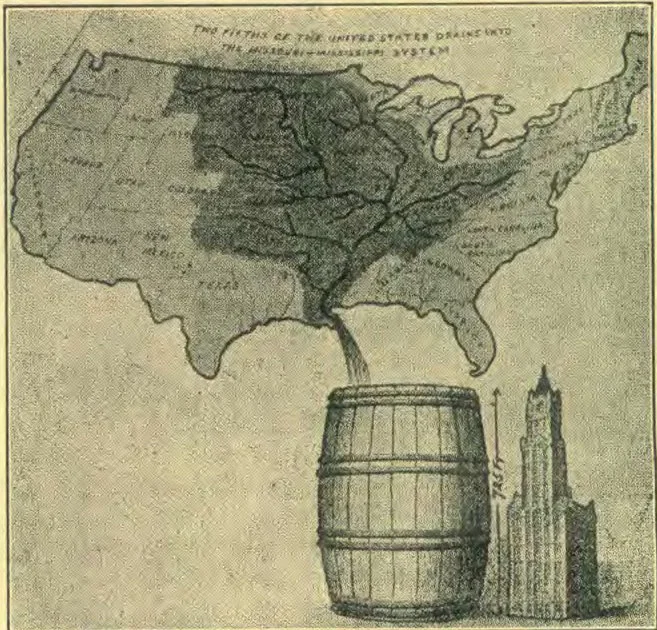
This illustration represents the Mississippi River as flowing into a huge water barrel. In order to hold a single minute's discharge this barrel must have a capacity of 138,000,000 cubic feet, which would make it something like 725 feet high, or a little short of the height of the Woolworth Building. If the river entered into a lake the size of New Jersey, it would raise it one foot in ten hours.—Scientific American.
Salute for the Flag
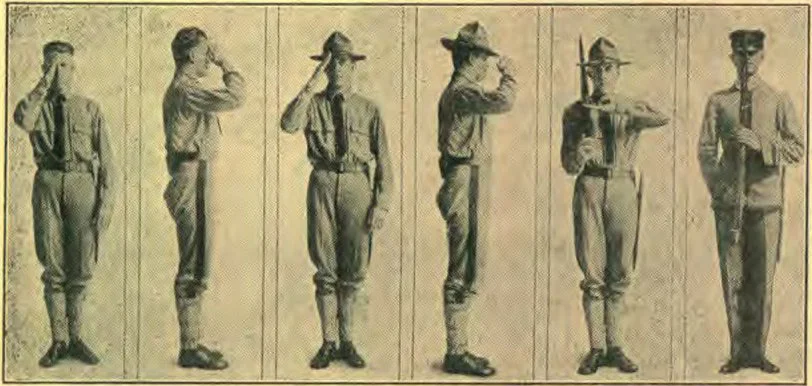
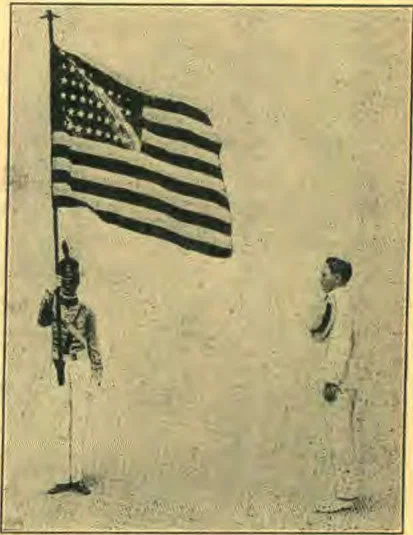
THE military salute for the flag is described thus: “Always the right hand, elbow out in front, forearm a straight line from elbow to finger tips, thumb held in to the hand, first finger touching the forehead above the right eye, or else touching the brim of the campaign hat. Hold the position an instant, looking at what you are saluting, officer or flag, then bring the hand quickly to the side. That is the military salute for those in uniform.
“Or, if armed with a rifle at right-shoulder-arms, the left hand is raised, and crooked at the elbow on a horizontal plane to bring the forefinger touching the firing mechanism. A sentinel salutes by presenting arms,”
“Indoors, the civilian salute consists in standing, uncovered, and remaining silent. Outdoors, when the flag is displayed or ‘The Star-Spangled Banner’ played, a boy or man should hold his hat by the brim in his right hand in front of his left shoulder, while a girl should rise and stand at quiet attention.”
For the Finding-Out Club
1. What is the meaning of the sign ℞ on a doctor's prescription?
2. How many eyelids do birds have?
3. What are the eyes of a ship?
4. What is the origin of the word “quinsy,” and how connected with its present meaning?
5. What and where was the Spanish Main?
6. Name the author of the following quotations:
a. “Full many a gem of purest ray serene,
The dark unfathomed caves of ocean bear.”
b. “Though he slay me, yet will I trust in him.”
c. “God tempers the wind to the shorn lamb.”
d. “Like one who wraps the drapery of his couch about him
And lies down to pleasant dreams.”
MRS. GRACE HOOVER.
Who Is He?
It was a perfect Iowa day, ideal for fishing, but Billy was of necessity helping his grandfather weed the garden. How could a small boy be thrifty under such bright summer skies? And soon grandfather discovered his companion in labor dreaming in the shade of a currant bush.
“Hello, son; what are you doing there?” queried the old gentleman.
“I was just a-thinking, grandfather.”
“Thinking? What about?”
“Thinking about what I’m going to do when I get to be a man.”
“And what do you think you are going to do then?”
“I think I’m not going to pull weeds when I get to be a man. I’m going to hunt around and find a good job I can work at with my head.”
During his early years this small boy saw much of the seamy side of life, and his mother, a widow, was finally obliged to send him to the Soldiers’ Orphans’ home in Davenport. There he had good school advantages, systematic religious instruction, and was taught to be earnest, energetic, and painstaking in his work. Discharged at the age of fourteen, he went to live with his grandfather; but farm work was not to his liking, and he started out to find the “job” of his dreams. And today he is working with his head, though no one could accuse him of physical indolence.
At one time when he was out of work he heard that Col. John Scott, of Nevada, wanted a boy, and immediately applied for the place. The colonel liked him at once, but Mrs. Scott was not so sure, so she said, “Scrub the cellar steps for me, son.” The boy went to work with characteristic energy, and the same sunny smile that has won for him thousands of friends. If he had been asked to pick his own job for a try-out he would have chosen scrubbing cellar steps. It was a trade he had learned well at the home, and by the time he had finished, Mrs. Scott was satisfied. While working here he attended high school, and during the last two years of his course held the position of janitor of the school building.
Soon after he finished school he became interested in baseball, and signed as a professional player in the National League.
While his team was playing in Chicago, he was converted, and became an active member of the Presbyterian Church. He was as energetic in his religious duties as in his ball playing, and frequently gave pointed and practical talks for the Y. M. C. A., later leaving his professional career to connect with the said organization as its religious secretary.
His first direct evangelistic work was done under the guidance of Dr. J. Wilbur Chapman, and the revival meetings he conducted were a marked success. His message from that time until the present—more than twenty years—has been, “Get right with God.” Throughout the length and breadth of the country he bears his testimony, never hesitating to call sin by its right name. Men may criticize the methods and unconventional language of the “baseball evangelist,” but one could not hear him and gainsay his earnestness or discount his courage.
He hates “booze” and has never used tobacco. He tithes every dollar of his income. He never takes a journey of any length that he does not invite the engineer and fireman to come to Christ. L. E. C.10
Can You Name Him?
He grew gray in the service of his country, regarded by many as an impossible military genius.
Statesmen liked to hear him talk,—he had done brave things in strange parts of the world,—but they found his talk impractical. It was unlikely that there would ever be another war of great magnitude, they argued, and if such a one did come, science and not strategy would decide it.
He was forever talking strategy, this old man. His military superiors laughed at him. Strategy was all very well in fighting savages; Cæsar and Napoleon had got away with it, and Hannibal, they said; but it had little place in the curriculum of a modern war college. These were the years immediately preceding 1914.
“I am old,” he said; “I will retire.” He was then more than sixty. The small fortune he had inherited from thrifty parents had dwindled away while he was seeing service in the colonial possessions of the republic. He had his retired general’s pay, however, and a small estate in the vine country of France. He planned to spend his last years cultivating flowers in a modest way. And, as he made his plans, the great war came. One of the strangest things about this strange war is the chance it has given to old men to prove the efficiency of theories they had held while others laughed.
In July, 1914, the old French general brushed his service clothes, polished his sword, and reported for duty, only to find that another general had been promoted over his head and given a superior command. It was Joffre, unerring judge of military genius, who took him out of reserve and sent him into Alsace. The Germans found him waiting when they attacked Verdun. Until Verdun’s long agony his tactics of ambuscade and indirect attack had been held little short of preposterous.
Then suddenly France realized that another great old man had come to the fighting force; for Verdun held, giving back blow for blow. This general went farther than any one else in despising Germany’s artillery onslaught. Strategically he lured the foe into furious fire upon points where the danger was least while he worked to “trim the edges.” He had used similar methods, in former years, in fighting savages in Algeria and quelling uprisings in China. The Germans were no more to him than maddened Hottentots—and Verdun held. Now he is known as “the hero of Verdun”—all France regards him as the eccentric genius to whom she must look for ultimate victory.—Every Week.
What Boys and Girls Have Done
Sold and Bought Liberty Bonds
MRS. WILLIAM G. MCADOO, daughter of President Wilson, and wife of the Secretary of the Treasury, in an article written recently for St. Nicholas, tells what the boys and girls of the public schools have done in the Liberty Bond sales:
“One farmer’s lad in a lonely part of the West commandeered his father’s automobile during the last Liberty Loan sale, and sold bonds worth twenty thousand dollars to farmers living in remote places. In Boston, the newsboys on the streets were able to make a fine showing in the sale of bonds. A little girl in Tennessee sold so many bonds that her feat attracted the attention of the whole State. It was discovered that she was a Girl Scout; and now a movement is on foot to secure for her one of the handsome war-service medals that are soon to be given to certain of the Boy Scouts for exceptionally good work in the sale.
“The pupils of the Chicago public schools subscribed to the Second Liberty Loan to the amount of $2,237,150. In one Chicago school, $11,500 worth of Liberty Bonds were purchased by 206 pupils. One student in this school took $700 in bonds, and another, $500. In most cases the subscribers in this school borrowed the money and are now paying off their loans in monthly installments.
“A St. Louis high school with 1,300 students subscribed for more than $6,000 worth of bonds.
“But the greatest record of all was that of the Boy Scouts, whose fine services have made their organization one of the indispensable parts of the Government’s war-bond selling machine. Of every forty-seven dollars received by the Government for the second Liberty Bonds, one dollar was secured by the Boy Scouts. With less than three hundred thousand members, the Boy Scouts secured subscriptions to the amount of $102,084,100!
“Because of the exceptional nature of this war service the Government is giving a special recognition to the Boy Scouts. War-service medals are soon to be presented to the Boy Scouts who did the best work in the campaign. On these medals will appear, with the express consent of the Secretary of the Treasury, the seal of the Treasury. This seal is placed on all the Government’s paper money; and it is against the law of the nation to reproduce it anywhere else except by consent of the Secretary of the Treasury.”
The Junior Red Cross Work
The school children of the country are now well organized for Junior Red Cross work. Already much has been accomplished by these young and efficient enthusiasts.
The Junior Red Cross of Los Angeles, California, has turned old tin cans, boxes, newspapers, bottles, rags, and rubber into “a steady stream of gold for use in Red Cross war service.” In a single month $1,200 was realized from the sale of this waste material. The first month an effort was made to collect and sell waste tin foil, $93.50 was received. The monthly sale now amounts to more than $100. Street sweepers and park workmen, candy and tobacco stores, help in collecting the tin foil.
Chicago schools before the beginning of 1918 “had contributed 17,122 garments for refugees and hospital patients, besides hundreds of knitted sweaters and other articles.”
Juniors in Buffalo sent 6,000 packages of peanut brittle to cantonments for Christmas presents. Most of the efforts of these juniors is devoted to supplying the refugee children of Europe with clothing, largely from clothing made from their own discarded garments.
In “Little Italy” in New York City, the children are saving the pennies and nickels they would spend for candy and gum, for the relief of their needy cousins across the sea. At least twenty-five dollars a month is raised through this self-denial fund.
A boy “raised a pumpkin large enough to fill forty-eight cans, which sold for ten cents a can. The $4.80 went to the Red Cross.”
The Juniors of Plainfield, New Jersey, by the first of the year had manufactured nearly 3,000 garments for soldiers and refugees.
One girl makes her ten dollars a month selling homemade candy, and other girls have held a “waffle day,” feeding 2,000 persons waffles, sirup, and coffee.
This report of the ways the boys and girls of the country are raising money for the Red Cross work suggests ways that our own boys and girls can raise money, both for the foreign missionary work and the Red Cross work. This is no time to waste time. The world is in need. It needs money, clothes, food, and most of all the bread of life. What are you doing to supply these great needs?
“We shall do so much in the years to come,
But what have we done today?
We shall give our gold in a princely sum,
But what did we give today?
We shall lift the heart and dry the tear,
We shall plant a hope in the place of fear,
We shall speak the words of love and cheer,
But what did we speak today?”
Edward Everett Hale's Rules for Effective Talking and Writing
How to Talk
Do not talk about your own affairs.
Confess ignorance.
Talk to the person who is talking to you.
Never underrate your interlocutor.
Be short.
How to Write
Know what you want to say.
Say it.
Use your own language (the language you use in daily life).
Leave out all the fine passages.
A short word (other things being equal) is better than a long one.
The fewer words the better.
The Right Incentive
I CAN’T say that I like this tendency some people show to need a prize offer before they’ll buckle down to do their best work,” I heard a business man remark the other day. He had been actively interested in certain sectional development work and spoke feelingly. “I’m tired of going around from one firm to another, and asking each one to put up a handsome prize as its contribution to the work that ought to go with a vim without any such outside inducements. Work for work’s sake — when the work is of a kind that ought to be done — I consider that the finest kind of incentive.”
“So do I,” said a listener, a man prominent in educational work, “that is what I am preaching to the young folks in our schools. I am trying to cultivate in them the desire to excel — to accomplish something worth while, with the achievement as its own big reward.”
Only the other day, while I was detained in a little store, I overheard scraps of a conversation between a young man and one of the salesgirls.
“And you carried off nine of the prizes?” she was saying in an admiring voice.
“Yes.”
“How much did they come to — were they all money prizes?” she asked, rather bluntly.
“All but one,” said the young man. “I got eight cash prizes — they were from a dollar up to two and a half, so I made a pretty good thing out of it. Altogether they amounted to thirteen dollars.”
“Well, you did do well,” said the girl. “I congratulate you! Thirteen dollars!”
“Well, I myself thought that that wasn’t bad! It’s quite a neat little sum!” assented the young man complacently.
What the achievements were that had brought him these eight money awards I have no idea. All that impressed me was his own and the girl’s evident valuation of his work in dollars and cents.
Prizes are not always to be decried. Sometimes it is right to offer them, and for young people, or older ones, too, for that matter, to try to win them. But surely the tendency to think of the tangible prize as the main incentive is to be deplored! — Young People’s Weekly.
Lost in a Blizzard
By Orpha Strong
TWENTY-NINE years ago the ninth of January, there occurred a terrible blizzard in the Territory of Dakota, in which many lives were lost.
The country was sparsely settled, so that one might look over the level or gently rolling prairie as far as the eye could reach and see no settler’s cabin to break the monotony of the scene. The climate in winter was very severe and the wind blew almost constantly, sometimes at a terrific speed, and if snow covered the ground, it was taken up by the wind, making it impossible to see any distance.
Just two years previous to this a young man, whom we shall call Henry Parks, had brought his young bride to this country to share with him the hardships and pleasures of a pioneer life. She did not shrink from living in a granary during the first year of their married life, for was not this the nucleus of their home to be?
They had one close neighbor, a bachelor who had taken a claim adjoining theirs. A few other settlers were scattered about with perhaps only a sod hut for their place of abode. The nearest town was thirty miles distant.
The next summer they built a warm one-room house, and this was well, for the following winter was an unusually severe one. During the year the Soo Railroad was put through, bringing a station within seven miles of their home.
One clear, still morning in January, the day already referred to, Mr. Parks hitched his horses to the sleigh to drive to the station to obtain necessities for their humble home. A deep snow had fallen during the night and was lying soft over the ground. The trail was entirely covered. With such conditions one must have a good sense of location to travel even in the fairest of weather, for there were no fences to mark the way. But Henry Parks had no fear, for he was accustomed to the country, and knew that he must drive due east three miles before turning north.
He had gone a distance he knew to be two miles, when the horses began to snort and act uneasy. At the same instant he became aware of a distant roar, and looking to the northwest—the storm corner—he saw a great white blizzard rolling toward him at a tremendous speed. He quickly turned toward home, but had gone scarcely ten rods when the storm burst12upon him with all its fury. Driving almost in the teeth of the blizzard, he was never able to see more than a rod ahead, and at times the snow was so blinding he could scarcely see the horses.
The tendency of the inexperienced when lost in a blizzard is to follow the course of least resistance and to go with the wind, but Henry Parks knew that his little nest lay two miles straight west and that the storm must strike his face from the northwest. Accordingly, he guided his horses, who fain would face the storm. After covering a distance which he thought to have been two miles, he circled around hoping to locate some familiar object, but failed in this. What should he do? To go on would mean certain death as there was no settlement for many miles. If he stayed where he was he would freeze to death. He thought of unhitching the horses and digging a cave in a snow bank, there to wait till the storm should be over.
In the meantime Mrs. Parks had walked the floor, wringing her hands, and beseeching God in behalf of her husband. Occasionally she would step outside the door and call as loudly as possible in the vain hope that she might be heard above the roar of the wind.
During this time the snow had banked up eight or ten feet around the house—not close in, but as is always the case, leaving a space of several feet around the building.
All at once she heard a sound which could not have been caused by the storm. She rushed to the door, and there was her husband, sled, and horses, as white as snow could make them. Unable to see, they had fallen down the embankment. She begged him to put the horses in the house and not to risk going to the barn, but he would not do that. Furnishing himself with a rope, he fastened one end to the house and the other end to the barn. After he had provided the stock with food enough for several days, he returned to the house and related the story of his deliverance.
When all human effort had failed, he earnestly prayed to the Lord to lead him safely home. Almost immediately there was a lull, and he could see his nearest neighbor’s house on the hill above him. Then he knew he was only a short distance from home, and hastened thither. Just as he reached the door the blizzard came again with renewed force, and raged without ceasing for three long, weary days.
Few who were out in that storm ever returned. When the reports were received, it was found that more than two hundred persons had lost their lives. One was a neighbor woman who lived about twelve miles from Mr. Parks. Her husband had gone to town to buy some fuel, and remained there for three days. When he finally came home, he found five little children weeping and nearly frozen to death. They were out of fuel, had used up all the pieces of wood they could find, and had even broken up the furniture. Then the mother, knowing that her husband could not leave town until after the storm, wrapped her shawl around her and started to seek help of a neighbor a half mile away. About two weeks later a piece of shawl was seen flapping above the snow, and there they found her body.
In after years, as Mr. Parks would tell this story to his children he would say, “Do not forget, my dears, that God is the same yesterday, today, and forever.” — Orpha Strong, in the Walla Walla Collegian.
The Missionary’s Farewell
By M. A. Morton
DEAR friends, I must leave you, both comrades and neighbors;
The time has now come, I must bid you adieu,
To answer the call of my Saviour, for labor,—
A call is sounding for me and for you.
The world is lying in darkness and slumber.
The Saviour is coming, his advent is near;
Then let me be one of that triumphant number
That shall meet him with gladness when he shall appear.
So I bid you adieu with bright hopes mixed with sadness;
Your faces, on earth, I may nevermore see;
But oh, in my wanderings this thought will bring gladness,
That you, my dear friends, are all praying for me!
I long to labor in the cause of my Master,
The third angel’s message to carry on,
To give to a lost world the plan of salvation
The Father has offered through his own dear Son.
I know I am small and weak and unworthy;
But the Father has promised his grace to impart
To all who accept his dear Son, who is worthy,
And serve him in truth from the depth of the heart.
Then I will go forth in the strength of my Master,
Relying on him for the strength I most need.
That I may labor both stronger and faster
To do my whole duty in sowing the seed.
M. A. MORTON.
What a Song May Do
THREE years ago two boys returned to their home in a large city, different boys from what they were when they left the preceding fall to attend school at one of our academies. During the school year they had associated with Christian boys and teachers, and having been deeply impressed with the beautiful life that Christianity produces, they had given themselves to the Saviour and been baptized.
The older of the two had joined the colporteurs’ band at school and was going to canvass during the summer, so he had only one week to spend with parents and sister.
On Friday evening the brothers and their sister went to the young people’s meeting. It seemed so good for them all to be united in Christian thought and service, that on returning home they joined in singing together songs of praise. Their favorite hymns were selected, and they sang to their hearts’ content. The window was open, and the music floated over the neighborhood.