Easter is an annual festival which is now observed throughout Christendom in commemoration of the resurrection of Christ. It is a survival from the old Teutonic mythology, and the name “Easter” is derived from Eostre, the name of the Anglo-Saxon goddess of love, or goddess of spring, to whom the fourth month, which corresponded to our April, was then dedicated. No trace of the celebration of Easter as a Christian festival is found in the New Testament. The festival day was handed down from our ancient pagan ancestors.
Easter Sunday was first set apart and celebrated in commemoration of the resurrection of Christ by the Catholic Church. It has since been adopted by the different Protestant denominations.
The custom of coloring Easter eggs doubtless formed a part of the ancient festival in honor of the goddess of spring, or goddess of love.
Easter comes on the first Sunday after Good Friday, the day observed by the Catholic Church in commemoration of the crucifixion of Christ.
Easter is still celebrated partially in keeping with its ancient origin and display. As all nature puts on her gorgeous robe of green, so women adorn themselves with new spring hats and gowns, vying one with another for the most attractive costume. In part it is but a new resurrection from the dormant state of winter into renewed beauty and activity. The birds carol their sweetest songs to their mates and also renew a bright plumage.
All must rejoice amid the glorious resurrection of life and activity in the natural world, and it is therefore considered a fit time to commemorate the resurrection of our Lord and Saviour who was the first fruits of them that slept. Were he still in the tomb, our hope of a resurrection would be in vain and our preaching also. I Cor. 15: 13-20.
If we die in the likeness of Christ, then may we hope for a resurrection in his likeness. Rom. 6: 5. It is therefore needful that we seek for a new consecration of life, a resurrection from the sins of this world unto the righteousness of Christ. The Biblical way to commemorate the resurrection of Christ is by baptism, rising in newness of life from the watery grave. MARY M. CRAWFORD.
Character as a Perfectly Educated Will
CHARACTER is a perfectly educated will.—Novalis.
Missionary Volunteer Work Summary, North American Division, Quarter Ending Septe
Summary of Missionary Volunteer Work in the North American Division Conference for Quarter Ending September 30, 1917
Conference / Union
Number of Societies
Present Membership
No. Members Reporting
Missionary Letters Written
Missionary Letters Received
Missionary Visits
Bible Readings and Cottage Meetings
Subscriptions Taken
Papers Sold
Papers Lent and Given
Books Sold
Books Lent and Given
Tracts Sold
Tracts Lent and Given
Hours of Chr. Help Work
Articles of Clothing Given
Value of Food
Treatments Given
Signers to Temperance Pledges
Bouquets Given
Scripture Cards Given
Offerings for Foreign Miss.
Offerings for Home Miss.
Conversions
ATLANTIC UNION
E. New York
8
79
32
24
9
15
1
140
2371
67
37
9
172
16
—
$ .15
4
—
16
—
$ 31.80
$ 4.06
2
Gr. New York
13
388
—
297
170
1472
461
1145
14346
4577
5196
194
696
2775
3503
259
1.84
—
79
—
—
243.65
69.44
2
Maine
8
127
63
115
26
467
93
98
1215
774
1074
49
6
713
126
18
.50
7
8
5
87.50
2.00
31
Massachusetts
18
382
328
539
199
963
216
39
10805
5909
2845
326
80
1603
248
170
23.45
174
9
47
20
324.45
65.96
18
N. New Eng.
2
—
—
7
10
21
8
—
—
158
7
12
—
85
10
49
—
—
—
—
—
6.00
—
—
S. New Eng.
14
—
38
24
18
24
12
9
317
229
1403
39
7
309
109½
30
1.10
—
—
22
16
51.49
1.60
14
W. New York
8
—
—
174
72
719
40
18
1351
6615
293
709
765
1400
1464
14
1.20
—
31
24
181
476.75
171.51
—
Bermuda Mis.
1
19
—
—
—
—
—
—
50
69
50
—
—
—
5
—
—
—
—
—
—
8.89
—
—
CENTRAL UNION
Colorado
31
540
364
550
338
1265
423
50
356
20677
1045
288
479
9252
1870
336
71.75
147
163
469
371
551.93
257.50
33
Kansas
29
495
179
144
76
506
101
8
262
3686
278
219
22
1622
682
124
11.75
37
—
53
104
139.21
5.45
73
Missouri
15
300
135
118
57
150
32
19
414
1789
249
95
51
488
418
118
6.13
9
13
93
7
77.01
2.81
32
Nebraska
23
572
250
99
57
1146
119
14
418
3410
490
121
43
1990
490
140
2.25
17
24
256
324
868.29
41.15
78
Wyoming
5
—
—
24
21
59
6
10
15
79
36
10
—
54
13
22
3.50
—
—
—
—
78.68
10.00
—
COLUMBIA UNION
Chesapeake
13
200
54
96
52
40
59
20
942
1450
189
72
66
1862
221
60
5.00
32
—
48
4
167.62
82.15
3
Dist. of Col.
5
315
86
374
19
126
6
—
635
9432
7
29
—
1116
96
42
—
16
—
—
—
15.05
—
—
E. Pa.
15
229
122
272
108
413
89
1
563
3173
1136
100
52
935
2306½
113
23.30
38
19
57
113
130.23
64.40
22
New Jersey
26
323
271
158
62
489
160
41
1471
2637
848
163
124
2285
773
33
21.75
6
—
174
65
127.58
32.75
5
Ohio
25
500
128
453
150
309
138
12
2817
2336
185
144
19
1864
692
149
39.25
32
5
78
90
220.58
58.11
6
Virginia
—
—
—
37
14
125
34
6
2347
157
629
36
46
359
286
38
7.50
—
4
29
51
15.45
11.24
—
W. Pa.
8
170
103
374
119
801
287
84
1335
3456
862
451
102
1381
483
118
49.35
43
—
31
94
86.85
64.83
8
W. Virginia
3
38
17
32
7
176
4
5
30
1912
170
17
—
99
38
3
—
2
—
6
—
6.20
2.04
2
LAKE UNION
E. Michigan
40
794
355
122
56
1056
154
112
291
5126
172
431
10
8363
923
155
37.00
35
13
125
1030
271.14
40.43
17
Indiana
31
504
—
227
102
402
126
13
517
888
460
130
34
1288
365
101
3.00
46
—
80
—
442.73
10.32
30
N. Illinois
40
799
351
644
273
2644
740
34
5446
10622
1217
341
633
7751
3583
938
29.61
230
104
186
375
575.11
144.12
57
N. Michigan
20
234
—
69
35
176
4
38
4869
91
47
50
249
197
60
8
.60
39
3
—
30
135.70
68.78
6
N. Wisconsin
11
163
75
102
34
111
14
6
26
628
328
66
3
311
99
19
2.80
—
4
52
16
94.84
4.85
7
S. Illinois
15
181
90
23
16
161
6
10
1527
1079
328
37
5
803
167
41
2.20
6
—
15
2
61.58
—
35
S. Wisconsin
30
478
226
183
64
290
182
6
322
2559
458
150
38
1097
286½
227
11.40
135
3
114
449
141.18
25.57
13
W. Michigan
48
1053
461
387
192
1226
417
54
308
11016
7355
227
300
4663
559
258
14.20
49
—
196
44
314.65
63.67
33
NORTHERN UNION
Iowa
24
353
235
173
84
452
64
16
3386
11023
1140
310
173
1935
1715
388
45.20
27
8
257
736
423.15
203.30
95
Minnesota
24
390
175
108
99
353
96
23
78
3741
147
166
64
2067
710
185
19.06
33
17
238
143
270.25
56.65
38
North Dakota
9
149
95
14
—
582
112
—
51
1836
47
11
—
79
32
9
—
—
—
4
—
160.91
75.89
26
South Dakota
—
—
52
154
54
63
16
15
—
540
4
9
—
82
227½
35
—
15
—
42
171
51.45
17.75
2
NORTH PACIFIC UNION
Montana
4
—
46
85
70
556
108
26
242
414
314
24
10
925
359
67
17.00
6
—
138
13
5.75
3.55
—
S. Idaho
15
307
181
28
10
37
4
—
104
2089
158
48
186
363
40½
16
.40
—
—
14
—
142.27
6.40
—
S. Oregon
9
139
129
46
13
72
35
15
20
1671
83
51
4
203
146
11
96.00
28
26
3
1
27.76
10.55
—
Upper Col.
13
309
289
133
31
306
154
37
206
2833
666
209
95
2241
961½
101
20.20
14
—
84
28
330.40
54.76
11
W. Oregon
15
202
136
82
14
39
7
50
548
2140
12
57
8
243
270
55
7.50
—
—
25
393
170.82
42.40
3
W. Washington
14
199
—
20
10
30
5
—
100
520
16
13
10
130
20
—
—
—
—
—
—
—
—
—
PACIFIC UNION
Arizona
4
60
53
30
15
35
13
—
—
893
28
8
—
158
8½
13
2.50
4
—
5
75
30.72
16.31
6
California
9
504
136
147
71
229
74
11
44
3737
80
149
2
3517
198
157
12.65
39
1
73
96
334.62
28.11
14
Cen. California
14
336
120
98
58
320
121
36
203
3868
312
235
32
774
288
144
30.80
38
8
28
—
429.46
63.73
8
Inter-Mountain
4
100
20
65
54
936
255
1
67
1384
221
123
—
374
494
32
6.20
8
3
156
—
44.36
10.75
6
Nevada Mis.
3
—
10
20
11
26
2
—
10
44
3
4
—
116
8½
—
1.50
1
—
3
52
23.39
6.92
—
N. California
15
248
83
51
24
153
74
14
—
2780
52
71
23
413
107½
24
2.45
16
4
9
13
328.40
19.04
27
N. W. Calif.
11
490
70
184
146
465
67
2
1460
3158
121
116
119
1026
694½
112
31.50
52
1
146
29
226.20
78.47
12
S. California
22
513
173
203
77
419
138
2
86
4063
80
301
276
1002
298
112
12.45
117
—
47
314
151.48
84.12
31
S. E. Calif.
11
292
228
159
60
150
32
1
66
979
28
33
2
193
274
86
9.80
—
—
—
—
49.39
5.49
7
SOUTHEASTERN UNION
Cumberland
4
—
—
47
28
283
56
1
700
83
122
73
16
66
164
84
.59
23
15
25
—
.30
2.00
5
Florida
15
147
70
172
80
301
109
10
357
2223
57
61
11
1218
337
120
4.55
12
—
56
1
28.64
6.10
3
Georgia
8
63
42
286
172
1771
277
8
961
980
942
528
63
1307
417
119
2.05
141
2
38
103
61.00
25.84
6
N. Carolina
11
251
132
225
164
801
191
2
120
662
261
139
—
600
435
367
22.20
18
1
21
52
—
116.14
13
S. Carolina
—
—
—
—
—
—
—
—
—
—
—
—
—
—
—
—
—
—
—
—
—
—
—
—
SOUTHERN UNION
Alabama
5
108
28
182
105
262
38
18
299
551
103
34
—
101
614
15
8.20
144
—
75
113
19.46
10.81
7
Kentucky
2
48
—
55
21
94
32
12
165
1879
18
43
29
221
78½
19
4.80
23
—
24
21
216.46
.10
7
Louisiana
7
69
41
26
11
543
114
6
188
1227
122
39
—
96
67
41
7.60
23
—
4
24
33.19
35.68
1
Mississippi
6
87
24
1
4
104
11
24
96
1777
635
15
1
10
43
71
4.20
4
—
2
1
104.00
13.10
—
Tenn. River
12
233
—
5
5
41
3
1
65
469
2
93
—
72
124
3
3.15
20
2
5
4
37.10
2.35
—
SOUTHWESTERN UNION
Arkansas
8
106
39
167
64
87
18
3
17
2394
95
56
47
546
381
30
5.25
1
18
31
32
31.30
82.33
12
N. Texas
10
249
28
39
16
376
43
8
35
804
739
57
—
139
149
107
3.00
32
—
—
—
10.21
4.34
—
Oklahoma
9
215
88
114
61
408
371
10
122
4421
167
47
22
665
192
55
11.00
98
—
84
14
352.96
8.60
46
S. Texas
3
46
—
11
—
21
1
12
231
211
60
8
—
434
—
3
—
1
—
5
—
29.58
—
10
Texico
11
96
36
15
5
49
34
—
41
639
82
23
45
235
88
24
3.75
—
5
6
6
55.60
78.32
—
EASTERN CANADIAN UNION
Maritime
—
—
—
75
35
210
25
—
240
530
425
140
—
110
56
6
2.00
23
—
—
—
—
—
—
Ontario
—
—
—
151
65
227
85
—
350
1893
843
158
—
1563
12
2
.15
14
—
—
—
17.93
.85
—
Quebec
—
—
—
92
52
118
20
—
—
935
6
52
—
260
160
51
.11
24
—
2
—
16.35
31.18
—
Newfoundland
3
56
—
45
28
114
18
—
80
158
—
43
—
146
27
4
.8
6
—
—
—
—
—
—
WESTERN CANADIAN UNION
Saskatchewan
8
130
84
133
40
89
51
15
20
1395
126
106
38
988
199
27
1.80
16
54
5
1
72.45
35.25
10
Manitoba
3
41
41
13
7
14
8
1
744
583
60
18
—
354
11
6
—
—
—
—
—
27.15
.30
—
Brit. Columbia
6
85
36
30
3
41
9
—
21
484
17
26
15
123
119½
4
.25
—
—
215
4
78.67
20.50
5
Alberta
4
112
3
20
2
7
—
2
—
—
1
—
—
20
12
—
—
—
—
—
—
12.05
2.00
—
Totals
856
15571
6651
9352
4225
26436
6823
2229
82153
178550
35966
8240
5130
79952
30624
6213
$770.52
2125
639
4050
5831
$10127.67
$2472.72
938
Two Pictures
By One of the Number
Our Old Society
ON Sabbath afternoon at four o’clock a little band of Missionary Volunteers met for a society program. The Standard of Attainment had been started, but seemed to be drifting as a boat without a pilot, as no leader had been appointed. Dry and uninteresting were the parts of the program that were rendered, as no one felt inclined to have a special burden for this phase of the society’s work. Very little missionary work had been done; the wrapping of a few papers that were sent out was the only special feature in this line. If the society had any committees, their activities were at such low ebb that the ones appointed had forgotten that they were members of these committees.
It seemed that the financial part of the society was being overlooked; the treasury was empty and a small debt hanging over it; the collections were so small that it was very evident the majority of the members were reserving the nickels and dimes for a big total for a special service of some kind; the pledges that call for volunteers were an unknown quantity; no prayer bands were organized, and so God’s greatest agency for winning souls back to himself was passed by and another downward step was taken. The effectual prayer of a righteous man that availeth much was absent; had there been a consecration service, it would at least have added a stimulus, for the speaking together encourages many times when all else fails.
This being only a young people’s society, older members did not feel disposed to attend; the leader by a hard struggle was keeping the appointed hour for the meeting; a struggle it was, indeed, for the strong fortress of the older members’ co-operation was sadly lacking. The young people realized this, and the importance of the work slipped from their grasp and they were drifting with the tide.
Our Society Made New
But an awakening took place, and on another Sabbath afternoon this same society met again at four o’clock. An hour before the meeting, the educational secretary, who had been appointed by the society, was standing before a class giving instruction in the Standard of Attainment. At four the study was finished, and the society proper was called to order. After the opening exercises, the secretary’s report was read, and was as interesting as any number on the program; for it showed that the society was a working one. One thousand of the Present Truth taken by the society, were being distributed by the young people each month. Early every Sunday morning, before the people were astir, house-to-house work was done. In their Sunday reading of the leaflet, people became interested and called for more.
It was a part worth mentioning when the leader stated that more money was needed to pay for the club of Signs. Fifty-cent pieces and twenty-five cent pieces rattled on the contribution plates, and each one felt doubly repaid when the correspondence committee received several subscriptions for the Signs, and letters showing interest in the paper. Not only was the club of Signs for mailing taken in this way, but the State penitentiary, local library, and various reading racks were also supplied with the Signs, Watchman, and other literature. The hospitals were not forgotten, but the patients were supplied with literature. Bouquets were given, and lonely hearts were cheered by a visit from a Missionary Volunteer who is a member of this once dead but now live society.
The membership committee is active, and frequently presents new names for membership. It is no task to have new members initiated into this society, for so inspiring is the program always rendered from the Gazette that the visitor has a real desire to join such a society. So his name is entered, and the membership now registers fifty.
These fifty members are divided into five divisions called “program bands,” with an individual leader for each band. In this way an equal opportunity is given to each member, and the same ones are not appearing on the program Sabbath after Sabbath. Every member of the society is a member of one of the bands. Each leader feels the spirit of competition, and the society is benefited by the spirited program that is rendered each week. By this responsibility each leader receives a training that fits him for greater leadership.
One worthy feature of this society is the training of workers. Leaders and secretaries are being developed. The young people are made to realize that a good education is needed for the finishing of this work. So forcibly has this been brought to mind, that ten Missionary Volunteers from this society entered our different colleges this year. It may all sound easy, but it meant effort. These boys and girls and their parents were labored with until “distant pastures” where these schools are located, looked “green” as well as inviting, and today, as a result, these young people are attending a Christian school. What a large number we might have in our schools if all would work to this end!
The members of the society are all members of the church. Nine of these have been baptized during the last year. During this period the Foreign Mission Goal was $100 for the society, but it reached beyond its15limit $156, making a total of $256. At the consecration service no one has to be urged to take part, but a hearty response is heard throughout the society, and a spiritual atmosphere pervades the meeting.
After listening to the program, one does not wonder that the older members of the church now attend the Missionary Volunteer meetings and enjoy them. It is their co-operation that builds the strong fortress that this body of young people must have in order to be protected from the snares that beset the pathway of the youth.
The leader of this society and his assistants are not the kind who remain in a rut, but some new feature is constantly brought before the society.
The closing benediction is not the last of the day’s work. As two of the members pass out, their arms are full of literature for the prisoners in the county jail. So the good work has developed in this society in such a way that many will be trained to have part in the finishing of the work. What has been done may be done again.
This pleasing picture is not merely a theory, but one which actually exists, for this is the history of our own society, and I am a member of it!
ONE OF THE NUMBER.
Him to Whom Honor Is Due
By Ella Iden
It is said that Saladin, while examining the sword of Richard Cœur de Lion one day, expressed great surprise that so ordinary a blade should have accomplished such mighty deeds. Baring his strong right arm, the lion-hearted king replied, “It was not the sword that did these things; it was the arm of Richard.”
Sometimes young people are reluctant to report missionary work done, because they feel that it would be boasting. But whose power really accomplishes the work they do? If our Missionary Volunteers would remember always that they are but the instruments through whom the Master works, they would be more willing to report their missionary activities, realizing that by so doing they are exalting the One whose power makes possible every good deed.
The accompanying quarterly report is encouraging; yet how much better it would have been if all had reported the work done! Shall we not be more faithful in reporting, thereby giving honor to whom honor is due — our heavenly Father? ELLA IDEN.
MEMORY VERSE: “Surely the Lord is in this place; and I knew it not.” Gen. 28: 16.
STUDY HELPS: “Patriarchs and Prophets,” pp. 183-188; “Bible Lessons,” McKibbin, Book One, pp. 99, 100.
The Angels’ Ladder
“If there were a ladder, mother,
Between the earth and sky,
As in the days of the Bible,
I would bid you all good-by,
And go through every country,
And search from town to town,
Till I had found the ladder,
With angels coming down.
“Then I would wait quite softly,
Beside the lowest round,
Till the sweetest-looking angel
Had stepped upon the ground;
I would pull his dazzling garment,
And speak out very plain,
‘Will you take me, please, to heaven,
When you go back again?’”
“Ah, darling,” said the mother,
“You need not wander so
To find the golden ladder
Where angels come and go.
Wherever gentle kindness
Or pitying love abounds,
There is the wondrous ladder,
With angels on the rounds.”
—Selected.
Questions
1. Why did Esau hate his brother Jacob? What did he say in his heart? Gen. 27: 41.
2. What plan did Rebekah propose for preventing Esau from carrying out his purpose? How did she introduce the subject to Isaac? Verses 42-46. Note 1.
3. What charge did Isaac give to Jacob? Where did he say Jacob should go? What blessing did he give him? Gen. 28: 1-5. Note 2.
4. As Jacob journeyed, what did he do when night came? Verse 11. Note 3.
5. What did he dream? How was the promise made to Abraham renewed to him? Verses 12, 14. Note 4.
6. What special comfort did the Lord give to Jacob in his loneliness? Verse 15. Note 5.
7. When Jacob awoke what did he say? Verse 16.
8. How did he feel when he realized that he had been in the presence of God? What did he say that place was? Verse 17.
9. What did Jacob do in the morning? Verse 18.
10. What did he name the place where he had spent the night? What is the meaning of the name? Verse 19, margin.
11. What vow did Jacob make? What did he say he would give to the Lord? Verses 20-22. Note 6.
Who?
Who had traveled over the road Jacob was journeying, but had started at Haran at the head of a caravan, and finally settled in Canaan near Jacob’s starting point?
Who had gone over that route with ten camels nearly a hundred years before Jacob’s time?
What youth traveled with his father on that road as far as Mount Moriah?
What maiden left her home in Haran and journeyed to Canaan?
Notes
1. “Esau naturally was very angry. He might have given up the birthright freely, but it made him indignant to be cheated out of it. He saw one easy course to obtain it. With his physical strength he could kill his brother Jacob, and the birthright would be his. To escape this danger Rebekah planned to have Jacob go away for a time, ostensibly to seek a wife among his kindred on the Euphrates. She knew Esau well enough to believe that his anger would soon burn itself out, and expected that Jacob would erelong return with one of her nieces for his wife. She little thought that it would be twenty years before he would return, and that she would never see her beloved son again.”—Peloubet.
2. Padan-aram in Mesopotamia, was the place where Abraham settled for a time before he came to Canaan, and where his brother Nahor remained. Jacob’s uncle Laban, brother of Rebekah, lived there. The distance was nearly five hundred miles.
3. “It was with a deeply troubled heart that Jacob set out on his lonely journey. With only his staff in his hand he must travel hundreds of miles through a country inhabited by wild, roving tribes. In his remorse and timidity he sought to avoid men, lest he should be traced by his angry brother. He feared that he had lost forever the blessing that God had purposed to give him; and Satan was at hand to press temptations upon him. The evening of the second day found him far away from his father’s tents. He felt that he was an outcast, and he knew that all his trouble had been brought upon him by his own wrong course. The darkness of despair pressed upon his soul, and he hardly dared to pray. But he was so utterly lonely that he felt the need of protection from God as he had never felt it before. With weeping and deep humiliation he confessed his sin and entreated for some evidence that he was not utterly forsaken.”—“Patriarchs and Prophets,” p. 183.
4. In this lesson the promise given to Abraham and to Isaac was renewed to Jacob. (See Ps. 105: 9-11.)
5. “The ladder symbolized the thought that there is communication between heaven and earth, between God and man.”
6. “What is the advantage of making vows?—It fixes definitely in mind what we intend to do. It quickens our conscience and re-enforces our will. When the vow is made publicly, like the marriage vow, the vow of church membership, the Christian Endeavor pledge, we are helped to keep it by the knowledge that other people know about it and expect us to be true to it. Best of all, the vow is made to God and associates him with our purpose; we can confidently call upon him to help us keep it. Vows should always be made with the greatest thoughtfulness, and kept with scrupulous care; but the more earnest we are in a matter, the more eager we shall be to make vows with regard to it.”—Peloubet.
Pertinent Proverbs
NEVER do an act of which you doubt the justice or propriety.— Latin.
If thou hast a loitering servant, send him of thy errand just before his dinner.— Fuller.
Shut doors after you; fast bind, fast find;
A proverb never stale in thrifty mind.
— Shakespeare.
As empty vessels make the loudest sound, so they that have the least wit are the greatest babblers.— Plato.
Above all things, always speak the truth; your word must be your bond through life.— Haliburton.
Write down the advice of him who loves you, though you like it not at present.
A willing helper does not wait until he is asked.
America Also Interested
Spitzbergen
WHAT is Spitzbergen? Where is it? It is a group of islands within the arctic circle, north of Europe. The archipelago lies between the tenth and twentieth meridians, and east of the northern part of Greenland. Spitzbergen has never been permanently inhabited, though hunters and scientific expeditions have wintered there. One hunter lived there continuously for fifteen years. Spitzbergen was discovered in 1596, by William Barents, and in 1607 Henry Hudson visited Spitzbergen.
Whaling stations on the coast thrived for years. As a result of the great slaughter made by the early whalers the Greenland whale has completely disappeared from the coasts of Spitzbergen. “No less than 57,500 whales were killed between 1669 and 1775.” Seals, walruses, reindeer, polar bears, arctic foxes, and birds suffered with the whales at the hands of the commercial hunter and the sportsman. For several years “from 1,500 to 2,000 reindeer were killed by hunters in a few weeks of summer.”
The flora of Spitzbergen, like that of all other polar lands, is limited in size and variety. The only tree is the polar willow, which at its best is not more than two feet in height. Its leaves are not larger than a man’s finger nail. However, over 130 species of flowering plants have been found. The yellow poppy sometimes grows on the heights of Spitzbergen near the coasts.
During the last decade or two Spitzbergen has attracted scientists and tourists as well as sportsmen. It was from one of the islands of this group that André made his fatal balloon ascent with the intention of floating over the pole.
The glacier and snow fields are of interest to the tourist. In 1900 coal began to be worked on Advent Bay, a seam ten feet thick having been discovered. This led to some discussion between the powers as to who owned Spitzbergen, the English, Dutch, Russians, and Norwegians having all had considerable to do with its development and history. But the question was never brought to a settlement. Recently the powers were surprised to find that in the agreement between Germany and the Bolsheviki of Russia, the two nations were to share Spitzbergen between themselves.
The London Times in commenting upon this generous division of the arctic land, says:
America Also Interested
“The power that holds the seas will have a word to say on that point, and so will the United States, for American companies have been working for some time at Spitzbergen. It seems desirable that its foreign office should take definite steps regarding Spitzbergen without delay and with due regard for the rights established by Norway, Sweden, and the United States. Bolsheviki may give away Russian provinces if they choose, but they cannot hand over to Germany a region where the Russian flag has never flown.”
“J. R. Maples, manager of the Northern Exploration Company, writes to the Times:”
“My company and its predecessors have worked continuously at Spitzbergen since 1906 on claims. It has staked out and partly developed 1,950 square miles of territory, the greater part of which is highly mineralized and incloses the principal harbors on the west coast.”
Annexation Long Urged
“‘Realizing the value to the nation of the mineral deposits we located, and the extreme danger of their becoming other than British owned, this company urged the British foreign office, both before and during the war, to annex Spitzbergen, either by reviving the claim thereon in behalf of King James I, which never has been annulled, or by formally taking possession of the British claim territory, arriving at arrangements with other nations respecting their holdings.”},{
Thy Will be Done
“I CANNOT say
Beneath the pressure of life's cares today,
I joy in these;
But I can say
That I would rather walk this rugged way,
If Him it please.
“I cannot feel
That all is well when darkening clouds conceal
The shining sun.
But then I know
God lives and loves, and say, since this is so,
Thy will be done.”
Contentment Amid Present Trials and Future Fears
By Marcus Aurelius
WHAT a happy mortal am I for being unconcerned upon this occasion! for being neither crushed by the present, nor afraid of what is to come.—Marcus Aurelius.
What a Song May Do
By George S. Belleau
(Concluded from page twelve)
A few houses down the street a woman lay in bed near the open window, sick and discouraged. She was allowing herself to entertain the thought that there was no God. A few months previous her son had enlisted in the army and had gone to France. The mother's daily prayer had been that he be spared, but he had been seriously wounded. She could not understand how God could fail to answer such an anxious plea.
Presently she heard the singing, and listened to the words, “God's way is the best way.” The thought went straight to her heart, and she felt cheered and comforted. As the young people continued to sing songs of praise, she renewed her trust in God.
Later she told the mother of the young singers of the peace the songs had brought to her. So, as is common with the Christian, in expressing their joy of a Saviour, they unconsciously gave new strength and courage to a burdened heart.
GEORGE S. BELLEAU.
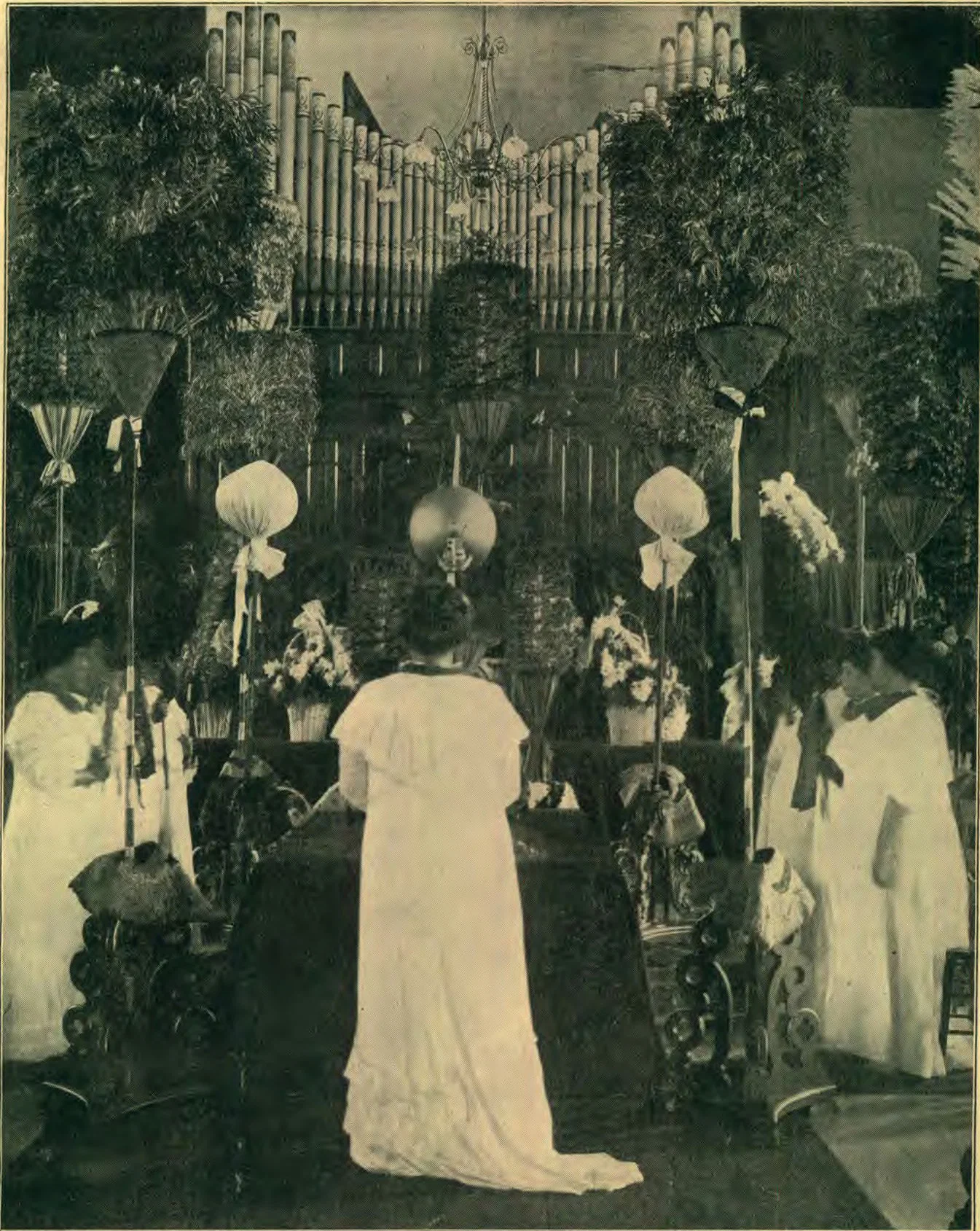
QUEEN LILIUOKALANI LYING IN STATE IN THE HISTORIC KAWAIAHAO CHURCH, HAWAII, ATTENDED BY NATIVE WOMEN
These watchers were chosen from the queen's intimate friends, each group being relieved every two hours.