Shall we take a stroll to one of the native villages this afternoon to see the native in his home? You will then have a better idea of him as we discuss him.
En route we shall cross a pretty brook, an open field, and quite a thick forest. On nearing the village we hear the barking of many dogs and the voices of merry children. The village is round, as well as most things in it. Surrounding the village we see a fence of poles and bush to keep out the wild animals. The cattle kraal is in the center of the village. This is made of poles set close to one another. The houses, or huts, are built around the cattle kraal. On our arrival we see round houses made of poles, with grass roofs and no windows. There is a hole for entrance, but no door.
We see plenty of dirt. The people sweep out the houses, perhaps once or twice a year. It is afternoon, and we find the women busy grinding corn for the evening meal. Some are using stones, others have the grain in a hollow log and are stamping it with a pole. The process is interesting. They first wet the corn, then stamp it a little, when all the hulls come off in the form of chaff. They then take out the corn and winnow it, and proceed to make meal out of it. This meal is made into a very thick porridge called inshima, or bread. It is eaten with a relish called yogurt in English, but mabisi in the native tongue. The porridge is cooked for about five minutes, or until the stick will stand straight in the pot. It is then ready to serve.
Their furniture is very primitive, consisting of a cooking pot, calabash (churn), water bucket, clay waterpot, spear, pipe, ax, stamping block, knobkerrie, low stool, and some grass baskets for carrying grain. A man who has all these things is “well fixed.”
The induna’s hut is larger than all the rest, and faces the entrance of the village, toward the setting sun. Outside the village we see queer little things built up on poles and plastered with mud. These grain bins are many in number, being the property of many individuals. They are rat proof, all plastered up except a tiny hole in the top. It is now time to return home. All we have learned is from what we could see in this short time.
Let us now follow in our thoughts a little child through life, that we may learn how he is brought up. His mother straps him on her back when he is but a day or two old. This is his cradle as long as he needs one. When he cries, his mother rocks him by swaying backward and forward. His first dress is a string of beads tied about the neck, and another about the loins, with bracelets of the same on the wrist and ankle. He is two or three years old before he has his first bit of limbo for his loin cloth. When he is big enough to play, he begins much like our white children, by copying the parents. You will see the little girls gather sticks for a fire, and go to an imaginary stream for water, with little pumpkins on their heads, as they have seen bama do when she goes for water. They place the stones in the fire ready for the pots. Of course they have no fire, they are only playing “mamma.” The little girls tie pieces of limbo on their backs, with a stick rolled in another bit of limbo for a doll. Then you will see the little boys making animals and huts out of mud. The little boy will take a reed for an assagai, and a stick for a knobkerrie. When he gets a little bigger, he has to herd the sheep and goats, and later the cattle. While he is out herding, you will see him riding the calf to water, and by the time the calf is a year or two old, he is a good riding ox.
At about the age of three years the children are sent away to be cared for by others until they are six or seven years old. The parents usually see them during this time, but sometimes the boys never come back. The girls always come back, because after they have grown to a marriageable age they are sold, and the fathers want the marriage dowry.
When they are large enough to have a room to themselves, houses are built for the boys, and also for the girls. Many from different families occupy the same house. You might call it a boys’ or girls’ dormitory. The fowls, sheep, goats, and calves also occupy these compartments. The children have but few blankets to keep them warm, therefore they are glad of the warmth of the animals. Many have no clothing whatever, nor blankets. Some have only a small loin cloth, which consists of a piece of cloth eight by twelve inches, strung on a string, and it may be found anywhere around the body.
Among some tribes there are certain ceremonies for the young men and women when they have reached manhood and womanhood. This age is about thirteen years. The young man is sent out of the village for one week to rough it in the veldt. He cannot come home for food, water, or shelter. If he is spied about the village, any one who happens to see him is at liberty to thrash him. He is to go anywhere in the veldt where there is no occasion for a person to come, no matter where, just so he is out of sight. If any one chances to pass that way, he is to run and hide himself.
The girls are put in charge of an old woman, who takes them to the veldt (open country), where they build up a grass scirm away from any footpath, and live there for a week. What takes place I do not know. If by any mistake a boy should pass that way, they whip him with their bushes, which they have previously collected for that purpose, and sometimes nearly kill him. Other tribes have different ceremonies. One of these is that the girls are shut up in a hut, fattened like cattle, and sold for wives.
While the native has very little conception of what is meant by marriage, still he has laws that are binding. When he is looking for a wife, he wants a fine, sleek one. There is no love or choice in the matter, especially on the part of the girl. Love and sympathy are no part of her make-up. Many of the baby girls are sold while infants, but they are not married until they are women. In this case the girl goes to live with the man’s mother, and is her slave. The man may be years older than she, perhaps full-grown when the contract is made.
Many are the suicides among the girls because they are sold, perhaps to an old, white-haired, decrepit man, just because he has the cattle with which to buy her. The father cares only for the few assagais, hoes, and perhaps a cow and a calf, which he gets for his daughter. Sometimes the wife runs away, but only to be brought back. If the girl will not live with her husband, then her father has to pay back the chiko, and as he does not want to do this, she is kicked out of her home, and perhaps beaten, and made to live with her husband. She knows nothing of love and care and kindly attentions from her husband. Practically speaking, she is his slave. Sometimes the wife is very stubborn. In all my experience I have seen nothing to equal the stubbornness of an old native woman when she wants to be mean. Many times husbands whip their wives. When we ask them why they do it, they say, “She will not cook my food nor do anything I ask her to do.” The women generally run away after they are whipped.
J. S. JAMES
By J. S. JAMES
Furlough Reflections—No. 2
J. S. JAMES
[Written while sailing on the Mediterranean Sea, July 10, 1914.]
I should not forget to mention the cordial welcome home given us by the Mission Board and our people in general. We were not lionized, nor did we desire a display of any such sentiment; but everywhere we went, from Washington to California, we found the people eager to hear about the work in foreign fields,—always questioning, inquiring, comparing, imagining,—their interest betraying an undoubted relationship to that cause which lies nearest the Master's heart.13
Our Mission Board is heavily burdened with the task of counsel and assistance, in order to give the greatest amount of profit both to the home field and to the workers themselves. And here I reflect that it is in no small degree a privilege to be identified with this cause, and associated with workers who have upon their hearts and before their faces continually the one purpose of meeting the mind of God in his work among men. We had laid aside our regular work to rest and recuperate for a time, and again and again as our spirits chafed from the thought of inaction and a changed environment, we were cautioned that the fruits of rest must be realized in preference to anything else. A furlough is an expensive arrangement
to both the individual and the Mission Board, but it is much to be preferred to a funeral, and infinitely more pleasant. Traveling expenses must be met and salaries paid, while at the same time the mission field is deprived of our active service. The greatest economy, therefore, would be realized in being situated so that we could be reequipped with health and strength and return to our field again. This did not mean that we were to remain idle, which would have been sore punishment for us indeed. Idleness is a cure for nothing, and we felt that we must be doing something that would contribute in some way to the progress of the work in the field we had left. In this we were not disappointed; for as I now look over my diary and sum up the work I have been privileged to do, I could not gather from it that I had been on idle furlough.
At the close of the General Conference session I had the pleasure of attending the camp meeting in South Dakota, where I met numerous friends and former fellow workers. I very much enjoyed this meeting, it being the first of its kind I had attended in seven years, although much of my work on behalf of missions had to be done under physical suffering and weakness. After this meeting I went with my family to the Pacific Coast, where it was our good fortune to spend the remaining portion of our furlough in sunny California, making our home at the Pacific Union College, near St. Helena, in order to give our boys the advantage of the school.
In this field, during the summer and fall months, I visited most of the camp meetings, numerous churches, and many of our institutions. I was given a hearty welcome by all, and the interest with which the people listened to my talks on the progress of the message in India, and the liberality which characterized their response, were sure indications that our brethren thoroughly believe in the great task which has been committed to them. This evidence impressed me as it never had before. To see the large, well-filled tents, and the halls with so many eager listeners assembled at the hour announced for foreign missions; to look into the faces of hundreds of believers who followed with feelings of joy and sorrow the mission story of toil, hardship, suffering, joy, conversions, growing
missions; to note the lively interest displayed in mission topics when other matters of vital interest in the conference or institutions were also pressing in for consideration; to mingle with the people and feel the more than formal grip of hands, and hear them say, with genuine earnestness in their voices, “God bless you and your work! Our hearts are with you,”—to note all this, and more, has many times sent me to my tent or room with thankfulness welling up in my heart that I could again touch hands and hearts with such a people. You who may read these lines, could you but know how these things fire the zeal, deepen the consecration, and brighten the hopes of the furloughed workers who sojourn with you a few months, you would be stirred to greater limits of self-denial for the Lord's cause. Seeing these things has caused me many times to exclaim, “God hasten the day when all our indebtedness and other hindering causes shall be cleared away, and this people can justly and fairly turn their whole heart and resources to the finishing of the work in all the world.”
In the light of his former experiences there are some things that are exceedingly hard for a returned missionary to reconcile. One who has been hedged about for years with heathen superstition, ignorance, and degradation; who has lived in the midst of pinching poverty and economic suffering; who must begin, build, and advance the work with the crudest and most meager facilities; who has to guard with rigid economy the expenditure of every penny, and make one
dollar do the service of ten; who after paying tithe and offerings, invests a large part of his remaining salary in furthering some needy part of the work—for such a one to return to a civilization such as is known in the Occident, and witness the extravagant luxuries of home life, the wanton waste of money and means, the multiplied facilities of an overdeveloped civilization, and the vast waste consequent to the hurry and rush of the age, is enough to make any one who has seen it, long for some way to forget it.
Iceland
By J. C. RAFT
J. C. RAFT
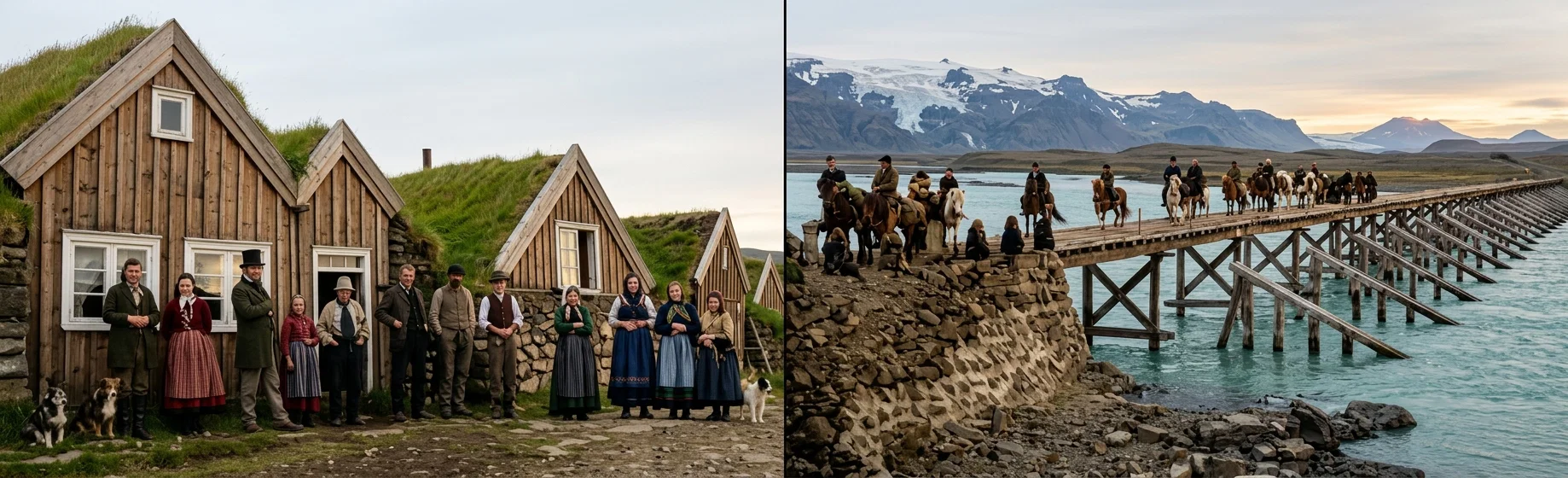
In the far north, between 63½° and 66½° north latitude, and about eighty miles east of Greenland, we find the rock-bound island of Iceland. It covers an area equal to one third of Great Britain and Ireland, but is very thinly populated, having about ninety thousand inhabitants. The country mostly consists of high mountains, large portions of which are covered with eternal snow. Some of these mountains have an altitude of six thousand feet. There are also some volcanoes and hot springs. Iceland has grand natural scenery, while the climate is somewhat inclement. Lowlands are comparatively scarce, in most places only a narrow strip, and with very few exceptions these are the only habitable parts of the country. Trees are very scarce, and real forests are not to be found at all. No grains are raised, but some roots, like potatoes, are cultivated. Pastures are excellent. The principal livelihood is fishing and sheep raising. Of late years some have engaged in the dairy business, and butter is exported to Scotland. A large number of small Icelandic horses are sent annually to Denmark.
FARM HOUSES IN ICELAND BRIDGE ACROSS LAGER RIVER
As a result of the extended commerce with Scotland, the population of Iceland, in times past of Norwegian origin, has become quite strongly mixed with Celtic blood. The language is, mainly, a northern dialect from the Middle Ages. In proportion to its population, Iceland has a very extended literature, and the Icelanders are well educated. Most of the people live in small towns near the coast; inland they are very scattered, so that frequently houses are several miles apart. The means of travel are very deficient. There are but few roads, and nearly4everything has to be transported on horseback.
When the Norwegian king, Harold the Fair, in the ninth century, united the entire Norway into one kingdom, a number of the wealthy peasants and chiefs who would not submit to Harold's rule went to Iceland and settled there.
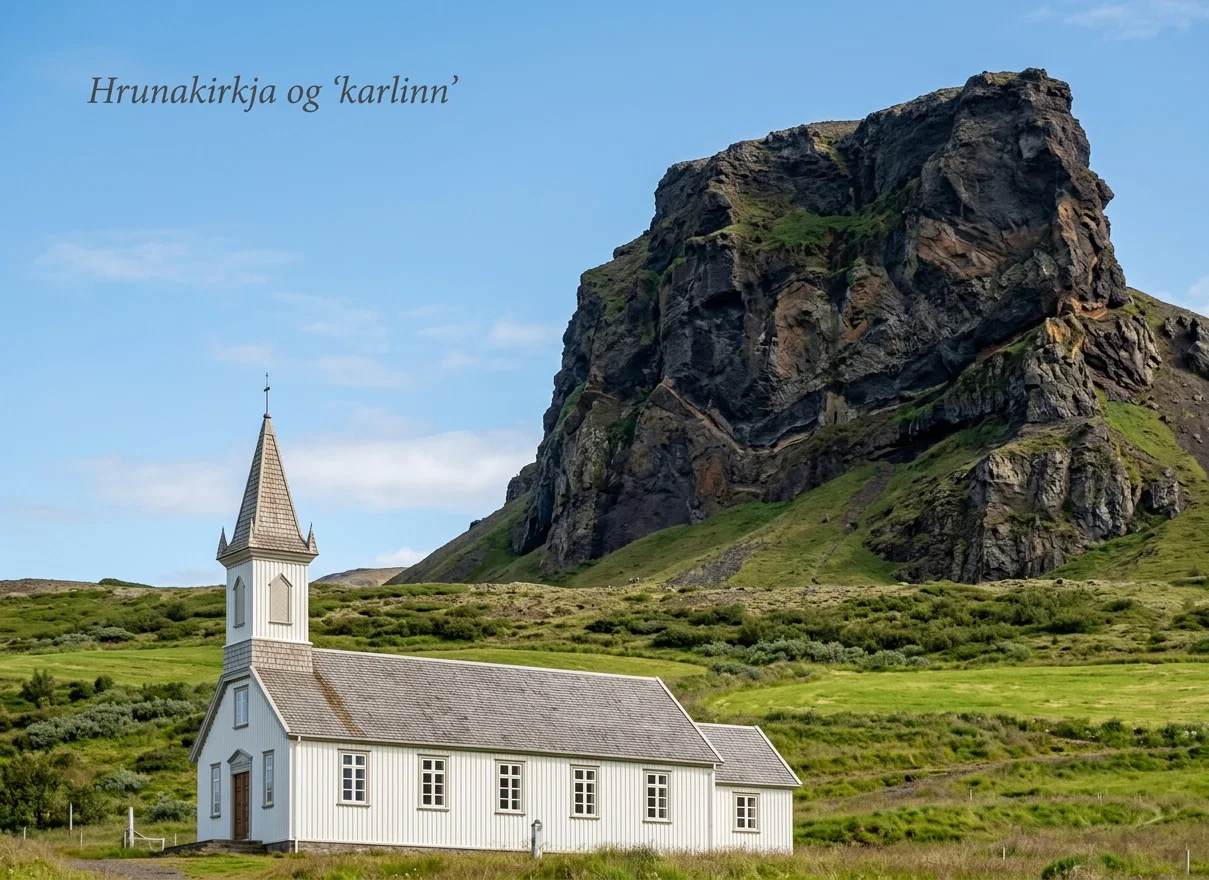
THE CHURCH (NOT OURS) AT HRUNA, AND VIEW OF THE ROCK "OLD MAN," AT RIGHT
In the course of time they established their own government. Iceland is now under the government of Denmark, but has some special rights. It has its own alting (legislature), its own secretary of state, etc.
Catholicism entered Iceland about the year 1000. In the sixteenth century Protestantism was introduced into the country. Both of these forms of religion were introduced by force, the same being true also of the other Scandinavian countries. In consequence of the far-away situation of the island, the Icelanders have been saved from much of the demoralization so common at the present time. A certain earnestness characterizes the people. Their requirements are few, but they lead a diligent and contented life.
In the year 1893 Elder O. J. Olsen Rost made a three months' trip to Iceland and the Faroe Islands. About four years later, one of our young ministers was sent to Iceland to begin work. He settled in the city of Reykjavik. The General Conference supported the Icelandic Mission till 1901, when it was taken over by the European Division. In 1904 the mission was incorporated into the Scandinavian Union, to which it still belongs.
(To be concluded)
“Why the Missionaries Remain in Turkey”
Those who have friends engaged in missionary service in lands now torn with war will find comfort in the following from the Bulletin of the American Board of Missions, the Congregational Society. Under the title “Why the Missionaries Remain in Turkey,” the Bulletin says:—
“The secretaries of the board are between two fires in these days. On the one hand the missionaries in Turkey are stirred up because the board is holding back fifteen newly appointed missionaries on account of the war. On the other hand the relatives and friends of the missionaries now in Turkey rebuke us for not calling all of them home. The missionaries write, ‘Under what possible argument are you keeping these workers from sailing when the opportunity here is so great?’ The friends and relatives write, ‘How dare you assume the responsibility of keeping the missionaries in Turkey in times like these?’ Each position is natural, but is based upon lack of information. The new workers for Turkey are kept in this country not because we would fear for their safety were they at their stations, but because travel, especially in the interior of the country, is impossible or unduly hazardous. As for not calling the missionaries home, we cannot do better than quote from a statement recently sent to relatives by Dr. Barton:—
THE HAIFORS WATERFALL, ICELAND
“Turkey was at war with England when missionary work began, ninety-five years ago, and from that time until the present there have been almost no decades which were not marked either by a war between Turkey and some outside hostile force, or by some internal uprisings, which, in many respects, involved greater peril to missionaries and missionary interests than foreign wars. This covers the war with Egypt in 1839-41, the Crimean War in 1854, the war between Turkey and Russia in 1877, and more recently the Balkan wars. Then there is the whole story of massacres and international conflicts, covering the difficulties that have been almost perennial between Turkey and Arabia, the war between Turkey and the Druses, the massacres of different periods, including those of the Bulgarians and Christians in Macedonia, and of the Armenians during the close of the century. In no case have the missionaries left the country because of war or of massacre. They have taken the ground that at the time of unusual disturbances and distress their place was with the people whom they were sent to help, and they have insisted on remaining ‘with their people.’ They have thus been able to render service of untold value in ministering to the needs of the suffering, in comforting the disheartened, in caring for orphans, and in helping to restore conditions of civilization when the conflict is past. It is worthy of note that in none of these disturbed periods, with the single exception of Mr. Rogers, has any missionary been injured personally or has American property been seriously interfered with.”
Tears Never Wound Up a Clock
TEARS never yet wound up a clock, or worked a steam engine.—Charles Dickens.
“Redeeming the Time”
By Benjamin Keech
BENJAMIN KEECH
“Redeeming the time,” for “the days are
evil,”—
Counsel sweet from the Fount of Truth,
Urging to work for a full salvation;
Good advice both for age and youth.
If now in idleness we may be drifting,
Let us arouse and redeem the time.
Better to work, though the task prove faulty;
God takes the effort and makes it sublime.
And if in vanity we may be spending
Life’s precious moments, O, let us repent!
Earth’s transient joys give no real satisfaction;
Doing God’s will brings the truest content.
And if in sin—ah, most hideous monster!—
We may be throwing our lives away,
Let us more soberly face the dark future,
Fight for the vict’ry while yet it is day.
Looking back o’er life’s devious pathway,
Much we can see that brings doubting and pain;
Then comes this thought from the Pages of Wisdom:
Redeem ye the time, and ’twill not be in vain.
Then let us work in a spirit of gladness,
Willingly, cheerfully, glad we can do
Something to keep the bright gospel light burning,
To rescue some wanderer and keep him more true.
“Redeeming the time,” for “the days are evil,”—
Counsel sweet that we all should heed.
By living for God we resist the tempter,
Help save the lost, and our own souls feed.
Randolph, N. Y.
Home Education
By MRS. C. C. LEWIS
Practical Problems of Home Makers—No. 7
Home Education
MRS. C. C. LEWIS
FROM the ages of your children, I am sure that what you need first is Early Education, one of the courses of the Mothers’ Normal Department of the Fireside Correspondence School. This is a course of twenty lessons, which are to be lived out with your children from their earliest age until they are five years old. Of course, you can pursue the studies and make out the recitation papers as rapidly as you have time; but after that the lessons are to be studied again and again, and slowly and patiently put into practice as the months go by, until your children are five years of age. Then you will take up the First Grade, and this will carry you two years farther. It is thought best to allow two years for the child to finish this grade, especially since he begins at the early age of five years. We would not have the child sent to school thus early, but we think the mother in her own home can take up such studies to good advantage. By the time you have finished these two courses, I hope lessons will be prepared in the other grades, although these two courses are all that are ready at the present time.
You have a beautiful little flock of children, and I am glad that these lessons have been prepared so that you can take them up and instruct your children in your own home. If you do this faithfully and intelligently, I am sure the Lord will bless your efforts, and you will see fruit of your work not only in this life, but in the life to come.
Helps for Adventist Mothers
I have read — for a number of years, and think it contains many good things; but, as you say, it is not designed for Adventist mothers. We, however, do have matter designed for Adventist mothers, which it would seem you are not familiar with. I refer to the department in the REVIEW AND HERALD called Our Homes, which contains every week important matter for mothers who are training their children. Then also we have the journal Christian Education, which is devoted to the education of the young, and has a department called Home Education. This department contains excellent instruction for mothers under just such circumstances as yours.
You make inquiry about how to prepare food for little children without the use of meat, so as to give them the proper nourishment and variety, as there are so many vegetable foods that a grown person can eat which children cannot. In reply to this question I am sending you a little booklet which I bought for twenty-five cents at the Washington Sanitarium. I am sure you will find it very helpful.
Again: we have the journal Life and Health, devoted to the subject of healthful living. The January number contains five up-to-date articles upon how to make the hygienic meal more attractive yet inexpensive. The subscription price of the REVIEW is $2; Christian Education, $1; Sabbath School Worker, 50 cents; Youth’s Instructor, $1.25; Life and Health, $1; total, $5.75. I am having samples of these journals sent you.
Why should our mothers go hungry for good reading matter to help them in their homes, or why should they go to other sources for help, when we have so much excellent instruction in our own publications?
The Blessed Experience of a Christian Mother
[The following experience of a dear Christian mother is so practical and helpful that I want all our mothers to read it; but for fear of embarrassment to the parents I am withholding the name. If mothers will only write me their experiences freely for the good of others, I will not betray their confidence, especially if they request that their names be not published. At the same time I should like short articles from parents over their own names.—MRS. C. C. L.]
JAMES is our only child, and the “way” before us is untried. One of the things we have often heard said is that “a child can go so long, and then you’ve got to whip him.” The particular morning I am going to tell you of found our little man of three years in a different mood. Nothing seemed to suit. He couldn’t get up in his high chair alone;16he didn’t want to “just have prayers all the time.” This last “straw” caused me to say in an undertone to his father, “That child has gone about as long as he can without a whipping.” To this his father agreed, saying, “Now straighten up, or I shall have to help you.”
Breakfast being ready, we all sat down to have worship. The way to handle the little son’s bad humor weighed on my heart so heavily that before my time to join in prayer came I just poured out my feelings to the Lord silently, and asked for wisdom to know how to deal with my child. He usually says the Lord’s Prayer at worship, and this time joined willingly; so some way the matter of his misconduct slipped my mind entirely until that evening when my husband and I were speaking of the events of the day. Then I suddenly remembered how the morning was started; and as I went over the day again in my mind, I remembered that my boy had not given one bit of trouble, and I had not even thought until then of his ill humor of the morning.
Now I firmly believe in the Bible plan of child training as I understand it, but I do not believe it is given to any one to know, without asking the Lord, how to “train up a child in the way he should go,” so he will not depart from it when he is old. I believe that “way” only God knows, and he will reveal it to us when we rely on him and ask for wisdom. I use the “rod of correction” sometimes, and yet I believe if I had used it that time I should have done wrong. The Lord mercifully saved me from it. How thankful I am for the privilege of being a mother, and also for morning and evening family worship. “Morning family worship is a strong seam well stitched on the border of the day to keep it from traveling out into contention, confusion, and ungodliness. Wise is that Christian parent who hems every morning with the Word of God and fervent prayer.”
Sleep, Beautiful Sleep
By MRS. E. M. PEEBLES
MRS. E. M. PEEBLES
SLEEP, beautiful sleep!
Resting the feet, now so tired and so weary
Walking life's pathway, often so dreary;
Folded the hands in grateful repose;
Dreaming of rest when the journey shall close;
Sleep, beautiful sleep!
Rest, beautiful rest!
Now all forgotten the care and the sorrow;
Waiting and hoping a brighter tomorrow;
Trusting the Father, who watches above;
Sleeping or waking to rest in his love:
Rest, beautiful rest!
Morn, beautiful morn!
Waking refreshed for the newborn day's duties;
Sunshine and gladness to fill earth with beauty;
Dewdrops are diamonds, there's gold on the mead;
Where love lightens labor, there's joy in the need:
Morn, beautiful morn!
Home, beautiful home!
Resting at last in the homeland eternal,
Where hearts never tire and joys are supernal;
Walking with loved ones the streets paved with gold,
Gathered all safe in the heavenly fold:
Home, beautiful home!
The Little Loaf
By Ella Lyman Cabot
MANY years ago there was a great famine in Germany, and the poor people suffered from hunger. A rich man who loved children sent for twenty of them and said to them: “In this basket there is a loaf of bread for each of you. Take it and come back again every day till the famine is over. I will give you a loaf each day.”
The children were very hungry. They seized the basket and struggled to get at the largest loaf. They even forgot to thank the man who had been kind to them. After a few minutes of quarreling and snatching for bread, every one ran away with his loaf except one little girl, named Gretchen. She stood there alone at a little distance from the gentleman. Then, smiling, she took up the last loaf, the smallest of all, and thanked him with all her heart.
Next day the children came again, and they behaved as badly as ever. Gretchen, who would not push with the rest, received only a tiny loaf scarcely the half size of the others. But when she came home, and her mother began to cut the loaf, out dropped six shining coins of silver.
“O Gretchen!” exclaimed her mother, “this must be a mistake. The money does not belong to us. Run quick as you can and take it back to the gentleman.”
So Gretchen carried it back; but when she gave the gentleman her mother’s message, he said: “No, no, it was not a mistake. I had the silver baked into the smallest loaf in order to reward you. Remember that the person who is contented to have a small loaf rather than quarrel for a larger one will find blessings that are better than money baked in bread.”—Ella Lyman Cabot, in “Ethics for Children.”
Conducted by Mrs. C. C. Lewis, Takoma Park, Washington, D. C
By Mrs. C. C. Lewis
Through the columns of this department, hints will be given on all matters pertaining to the home life. Short articles and letters are solicited from home makers, telling of their everyday experiences,—their joys and sorrows, their failures and successes.
“They Shall Be Mine”
By MRS. MARY WILLIAMS
MRS. MARY WILLIAMS
THOU Son of God, who once below
Drained the full cup of human woe!
Sharing with thee the mortal strife,
Rising to new and endless life,
Deep in the Spirit’s shrine we trace
Thy sacred promises of grace.
“They shall be mine.” O thou whose sight
Can pierce the deepest shades of night,
Each thought and wrong intention scan
That lurks within the mind of man,—
Whate’er we do, or think, or be,
Dear Lord, the record lies with thee.
Who then of thy rebellious race
Shall win this heritage of grace,
Endure the scrutinizing test,
In thy pavilion safely rest?
Each ardent longing of the mind,
In thee will full fruition find.
The heart that beats for self alone,
To heavenly attributes unknown,
Where no responsive feelings glow
For earthly need or human woe,—
That heart, untouched by love divine,
Ne’er moves in harmony with thine.
Imperious minds, unyielding, proud,
Oft with superior gifts endowed,
Seeking emoluments of earth,
Blind to the soul’s eternal worth,—
How false the treacherous dream, though fair,
That terminates in dark despair!
Souls who in holy union meet,
Thy sacred counsels oft repeat,
And oft in glad accordance raise
The voice of prayer, the song of praise,
Joyfully earth’s glittering charms forgo,
Thy cross to bear, thy love to know.
Though on the grand archives of time
No brilliant eulogies sublime
Their glorious triumphs may review
Or note their deeds of valor true,
Who, battling with the powers of sin,
Immortal sheaves of victory win;
Enrolled in life’s fair book above,
The wondrous volume of thy love,
In blest remembrance written there,
As radiant jewels, pure and fair,
Their names in fadeless letters shine,
Engraven by the hand divine.
Troy, N. Y.
A Comfortable Sort of Woman
“It comforts me,” said the bent little old man as he spoke of his dead wife, “it comforts me to know that Sally would allus lie down every afternoon an’ sleep a bit. Some folks tho’t ’twas a dretful lazy habit and ’twas no wonder we didn’t get rich faster, but she suited me jest as she was. Sally was a comfortable sort of a woman to have around, never frettin’ at a feller or faultin’ him when things didn’t go right. When feelin’ troubled, she’d often say, ‘Father, I believe I’ll lie down for a few minutes;’ then back she’d come spry and chipper as a canary bird. Sally didn’t drive and scold, but she wasn’t lazy, an’ she brought up the youngsters to do their part. I don’t see that drivin’ women get on one mite better than she did. It does comfort me to know that Sally would take her rest.”
A good many women who are overworking to do things which are not half as necessary as a live mother is, might well take a lesson from this “comfortable sort of a woman” and lie down for a few minutes, and take their rest. And if mothers would bring up “the youngsters to do their part,” instead of working themselves to death while sons are lying in bed and daughters are playing the lady, we might have more healthy, cheery grandmothers than we now have; and their children, when arriving at the years of discretion, would be thanking God for mothers who taught them to work, instead of mourning over the graves of mothers who worked themselves to death instead of laying a part of the burden on the shoulders of thoughtless children who are much better able to bear it.—Selected.
The Antiquity of Toys
Up to the present, nothing with which man has had to do in the progress and development of the human race has changed as little as toys.
Ages ago infantile Egypt played with dolls, boats, balls, dishes, wagons, miniature horses and other animals. The little Greeks and Romans amused themselves with much the same playthings, except for the further possession of a rattle, which some wise Grecian gentleman very kindly invented for them.
We know this from the chance words of a few early writers; from the sculptures which have been saved of the different ancient nations, which represent children in the act of playing; and also from the fact that many small toys, closely analogous to many toys of today, have been found in the tombs of the children of bygone ages,—dolls, balls, boats, tops, and tiny dishes, added to which there were small warlike implements for the boys, such as javelins and bows and arrows.
In the Metropolitan Museum of Art, in New York, there is a fascinating terra cotta boat, complete to the smallest detail, says The Mother's Magazine. It was found in the tomb of an Egyptian boy of four thousand years ago.
Take the doll, one of the few of the very old toys which fit into the modern scheme of playthings that teach,—as girls always have and always will play with dolls,—because they develop and foster the birthright of every woman, mother love. The early Egyptians made dolls of earthenware, metal, or stone. Sometimes arms and legs were made solid with the body, sometimes separate and attached by a string. The prehistoric Peruvians had pieces of bone wrapped in cloth, a male doll being identified by the blanket over its shoulders, the female by a petticoat.
Horace makes mention of the stick horses of the Roman children. Chroniclers of the Middle Ages picture little people still astride such makeshift steeds, and the ordinary riding horse of the ordinary child remained a stick with a horse head until late in the seventeenth century. One hundred years later we find horse forms with curtains around them, so that the child might run on his own legs beneath the sheltering drapery, just as clowns in the circus do today. Early in the nineteenth century rocking-horses came into fashion, after which, in 1847, horses were shown at the French exposition, covered with hair and very natural in form—the toy horse, as we know it today.—Selected.
A Daily Witness to the World
God would have the daily witness of the life of every child of his be, by its contrast to the world, both a rebuke and a winsome invitation to all near by who are not serving God.—Sunday School Times.