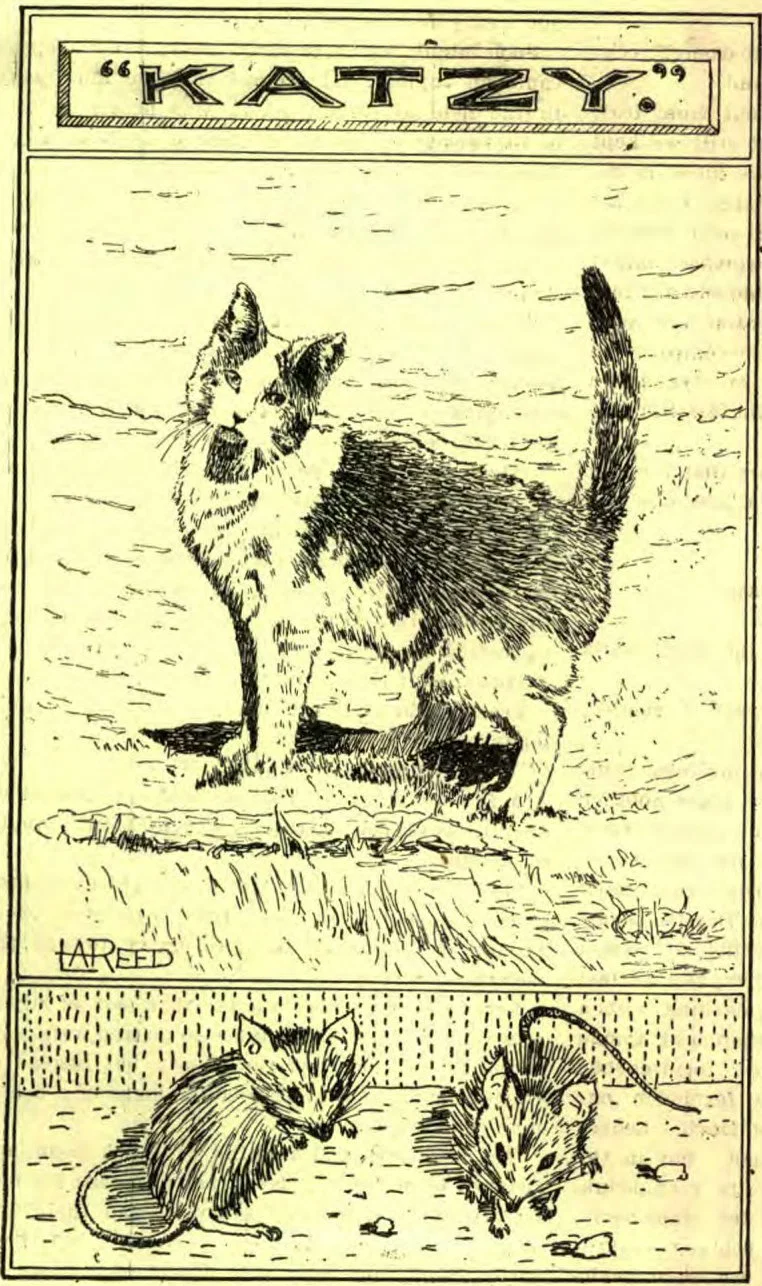
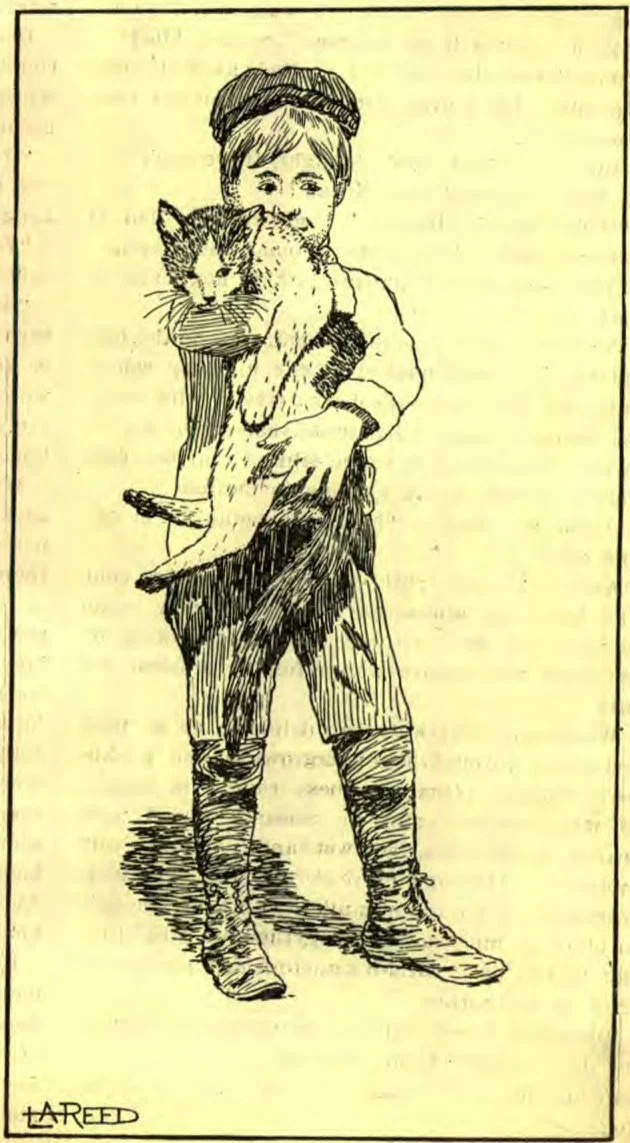
JOHNNY was playing on the sidewalk when he saw a strange boy across the street lean over the fence, and drop something into Mr. Brown’s front yard. Full of curiosity, he at once left his play, and ran to the spot, where he found a tiny kitten mewing piteously. The strange boy looked back, and Johnny called to him,— “Goin’ to leave this kitten?” “Yes,” said the boy; “we’ve got too many of ’em; want to get rid of ’em.” “Can I have it?” Johnny asked, looking at the strange boy anxiously. “I don’t care. We don’t want it.” Just then the little bunch of white and gray fur turned its pink nose up toward Johnny, looked at him with blinking, plaintive eyes, and mewed faintly. “O, you dear little pussen-kitten!” cried Johnny, gathering it into his arms.
The little creature soon learned to know Johnny, and seemed to love him best of all the members of the household. At first, while it was so helpless and little, he never thought of tormenting it, and the way it seemed to trust him was something both lovely and wonderful.
But the “pussen-kitten” grew to be a “kitten-cat,” and showed more the spirit of independence. Johnny seemed to resent this, and soon began a series of little torments. One day his mama found him ill-treating the cat. First she talked to him about it and finally had to punish him.
It was strange, but Johnny did not seem to realize that a cat can feel. And yet how often she showed that her feelings were apparently as keen as his own, and her sense of the fitness of things even more developed and acute.
When she came to him in joy after a separation, and he, busy with something else, gave her a rebuff, she would turn and walk sadly away, with ears set, face averted. If he spoke kindly to her, she came instantly. If, instead, he heeded her not, she walked off to some corner, and watched him with a questioning gaze. If his disregard for her continued, she perhaps came to him again, and, gently lifting one white paw, touched him softly on the arm, seeking thus to arrest and secure his attention. If he petted her, or, better, let her climb upon him and perch on his shoulder, she showed her delight by loud and unbroken purring.
But after a time Johnny was made to realize that even a cat has feelings much as people have. It was a wonderful revelation to the boy, and a lesson he never forgot.
One noon the barn caught fire. In a very few minutes the whole structure was in flames. Fortunately, the cow was in the pasture, and Johnny’s mother had taken the horse to town.
Johnny was on the back porch, and was the first to give the alarm. As his home was on the outskirts of the city, it would take ten minutes for the fire-engines to reach the place.
At first Johnny stood and watched the fire. Now and then he cried softly. By and by something attracted his attention.
“Kitten-cat” was now full grown, so he called her “Katzy.” As Johnny stood by the porch, she came running to him, mewed, pawed at him, and then ran toward the barn. Then she came back, mewed, jumped up at him, and ran away again.
Partly understanding, Johnny followed her. This seemed to be what she wanted, for she ran straight toward the barn, now and then looking back to see if Johnny was coming. Johnny went on until he was afraid to go farther.
But where was “Katzy?”
Just then he caught sight of her on the roof of the shed. A moment more, and she disappeared inside the burning barn.
“Come back, Katzy,” cried Johnny. “Come back, Katzy, Katzy, Katzy! You’ll be all burned. O, do come back!”
And in a moment or two she did come back, carrying something in her mouth. On account of the smoke, Johnny could not see what she had, but she was soon at his side and dropped a wee kitten, whose eyes were not yet open, at his feet. Then she looked up at him, mewed, and ran away again.
This time she was in the building longer, and when she came back, bore another kitten in her mouth. She placed this beside the other, looked up at Johnny, and mewed. Her fur was scorched in places, her tail had lost most of its hair, and the smoke had blackened her face, and the fire had burned her whiskers.
She looked up at Johnny in mute appeal, and then started to make another trip, but the boy was too quick for her. He caught her by her ragged tail, and pulled her to him, sobbing as he held her, and saying, gently:— “You can’t go again, Katzy. You mustn’t go any more. The other kittens’ll have to burn. You just can’t go, ’cause you’re worth more’n a hundred kittens.”
L. A. REED
Cranberries and Fog
By Minnie Rosilla Stevens
A True Story
DEVIL’S LEDGE is roaring angrily to-night, and a thick, white fog is curling up from the sea, through what is left of the dense spruce forests that surrounded my childhood home. I suppose the cranberries, too, still grow upon the bleak little island; and although it has been long since I saw them there, I shall never forget how the red clusters look, all damp with mist from the chill New England shore.
It was sixty years ago it all happened, when I was only a little girl nine or ten years old. Mother had a houseful of company, as was often the case in those good, old-fashioned times. Aunt Thankful and Aunt Mary had come with their families to spend the day, and we youngsters, of whom there was a small battalion, were having a fine frolic. Though toes were often stepped upon, and heads thumped, we constantly dodged about underfoot as mother passed to and fro before the kitchen fireplace; so, after dinner, I was not surprised to hear her say,—
“Elizabeth, take the pail, and you youngsters go down to the head of the field, and gather some cranberries.”
Now I knew well that there was an abundance of cranberries already in the house, and realized that mother only wished to be rid of our disturbing clatter for a time, in order to give our elders an opportunity for rest and a quiet little chat. But in those days, children were not allowed to argue the command of their parents, however unwilling they were to obey; so I took up the pail, and slowly set out for the head of the field, leaving the others to follow as they would. Many of the cousins, however, did not care to go, and finally, only Cousin Susan and myself, with each a small brother, Bine and Albert, found ourselves trudging in the direction of the cranberry woods.
No doubt we were an odd looking little band, with our hair cut off straight around our necks, tanned brown by the sun and the salt sea breezes. But we scurried along as unmindful of our appearance as so many Mother Carey’s chickens, down on the shore.
We were not in haste to begin gathering berries6A few minutes’ work would procure enough for supper, and knowing the whole afternoon was before us, we romped about hunting squirrels, swinging on grape-vines, or climbing into the prickly spruces in search of pink spruce gum. Absorbed in play, none of us noticed that one of the sudden fogs, common in that locality, was rising from the ocean, and rapidly sweeping inland. By and by the sunshine began to darken, and the woods to fill with mist; then, in sudden alarm, I seized the cranberry pail, almost empty as it was, and called to the others to come on home.
But we had played too long. Thicker and denser settled the fog, until in a few minutes we could see only a few feet in any direction. Familiar tree-trunks took on unnatural shapes, and well-known landmarks were either completely obscured, or so veiled in mist that we could not recognize them. Being the eldest, I felt responsible for the other youngsters, and hurried them as fast as possible toward home, as I thought; but as our surroundings were shut out by the ever-increasing fog, I began to grow confused, and soon could not tell where we were, or in what direction we were going. I was sorely frightened, but tried to conceal the fact from the others, as the boys were already beginning to whimper with fear for the darkness and mist and ghostly surroundings.
Suddenly a hoarse, unearthly screech sounded out toward the sea; for an instant we were terror-stricken at the unexpected sound, then recognized it as the fog-horn on the single steamer, that in those days, plied between Boston and St. Johns. Often before we had heard its dismal “Troo-o-o-nk, troo-o-o-nk, troo-o-o-o-nk!” proclaiming danger out on the ocean; now it sounded again and again, while after every whistle we became more nervous and excited as we stumbled along through the murky woods.
“It must be a bad fog,” faltered Susan.
“I guess it is,” I answered, “and I don’t see a thing I know. I believe we’re lost.”
At this, Bine and Albert set up a cry of terror, Susan and I quieting them as best we could.
“But what shall we do?” asked Susan.
“We’ll just have to keep on,” said I. “Now, Albert, don’t cry; for we’ll come out all right. We’ll be sure to see something we know before long.”
“Bu-u-t I want to go h-o-ome!” wailed Albert.
“You’ll soon be there,” I replied, as soothingly as possible, but a great deal more confidently than I really felt.
“But what shall we do to-night, if we can’t find our way?” moaned poor Susan.
“We’ll find it, though,” I answered; “but if we’re not home at dark, they’ll come out after us.”
“They could never find us in this fog,” she replied, hopelessly.
Then the fog-horn sounded again, out on the bay, and my own soul quaked at the uncanny sound, while the wail from the boys revived with terrified energy. Again I reassured them, then started on once more, with a vague feeling that our only hope of succor lay in keeping in motion.
“Come on,” said I, “let’s keep going! I’m getting cold.”
And, to tell the truth, we were all getting cold. The damp fog, almost as wet as rain, now began to penetrate our clothing, besides collecting on the trees and bushes whose foliage brushed our path.
We became first wet, then dripping, as we plodded along through the undergrowth and huckleberry bushes. Often our toes caught in tangles of wild hemlock, and we constantly trod upon scarlet cranberries, now wet and shining with moisture. Although they had been in a measure responsible for our sorry plight, we never thought to pluck so much as one berry, though still clinging to the pail, with its one forlorn handful of fruit in the bottom.
Bine and Albert kept up an unceasing sniffing as they trudged along, keeping fast hold of Susan and me, as if fearing to lose even us in the fog.
“Boo-oo-hoo! I want mother,” Albert would sob, as Susan dragged him along.
“Uh-h-h-h-hoo-oo! I want to go ho-o-ome!” echoed Bine, as I pulled him by the hand.
We went on until almost tired out from fear, cold, and the distance traveled, but still we kept on because it was the only thing we knew to do. The other youngsters depended entirely upon me for a way out of our difficulty, and as I realized more and more what serious consequences might follow if nightfall should shut us hopelessly into the wild, wet woods, I naturally became very anxious, and kept them all, our entire company, in motion while continually straining my eyes in an endeavor to catch a glimpse of some familiar object.
Suddenly a sound reached my ears that brought me to an abrupt standstill, with a new and awful fear.
“Listen!” I said.
“What’s the matter?” asked Susan.
“Don’t you hear that?” said I.
“What?” faltered Susan, while the boys’ wails began to gain strength.
“The Devil’s Ledge, right there!” I replied, pointing ahead.
Sure enough; above the constant, uniform rumble of the waves on the rocky shore, arose another sound,—a mighty, angry roar, that rapidly grew more distinct as we advanced. We had heard that roar before, and knew that it could come from nothing else on the island but the Devil’s Ledge, a rugged cliff of rock rising perpendicularly from the water, a sheer three hundred feet, and against which terrific waves were always dashing with a roar terrifying to stouter hearts than beat among that frightened little quartet of fog-drenched youngsters. Mother had always forbidden our going anywhere in the vicinity of Devil’s Ledge; for it was indeed a dangerous spot; but in the fog we had wandered almost to its very brink, now veiled from sight, but only a few steps away, with the cruel ocean dashing far below.
When we realized our danger, we were panic-stricken. Bine’s and Albert’s whimpers developed into lusty howls, and probably Susan and I would have joined in, had there been any older person to depend upon; as it was, our danger made us desperate, and as is often the case, desperation originated a way out of our dilemma.
Once more we calmed the boys as well as we could, though half crying ourselves, and as I listened to the roar of Devil’s Ledge, a happy idea flashed to my mind.
“O Susan!” I said, hopefully, “don’t you remember that there are field fences opposite Devil’s Ledge?”
“Ye-e-s,” said Susan, “Uncle Alden’s clover fields.”
“Sure enough,” I replied. “Well, then, if we turn square around, and keep straight, we will be sure to strike Uncle Alden’s fences, and then we can find his house, and he will take us home. We will get away from Devil’s Ledge, at any rate. Come on, let’s try it.”
With hope somewhat renewed, we turned our backs on the roaring cliff, and started in the opposite direction. If my idea had failed to work, there is no telling what would have become of us poor, dripping youngsters; but, fortunately, my memory was correct, and we kept a reasonably straight course as we proceeded, so finally we stumbled upon a rail fence, which, when we followed a short distance, we recognized. How delighted we were to see something familiar once more; even those old, weather-beaten rails, in the ugly worn fence, looked beautiful to us, for they were a possible connection between us and home. We quickly clambered over into Uncle Alden’s clover field and began our search for his house.
But we were by no means out of our predicament. The fog was as thick as ever, and we wandered about in the young clover with little idea of distance or direction, as we could see but a few feet at a time. Hope had revived our spirits, and stopped the boys’ wails for a time; but as we continued to wander, and found no sign of a house, our weary feet began to drag.
Soon night began to draw near, and darkness came on rapidly. It seemed that we must stay in the field all night, which was nearly as bad as the woods, except for the fear of Devil’s Ledge. Susan and I were in despair and felt like sitting down in the wet clover, and crying till we were rested; but we dared not stop, with night so near, so plodded on, almost dragging the poor little boys along.
When it became nearly dark, our feet suddenly stumbled into an uneven spot amid the clover, and looking down, I noticed a narrow, beaten track, extending as far as I could see, where it disappeared in a wall of mist.
“Here is a little path,” said I. “Let’s follow it, and see where it will take us.”
Almost mechanically, the others followed where I led, for they had all become too weary to take much interest in trifles; but we had followed the path only a little way, when Susan suddenly exclaimed,—
“Look, isn’t that a light?”
Peering through the mist, I thought I could make out a faint gleam.
“I do believe it is,” I said. “O, hurry up!”
A few steps proved that we were not mistaken, and the boys’ sobs changed to excited little laughs of delight.
“It’s Uncle Alden’s! It’s Uncle Alden’s!” they cried joyously, and their tired bare feet were aroused to life once more to hurry toward the welcome glimmer.
Light did not penetrate far that sort of night, so we had but a short distance to go, and were soon rapping at the door of the house; but instead of Uncle Alden’s, it proved to be the home of a fisherman who lived near.
The fisherman and his kind wife took us in, and listened to our story. Now that all cause for fear or excitement had been removed, and their first joy for safety was over, their bodily comfort asserted itself, and Bine and Albert once more began to cry for home and mother. This time the bluff old fisherman consoled them:—
“There, there, now, don’t cry, don’t cry! You’ll soon be home, and have a nice hot supper. It’s only a little piece farther to go—there’s nothing to cry about. You’ll soon be home. There now, there now, I wouldn’t cry!”
Thus he talked, while we stood by the fireplace and warmed ourselves by the blazing fire. The fisherman soon had his lantern prepared and lighted, and then we set out once more for home, but by the road this time, and with the cheerful gleam of the fisherman’s lantern for a guide. And never did home seem such a delightful place as when, a few minutes later, we, a bedraggled little band of cranberry pickers, saw its lights faintly shining through the dense fog that still smothered land and sea.
At home the spirit of alarm was in the air. The men had come in when the fog began to gather thickly, and when we youngsters did not appear in a reasonable time, they all grew anxious for our safety. At the approach of night, satisfied that we were lost, the men collected lanterns and lights of various descriptions, and were just about to start out in search of us, when we appeared upon the scene.
As the kind fisherman led us into the warm, comfortable kitchen, we created quite a sensation.
“Why-y-y, children, where have you been?” said mother.
Countless other questions followed, till our adventure was fully discussed and explained; but an interruption occurred in the form of a whisper, and a tired little voice from Bine,—
“I’m hungry!”
So we were hurried into dry clothes, and were soon eating a bountiful supper, which included cranberry sauce.
A night’s rest restored us completely, and the next day we had almost forgotten that we had ever been tired, and were ready for another romp in the woods.
MINNIE ROSILLA STEVENS.
Doing More Than Your Salary Requires
“THE boy who fears he will do more than his salary calls for will never have any salary to call for.”
Shiloh was not, at the time of Samuel’s boyhood, a good place for a child to be. The sons of Eli and their bad companions had filled it with wickedness. When the people brought their sacrifices to the Lord’s house, these young men seized whatever part they liked best, and if the people refused it, they threatened to take it by violence. See 1 Sam. 2:12-17. Therefore the people “abhorred the offering of the Lord;” they did not like to bring their gifts to the Lord’s house.
God warned Eli by his prophet about the wickedness of his sons. The last part of the second chapter gives the message that he sent. Eli spoke to his sons about their evil ways. But when they were children, they had been allowed to have their own way in everything, and now that they were grown they took no notice of their father’s words.
But in the midst of evil, the child Samuel grew pure, strong, and beautiful, like a fair white lily on the bosom of a slimy pool. His mother had given him to God in faith, and God kept him without stain in the midst of evil. Think of these things day by day, when you pray in the words our Lord has taught us, “Lead us not into temptation, but deliver us from evil.” In this evil world, which gets worse and worse as the end draws near, we are not safe for a moment unless the Lord keeps us by his power.
Notice how attentive Samuel was to the aged Eli. As soon as he thought he heard Eli calling, he arose and ran to see what was wanted. This he did three times, although if he had wanted an excuse, he need not have gone after Eli told him it was not he who called.
It was because Samuel was so quick to run at the call of Eli and do his bidding, that God could honor him by speaking to him as he now did. If Samuel had not run to Eli, he would not have found out that it was God speaking. By obedience to those whom God has placed over us, we are learning to obey God. But if we make excuses, or pay no attention to their words, we shall not be likely to heed the voice of God when he speaks to us.
The words that Eli told Samuel to answer when the voice of God called him show how our minds should be ever turned toward God, ready to hear whatever he has to say to us. “Speak, Lord; for thy servant heareth,” should be the language of our hearts.
Samuel was truly a little servant of the Lord, although God had not yet spoken to him except through others.
“O give me Samuel’s ear,
The open ear, O Lord!
Alive and quick to hear
Each whisper of thy word;
Like him to answer at thy call,
And to obey thee first of all.”
The words of God to Samuel made the child’s heart very heavy. He loved Eli, and was sad to hear of the terrible judgment that was coming on his family because he had let his sons go on in their evil ways after God had warned him.
The old priest must have wondered what the Lord’s message was, and why the boy did not come to tell him. But Samuel feared to show Eli the vision. Yet when Eli, fearing the worst, called him, and asked him about it, he “told him every whit, and hid nothing from him.” God had given him this hard and trying duty, and he did his work faithfully.
“And all Israel from Dan even to Beersheba knew that Samuel was established to be a prophet of the Lord.” A prophet is one who speaks the words of God—a mouthpiece for God. “He that hath my word,” saith the Lord, “let him speak my word faithfully.” Samuel did this; and because he spoke faithfully the words that God gave him, “the Lord was with him, and did let none of his words fall to the ground.”
Questions
What sort of place was Shiloh in Samuel’s childhood? Who had corrupted the place? How did they make the people feel about the Lord’s house and worship?
Did this have any effect on Samuel? What kind of child was he? How was he kept pure?
How did God first warn Eli about the wickedness of his sons? What terrible punishment did he say should come upon Eli’s house? Did this warning make any change in the lives of Eli’s sons?
Through whom did God next speak to Eli? What time was it? Where was Samuel when he heard God’s voice calling him?
Did Samuel know the voice of the Lord? To whom did he go? What did Eli say? How many times did he go to Eli?
What did Eli then perceive? What did he tell him to answer the next time he heard the voice?
How had Samuel been serving God all his life?
What do we learn about Samuel’s habits, from his running at once to Eli? How do children learn to obey God? Who are most likely to heed when God speaks?
What did God tell Samuel? How long did Samuel wait before he told Eli the message?
When Eli asked him about it, what did he do? What does God say about those to whom he gave his words? Jer. 23:28.
What name is given to one who speaks for God? How far did the news spread that Samuel had become a prophet? What are we told about his words? Why did God not let Samuel’s words fall to the ground? Isa. 55:11.
MEMORY VERSE: “Children, obey your parents in the Lord: for this is right. Honor thy father and mother; which is the first commandment with promise.” Chap. 6:1, 2.
For no man ever hated his own flesh; but nourisheth and cherisheth it, even as Christ also the church; because we are members of his body. For this cause shall a man leave his father and mother, and shall cleave to his wife; and the two shall become one flesh. This mystery is great; but I speak in regard of Christ and of the church. Nevertheless do ye also severally love each one his own wife even as himself; and let the wife see that she fear her husband. Children, obey your parents in the Lord; for this is right. Honor thy father and mother (which is the first commandment with promise), that it may be well with thee, and thou mayest live long on the earth. And, ye fathers, provoke not your children to wrath: but nurture them in the chastening and admonition of the Lord. Servants, be obedient unto them that according to the flesh are your masters, with fear and trembling, in singleness of your heart, as unto Christ; not in the way of eyeservice, as menpleasers; but as servants of Christ, doing the will of God from the heart; with good will doing service, as unto the Lord, and not unto men: knowing that whatsoever good thing each one doeth, the same shall he receive again from the Lord, whether he be bond or free. And, ye masters, do the same things unto them, and forbear threatening: knowing that he who is both their Master and yours is in heaven, and there is no respect of persons with him.—American Standard Revised Version.
Questions
1. What encouraging lesson may we learn from the love that husbands show toward their wives?
2. How does Christ regard his church?
3. What relation do we, as members of his church, sustain to him?
4. How is this illustrated in the true marriage bond?
5. What is this union called? What is this mystery? Col. 1:27.
6. What lesson do the husband and wife learn regarding their duty toward one another, from the relation of Christ to his church?
7. What instruction is given to children? From whom are they to learn how to obey? Why are they to be obedient?
8. To whom is the first commandment with promise made? Who is concerned in this commandment? What is the commandment? When was it first given?
9. What was the promise?
10. How are fathers to treat their children? How are they to train them?
11. How are servants to obey their masters? Whom are they to hold in regard in all their service?
12. What is to be the nature of their service?
13. From whom may they expect to receive their reward? How many are included in this promise?
14. How are masters to regard those who labor for them? To whom are the masters responsible? How does God regard every individual? See also Acts 10:34, 35.
Notes
Many times the relation of Christ to his people is illustrated by the relation of the husband to the wife. As they become one, so Christ makes himself one with us. We need not feel that because we are young, he does not appreciate our needs, our temptations, and our efforts to please him. He was in all points tempted like as we are, and knows so perfectly our humanity that he is able in every temptation to provide a way of escape. As we open our hearts to his presence, he comes in to abide, and we two become one in everything; so that, with Paul, we can say, “I live; yet not I, but Christ liveth in me.”
Often the service which we are called to perform seems menial, and we are tempted to abhor it. Perhaps our efforts are not appreciated, or the reward is not equal to the service. But if we keep in mind the fact that One is our Master, even Christ, and he regards our service in its true value, it will make the most difficult tasks easy. Doing everything heartily, as unto the Lord, brings his blessing into our lives, and makes us a blessing to those about us.
Life's Value as Preparation for Eternity
LIFE is of value only as it is a preparation for the life beyond.
The Sea of Galilee
I LOOKED upon a sea,
'Twas bright and blue;
Around its shores were life
And verdant hue,
'Twas fed by many rills
With mountain source
On Hermon's snowy peak,
Whence Jordan's course.
But Galilee's blue sea
Lives not alone
Because it gets these streams
As all its own.
It lives because it gives
Its waters blue
To other shores, and then
Is filled anew.
—Selected.
A Call From Africa
THE following stirring appeal from Sister Ellen Burrill, who has been working for some time in Cape Town, is given with the prayer that it may awaken a response in the hearts of some of the older young people who read the INSTRUCTOR:—
“This evening’s post brings the Bulletin. It is indeed a welcome visitor. It brings the spirit of the Conference to us. News from the homeland is most refreshing. As years pass on, I become more wedded to the land of my adoption; but I do not cease to love that of my birth, and long to see the old familiar faces that I love. The work here grows dearer to me all the time. This is a good place to work. There are many obstacles and difficulties, but there is power to overcome them all.
“We have only a few workers left, and the burdens are heavy on their shoulders. But sadder than this is the fact that so much ought to be done, and so many doors are open for labor, and there are no workers. O, that the Lord would send forth laborers into this part of the field! We need help here in our schools, we need teachers in other schools. Are there not young people at home who will come and help us? I would say, Do not be afraid to go anywhere God calls you. Be sure of his call. Do not move until he speaks, then go forward, expecting difficulties and obstacles of all kinds in your work; you will find them. But you will also find help in Him that is mighty.
“You will be homesick, so homesick that you would willingly lay down your life rather than go on. If at that time you ask it, your Heavenly Father will give you such a glimpse of the heavenly mansions that your only desire will be to labor more earnestly to soon be at home over there. Do not expect to be appreciated by those for whom you come to labor. You probably will not be; Christ was not. But if you will go aside and listen, when duty is finished, you can day by day hear the Master’s voice saying, ‘This is my beloved child, in whom I am well pleased.’ This is all the appreciation, all the approval, we need. Sometimes, also, God will veil his face for a time. But it is only for a time, and soon again we will see the sunshine of his love, all the brighter, because of the darkness just before. You may be ill; so you might be at home. The Great Physician is just as near us here as there. Some must give up their lives ere this truth triumphs. Those faithful unto death will receive a crown of life. There is a whole continent before us. O, we need workers for this field—young men and women full of life and vigor, who are willing to labor, who can bear disappointment, who are willing to take advice. O, that God would send them here!”
“Our school work is doing well. Here at the college we have added a new teacher, and made some other changes. I am now in charge of the twenty-two girls in the home. I find it a very happy work; for I have great hopes that some of them will become faithful workers.”
“I trust I have not said too much about workers. If my experience here will be the means of helping any one else, I should like to have them know it. The keynote of it all is that it is a good thing to serve the Lord; yes, I can add, it is a good thing to serve the Lord in Africa. May God bless in the efforts to send other laborers to the far-away lands.”
The Interpretation of the Vision of the Great Image
By Ellen G. White
HAVING described the image that the king had seen, Daniel gave the interpretation, foretelling the remarkable events that were to take place in prophetic history:—
“Thou, O king, art a king of kings: for the God of heaven hath given thee a kingdom, power, and strength, and glory. And wheresoever the children of men dwell, the beasts of the field and the fowls of the heaven hath he given into thine hand, and hath made thee ruler over them all. Thou art this head of gold.”
“And after thee shall arise another kingdom inferior to thee, and another third kingdom of brass, which shall bear rule over all the earth.”
“And the fourth kingdom shall be strong as iron: forasmuch as iron breaketh in pieces and subdueth all things: and as iron that breaketh all these, shall it break in pieces and bruise. And whereas thou sawest the feet and toes, part of potters’ clay, and part of iron, the kingdom shall be divided; but there shall be in it of the strength of the iron, forasmuch as thou sawest the iron mixed with miry clay. And as the toes of the feet were part of iron, and part of clay, so the kingdom shall be partly strong, and partly broken. And whereas thou sawest iron mixed with miry clay, they shall mingle themselves with the seed of men: but they shall not cleave one to another, even as iron is not mixed with clay.”
“And in the days of these kings shall the God of heaven set up a kingdom, which shall never be destroyed: and the kingdom shall not be left to other people, but it shall break in pieces and consume all these kingdoms, and it shall stand forever. Forasmuch as thou sawest that the stone was cut out of the mountain without hands, and that it brake in pieces the iron, the brass, the clay, the silver and the gold; the great God hath made known to the king what shall come to pass hereafter: and the dream is certain, and the interpretation thereof sure.”
Nebuchadnezzar felt that he could accept this interpretation as a divine revelation; for to Daniel had been revealed every detail of the dream. The solemn truths conveyed by the interpretation of this vision of the night made a deep impression on the sovereign’s mind, and in humility and awe he “fell upon his face, and worshiped,” saying, “Of a truth it is, that your God is a God of gods, and a Lord of kings, and a revealer of secrets, seeing thou couldest reveal this secret.”
Daniel’s exposition of this dream resulted in the king’s conferring honor and dignity upon him and his companions. “The king made Daniel a great man, and gave him many great gifts, and made him ruler over the whole province of Babylon, and chief of the governors over all the wise men of Babylon. Then Daniel requested of the king, and he set Shadrach, Meshach, and Abednego, over the affairs of the province of Babylon: but Daniel sat in the gate of the king.” “The gate of the king” was a place where justice was dispensed. Daniel’s three companions were made counselors, judges, and rulers in the land. These men were not puffed up with vanity, but they saw and rejoiced that God was recognized above all earthly potentates, and that his kingdom was extolled above all earthly kingdoms.
The lord was working in the Babylonian kingdom, and communicating light to the four Hebrew youth, in order that he might represent his work before the idolatrous nation. He would reveal that he had power over the kingdoms of the world,—power to enthrone and to dethrone kings. The King over all kings was communicating great truths to the Babylonian monarch, and awakening in his mind a realization of his responsibility to God. Nebuchadnezzar saw clearly the difference between the wisdom of God and the wisdom of the most learned men of his kingdom.
The events of the future, reaching down to the end of time, were opened before the king of Babylon, in order that he might have light on this important subject. The record of the dream and its interpretation was traced by the prophetic pen, in order that the rulers of the kingdoms that should succeed Babylon might have the same light.
MRS. E. G. WHITE.
Opportunity Often Means Self-Denial and Suffering
Do not make the mistake of thinking that opportunity always means something agreeable, something pleasant, something that from its very appearance is a thing to be desired. It may mean self-abnegation, humiliation, suffering. The opportunity to save the world meant all these things to Jesus—yet he counted it all joy, and for that joy endured the cross, despising the shame. Shall his followers do less?